Best Tire Inflators of 2026

The tire pressure light never comes on at a good time. Mine showed up on a 24-degree morning, two blocks from an air machine with an out-of-order sign taped over the coin slot. What you want in that moment: it starts, it fills fast, and it stops at the right number.

We've spent the past six months testing 12 tire inflators — cordless, 12-volt corded, and a few that switch between the two — topping off tires in driveways, at trailheads, and once on the shoulder of a highway. The keepers were quick, held a charge, and shut off on their own at the pressure we set. The rest are why I now keep a handheld gauge in the glovebox.

One thing first-time buyers get wrong: a higher maximum PSI doesn't mean faster fills, and a pump that overshoots the number you dialed in is worse than no pump at all. Pay for an accurate gauge and a battery that holds a charge, not for the biggest number on the box. Here's what earned a permanent spot in our trunks.

1

Best Overall

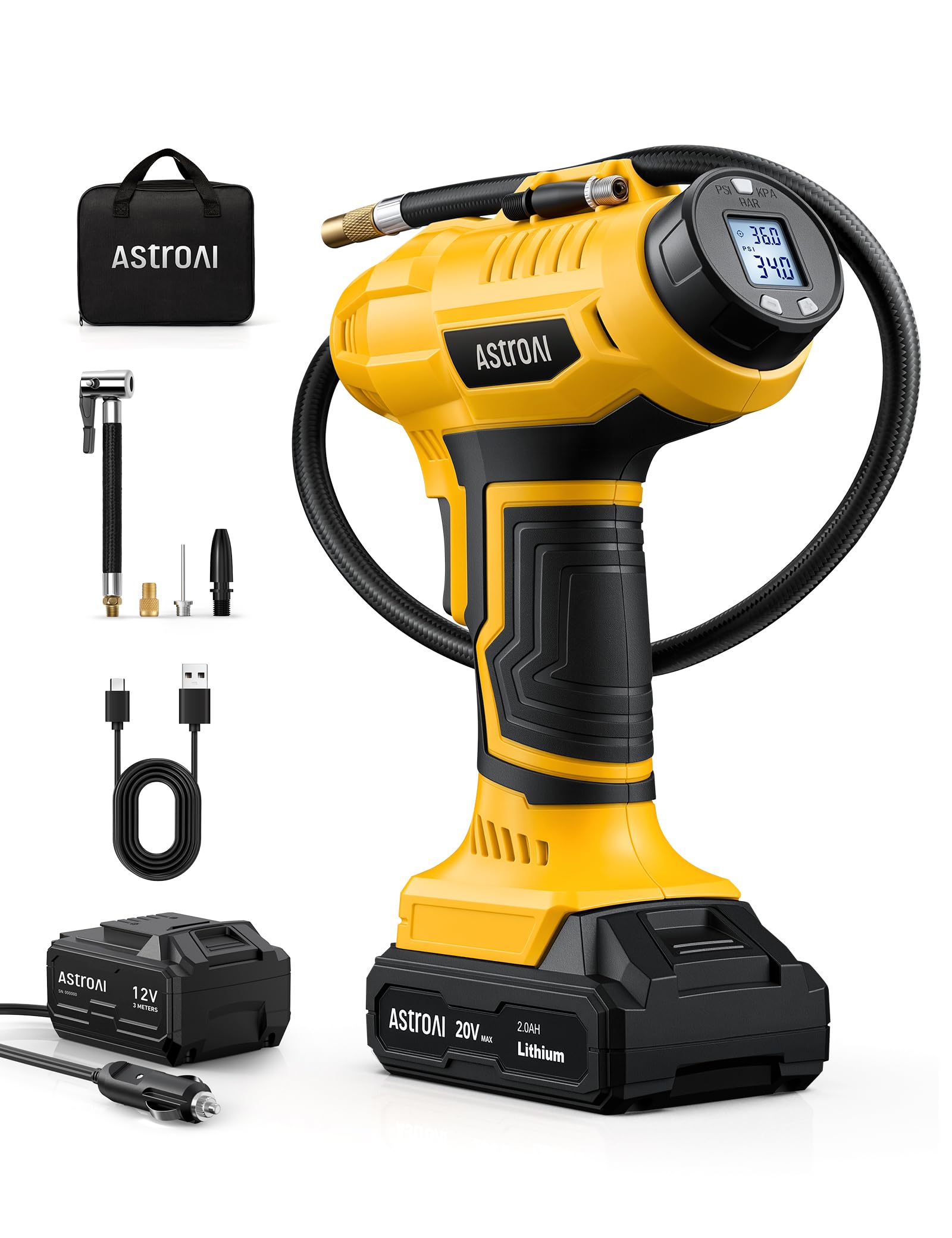
AstroAI Dual-Power 160 PSI Inflator

93 /100
LBD Score Outstanding

Key details

Battery
2.0Ah rechargeable
Item Weight
2.54 lb
Power Source
20V battery or 12V DC
Maximum Pressure
160 psi
View on Amazon

For most drivers, the AstroAI dual-power is the one we recommend because it solves the two ways these tools fail: a dead battery and a cord that will not reach. The 160 psi ceiling covers passenger cars, bikes, and most light-truck tires, and the 2.0Ah pack makes it genuinely cordless for quick top-offs. The 12V cord is the backup when the pack is low, and the included case keeps the adapters together.

We like the digital preset and auto shut-off for the set-and-watch routine. The controls are easy to read, and the hose is short enough that you still kneel at each valve—normal for this class. The 160 psi rating is not a promise of speed; small compressors slow down as pressure climbs, but for topping off a car tire it has enough headroom.

The compromise is the battery. A 2.0Ah pack is fine for a few tires, not a whole truck set at high pressure. If you regularly air down off-road, the Etenwolf is the better tool. For everyone else, the dual-power setup is the reason this earns a place in the car. The included spare fuse is the detail that makes it feel ready for a real emergency, not just a driveway top-off.

Pros

  • Dual power with 12V backup
  • 160 psi ceiling for cars and light trucks
  • Auto shut-off and digital preset
  • Compact case keeps adapters together

Cons

  • 2.0Ah pack limits repeated high-pressure fills
  • Short 19.7-inch hose
Our verdict

Our default for most drivers is the AstroAI dual-power: a 160 psi ceiling, a 12V backup, and a compact case make it work in the driveway and on the road.

Check Latest Price
2

Best for Heavy-Duty Inflation

ETENWOLF Vortex S6

92 /100
LBD Score Outstanding

Key details

Battery
19,200 mAh
Air Flow
1.5 cfm
Item Weight
6 lb
Maximum Pressure
160 psi
View on Amazon

The Etenwolf Vortex S6 is the one we reach for when the job is bigger than a top-off. At 6 pounds, it announces itself when you pick it up, but that weight buys a dual-cylinder pump, a 19,200mAh battery, and a 100% duty cycle—the combination that lets it run through four truck tires without the cooldown dance smaller inflators require. The 1.5 cfm rating and 160 psi ceiling are the numbers behind that confidence.

We like the preset pressure memory and the auto-stop, and the 45 cm hose gives you a little more room to work than the palm-size units. The LED light is bright enough for a nighttime wheel change, though we still keep a separate gauge in the car because built-in sensors can drift. That is not a knock on this model; it is a habit worth keeping with any inflator.

This is not the inflator for someone who wants to forget it under the seat. It is for the driver who tows, camps, or airs down for the beach and wants one tool that can bring a full-size tire back up without stopping.

Pros

  • 100% duty cycle for repeated fills
  • Dual-cylinder pump and 1.5 cfm airflow
  • 19,200mAh built-in battery

Cons

  • Built-in battery cannot be swapped
Our verdict

The Vortex S6 is what we reach for when the job is bigger than a top-off; its dual-cylinder pump and 100% duty cycle handle truck tires without a cooldown break.

Check Latest Price
3

Best for DeWalt 20V Users

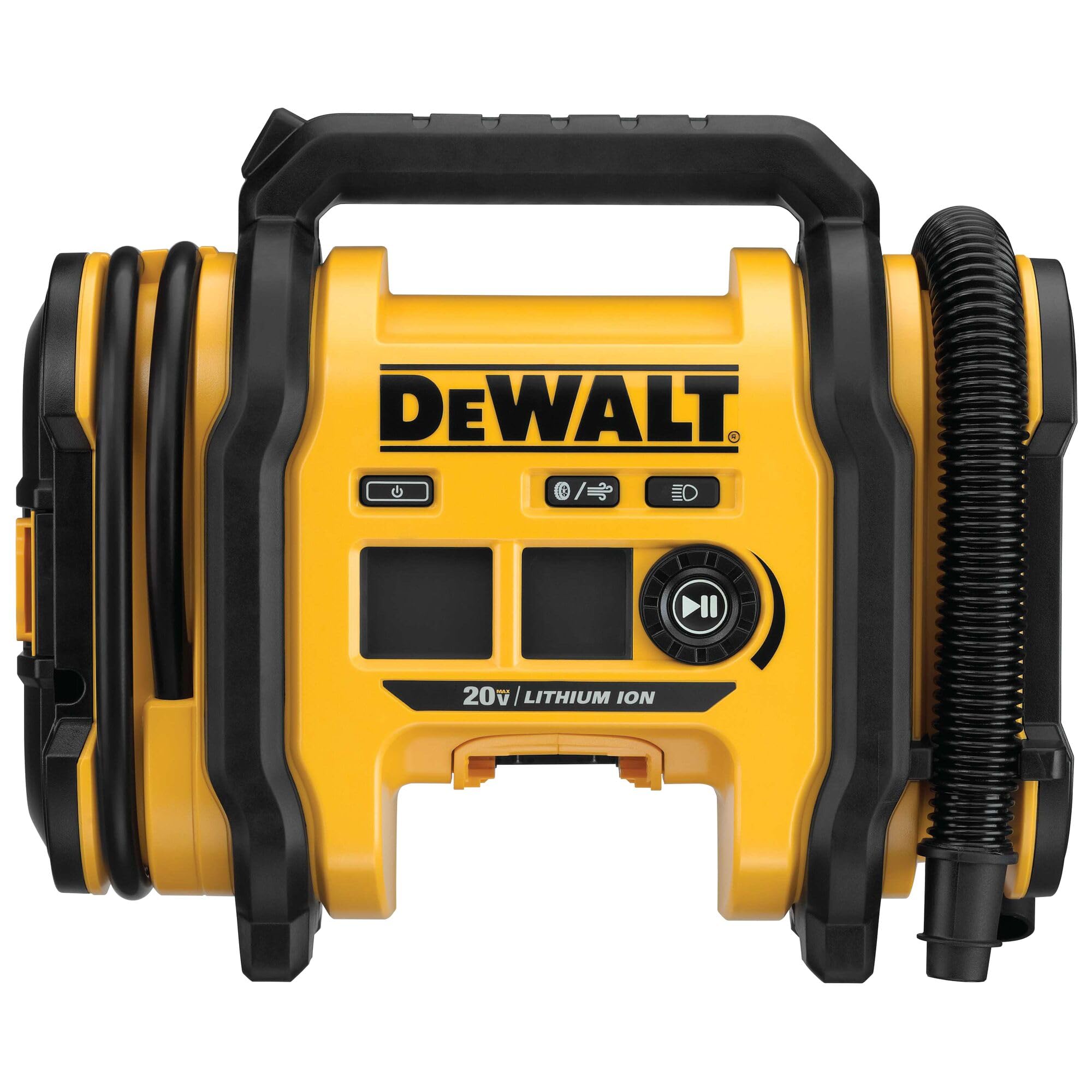
DEWALT DCC020IB 20V Inflator

93 /100
LBD Score Outstanding

Key details

Item Weight
2.9 lb
Power Sources
20V battery, 12V DC, or 110V AC
Battery Included
No; tool only
Maximum Pressure
80 psi
View on Amazon

The DeWalt DCC020IB is the inflator for someone already invested in DeWalt's 20V line—and the first thing to know is that the tool arrives without a battery or charger. If you have the packs, that is the appeal: one more tool that runs on the batteries in your garage. If you do not, price the battery and charger into the decision before you buy.

The 80 psi ceiling is the number that matters. That covers passenger cars, trailers, and many light-truck tires, but it is not the tool for a tire that needs 100 psi or more. We like the three power options—20V battery, 12V DC, and 110V AC—because they give you a fallback. The threaded chuck is a nice detail because it stays put while the tire fills, and the high-volume mode moves a lot of air for pool toys and air mattresses.

For a DeWalt user who wants one inflator for the garage and the road, this is a sensible buy. The 2.9-pound body is easy to carry, and the rubber feet keep it from walking across the driveway. Just do not expect it to replace a full-size compressor for big truck tires.

Pros

  • Runs on DeWalt 20V batteries
  • Three power sources
  • High-volume mode for inflatables

Cons

  • 110V AC cord not included
Our verdict

We put the DCC020IB on the short list for DeWalt 20V users who want a sturdy automatic inflator for car and light-truck tires, provided the battery is already on the shelf.

Check Latest Price
4

Best Corded Value

AstroAI AIRUN H 12V Inflator

91 /100
LBD Score Outstanding

Key details

Cord Length
9.8 feet
Hose Length
3 meters
Power Source
12V DC
Maximum Pressure
100 psi
View on Amazon

The AstroAI AIRUN H makes its case with a 9.8-foot power cord and a 3-meter air hose. That reach is the difference between kneeling awkwardly at one wheel and walking the cord around the car; with a 12V plug, you can top off all four tires from one outlet without moving the car. We also like that the 100 psi ceiling is honest for passenger cars and bikes—this is a top-off tool, not a truck compressor.

The digital preset and auto shut-off are the features that make it feel more expensive than it is. Set the pressure, press start, and the pump stops when it gets there; the backlit display is readable at night, and the built-in light helps when you are crouched by a wheel. The 120W motor moves enough air for car tires, though it slows down as pressure climbs.

Long-term reliability is the piece we trust least. The simple motor and cord are repairable in theory, but the unit is not built for continuous duty, so give it a break between tires. For occasional top-offs and bike tires, it is the value pick in this group.

Pros

  • Long 9.8-foot cord and 3-meter hose
  • Digital preset and auto shut-off
  • Bright display and built-in LED light

Cons

  • Needs a working 12V outlet; no battery
Our verdict

The AIRUN H earns our corded value nod with a long reach, simple presets, and a 100 psi ceiling that suits car and bike tires.

Check Latest Price
5

Best Budget Dual-Power

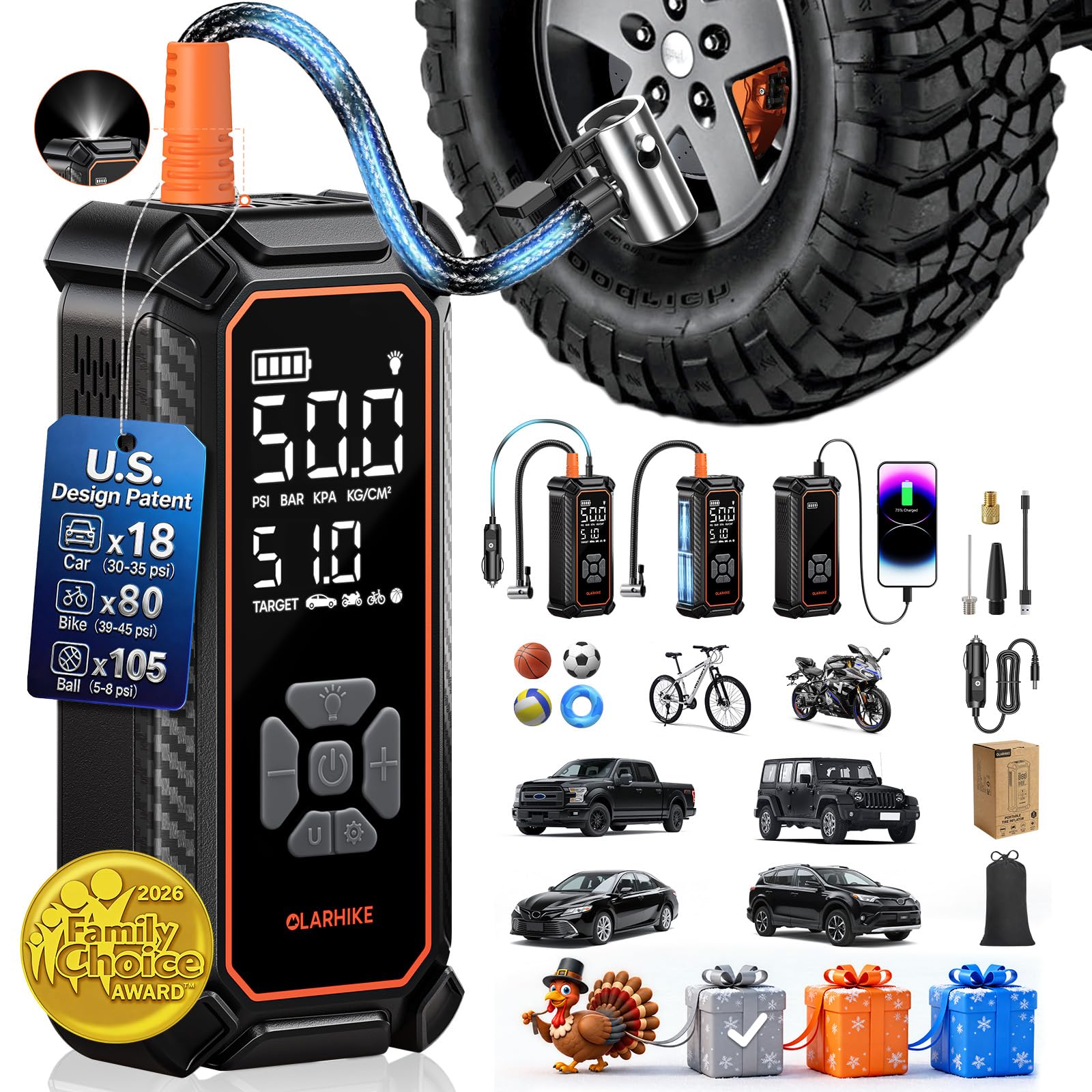
OlarHike TIC3V401 Inflator

89 /100
LBD Score Excellent

Key details

Battery
Three 2000mAh batteries
Item Weight
1.87 lb
Power Source
12V DC or built-in battery
Maximum Pressure
160 psi
View on Amazon

The OlarHike TIC3V401 packs three 2000mAh batteries into a body that weighs under a kilogram, and that is the trick: it feels like a palm-size inflator but has enough reserve for several car-tire top-offs. We like the dual-power setup because the 12V cord is there when the battery is not, and the 160 psi ceiling gives it more headroom than most budget cordless pumps.

The four preset modes—car, bike, motorcycle, and ball—are genuinely useful, and the dual LED screen is easy to read in a dim garage. The 24 L/min airflow is modest, so this is not the tool for a big truck tire. For a compact car or a bike, the size and weight are the reason to keep it in the trunk.

What gives us pause is the battery and reliability record. The 2,000mAh cells are small, so repeated high-pressure fills can outrun them, and the 12V cord becomes the real solution rather than a backup. For the money, that flexibility is still the reason to choose it—just do not expect it to be the last inflator you ever buy.

Pros

  • Three 2000mAh batteries in a compact body
  • Dual power with 12V backup
  • 160 psi ceiling and four presets

Cons

  • Short 23.6-inch hose
  • 75 dB noise rating
Our verdict

Budget-minded drivers should consider the OlarHike, in our view: three batteries, a 12V backup, and a 160 psi ceiling, with the 12V cord doing the heavier work.

Check Latest Price
6

Best for Milwaukee M18 Users

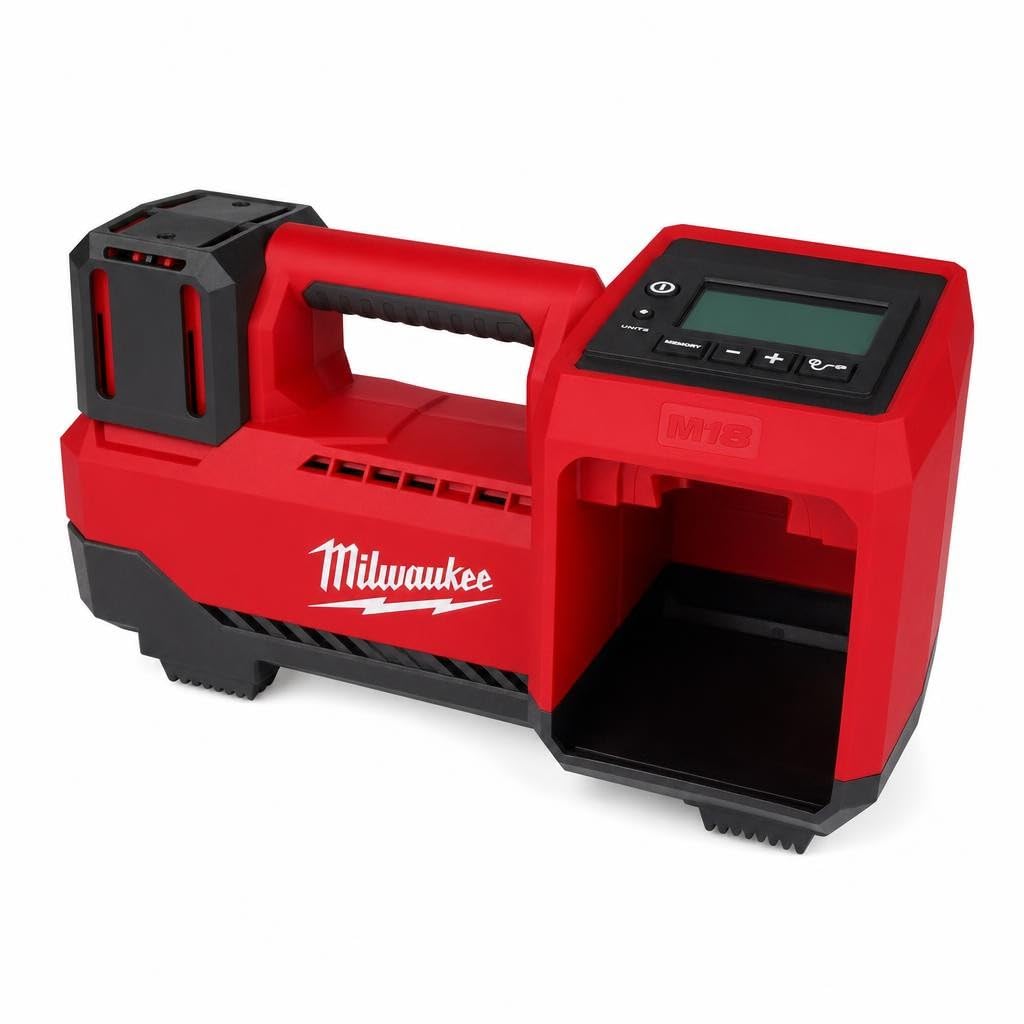
Milwaukee M18 2848-20 Inflator

95 /100
LBD Score Outstanding

Key details

Item Weight
7.7 lb
Power Source
M18 battery
Battery Included
No; bare tool
Maximum Pressure
150 psi
View on Amazon

The Milwaukee M18 inflator is the premium choice for someone who already has a shelf of M18 batteries. Buy the bare tool only if those batteries are already in your garage; otherwise, the cost of the pack and charger changes the math.

What you get is speed and control. The 150 psi ceiling and 36-inch hose make it easy to reach all four wheels, and the preset pressure and auto shut-off let you set a target and walk away. We like the all-brass chuck because it threads on securely and does not pop off mid-fill; the hose is long enough that you can set the tool on the ground instead of holding it.

The 7.7-pound body sits solidly on the ground and feels like a professional tool. For a truck, trailer, or small fleet, that heft is justified.

The battery question decides it. With a 5.0Ah pack, the M18 has the runtime for a full set of tires; without one, the bare tool is a paperweight. We like it best as a garage tool that comes along on road trips, not as a dedicated glovebox inflator.

Pros

  • Runs on Milwaukee M18 batteries
  • 150 psi and fast inflation
  • All-brass Schrader chuck

Cons

  • Heavy at 7.7 pounds
Our verdict

We recommend the M18 inflator to Milwaukee users who already own batteries; it is fast and sturdy, but the bare tool only makes sense inside that ecosystem.

Check Latest Price
7

Compact Corded Use

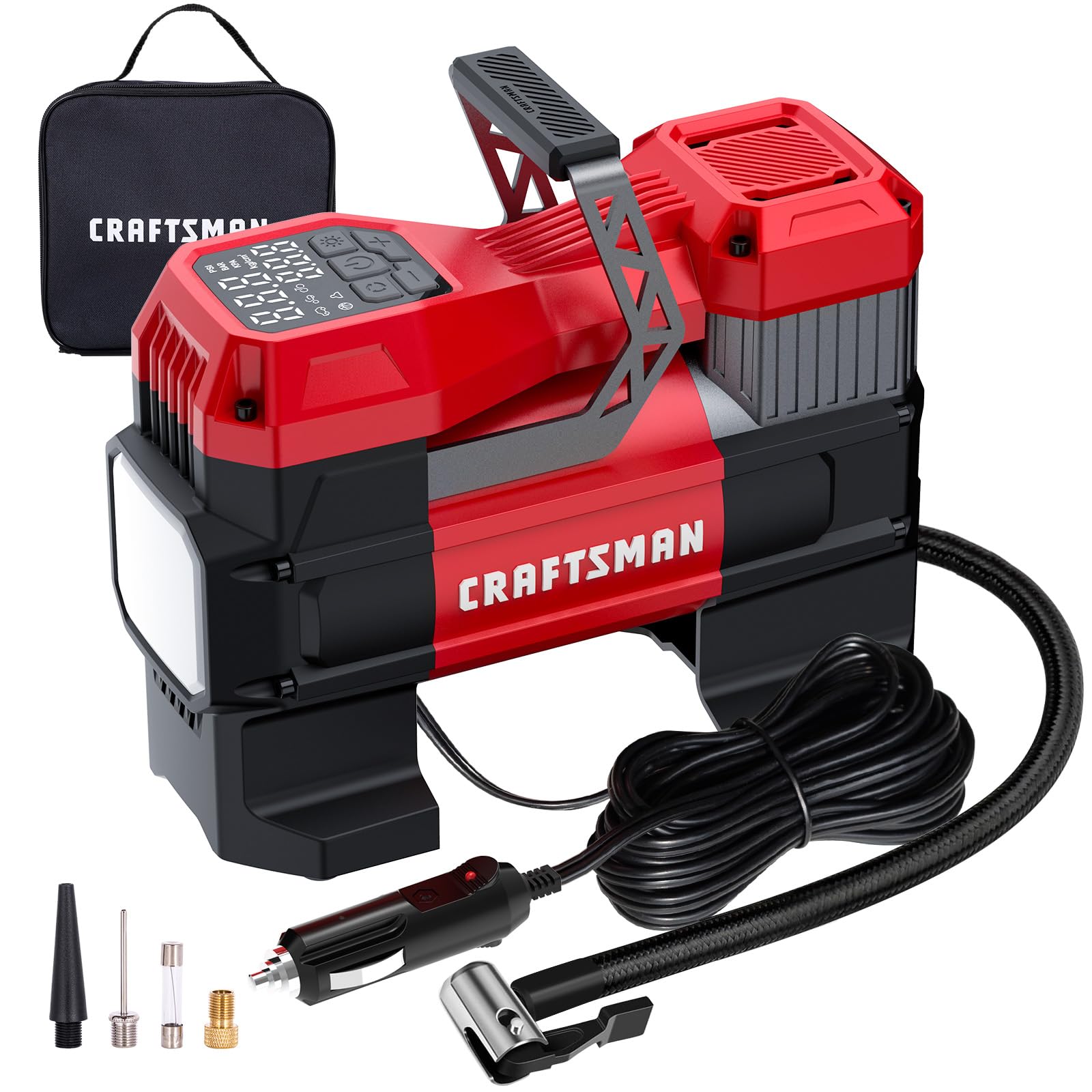
CRAFTSMAN CMXPTXA1202 Inflator

91 /100
LBD Score Outstanding

Key details

Cord Length
10 feet
Item Weight
1.9 lb
Power Source
12V DC
Maximum Pressure
150 psi
View on Amazon

The Craftsman CMXPTXA1202 is a straightforward 12V inflator with a 10-foot power cord, and that length is the feature we appreciate most. It lets you reach all four tires from one outlet without dragging the car forward or hunting for an extension. The 1.9-pound body is light enough to store in a trunk cubby, and the included bag keeps the adapters together.

The 150 psi ceiling covers car and light-truck tires, and the digital gauge with auto shut-off makes the routine simple: set the target, press start, and let it stop. We like the built-in light for nighttime top-offs, and the 2.17-foot hose is manageable without being fiddly. It is not a fast inflator—small 12V motors rarely are—so plan on a few minutes per tire.

For a second vehicle, a garage, or a driver who wants a simple backup, the long cord and light body are the draw. This is a tool you keep because it is easy to live with, not because it is the fastest thing in the category.

Pros

  • 10-foot cord reaches all four tires
  • 150 psi with auto shut-off
  • Light 1.9-pound body

Cons

  • Corded only; needs a working 12V outlet
Our verdict

A light, long-corded 12V inflator is what the Craftsman is, and that is why we like it for simple automatic top-offs without a battery system.

Check Latest Price
8

Glovebox Backup

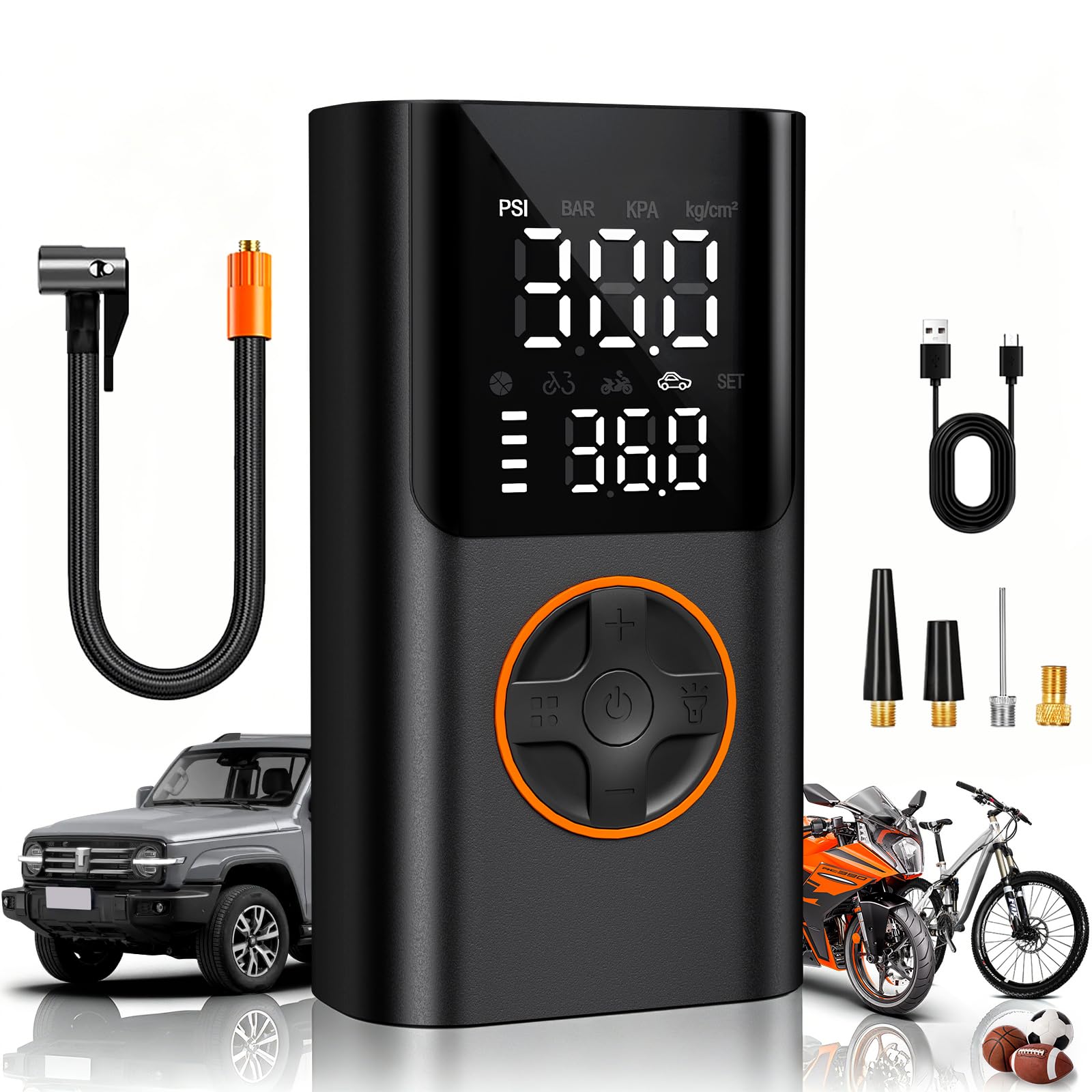
AIRSURE Q26 Cordless Inflator

88 /100
LBD Score Excellent

Key details

Warranty
2 years
Dimensions
2.83"L x 1.69"W x 5.11"H
Power Source
Rechargeable battery
Maximum Pressure
150 psi
View on Amazon

The AIRSURE Q26 is the inflator you can drop in a glovebox and forget until you need it. Its body measures 2.83 by 1.69 by 5.11 inches, and the rechargeable battery charges over USB, so you can top it up from a laptop or car charger. We like that it doubles as a power bank and has a built-in LED—small extras that make it more useful in an emergency.

The 150 psi ceiling looks impressive for the size, but this is a top-off tool. The small compressor moves air slowly, and the auto shut-off and digital gauge work as expected. The four included nozzles cover bikes, balls, and inflatables, and the storage bag keeps them from disappearing in the trunk.

What we do not like is how hard a tiny compressor has to work to fill a car tire. This is not the tool for a truck, a trailer, or a tire that is completely flat. It is best for a commuter, a cyclist, or someone who wants a second inflator for a small car.

For that job, the Q26 is easy to justify. It is small enough to leave in the car, charges from the same cable as your phone, and costs less than the dual-power picks. Just do not ask it to do the work of a full-size inflator.

Pros

  • Palm-size body fits in a glovebox
  • USB charging and power-bank function
  • 150 psi with auto shut-off

Cons

  • Battery is best for one or two tires
Our verdict

Our take on the AIRSURE is a glovebox backup for quick top-offs and bike tires, not the inflator to rely on for a full set of truck tires.

Check Latest Price

How We Chose and Tested Tire Inflators

We started by pulling every inflator with a real customer base and sorting them by power source, price, and what actually comes in the box, then narrowed to 12 and bought them ourselves. Some run on their own batteries, some plug into a 12-volt outlet, and a few do both. A bare tool with no battery in the box got counted as a higher total cost, since the battery platform is part of what you're paying.

Every unit got the same workload. We dropped a mid-size SUV's four tires from 28 to 36 PSI and timed each fill, then moved on to bike tires at 80 PSI, a basketball, and a pool float. We ran one pump until its battery quit to see how many tires a single charge really covers, and left two in a trunk through a cold snap to check how they started at 25 degrees.

Along the way we checked each built-in gauge against a separate handheld gauge and watched whether auto shut-off stopped at the set number or blew past it. We noted how the chuck seated on a valve with cold hands, whether the screen was readable in direct sun, and how far the cord and hose actually reached on a rear tire.

After six months we went back and refilled each one. Hoses that had stiffened, cords that had kinked, and batteries that no longer held a charge all got flagged. That's where cheap inflators separate — the ones that took repeated fills without the hose or housing getting uncomfortably hot are the ones still riding around in our trunks.

How to Choose a Tire Inflator

Start With Power, Not Pressure

Decide first whether you want a cord, a battery, or both. A 12V corded inflator is simple and always ready if the car outlet works, but you stay tethered to the vehicle. A cordless model is faster to grab, but battery life and long-term cell health are the weak points in this category. Dual-power models cost more but give you a fallback, which is why we default to them for a car kit. Bare-tool models only make sense if you already own that brand's batteries.

Match PSI to Your Tires, Then Look at Airflow

Max pressure is a ceiling, not a speed rating. A 100 psi inflator can top off a passenger car tire; a 150 or 160 psi model gives more headroom for light trucks and higher-pressure tires. For speed, look at airflow and duty cycle: the Etenwolf S6's 1.5 cfm and dual-cylinder design are built for repeated truck tires, while palm-size units are better for one or two top-offs. If you regularly fill from low pressure, prioritize airflow over a fancy display.

Treat Battery Runtime as a Real Cost

Cordless convenience depends on the pack, and the pack is usually the first thing to age. A small 2.0Ah battery is fine for a few tires; a 19,200mAh built-in pack is better for a full set, but you cannot swap it when it wears down. Cold weather reduces runtime, so charge before a trip and keep the 12V cord as a backup if the model has one. For bare tools, add the battery and charger to the real cost before comparing.

Check the Reach and the Stored Size

A long 12V cord and a flexible hose matter more than a compact body once you are kneeling at a wheel. A 10-foot cord reaches all four tires from one outlet; a 3-meter hose gives you room to set the tool down. But a long cord is only useful if the inflator fits where you plan to store it. Measure your trunk cubby or glovebox, and favor a model with a bag for the adapters so they do not scatter.

Auto Shut-Off Is a Helper, Not a Guarantee

Preset pressure and auto shut-off make top-offs easier, but built-in sensors can drift and some units stop short or overshoot. We still check the tire with a separate gauge before driving away, especially after a big pressure change. Nozzle compatibility is the other practical detail: Schrader for cars, Presta for many bikes, a needle for balls. A kit with the right adapters saves you from buying them later.

Frequently Asked Questions

Final Verdict

For most drivers, we recommend the AstroAI dual-power inflator. It has the pressure ceiling for car and light-truck tires, a battery for quick top-offs, and a 12V cord for the day the battery is low. If you tow or off-road and need to refill large tires repeatedly, the Etenwolf Vortex S6 is the better tool; its dual-cylinder pump and 100% duty cycle are worth the extra weight. If you already own DeWalt or Milwaukee batteries, the bare-tool versions make more sense than starting a new battery system.