Best DJ Headphones of 2026

A DJ headphone has one job a studio pair is never asked to do: let you hear the next track while a sound system is trying to drown it out. That's why the ones that hold up are closed-back, clamp a little harder than is strictly comfortable, and come with a cable you can replace after someone steps on it.

I've spent six months with 14 pairs, cueing on a borrowed controller, folding cups flat against my shoulder, stuffing them into a gig bag, and wearing them well past the point a set should have ended. What separated them wasn't the spec sheet — it was fit and weight. A heavy pair that feels fine for ten minutes starts to ache by hour two, and swivel cups only earn their keep if they actually sit flat when you tilt one ear off.

The small things mattered nearly as much as the sound: whether the cable detaches at both ends, whether the adapter screws on or vanishes into a bag, whether the pads can be swapped. The picks below are the ones I'd hand to someone building a first booth and to the person who's already replaced a cable twice.

1

Best Overall

Audio-Technica ATH-M50x

95 /100
LBD Score Outstanding

Key details

Type
Over-ear, closed-back
Cable
Detachable
Drivers
45 mm
Swiveling Cups
90 degrees
View on Amazon

The M50x earns the top spot here because it solves the two jobs a DJ asks of a headphone: it isolates enough to hear the cue, and its 90-degree swiveling cups let you work one ear free without taking the pair off. The over-ear fit is the other half of the appeal. It puts a cushioned cup around your ear instead of pressing on it, which is a welcome change if on-ear designs start to ache. The closed-back design and 45 mm drivers give you a full, bass-forward sound that makes kick drums easy to follow in a loud room.

We think it is the best default for most DJs because it covers cueing, practice, and studio listening without asking you to buy a second pair. The detachable cable is a real gig advantage: if the lead gets yanked or fails, you replace the cable instead of the headphones. The 38-ohm impedance and 99 dB sensitivity also mean it will run from a controller, laptop, or phone without a separate amp. The low-end lift is useful when you need to find the beat.

That bass lift is the point, but it can make long critical listening feel heavy. If you want a flatter response, the M40x is the obvious sibling to try. The M50x is the pair for cueing first, studio reference second. It is also not the lightest pair here, but the over-ear cushioning and swivel cups are worth the trade for many DJs.

The folding design and detachable cable make it easier to pack than a fixed-cup studio pair, and the swiveling cups are the feature we come back to at every gig. As a single pair for cueing, mixing, and the odd studio session, it is the one we recommend first.

Pros

  • 90-degree swiveling cups
  • Detachable cable with locking connector
  • Bass-forward sound for cueing
  • Closed-back isolation

Cons

  • Firm clamp on larger heads
  • Hinge and pad wear with heavy use
Our verdict

The M50x is our top pick for DJs who want one over-ear pair for cueing, practice, and studio work, with swiveling cups and a replaceable cable.
Check Latest Price
2

Best Lightweight for Loud Booths

Sennheiser HD 25

92 /100
LBD Score Outstanding

Key details

Type
On-ear, closed-back
Cable
Detachable single-sided
Weight
4.94 oz
Sensitivity
120 dB
View on Amazon

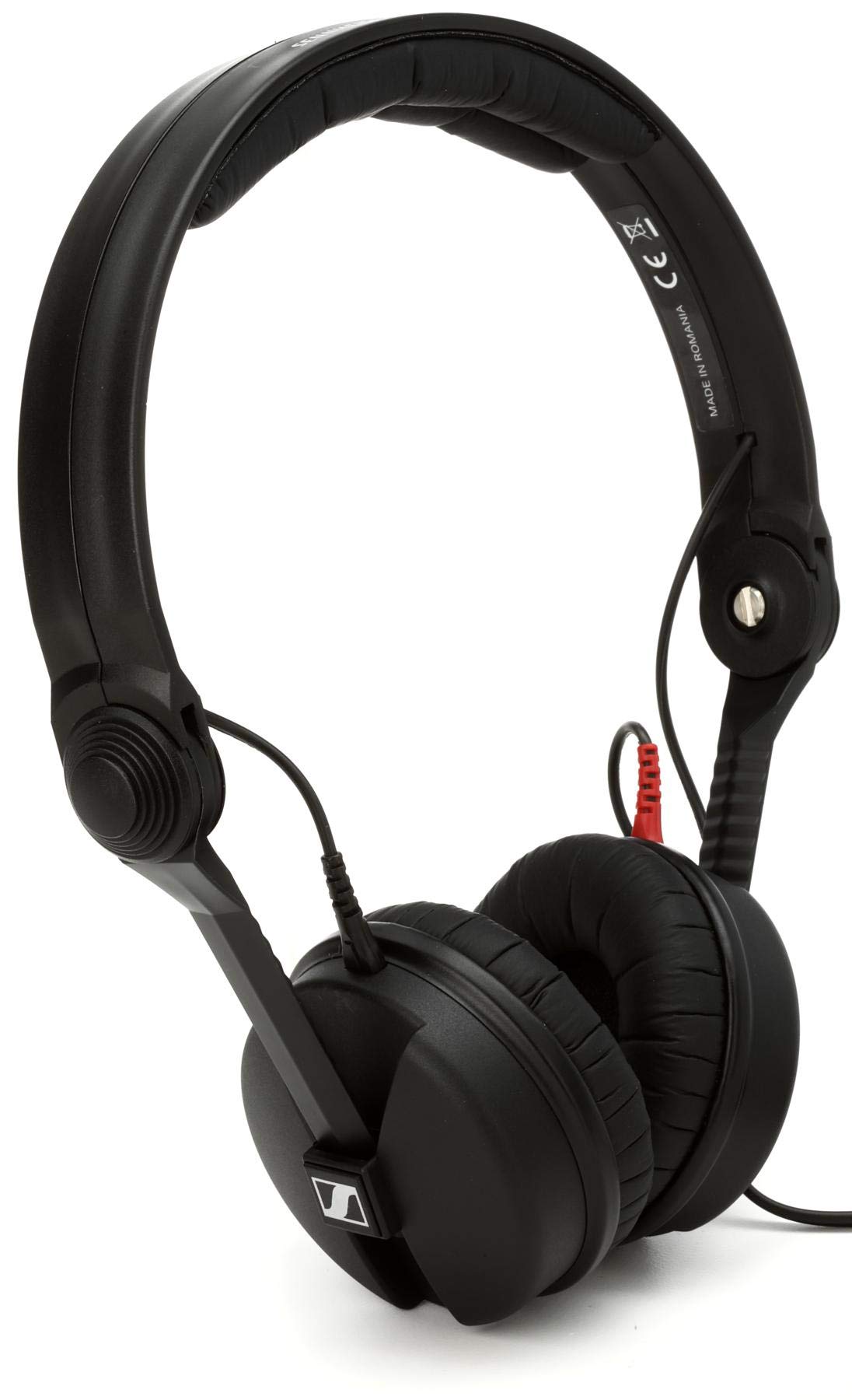
At 140 grams, the HD 25 is the pair we grab when we want to travel light and still get loud. Its 120 dB sensitivity means it will run from a mixer or phone without extra gain, and the closed-back cups cut the room down. For a loud booth and a fast set, the light weight and high output are hard to beat. That is why it is our pick for DJs who prioritize portability and gain.

The detachable single-sided cable is a real advantage in a dark booth. There is no Y-splitter to untangle, and if the lead fails you can replace it. The HD 25 also handles high sound pressure levels, which is exactly what you want when the monitor is competing with a club system. We like that the design is simple: no app, no battery, no controls to fumble for.

The HD 25 is not the most transparent pair here, and its tuning is more about punch than studio flatness. What it has is a lighter, faster feel on the head and a sound that cuts through a loud room. If you want a flatter response for studio work, the M40x is the better tool. If you want the pair that disappears in a gig bag and gets loud instantly, this is the one.

Pros

  • Very light at 140 g
  • 120 dB sensitivity gets loud
  • Detachable single-sided cable
  • Closed-back isolation

Cons

  • On-ear clamp can feel tight over long sets
Our verdict

The HD 25 is our pick for DJs who want the lightest, loudest cueing pair here, provided the on-ear clamp suits you.

Check Latest Price
3

Best for New DJs

Pioneer DJ HDJ-CUE1

92 /100
LBD Score Outstanding

Key details

Type
On-ear, closed-back
Cable
Detachable
Weight
7.58 oz
Swiveling Cups
Yes
View on Amazon

The CUE1 is the pair we point a new DJ toward first. It is an on-ear, closed-back design with 40 mm drivers, 32-ohm impedance, and 104 dB sensitivity, so it will get loud enough from a controller or laptop without extra gear. At 215 grams it is light enough to forget about during a practice session, and the swiveling earcups make the one-ear cueing move feel natural rather than like a workaround.

We like that Pioneer did not overload it. There is no app, no battery, and no active noise cancellation to manage—just a detachable cable, a foldable frame, and a sound that stays clear when you push the level. The CUE1 is not the last word in isolation or bass weight, but it gives a beginner the two things that matter most: a clear cue and a cup that gets out of the way.

The foldable frame is the detail that makes it a grab-and-go pair: it collapses into a bag without a dedicated case. The CUE1 also stays comfortable enough for long practice sessions. It is not the pair for a loud club booth or a bass-heavy cue, but it is a sensible first step that leaves room to upgrade.

Pros

  • Swiveling cups for one-ear cueing
  • Light 215 g frame
  • Easy to drive at 32 ohms
  • Detachable cable and foldable design

Cons

  • Pads can feel small on larger ears
  • No 1/4-inch adapter included
Our verdict

The CUE1 is our pick for new DJs who want a light, swiveling pair that gets loud from a controller without extra gear.

Check Latest Price
4

Best Studio-To-Booth Workhorse

Sony MDR7506

95 /100
LBD Score Outstanding

Key details

Type
Over-ear, closed-back
Cable
9.8 ft fixed
Drivers
40 mm
Folding
Yes, with case
View on Amazon

The MDR7506's 9.8-foot cord is either the reason you want it or the reason you don't. In a studio or a fixed booth, that length lets you move between the mixer and a laptop without dragging the headphones off your head. On a crowded stage, it is a lot of cable to manage, and because it is fixed, a failure at the jack retires the whole pair.

The rest of the design is old-school in a useful way. The 40 mm drivers have a clear, detailed sound that makes cueing vocals and hi-hats easy, and the closed-back cups cut enough room noise to keep the cue from getting muddy. The headphones fold into the included soft case, which makes them easier to pack than a fixed-cup studio pair, and the 63-ohm impedance is manageable from most gear.

The sound is more neutral than bass-forward; if you need a big low end to cue kicks, the M50x will feel more immediate. The Sony is the pair for precise, stationary work, not for bouncing around a stage. The closed-back cups also keep leakage down, which matters in a shared booth.

We keep the MDR7506 in the studio-to-booth category because it is detailed, easy to fold, and built around a long fixed cord. It is not our first choice for live one-ear cueing, since the fixed cable asks more of you in a loud room. But if your gig is mostly studio work, broadcasts, or a fixed booth, it is a sensible, long-running tool.

Pros

  • Detailed, neutral sound
  • Closed-back isolation
  • Folds into included soft case
  • Long 9.8-foot cord for fixed setups

Cons

  • Fixed 9.8-foot cable is not replaceable
  • Firm clamp on larger heads
Our verdict

The MDR7506 is our pick for studio and fixed-booth work, where its long cord and detailed sound matter more than one-ear stage moves.

Check Latest Price
5

Best Wireless Hybrid

OneOdio A70

89 /100
LBD Score Excellent

Key details

Type
Over-ear, closed-back
Weight
8.96 oz
Battery
72 hours
Connectivity
Bluetooth 5.3 and wired
View on Amazon

The A70's 72-hour battery is the headline, but the wired jacks are what make it useful for DJs. We like it as a practice and backup pair: Bluetooth 5.3 for listening and running through tracks, then the included 3.5 mm and 6.35 mm cables for cueing when latency matters. The 40 mm drivers have a clear, bass-friendly sound, and the rotatable, foldable frame makes it easy to pack.

At 8.96 ounces it is light enough for long sessions, and the soft earcups keep pressure reasonable. The share function is a small bonus that we did not expect to use: a second listener can tap into the same source, which is handy for practice rooms and shared laptops. The controls are physical buttons, so you can find them by feel, though they are not the most obvious set we have used.

The wired mode is the one to trust at a gig, and that is the point of the dual design: you are not dependent on a battery or a pairing screen when the set starts. The A70 is not the most transparent pair here, and the bass is more fun than forensic. As a practice pair that can become a wired backup, it earns its place.

Pros

  • 72-hour battery for practice and travel
  • Bluetooth 5.3 and wired modes
  • Rotatable, foldable frame
  • Share function for a second listener

Cons

  • Bluetooth pairing can be fussy
  • Hinge wear can loosen the left cup
Our verdict

The A70 is our pick for a budget practice pair that can go wired at the gig, as long as you treat the hinge as the weak point.

Check Latest Price
6

Best Flat-Response Alternative

Audio-Technica ATH-M40x

93 /100
LBD Score Outstanding

Key details

Type
Over-ear, closed-back
Cable
Detachable
Drivers
40 mm
Swiveling Cups
90 degrees
View on Amazon

If the M50x's bass-forward tuning feels like too much, the M40x is the flatter sibling. It uses 40 mm drivers, a 35-ohm impedance, and a tuning that is meant to stay accurate across the range. We like it for precise cueing and long monitoring sessions because it does not add extra low end to everything you hear. The 90-degree swiveling cups and detachable cable are here too, so it does not give up the DJ basics.

The M40x is the one we reach for when we need to hear what is actually in the mix. Kick drums and basslines are still present, but they are not exaggerated, and vocals sit in a more honest place. It is also lighter than the M50x at 0.24 kg, which matters over a long set. The trade-off is that it can feel less exciting on bass-heavy tracks.

The detachable cable helps with long-term ownership, and the folding cups make it easier to store than a fixed-cup studio pair. If you want a warmer, more club-like sound, the M50x is still the better cueing tool. If you want accuracy and a lighter feel, the M40x is the pair.

Pros

  • Flat, accurate tuning
  • Lighter 0.24 kg build
  • 90-degree swiveling cups
  • Detachable cables

Cons

  • Pads feel stiff out of the box
  • Clamp can be tight for larger heads
Our verdict

The M40x is our pick for DJs who want flat, accurate cueing and a lighter over-ear fit, with the same swivel and detachable cable as the M50x.

Check Latest Price
7

Maximum Isolation

Sennheiser HD 280 Pro

91 /100
LBD Score Outstanding

Key details

Type
Over-ear, closed-back
Cable
Coiled, 3.3 to 9.8 ft
Weight
1.3 lb
Attenuation
Up to 32 dB
View on Amazon

The HD 280 Pro's 32 dB attenuation figure is the reason to look at it. The closed-back cups seal hard, and the coiled cable stretches from 3.3 to 9.8 feet, so you can move around a desk or a booth without a straight cable pooling in your lap. For a loud room, a shared workstation, or a live monitor position where you need to block out the PA, that isolation is the feature that matters.

We reach for the HD 280 Pro when the job is blocking out the room, not when we need an ear free. There is no swiveling cup here, so it is a poor fit for one-ear DJ cueing. The sound is clear and balanced rather than bass-heavy, and the replaceable pads, headband padding, and cord give it a longer service life than most sealed pairs.

The isolation is not free. The clamp is firm, so it is better for stationary work than for a four-hour dance floor. The replaceable parts are the saving grace: when the pads flatten or the cable fails, you can refresh the pair instead of replacing it. If you need one-ear cueing, look at the M50x or the CUE1; if you need to shut out a loud room, the HD 280 Pro is the specialist.

Pros

  • Up to 32 dB attenuation
  • Replaceable pads, headband, and cord
  • Coiled cable reaches 3.3 to 9.8 feet
  • Clear, balanced sound

Cons

  • 1.3-pound weight can tire you
  • Coiled cable adds bulk
Our verdict

The HD 280 Pro is our pick for blocking out a loud room, not for one-ear cueing; its 32 dB isolation and replaceable parts suit stationary work.

Check Latest Price
8

Budget Wired

OneOdio Pro-10

89 /100
LBD Score Excellent

Key details

Type
Over-ear, closed-back
Weight
14.6 oz
Drivers
50 mm
Swiveling Cups
90 degrees
View on Amazon

The Pro-10 is the budget entry in this set, and it leads with hardware: 50 mm drivers, 90-degree swiveling cups, and a detachable cable. On paper it looks like a lot of DJ headphone for the money, and in use the bass-forward tuning does help you find the kick when the cue is busy. The closed-back cups also cut enough room noise for practice and small gigs.

The frame feels planted rather than delicate, and the swiveling cups move with enough resistance to stay where you put them. The share port is a small extra that makes it more useful than its price tier suggests: a second listener can plug in without a splitter, which is handy for practice rooms and shared laptops. The detachable cable is the part we care about most, because a damaged lead does not end the pair.

The Pro-10 is not the most refined pair. The bass is more blunt than detailed, and the closed-back cups are not as quiet as the HD 280 Pro. The sound is still clear enough for cueing, and the 32-ohm impedance means it will run from a phone or controller. It is a workhorse for the budget tier, not a precision tool.

We recommend the Pro-10 when the budget is tight and you need the DJ basics now: swiveling cups, a detachable cable, and a bass-forward cue. It is not the pair we trust for a paid set without a backup. If you can stretch to the CUE1, you get a lighter, more polished first DJ headphone; if you need the lowest-cost entry, the Pro-10 is it.

Pros

  • 50 mm drivers with strong bass
  • 90-degree swiveling cups
  • Detachable cable and share port
  • Budget-friendly wired entry

Cons

  • 415 g is heavy for long sets
  • Hinge and ear-cup durability are the weak point
Our verdict

The Pro-10 is our budget pick for DJs who need swiveling cups and a detachable cable now, with the understanding that the hinge is the weak point.

Check Latest Price

How We Tested DJ Headphones

We started with every closed-back pair sold for DJing and studio monitoring, then filtered by the things that decide whether a headphone survives a booth: cups that swivel flat for one-ear cueing, a detachable cable, replaceable pads, and what ships in the box — coiled cable, straight cable, screw-on adapter. From that list we bought 14 pairs and used them for six months across a bedroom controller setup, a desk for mixing, and a few genuinely loud rooms.

We judged isolation by doing: cueing a track with one cup tilted behind the ear while a speaker ran at party volume, then noting how much of the room leaked into the other cup. Comfort went on a clock — every pair got a three-hour session, and we logged whether the clamp showed up first at the temples, the crown, or the ears. We weighed each one and tried them on the widest and narrowest heads on the team, because fit varies more than the spec sheets let on.

For build and reliability, we dropped each pair onto carpet from waist height, pulled cords out by the cable rather than the plug, coiled and uncoiled until we stopped counting, and folded each one into a bag twice a week. Sound got the same three tracks every time — one bass-heavy, one vocal-led, one full of hi-hats — so we could tell whether a pair flattered everything or told the truth. We also noted the accessories, since value here is usually decided by what ships alongside the drivers. Anything that developed a rattle or a loose jack got set aside rather than re-tested.

How to Choose Dj Headphones

One-ear cueing comes first

If you beatmatch with one ear free, the cup has to move out of the way without you taking the headphones off. A 90-degree swiveling cup is the clearest version of that, and it is the feature we check before anything else on a DJ pair. The M50x, CUE1, and Pro-10 all give you that move. A fixed-cup studio headphone can sound excellent and still be the wrong tool for live cueing. If you work both ears on, this matters less.

Isolation and output work together

Passive isolation is what keeps the cue separate from the room, and a tight closed-back seal does more for that than a marketing claim about noise cancellation. Pair that with sensitivity: the HD 25's 120 dB rating explains why it gets loud from a mixer without extra gain, while the HD 280 Pro's 32 dB attenuation is the isolation specialist. If your booth is loud, prioritize both. If you play quiet rooms, you can trade some isolation for a lighter, more open-feeling fit.

Wired is still the cueing standard

Use the wire for cueing. A detachable cable is the difference between replacing a lead and replacing the headphones, and a coiled or long straight cable should reach from your head to the mixer without pulling. The M50x and HD 25 both use detachable cables; the Sony MDR7506 does not, which is a real long-term cost. Bluetooth is useful for practice and listening, but keep a wired option for the booth. The A70 makes that switch easy.

Comfort is a fit decision, not a spec

On-ear and over-ear designs ask different things of your head. The HD 25 is 140 grams and stays light, but its on-ear cups press closer; the M50x puts a cushioned cup around your ear but clamps firmly. The HD 280 Pro is 1.3 pounds, which is a lot to carry through a long set. Try the clamp with glasses or a hat if you wear them. A lighter pair is not automatically more comfortable if the pads are too small.

Durability and repair add up

DJ headphones live in bags, get pulled off with one hand, and spend nights in hot booths. Look at the hinge, the cable entry, and whether the pads are replaceable. The HD 280 Pro lists replaceable pads, headband padding, and cord; the M50x and M40x use detachable cables. A fixed cable is not a dealbreaker, but it shortens the repair path. Treat the hinge as the wear part on budget pairs, and keep a backup if you play paid sets.

Frequently Asked Questions

Final Verdict

The M50x is our top pick because it gives most DJs the complete package: swiveling over-ear cups, a detachable cable, closed-back isolation, and a bass-forward sound that makes cueing easier. If you want a lighter pair for a loud booth, the HD 25 is the specialist to audition. New DJs on a tighter budget should start with the CUE1, which keeps the swivel and the light weight without the extra features.