Best Digital Oscilloscopes of 2026

An oscilloscope's job is simple to state and hard to shop for: it shows you what a signal is doing right now, on a screen you have to trust. The specs that sell scopes — bandwidth, sample rate, channel count — won't tell you whether the trigger will catch the intermittent glitch you've been chasing, or whether you'll spend every debugging session three menus deep. The right one does the opposite: it turns a vague sense that something is wrong with a board into a waveform you can point at.

Spend any real time debugging and you learn that two channels run out fast, and that a built-in waveform generator saves more bench space than it sounds like it would. I've had seven of these scopes in and out of my workspace over the past eight months, from budget two-channel units to four-channel bench instruments and battery-powered touchscreens, and the differences showed up in the places spec sheets skip.

A couple earned a permanent spot on the bench; one or two went back in the box. Here's what actually held up.

1

Best Overall

Siglent SDS1104X-E

94 /100
LBD Score Outstanding

Key details

Bandwidth
100 MHz
Serial Decode
I2C, SPI, UART/RS232, CAN, LIN standard
Analog Channels
4
Included Probes
4 passive probes
View on Amazon

Four analog channels at 100 MHz, with I2C, SPI, UART, CAN and LIN decoding included rather than sold as an upgrade, is the combination that makes this the scope we point most people toward. Almost everything that lands on a bench — a microcontroller bus, a switching rail, a sensor output, a clock — fits inside 100 MHz, and four inputs let you watch a signal and whatever is driving it at the same time.

What we kept coming back to is how little stands between switching on and getting a usable trace. The front panel reads the way a bench scope should, measurements and cursors sit where you expect them, and four passive probes ship in the box so there is nothing to buy before the first session. The one annoyance is the main selection knob, which does not always register a click and occasionally wants a second press.

Two capabilities cost extra: the 16 logic channels and the plug-in waveform generator are options on this model rather than included. We treat that as a fair split, since the analog channels and the decoding are what troubleshooting actually uses. The display also mirrors to a PC, which matters more than it sounds when you are trying to show someone a glitch you caught ten minutes ago.

Pros

  • Four analog channels for multi-signal work
  • Serial decode included as standard
  • Four passive probes in the box
  • Interface is quick to learn

Cons

  • MSO and generator channels cost extra
  • Selection knob misses an occasional click
Our verdict

The scope we recommend to most people: four channels, 100 MHz and serial decoding in the box, with a front panel that stays out of the way.

Check Latest Price
2

Best for High Bandwidth on a Budget

Siglent SDS1202X-E

93 /100
LBD Score Outstanding

Key details

Bandwidth
200 MHz
Sample Rate
1 GSa/s
Memory Depth
14 Mpts
Analog Channels
2
View on Amazon

Half the channels, twice the bandwidth, less money. Set against the top pick, this Siglent is the scope for anyone whose work lives above 100 MHz — switching supply edges, fast digital transitions, RF through the low hundreds of megahertz — because 200 MHz shows detail a 100 MHz front end simply rounds off.

It is not a stripped instrument. There is 1 GSa/s, 14 Mpts of record length and the same standard serial decoding set, and the front panel is quick to drive, with an Auto Setup that gets a new signal on screen in one press. Give it a few minutes to warm up before judging trace stability; it settles noticeably after that, and the difference is worth waiting for rather than chasing with the trigger.

The choice between this and the four-channel Siglent comes down to counting. If you routinely need three or four signals on screen at once — clock, data, enable, rail — no amount of bandwidth replaces the missing inputs. If you mostly chase one signal at a time and need to see its fast edges honestly, this is the better instrument and the cheaper one.

Pros

  • 200 MHz shows fast edges and switching noise
  • 14 Mpts of record length
  • Serial decode included as standard
  • One-press Auto Setup gets a trace fast

Cons

  • No XY mode for phase work
  • Horizontal adjustment moves in steps
Our verdict

Buy this one when bandwidth beats channel count: 200 MHz and 14 Mpts for less than a four-channel scope, with serial decoding still included.

Check Latest Price
3

Best for Advanced Analysis

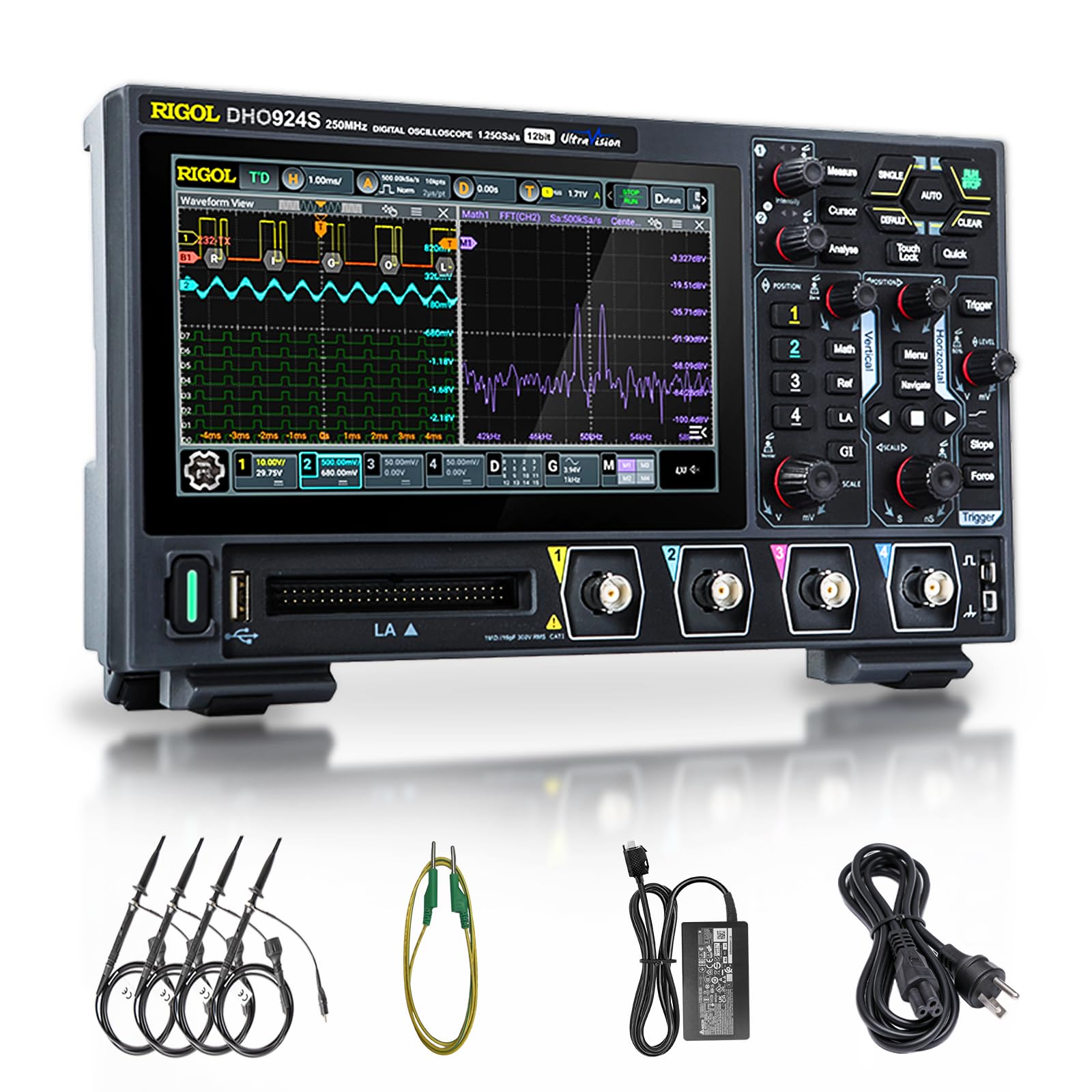
RIGOL DHO924S

86 /100
LBD Score Excellent

Key details

Bandwidth
250 MHz
Analog Channels
4
Built-in Generator
Single-channel AFG, Bode plot to 25 MHz
Vertical Resolution
12-bit
View on Amazon

Twelve bits is the reason to look here. Every other scope on this page digitizes at eight, and the extra vertical resolution is the difference between knowing a rail is noisy and seeing the shape of the noise. Add 250 MHz across four channels and this becomes the instrument for work where measurement quality, not just a trace, is the point.

The S model also carries a single-channel AFG and Bode plot analysis from 10 Hz to 25 MHz, so a loop-response check does not need a separate generator and a second round of setup. HDMI and LAN are standard, which makes documentation painless, and the VESA mount on the back turned out to be the detail we appreciated most: it hangs the scope above the bench instead of burying it under probe leads.

The price is the thing to get comfortable with. This is the most expensive scope in the group by a wide margin, and for straightforward bus and rail checks the four-channel Siglent gets you there for less. What you are paying for is resolution and built-in analysis, and those only earn their keep if you will genuinely use them.

Pros

  • 12-bit resolution reveals small-signal detail
  • Built-in AFG and Bode plot to 25 MHz
  • 250 MHz across four channels
  • VESA mount and HDMI output

Cons

  • 7-inch screen crowds with four traces open
Our verdict

Worth the money when 8-bit resolution is what limits your measurements: 250 MHz, four channels, 12-bit conversion and a generator built in.

Check Latest Price
4

Best Budget Four-Channel

RIGOL DS1054Z

90 /100
LBD Score Outstanding

Key details

Bandwidth
50 MHz
Sample Rate
Up to 1 GSa/s
Memory Depth
Up to 24 Mpts
Analog Channels
4
View on Amazon

Fifty megahertz is the lowest bandwidth on this page, and there is no point dressing that up. What the DS1054Z puts in its place is four channels, 24 Mpts of memory and serial decoding for I2C, SPI and UART, for less than any other four-channel scope here.

The memory is what earns the money. Recording up to 60,000 frames and then zooming into a long capture is how you find the one event in a burst that broke something, and a 30,000 wfms/s capture rate means the scope is not blind between sweeps. Four probes come in the box, and they calibrate cleanly against the built-in reference output.

In daily use the trigger is the part that asks for attention: on a noisy signal it can refuse to lock until you flick on the 20 MHz bandwidth limiter, after which it holds. That is a small habit to build, and about the only recurring friction we hit. For audio, Arduino-level logic and power rails, it remains more scope than the job needs.

Pros

  • Cheapest four-channel scope in this group
  • 24 Mpts for long captures
  • Serial decoding for I2C, SPI and UART

Cons

  • 50 MHz bandwidth caps fast-signal work
  • Common settings sit deep in menus
Our verdict

The budget four-channel pick: 50 MHz will not suit fast digital work, but 24 Mpts and decoding make it a lot of scope for slow signals.

Check Latest Price
5

Best Value with a Signal Generator

Hantek DSO2D15

88 /100
LBD Score Excellent

Key details

Bandwidth
150 MHz
Sample Rate
1 GSa/s
Analog Channels
2
Built-in Generator
Single-channel arbitrary waveform output
View on Amazon

A 150 MHz two-channel scope with a single-channel arbitrary waveform generator built in, for less than the four-channel Rigol costs. The generator is not a checkbox: injecting a known signal and watching what comes back is how you test a filter, an amplifier stage or a sensor input without dragging a second instrument onto the bench.

Behind the panel there is 1 GSa/s and 8 Mpts, five serial protocols for trigger and decode, and 14 trigger modes — enough coverage that you rarely hit the edge of what it can catch. Accuracy held up from DC through low and medium frequency RF, and the whole thing behaves like a bench instrument rather than a toy with a screen.

The 8 Mpts of memory is adequate rather than generous, so a very long serial capture needs shorter windows than the deep-memory picks allow. Beyond that, this is a scope that behaves well above its price: 150 MHz, a usable generator, and controls that do not punish a beginner who is still learning the menus.

Pros

  • Built-in arbitrary waveform generator
  • 150 MHz on two channels
  • 14 trigger modes and five protocols

Cons

  • Two channels only
  • Manual trails the current firmware
Our verdict

A 150 MHz bench scope with a real signal generator inside — plenty for learning, audio and low-to-mid RF work at a budget price.

Check Latest Price
6

Best Portable on a Budget

FNIRSI 1013D Plus

85 /100
LBD Score Excellent

Key details

Battery
6000 mAh built in
Bandwidth
100 MHz
Included Probe
100X high-voltage probe
Analog Channels
2
View on Amazon

This is the scope that goes where the bench scope cannot follow: the car, the panel, the site with no outlet. A 6000 mAh battery, a 7-inch touchscreen and 2.3 pounds mean it lives in a bag, and the 100X high-voltage probe in the box makes the automotive intent plain.

Inside is a 100 MHz two-channel scope at 1 GSa/s with single, normal and auto triggering, FFT and Lissajous views, and a gigabyte of storage for screenshots and waveform sets — enough to capture a fault in a parking lot and study it later. The autoset button does most of the work of getting a stable trace, which is exactly what you want in poor light with one hand free.

It is happiest as a second scope, the one that comes out when the job is not on a bench. The touch interface takes a session or two before it feels natural, and the autoset button means you do not need to be fluent in the menus to get a first useful trace. Nothing else here travels as well for the money.

Pros

  • Battery powered and 2.3 pounds
  • 7-inch touchscreen with autoset
  • Stores 1,000 screenshots and waveform sets
  • 100X high-voltage probe included

Cons

  • Amplitude accuracy is the weak point
  • No carry case in the box
Our verdict

The second scope you keep in the car: battery power, a bright touchscreen and 100 MHz in a 2.3-pound package, with accuracy to match the price.

Check Latest Price
7

Spectrum and FRA

FNIRSI DPOS350P

79 /100
LBD Score Very Good

Key details

Battery
8000 mAh, USB-C charging
Bandwidth
350 MHz
Memory Depth
47 Kpts
Analog Channels
2
View on Amazon

Four instruments in one enclosure: a 350 MHz two-channel scope, a spectrum analyzer to 350 MHz, a frequency response analyzer from 10 Hz to 50 MHz and a DDS generator to 50 MHz. That is a remarkable amount of measurement for the money, and the spectrum and Bode views are the reason to look — EMI sniffing and loop-response work are exactly what a plain scope cannot do.

The scope half is competent: 1 GSa/s, 50,000 wfms/s, an 8-to-16-bit conversion path, and a hardware bandwidth limiter at 150 MHz or 20 MHz for when a wide-open front end makes everything look noisier than it is. Memory is where it thins out: 47 Kpts is shallow for long serial captures, so this is a scope for looking at signals rather than recording them at length.

Then the interface, which is the real cost. Changing range or units in spectrum mode is not where you would put it, and settings you reach for constantly sit a level deeper than on a bench scope. One practical warning: the supplied adapter is 12 V, so keep it away from anything expecting an ordinary USB charger.

The way we think about it: a specialist's second instrument rather than a first scope. If EMI, filter design and frequency response are your work, the four-in-one format earns its bench space and the learning curve is worth climbing. If you mostly chase digital buses, the shallow memory and the menus will wear you down before the feature list wins you over.

Pros

  • Four instruments in one enclosure
  • Spectrum and FRA views to 350 MHz
  • Built-in DDS generator to 50 MHz

Cons

  • 47 Kpts memory limits long captures
  • Menu navigation is awkward
Our verdict

A spectrum analyzer, Bode plot and 350 MHz scope in one box — a specialist's instrument that rewards patience with the menus.

Check Latest Price

How We Tested the Best Digital Oscilloscopes

We started with a list of about thirty scopes and cut it down by reading spec sheets — bandwidth, channel count, sample rate, memory depth — against price, and dropping anything that skipped a real hardware trigger or buried its basic controls in menus. Seven instruments made the cut, and they've been in steady use for eight months: on a hobbyist's bench, in a student lab setup, on a repair cart that rolls out to a car bay, and in a shoulder bag for field calls.

Accuracy came first. We fed each scope sine waves of known amplitude at several frequencies and compared the on-screen voltage reading against a calibrated meter, then pushed a fast edge into each input to see how far the displayed rise time drifted from the source's — which is really a test of how much of the advertised bandwidth you can actually use. We also judged build the unglamorous way: knob feel, connector wobble, and how warm the chassis got after an hour.

Triggers got their own afternoon. We injected a clean repeating waveform with an intermittent narrow glitch buried inside it and counted how often each scope caught it on normal trigger before we gave up and reached for holdoff or single-shot. Controls and interface we timed rather than admired: how many steps it took to change timebase, vertical scale, and position on a live signal, and whether a touchscreen sped that up or got in the way.

Battery life we measured with a stopwatch, running the portable units off the charger until they shut down. Each built-in generator got used to drive a small motor controller, noise floor was checked at high sensitivity, and every scope was packed back into its case to see which ones were genuinely compact enough to carry.

How to Choose a Digital Oscilloscope

Bandwidth and channels, decided together

Bandwidth decides what the scope can show faithfully, and the working rule is to buy roughly five times the fastest edge you expect to measure — a 100 MHz scope is a comfortable home for a 20 MHz signal. Channels decide how much you can see at once. Four inputs let you watch a clock, its data line, an enable signal and a power rail simultaneously, which is where most embedded faults actually live.

Our two Siglent picks frame the choice neatly. The SDS1104X-E gives four channels at 100 MHz; the SDS1202X-E gives 200 MHz across two for less money. Count the signals you need on screen at the same moment, and the decision usually makes itself.

Sample rate and memory are shared, not per channel

Headline sample rates are usually quoted for one channel running alone; switch on all four and the converter divides its work. Memory works the same way. The Rigol DS1054Z advertises up to 24 Mpts, but that is the single-channel figure and it falls as you enable more inputs.

If you plan to decode long serial bursts or capture a slow event, look at the depth available at the channel count you will really use, not the number on the box. A scope with generous memory at two channels can beat a four-channel instrument for long captures.

Eight bits or twelve

Most scopes digitize at 8 bits, which is fine for timing and logic. A 12-bit front end such as the one in the Rigol DHO924S splits the same voltage range into far finer steps, so low-level ripple on a supply rail or the noise floor of an analog stage becomes visible instead of a thick fuzzy trace.

If your work is power integrity or small-signal analog, resolution is worth paying for. If you are chasing digital timing, extra channels and bandwidth buy you more than extra bits.

Decoding, triggers, and whether you need a generator

Serial decoding turns a scope from a waveform viewer into a protocol tool: you see the bytes next to the edges. Check whether I2C, SPI, UART and CAN are included or unlocked later — on the SDS1104X-E the decoding is standard while the 16 logic channels and the generator module are options you pay for.

A built-in generator, as on the Hantek DSO2D15 and Rigol DHO924S, saves bench space and a second purchase if you regularly inject test signals or run frequency-response sweeps.

Bench, bench-with-a-battery, or handheld

A mains-powered bench scope gives you the biggest screen, dedicated controls and the fewest compromises. A battery instrument like the FNIRSI 1013D Plus trades accuracy and menu depth for the ability to measure in a driveway or on a roof.

The trap is treating a handheld as a portable bench scope. Shallow memory and one converter shared across channels make fast, complex signals look worse than they are. Buy portability for where you work, not as a discount on a bench instrument.

Frequently Asked Questions

Final Verdict

The Siglent SDS1104X-E is the scope we point most people at: four channels, 100 MHz and serial decoding included, which covers embedded bring-up, power rails and bus troubleshooting without add-ons. If your signals are fast, the SDS1202X-E gives you 200 MHz for less money and asks you to work across two channels instead of four.

And if low-level analog detail is the whole job rather than an occasional need, the 12-bit Rigol DHO924S is the upgrade that changes what you can actually see.