Best Dehumidifiers of 2026

A dehumidifier is usually bought after something has already gone wrong: a musty smell that won't leave the basement, water beading on the bedroom windows, a sofa that feels faintly damp every July. The job is simple — pull moisture out of the air before it settles into drywall and fabric — but the labels make it harder than it should be. A machine advertised at 115 pints was likely measured in a 90-degree, 90-percent-humidity room; in a cool basement it will collect a fraction of that.

We ran 12 of them for eight months, and the dividing line was rarely raw power — it was water. How much the tank holds, how often you're lugging it to a sink, whether the hose connection drips, whether it shuts off cleanly when full. Noise runs a close second; a unit you can hear through a closed door at night is one that ends up switched off. Compact sizes earn their keep in closets and bathrooms, while basements reward capacity and drainage. The picks below got both right.

1

Best Overall

hOmeLabs 50-Pint with Pump

93 /100
LBD Score Outstanding

Key details

Weight
30.5 lb
Tank And Pump
1.6-gallon tank, built-in pump
Coverage Claim
7,500 square feet
Moisture Removal
50 pints/day at 80°F, 60% RH; 120 pints/day max at 95°F, 90% RH
View on Amazon

The pump is the reason this one holds the top spot. A standard dehumidifier needs gravity — the hose runs downhill to a floor drain or a slop sink, which rules out the middle of a basement, the corner where the damp actually is, and anywhere you'd have to drill through a wall. The hOmeLabs lifts condensate instead, so the hose can climb to a utility sink or out a window well. We put ours where the humidity was worst and never had to move it for drainage.

The capacity holds up too. Fifty pints a day is measured at 80°F and 60% humidity, the condition closest to a real house; the 120-pint figure on the box comes from 95°F and 90% humidity, which is a swamp rather than a basement. Fifty pints is still a serious machine, with three fan speeds, a 135 cfm blower, a washable filter and a 7,500-square-foot coverage claim that assumes, like all of them, a closed space. Just plan the drainage before you start: at this output the 1.6-gallon tank is a formality.

Controls are the boring part done well — comfort, turbo and continuous modes, a humidity readout you can read from across the room, and a check-filter light that saves you from guessing. The Wi-Fi app works, though we reached for the panel every time. At 30.5 pounds with recessed handles, it's also one of the easier full-size units here to get down a flight of stairs.

Pros

  • Built-in pump drains water uphill
  • 50 pints a day at a realistic 80°F, 60% rating
  • Simple panel with three working modes
  • 30.5 pounds with recessed handles

Cons

  • Compressor noise carries into the next room
Our verdict

Our default for a full-size basement: a comparable 50-pint rating and a pump that lifts water uphill, so a floor drain stops being a requirement.
Check Latest Price
2

Best for Easy Emptying

avylo 90-Pint with Pump

88 /100
LBD Score Excellent

Key details

Tank
2.11 gallons, top-mounted
Noise
41 dB
Drainage
Pump, hose, three options
Moisture Removal
90 pints/day max
View on Amazon

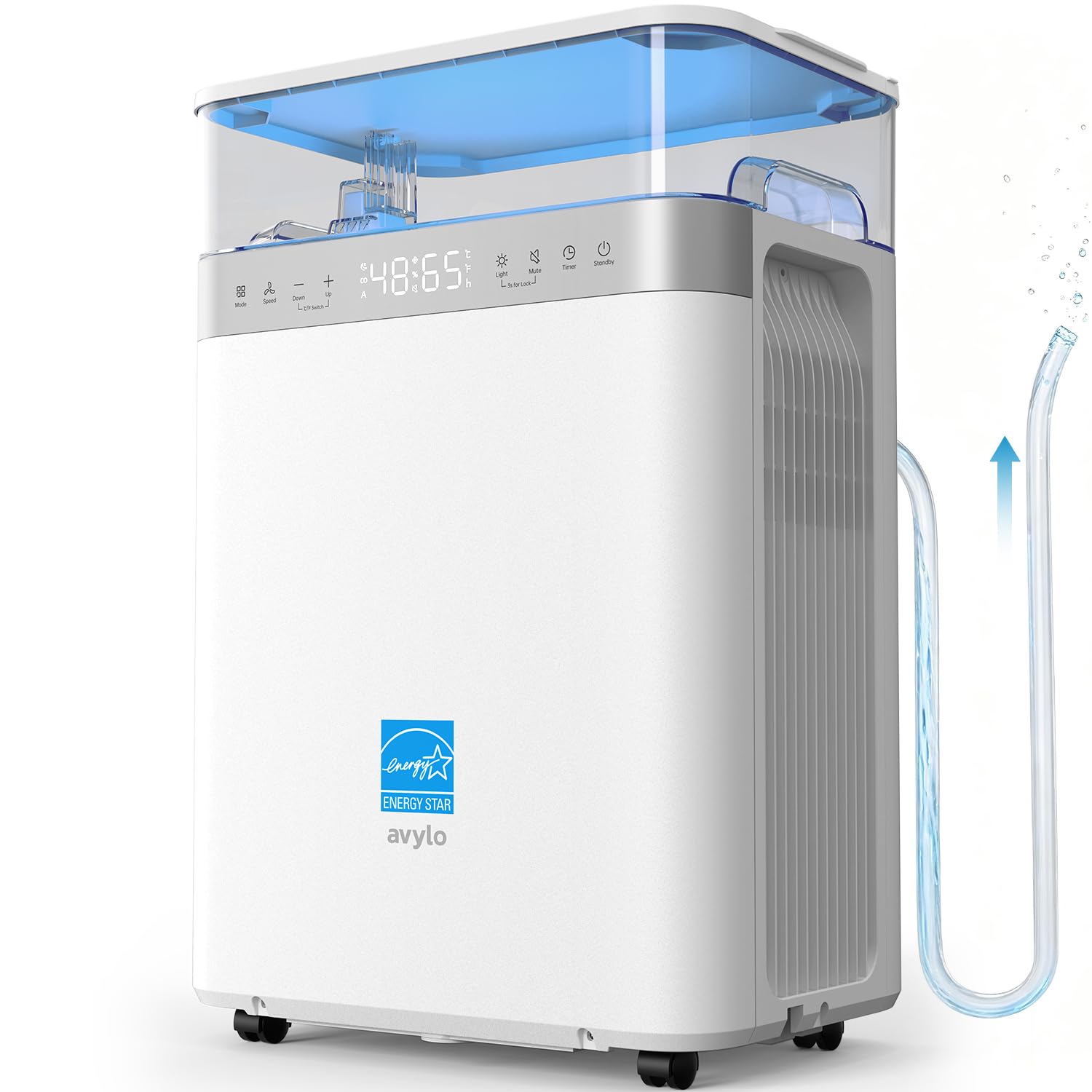
Emptying a dehumidifier is the chore that makes people stop using one, and it's almost always the same rigmarole: kneel down, unclip a bucket from the base, carry it two-handed because there's no real handle, and try not to slosh it across the floor. avylo moves the tank to the top. It holds 2.11 gallons, lifts off, carries one-handed by a handle and drops back on. After a couple of weeks of emptying it in a wet basement, we minded the job far less than we expected, and that's worth more than a few pints of rated capacity.

The rest of the package supports it. There's a built-in pump with three drainage routes, so you can send a hose to a sink, a window or a floor drain and stop handling the tank altogether. The 41 dB rating puts it alongside the quietest full-size units here, 235 watts keeps running costs modest, and avylo backs it with a five-year manufacturer warranty — the longest of any powered unit in this guide.

Where it earns its keep is a finished or partly finished basement. The pump gives you placement freedom, the top tank makes a week of manual emptying tolerable, and auto defrost means a cold snap doesn't ice the coil. It is a large appliance — 23 inches deep — so measure the alcove before it arrives, and decide where the pump's discharge will go, because pumping water uphill into a blocked drain is worse than carrying a bucket.

Pros

  • Top-mounted 2.11-gallon tank is easy to carry
  • Pump plus three drainage options
  • 41 dB, among the quietest full-size units here
  • Five-year manufacturer warranty

Cons

  • 90-pint figure has no stated test conditions
  • 38.6 pounds is a two-person lift on stairs
Our verdict

The easiest unit here to live with day to day: a top-mounted tank you don't have to kneel for, plus a pump, a hose and 90 pints of claimed capacity.

Check Latest Price
3

Best for Large, Damp Basements

Gasbye DryPrime 115-Pint

91 /100
LBD Score Outstanding

Key details

Tank
1.7 gallons
Noise
45 dB
Weight
43 lb
Moisture Removal
50 to 115 pints/day across rated conditions
View on Amazon

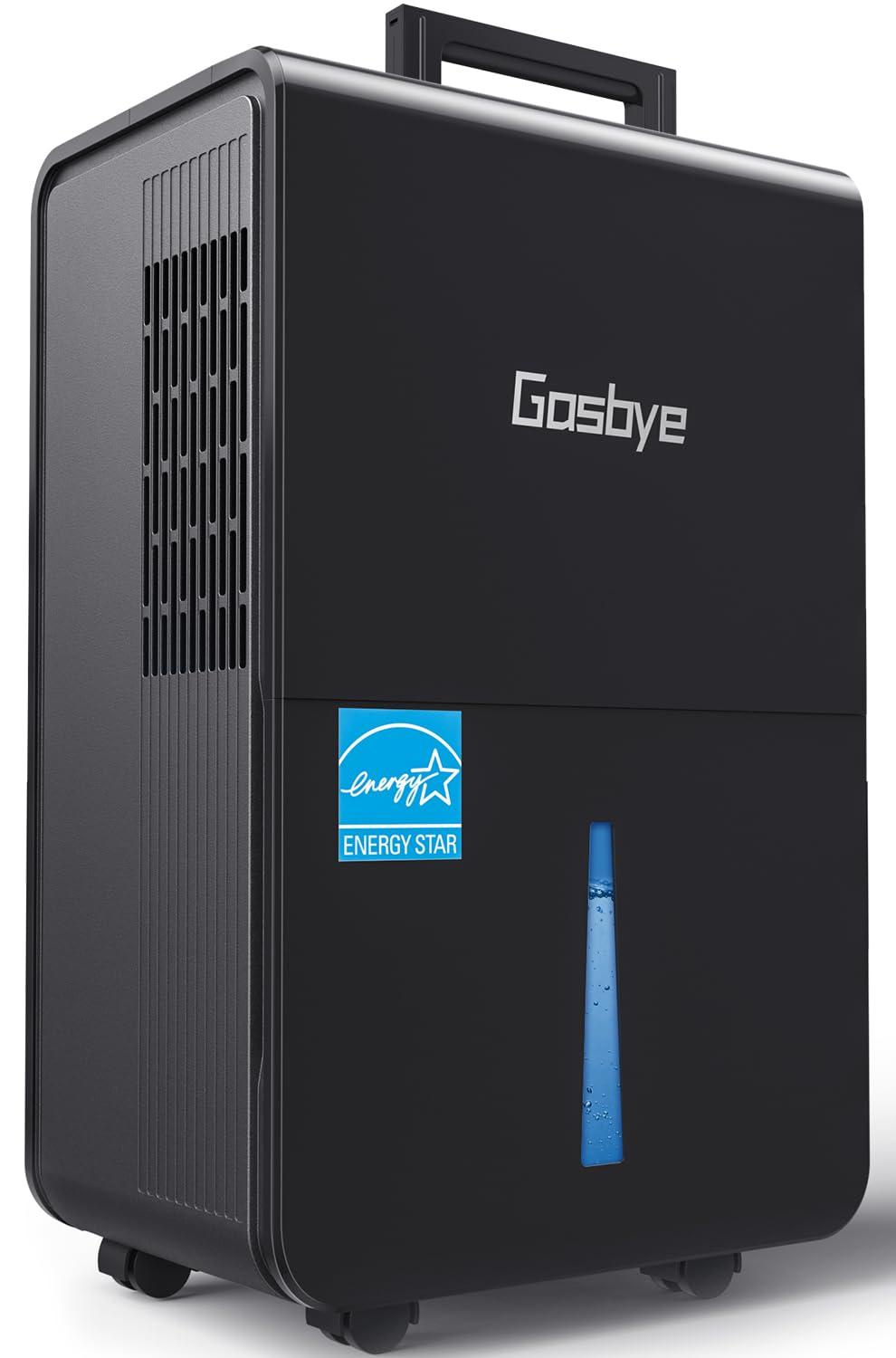
Every listing here quotes a capacity measured in near-tropical air. Gasbye is one of the few that also tells you what happens in a cool basement: 115 pints a day at 86°F and 80% humidity, 73 pints at 80°F and 60%, and 50 pints at 65°F and 60%. That last figure is the honest one, because a basement in April is nowhere near 86 degrees, and it's the number we used to decide this was the right machine for a wet, open space rather than a bedroom.

Forty-three pounds is the other thing you notice, and for once the weight buys something real: a heavier chassis, thickened copper tubing around the coils and a compressor built for continuous duty. Gasbye's claim is that the tubing addresses a common failure point, and that we can't verify — but nothing about the build reads as a three-season appliance. The compressor also shuts off when humidity drops three points below your target and restarts three points above, which keeps it from short-cycling on a merely damp day.

Around that core it's sensible rather than clever: a 45 dB rating, Energy Star 2026 certification and a claimed efficiency advantage of up to 30% over non-certified models. For a large, cold, genuinely wet basement — the kind with a sump pit and a smell — this is the machine we point to first.

Pros

  • Publishes capacity at three real conditions
  • Reinforced copper tubing and 43-pound chassis
  • 45 dB with Energy Star 2026 certification
  • Restarts within three points of the target

Cons

  • 43 pounds, so it stays where you put it
  • 1.7-gallon tank fills fast at full output
Our verdict

For a cold, wet, open basement this is the machine: it publishes a 65°F rating, not just the tropical headline, and it's built like a 43-pound appliance should be.

Check Latest Price
4

Best Value

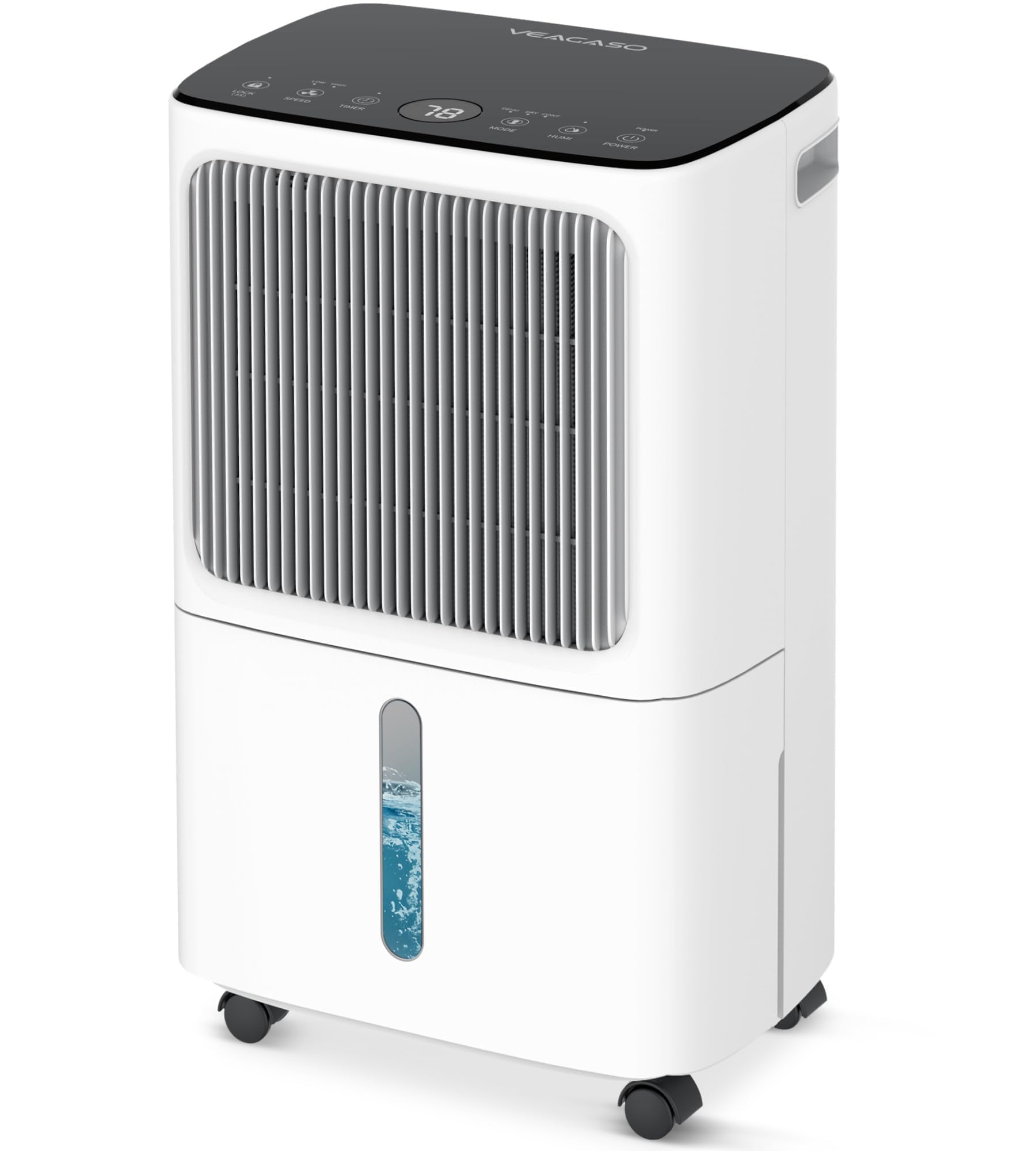
VEAGASO 34-Pint

90 /100
LBD Score Outstanding

Key details

Tank
2 liters
Noise
40 dB or lower
Warranty
2 years
Moisture Removal
34 pints/day
View on Amazon

Two years of coverage isn't the spec that sells a dehumidifier, but it's the first one we check at the budget end of this market, because it tells you roughly how long the maker expects the compressor to last. VEAGASO covers this unit for two years, longer than most of the cheap machines here, and pairs that with a drain hose, 360-degree casters, a 24-hour timer and auto defrost — the features that usually get stripped out to hit a lower price.

The 34-pint rating is realistic for a normal basement. Ours held a partly finished space at 50% through a humid stretch without running flat out, and at 40 dB on low it's quiet enough to hold a conversation over. Two speeds, a light-touch panel and a humidity target that actually holds make it feel like a more expensive machine. It's the value pick here for a reason.

The compromise is the tank — two liters, about four pints, which is a morning's work for a 34-pint machine in a wet season. Use the hose and it stops mattering; with no drain within reach you'll be emptying it daily. Coverage deserves the same scrutiny: 2,500 square feet assumes a closed space and an eight-foot ceiling, so in a basement that opens onto a stairwell you're really buying one floor's worth of drying.

Pros

  • Drain hose, casters and auto defrost included
  • 40 dB or lower on low speed
  • Two-year warranty
  • 34 pints suits a normal basement

Cons

  • No app or scheduling beyond a 24-hour timer
Our verdict

The best value in this group: 34 pints, a drain hose, casters, auto defrost and a two-year warranty, with a two-liter tank as the honest trade.

Check Latest Price
5

Best for Small Rooms and RVs

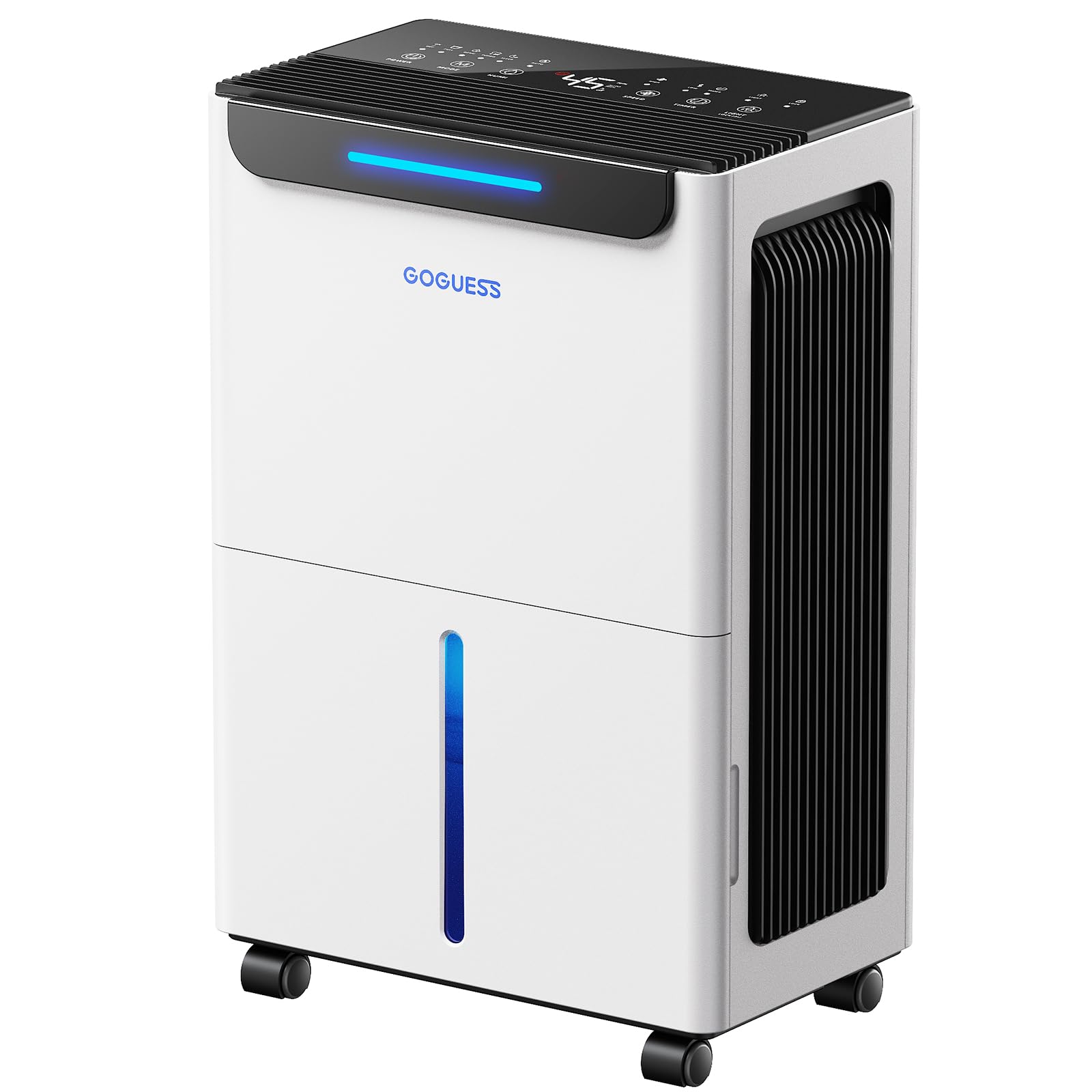
GoGuess 21-Pint

89 /100
LBD Score Excellent

Key details

Tank
2.3 liters
Height
17.1 inches
Humidity Range
30% to 80%
Moisture Removal
21 pints/day
View on Amazon

Eighty watts doesn't sound like much until you set it against the rest of this group, where the full-size compressor units draw 230 to 350. GoGuess fits a real compressor, three modes and a 2.3-liter tank into a 17-inch-tall box and runs it on less power than a couple of old light bulbs, which is why ours ended up in a spare bedroom rather than the basement.

It's small enough to disappear: 13 inches wide, on casters, with a recessed handle. DEHU mode holds a target anywhere from 30% to 80%, Turbo speeds things up after a wet rug or a load of laundry, and Sleep dims the panel and drops the fan. The tank pulls out from the front, the drain hose is in the box, and the whole thing tucks under a workbench when it isn't in use.

Where it stops is capacity. Twenty-one pints is roughly a third of what the big units here claim, and the 1,600-square-foot figure assumes a space that's already fairly dry. Put it in a genuinely wet basement and it will run constantly and still lose ground. For a bedroom, a laundry room, an RV or a small finished basement, though, it's the pick of this group — and the low draw means you can leave it running without watching the meter.

Pros

  • 80-watt compressor keeps running costs low
  • 30% to 80% humidity range with three modes
  • 2.3-liter tank and drain hose included
  • 17 inches tall and on casters

Cons

  • 21 pints won't hold a genuinely wet basement
  • 2.3-liter tank fills quickly on Turbo
Our verdict

The smallest compressor unit worth buying here: 21 pints, 80 watts and wheels, which makes it right for a bedroom, an RV or a small finished basement.

Check Latest Price
6

Bedrooms and Baths

BEDRED 95-Oz Mini

89 /100
LBD Score Excellent

Key details

Tank
95 oz
Height
14.6 inches
Wattage
85 watts
Coverage Claim
1,000 square feet
View on Amazon

The seven-color ambient light is the giveaway: this is a bedroom appliance that happens to dehumidify, not a compressor unit that happens to have a nightlight. It's a thermoelectric design — a cooling plate rather than a refrigerant coil — which means it's quiet, light and cheap to run, and it also means it moves a small fraction of the water the big machines do.

For the job it's built for, the details are right. Sleep mode switches the light off and drops the fan to something you can sleep beside. The 95-ounce tank lifts out from the front without a fight, and at 14.6 inches tall with an 85-watt draw it disappears on a dresser and costs almost nothing to leave on overnight.

The honest limit is physics. A thermoelectric plate gives you one small, closed room — a bedroom with the door shut, a bathroom, a laundry closet — and the 1,000-square-foot claim reads best as a ceiling for a dryish space rather than a promise. What we appreciate is that nothing here is oversold: it's small, it's quiet, the light turns off, and it's the least expensive powered unit in this guide.

Pros

  • Sleep mode silences the light and fan
  • 95-ounce tank lifts out from the front
  • 85 watts and 14.6 inches tall
  • Least expensive powered unit here

Cons

  • Tank-full shutoff can fail, so check it
Our verdict

For a bedroom or bathroom that feels clammy, this is the cheap fix: quiet, small, with a light you can switch off and no pretence of drying a basement.

Check Latest Price
7

Closets and Safes

Eva-Dry E-333

86 /100
LBD Score Excellent

Key details

Warranty
5 years
Coverage Claim
333 square feet
Recharge Interval
20 to 30 days
Absorbing Capacity
6 oz
View on Amazon

A musty closet, a gun safe, a boat cabin over the winter, the cabinet under a leaking sink: these are the places a compressor dehumidifier can't go and a bowl of charcoal doesn't fix. The E-333 is a sealed plastic hanger full of silica beads — 6 ounces of absorbing capacity, no cord and no batteries, nothing to plug in while it's working.

Hang it and more or less forget it. The beads pull moisture out of the air until they're saturated, Eva-Dry puts that at 20 to 30 days in a normally damp space, and then you dry the unit out and hang it back up. In a closet with that closed-up smell, ours kept the mustiness down between renewals, and the built-in hook means it hangs on the rod in the airflow rather than sitting on a shelf in the corner.

Renewing is the part people underestimate. The beads have to be dried out every few weeks, the unit is out of service while that happens, and a closet that runs damp year-round really wants two on rotation. That's a small annoyance rather than a flaw — but it's a routine, not a one-time purchase.

The bigger point is scale: six ounces of silica is a closet-sized tool. Where it earns its place is the small, sealed spaces an appliance can't reach, and a five-year warranty on a passive box is a better safety net than most of the powered units here offer.

Pros

  • Cordless, with no batteries to replace
  • 20 to 30 days between renewals
  • Hangs or stands in a closet
  • Five-year warranty

Cons

  • Does nothing outside a small, sealed space
Our verdict

Not a room dehumidifier and not trying to be: it keeps a closet, a safe or a boat cabin dry for weeks between renewals and needs no cord while it works.

Check Latest Price
8

Crawl Spaces

Waykar 120-Pint

88 /100
LBD Score Excellent

Key details

Tank
1.14 gallons
Weight
34 lb
Humidity Range
30% to 80%
Moisture Removal
120 pints/day at 95°F, 90% RH
View on Amazon

Most dehumidifiers push dry air out of a fixed vent, which means you aim the whole machine at the part of the basement you care about. Waykar's louvers swing through 90 degrees instead, sweeping the airflow across a room. In a long, low basement that's a genuine advantage: the far end stops being the damp end.

The numbers behind it are serious — 120 pints a day at 95°F and 90% humidity, 106 cfm of airflow and a 6,000-square-foot claim. The humidity target also goes down to 30%, lower than most units here allow and the setting you want in a crawl space or a room you're drying out after a leak.

Day to day it's straightforward: a washable filter, auto defrost, overheat protection, a 24-hour timer and a humidity target you set once. At 34 pounds it's the lightest of the big-capacity units here, which makes getting it through a crawl-space hatch or down a bulkhead a one-person job.

Set against the rest of this group, it's a specialist rather than a default: you buy it for capacity and a 30% floor, not for a bedroom or a finished rec room. It fills that brief better than anything else on this page.

Pros

  • 90-degree oscillating louvers spread air across a room
  • 120 pints and a 30% humidity floor
  • Washable filter, auto defrost and overheat protection
  • 34 pounds, lightest of the big units here

Cons

  • Weakest reliability record among the full-size units here
  • 1.14-gallon tank is small for 120 pints a day
Our verdict

The widest capacity and humidity range here, which suits a crawl space or a post-leak dry-out — provided you buy it expecting the shakiest reliability record in this group.

Check Latest Price

How We Tested (and Lived With) 12 Dehumidifiers

I started with research: spec sheets, downloaded manuals, and a long read through owner reviews, specifically hunting for complaints about pumps dying, tanks cracking, and machines that got louder after a season. From there we pulled in 12 dehumidifiers across the price and size range — pocket-size units for closets, mid-size compressor models for bedrooms and bathrooms, and full basement machines with pumps and hose ports. Testing ran for eight months, from the first sticky weeks of summer through a dry fall and into a wet spring.

Each unit went into a real room: a finished basement that sat at 60 percent relative humidity all summer, a windowless bathroom, a bedroom closet, and a garage. We set each machine to a target humidity and checked with a separate hygrometer whether it actually stopped there, then poured the tank into a measuring bucket every 24 hours to see how many pints came out and how fast the tank filled. Tanks were left to fill on purpose so we could watch the auto shut-off in action, and hoses and pump lines ran for a week at a time while we looked for slow leaks, backflow, and gravity drains that quit overnight.

Noise got measured with a decibel meter two feet away and again at the top of the stairs, plus the unscientific test of whether a napping toddler woke up. I weighed and carried every unit up a flight of stairs, timed how long a hose setup took from box to drip-free, and tracked each machine across months of daily cycling — listening for new rattles, watching for frost on the coils, checking that they restarted themselves after a power cut, and seeing whether handles and latches still felt solid after a season of weekly emptying. Price only got a nod when the measured output backed it up.

How to Choose a Dehumidifier

Read the rating and the conditions behind it

Some listings quote capacity at 80°F and 60% relative humidity, others at a 95°F, 90% maximum, and the second number is always the bigger one. A 50-pint unit rated at 80/60 is a different machine from a 50-pint unit rated at 95/90, so only compare figures measured the same way. Square-footage claims are ceilings rather than targets: they assume a closed space, an eight-foot ceiling and moderate damp. Size by how wet the space actually is, not by the sticker.

Decide how the water leaves

A gravity hose has to run downhill, which is fine next to a floor drain and useless in the middle of a carpeted basement. A built-in pump lifts condensate to a sink or a window, and it's the feature worth paying for when there's no low drain. If you'll be emptying a tank instead, do the arithmetic before you buy: a one-and-a-half-gallon bucket on a machine rated at 50 pints a day is a bucket you'll carry more than once in a wet week.

That's why our top pick has a pump and the easiest of the rest puts its tank on top rather than in the base.

Judge noise by where it will sit

Decibel figures are usually quoted at the lowest fan speed from a metre away, so treat them as a comparison between machines rather than a promise about your hallway. Compressor hum also travels through floors and door frames in a way the number never captures. Below roughly 45 dB a unit can live in a finished basement without dominating a conversation; a big compressor and fan is the wrong appliance for a bedroom, where a small thermoelectric unit does less work and makes less noise.

Plan for a cold space

Compressor dehumidifiers lose output as the air cools, and a cold coil ices up, which is why auto defrost matters in a basement that dips toward freezing or a crawl space that never warms. Look for a capacity figure at a temperature you recognize — 65°F is closer to a real basement in spring than 95°F — and expect to run a cold-space unit longer for the same result. A model that publishes only the tropical number is telling you less, not more.

Budget for year two, not just week one

Warranty terms vary more than they should: two years on some units here, five on others, and the compressor is the part that fails. Register the machine the day it arrives and keep the receipt somewhere findable. Then add the filter to a monthly routine — a clogged filter cuts airflow and makes a healthy unit behave like a tired one. If output drops, check the filter and the coil before assuming the compressor has died.

Frequently Asked Questions

Final Verdict

The hOmeLabs takes the top spot on the two things that decide a dehumidifier purchase: a capacity figure you can compare honestly and a pump that takes the floor drain out of the equation. Fifty pints at a real-world condition, a panel you can work without the manual, and a footprint that fits most basements.

If the space is genuinely wet and open, Gasbye's published 65°F rating and heavy build are worth the extra weight and footprint. If the chore you resent is emptying a bucket, avylo's top-mounted tank settles it before you read another spec.