Best Stand Mixers of 2026

A stand mixer is one of the few kitchen appliances people buy expecting to keep it for 20 years, which is why it stings when one starts to labor halfway through a stiff bread dough. I've stood over a machine that smelled faintly hot and pretended not to notice. The real dividing line isn't the wattage printed on the box — nobody measures that the same way — it's how the motor and the bowl work together when the dough gets heavy.

Over the past seven months, my team and I have creamed, whipped, and kneaded with ten of them, from compact tilt-heads to a bowl-lift that barely cleared my upper cabinets. We learned that the number of speeds on the dial matters far less than how gently the lowest one starts, and that a splash guard you actually leave on beats one that ends up in a drawer. These machines live out on the counter, so color and finish got judged right alongside what comes in the box. The picks below are the ones we'd plug in again.

1

Best Overall

KitchenAid Artisan 5-Qt

95 /100
LBD Score Outstanding

Key details

Speeds
10
Capacity
5 quarts
Warranty
1 year limited
Head Design
Tilt-head
View on Amazon

The 325-watt rating on this mixer looks thin next to budget machines claiming twice the power, and that is the first thing worth understanding about stand mixers: wattage is a marketing number, and what actually kneads dough is the gearing behind it. This one took everything we mixed, from creamed butter to a stiff bread dough, without the head rocking or the motor changing note. We reach for it first for a reason.

Five quarts is the sensible middle of this group. It is enough for a double batch of cookie dough or a layer cake, and not so much that a single small batch leaves the beater spinning in air above a puddle of batter. Ten speeds with a genuinely slow stir at the bottom of the dial is the other thing we appreciate: you can fold in flour or chocolate chips without flinging them across the counter.

The pouring shield that ships in the box turned out to be the accessory we use most, since adding flour through the chute means stopping less often. The zinc body is heavy enough to sit still through stiff dough, which matters more the harder you push it, and the front hub opens up the brand's attachment range later if you want pasta or a grinder.

What it is not is a volume bread machine. If you bake four loaves at a time, the seven-quart bowl-lift further down this page gives you the room. For everything else, this is the stand mixer we point people toward.

Pros

  • Handles every everyday baking job without straining
  • Front hub accepts the brand's add-on attachments
  • Slow stir speed folds without flinging flour
  • Heavy zinc body stays planted in stiff dough

Cons

  • One-year warranty is the shortest in this group
  • Coated beater and dough hook can chip
Our verdict

We reach for this one first because it handles every ordinary baking job and its front hub lets it become a pasta maker or grinder later. It is the safest place to spend your mixer money.

Check Latest Price
2

Best Value

Cuisinart Precision Master 5.5-Qt

95 /100
LBD Score Outstanding

Key details

Motor
500 watts
Speeds
12
Capacity
5.5 quarts
Warranty
3 years limited
View on Amazon

Set this next to our top pick and the differences are less dramatic than the tier gap suggests. The Cuisinart's bowl is actually the larger of the two at 5.5 quarts, its motor is rated higher on paper, and it is covered for three years instead of one.

What we noticed first was the noise, or the lack of it. Creaming butter early in the morning in an open kitchen is a different experience on a machine this quiet, and the click-stop dial makes it easy to land on the same speed twice. Twelve speeds also means there is a genuinely slow one for folding, which is the setting we use most.

The flat paddle does not scrape, so a ring of flour or butter builds up on the bowl until you stop and deal with it. Budget two or three spatula passes per batch; that is the routine on most mixers here, and it is the main reason this one does not sit above the KitchenAid.

The die-cast body gives it more heft than the rest of the midrange group, and that heft is why it stays planted through a stiff dough. The bowl, paddle, and dough hook all go in the dishwasher, which matters more on a machine you use twice a week than any single feature on the box.

Pros

  • 5.5-quart bowl is bigger than our top pick's
  • Quiet enough for an early-morning bake
  • Three-year limited warranty on the motor
  • Bowl, paddle and hook are dishwasher-safe

Cons

  • Seventeen pounds takes two hands to move
Our verdict

The smart-money pick: a bigger bowl than our top pick, a three-year warranty, and enough power for everyday dough. We recommend it to anyone who wants the results without the premium.

Check Latest Price
3

Best for Bread

Bosch Universal Plus 6.5-Qt

90 /100
LBD Score Outstanding

Key details

Motor
500 watts
Speeds
4
Capacity
6.5 quarts
Bowl Material
BPA-free plastic
View on Amazon

There is no head over this bowl. The drive comes up through the base, so the top of the 6.5-quart bowl stays wide open for adding flour, and the lid and splash ring keep the mess in. After a few batches with that much clearance, going back to a tilt head feels like working around a low cupboard door.

The numbers are unusually specific, and they hold up. Bosch rates it for up to 15 pounds of whole-grain dough at once, roughly 14 loaves, or 34 dozen cookies, and the dual beaters will whip a single egg white as readily as they mash 10 pounds of cooked potatoes. That range is why bread bakers keep buying it.

What settled it for us is the belt-driven transmission: torque stays even at low speeds, so stiff dough gets kneaded rather than thrown around, and the machine does not walk across the counter. It is a bread tool that happens to do cakes, not the other way around, and for a weekly sourdough habit that is the right priority.

The plastic bowl is the part traditionalists will object to, and it is also why the bowl is light, dishwasher-safe, and easy to tip ingredients into. The dough hook extender in the box is easy to overlook; fit it before a big batch, not during one.

Pros

  • Open bowl top with a lid and splash ring
  • Kneads up to 15 pounds of whole-grain dough
  • Belt drive holds torque at low speeds
  • Bowl is light and dishwasher-safe

Cons

  • Four speeds, with no gentle folding setting
  • Plastic whip drive is the part that wears
Our verdict

Bread is what this machine is for: a still bowl, moving beaters, and enough torque for whole-grain dough in quantity. Buy it if your baking runs to loaves rather than layer cakes.

Check Latest Price
4

Best Lightweight

Martha Stewart 5.3-Qt

84 /100
LBD Score Excellent

Key details

Motor
660 watts
Speeds
12
Weight
9 lb
Capacity
5.3 quarts
View on Amazon

Nine pounds is the number that defines this mixer. It is light enough to come out of a cupboard with one hand and go back the same way, which in a small kitchen is the difference between using it on a Tuesday and saving it for occasions.

The rest of the spec sheet is more than the weight suggests: a 5.3-quart stainless bowl, 660 watts, and a splash shield with a pour chute. Martha Stewart rates the bowl for up to nine dozen cookies, and the silicone edge on the flat beater is the detail we did not expect at this tier, since it wipes the bowl as it turns and saves most of the scraping.

Twelve speeds is more than this machine needs, but there is a real low gear for folding nuts into a batter, and the plain knob means nothing to learn before the first batch. The tilt head gives you room to scrape down without unclipping anything, and the removable splash shield lifts off in one piece for the sink.

Pros

  • Nine pounds, easy to lift in and out
  • Silicone-edged beater scrapes as it mixes
  • Splash shield with a pour chute
  • Rated for up to nine dozen cookies

Cons

  • Light body lets the head rock in stiff dough
Our verdict

Nine pounds that comes out of the cupboard without a grunt, and a silicone-edged beater that scrapes as it goes. We recommend it wherever the mixer has to be put away.

Check Latest Price
5

Best Budget

VIVOHOME 6-Qt

91 /100
LBD Score Outstanding

Key details

Motor
660 watts
Speeds
10 plus pulse
Weight
11 lb
Capacity
6 quarts
View on Amazon

The flex-edge beater is why this one made the list: it scrapes the sides and bottom as it turns, so you are not stopping halfway through a batter with a spatula in your hand. The splash guard lets you pour while it runs, which sounds like a small thing until you have added cocoa to a running mixer without one.

Six quarts is enough for three loaves or 2.2 pounds of flour by the maker's reckoning, and the suction feet grip hard enough that lifting it off the counter takes a deliberate tug. At 11 pounds it is easy to move but planted while it works, which is the balance we want from a budget machine.

It is loud. The spec sheet lists 80 dB and we believe it, so it is not the mixer for an open kitchen at nap time. For cake batter, cookie dough, buttercream, and frosting it does what the expensive ones do, and the scraper beater means fewer stops to scrape.

Pros

  • Flex-edge beater scrapes sides and bottom
  • Splash guard lets you pour while it runs
  • Six-quart bowl with strong suction feet

Cons

  • Bowl handle and whisk are the parts that fail
  • Replacement parts are hard to source
Our verdict

Six quarts, a scraper beater, and a splash guard at the lowest tier for a full-size bowl. We point cake and cookie bakers here first.

Check Latest Price
6

Big Batches

KitchenAid Bowl-Lift 7-Qt

81 /100
LBD Score Excellent

Key details

Motor
500 watts
Speeds
11
Weight
28 lb
Capacity
7 quarts
View on Amazon

This is a bowl lift, so the bowl rides up on two arms and a lever brings it to the head rather than the head tipping back. It is the design that makes a seven-quart bowl manageable, since you are not heaving a huge batch of dough under a hinge, but it also means the bowl has to be lined up and seated every single time.

Eleven speeds includes a half setting between off and one, which exists so you can fold blueberries or whipped egg whites into a batter without knocking the air out of it. The double flex-edge beater has two flexible edges and scrapes both sides of the bowl as it goes, and the motor is rated to knead more than 8 pounds of bread dough or mash 7.5 pounds of potatoes.

It is a big machine: 28 pounds and 16.5 inches tall, so it wants a dedicated landing spot rather than a shelf. What that buys is stability. Nothing we mixed made the head budge, and the bowl holds enough for two generous batches at once.

The caution is early failure. If a machine like this is going to quit, it does it in the first few batches, so run a stiff dough through it in the first week while a return is still simple. Buy it for volume and for that folding speed; our top pick cannot match either.

Pros

  • Seven-quart bowl takes 13 dozen cookies at once
  • Half speed folds berries and egg whites gently
  • Double flex-edge beater scrapes both sides

Cons

  • Twenty-eight pounds is a two-hand lift
  • Bowl has to be seated carefully on the arms
Our verdict

The big-batch choice: seven quarts, a folding half speed, and a scraper beater that covers the whole bowl. Worth it if you bake in volume, overkill if you do not.

Check Latest Price
7

Family Batches

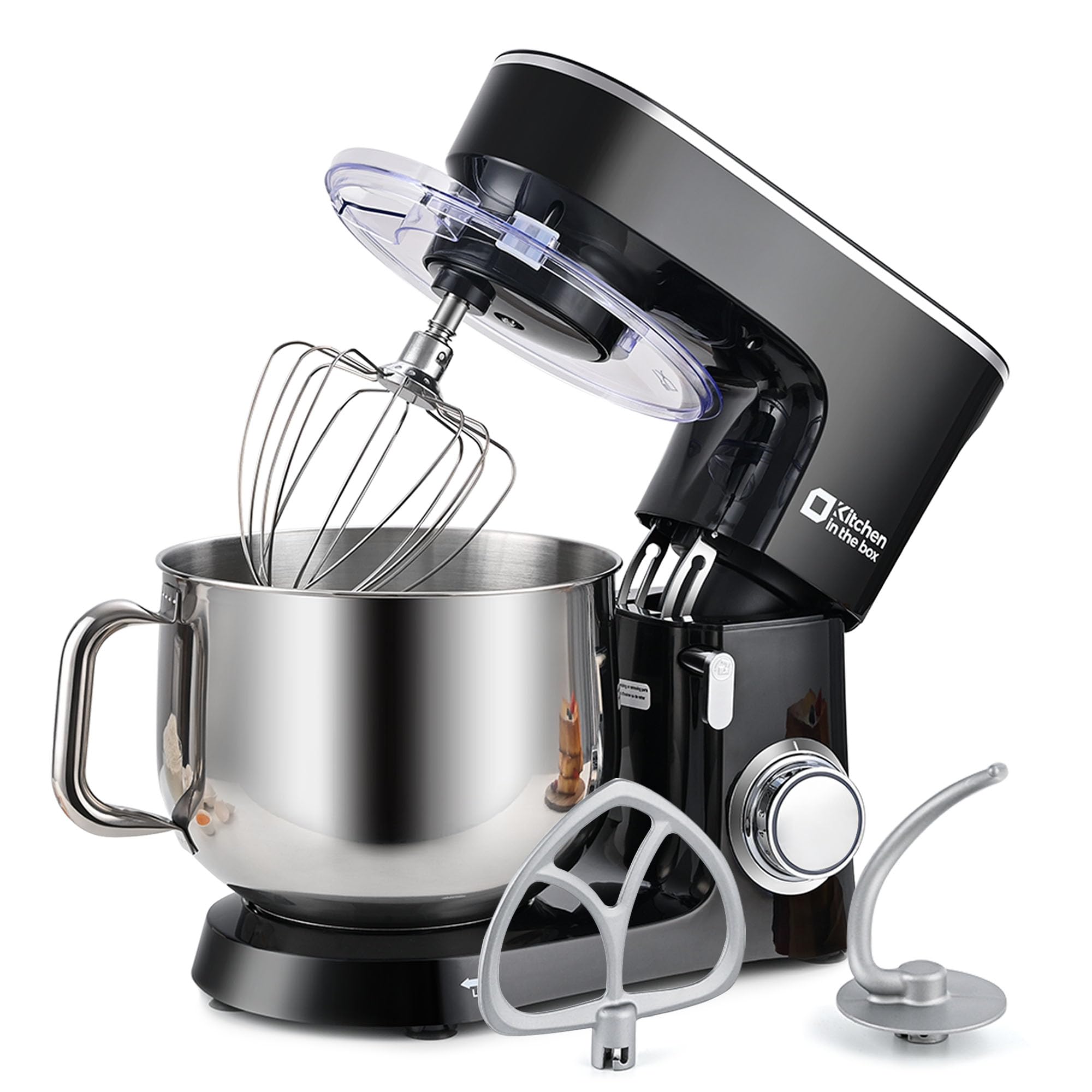
Kitchen in the box 8.5-Qt

89 /100
LBD Score Excellent

Key details

Motor
900 watts
Speeds
10 plus pulse
Capacity
8.5 quarts
Head Design
Tilt-head
View on Amazon

Eight and a half quarts is the biggest bowl on this page, and the 900-watt copper motor is the strongest rating in the group. If you bake two sheets of cinnamon rolls at a time and still want room to spare, that combination is the whole point of this machine.

The bowl has a handle, which matters more than it sounds once the bowl is full: a batch this size is heavy, and carrying it to the sink one-handed instead of hugging it with both arms is a small daily improvement. The tilt head and splash guard make adding flour a one-handed job too.

Build quality follows the money: the body is plastic and the motor is where the budget went. We noticed the motor rather than the finish, which is the right trade at this tier, though it is a machine that looks more serious than it feels.

What we cannot tell you yet is how it ages. This is a recently introduced model with a short record behind it, so buy it for the capacity, keep the receipt, and do not expect the fit and finish of a KitchenAid. For family-size batches it is the most capacity you can get without jumping a tier.

Pros

  • 8.5-quart bowl is the largest here
  • 900-watt motor is the strongest rating here
  • Handle makes a full bowl carryable

Cons

  • Short track record, so long-term wear is unknown
Our verdict

The biggest bowl here, and 900 watts behind it, at a midrange tier. We like it for family-size batches, as long as you are comfortable with a short track record.

Check Latest Price
8

First Mixers

Electactic 5.3-Qt

88 /100
LBD Score Excellent

Key details

Motor
300 watts
Speeds
12
Weight
8 lb
Capacity
5.3 quarts
View on Amazon

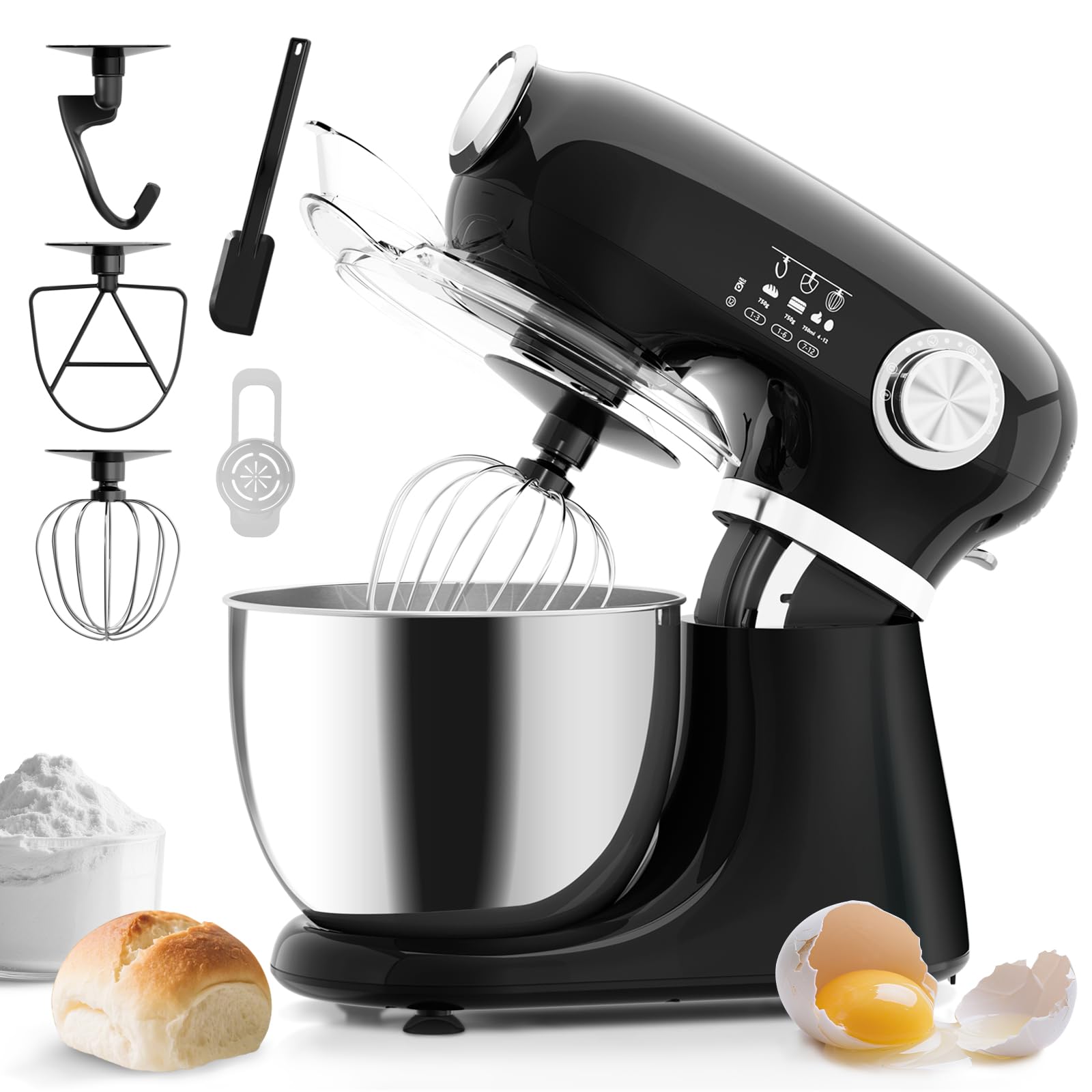
A twelve-speed dial and a pulse button are more control than this tier usually offers, and the useful part is the slow end: you can start a cake batter without a cloud of flour coming out of the bowl.

Eight pounds and four suction feet are what make it workable. It sits on the counter without walking and it is light enough to put away afterwards, which is more than we can say for machines twice its weight. The tilt head gives you room to scrape down without unclipping anything.

It comes with a spatula and an egg-white separator spoon alongside the whisk, hook, and beater. The separator is the sort of thing you never buy separately and always want the one time a recipe calls for yolks only. It does the job without asking for counter space or a learning curve.

Pros

  • Twelve speeds with a slow, clean start
  • Eight pounds, easy to move and store
  • Includes spatula and egg separator

Cons

  • 300 watts limits it to batters and light doughs
Our verdict

Twelve speeds and a 5.3-quart bowl in an eight-pound body, for the least money here. A sensible first stand mixer if your baking is cakes and frosting.

Check Latest Price

How We Tested: Ten Mixers, Seven Months, a Lot of Bread

To build the shortlist, we started with the machines that keep coming up in the same conversations — tilt-heads and bowl-lifts between roughly 5 and 8.5 quarts — then filtered out anything with a bowl too small for a double batch of cookie dough or controls that looked like a chore to use. We ended up with ten mixers and ran them for seven months in home kitchens rather than a lab, so every loaf, batch of frosting, and Sunday pancake batter went through them at normal cooking pace.

Each mixer got the same workout. A stiff bagel dough on the lowest setting showed us whether the head bounced, whether the whole machine crept across the counter, and whether the feet actually gripped; creamed butter and sugar revealed pockets of flour the beater never reached; a run of whipped cream showed how fast soft peaks tipped into overwhipped. We loaded the bowls to capacity with bread dough and with three dozen cookies' worth of batter to see what 5 quarts really means next to 6.5 or 8.5, and we counted how many times we had to stop and scrape down the sides.

Between bakes we watched the boring things. We listened for gear noise and felt how warm the housing got after back-to-back heavy mixes, and by the fourth month we could tell which machines had started to sound different. Bowls, guards, and attachments went on and off dozens of times to see whether the locking felt solid or fiddly, and we checked head clearance under standard upper cabinets. Every finish got wiped down with a damp cloth to see which colors held fingerprints and scuffs, and we weighed what shipped in the box against what each machine cost, since a mixer that makes you buy a dough hook separately is a worse deal than it looks. The ten that made the list are the ones that finished all of it without being nursed along.

How to Choose a Stand Mixer

Match the bowl to your biggest regular batch

The number on the box is volume, not usefulness. A 4.5- to 5.5-quart bowl suits most households: it takes a double batch of cookie dough or a layer cake without leaving the beater spinning in air above a scrap of batter. Step up to 6 quarts or more only if you routinely bake for a crowd, because a large bowl handles a single small batch badly and you end up scraping the bottom by hand.

Count the biggest thing you make in a normal month and buy for that, not for the holiday you host once a year. The 5.3- and 5.5-quart machines here are the sweet spot for two to four people; the 8.5-quart model is for someone who fills two sheet pans at a time.

Wattage is not the same as strength

Watts measure what the motor draws, not what reaches the beater, and the two can point in opposite directions. Our top pick is rated at 325 watts and kneads better than machines here advertising twice that, because the gearing and the weight sitting over the bowl do the real work.

Instead of chasing the biggest number, look for a stated dough capacity, a body that stays put when the dough stiffens, and a brand that will still sell you a replacement beater in a few years. Those three things predict satisfaction better than any figure on the front of the box.

Tilt head or bowl lift

A tilt head hinges back, which makes adding flour and scraping down a two-second job, and it is the design we prefer for frequent small batches. A bowl lift raises the bowl on two arms instead: it is more stable with heavy dough and becomes the standard choice once you pass 6 quarts, but the bowl has to be seated squarely and the head stays where it is.

If you bake bread weekly, the lift earns its awkwardness. If frosting and cookies are more your week than dough, take the tilt.

Decide where it lives before you buy

A mixer that has to be lifted out of a low cupboard gets used less, and that is a purchase decision, not a storage one. Measure the landing spot and the path to it: the machines here stand between roughly 14 and 19 inches tall and weigh anywhere from 8 to 28 pounds.

If it will live on the counter, check the footprint against the space beside the toaster. If it goes away between batches, weight is the specification that matters most, and the 8- to 11-pound models are the ones that come out without a fight.

Attachments and what the warranty covers

Most mixers here have a hub or a bottom drive that takes add-ons, which is how one machine becomes a pasta roller or a meat grinder years later. Check the box contents before you compare anything else, because a pouring shield and a spare bowl are separate purchases on some models and included on others.

Then read the warranty, which varies more than any other specification on this page. One year on our top pick against three on the Cuisinart is a real difference if the motor ever quits.

Frequently Asked Questions

Final Verdict

Buy the KitchenAid Artisan if you want one mixer that handles buttercream, cookie dough, and a batch of bread, and can grow into pasta or grinding later through its front hub. It is the machine we point people toward when they want to buy once.

If the budget is tighter, the Cuisinart does the same everyday work with a bigger bowl and three years of cover, and we hand it to anyone who would rather spend the difference on ingredients. If bread is the hobby rather than the afterthought, start with the Bosch instead.