Best Countertop Microwaves of 2026

A microwave is the appliance you notice only when it fails: leftovers that come out lava-hot at the edges and cold in the middle, popcorn that scorches before it pops, or a beep loud enough to wake the house. The right countertop model fixes those daily annoyances without asking for a remodel—it heats evenly, fits the gap you actually have, and stays simple to use.

I've lived with enough microwaves to know wattage isn't the whole story; how a model moves heat around matters more than the number on the box. Over eight months, my team and I tested 12 countertop microwaves in real kitchens, from compact units for dorm rooms and office break rooms to larger stainless-steel models for family counters. We weighed size and fit against counter space, checked whether doors and turntables held up after daily use, noted fan noise and beep volume, and compared value. We also tried sensor cooking and one-touch presets, because functionality only counts if you'll actually use it—the picks below earned their counter space.

1

Best Overall

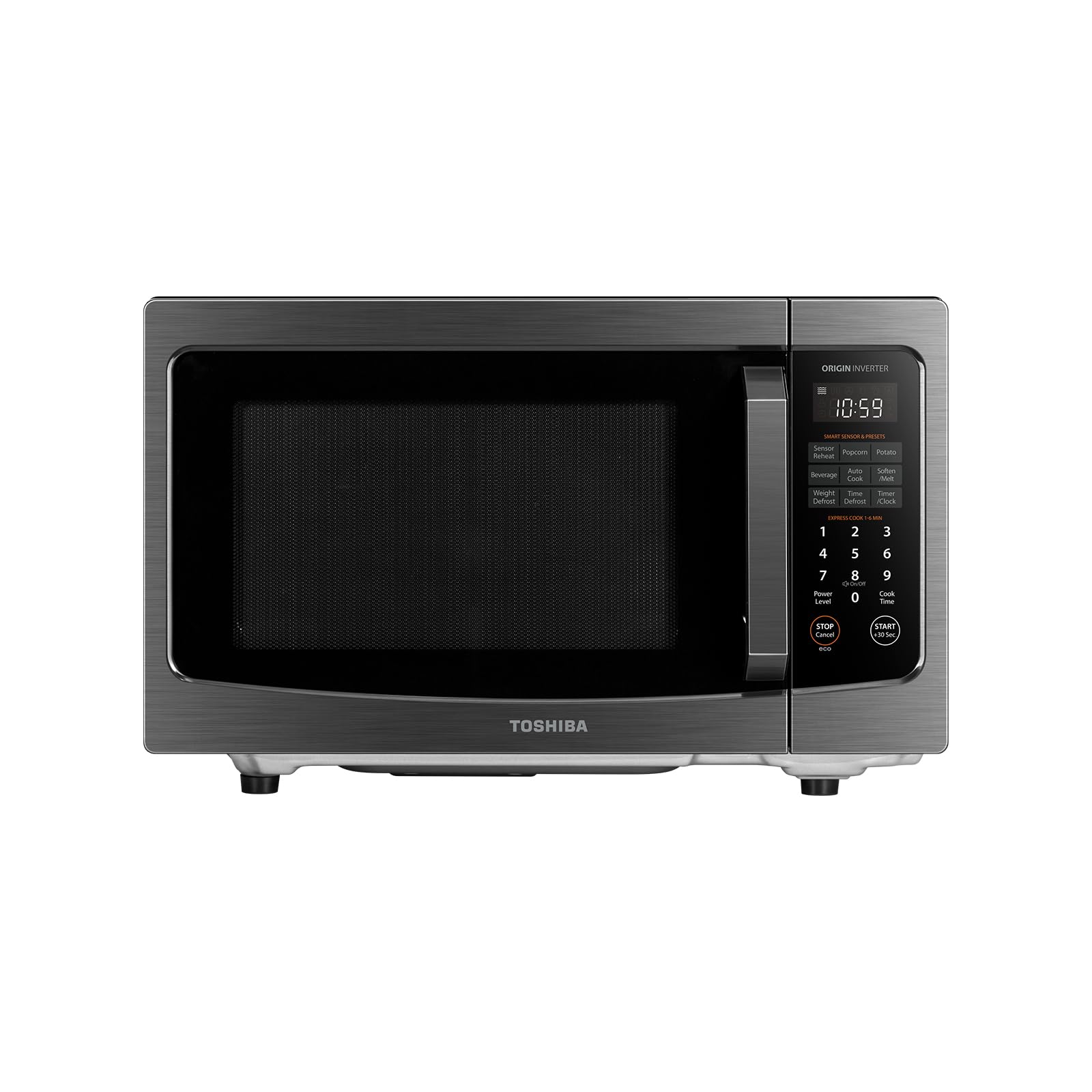
Toshiba Flatbed 1.3 Cu. Ft.

86 /100
LBD Score Excellent

Key details

Power
1200 watts
Capacity
1.3 cu ft
Interior
Flatbed, no turntable
Dimensions
14.6"D x 20.4"W x 12.5"H
View on Amazon

The flatbed interior is the reason this Toshiba earns our top spot. With no turntable ring or glass plate to lift out, the bottom is one smooth surface, and wiping up a spill takes a single pass instead of chasing crumbs around a spindle. That matters more than it sounds in a microwave used every day. The 1.3-cubic-foot box is big enough for a dinner plate or a rectangular casserole, and the 1200-watt inverter system is the most powerful setup in this group. We found it heats leftovers quickly and, just as important, evenly enough that we weren't rotating the dish by hand halfway through.

The sensor menus are genuinely useful for popcorn and vegetables; you choose the food, and the oven adjusts rather than making you guess at time. At 20.4 inches wide and 25.8 pounds, it still lands in countertop territory, though it takes up more room than the 0.7-cubic-foot compacts here. We also appreciated the black stainless finish, which looks less appliance-basic than the plastic-front budget models. Our reservation is the price: this is a premium pick, and the turntable Toshiba below gives you more capacity for less. The flatbed is worth it if easy cleaning and even reheating are the things you notice every day.

Pros

  • Flatbed wipes clean without a turntable ring
  • 1200 watts and inverter heating even out leftovers
  • Sensor menus take guesswork out of popcorn and vegetables
  • Fits rectangular dishes and full dinner plates

Cons

  • Premium price for the capacity
Our verdict

This is the countertop microwave we recommend first for everyday reheating: the flatbed is easier to clean, and the 1200-watt inverter heats more evenly than the budget models here.

Check Latest Price
2

Best for Large Families

Toshiba 1.6 Cu. Ft.

87 /100
LBD Score Excellent

Key details

Power
1200 watts
Capacity
1.6 cu ft
Turntable
13.6 inches
Dimensions
17.8"D x 21.8"W x 12.9"H
View on Amazon

The 13.6-inch turntable is the number to start with: it takes a 13-inch pizza, two frozen dinners, or a full family-size casserole without angling. That makes this the microwave in our group for people who routinely heat more than one plate. The 1.6-cubic-foot interior is the largest here, and the 1200 watts put it near the top of this set for raw power. We used it for big bowls of soup and leftovers, and the sensor reheat did a better job than the compact 700-watt models at avoiding the cold-center problem.

We also like the position-memory turntable, which returns the plate to where you set it; it sounds like a small thing until you're reaching into a dark cavity. The sound-off function is welcome in an open kitchen, and the child lock is useful if small hands are around. The trade-off is counter space. At 21.8 inches wide and 36.6 pounds, it needs a deep, sturdy spot, and it crowds a small kitchen. If you have the room and feed a family, the capacity and power earn their keep. If you mostly reheat a mug, the smaller Toshiba flatbed is the easier fit.

Pros

  • Fits a 13-inch pizza and two dinners
  • 1200 watts heats large portions fast
  • Position-memory turntable and sensor menus
  • Sound-off and child lock add flexibility

Cons

  • Keypad buttons need a firm press
Our verdict

Choose this Toshiba when capacity is the priority: the 1.6-cubic-foot cavity and 1200 watts handle family-size dishes, provided you can spare the counter depth.

Check Latest Price
3

Best for Small Kitchens

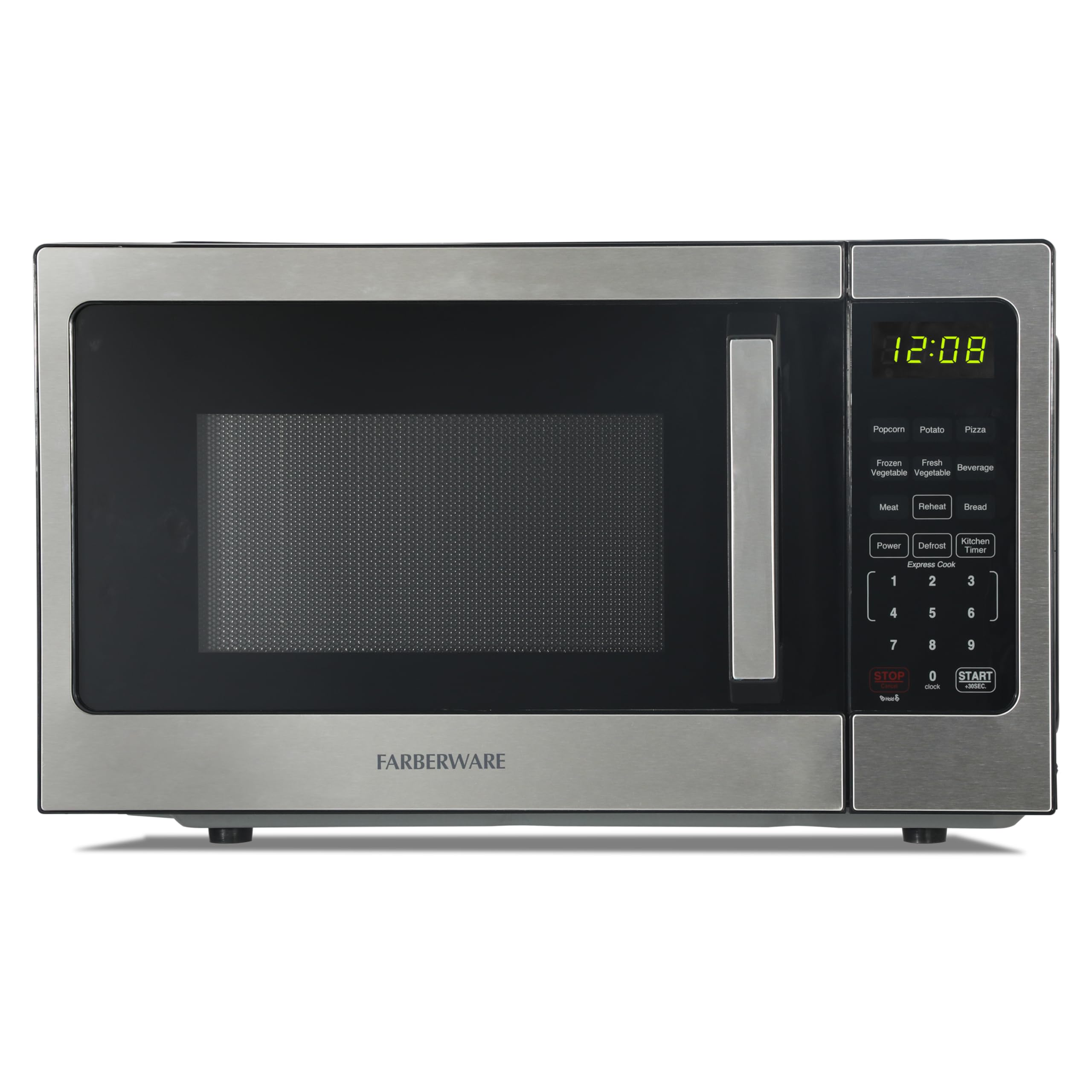
Farberware 0.9 Cu. Ft.

88 /100
LBD Score Excellent

Key details

Power
900 watts
Presets
8 auto-cook
Capacity
0.9 cu ft
Dimensions
18.62"D x 14.72"W x 10.7"H
View on Amazon

A handle door is the quiet advantage here. Instead of hunting for a push-button release, you pull the door open the way you do a full-size oven, which is easier on hands that don't grip well and simpler when you're holding a plate. At 0.9 cubic feet and 900 watts, this Farberware sits in the middle of our group: roomier than the 0.7-cubic-foot compacts but still small enough for an apartment counter. We found the stainless front looks more built-in than its price tier suggests, and the eight auto-cook presets cover the usual popcorn, pizza, potato, and beverage chores without a manual.

The 900 watts are enough for leftovers, though it is not as quick as the 1000- and 1200-watt models here. What we like most is the daily handling. The handle, readable LED, and +30-second key make it feel less fussy than the button-door budget models. The stainless finish also hides fingerprints better than black plastic, which is a small win in a busy kitchen. If you want a mid-size microwave that is easy to open and easy to live with, this is the one we point to. It is not the most powerful here, but it is the most comfortable to use in this size class.

Pros

  • Handle door is easier to pull with full hands
  • 0.9 cu ft fits small kitchens without feeling tiny
  • 900 watts and eight presets cover daily reheating

Cons

  • Heating can be uneven with dense foods
Our verdict

This is our pick for a small kitchen that wants a handle door and mid-size capacity: the 0.9-cubic-foot Farberware is easier to open and live with than the button-door compacts.

Check Latest Price
4

Best for Dorms and Offices

COMFEE' 0.7 Cu. Ft.

89 /100
LBD Score Excellent

Key details

Power
700 watts
Capacity
0.7 cu ft
Turntable
10 inches
Dimensions
13"D x 17.3"W x 10.2"H
View on Amazon

Compact microwaves ask you to trade power for counter space, and this COMFEE' makes that trade clearly. The 0.7-cubic-foot box and 10-inch turntable fit a mug, a small bowl, or a dinner plate with little room to spare; it is the kind of microwave that disappears onto a dorm shelf or a tiny apartment counter. We like the one-touch 1-to-6-minute start and the +30-second key, because they skip the step of dialing in a time when you're just reheating coffee. The sound-off function is also a real convenience in a shared room or a quiet office.

The catch is the 700 watts. It takes longer than the 900- and 1200-watt models here, and dense leftovers can need an extra minute or two and a stir. That is not a defect so much as the price of the size, but it is the reason we don't recommend it as a main kitchen microwave for a family. The eco mode is a small bonus, and the child lock makes sense in a dorm or break room. If you need a small second oven for a dorm, office, or guest suite, the size and simple controls make it easy to live with. If you reheat full dinners every night, step up to more power.

Pros

  • Fits tight counters and dorm shelves
  • One-touch start and +30 seconds simplify reheating
  • Sound-off and eco mode suit shared spaces
  • Child lock adds shared-space safety

Cons

  • Durability is a concern
Our verdict

This is the compact we recommend for dorms and offices: it saves counter space and keeps controls simple, with one-touch start and a sound-off mode.

Check Latest Price
5

Standard-Size Kitchens

GE 1.1 Cu. Ft.

82 /100
LBD Score Excellent

Key details

Power
950 watts
Capacity
1.1 cu ft
Turntable
12.75 inches
Dimensions
20.51"D x 16.69"W x 12.01"H
View on Amazon

The 1.1-cubic-foot size is the practical middle of this group: it takes a dinner plate without the bulk of the 1.6-cubic-foot Toshiba, and it gives you more room than the 0.7-cubic-foot compacts. GE pairs that with 950 watts and a 12.75-inch turntable, so a standard plate fits with a little clearance. We liked the one-touch controls more than we expected; the six convenience settings and express keys are easy to read, and the included pasta cooker is a nice extra if you make boxed pasta in the microwave. The stainless finish also looks more built-in than the black plastic budget models.

The caveat we keep coming back to is noise. This is one of the louder units in our group when the turntable rolls, and that is noticeable in an open kitchen. The 950 watts are enough for day-to-day reheating, though the 1200-watt models here have more headroom for frozen blocks. If you want a standard 1.1-cubic-foot microwave with a somewhat more premium finish and a pasta extra, this GE is worth a look. If quiet operation matters more, the Toshiba flatbed is the better fit.

Pros

  • 1.1 cu ft fits dinner plates without huge bulk
  • 950 watts and 12.75-inch turntable
  • One-touch controls and six convenience settings
  • Pasta cooker included

Cons

  • Mixed reliability record
Our verdict

This GE is a straightforward 1.1-cubic-foot choice for one-touch cooking and standard dinner plates, with a pasta cooker as a useful extra.

Check Latest Price
6

Spare or Office

Emerson 0.7 Cu. Ft.

84 /100
LBD Score Excellent

Key details

Power
700 watts
Defrost
Time and weight
Presets
6 auto-cook
Capacity
0.7 cu ft
View on Amazon

The Emerson is the plainest microwave in this group, and that is the point. There are no sensor menus, no flatbed, and no styling tricks: just a 0.7-cubic-foot box with 700 watts, ten power levels, and six presets for popcorn, pizza, potato, and the usual suspects. We found the controls easy to read and the express cook handy for a quick reheat; the 99-minute timer is more than most people need, but it is there. The compact footprint fits where a larger oven won't, and the simple button layout is easy to explain to a guest or a coworker.

The trade-off is the same one every 700-watt compact makes: dense food takes longer, and a full dinner plate is tight. The child lock is a useful addition for a shared office, and the time and weight defrost options cover the basics without a manual. If you need a low-cost second microwave for an office break room or a camper, the simple controls and small footprint make sense. If it will be your only oven, step up to a model with more power and a larger cavity.

Pros

  • Simple controls and six presets
  • Compact 0.7-cubic-foot footprint
  • Time and weight defrost options
  • Express cook and child lock

Cons

  • Long-term durability is the weak point
Our verdict

This is our pick for a cheap spare or office microwave: the simple controls and small footprint are the appeal, and it costs less than most of the set.

Check Latest Price
7

Tiny Counters

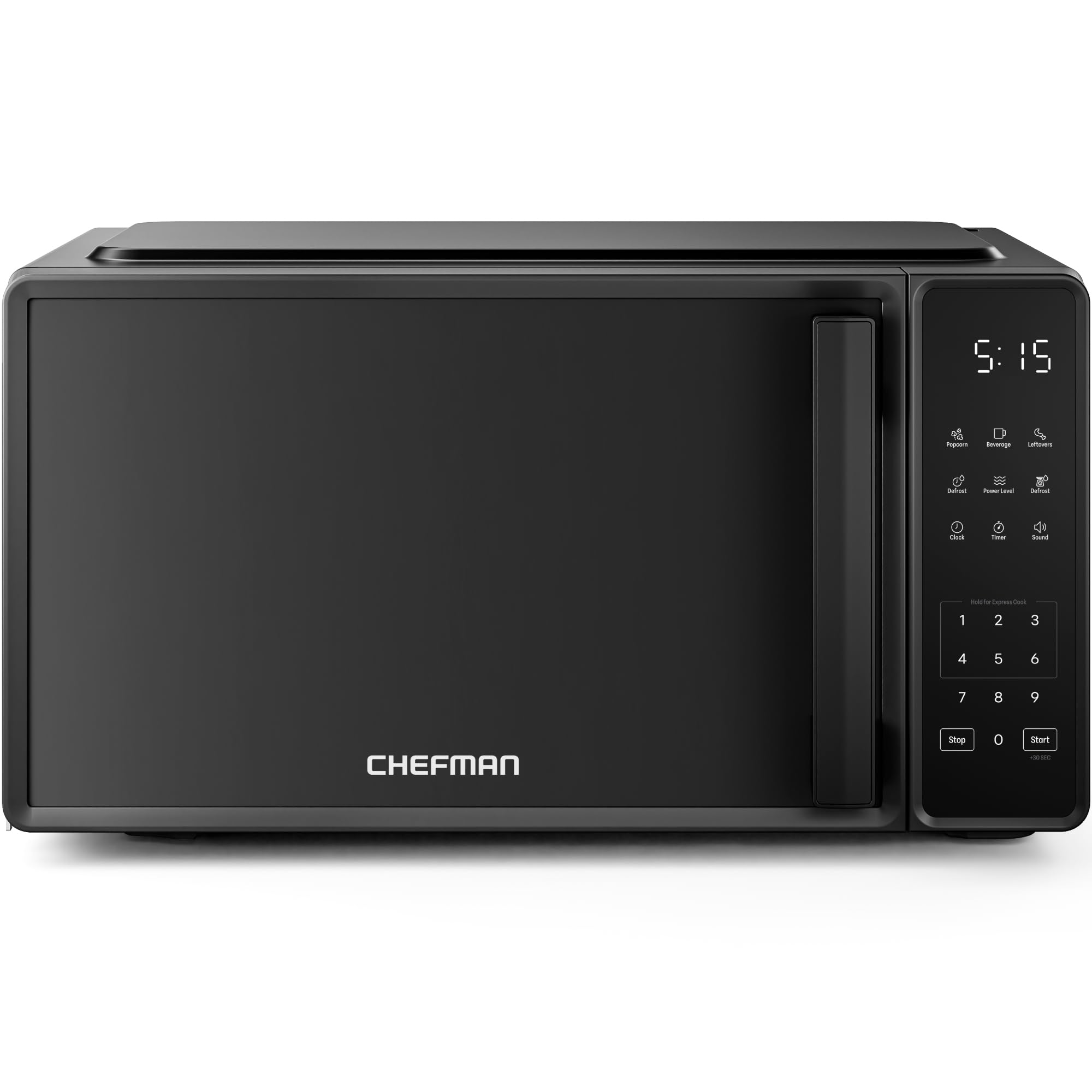
Chefman 0.7 Cu. Ft.

88 /100
LBD Score Excellent

Key details

Power
700 watts
Presets
6 cooking
Capacity
0.7 cu ft
Dimensions
12.93"D x 17.52"W x 9.53"H
View on Amazon

A child lock on the door handle and a mute button are the two details that separate this Chefman from the other 0.7-cubic-foot compacts. The lock is a physical latch on the handle, so it is easy to see whether it is engaged; the mute button kills the beeps, which is a small mercy in a kitchen where someone is still asleep. The 0.7-cubic-foot capacity and 700 watts are familiar territory: fine for a mug, a bowl of oatmeal, or a plate of leftovers, but not a match for the 1000- and 1200-watt models on dense food. We liked the low 9.53-inch height, which slides under a shelf or cabinet lip where taller compacts won't.

The trade-off is the usual compact compromise: the cavity is tight, and a full dinner plate can be a squeeze. Heating is also mixed enough that we stir or rotate food rather than trust a single preset. The one-touch express cook is handy for a quick reheat, and the ten power levels give you more control than the price tier suggests. It is a good fit for a dorm, a break room, or a guest suite where the door lock and quiet mode matter more than speed. If you need one microwave for a family, the larger Toshiba is the safer buy.

Pros

  • Physical child lock on the handle
  • Mute button silences beeps
  • Low 9.53-inch height fits under shelves
  • One-touch express cook and 10 power levels

Cons

  • Durability is the weak spot
Our verdict

This is the compact to choose when a physical child lock and muted beeps matter: the 0.7-cubic-foot Chefman is easy to tuck under a shelf and simple to run.

Check Latest Price

How We Tested Countertop Microwaves

We started by narrowing the field to countertop models that would fit a standard kitchen counter, then sorted by capacity, wattage, control type, footprint, and price. We ruled out oversized units that blocked cabinet doors and tiny models that couldn't handle a dinner plate. The final shortlist was 12 microwaves, and testing ran for eight months—not just a week of reheating coffee.

Each unit went on a real kitchen counter, and we measured the exterior footprint, door swing, and clearance under the cabinets before cooking anything. In daily use we reheated leftovers in shallow bowls, heated two cups of water in a marked glass and checked the center and edges with an instant-read thermometer, defrosted a pound of frozen ground beef, and popped popcorn. We noted cold spots, scorched edges, unpopped kernels, and whether the sensor or preset cycles did what the manual promised.

We also paid attention to the parts you touch and hear: door latches after repeated openings, turntable wobble, control-panel legibility, fan noise from the next room, and the volume of end beeps. Where a model offered a mute or sound-off setting, we toggled it and checked whether the beep still carried. Child locks got a one-handed test, and we wiped spills from the interior to see whether the finish stained or scratched.

By the end, we compared notes on build quality, reliability, and value: did the door still close cleanly, did the finish show fingerprints, and did the price feel fair for the capacity and performance? We kept using the strongest performers for morning oatmeal, lunch leftovers, and late-night popcorn, and that everyday grind is what separated the reliable models from the merely good-looking ones.

How to Choose a Countertop Microwave

Start with the plate, then the counter

Capacity is about the plate, not the number on the box. A 0.7-cubic-foot model is fine for mugs, oatmeal, and small bowls, but a full dinner plate is tight. Step to 0.9 to 1.1 cubic feet for regular plates, and 1.6 cubic feet if you routinely heat two dinners or a 13-inch pizza. Then measure the counter. Cubic feet describes the inside; the outside can be much wider. The Toshiba 1.6 has a family-size cavity and a 21.8-inch-wide body, so it needs a genuinely large counter. Leave room for the door to swing, too.

Decide how much power you need

700 watts is the minimum for reheating, not a recipe for speed. If you mostly warm coffee or a bowl of soup, a 700-watt compact like the COMFEE' or Chefman can be enough. For nightly leftovers, 900 to 1000 watts is a better baseline, and 1200 watts is the step up for large portions and frozen food. Wattage is only part of evenness: a flatbed inverter like the Toshiba spreads heat without a turntable, while a turntable model relies on the plate turning. Buy the most power you can fit and afford if the microwave will be your main oven; save 700 watts for a secondary setup.

Choose a door and control panel you can live with

Door design matters more than the spec sheet suggests. A handle door, like the Farberware's, is easier to pull when your hands are full and is friendlier for weaker grips. Push-button releases can be stiff and are the kind of mechanism that gets worse with age. On controls, one-touch start and a +30-second key are the features you use daily; sensor menus are worth paying for if you reheat without measuring. A mute function is useful in an office or a small apartment. Try the door and keypad before you commit if you can, and check that the display is readable from standing height.

Turntable or flatbed?

A turntable moves food through the microwave's hot spots, and a 12- to 13.6-inch plate is roomy enough for dinner plates and pizza. A flatbed uses a stationary antenna instead, so there is no ring or glass plate to clean around, and rectangular dishes fit more naturally. We prefer the flatbed for everyday cleanup, especially if you reheat saucy food. The trade-off is usually price and a more complex interior. Neither design guarantees even heating; power, sensor programming, and how you arrange the food still matter.

Plan for noise and longevity

Countertop microwaves are not quiet appliances, and the spread within this group is wide. A unit that rattles or buzzes loudly is worth returning during the trial window. Longevity is the harder promise: compact models in particular have a rough record, and a one-year warranty is common. Keep the receipt, register the product, and avoid blocking the vents. If the microwave is going into a rental, a dorm, or an office, buy for the replacement cost you can accept rather than the longest feature list.

Frequently Asked Questions

Final Verdict

Our top recommendation is the Toshiba flatbed. It is the one we recommend for a main kitchen because the 1200-watt inverter heats evenly and the flatbed takes the annoyance out of cleaning. If you routinely cook for a family, the 1.6-cubic-foot Toshiba is the better fit; if you want a handle door and a smaller footprint, the Farberware is the more comfortable everyday choice. The compact 700-watt models are best kept for dorms, offices, or backup duty.