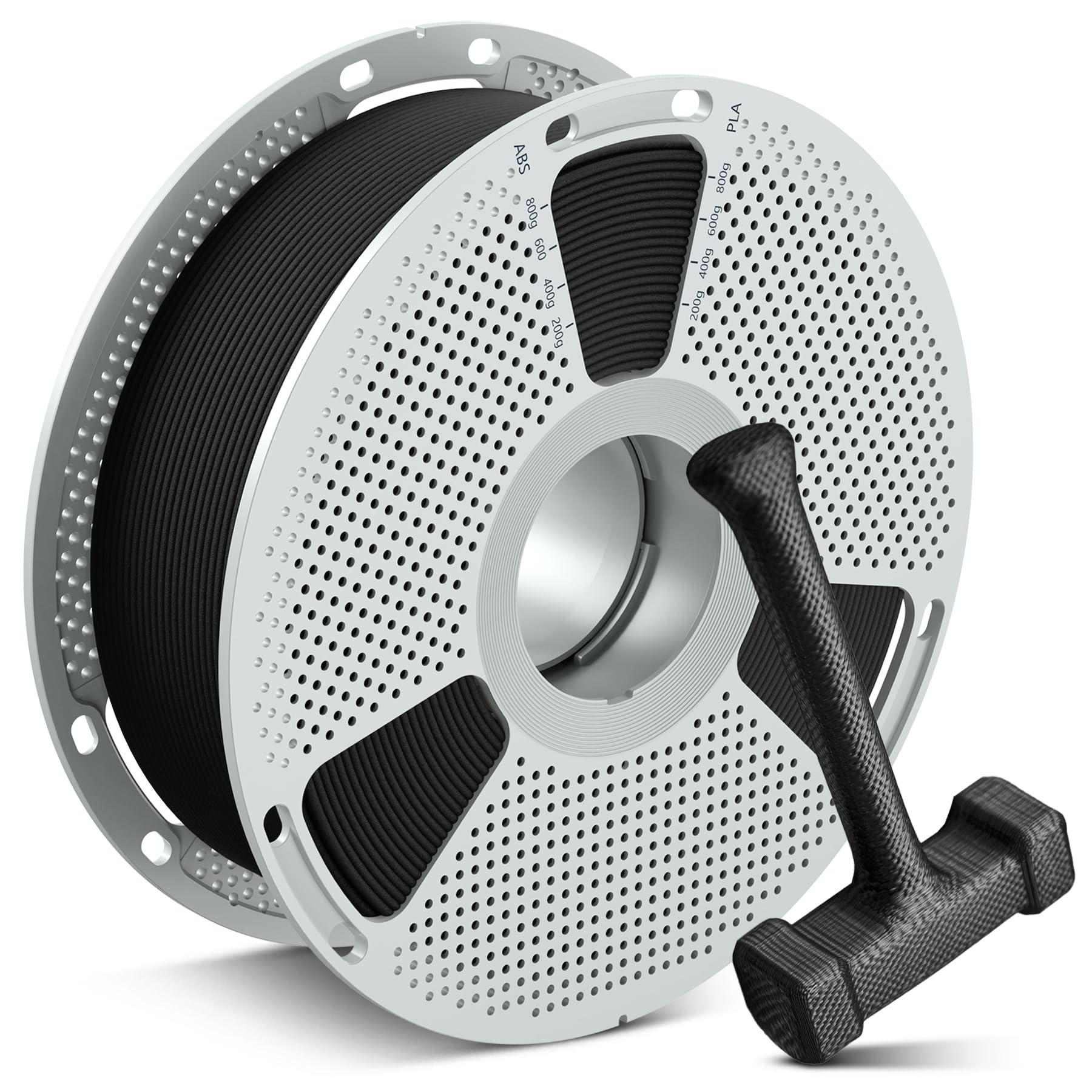
Best Carbon Fiber Filament of 2026

Carbon fiber filament doesn't make a print stronger so much as stiffer, and that difference matters more than anything printed on the label. A plain PLA bracket bends before it breaks; the same bracket with chopped fiber holds its shape right up until it cracks. That trade is why I keep a spool loaded for jigs, brackets, and parts that end up sitting in a hot car.

My team put 14 spools through four months of ordinary printing — nylon, PETG, and PET blends, with fiber loads from 10 to 20 percent — and the spread was wider than I expected. Some printed clean from the very first layer; others clogged a nozzle inside an hour or snapped at the spool rim before the filament ever reached the hotend.

Two things first-time buyers usually learn the hard way: the fiber is abrasive enough to chew through a brass nozzle, so a hardened one isn't optional, and a loosely wound spool will tangle mid-print no matter how good the plastic is. The picks below are the ones that held up — stiff, dimensionally honest, and predictable enough to leave running overnight.

1

Best Overall

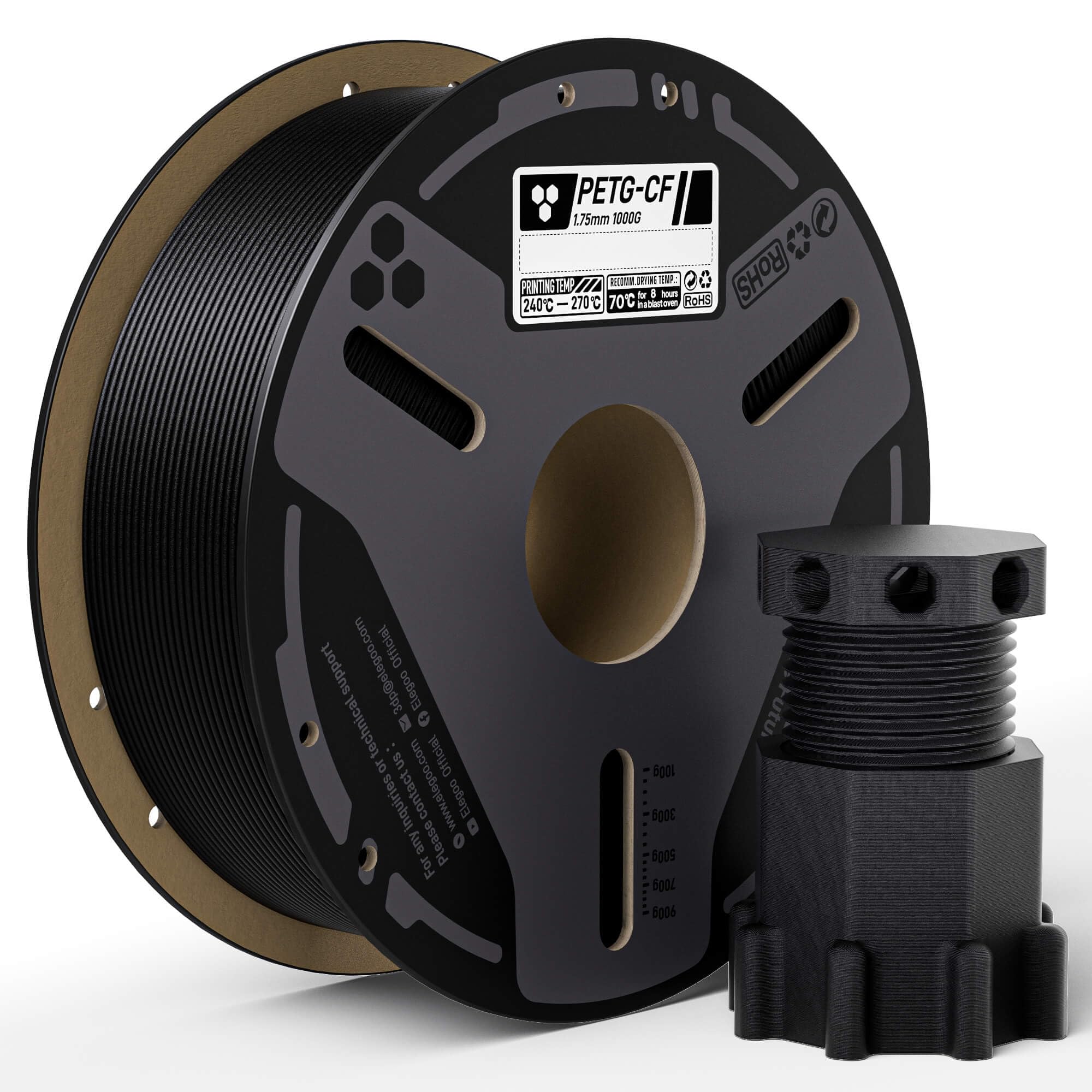
ELEGOO PETG-CF

93 /100
LBD Score Outstanding

Key details

Nozzle
Hardened steel, 0.4 mm or larger
Diameter
1.75 mm
Material
PETG with carbon fiber
Spool Weight
2.2 lb
View on Amazon

A full kilo of carbon-fiber PETG that behaves itself on an ordinary desktop printer is why this spool sits at the top of our list. The fiber does the job you're paying for: a printed bracket comes off the bed noticeably stiffer than the same part in plain PETG, and the fine matte texture breaks up layer lines until the surface reads closer to cast than extruded. ELEGOO also builds in abrasion resistance, which is what makes it a sensible choice for gears, jigs, and anything that rubs against something else.

What settled it for us was how little the prints asked of us. Beyond fitting a hardened steel nozzle at 0.4 mm or larger — carbon fiber is abrasive, and a brass nozzle will open up — we changed nothing about our PETG profiles, and the parts came out dimensionally true enough that a printed spacer dropped into place without reaming. Dry the spool first. Every carbon-filled filament we handled printed better after a session in a dryer, and this one is no exception.

One thing to plan for: small footprints want a brim. A wide, flat part sticks fine, but fiddly parts with a narrow base are where bed adhesion gets interesting on a textured plate. The rest of the spool behaved, including the last few meters, which is more than we can say for some carbon blends.

Pros

  • Stiff, matte parts on a normal PETG profile
  • A full kilogram rather than a half
  • Lowest cost per spool among the 1 kg picks
  • Abrasion resistance suits gears and wear parts

Cons

  • Carbon fiber percentage isn't published
Our verdict

Our default pick: a full kilo of carbon-fiber PETG that prints clean on a hardened nozzle and gives you stiff, matte parts for less per spool than any other kilo here.
Check Latest Price
2

Best for High Heat

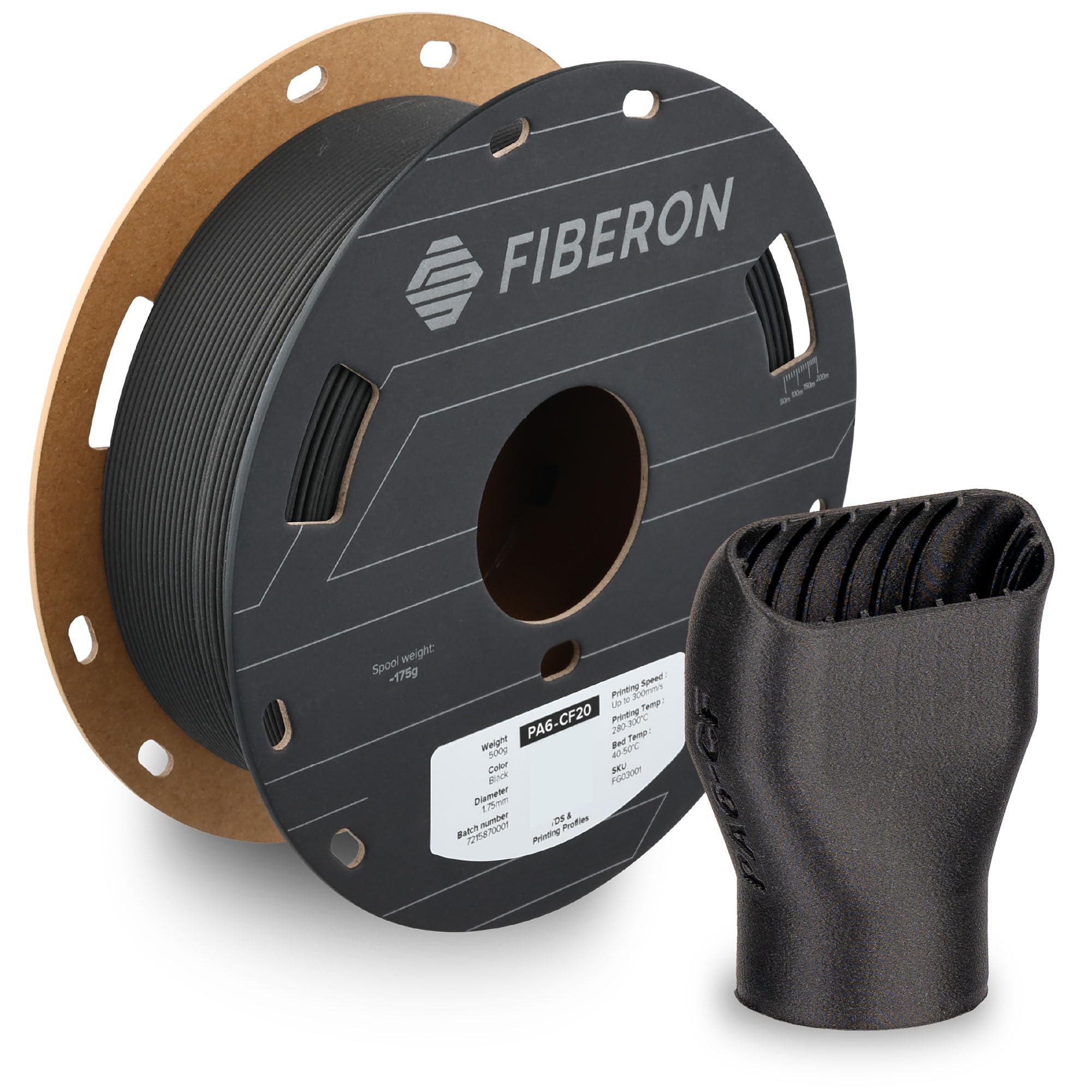
Polymaker Fiberon PA6-CF20

90 /100
LBD Score Outstanding

Key details

Material
PA6 nylon with 20% carbon fiber
Spool Weight
1.1 lb
Heat Deflection
215 °C after annealing
Nozzle Temperature
280–300 °C
View on Amazon

Two hundred and fifteen degrees Celsius is the number that matters here. That's the heat deflection temperature Polymaker quotes for PA6-CF20 once a part has been annealed, and it's what separates this spool from every PETG-CF on the page: a part that keeps its shape near a hot end or a motor instead of softening into whatever the mounting bolts allow. Twenty percent carbon fiber in a nylon 6 base backs it up, with a published 109.3 MPa tensile strength and an 8.64 GPa modulus.

Getting there takes a real setup. The nozzle runs 280–300 °C through an all-metal hotend, the bed stays at 40–50 °C, and the part cooling fan stays off. No heated chamber is required, which we appreciate — it puts the material within reach of an ordinary enclosed printer. What it does demand is dryness: ten hours at 100 °C before printing, then storage and printing below 20% relative humidity. We treat the dry box as part of the printer for this spool, and the prints reward it.

Where it lands for us: this is the best high-heat performer in the set, and the spool we keep for parts that genuinely need it rather than for brackets a PETG-CF would handle. One handling note — the filament can arrive brittle enough to snap if your feed path makes a hard turn, so check the first meter and keep the run from spool to extruder gentle.

Pros

  • Holds shape to 215 °C after annealing
  • 20% carbon fiber in a nylon 6 base
  • No heated chamber required
  • Highest published stiffness in this set

Cons

  • Costs the most per finished part here
  • Half-kilo spool limits large parts
Our verdict

We reach for this when a part has to survive real heat: 20% carbon in nylon 6, and 215 °C of shape retention once it's annealed.

Check Latest Price
3

Best for Rigid Tooling

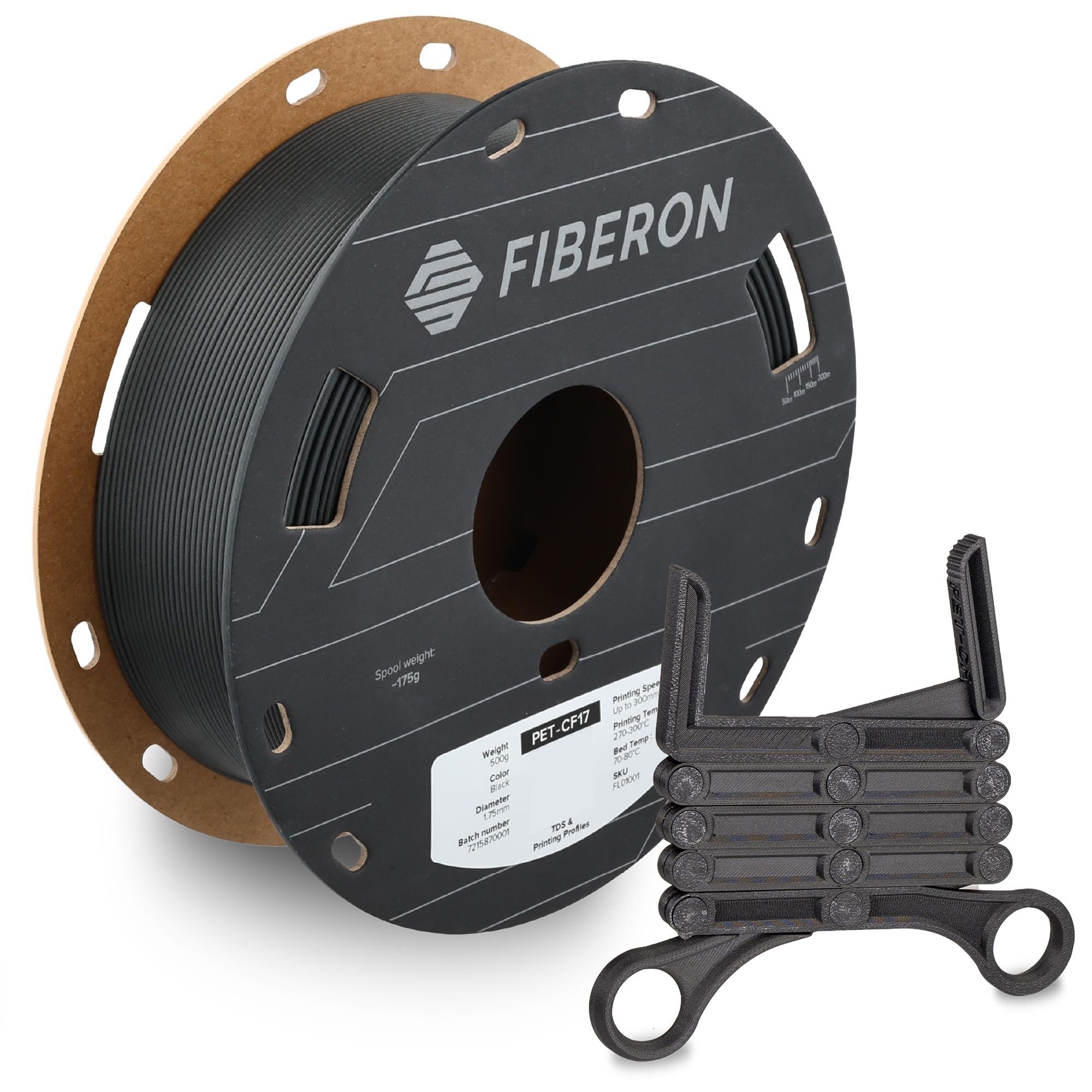
Polymaker Fiberon PET-CF17

90 /100
LBD Score Outstanding

Key details

Material
PET with 17% carbon fiber
Spool Weight
1.1 lb
Heat Deflection
147.5 °C after annealing
Nozzle Temperature
270–300 °C
View on Amazon

No heated chamber, no nylon-level moisture anxiety, and 147.5 °C of heat deflection once annealed — that combination makes this the sleeper of the group, and the spool we hand to anyone printing jigs, fixtures, and tooling that has to stay flat and stiff. Seventeen percent carbon fiber in a PET base supplies the rigidity Polymaker built it for; the load-bearing version of the heat claim is 105 °C at 1.8 MPa.

Printing is straightforward for an engineering material. The nozzle wants 270–300 °C, the bed 70–80 °C, the fan off, and an all-metal hotend with a hardened nozzle. Moisture handling is easier than the nylons: PET-CF17 is less sensitive to ambient humidity, so a sealed box with desiccant covers storage and a dryer session rescues a spool that's been open a while. The 120 °C anneal is what unlocks the heat figure, so design the fit around a part that goes through a second thermal cycle.

The rigid filament is the one thing to manage. It snaps rather than bends if the path from spool to extruder makes a sharp turn or doubles back on itself, so a direct run and a holder that turns freely matter more here than with PETG. Get that right and the payoff is a flat, matte, industrial-looking part that never needed an enclosure to print.

Pros

  • 147.5 °C heat deflection after annealing
  • Stiff enough for jigs and tooling
  • Less moisture-sensitive than nylon grades
  • Prints without a heated chamber

Cons

  • Annealing adds a ten-hour step per part
Our verdict

For jigs, fixtures, and parts that see heat but not impact, this is the spool we hand over first: stiff, annealed to 147.5 °C, and no chamber required.

Check Latest Price
4

Best for Maximum Stiffness

IEMAI PETG-CF

89 /100
LBD Score Excellent

Key details

Finish
Matte black
Material
PETG with 20% chopped carbon fiber
Spool Weight
2.2 lb
Diameter Tolerance
±0.03 mm
View on Amazon

Twenty percent chopped carbon fiber is a number most filament listings quietly leave out; IEMAI puts it on the label. That load is why the parts feel the way they do — rigid in the hand, with a matte black surface that swallows layer lines and reads closer to a molded component than an extrusion. For brackets, housings, and jigs that need stiffness more than heat resistance, the fiber is doing visible work.

The printing side is undemanding for a filled material. A 0.4 mm hardened nozzle, a dry spool, and a normal PETG-range profile produced clean extrusions, and the stated ±0.03 mm diameter tolerance kept flow steady enough that we didn't spend an evening chasing extrusion multipliers. Bed adhesion held on a textured plate for parts with a reasonable footprint.

Consistency between spools is what we watch. The roll we printed from was good, though these spools can arrive wound loosely enough that ten minutes with a rewinder before a long job is worth the effort. Set against the published fiber load and the full-kilo spool, that's a small tax, and it's why this one stays near the front of the group for anyone whose parts need stiffness at low cost.

Pros

  • Published 20% chopped carbon fiber load
  • ±0.03 mm stated diameter tolerance
  • Matte surface minimizes visible layer lines
  • Full kilo rather than a half

Cons

  • Layer bonding can let go under load
Our verdict

The PETG-CF pick when stiffness is the point: a published 20% carbon load, ±0.03 mm tolerance, and a full kilo on the shelf.

Check Latest Price
5

Best for High-Volume Printing

FlashForge PETG-CF

92 /100
LBD Score Outstanding

Key details

Material
PETG with carbon fiber
Spool Weight
2.2 lb
Diameter Tolerance
±0.02 mm
View on Amazon

Same material class as our top pick, a tighter stated tolerance, and a higher price per kilo — that's the trade FlashForge is asking you to make. The ±0.02 mm diameter figure is the best published tolerance in this group, and the spool is dried for 24 hours before it's bagged, which is the kind of detail that shows up as fewer bubbles in a tall print.

The prints themselves came out clean and the finish is genuinely handsome: a deep black with fine light flecks that catch a desk lamp rather than glitter. Generic CF PETG profiles worked without much coaxing on our machines. Where it loses ground to the ELEGOO is in what the extra money buys — a tolerance number and a drying promise, not a better-looking or stronger part. If you print a lot of tall, thin-walled parts where diameter drift shows up as banding, that tolerance earns its keep; for everything else the cheaper spool does the same job.

Retraction is the setting to spend time on. This blend strings more than unfilled PETG until you dial it in, and a little more travel speed cleans up the wisps. Do that and the parts are as crisp as anything here.

Pros

  • Tightest published diameter tolerance here
  • Prints clean on generic CF PETG profiles
  • Matte black finish with subtle light flecks
  • Full kilo spool for long print runs

Cons

  • Winding varies from spool to spool
Our verdict

A clean-printing carbon PETG with the tightest published tolerance here and a genuinely handsome flecked finish; the higher price per kilo is the trade.

Check Latest Price
6

Best Budget Nylon CF

SUNLU PA6-CF20

84 /100
LBD Score Excellent

Key details

Material
PA6 with 20% carbon fiber
Spool Weight
2.2 lb
Heat Resistance
209 °C
Nozzle Temperature
270–290 °C
View on Amazon

A full kilogram of 20% carbon PA6 for roughly what the premium nylons here charge for half of it is the pitch, and it holds up. This is the only spool in the group that lets you print genuine nylon carbon parts by the kilo, which changes what you're willing to put on the plate: brackets, housings, and replacement latches that would feel too expensive to attempt on a half-kilo roll.

The material asks for a proper setup. Nozzle 270–290 °C, bed 50–70 °C, 50–150 mm/s, an all-metal hotend, and a hardened nozzle. Annealing at 80–130 °C for five to twelve hours is what develops the 209 °C heat resistance, so the oven step is part of the process rather than an optional extra. Drying isn't negotiable either — this is nylon, and a spool that's been open for a week prints like a different material.

When it was dry and hot enough, the parts came out strong, matte, and dimensionally correct, with the flat industrial look that carbon fill gives you. The filament itself is brittle, though, so a feed path with a sharp bend can snap a strand mid-print, and a spool that arrives wound loosely will jam if you pull it fast.

Our read: this is the value pick of the group, and the value only lands if you commit to the process — dry spool, hard anneal, gentle feed path. Do that and you get PA6-CF parts at a price that makes big prints feel reasonable. Skip the drying and you'll blame the filament for something the filament didn't do.

Pros

  • Full kilo of 20% carbon PA6
  • 209 °C heat resistance after annealing
  • Lowest per-kilo cost of the nylon grades here
  • Matte finish with minimal shine

Cons

  • Not compatible with AMS or multi-color systems
Our verdict

The value pick: a full kilo of 20% carbon PA6 that takes real heat once annealed, at a fraction of the premium nylons' price per kilo.

Check Latest Price
7

Beginner CF Prints

SUNLU PETG-CF

82 /100
LBD Score Excellent

Key details

Material
PETG with 10% carbon fiber
Spool Weight
2.2 lb
Heat Distortion
70 °C
Nozzle Temperature
240–250 °C
View on Amazon

Ten percent carbon fiber is enough to change how a part feels and not enough to change what it's for. SUNLU's PETG-CF comes out stiffer and flatter than plain PETG, with the matte, close-to-molded surface that carbon fill gives you, and it still behaves like PETG on the bed: 240–250 °C, a 50–70 °C plate, no enclosure. We think of it as the entry point to the category — the look and a real bump in rigidity without engineering-nylon money.

The ceiling is where to be honest with yourself. Heat distortion tops out at 70 °C, the lowest figure in this group, so a part that lives in a car or near a heated bed will soften where PET-CF and the nylons wouldn't. Ten percent is also the lightest fiber load here, half of what the SUNLU PA6-CF20 carries, and that shows up as less stiffness in thin sections.

Where it earns its place is the ordinary stuff: brackets, cable clips, drawer pulls, replacement knobs — parts that used to be plain PETG and could stand to be a little stiffer and a lot better looking. Run it through a hardened nozzle, dry it like any filled spool, and it behaves. The full kilo also means you can treat it as a working filament rather than a special-occasion one.

Pros

  • Runs at ordinary PETG temperatures
  • Matte textured surface refines the finish
  • Full kilo of PETG-CF at a low price

Cons

  • Lowest heat distortion here at 70 °C
  • Lightest carbon load in the group
Our verdict

A good first carbon-fiber spool: stiffer than plain PETG, better looking, and cheap enough to print freely, as long as the part never gets hot.

Check Latest Price

How We Tested Carbon Fiber Filament

We started with about 40 spools on paper and cut the list down by base polymer, fiber load, and what each filament demanded of the printer — anything that needed a heated chamber or a special hotend just to finish a test print got set aside. Price stayed in the spreadsheet as one column among several, not as the deciding factor.

The 14 that made the cut ran for four months on two printers in my garage, mostly in the evenings and overnight, when a failed print costs a whole morning. Every spool got the same treatment: caliper readings at several points across the wind, a few meters unspooled by hand to check for crossovers and flat spots, and a standard test print on a 0.4mm hardened nozzle. I logged each clog, each first-layer redo, and how the nylons behaved after a week sitting out in open air.

Layer adhesion came down to breaking printed bars in a vise and seeing where the fracture landed — along the layer lines or straight through them. Brittleness got a cruder test: bend a thin strip until it snaps, then drop a finished bracket on the garage floor. Heat resistance we judged on a car dashboard in July, and appearance on surface finish, matte versus gloss, and whether a second spool of the same black matched the first.

For value, we counted usable parts per spool rather than the sticker price — failed prints, jams, and the brittle tail end of a spool all counted against it.

How to Choose Carbon Fiber Filament

Start With the Base Polymer, Not the Fiber

Carbon fiber raises stiffness. It doesn't make a part tough, and it doesn't stop PLA-CF from behaving like PLA at 60 °C. Choose by the job instead: PLA-CF for easy, accurate, good-looking parts that live indoors; PETG-CF for impact resistance and a middle-range heat ceiling; PET-CF and PA6-CF for tooling, fixtures, and anything near a heat source.

The trap is reading "carbon fiber" as one material. A PLA-CF bracket and a PA6-CF bracket look similar and behave nothing alike under load or heat, and the price gap between them reflects the base polymer far more than the fiber.

Know What the Heat Numbers Assume

Heat deflection temperatures for these materials are usually quoted after annealing, and that step isn't optional. Polymaker's PA6-CF20 reaches 215 °C only after a ten-hour anneal at 100 °C, PET-CF17 reaches 147.5 °C after ten hours at 120 °C, and SUNLU's PA6-CF20 wants 80–130 °C for five to twelve hours to develop its 209 °C figure.

Plan for that cycle in the part's dimensions and in your week. Printing a part and skipping the anneal gives you a softer, less heat-resistant component than the spec sheet describes, and the difference can show up as a fit that no longer works.

Check Your Hotend and Nozzle First

Carbon fiber is abrasive, so a hardened steel or ruby nozzle is the entry ticket, at 0.4 mm or larger because a finer orifice clogs. The engineering grades also want an all-metal hotend rated for 280–300 °C, and nylon and PET-CF both want the part cooling fan off.

A heated chamber isn't required for the PET and PA6-CF spools here, which is why they're usable on ordinary enclosed printers. If you aren't sure your hotend is all-metal, check before you order rather than after — a PTFE-lined hotend at 280 °C is not an experiment worth running.

Budget for Drying, Not Just the Spool

Nylon is hygroscopic and PA6 is the thirstiest of the group: dry it at 100 °C for ten hours, then store and print below 20% relative humidity. PET-CF17 is less sensitive to ambient moisture but still wants a sealed box with desiccant behind it.

Even PETG-CF prints noticeably better after a session in a dryer. A dryer belongs in the cost of owning carbon filament rather than in the accessories list, and it's usually the difference between a spool that prints and a spool that strings.

Spool Size and Cost per Part

Engineering grades often arrive in half-kilo spools while PETG-CF comes in full kilos, so the number on the label isn't the number you print with. Compare cost per kilogram, then divide by what your part actually weighs in the slicer.

A kilo of PETG-CF and a half-kilo of PA6-CF both feel like "one spool" at checkout and behave very differently by the third large print. If the part is big or the design is still changing, buy the larger spool of the cheaper material and save the engineering grade for the final version.

Frequently Asked Questions

Final Verdict

If you want one spool to learn carbon fiber on, it's the ELEGOO PETG-CF: a full kilo, clean prints, and a stiff matte part at the end of it. Move up to Polymaker's PA6-CF20 only when a part has to hold its shape at real heat, and to PET-CF17 when you're making tooling and want the stiffness without a nylon's drying routine.

The SUNLU PA6-CF20 is the one to beat on material per dollar, provided your hotend reaches 270 °C and you have an oven free for the anneal.