Best Boat Stereos of 2026

A day on the water has a soundtrack, and the quickest way to lose it is a stereo that quits the first time spray comes over the bow. I've heard plenty of systems that sounded great tied to the dock and fell apart by the second mile: buttons that stopped answering, Bluetooth that dropped the moment someone walked back to the cooler, volume that vanished under engine noise.

Over seven months I ran 12 marine stereos through real boat days — a small center console, a pontoon full of kids, a runabout that gets hosed off after every trip. The first thing I listened for was whether I could still hear the vocal line at cruise with the engine wound up, which is something the wattage printed on a box never tells you.

What new buyers miss is that a car head unit will slide right into a boat dash and still be dead by August; salt air eats circuit boards and spray finds the seams around buttons. These also sit in plain view at the helm, so looks count for more than you'd expect. Below are the ones worth cutting a hole for.

1

Best Overall

BOSS MGR450B

90 /100
LBD Score Outstanding

Key details

Power
240 watts, 4 channels
Tuner
AM/FM with NOAA weather band
Form Factor
Gauge-style
Water Resistance
IPX6
View on Amazon

A boat helm is a bad place for a car radio: sun bakes the display, spray finds every seam, and the radio has to compete with an outboard. The BOSS MGR450B earns our top spot because it is built around that reality. It drops into a gauge-style cutout, carries an IPX6 rating, and packs a 240-watt, four-channel amplifier with AM/FM and NOAA weather band. We also like that it has no CD mechanism to seize up in a damp console.

Power is the part that matters once you are underway. BOSS rates the MGR450B at 240 watts total, or 60 watts across four channels, which is enough to drive a set of 6.5-inch speakers without a separate amp. The front, rear, and subwoofer preamp outputs give you room to add an amplifier later, and the USB and auxiliary inputs cover phones and music players. We paid attention to the tuner, too: NOAA weather band is a genuinely useful safety feature on a boat, not a checkbox.

The gauge layout is the other reason it tops our list. It fits the round cutout many boats already have for a gauge or an older radio, and the front panel is UV-coated with a conformal-coated circuit board. We wish the display had the same high-contrast treatment as the Kenwood, but the controls are simple enough to work with a hand on the wheel. The compact chassis also leaves more room behind the dash for wiring.

Pros

  • IPX6-rated against spray and splashes
  • 240 watts across four channels
  • NOAA weather band built in
  • Fits a gauge-style helm cutout

Cons

  • Gauge-style cutout only
  • No speakers included
Our verdict

We recommend the BOSS MGR450B as the default boat receiver: it fits a gauge-style helm, carries an IPX6 rating, and delivers 240 watts with NOAA weather band.

Check Latest Price
2

Best Complete Kit

BOSS MCKGB450B.6

86 /100
LBD Score Excellent

Key details

Power
240 watts, 4 channels
Tuner
AM/FM with NOAA weather band
Form Factor
Gauge receiver plus two 6.5-inch speakers
Water Resistance
IPX6 receiver
View on Amazon

A receiver alone does not help if the speakers are sun-bleached and crackling. The MCKGB450B.6 solves that in one box: a gauge-style BOSS receiver rated IPX6, plus a pair of 6.5-inch dual-cone speakers. It covers the whole signal chain without asking you to match a head unit to separate speakers, which is why it suits a small center console or a UTV.

The receiver is a 240-watt, four-channel unit with Bluetooth, USB, AM/FM, NOAA weather band, and front/rear/subwoofer outputs. We like that it can run four speakers without an amp and still leave room for a small subwoofer later. The included 6.5-inch speakers are dual-cone, 4-ohm units with a frequency response down to 80 Hz; they are fine for radio, vocals, and casual streaming, but they will not deliver much low-end. If bass matters, plan on the subwoofer output and a separate sub rather than expecting it from the kit.

Installation is straightforward if you already have a gauge cutout and speaker locations, but check the mounting hardware before you start; the kit's fasteners are the weak point. The receiver can also shut off unexpectedly, so buy from a seller with a straightforward return policy and keep the warranty card. The payoff is a compact, weather-resistant package that gets a small boat playing again without a second shopping trip.

Pros

  • Receiver and two 6.5-inch speakers included
  • IPX6 receiver with NOAA weather band
  • 240 watts and subwoofer output
  • Simple gauge-style installation

Cons

  • Dual-cone speakers are light on bass
Our verdict

If you need speakers too, the BOSS MCKGB450B.6 bundles a 240-watt gauge receiver with two 6.5-inch marine speakers, making it the simplest one-box upgrade for a small boat or UTV.

Check Latest Price
3

Best for Sunlight Readability

Kenwood KMR-M332BT

84 /100
LBD Score Excellent

Key details

Power
200 watts, 4 channels
Inputs
Bluetooth, USB, aux, SiriusXM ready
Display
High-contrast black on white
Form Factor
Single-DIN
View on Amazon

The first thing we check on a boat stereo is whether we can read it at noon. The Kenwood KMR-M332BT answers that with black characters on a white background, the opposite of the usual glowing-on-black boat radio. That sounds like a small thing until you are squinting at a preset list with the sun behind you. It is the display, more than any single feature, that makes this the premium single-DIN pick.

The rest of the package is built for a serious small system. Kenwood rates it at 200 watts across four channels, with Bluetooth, a front USB port, an auxiliary input, AM/FM, and SiriusXM readiness. FLAC playback is a nice upgrade if you keep a lossless library on a USB drive, and the 2.5-volt rear/subwoofer preamp outputs give you a clean path to an amplifier. We also appreciate that Kenwood includes an external microphone for hands-free calls rather than burying one in the faceplate.

The front USB and auxiliary inputs are easy to reach when the boat is moving, and the included microphone means hands-free calls are not an afterthought. We also like that the single-DIN chassis is a standard size, so it drops into a rectangular dash opening. If you want satellite radio or a lossless USB library, this is the one we point to.

Pros

  • High-contrast display for direct sun
  • SiriusXM-ready with FLAC playback
  • External microphone included
  • Standard single-DIN fit

Cons

  • Premium price
  • One-year warranty
Our verdict

For a standard single-DIN opening, the Kenwood KMR-M332BT is the premium pick: its high-contrast display stays readable in direct sun, and it adds SiriusXM readiness, FLAC playback, and an external mic.

Check Latest Price
4

Best for Open Helms

Kicker 46KMC2

86 /100
LBD Score Excellent

Key details

Power
200 watts, 4 channels
Inputs
Bluetooth, USB, RCA, AM/FM
Form Factor
Gauge-style
Water Resistance
IPX66
View on Amazon

A row of tiny buttons is miserable with wet fingers. The Kicker 46KMC2 puts the main control on a large rotary encoder and wraps the electronics in an IPX66 gauge housing, the highest water-and-dust rating in this group. That is the combination we want for an open center console or a tiller boat where spray is a given and you do not want to look down at a menu to change the volume.

The Kicker is a media center rather than a full-feature radio: Bluetooth, USB, RCA inputs, and AM/FM, with 200 watts across four channels. We like it for a simple, wet helm because there is less to fiddle with, and the rotary knob is easy to find without looking. The 200 watts are enough for four efficient speakers, and the simple layout keeps the install tidy.

The IPX66 rating is the reason we keep this one on the short list for a boat that lives outside. It means the housing is dust-tight and protected against powerful water jets, not just a light splash. We also appreciate the compact gauge footprint, which leaves room behind the dash for the wiring.

Pros

  • IPX66-rated gauge housing
  • Large rotary knob for wet hands
  • 200 watts across four channels
  • Compact gauge footprint

Cons

  • Premium price
Our verdict

The Kicker 46KMC2 is the one we choose for an open helm: its IPX66 gauge housing and large rotary knob are built for wet hands, and 200 watts is enough for four speakers without a separate amp.

Check Latest Price
5

Standard Single-DIN

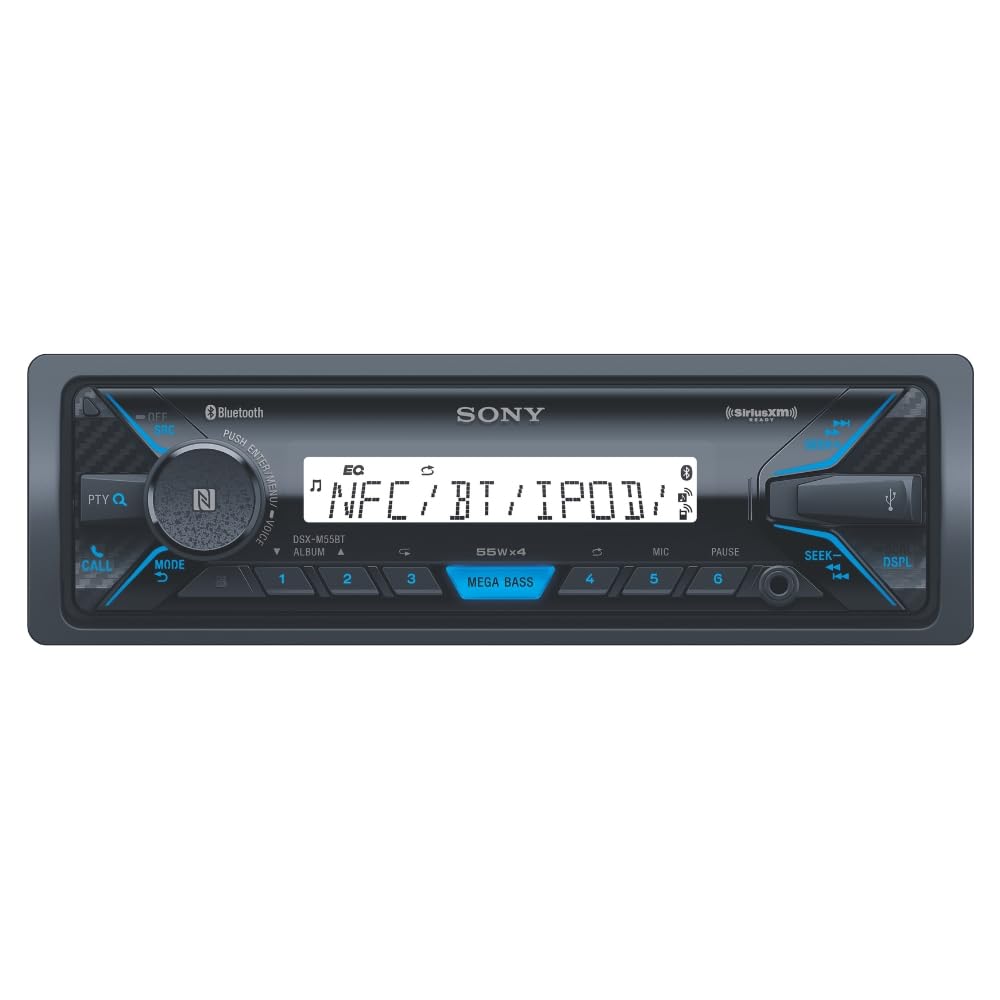
Sony DSXM55BT

84 /100
LBD Score Excellent

Key details

Power
55 watts, 4 channels
Inputs
Bluetooth, NFC, USB, aux, SiriusXM ready
Remote
Wireless remote included
Form Factor
Single-DIN
View on Amazon

A remote is one of those boat-stereo features you do not appreciate until you are anchored off the stern and the volume is wrong. The Sony DSXM55BT includes a wireless remote, and it adds NFC one-touch pairing and SiriusXM readiness in a standard single-DIN chassis. That makes it a useful fit for a boat with a rectangular dash and a crew that passes the remote around.

The Sony includes Bluetooth, NFC, a front USB port, auxiliary input, AM/FM, and SiriusXM readiness, plus Siri control for iOS devices. The wireless remote is the feature we come back to: it lets you adjust volume from the stern without running back to the helm, and it stows out of the way when you are underway. The front inputs are easy to reach, and the single-DIN chassis is a standard size.

The Sony is a receiver rather than a kit, so you will need speakers and wiring. We still recommend it for a small boat with a standard single-DIN opening, especially if you want a remote and use SiriusXM. The NFC pairing is a nice touch when your phone is in a waterproof bag and you do not want to dig it out.

Pros

  • Wireless remote included
  • NFC one-touch pairing
  • SiriusXM-ready single-DIN
  • Siri control for iOS

Cons

  • Modest 55-watt output
Our verdict

The Sony DSXM55BT is a solid single-DIN alternative when you want a wireless remote, NFC pairing, and SiriusXM readiness; it fits a standard radio opening and adds useful phone control.

Check Latest Price

How We Tested These Boat Stereos, Spray and All

We started with roughly 40 listings and narrowed by water-resistance ratings, honestly stated power specs, input types, and cutout size — a round gauge-style receiver and a single-DIN chassis are not interchangeable in an existing dash, and on a small open helm the round one is sometimes the only thing that fits. That left 12 units, installed and run for seven months across a center console, a pontoon, and a trailered runabout.

Every stereo got the same day on the water: a long run at cruise with the engine wound up, listening for whether vocals stayed clear over wind and engine noise rather than trusting the wattage on the box. We hosed each faceplate straight on for five minutes, then pulled the unit and looked for water behind the bezel. Bluetooth got a walk to the bow and up the dock while we counted dropouts, and we paired a second phone mid-song to see how quickly it took over. USB sticks and aux cables went in and out until we knew whether playback resumed where it left off, and the satellite- and weather-ready functions were checked to see whether they actually pulled a signal.

Installs were timed solo into an existing cutout, noting whether the wiring harness reached the battery switch and whether the trim ring covered the old screw holes. We worked the controls with wet, sunscreen-slick fingers and again with gloves, and read each display in direct midday sun. Faceplates spent the season under a mooring cover and in open weather; we watched for fogging, buttons that stiffened up, and presets that survived a battery disconnect. Back at the dock, we judged how each one looked sitting at the helm and whether the money asked matched what it delivered.

How to Choose a Boat Stereo

Start With the Cutout

Measure the opening before you shop. A single-DIN radio uses a rectangular dash opening and a standard chassis, so it drops into many older boat dashes and is easy to replace later. A gauge-style unit fills a round cutout and often suits center consoles and open helms. The BOSS MGR450B and Kicker 46KMC2 are gauge-style; the Kenwood and Sony are single-DIN. If you are replacing a working radio, match its shape rather than assuming you can adapt the hole.

Look Past the Wattage

Peak wattage is the biggest number on the box and the least useful one by itself. A 240-watt rating usually means 60 watts across four channels, which is enough for four efficient 6.5-inch speakers; a 300-watt max rating can still be modest in real use. If you plan to run a subwoofer or a bigger system, choose a receiver with preamp outputs and budget for a separate amplifier. The BOSS MGR450B and MCKGB450B.6 both have subwoofer outputs; the Kicker and Sony are simpler.

Water Resistance and Display

An IP rating tells you what the housing survives, not how long the electronics will last in salt air. IPX6 handles powerful water jets; IPX66 adds dust protection. A sealed front panel and a conformal-coated circuit board matter as much as the rating, and a high-contrast display is what keeps the radio usable in direct sun. The Kenwood's black-on-white screen is the clearest example here; gauge-style units can fog in humid conditions, so look for a sealed front panel and plan a cover if your helm is open.

Tuner and Connectivity

Bluetooth is the default, but the tuner is what separates a boat radio from a car stereo. AM/FM is basic; NOAA weather band adds forecast reception when you are away from cell service, and SiriusXM readiness lets you add satellite radio with a subscription. USB and auxiliary inputs are useful for phones and music files. If you boat offshore or in fast-changing weather, put NOAA near the top of your list; the BOSS MGR450B and MCKGB450B.6 have it, while the Kenwood and Sony prioritize SiriusXM and smartphone control.

Decide Whether You Need Speakers

A receiver replaces only the head unit; a kit adds speakers and sometimes a remote and microphone. If your existing speakers are dry, uncracked, and the right impedance, a receiver is the better buy. If they are sun-bleached or you are starting from scratch, a kit saves a second shopping trip. The BOSS MCKGB450B.6 pairs a gauge receiver with two 6.5-inch speakers; if you need four speakers, budget for a second pair.

Frequently Asked Questions

Final Verdict

We recommend the BOSS MGR450B as the default for a gauge-style helm: IPX6 protection, 240 watts, and NOAA weather band make it the most complete receiver here without a premium price. If your dash takes a standard single-DIN radio, the Kenwood KMR-M332BT is the better buy for sunlight readability and SiriusXM. If you need speakers too, the BOSS MCKGB450B.6 is the simplest one-box upgrade.