Best Bluetooth Digital Pianos of 2026

The spec sheet is the easy part of shopping for a digital piano: 88 keys, Bluetooth, a few hundred voices. What actually decides whether you're still playing six months from now is the keybed under your fingers and whether the thing genuinely fits in the room you've got. A good Bluetooth piano solves two problems at once — practice you can hear without annoying the whole house, and a feel close enough to an acoustic that your technique carries over when you finally sit down at one.

I've played weighted and semi-weighted boards back to back for years, and over the past seven months my team has lived with eight of them, from compact slabs to upright cabinets to a folding model you can carry under one arm. Beginners tend to overrate voice count and underrate what comes in the box; a stand and a three-pedal unit can quietly change the real price of a budget pick.

Everything below connects over Bluetooth, which is presumably why you're here. Not everything below feels like a piano, and that gap is exactly what all those weeks of testing were for.

1

Best Overall

Roland FP-30X

89 /100
LBD Score Excellent

Key details

Keys
88, PHA-4 weighted
Weight
32.7 lb
Bluetooth
MIDI and audio
Included Pedal
Damper foot switch
View on Amazon

Two different Bluetooth jobs matter on a digital piano, and the FP-30X is the one here that does both: it sends MIDI to an app so you can drive a soft synth or a notation program, and it receives audio so a backing track plays through its own speakers. We spent most of our time with it in the second mode, and what kept us at the bench was the keyboard underneath. Roland's PHA-4 action has a textured, ivory-feel surface and a firmness that pushes back the way an acoustic does near the back of the key. That pairing — wireless that works and a keyboard that feels like an instrument — is why it's our top pick.

The SuperNATURAL tone responds to how hard you play rather than just how loud, which is the difference between a piano that feels expressive and one that feels switched on. The speakers matter more than the spec sheet suggests: streamed audio has to come out of something worth listening to, and here it does, so play-along is a real feature rather than a checkbox. Play quietly, though, and you'll hear the action itself, a mechanical thump sitting under the notes. Headphones erase it, and the 1/4-inch jack means a decent studio pair plugs straight in.

The bundled damper is a small switch-style pedal that slides around underfoot. Swapping it is the first upgrade worth making, and Roland makes that easy with a second pedal jack for a proper piano-style unit. Otherwise the package is ready to go: music rest, power supply, and USB to a computer for recording.

What it isn't is furniture. It's a slab, so it needs a stand, and the music rest clips to the back rather than folding out of a cabinet. If the piano has to hold its own in a living room, the Donner DDP-400 answers that better. If it has to feel like a piano every time you sit down, this is the one we keep coming back to.

Pros

  • Sends MIDI and receives audio over Bluetooth
  • PHA-4 action with ivory-feel key surfaces
  • Speakers handle streamed backing tracks
  • Second pedal jack for an upgrade

Cons

  • Heaviest slab here at 32.7 pounds
Our verdict

The most complete Bluetooth piano here: dual wireless, Roland's PHA-4 action, and speakers good enough to make streaming worth using.
Check Latest Price
2

Best for Bluetooth Audio

Yamaha P145BT

88 /100
LBD Score Excellent

Key details

Keys
88, Graded Hammer Compact
Weight
24.5 lb
Bluetooth
Audio streaming
Included Pedal
Sustain foot switch
View on Amazon

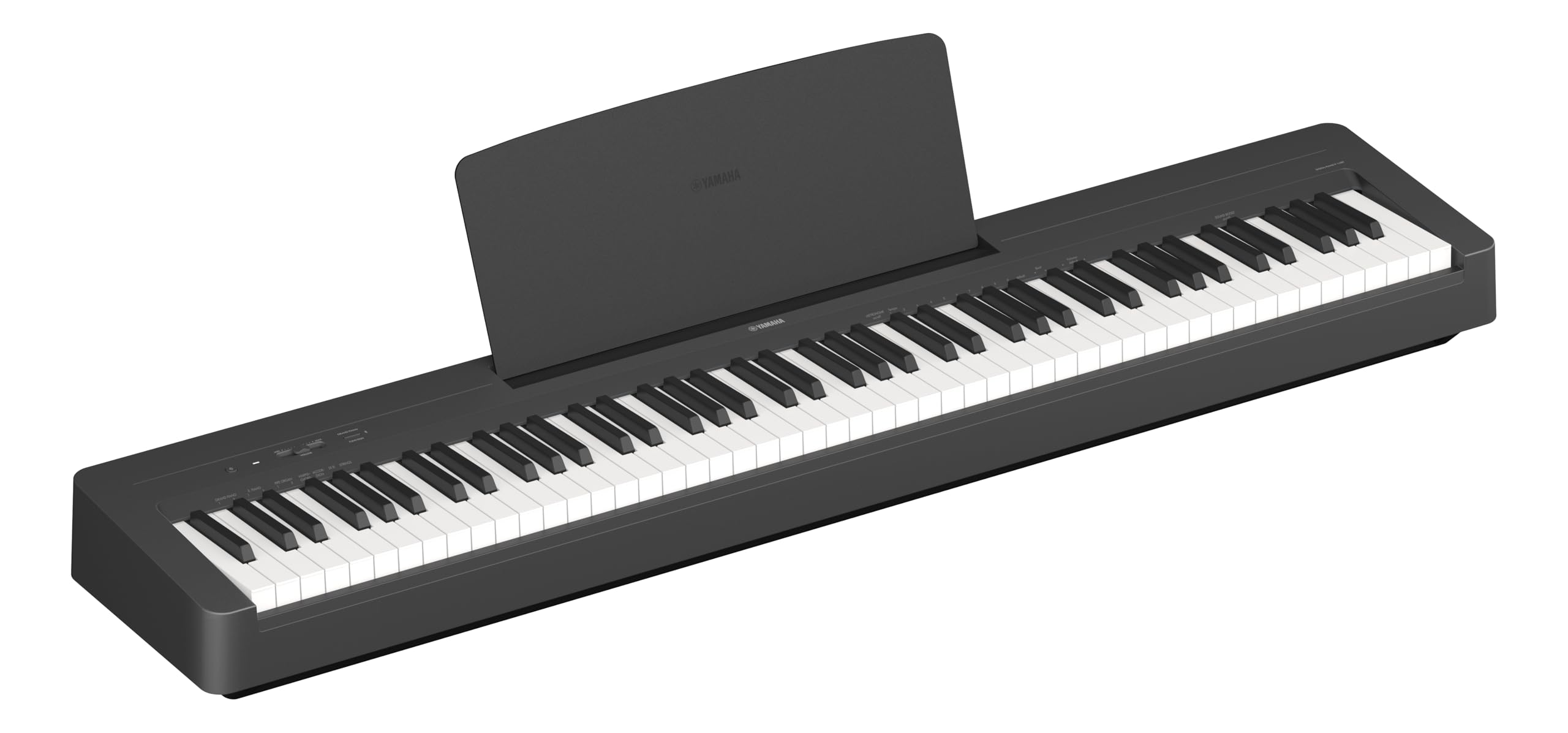
The P145BT is the lighter answer to the same question our top pick answers. It's a full 88-key piano with a graded hammer action and Bluetooth, and at 24.5 pounds it's about eight pounds lighter — light enough that carrying it to a rehearsal stops being a decision. The action is Yamaha's Graded Hammer Compact, a shorter mechanism than you'd find in a cabinet piano, and you feel that most in the bass, where the keys carry more weight than the treble.

Bluetooth is where this one earns its label. It streams audio from a phone through the speakers, so you can pull up a backing track or a lesson video and play along without a cable snaking across the floor. The Smart Pianist app handles the settings that would otherwise mean holding down button combinations, and we think that's the right division of labor on a piano with no screen to speak of. For anyone who mostly plays along with recordings, it's the feature that decides the purchase.

The sound is piano-led, with a grand tone and a piano-and-strings layer if you want it, which suits practice and doesn't pretend to be a workstation. The Roland's action still feels the more substantial of the two, and that's mostly what the extra weight buys. For a small apartment, a player who shifts rooms, or anyone who mainly plays along with recordings, it's the sensible buy.

Pros

  • Lightest full-size slab at 24.5 pounds
  • Bluetooth audio streaming from a phone
  • Graded Hammer Compact weighted keys
  • Smart Pianist app handles deeper settings

Cons

  • Sustain is a foot switch, not a pedal
  • No stand or bench in the box
Our verdict

Pick this one if the piano moves around — it's the lightest full-size slab here and streams audio without a cable.

Check Latest Price
3

Best Upright-Style

Donner DDP-400

87 /100
LBD Score Excellent

Key details

Keys
88, progressive weighted hammer
Polyphony
128 notes
Connectivity
Bluetooth and USB
Amplification
15 W × 2
View on Amazon

The DDP-400 is for the person who wants a piano in the room, not a slab against the wall. It arrives as a brown cabinet with curved legs and a music rest built into the lid, and it's the more polished of the two cabinet pianos here. That matters more than it sounds. A piano you can see from the sofa gets played; one that lives in a case doesn't.

Donner builds the amplifier into an extended cabinet, which is an acoustic decision rather than a styling one — more enclosure gives the low end somewhere to develop, and 15 watts per side with 128-note polyphony means two-handed chords don't collapse into mush. The 138 tones, 100 rhythms, and 100 etudes go further than most players need, and the LCD is the detail we appreciated most, since a feature list that long is useless if you can't find your way around it.

Assembly is straightforward — plan on a second pair of hands for the cabinet stage and you'll be playing the same afternoon. Bluetooth and USB both handle apps and recording. A key can fall silent over time, though, so play every note in the first week and register the one-year warranty while it's fresh. That caveat is why the Roland stays ahead for a serious student; the cabinet and the tone are why this one still earns a place.

Pros

  • Extended speaker cabinet with 15 W per side
  • 128-note polyphony keeps big chords intact
  • 138 tones, 100 rhythms, and an LCD
  • Assembly is quick and clearly explained

Cons

  • Deep cabinet limits where it fits
Our verdict

For a piano that has to look like furniture, start here: upright cabinet, big cabinet sound, wireless built in.

Check Latest Price
4

Best Budget

Donner DEP-1S

84 /100
LBD Score Excellent

Key details

Keys
88, velocity-sensitive
Weight
17.6 lb
Included
X-style stand and sustain pedal
Connectivity
Bluetooth and USB
View on Amazon

The DEP-1S is the cheapest way into 88 keys and a wireless connection in this guide, and it doesn't pretend otherwise. The body is light enough for one person to lift onto the X-stand that comes in the box, and the whole thing comes apart again when the room needs to be a room. What you give up is the action. Donner describes the keys as velocity-sensitive, meaning they respond to how hard you play but don't carry the hammer weight that builds finger strength. For a first year of lessons that's fine; for a student heading toward graded exams it isn't.

The rest of the bundle is more useful than the price suggests: stand, sustain pedal, and stickers to label the keys while you learn. Eighty-eight full-size keys mean the layout you practise on is the layout you'll meet on an acoustic, and the reddish-brown finish looks less like a toy than most budget boards. The pedal is the weak link — it can miss repeated notes, so anything with a driving bass octave gets muddy. Replace it before you replace anything else.

Pros

  • Full 88 keys at the lowest price here
  • 8 kg body lifts onto its stand alone
  • Stand, pedal, and key stickers included
  • Breaks down for storage between lessons

Cons

  • Velocity-sensitive keys, not hammer-weighted
Our verdict

Buy it if the budget is the deciding factor and you accept a light, velocity-sensitive action in return for 88 keys.

Check Latest Price
5

Small Spaces

Casio PX-S1000

92 /100
LBD Score Outstanding

Key details

Keys
88, Smart Scaled Hammer Action
Weight
24.7 lb
Polyphony
192 notes
Connectivity
Bluetooth audio, USB
View on Amazon

The Bluetooth on the PX-S1000 is the streaming kind: pair a phone and the music comes out of the piano's speakers so you can play along. What it won't do is feed a pair of wireless headphones, which is the assumption a lot of shoppers bring to a Bluetooth badge. Once that's clear, the rest of the design is easy to like. At just over four inches deep it's the slimmest 88-key instrument here, and it's the one that disappears against a wall instead of dominating the room.

The Smart Scaled Hammer Action is the reason to keep looking. Keys are weighted and graded, with a simulated ebony-and-ivory finish that keeps your fingers from sliding, and 192-note polyphony means long pedalled passages don't drop notes. We found the action quick and even, closer to a stage piano than a console, and it's the best-looking instrument in this group, in a white finish that reads as deliberate rather than default.

The sound set is deliberately small — 18 tones rather than the hundreds some rivals pile on — and we read that as confidence rather than stinginess: a good piano, a few usable electric pianos and organs, and controls you can see. It rewards headphones, and the 1/8-inch jack means the earbuds already in your bag work without an adapter.

Pros

  • Just over four inches deep
  • Smart Scaled Hammer Action with ebony and ivory feel
  • 192-note polyphony
  • Bluetooth audio streaming for play-along

Cons

  • Built-in speakers are the weak point
Our verdict

A slim, handsome 88-key piano for small rooms, with Bluetooth audio and an action that feels far bigger than its footprint.

Check Latest Price
6

Budget Cabinet

Eastar EUP-100

88 /100
LBD Score Excellent

Key details

Keys
88, fully weighted hammer action
Pedals
Three-pedal unit
Weight
48.5 lb
Connectivity
Wireless MIDI and USB
View on Amazon

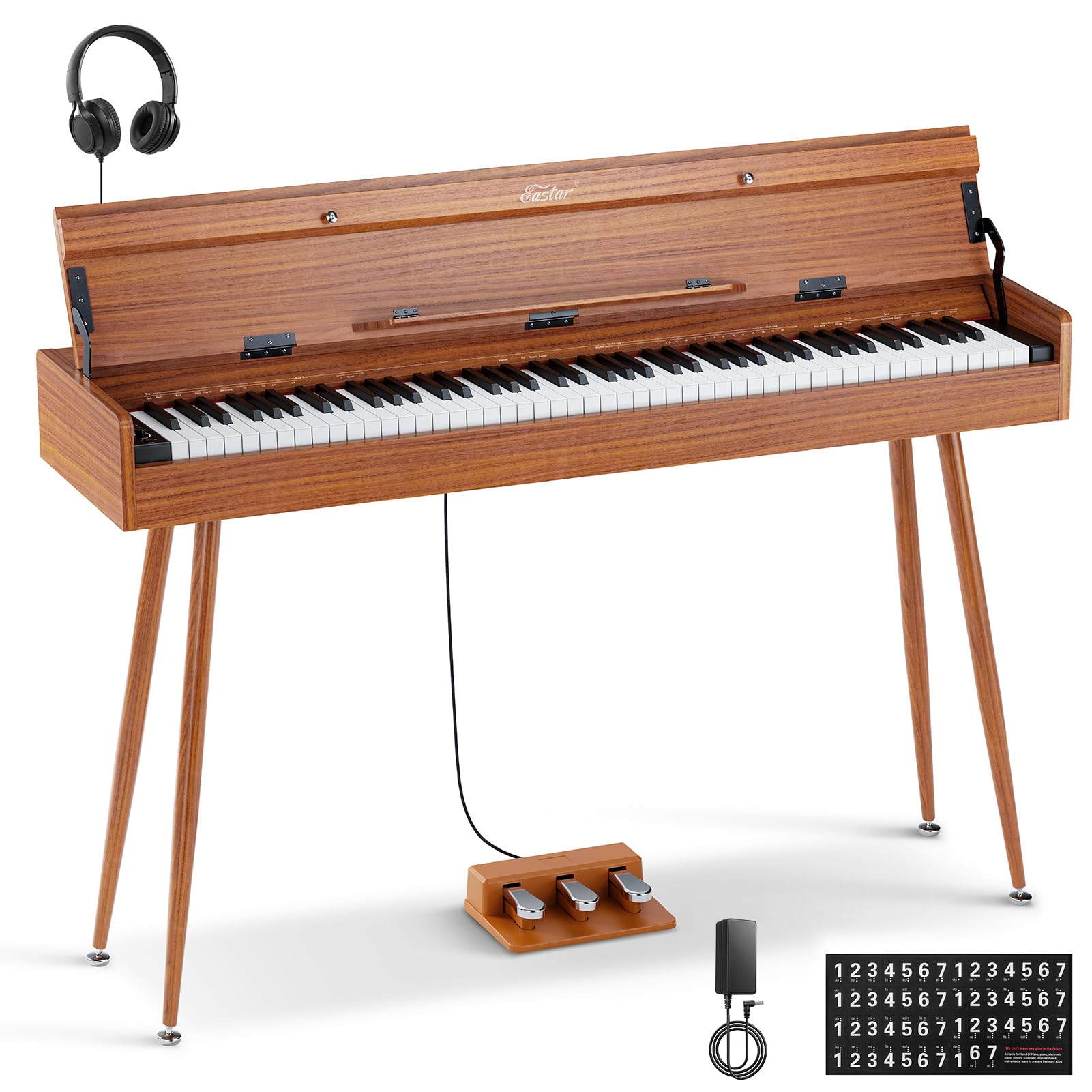
Three pedals at this price is the first thing that stands out about the EUP-100. Most budget pianos here ship a single foot switch, and having soft and sostenuto alongside the damper is a real step up if you're working through graded pieces. The bundle adds a headphone and stickers for the keys, and the retro wood finish makes it read as a small upright rather than a keyboard on a stand.

Under the lid it's a fully weighted hammer-action keyboard with 88 full-size keys, and the cabinet is solid enough that it doesn't walk across the floor when you play hard. Put it together where you intend to keep it, because moving it afterwards is a two-person job. The desk-style body has a music rest and enough depth to feel like an instrument rather than a shelf.

Wireless MIDI is the connection here, which means apps and recording software rather than streaming audio through the speakers. Dual voice, auto chord, transpose, and a built-in metronome cover the practice basics, and MIDI over USB gets you into GarageBand when you want to record.

Where it sits below the big names is the long game. Roland, Yamaha, and Casio have decades of service networks behind them and this one doesn't yet, which is worth weighing if you keep a piano for a decade. What's not in doubt is the value: weighted keys, three pedals, and a cabinet that looks like furniture, for a fraction of what the premium uprights cost. We came away thinking the pedals alone justify choosing it over the cheaper Donner slab.

Pros

  • Three-pedal unit at a budget price
  • Fully weighted hammer-action keys
  • Wireless MIDI plus USB
  • Wood cabinet looks like a small upright

Cons

  • Heavy cabinet is hard to move
Our verdict

Three pedals, weighted keys, and a wood cabinet for budget money — the best value in this group for a living room.

Check Latest Price
7

Travel and Storage

FingerBallet BX20

84 /100
LBD Score Excellent

Key details

Keys
88, semi-weighted, folding
Power
Battery or included charger
Weight
12.4 lb
Connectivity
Bluetooth MIDI
View on Amazon

The first time we folded the BX20 in half and zipped it into its bag, the appeal was obvious: it goes where a piano can't. At 5.64 kg with the option of battery power, it unfolds and is ready to play on a desk, a table, or a keyboard stand, which is why it's the one here that works in a hotel room, at a relative's house, or in an apartment where the keyboard goes back in the closet after practice.

Eighty-eight full-size keys in a folding body means a hinge across the middle and semi-weighted keys rather than a hammer action, so the resistance that builds finger strength isn't there. That's the trade, and it's a fair one for the job this keyboard does: keeping your hands moving while you're away from your real instrument. It's not the piano to learn on if a weighted action is the whole point of the purchase, and at this price nobody should expect it to be.

Bluetooth MIDI is the smart way to use it — drive a piano app on a tablet and let the app supply the sound. The 128 tones and rhythms are there if you want them, the sustain pedal and carry bag come in the box, and the hinge has held up in transit. For a traveller, a commuter, or someone in a studio apartment, that's a genuinely clever instrument.

Pros

  • Folds in half into a carry bag
  • 5.64 kg and battery powered
  • Bluetooth MIDI for app sounds
  • Full-size 88 keys despite the fold

Cons

  • Built-in speakers sound thin
Our verdict

It folds in half and runs on batteries, which makes it the travel piano here rather than a substitute for a weighted action.

Check Latest Price

How We Tested Bluetooth Digital Pianos

We built the shortlist from specs first, dropping anything without 88 keys, a weighted or semi-weighted action, and Bluetooth audio or MIDI, then cross-checked long-term owner complaints about reliability before settling on eight models spread across the price range. We also recorded what shipped in each box — stand, pedals, bench, headphones — so we could compare real cost rather than sticker price.

Each piano was assembled the way a buyer would, and we timed it. We set every one against the same 5-by-8 rug to judge footprint, weighed it packed, and carried each up a flight of stairs alone to see where the upright cabinets separated from the slabs.

For sound, we ran an identical fifteen-minute routine on all eight: scales at the low and high ends to hear how the samples break across the keyboard, a slow movement with heavy pedaling, and a pop progression at full volume to check whether the speakers distorted. We listened once through the built-in speakers, once on wired headphones, and once over Bluetooth from a phone across the room, noting dropouts and lag.

Two beginners on the team took a week of lessons on each model — following an app, plugging in the sustain pedal, working from the included stickers — and told us what confused them. After a month of daily playing we checked for key noise and wobbly jacks.

How to Choose a Bluetooth Digital Piano

Which Bluetooth You're Getting

MIDI over Bluetooth sends your playing to an app; audio over Bluetooth brings a backing track into the piano's speakers. They are separate features, and the badge on the box rarely tells you which one you're getting. Want to practise with a lesson app, notation software, or a soft synth? You need MIDI — the Roland FP-30X and Eastar EUP-100 both cover it. Want to play along with recordings? You need audio, which the Yamaha P145BT and the Casio PX-S1000 stream.

Check the listing before you buy, because no firmware update adds a radio that isn't there. The FP-30X is the one here that does both, which is a large part of why it leads this list.

Weighted, Semi-Weighted, or Velocity-Sensitive

The line that matters is whether the keys carry a hammer mechanism. A weighted, graded action gets heavier toward the bass and pushes back as you play, which is what builds the control an acoustic demands. Velocity-sensitive and semi-weighted describe keys that respond to how hard you hit them but spring back on their own. They're fine for arranging and travel, and poor for building technique.

The Donner DEP-1S is honest about being velocity-sensitive and the FingerBallet is semi-weighted by design; both are good at their jobs. But if lessons are the goal, buy weighted — the Yamaha, Roland, Casio, Eastar, and DDP-400 all qualify.

Slab, Cabinet, or Something That Folds

An 88-key piano is a big object whatever shape it comes in, so the real question is where it lives. A slab sits on a stand, runs about 25 to 33 pounds in this group, and can go in a closet between lessons. A cabinet like the Donner DDP-400 or Eastar EUP-100 wants a wall, a second pair of hands at assembly, and a decision you won't reverse often. Folding designs trade the action for a bag you can carry.

A piano that's a hassle to set up gets played less. Pick the shape that matches the room, not the one that looks best in a photograph.

Pedals and Speakers

Bundled sustain pedals on budget models are usually switch-style units that slide underfoot, and a piano-style pedal with a real mechanism is the cheapest meaningful upgrade you can make. Check for a second pedal jack before you buy, since that is what makes the upgrade possible on a slab.

Speakers decide whether Bluetooth audio is worth having at all. A slim slab won't fill a room, and the difference between a piano that streams well and one that doesn't is usually the amplifier rather than the radio.

Frequently Asked Questions

Final Verdict

The Roland FP-30X is the piano we point most people to, because it's the only one here where both Bluetooth jobs work without a compromise elsewhere: MIDI to your apps, audio through speakers good enough to make play-along worth doing, and a PHA-4 action that feels like an instrument rather than a controller.

If the piano has to move, the Yamaha P145BT is the better travelling companion with the same audio streaming and eight pounds less to carry. If it has to look like furniture, the Donner DDP-400 earns its place in the room. Everything else on this list is a way of solving one of those three problems more cheaply.