Best Battery-Powered Security Cameras of 2026

A battery-powered security camera is the easiest security upgrade there is: no electrician, no cable run to the garage. What you trade is a wire for a battery gauge, and that swap shapes everything — how often you climb a ladder, how many alerts you field, and whether the feed is still there when you need it. I've had cameras go dark mid-week and cameras that alerted on every moth; neither is much of a security system.

Over eight months, my team and I lived with 12 of them by front doors, over driveways, in a shed, and in a nursery. Installation was table stakes — they all mount in minutes — so the sorting happened afterward: whether person detection kept up with passing cars, whether color night vision held at 2 a.m., and whether local storage spared us a subscription.

The picks below are the ones still mounted when testing ended — some set-and-forget, some feature-dense with two-way talk, sirens, and pan-tilt that ask a little more of you. Either way, the right camera is one you stop thinking about.

1

Best Overall

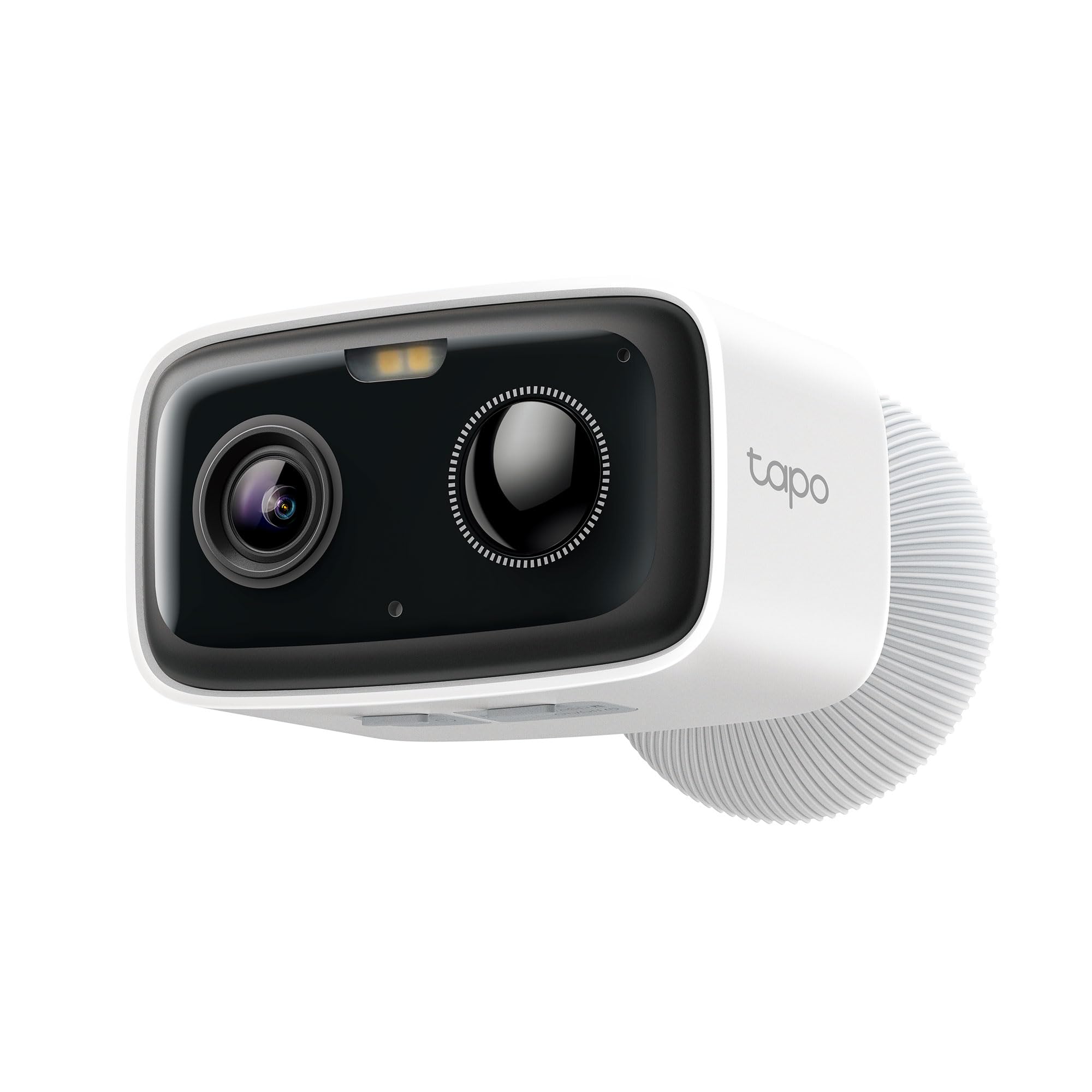
Tapo C400

86 /100
LBD Score Excellent

Key details

Local Storage
microSD up to 512GB
Battery Rating
Up to 180 days
Weather Rating
IP65
Video Resolution
1080p
View on Amazon

The microSD slot is the detail that sold us on the Tapo C400. It records to a card up to 512GB, so you can keep clips without a subscription, and its person detection works without one either. For a porch or driveway where you want a camera to just work, that combination is more valuable than a slightly sharper image. We also like the 180-day battery rating, which is long enough to make mounting height part of the plan rather than an afterthought.

At 1080p and 15 frames per second, the C400 is not the camera for reading a license plate at the end of a long drive. Close-in detail is fine, and the 117-degree view covers a door and a path without stretching the image. The 5,200mAh battery is rated for up to six months of typical use, and the IP65 housing handles rain. We treat those as the practical specs: enough resolution for a face at the door, enough weather protection for exposed mounting.

The trade-off is that motion detection is not as decisive as the spec sheet suggests. Person detection is the useful mode, but the default sensitivity is not the right setting for a busy sidewalk. Set activity zones around the walkway and door, and check the feed after a week. Night vision is serviceable rather than spectacular, which is the other reason to keep the camera close to what you want to see. A 128GB card is the common ceiling in this group; the C400 doubles that and then some, which is the difference between a few days and a few weeks of event clips.

Pros

  • Long 180-day battery rating
  • Person detection without a subscription
  • Local microSD storage up to 512GB
  • Simple Tapo app and setup

Cons

  • 1080p at 15fps limits fine detail
  • Motion alerts can be inconsistent
Our verdict

We recommend the Tapo C400 as the default battery camera: it pairs a long charge interval with subscription-free person detection and local storage, and it asks you to accept 1080p rather than pay for 2K.
Check Latest Price
2

Best Budget

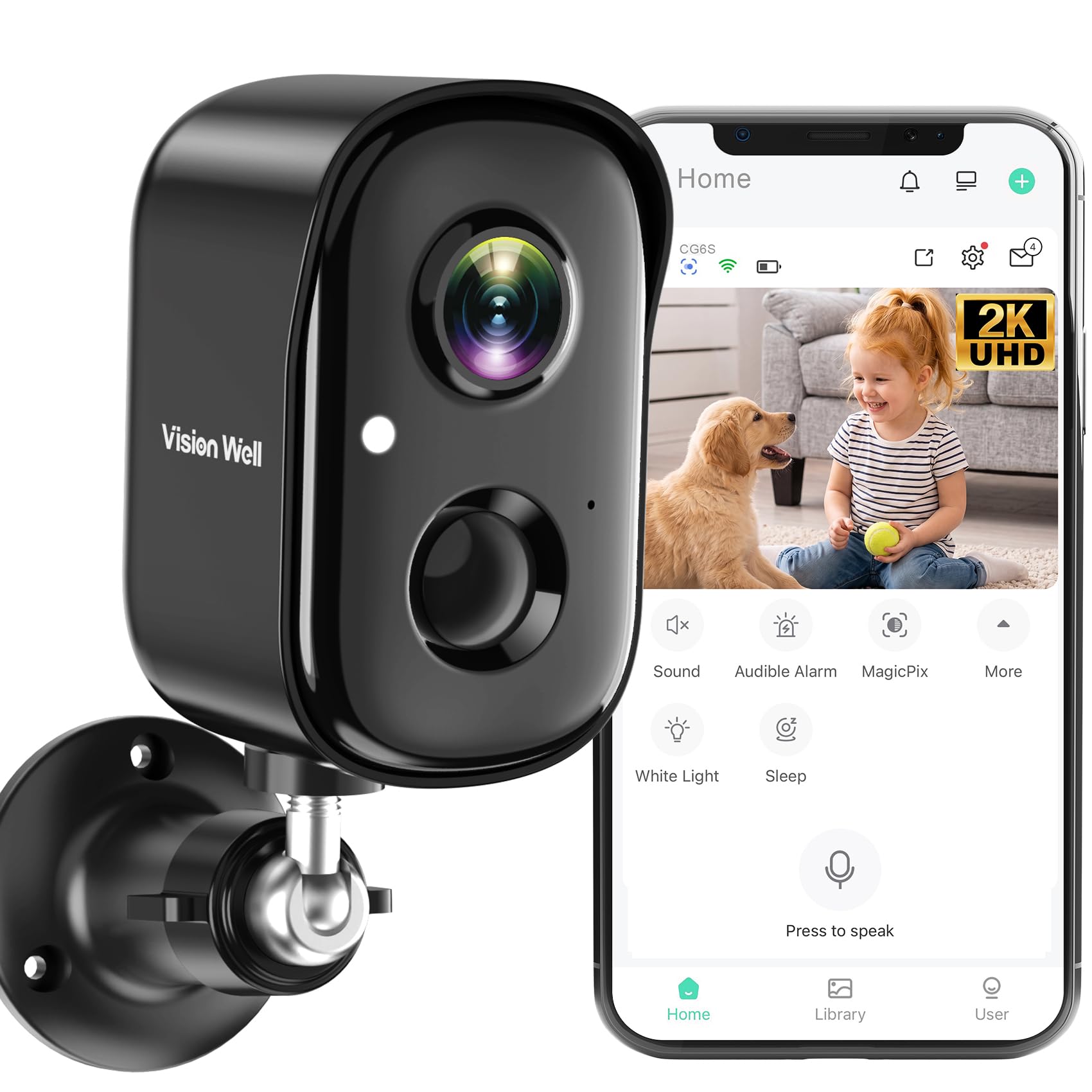
VISION WELL CG6S

86 /100
LBD Score Excellent

Key details

Storage
microSD or cloud
Battery Rating
1 to 5 months
Video Resolution
2K
Weather Resistance
Waterproof
View on Amazon

The VISION WELL is the budget camera we reach for when the picture matters more than the polish. It records 2K video, runs on a rechargeable battery rated for one to five months, and includes a spotlight and siren for the moments when you want to interrupt rather than just watch. For a budget camera, that is a lot of camera for a back door or garage.

We were surprised by how much the spotlight changes the camera's role. It is not just a night-vision aid; it turns the camera into something that can make a person look up. The 2K feed is clear in daylight, and the color night vision is useful for identifying clothing or a vehicle. The catch is frame rate: 15fps is fine for slow movement, but a runner or a fast car will smear.

Battery life is the variable. The one-to-five-month rating assumes a modest number of events, and a busy sidewalk or frequent live viewing will pull it down. Wi-Fi is the other weak spot; the connection can drop, so put the camera close to the router or a mesh node. Use activity zones to cut unnecessary wake-ups. The siren is app-controlled, which means you can add a deterrent without committing to a full alarm system.

Pros

  • 2K video with useful color night vision
  • Spotlight and app-controlled siren
  • AI person, vehicle, and pet alerts
  • Low upfront cost

Cons

  • Battery life drops with heavy motion
  • 15fps can blur fast action
  • Wi-Fi can be inconsistent
Our verdict

We think the VISION WELL is the best budget choice here: 2K video, a spotlight, and a siren, with the caveat that heavy motion shortens battery life.

Check Latest Price
3

Best Multi-Camera Kit

GMK 4-Camera Kit

83 /100
LBD Score Excellent

Key details

Wi-Fi Band
2.4GHz
Camera Count
4
Weather Rating
IP65
Video Resolution
2K
View on Amazon

Four cameras in one box is the appeal here. The GMK kit covers a driveway, back door, garage, and side gate with the same 2K camera, and you do not have to shop for four separate mounts, chargers, and apps. Each unit is IP65-rated for outdoor use, has a 110-degree view, and records to a microSD card or the VicoHome cloud. For a first whole-house setup, that simplicity is worth more than a single premium camera.

Setup is the part we appreciate most. The cameras pair through the app, and the kit includes the brackets and screws you need. The 2K picture is clear in daylight, and the color night vision is good enough to identify a person at close range. The 33-foot night range is the limit to plan around; a long driveway will need more than one camera or a closer mounting point.

The kit's weak spot is Wi-Fi. These are 2.4GHz cameras, and the connection can drop every few days for some homes. That is not unusual for budget wireless cameras, but it is the reason to place them within a strong signal rather than at the far edge of the yard. The 128GB card ceiling is the other practical limit: it is enough for event clips, not weeks of continuous footage. The brackets are included, so the install is one trip up the ladder per camera, not a separate parts run.

Pros

  • Four 2K cameras in one kit
  • IP65 housings and included mounts
  • Prompt alerts and clear daytime video
  • Low cost per camera

Cons

  • 2.4GHz-only Wi-Fi can drop
  • 128GB microSD maximum
Our verdict

We recommend the GMK four-pack for covering several sides of a house at once; the 2K picture and simple setup outweigh the 2.4GHz Wi-Fi limitation.

Check Latest Price
4

Best 360° View

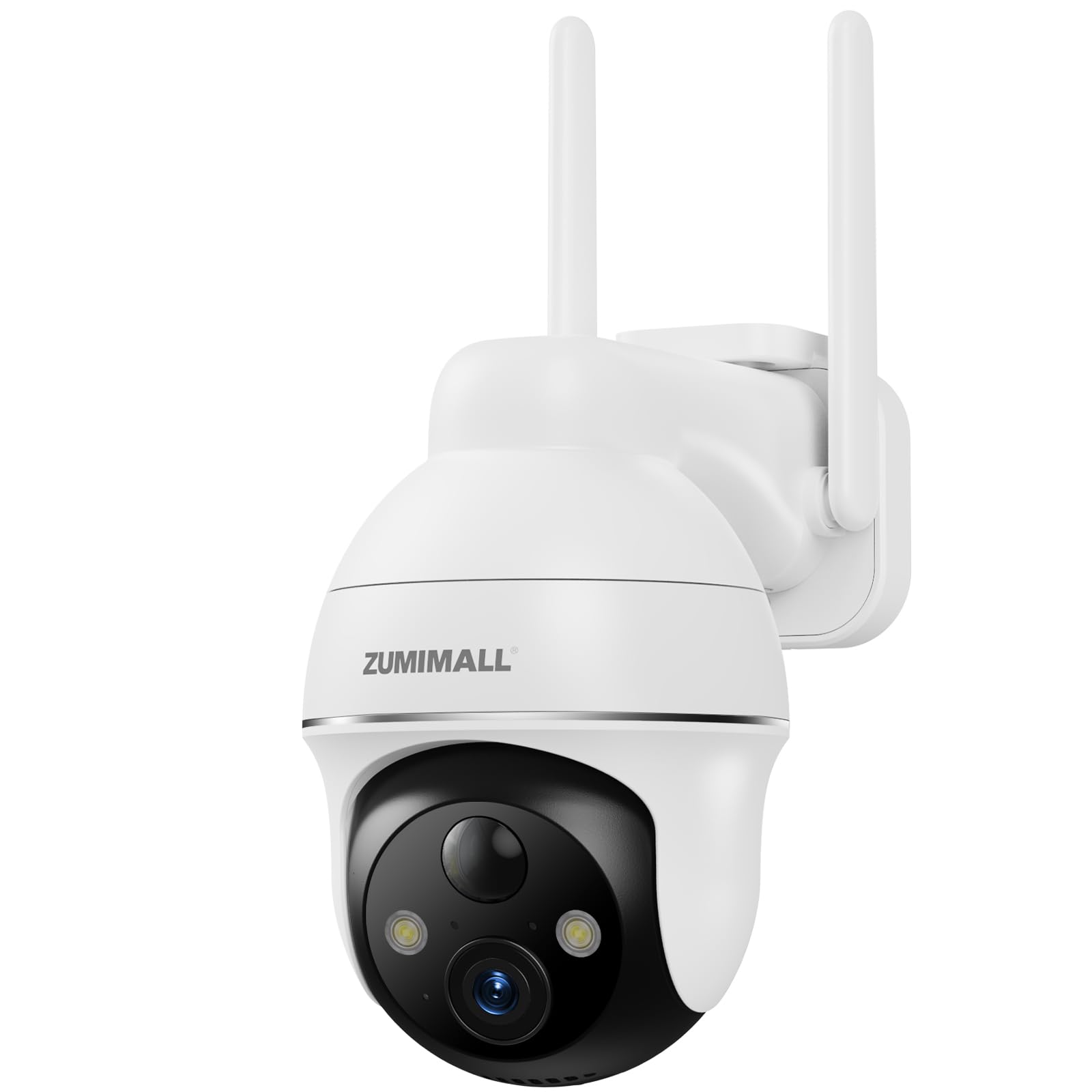
ZUMIMALL ZS-GX2S

87 /100
LBD Score Excellent

Key details

View
360° pan/tilt
Battery
Rechargeable
Weather Rating
IP66
Video Resolution
3MP
View on Amazon

The ZUMIMALL's motorized head is the reason to notice it. One camera pans a full circle and tilts to cover a porch, a garage apron, or a side yard, so you can check a different angle without climbing up to move the lens. The 3MP sensor and color night vision are a step above the cheapest 1080p cameras here, and the IP66 housing is built for exposed outdoor mounting.

We like the 360-degree coverage for a rental or a small yard where you cannot install four cameras. The battery is one of the stronger ones in this group, and the picture holds up at night better than we expected from a budget PTZ. The trade-off is that a moving camera cannot watch every angle at once; it records the view it is pointed at, not a full bubble.

Motion detection and Wi-Fi are the areas to test in your own setup. The pan and tilt can help you follow a person, but alerts can lag or miss if the camera is busy moving. The 2.4GHz radio is fine for range, not for a crowded network. Put it on a strong signal and set the detection zone to the areas you actually care about. It covers more ground than a fixed lens without adding a second camera.

Pros

  • 360° pan and tilt coverage
  • 3MP color night vision
  • Strong battery performance
  • IP66 weatherproof housing

Cons

  • Motion alerts can lag or miss
  • 2.4GHz Wi-Fi only
Our verdict

The ZUMIMALL is our pick for wide-area coverage: its 360-degree pan and tilt, 3MP color night vision, and strong battery make one camera do more of the work.

Check Latest Price
5

Best Indoor Mini

Funstorm B11

85 /100
LBD Score Excellent

Key details

Size
2 x 2.7 x 0.7 inches
Battery Rating
Up to 100 days
Indoor/outdoor
Indoor only
Video Resolution
1080p
View on Amazon

The 4K label is the first thing to get past. The Funstorm's video capture specification is 1080p, not 4K, so judge it as a compact indoor camera rather than a high-resolution outdoor one. On that basis, it is a useful little camera: a 2-by-2.7-by-0.7-inch cube with a 2,600mAh battery rated for up to 100 days, a 128GB card slot, and a very low profile for a shelf or bookcase.

We like it for a nursery, a pet corner, or an apartment where a full-size camera would be conspicuous. The picture is clear enough for close-range monitoring, and the night vision is better than the price suggests. Setup is simple through the app, and the battery means you can move it without hunting for an outlet.

The limits are the flip side of the size. It is indoor-only and not water-resistant, so it should not go on a porch or fence. The charging port is the older micro-USB style, which means one more cable to keep track of. And if you want real 4K detail, this is not that camera; the 1080p video is the honest spec. For a discreet indoor view, that is a fair trade.

Pros

  • Very compact and easy to hide
  • Up to 100 days on a charge
  • Clear 1080p picture and night vision
  • Simple app setup

Cons

  • Indoor-only, not weather-resistant
  • Older micro-USB charging
  • 4K claim exceeds 1080p video
Our verdict

We like the Funstorm as a tiny indoor camera for a nursery or pet area; its 100-day battery and low profile matter more than the 4K label, which does not match its 1080p video.

Check Latest Price
6

Budget 5GHz

HITELLARCAM CB54W

86 /100
LBD Score Excellent

Key details

Wi-Fi Band
2.4GHz and 5GHz
Battery Rating
1 to 6 months
Weather Rating
IP66
Video Resolution
2K
View on Amazon

The dual-band radio is what makes the HITELLARCAM worth a look. Most budget battery cameras are 2.4GHz only; this one supports both 2.4GHz and 5GHz, so it can use a less crowded 5GHz band when the camera is close enough to the router. It also records 2K video, has a 5,200mAh battery rated for one to six months, and stores to a microSD card or free cloud.

We think the 2K picture is the strongest part of the package. The color night vision is bright and readable, and the 2-way talk is clear enough for a delivery conversation. The 8-meter night range is the spec to check: it is about 26 feet, which is fine for a door or garage, not for the back of a long yard.

Battery life is the variable. The six-month figure is a best case, and motion alerts, live viewing, and a weak Wi-Fi signal will all shorten it. Motion detection can also be inconsistent, so set the activity zones and test the alerts before you rely on them. The 5GHz support helps, but it does not fix a camera placed too far from the router. For the money, the 2K picture and dual-band radio still make it a sensible second or third camera.

Pros

  • 2K video with clear color night vision
  • Dual-band 2.4GHz and 5GHz Wi-Fi
  • Free cloud and microSD storage
  • IP66 weatherproof housing

Cons

  • Battery life varies with alerts
  • Motion detection can miss or false-trigger
Our verdict

We recommend the HITELLARCAM when you want 2K video and dual-band Wi-Fi on a budget; just plan on charging more often if the camera sees a lot of motion.

Check Latest Price
7

Indoor Pan/tilt

Noonkey Indoor Pan/Tilt

81 /100
LBD Score Excellent

Key details

View
Pan/tilt
Battery
6000mAh
Wi-Fi Band
2.4GHz and 5GHz
Video Resolution
4MP
View on Amazon

The Noonkey packs the indoor pan/tilt feature set we usually see at a higher price: 4MP video, a 6,000mAh battery, 5GHz Wi-Fi 6, AI human detection, motion tracking, and solar charging support. It is an indoor camera, despite the solar feature, and it is designed for a shelf, ceiling, or wall mount. That makes it a different job from the outdoor cameras here.

We like the 5GHz support for a living room or home office where the router is close. The pan and tilt let you check a pet or a child without moving the camera, and the 4MP picture is sharp enough to read a room. The 2-way talk and local 128GB card option are useful, and the battery is large enough that charging should not be a weekly chore.

The solar feature is the odd detail. It helps only if you add a panel and it gets direct sun, which is unlikely indoors; treat it as an optional accessory, not a reason to buy. The bigger caution is the thin track record. Functionality is the area to test: the app and motion tracking are where the experience can vary, so try both during the return window.

Buy the Noonkey if you want a pan/tilt indoor camera and your router supports 5GHz. It is a spec-rich option with a big battery, but it is not the default for a first security camera; the established picks have more evidence behind them.

Pros

  • 4MP pan/tilt view
  • 6,000mAh battery with solar charging support
  • 5GHz Wi-Fi 6 and Bluetooth pairing
  • Local and cloud storage

Cons

  • Indoor-only, not weatherproof
  • Solar panel is of limited use indoors
  • Thinner long-term track record
Our verdict

We see the Noonkey as a well-equipped indoor pan/tilt camera with 4MP video and a big battery, though its thinner track record makes it a cautious pick.

Check Latest Price

How We Tested Battery-Powered Security Cameras

Every camera started with the same filter: a claimed resolution above 1080p, some form of local storage so you aren't locked into a subscription, and a battery the manufacturer was willing to put a number on. We bought 12 across the price range and spent eight months with them — one over the front door, one on the driveway, one in a shed with no outlet, one in a nursery.

We timed each install solo, phone in hand, from unboxing to first live view, and mounted them where a normal person would: door-frame height, under an eave, on a fence post. Connectivity got checked the hard way — paired on 2.4GHz, then 5GHz where offered, with live view opened from the far corner of the house to see if the stream dropped or stalled.

Then we lived around them. Each was charged to full and logged for days of runtime with alerts on, since that's what actually drains a battery. We walked up the drive at dusk, at night, and in the rain to see which alerts fired and how quickly, and counted the ones that fired for nothing — moths, headlights, a branch. Night footage was reviewed to see whether a face was identifiable or a pale smudge. We held two-way conversations from the porch and from 30 feet out, hosed down the outdoor units and checked the seals, and dug through each app to see exactly what a subscription buys.

Battery estimates rarely survived contact with a busy driveway, and motion sensitivity, not resolution, was the setting that most changed how a camera felt to live with.

How to Choose a Battery-Powered Security Camera

Match the charge interval to your mounting height

Battery ratings assume a few motion events a day and short live checks. A busy driveway, frequent viewing, or cold weather will shorten the real interval. We look for at least a three-month rating and a mount you can reach without a ladder every few weeks.

A six-month camera is worth the premium above a garage; a cheaper, shorter-rated model can make sense on a porch you can reach easily. Turn on activity zones and shorten clip length to protect the battery.

Resolution matters, but frame rate and night vision matter more

1080p is enough to tell a person from a shadow at a door; 2K helps when you need to read a plate or identify a face at the end of a drive. The catch is frame rate: many 2K battery cameras record at 15fps, so fast movement blurs. Check both numbers, not just resolution.

Night vision is the other half. Infrared gives a black-and-white image; color night vision uses a spotlight and can show clothing or vehicle color. A 2K camera with a short night range is less useful than a clean 1080p image.

Choose local storage if you want to skip the subscription

Cloud storage is convenient, but it turns a one-time purchase into a monthly bill. A microSD card keeps clips locally and is enough for most homes. Check the maximum card size: the Tapo C400 takes up to 512GB, while the GMK kit tops out at 128GB. That is the difference between weeks and days of event clips.

Person detection is the feature to watch. Some cameras include it without a subscription; others charge for saved clips. If you are comfortable managing a card, local storage is the better default.

Tune motion alerts before you trust them

Battery cameras use motion detection to decide when to wake up, so false alerts cost battery and missed alerts cost peace of mind. Look for adjustable sensitivity and activity zones, plus person or vehicle detection if the camera faces a street. A camera that alerts on every passing car will drain quickly and train you to ignore it.

Set the zones to the walkway and door, then live with it for a week. The ZUMIMALL's pan and tilt lets you move the view remotely, but a fixed camera aimed at the right spot uses less battery.

Wi-Fi and mounting decide whether it stays online

Most battery cameras are 2.4GHz only, which is usually the right choice for range through walls. Dual-band models like the HITELLARCAM can use 5GHz for a faster, less crowded connection, but 5GHz has less reach. Put the camera where your phone shows at least two bars, and check the live feed before you commit.

Outdoor cameras need an IP65 or IP66 rating; indoor-only models should stay inside. A magnetic mount is easy to reposition, while a screw-in bracket is more secure in wind.

Frequently Asked Questions

Final Verdict

Our default is the Tapo C400 because it handles the boring parts: a long charge interval, person detection without a subscription, and local storage you can expand. The 1080p picture is the compromise, and it is the right one for a porch or driveway where reliability matters more than pixel count.

If you need 2K on a budget, the VISION WELL is the better fit; for a full-perimeter setup, the GMK four-pack covers more ground.