Best Air Quality Monitors of 2026

The first air quality monitor I bought was a glowing box that answered a question I hadn't asked. It spat out a VOC number, but couldn't tell me why my kitchen felt stuffy. A useful monitor turns a reading into a decision: open a window, run the purifier, or stop worrying. That takes an accurate sensor, a readable display, and a setup simple enough to leave running. Over six months, my team and I lived with 12 monitors—battery-powered units on bookshelves, plug-in models on desks, and app-connected ones that promise the whole house and a downloadable history.

What mattered more than a feature list was whether the numbers held up. A screen cycling through a dozen metrics doesn't help if the readings drift or the app drops after a reboot. I cared more about whether CO2 climbed when I shut the bedroom door, whether PM2.5 jumped when I seared a steak, and whether the battery estimate held after a month. The picks below answer one question: is the air in this room okay?

1

Best Overall

Aranet4 CO2 Monitor

93 /100
LBD Score Outstanding

Key details

Battery
Up to 4 years (2 AA)
Display
E-ink
Measures
CO2, temperature, humidity, pressure
CO2 Sensor
NDIR
View on Amazon

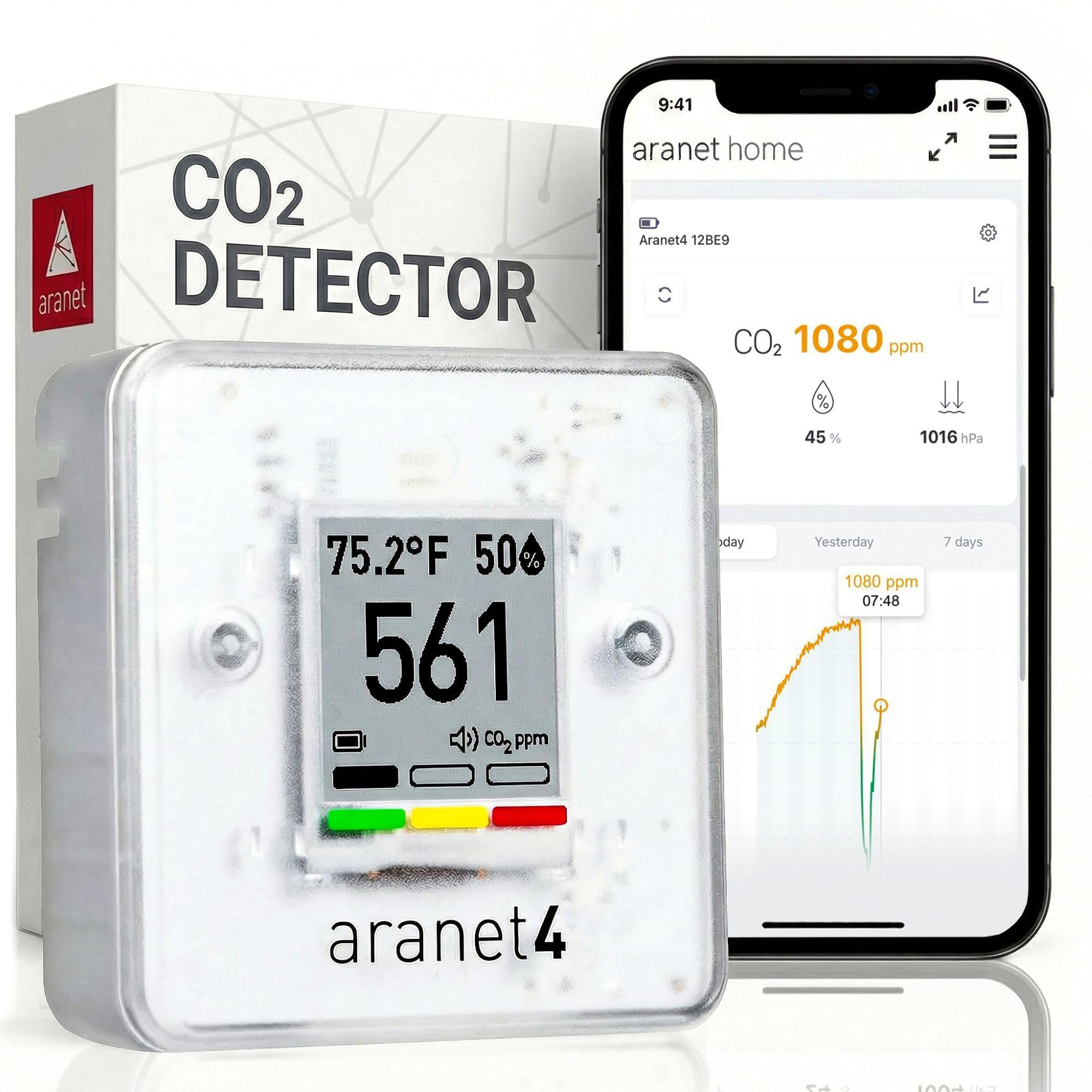
Every monitor here will tell you the air is fine, or not fine. The Aranet4 answers a narrower question that turns out to be the useful one: is this room getting enough fresh air? Carbon dioxide is the honest proxy — it climbs when a room fills with people and drops within minutes of a window opening — and the e-ink number on the front is big enough to read from the doorway. We stopped opening the app within a week and just looked at the screen.

What makes it our top pick is a real NDIR sensor paired with the least fussy ownership in this group. It runs on two AA batteries for up to four years, so there's no cable, no charging routine and no reason to move it once it's placed. Of the monitors here, this is also the one whose accuracy held up most consistently: a closed bedroom climbs overnight, an open window drops the number, and the colour band behind it saves you from interpreting ppm at all.

The free app is optional in a way it isn't on most of these. Leave it unopened and you still have everything you need; open it and you can pull 90 days of history over Bluetooth. Syncing is the one place it shows its age — the download can take a minute to start, so set it going and come back rather than watching it. Otherwise it disappears into a room, which is the highest compliment a monitor can earn.

Pros

  • Up to four years on two AA batteries
  • E-ink screen readable from across a room
  • True NDIR sensor, not an estimated reading
  • 90 days of history in a free app

Cons

  • No PM2.5, VOC or radon readings
Our verdict

We recommend the Aranet4 first: it answers the question you'll act on — is this room ventilated? — and its accuracy is the most consistent of anything in this group.

Check Latest Price
2

Best for Radon

Airthings View Plus

81 /100
LBD Score Excellent

Key details

Power
6 AA batteries, up to 2 years
Measures
Radon, PM2.5, CO2, VOCs, temperature, humidity, pressure
Dimensions
4 x 4 x 2 in
Connectivity
Wi-Fi, Bluetooth
View on Amazon

Radon is the one hazard on this list you can't sense for yourself. It seeps out of the ground, it has no smell, and it's the leading cause of lung cancer among non-smokers — which makes a monitor that reads it a different kind of purchase from one that counts dust. The View Plus is the only device here that does.

Around that radon sensor sits the widest set of readings in this group: PM2.5, CO2, VOCs, humidity, temperature and pressure, all from a four-inch cube that runs up to two years on six AA batteries. The lack of a cord matters more here than anywhere else, because the basement shelf and the slab corner are exactly where you want the radon number and exactly where nobody wants to run an extension lead.

It's the priciest monitor here by some distance, and the radon sensor is what that money buys. If you have a basement, a sump pit or a 1970s split-level, we think it's worth it, and the long log is the thing a mitigation contractor wants to see. If your worry is cooking smoke or a stuffy bedroom, the Temtop and the Aranet get you there for less.

Pros

  • Only pick here with a radon sensor
  • Seven measurements from a battery-powered unit
  • Five-year extended warranty with registration

Cons

  • Wi-Fi reconnection can be stubborn
Our verdict

If radon is why you're shopping, this is the monitor: it's the only one here that reads it, and it runs on batteries so it can live in the basement.

Check Latest Price
3

Best for Data Logging

Temtop LKC-1000S+

83 /100
LBD Score Excellent

Key details

Battery
6-8 hours
Measures
PM2.5, PM10, HCHO, TVOC, temperature, humidity, AQI
Dimensions
6.97 x 1.26 x 2.56 in
Data Logging
3 months, USB export to Excel
View on Amazon

We ended up carrying the LKC-1000S+ from room to room rather than leaving it anywhere, because that's what it's built for: the spot check. Hold it over a new rug, set it beside a stripped door frame for half an hour, then move on. It answers the question a fixed monitor can't, which is whether the thing you just did made the air worse.

Seven readings share the screen — PM2.5, PM10, formaldehyde, TVOC, temperature, humidity and a combined AQI — and the one that earns it a place here is the logging. It holds three months of readings and exports them to Excel over USB, which turns the vague feeling that the air is bad into a before-and-after you can put in front of a contractor. For a renovation, that's the whole job.

On its own battery it runs six to eight hours, which covers a morning of moving between rooms; for a week-long record you want it on USB-C. And like every consumer particle sensor here, it's better at showing that something changed than at handing you a number to defend to three decimal places.

Pros

  • Seven parameters including PM10 and formaldehyde
  • Three months of readings export to Excel
  • Six to eight hours on its internal battery

Cons

  • Chunky next to the pocket-sized monitors here
Our verdict

For renovation dust or a formaldehyde worry, we reach for this one: seven readings, three months of logs, and a spreadsheet you can hand to someone.

Check Latest Price
4

Best for App Tracking

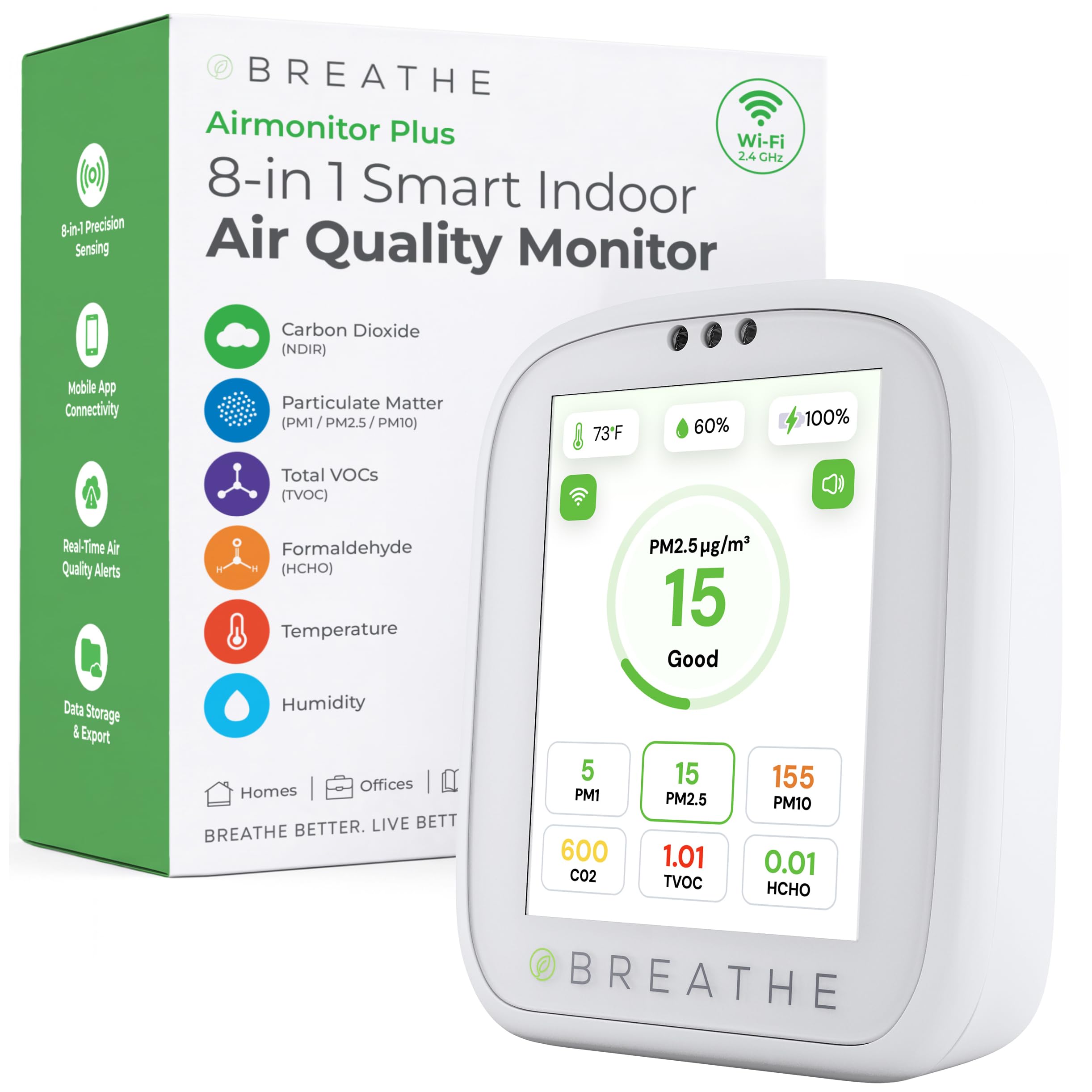
BREATHE Airmonitor Plus

79 /100
LBD Score Very Good

Key details

Battery
6 hours
History
90 days, CSV export
Measures
CO2, PM1, PM2.5, PM10, TVOC, HCHO, temperature, humidity
CO2 Sensor
NDIR
View on Amazon

The BREATHE reads almost the same list as the Airthings — CO2, PM1, PM2.5, PM10, TVOC, formaldehyde, temperature and humidity — for far less money and without a radon sensor. For anyone who wants the readings on a phone rather than on a panel across the room, that's the trade we recommend in this group.

Setup is the part that went well: the app walks you through pairing, the readings are legible, and the unit is four ounces and barely three inches tall, so it fits beside a lamp. You get custom alerts on CO2 and PM2.5, 90 days of graphs, and a CSV export when you want the raw numbers. We set an overnight CO2 alert and it did exactly what an alert should — told us to open a window.

Plan to leave it plugged in. It's a corded unit with a short battery reserve, so treat the battery as a way to move it between outlets rather than as a week on a bookshelf. At this size and this price we prefer the eight readings to a bigger battery, but the outlet matters more than the spec sheet suggests.

Pros

  • Eight readings including true NDIR CO2
  • 90 days of history with CSV export
  • Small enough to sit beside a lamp

Cons

  • 2.4 GHz Wi-Fi only, and pairing can take a few attempts
Our verdict

We think this is the best value among the app-connected monitors here: eight readings, real NDIR CO2, and 90 days of history without paying for radon.

Check Latest Price
5

Best Budget Monitor

GoveeLife H5106

85 /100
LBD Score Excellent

Key details

Power
USB-C corded
Measures
PM2.5, temperature, humidity
Refresh Rate
2 seconds
PM2.5 Accuracy
±15 µg/m³ (0-100), ±15% (100-1000)
View on Amazon

Two things make this the one to beat at the bottom of the range. It publishes a PM2.5 accuracy figure instead of a vague claim — plus or minus 15 micrograms per cubic metre below 100, 15 percent above it — and it refreshes every two seconds, so a pan of bacon registers while the pan is still hot.

The display carries the rest of it: a colour level, a clock, a brightness you can drop so it doesn't light a bedroom. We got the most out of the automations, though. Set a PM2.5 threshold and a Govee purifier or fan starts itself, which is the closest thing here to a monitor earning its keep while nobody is looking at it.

It's a room monitor rather than a house instrument, and the rooms it suits are the ones where particles are the whole story: a workshop, a nursery, the corner where the cat litter lives. Treat a flat zero with suspicion too. Hold it near a just-extinguished match and watch for the number to move; a sensor that stays at zero through that isn't telling you the air is clean.

Pros

  • Published PM2.5 accuracy, not a vague claim
  • Two-second refresh catches cooking and candles
  • Triggers Govee purifiers and fans automatically

Cons

  • Only PM2.5, temperature and humidity
Our verdict

The cheapest way to watch particles here: a published PM2.5 accuracy figure, a readable display, and it can switch a Govee purifier on when the air turns.

Check Latest Price
6

Best Budget CO2 Monitor

Temtop C1 CO2 Monitor

87 /100
LBD Score Excellent

Key details

Battery
Up to 70 days standby
Measures
CO2, temperature, humidity
CO2 Range
400-5000 ppm
CO2 Sensor
Sensirion SCD41
View on Amazon

There's a Sensirion SCD41 inside this little box — a Swiss photoacoustic CO2 sensor rated to plus or minus 40 ppm plus 5 percent of the reading — and that chip is the entire argument. At this money you can buy plenty of gadgets that guess at CO2. This one measures it, across a range up to 5,000 ppm, which is the reason we put it on a nightstand rather than something cheaper.

The battery is the rest of the pitch: up to 70 days on standby, charged over USB, so it's a monitor you can move from bedroom to kitchen and forget about. Temperature and humidity sit alongside the CO2 number, and the buzzer can be set to nag you when a room climbs — handy in a classroom, less so at night, where you'll want it off.

Pros

  • Photoacoustic CO2 sensor rated to ±40 ppm
  • Up to 70 days on standby
  • Buzzer alert when CO2 climbs

Cons

  • Screen isn't backlit
Our verdict

The cheapest CO2 reading here we trust: a real Sensirion sensor, a clear number you can glance at, and a charge that lasts months.

Check Latest Price
7

Big Display

YNAK 16-in-1 Monitor

82 /100
LBD Score Excellent

Key details

Weight
10.6 oz
Display
7-inch
Runtime
Up to 8 hours
Measures
CO2, TVOC, PM1.0, PM2.5, PM10, HCHO, temperature, humidity, AQI
View on Amazon

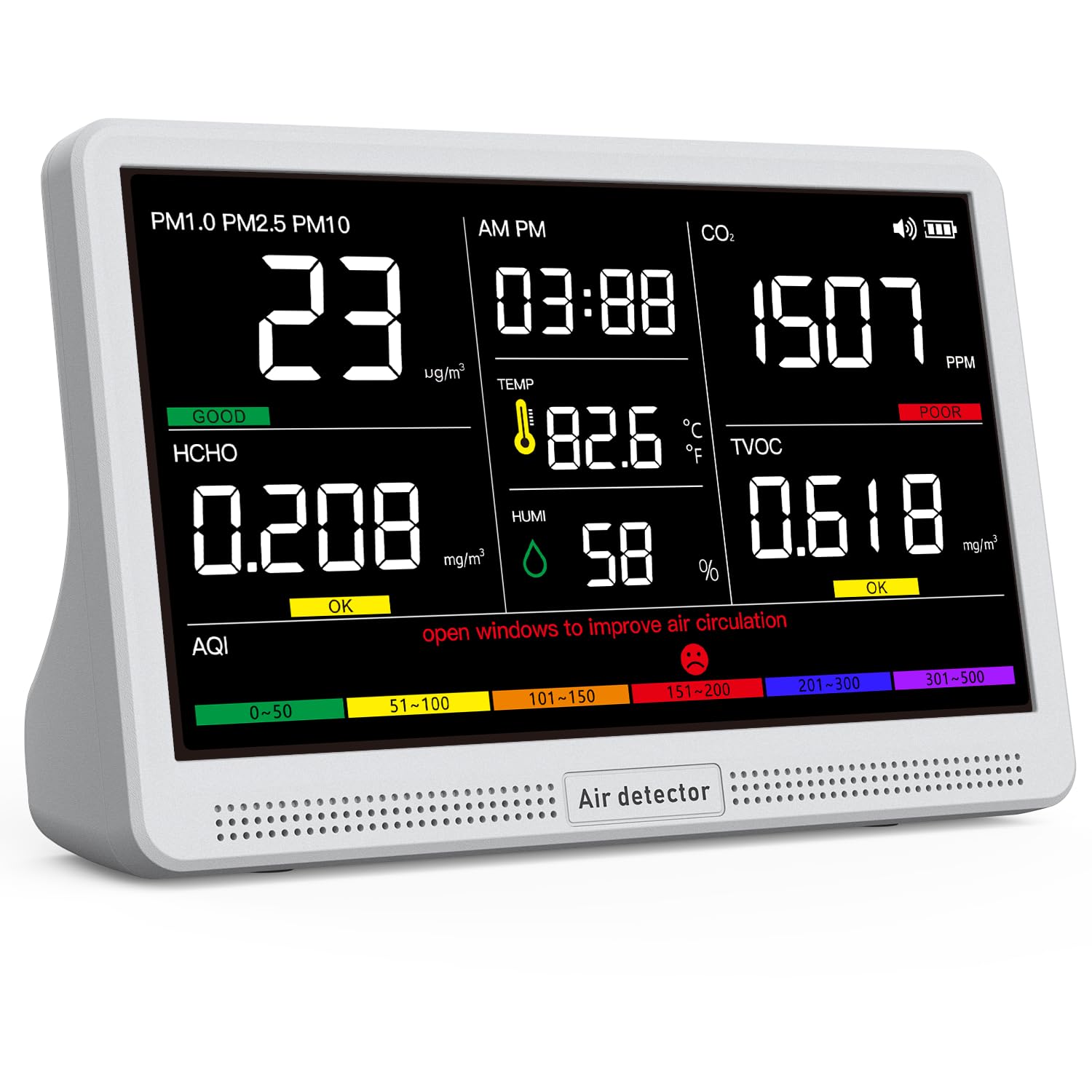
Seven inches of screen is an unusual thing to fall for, but it's the reason to look at this one. In a hallway, a classroom or a workshop, people read it without being asked to — the numbers are big, colour-coded, and legible from across a room in a way no phone app has managed. We noticed it from the doorway before we noticed anything else on the shelf.

Nine readings share that panel: CO2, TVOC, PM1.0, PM2.5, PM10, formaldehyde, temperature, humidity and a combined AQI, plus the time, which is the sort of detail that makes it feel like furniture rather than an instrument. It charges over USB-C and runs up to eight hours off the cord, enough to carry it between rooms.

The caveat is that a wall of numbers is not a wall of sensors. Several of these readings come from the same few elements, and the ones that move fastest aren't always the ones to believe. Treat the panel as a prompt — something changed, look up — rather than as a measurement to act on alone.

The place for it is where people see it: a shared office, a waiting room, a classroom with the windows shut. For a number to put in an email to a landlord, the Aranet or the Temtop is the better tool; for getting a room full of people to notice the air at all, the big screen does more than any app.

Pros

  • Seven-inch screen readable across a room
  • Nine readings plus a clock on one panel
  • USB-C charging with up to eight hours off the cord

Cons

  • TVOC and HCHO readings can run far off
Our verdict

We like it for the screen rather than the sensor count: nine readings where a whole room can see them, which is worth more than it sounds in a shared space.

Check Latest Price
8

Portable All-Rounder

LifeBasis 11-in-1

78 /100
LBD Score Very Good

Key details

Battery
2500 mAh, 11-12 hours
Charging
USB-C
Measures
AQI, CO2, PM1.0, PM2.5, PM10, HCHO, TVOC, temperature, humidity
Dimensions
0.95 x 2.92 x 6.3 in
View on Amazon

Six ounces, a built-in stand and a battery rated for 11 to 12 hours: this is the monitor you take to the rental, the workshop or the basement and stand on a shelf for the afternoon. It's the unit we hand to someone who wants to check a room before signing a lease.

Eleven readings share a colour-coded screen, and the alerts are the part we ended up valuing. The icon moves from green through red as a reading climbs, and there's an audible alarm with it, so you don't have to be watching the screen when something changes. In a room where you're working with your back turned, that's the whole feature.

Underneath, the sensor set is more sensible than the readout count suggests: an NDIR infrared CO2 sensor rather than an estimate, plus a laser particle counter, which is what you want for smoke and dust. If a reading flatlines for days, cycle the power before you believe it — on a unit with this many elements, one can drop out without the rest noticing.

For the money it's the most readings per dollar here, and that has real value when what you want is a nudge rather than a certificate. We keep it for spot checks around the house and for travel; when the decision costs money — a purifier, a mitigation job — spend more and buy one of the picks above.

Pros

  • Eleven readings on a colour-coded screen
  • Visual and audible alerts
  • Light enough to carry between rooms

Cons

  • VOC and formaldehyde readings are the shakiest of the eleven
Our verdict

We reach for it when we want a lot of readings in a lot of places for very little: eleven parameters, working alerts, and a battery that survives a day of moving.

Check Latest Price

How We Chose and Tested the Best Air Quality Monitors

We tested 12 monitors, chosen from major retailers and specialty air-quality brands and filtered by sensor type: NDIR for CO2, optical for PM2.5 and PM10, and metal-oxide or electrochemical for VOCs and formaldehyde. We kept a mix of battery and plug-in models and screens and app-connected units, because the right choice depends on which pollutant you're watching. Price mattered, but only after the sensor list matched the claims.

Setup was timed from unboxing to first stable reading with only the quick-start card. I noted whether the screen was readable across the room, in dim light, and at an angle; whether it cycled through metrics or let me pick one; and whether the app was required for basic use. For connected units, I paired to Wi-Fi, rebooted the router, walked out of range, and checked whether readings resumed without re-pairing. Where the app kept history, I exported a week of readings and checked for timestamp gaps. Battery models got fresh cells and a weekly log; plug-in units stayed powered for the full six months to catch freezes or drift.

Then came daily life: a kitchen counter during steak searing and pasta boiling, a bedroom shelf overnight with the door shut, and a home office during workdays. I watched how fast CO2 rose in a closed room, whether PM2.5 jumped when I lit a candle or ran the vacuum, and whether readings fell after I opened a window. We cross-checked CO2 against a calibrated reference meter and compared PM2.5 response during known events; a monitor that missed a visible plume or took minutes to notice a stale room lost points. Value came down to whether the sensors you'd actually use held up, not the metric count on the box.

How to Choose an Air Quality Monitor

Start With the Pollutant You're Worried About

CO2 tells you about ventilation: it climbs in a closed bedroom or a full meeting room and falls the moment air moves. PM2.5 tells you about smoke, dust and cooking. Radon needs a different instrument entirely, and VOCs and formaldehyde are the readings consumer sensors handle least confidently. Decide which of those is keeping you up at night and buy for that one.

A monitor covering everything at once usually covers your actual worry with the weakest sensor in the box. Our top pick is a CO2 instrument with a single job, and that was deliberate.

The Sensor Matters More Than the Readout Count

Two monitors can both display CO2 while only one is measuring it. A true NDIR or photoacoustic sensor — the Sensirion chip in the Temtop C1, the NDIR units in the Aranet and the Airthings — samples the gas directly. Cheaper designs infer CO2 from temperature and humidity, which is a guess with a decimal point attached.

For particles, look for a stated accuracy figure rather than a range; Govee publishes one, which is part of why it does so well at its price. Ignore claims about 0.001 accuracy: resolution is not accuracy, and neither is the number of parameters printed on the box.

Decide Where the Numbers Will Live

A monitor with a screen is one you'll glance at; a monitor without one is an app, and the app becomes the product. That's fine if you want history and alerts on your phone — the BREATHE does it well — but a weak app can ruin a good sensor, and a dropped Wi-Fi connection takes the whole device with it.

If you want a record you can keep or hand to someone, check how much history it holds and whether it exports: three months to Excel on the Temtop, 90 days and CSV on the BREATHE.

Plan for Power and Placement

Battery life decides where a monitor can live. Two AA cells good for years, as on the Aranet and the Airthings, mean it can sit in a basement or a garage with no outlet nearby; a corded unit belongs on a desk. Put it where you breathe and near the likely source — a few feet from the stove, at seated height in a bedroom — rather than tucked against a wall.

If you're comparing rooms, carry one monitor between them over a few days. It's cheaper than two, and the comparison is more honest.

Frequently Asked Questions

Final Verdict

If you want one number that changes what you do tomorrow morning, buy the Aranet4. Measuring only CO2 sounds like a limitation until you've lived with a screen full of readings you can't act on; the Aranet tells you to open a window, and it's the monitor here we trust most to be right about it.

For smoke, dust or a renovation, take the Temtop LKC-1000S+ instead — seven readings and three months of logs you can export. And if there's a basement, a sump pit or a slab floor in your life, none of that matters next to radon: the Airthings is the only one here that reads it.