Best Wood PLA Filament

Wood PLA is regular PLA with real wood fiber milled into it — often around 30 percent — and that single ingredient rewires the whole printing experience. Prints come off the bed matte and slightly grainy, they smell faintly of a woodshop, and they sand and take stain like a scrap of lumber rather than plastic. What that fixes is the sheen that makes even a clean print look like a toy.

The tradeoff is fussiness. Wood fiber makes filament more brittle on the spool, hungrier for a wider nozzle, and unpredictable in color — walnut from one maker and walnut from another can be two completely different browns. We've run 16 spools through our printers over the past four months, and the gaps in color, print quality, and reliability were wider than I expected going in.

One thing I wish someone had told me sooner: wood filament drinks moisture faster than plain PLA, so a spool left open for a month will pop and sputter at the nozzle no matter how neatly it's wound. The picks below run from single rolls to sampler bundles, and each one is here for a reason.

1

Best Overall

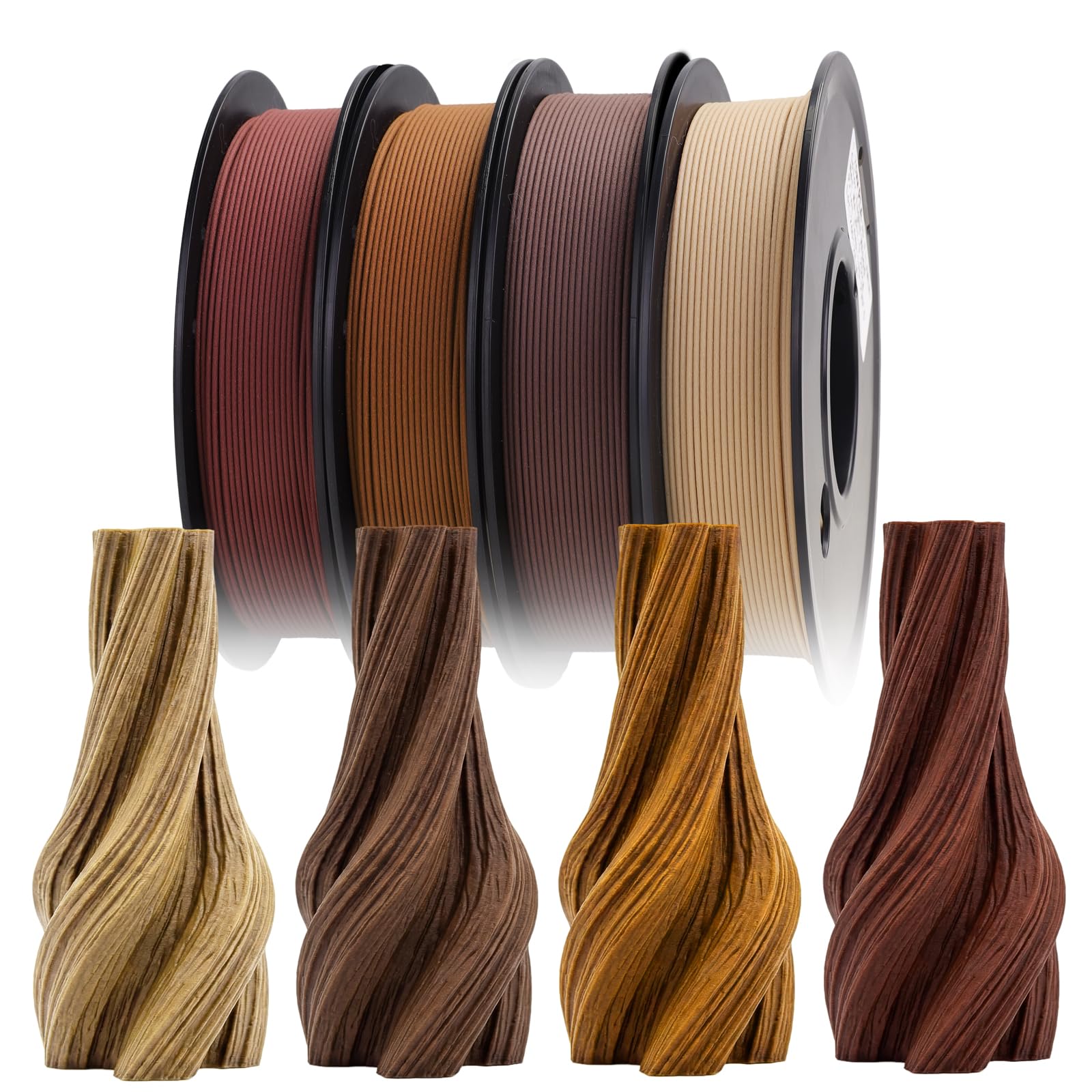
Semdon Wood PLA 4-Pack

90 /100
LBD Score Outstanding

Key details

Wood Fiber
30% real wood
Wood Tones
Maple, mahogany, walnut, cherry
Spool Format
4 × 250 g
Filament Diameter
1.75 mm
View on Amazon

Four 250-gram spools, each in a different wood tone, is the most useful format we found for wood PLA. Maple, mahogany, walnut, and cherry let you print a set of small models without buying a kilogram of a color that turns out wrong on your printer. The 30% real wood fiber gives a matte surface with visible texture, and each spool is individually vacuum packed.

We like the way the four tones sit next to each other: maple is pale and clean, cherry warms up under light, and walnut is dark enough to carry a small object on its own. The blend sands to a softer, warmer surface than plain PLA, which is the point of paying for wood fiber. The detail holds up on small decorative pieces, and the spools feed without the aggressive tangling that makes some samplers frustrating.

This is a specialty material, so plan to dry it and keep a hardened nozzle on the printer. The reward is a finish that takes sanding and stain better than a wood-color PLA. For a full kilogram of one tone, the iSANMATE spool is the better shape; for comparing four woods in one sitting, this is the set we reach for. The four small reels also take up less shelf space than a row of full-size spools, which helps in a crowded print area.

Pros

  • Four real-wood tones in one box
  • 30% wood fiber gives a matte, sandable finish
  • Individually vacuum packed
  • Strong color and print quality

Cons

  • 250 g spools run out quickly
  • Some spools arrive brittle or unevenly wound
Our verdict

We recommend the Semdon four-pack as the best overall wood PLA for most people: four real-wood tones let you test finishes without committing to a full kilogram.
Check Latest Price
2

Best Single-Spool Wood Fiber

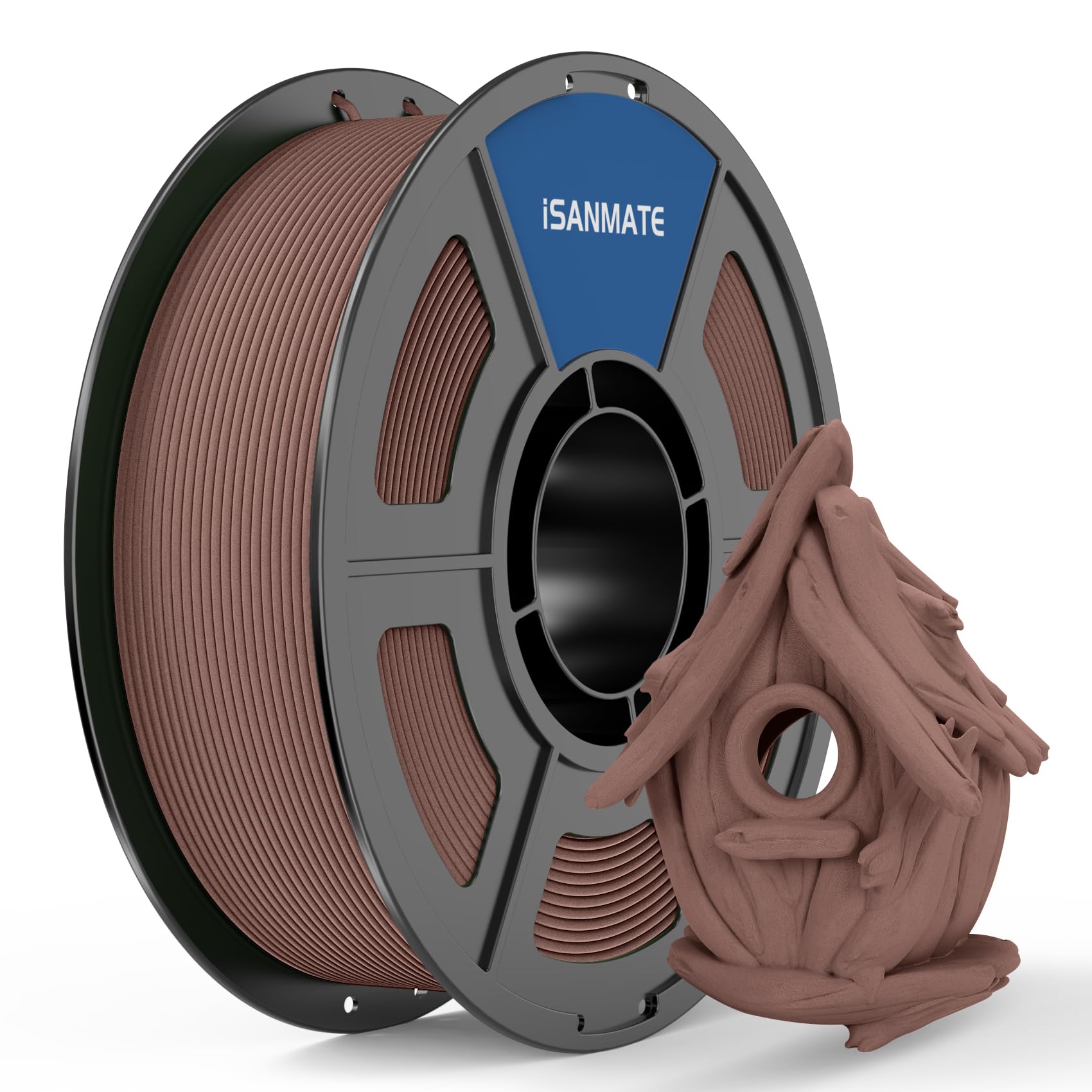
iSANMATE Wood PLA Walnut

89 /100
LBD Score Excellent

Key details

Wood Fiber
30% real wood
Spool Format
2.2 lb
Diameter Tolerance
±0.02 mm
Nozzle Recommendation
>0.4 mm hardened steel
View on Amazon

A full kilogram of one wood tone is the opposite of a sampler, and that is why the iSANMATE spool earns a place. The walnut variant uses 30% real wood fiber, holds a ±0.02 mm diameter tolerance, and is wound to work with Bambu Lab printers and AMS. That makes it the pick when you have a single project in mind and you do not want to splice small spools.

We like that the color reads as walnut without a stain. The finish is matte and slightly grainy, and light sanding brings out the grain instead of polishing it into plastic. The 1 kg spool gives you enough for a box, a lamp base, or a set of coasters without a color change mid-print. It is also a cleaner, deeper look than the brighter cherry and maple tones in the Semdon set.

The trade-off is flexibility: one spool, one tone. If you want to compare four woods, the Semdon bundle is more useful. Wood fiber also needs a hardened nozzle and a dry spool, so plan for that setup. The 1 kg spool is easier to store than four small reels and leaves less partial filament behind.

Pros

  • Full kilogram of one wood tone
  • 30% real wood fiber with ±0.02 mm tolerance
  • AMS/Bambu-friendly winding
  • Matte walnut finish takes sanding

Cons

  • One tone per spool
Our verdict

We recommend the iSANMATE walnut spool when you need a full kilogram of one real-wood tone for a single project with AMS-friendly winding.

Check Latest Price
3

Best Easy-Printing Wood Tone

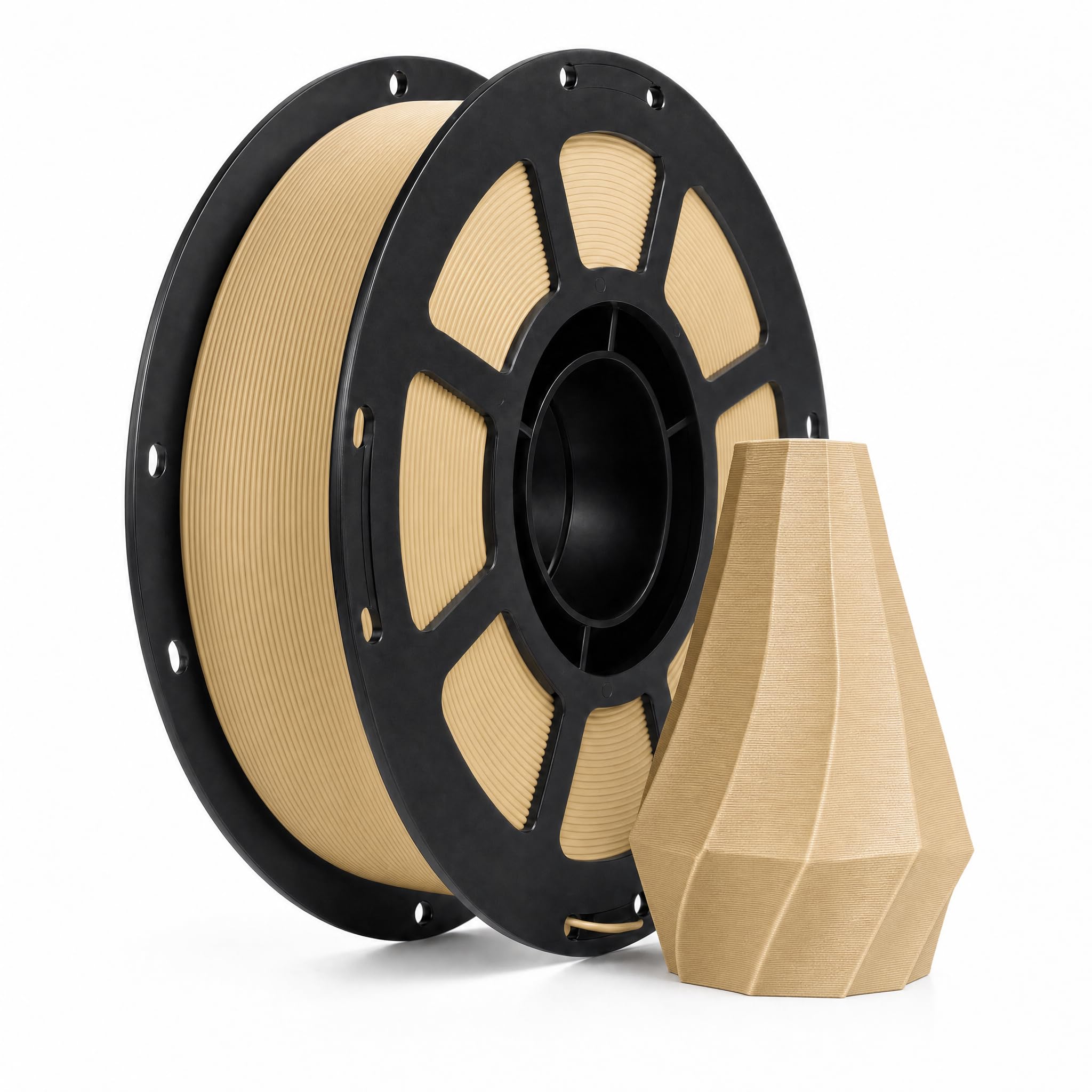
SUNLU PLA+ 2.0 Oak

94 /100
LBD Score Outstanding

Key details

Material
PLA+ 2.0
Spool Format
2.2 lb
Max Print Speed
300 mm/s
Diameter Tolerance
±0.02 mm
View on Amazon

This is not a wood-fiber filament, and that is the point. SUNLU's PLA+ 2.0 in Oak is a wood-colored PLA+ for buyers who want the warm tone without the abrasive, moisture-hungry behavior of real wood powder. It prints at up to 300 mm/s and holds ±0.02 mm, so it behaves like a modern PLA+ rather than a specialty material.

We like it for furniture models, tool holders, and anything that needs a wood color but not a wood surface. The finish is smooth, not grainy; if you want visible grain, go with a fiber blend. The 1 kg spool gives you enough for a full project, and the oak tone is consistent from start to finish. It is the spool we hand to someone who wants the look without a new set of printing habits.

The trade-off is authenticity. It looks like oak paint, not oak. The winding and bed adhesion are not as consistent as the print profile suggests, so check the first layer and keep the spool path clear. For fuss-free wood-tone prints, the fast print profile is the real luxury: you can treat it like ordinary PLA+ and save the slow, fussy settings for fiber blends.

Pros

  • Wood-color PLA+ without wood-fiber fuss
  • Fast printing up to 300 mm/s
  • ±0.02 mm diameter tolerance
  • Consistent oak tone on a 1 kg spool

Cons

  • Smooth finish, no real wood grain
  • Winding and bed adhesion can vary
Our verdict

We recommend the SUNLU PLA+ 2.0 Oak when you want a warm wood color and easy PLA+ printing without the abrasion and drying demands of real wood fiber.

Check Latest Price
4

Best Bulk Bundle

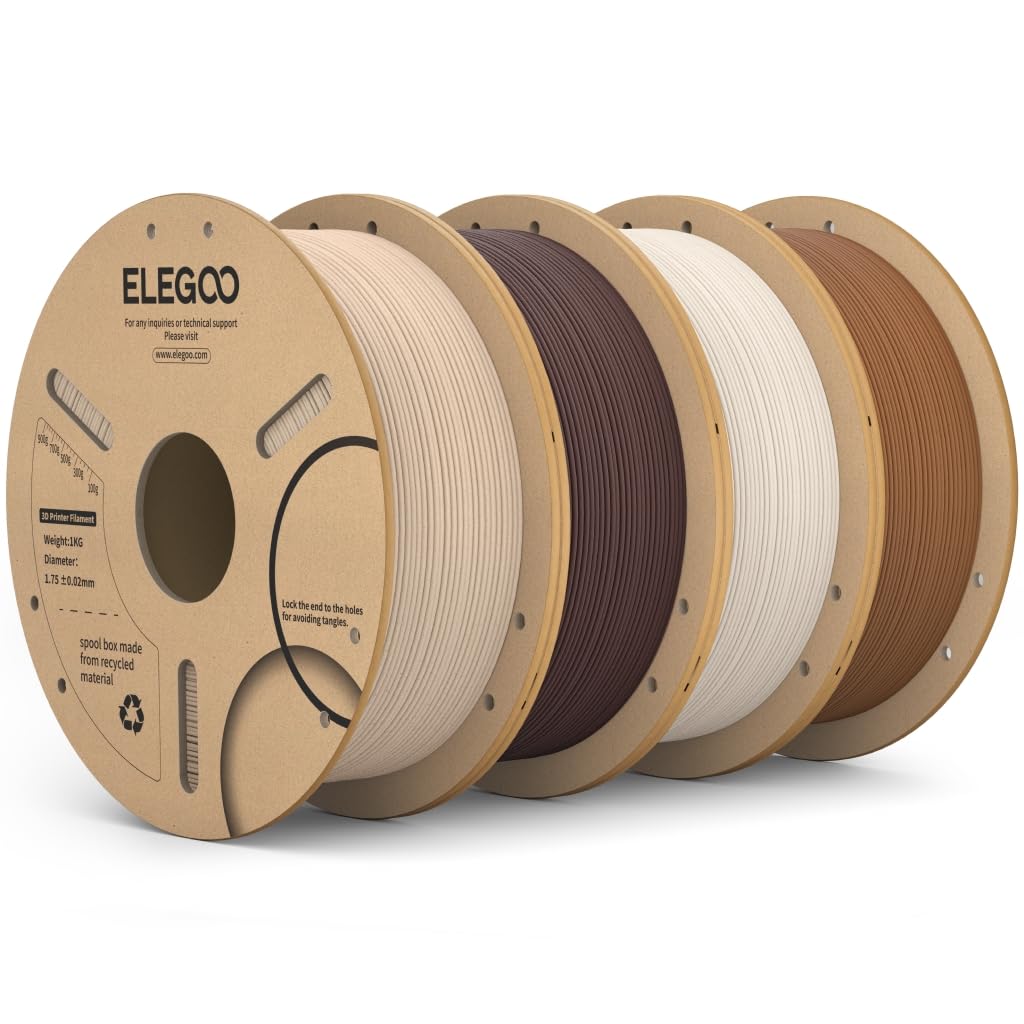
ELEGOO Wood PLA 4-Pack

88 /100
LBD Score Excellent

Key details

Wood Tones
Oak, rosewood, walnut, tan birch
Spool Format
4 × 1 kg
Wood Content
Real wood powder
Filament Diameter
1.75 mm
View on Amazon

Four full kilogram spools in one box is the reason the ELEGOO set exists. Oak, rosewood, tan birch, and walnut cover the warm end of the wood spectrum, and the real wood powder gives a matte finish that reads as stained lumber rather than plastic. The 4 kg total is the largest amount of wood-fiber filament here by a wide margin.

We appreciate the dimensional accuracy and the vacuum sealing, and the 1 kg format is the right one for larger decorative builds: a full-size box or a set of panels won't stall halfway through for a spool change. The finish is consistent across the four tones, which matters if you are building one object from more than one color. The spools also fit standard holders without the wobble of a tiny sampler.

Clogging is the caveat. Wood powder makes the filament abrasive, and a hardened nozzle and a slower profile are not optional. We treat this as a spool for experienced users with a dedicated wood setup, not a first wood PLA. Dry it before use, print slower than with plain PLA, and clear the hot end if the flow starts to pulse. If you want four tones without the bulk and the clog risk, the Semdon sampler is the safer first step.

Pros

  • Four 1 kg spools in four wood tones
  • Real wood powder for a matte finish
  • Consistent 1.75 mm diameter
  • Vacuum sealed for moisture protection

Cons

  • Clog risk with wood powder
  • Four-spool buy is a big commitment
Our verdict

We recommend the ELEGOO set for experienced makers who need four full kilograms of real-wood tones and can manage the clog risk with a hardened nozzle.

Check Latest Price
5

Budget Wood-Tone Spool

HOTFINE PLA+ Wood

83 /100
LBD Score Excellent

Key details

Material
PLA+
Spool Format
2.2 lb
Print Temperature
200–220°C
Diameter Tolerance
±0.02 mm
View on Amazon

The budget spool of the group is also the one that most often surprises people on color. HOTFINE's PLA+ in Wood is a full kilogram at the lowest price here, with ±0.02 mm tolerance and a 200–220°C print window. It behaves like a standard PLA+ rather than a wood-fiber blend: smooth, easy to feed, and not abrasive.

We like it for jigs, organizers, and painted models where the exact wood tone matters less than the cost per spool. The color is lighter and more off-white than the listing photo suggests, so do not buy it expecting a deep oak. The light color gives you a neutral base for primer and paint, which is the workaround: prime it, paint it, and the mismatch disappears.

The winding is the other weak spot. Some spools arrive tightly wound and print fine; others need babysitting. We keep the spool on a smooth holder and check the first layer. For a budget wood-tone spool that you plan to paint, it earns its place; for a bare wood finish, spend more on a fiber blend. It is a spool for testing a wood-tone idea, not for a showpiece.

Pros

  • Lowest-cost 1 kg wood-tone spool here
  • Standard PLA+ behavior, no wood fiber
  • ±0.02 mm tolerance
  • 200–220°C print window

Cons

  • Color runs lighter than photos
  • Winding can be inconsistent
Our verdict

We recommend the HOTFINE spool as the budget wood-tone choice for painted parts, as long as you accept a lighter color and variable winding.

Check Latest Price
6

Oak and Teak

OVV3D Wood PLA 4-Pack

87 /100
LBD Score Excellent

Key details

Wood Fiber
Over 30% real wood
Wood Tones
Walnut, oak, cherry, teak
Spool Format
4 × 200 g
Diameter Tolerance
±0.03 mm
View on Amazon

Teak and oak are the reason to look at this bundle. Most wood PLA samplers lean on maple, cherry, and walnut; OVV3D swaps in teak and oak alongside walnut and cherry, which is useful if you are matching a specific furniture finish. The 200 g spools are small even by sampler standards, but they are enough for color chips, small boxes, and test prints.

The blend carries more than 30% real wood fiber, and the matte surface has a dry, fibrous look that takes stain. We like the paper spools and the compact format for storage. The four tones are close enough to real lumber that a set of coasters reads as a set, not a color experiment. That is the strongest argument for this bundle over a generic wood-color PLA.

Bed adhesion is where it loses ground to the Semdon set. The first layer can be fussy, so slow it down, clean the bed, and use a brim on tall parts. If you need teak or oak specifically, it is worth the extra setup; if you just want a reliable four-tone sampler, the Semdon is the safer pick. The teak tone is the one that justifies the fuss.

Pros

  • Teak and oak tones in one bundle
  • Over 30% real wood fiber
  • Matte, stainable surface
  • Paper spools and compact storage

Cons

  • First-layer adhesion can be fussy
  • 200 g spools are small
Our verdict

We recommend the OVV3D bundle when teak or oak is the finish you need, and you are willing to slow down the first layer to get it.

Check Latest Price

How We Tested Wood PLA Filament

We started with every wood-fiber PLA we could find that stated a fiber percentage, published a diameter tolerance, and came on a spool size a home printer could actually finish before it went stale, then cut anything that read like standard PLA with brown pigment stirred in. That left 16 spools over four months: single rolls and multicolor bundles covering maple, cherry, walnut, mahogany, oak, teak, rosewood, and birch. Two of them are wood-toned PLA+ rather than fiber-filled, which is a real distinction in this category — they print smoother and tougher but show no grain — so we judged them on those terms instead of holding them to a wood look they never promised.

Every spool went onto the same two printers and printed the same short lineup: a 20mm cube to check dimensional accuracy, a spiral vase planter to read surface and color, and a small overhang-heavy figure. Half ran through a 0.4mm nozzle and half through a 0.6mm so we could log who clogged and who sailed through. First layers went down on textured PEI and on bare glass, and we noted which spools needed glue stick or a brim to hold. We measured diameter with calipers at five points per spool and flagged any roll that crossed over itself, because a tangle at hour six of a nine-hour print is the failure that stings.

After printing, we sanded one sample and stained another to see whether the grain deepened or muddied, and set the finished planters side by side in daylight to compare color against the same species name from other makers. We flexed thin test bars until they snapped to gauge brittleness, and we weighed every spool on a kitchen scale to work out real cost per gram, since a 200g sampler and a 1kg roll are not the same purchase. Spools sat open on a shelf between prints, and we tracked which ones started popping and stringing first.

How to Choose Wood Pla Filament

Real Wood Fiber vs. Wood Color

Wood-fiber PLA blends ground wood powder into the polymer. That is what gives a matte, slightly grainy surface you can sand and stain, and it is why these spools are more abrasive and more moisture-sensitive than ordinary PLA. A wood-color PLA+ has the warm tone but a smooth, plastic finish; it prints faster and clogs less, but it will not look like lumber up close. Choose fiber for decorative pieces where the surface is the point. Choose wood color for jigs, organizers, or painted models where you want the tone without the fuss. The Semdon four-pack sits on the fiber side of that line; the SUNLU PLA+ Oak sits on the color side.

Spool Size and Project Size

A 250 g spool is a sample, not a workhorse: it suits color chips, small figures, and a few decorative pieces, and a large box or lamp can use one up before the print is done. A 1 kg spool is the right unit for a single-tone project, while a four-spool bundle of 1 kg reels only makes sense if you already know you will use the colors. Count the grams your slicer estimates, then add a margin for purge and failed first layers. If you are testing tones, buy the smallest spools that let you compare; if you have committed to one tone, buy the kilogram.

Nozzles, Drying, and Clog Prevention

Wood fiber is abrasive. A hardened steel nozzle in 0.4 mm or larger is the practical minimum; brass will wear, and a 0.6 mm nozzle gives the fibers more room to pass. Dry the spool before a long print, especially if the vacuum seal is loose or the spool has been open for a while. Print slower and cooler than with plain PLA, and keep retraction modest. If a spool starts to clog, cut the filament above the nozzle, clear the hot end, and dry the spool before trying again.

Check the Spool Against Your Printer

Small sampler spools can be too narrow or too light for a spool holder, and some automated material systems reject nonstandard hubs. Measure the spool diameter and hub before you buy, especially if you use an AMS or a closed filament path. Bed adhesion is the other variable: wood-fiber blends often need a clean plate, a slower first layer, and a brim on tall parts. A glue stick or textured plate can help, but fix the first layer before you blame the filament.

Frequently Asked Questions

Final Verdict

Our pick for most people is the Semdon four-pack. It gives you four real-wood tones in spools small enough to test without committing a full kilogram to a color that might not suit your printer, and the 30% wood fiber gives the matte, sandable surface that makes wood PLA worth the extra care.

The 250 g format is the limitation: if your project needs a full kilogram of one tone, the iSANMATE walnut spool is the better shape. And if you want the warm oak look without wood-fiber clogging and drying, the SUNLU PLA+ 2.0 Oak is the easy button.