Best Wired Gaming Headsets of 2026

Wired headsets haven't gone anywhere: no charging, no pairing, no half-second hitch when footsteps come around a corner. What you trade is the cable and, more often than shoppers expect, the microphone — usually the first place a manufacturer saves money. Over six months I wore 12 of them through long sessions on PC, console, and a Switch balanced on my knees on the train, and the ones worth buying got the boring things right.

The spec that sells a headset is rarely the spec that keeps it in rotation. A bigger driver doesn't fix a mic that sounds like a drive-thru speaker, and surround processing usually only works over USB — so the 3.5mm jack that fits everything may not deliver the positional audio you were promised. Clamp force, cushion foam, and a mute switch you can find without looking matter more by month three than anything printed on the box.

The picks below survived all of it: solo campaigns, party chat, and whatever machine you plug into tonight.

1

Best Overall

HyperX Cloud III

88 /100
LBD Score Excellent

Key details

Mic
Detachable 10 mm
Weight
10.9 oz
Drivers
53 mm angled
Connection
3.5 mm, USB-C, USB-A
View on Amazon

Three ways to plug in is the reason this is our default: a 3.5 mm jack for a controller, USB-C for a laptop, and USB-A for a desktop. The frame is aluminum, the microphone detaches completely for solo sessions, and the whole thing carries a two-year warranty. That combination is what a wired headset has to do if it's going to follow you between a console in the living room and a PC upstairs.

Comfort is HyperX's long suit, and the memory foam pads hold up across a long evening — but 308 g isn't the lightest thing here, and the Razer and the JBL both undercut it. We also found the headband runs snug. If you wear glasses or have a wide head, give it an evening before you decide, and expect the clamping to ease as the pads soften.

The angled 53 mm drivers are the largest in this set, and they're tuned flat rather than bass-heavy. Footsteps and reloads sit forward of explosions, which is exactly right in a shooter and a little dry in a single-player campaign. The 10 mm mic has a mesh filter and does its best work a thumb's width from the corner of your mouth; through USB on a PC you also get DTS spatial audio.

What you give up is novelty: no lighting, no software tricks beyond the spatial toggle, and a fit that favors average heads over very large ones. For someone who wants one headset covering a console and a computer and then stops thinking about it, that's a good trade.

Pros

  • 3.5 mm, USB-C, and USB-A in one headset
  • Aluminum frame holds up better than plastic
  • Detachable 10 mm mic with mesh filter
  • Memory foam pads stay comfortable for hours

Cons

  • 308 g, heavier than the lightest picks here
  • Snug headband on larger heads
Our verdict

If you want one wired headset that works on a PC, a PS5, and a Switch without an adapter, this is the one we hand people — sturdy, comfortable, and clear on voice chat.

Check Latest Price
2

Best Budget

Razer BlackShark V2 X

89 /100
LBD Score Excellent

Key details

Weight
8.47 oz
Drivers
50 mm titanium
Surround
7.1 on Windows
Connection
3.5 mm
View on Amazon

At 240 g this is roughly 68 g lighter than our top pick and about two-thirds the price, and over a four-hour session that's the difference you actually feel. It's the headset we point at anyone who wants to spend as little as possible without landing in the anonymous budget tier.

Sound is where it earns the recommendation. The titanium-coated 50 mm drivers are lively and clear, positional cues come through well enough to place a shooter's footsteps, and the closed cups seal out a room without any electronics involved. The 7.1 surround is software on Windows 10 64-bit only, so console players get stereo — good stereo, but stereo.

The HyperClear cardioid mic does the job in a squad chat, and the boom is the piece to watch over the long term. The cable runs 1.3 m, which is controller length rather than desk length; Razer includes an audio/mic splitter cable, and on a tower with separate jacks you'll need it. That's a workaround, not a dealbreaker.

Pros

  • Light 240 g frame for long sessions
  • Lively, clear 50 mm drivers
  • Includes an audio/mic splitter cable
  • Passive isolation seals out room noise

Cons

  • 7.1 surround only on Windows 10 64-bit
  • Leatherette earcups get warm
Our verdict

Spend as little as you can while still getting sound we're happy to game on — just know the surround effect is a Windows-only extra and the mic boom is the wear item.

Check Latest Price
3

Best for Console Gaming

Turtle Beach Recon 70

89 /100
LBD Score Excellent

Key details

Mic
Flip-to-mute
Drivers
40 mm
Controls
On-ear volume
Connection
3.5 mm
View on Amazon

If there's a PS5 in the living room and an Xbox in the bedroom, this is the headset that hops between them without a second thought: one 3.5 mm plug, no software, no pairing, no battery.

The flip-to-mute boom is the feature we appreciate most. Flipping the mic up is faster than hunting for a button mid-match, and the volume wheel sits on the earcup where your thumb already rests. Sound is clear and a little mid-forward, which suits chat and footsteps, and the noise-isolating cushions take the edge off a shared room without pretending to be active noise cancellation.

It's built to a price and feels like it, which is the honest trade at this end of the market. On a desktop with separate headphone and mic jacks you'll need a Y splitter, and the boom doesn't come off, so these can't double as plain headphones on a commute. For a second headset, a spare for a kid, or a first setup that has to work on three consoles, it makes more sense than stretching for our top pick.

Pros

  • Flip-to-mute boom is quick mid-match
  • On-ear volume wheel within thumb reach
  • Works on PS5, Xbox, Switch, and PC
  • Clear, chat-forward sound

Cons

  • Boom mic doesn't detach
  • Desktops with separate jacks need a splitter
Our verdict

The simplest way into console chat we found: one plug, a flip-to-mute boom, and nothing to configure before you're in a lobby.

Check Latest Price
4

Best USB-C

Razer Kraken V4 X

88 /100
LBD Score Excellent

Key details

Mic
Retractable cardioid
Weight
14.1 oz
Drivers
40 mm TriForce
Connection
USB-C, USB-A
View on Amazon

There's no 3.5 mm jack here at all, which rules out an Xbox controller and any phone without USB-C. If your setup is a PC or a PS5 with a free USB port, that constraint flips into the reason to buy: one cable, digital audio, and no splitter to lose.

We like the retractable mic more than we expected to. It slides back into the earcup when you're not talking, so it isn't parked in front of your face during a solo campaign, and it pulls out far enough to sit properly. The cardioid pickup stays focused on your voice rather than the room, and Chroma lighting runs around the cups if you want the look.

Comfort is where it asks something back. At 400 g it's the heaviest headset in this group, well over the Razer two slots up, and the hybrid fabric-and-leatherette pads only partly make up for the mass. Sound from the 40 mm TriForce drivers is bright and clear for games, with 7.1 processing through Razer's Windows software. On a desk where it never leaves the cable, the weight is easy to ignore; around your neck between rounds, it isn't.

Pros

  • Retractable mic tucks into the earcup
  • USB-C with a USB-A adapter in the box
  • Clear, bright TriForce tuning with 7.1

Cons

  • No 3.5 mm jack, so no Xbox support
  • Heaviest headset in this group at 400 g
Our verdict

The wired headset we point at a USB-C desk — a mic that disappears when you're not using it, traded against real weight and no Xbox support.

Check Latest Price
5

Long Solo Sessions

Logitech G335

88 /100
LBD Score Excellent

Key details

Weight
8.47 oz
Drivers
40 mm
Headband
Suspension
Connection
3.5 mm
View on Amazon

At 240 g on a suspension band, this is the headset that stops reminding you it's there. The elastic band spreads the load instead of clamping down, and the sports-mesh pads breathe in a way the leatherette picks here don't.

That comfort is the whole argument, and it's a strong one if you wear a headset for five hours at a stretch. Sound from the 40 mm drivers is clean but lean; the missing low end is most obvious in a big single-player score, and the volume ceiling sits lower than we expected. The roller on the earcup is easy to find without looking.

The catch is the microphone. Flip-to-mute works exactly as it should, but voice pickup is the thinnest of the headsets in this group, and the people you play with will notice before you do. If you play solo, or you already have a standalone mic, that's a trade worth making; if your evenings are squad nights, put the money toward the Razer or the HyperX instead.

Pros

  • 240 g on a weight-spreading suspension band
  • Mesh pads stay cool over long sessions
  • Flip-to-mute with an on-ear volume roller

Cons

  • Mic pickup is the weakest in this group
Our verdict

Buy it for comfort and solo sessions — 240 g you forget about within an hour — and accept that voice chat is the thing it does least well.

Check Latest Price
6

Streaming-Grade Voice

Logitech G PRO X

88 /100
LBD Score Excellent

Key details

Mic
Detachable Blue VO!CE
Weight
9.14 oz
Drivers
50 mm
Connection
USB and 3.5 mm
View on Amazon

This is the most expensive headset in our group, and the money goes to one place: the microphone. The detachable boom runs through Blue VO!CE in Logitech's software, which gives you a noise reducer, compressor, and limiter — the closest thing here to a broadcast chain.

On a Windows PC with the included USB sound card, that's a real upgrade: voices come out fuller and the clatter of a mechanical keyboard drops away. Without the card, plugged in over 3.5 mm, it's an ordinary boom mic and the software features simply aren't there.

The rest of the package is genuinely nice. Aluminum forks, a steel headband, two sets of memory foam pads, a case, and cables with inline volume and mute. We swapped to the velour pads for a long session and left them on — they breathe better than the leatherette set, which matters more than the slightly looser seal.

The reservation is durability. The headband ends can crack under heavy handling, and at this price that's hard to accept. If voice quality is the reason you're buying and you look after your gear, it delivers; if the headset lives loose in a backpack, the HyperX is the safer spend.

Pros

  • Blue VO!CE processing on the mic
  • Aluminum forks and a steel headband
  • Ships with velour and leatherette pads plus a case

Cons

  • Blue VO!CE needs the USB card and a Windows PC
  • Headband ends can crack under heavy handling
Our verdict

Worth the premium only if your voice is the point and you're on Windows — the Blue VO!CE chain is the reason, and the headband is the risk.

Check Latest Price
7

Controllers and Laptops

JBL Quantum 100M2

80 /100
LBD Score Excellent

Key details

Mic
Detachable directional
Weight
7.76 oz
Drivers
40 mm
Connection
3.5 mm
View on Amazon

Pop the mic off and this becomes a pair of 220 g headphones you can wear on a train — which is more than most budget gaming headsets can claim.

At 220 g it's the lightest headset on this list, and the fabric-and-memory-foam pads are why it stays pleasant through a long evening. Sound is the weak spot: the 40 mm drivers are clear through the mids but thin on bass, and the volume ceiling sits lower than the rest of the group. Spatial audio comes from Windows Sonic on PC and Xbox rather than from anything inside the headset.

The cable is short. On a controller it reaches fine; on a desktop tower it may not, and if your PC has separate headphone and mic jacks you need a splitter on top of that. For a console or a laptop none of it matters, and the directional mic with its windshield foam keeps your voice ahead of the room.

So this is a budget pick for a controller, not a desk. The detachable mic and the low weight are the two things nothing else at this price offers, and the cable and the bass are what you accept in exchange — neither shows up in a controller-and-couch setup.

Pros

  • Lightest headset here at 220 g
  • Detachable mic turns it into headphones
  • Cross-platform 3.5 mm on PC, console, and mobile

Cons

  • Short cable limits desktop use
  • Thin bass
Our verdict

The lightest headset we tested here, and the only budget one with a detachable mic — great on a controller, cramped on a desktop.

Check Latest Price
8

Kids' First Headset

BENGOO G9000

88 /100
LBD Score Excellent

Key details

Mic
Omnidirectional
Weight
9.6 oz
Drivers
40 mm
Connection
3.5 mm
View on Amazon

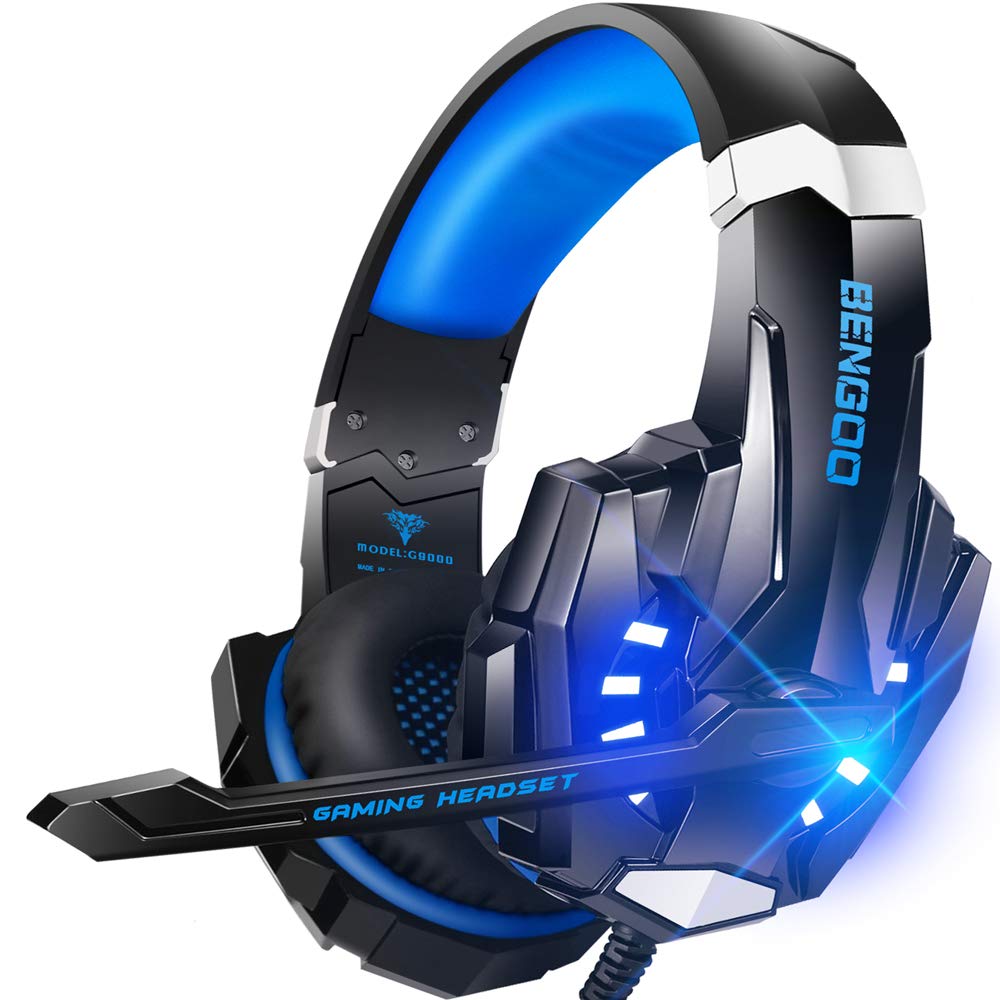
Blue LED rings, a braided cable, and a rotary volume dial on the cord: the G9000 looks like the gaming headset a twelve-year-old would draw, and that's largely who ends up wearing it.

What the least expensive headset here gives you is more than you'd expect: 40 mm drivers tuned warm and loud, closed cups that knock down a shared room, rotary volume and mute on the cable, and a two-year warranty that outlasts several pricier headsets in this group.

This is the one we hand to a kid or a visitor without worrying about what comes back. It's comfortable for a couple of hours at a stretch, the closed cups do a surprising amount of isolation work, and nothing about it needs configuring before it works.

The microphone is the weak link. It's omnidirectional, so it picks up the room alongside your voice, and clarity sits a step behind everything else on this list. The 49-inch cable is short for a desktop, too. For party chat and a first setup both are liveable; for anything competitive, they aren't.

Pros

  • Warm, loud sound well above its price
  • Two-year warranty
  • Closed cups block a fair amount of room noise
  • Rotary volume and mute on the cable

Cons

  • Omnidirectional mic picks up the room
  • 49-inch cable is short for a desk
Our verdict

The one to buy when a kid needs a first headset on a tight budget: loud, comfortable, and covered for two years, with the mic as the compromise.

Check Latest Price

How We Tested the Best Wired Gaming Headsets

We built the shortlist from spec sheets and a few thousand customer reviews, then filtered by connection type, platform support, and mic design so the 12 units spanned 3.5mm plugs, USB-C and USB-A connections, flip-to-mute booms, and detachable mics. Testing ran six months, every headset did the same rounds, and we compared what each one gave you for the money.

The microphone got the most attention because it's the part that fails first. I recorded the same paragraph of speech on each headset twice — once in a quiet room, once with a fan running and a keyboard clacking — then played the clips back through cheap earbuds to hear what a teammate actually hears. Each mute switch had to be found in the dark 20 times, and every boom arm was bent to its limit weekly to see which ones went slack or started to crackle.

For sound, I cycled through the same matches and the same playlist, noting whether footsteps sat above or under the bass and whether explosions swallowed callouts. Comfort got a four-hour stretch per headset, with and without glasses, watching for clamp headaches and hot ears. I also noted how much room noise leaked in, and how much of my room leaked back out through the mic.

Durability was the unglamorous half: each set was coiled into a backpack with a laptop, carried on a commute, dropped on hardwood, and twisted at the headband. By month six I could see which cables were fraying and which shells had started to creak.

How to Choose a Wired Gaming Headset

Match the Plug to Your Hardware

3.5 mm is the universal answer: it works in a DualSense, an Xbox controller, a Switch, a laptop, and a desktop, which is why most of our picks use it. USB-C and USB-A buy you digital audio and software features, but they tie you to devices that accept USB audio — the Kraken V4 X doesn't list Xbox support, and that's the usual pattern with USB-only headsets.

On a desktop with separate green and pink jacks, budget for a Y splitter; the Razer BlackShark V2 X includes one, most others here don't. And treat 7.1 as software rather than hardware: it's processing on a Windows PC, while consoles run their own spatial audio through the same stereo jack.

Weight and Clamp Decide How Long You Last

Everything above 300 g starts to make itself known around hour three. Our lightest picks sit at 220 g and 240 g and effectively disappear; the 400 g Kraken V4 X is a desk headset, not a couch one. A suspension band spreads load better than a padded slider, and fabric or mesh pads run cooler than leatherette across a long evening.

If you wear glasses, prioritise a light clamp over deep cushions, because the arms of your frames break the seal either way. And give any new headset an evening before you judge it — pads soften and clamping eases with a few hours of wear.

Judge the Mic by Pattern, Not by Size

A cardioid mic rejects the room behind and beside it; an omnidirectional one picks up everything, which is why the cheapest headsets sound hollow in a busy room. The mount matters as much as the capsule: detachable and retractable booms let you place the mic close to your mouth, and flip-to-mute saves you a button hunt mid-match.

The strongest voice processing in this group is Logitech's Blue VO!CE, but it exists only over the included USB sound card on a Windows PC. Over 3.5 mm, that same mic is ordinary — worth knowing before you pay for it.

Build, Cable, and Warranty Are the Quiet Costs

Headsets fail at the joints: the headband ends, the pivot where the cup meets the fork, and the spot where the cable enters the cup. Aluminum forks and a steel band cost more and last longer, and several picks here carry a two-year warranty against one year for the rest.

Cable length is the other thing to check. Roughly 1.3 m is controller length, 2 m is desk length, and a 49-inch cord won't reach a tower sitting on the floor. If your PC has separate headphone and mic jacks, add a splitter to the total before you compare.

Frequently Asked Questions

Final Verdict

The HyperX Cloud III is the headset we recommend to most people: three connection types, an aluminum frame, a detachable mic, and a fit that survives a long evening. Buy the Razer BlackShark V2 X if the budget is tight — it's lighter and less expensive, and the only thing it really gives up is USB.

Console-first households can save more with the Turtle Beach Recon 70, and a USB-C desk with no Xbox in the house is the one place the Kraken V4 X earns its price.