Best Tire Pressure Monitoring Systems of 2026

A trailer tire almost never blows without warning. It heats up, loses a few pounds, and telegraphs the problem for miles — a warning you'll miss entirely if your only gauge lives in the glovebox. A tire pressure monitoring system puts that warning on your dash: sensors on the valve stems, a display up front, and an alarm that fires while a soft tire is still just soft.

I've towed behind a four-sensor kit that chirped at every rest stop and behind a color-screen unit I came to trust more than my handheld gauge. My team and I have now spent nine months with 11 systems — cap sensors, flow-through sensors, solar and USB models — and the gap is almost never in the sensors.

It's the display. Cheap kits wash out in noon sun, bury the pressure reading two menus deep, and ship with instructions written for someone who's done this before. Programming four sensors shouldn't eat an afternoon, and on the good ones it doesn't. The picks below run from ten-tire fifth wheels to single-axle campers.

1

Best Overall

TST 507 TPMS

88 /100
LBD Score Excellent

Key details

Display
3.5-inch color LCD
Warranty
3 years
Sensor Batteries
Replaceable CR2032
Sensors Included
4 cap sensors
View on Amazon

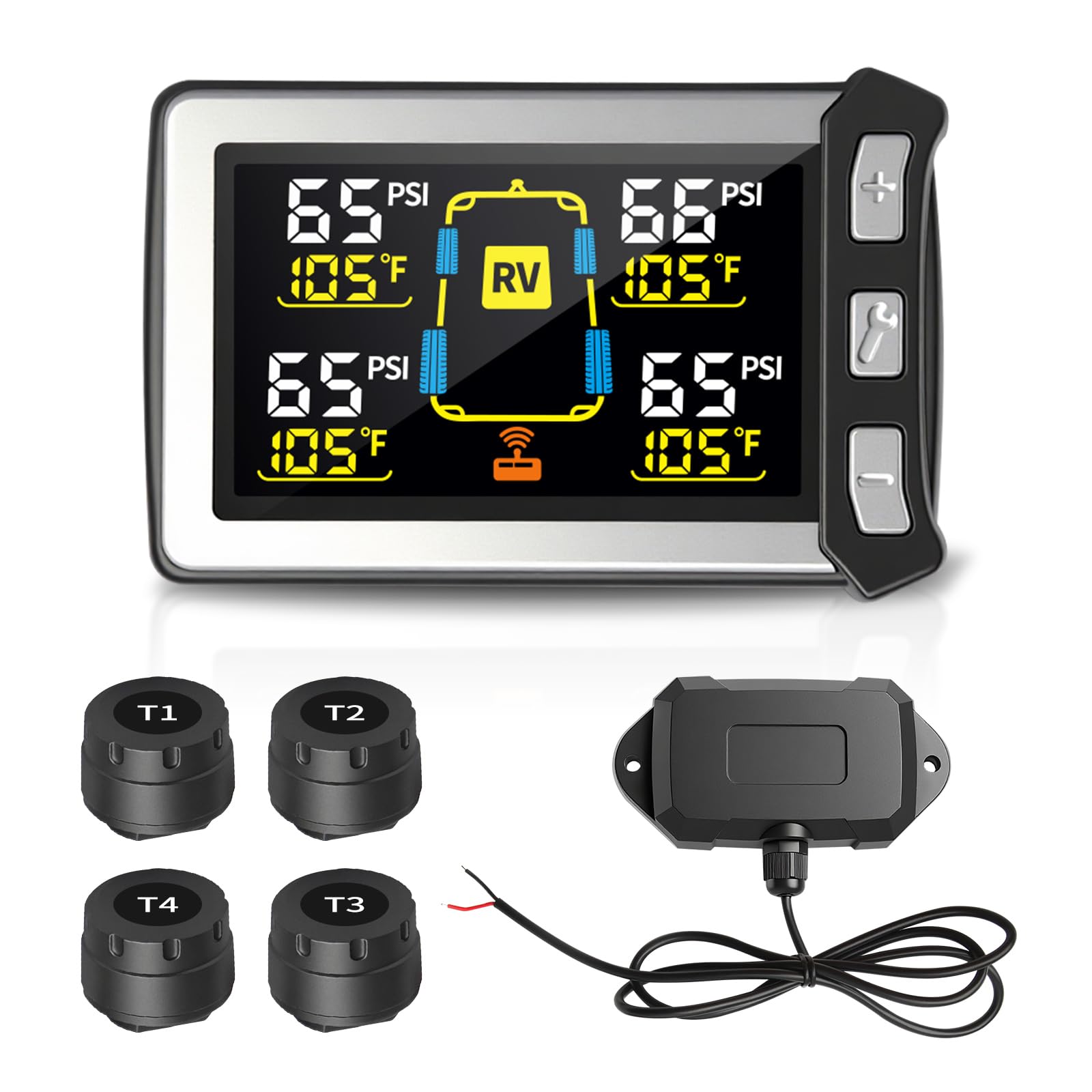
It's a premium kit in every sense, and it's still the one we tell trailer and motorhome owners to buy. The case for the 507 isn't a long feature list — it's a 3.5-inch color display that's readable at a glance, four cap sensors that pair without drama, and a three-year warranty with live U.S. support behind it. When a tire alarm is the difference between a pull-over and a shredded sidewall, that margin is worth paying for.

Setup is the part that won us over. The cap sensors thread onto the valve stems, pair to the monitor, and the display holds pressure and temperature for every tire on one screen instead of cycling through them one at a time. Alerts cover low pressure, high pressure, a fast leak, and high temperature, and the screen locks onto the problem tire when one fires — a small thing that matters a great deal when something starts beeping as you merge.

Two ownership details we've come to value: the sensor batteries are standard CR2032s you swap yourself, so a dead sensor doesn't mean buying a replacement, and the system expands to your tow vehicle plus several trailers, with tire positions you can reassign after a rotation. Mount the monitor where the windshield doesn't bounce light straight into it, because direct sun does wash the screen out.

The honest trade-off is sensor count. Four is right for a trailer and its tow vehicle and wrong for a rig with two axles behind you, and the money here goes into the display, the battery design, and the warranty instead. If you're watching ten tires, the GUTA below covers them for about the same money.

Pros

  • Display stays readable at a glance
  • CR2032 sensor batteries you replace yourself
  • Three-year warranty with U.S. support
  • Expands to multiple trailers

Cons

  • Premium price for four sensors
  • Cap sensors come off to add air
Our verdict

We recommend the TST 507 to anyone towing a trailer or driving a motorhome: a display you can read at speed, batteries you swap yourself, and three years of warranty.
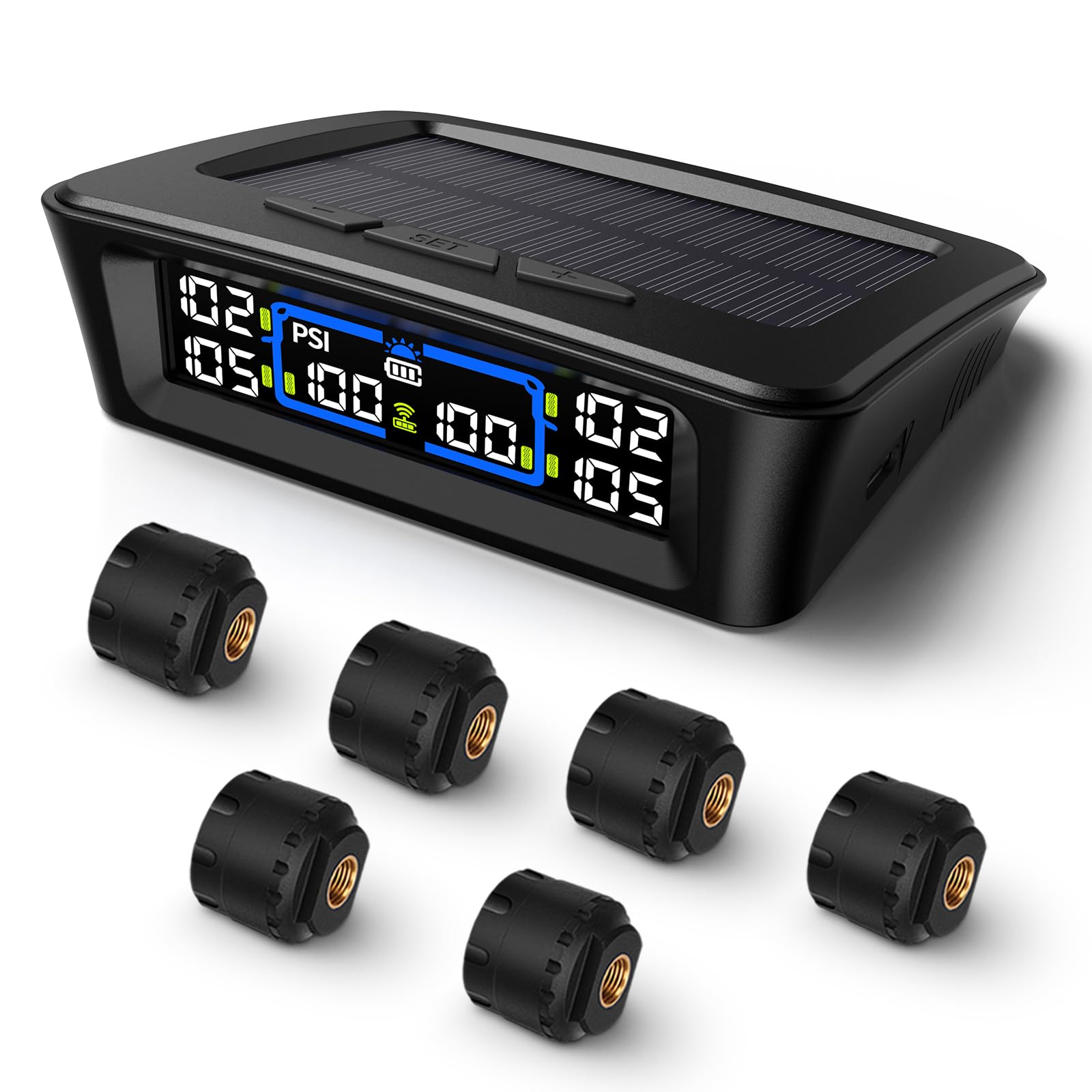
Check Latest Price
2

Best for Big Rigs

GUTA GT80

84 /100
LBD Score Excellent

Key details

Display
4.3-inch color touchscreen
Tire Capacity
Up to 22 tires
Pressure Range
0-188 PSI
Sensors Included
10 flow-through sensors
View on Amazon

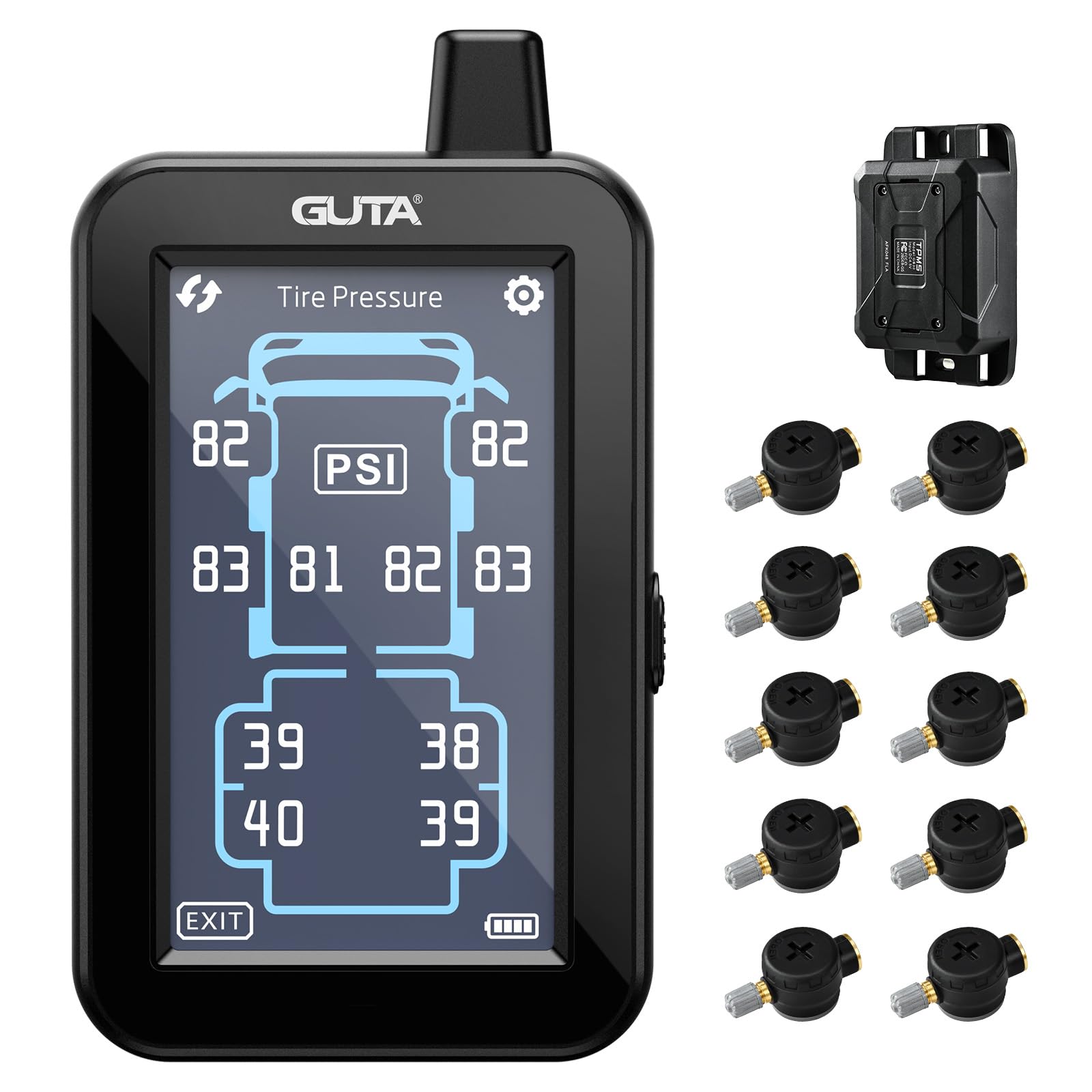
Ten flow-through sensors come in the box, and that single design choice is what makes the GT80 worth its premium. Flow-through caps let you add air without unscrewing the sensor, so a before-trip pressure check on a ten-tire rig becomes a walk-around with a chuck instead of a session on your knees.

The 4.3-inch vertical touchscreen is the other half of the appeal: it puts up to ten tires on one page, switches between front and rear groups on a longer rig, and lets you set high and low thresholds by tapping instead of punching through a three-button menu. Sensors arrive paired from the factory, and a signal booster is included for the run from the trailer axles to the dash.

We appreciated the power-saving behavior: the monitor sleeps when there's no motion and wakes on vibration, which is how a dash unit survives a winter parked without a dead battery. The sensors are also labeled for the tire they belong to, so a rotation doesn't turn into a guessing game.

Two things to plan for. The monitor is a chunky vertical unit and takes dash real estate a smaller screen doesn't, so measure before you commit a spot. And if a pressure tile blanks out while you're driving, give it a minute; if the same sensor keeps disappearing, that's a sensor to replace rather than a system to send back.

Pros

  • Flow-through sensors inflate without removal
  • Shows ten tires on one touchscreen
  • Sensors arrive paired, booster included

Cons

  • Bulky vertical monitor needs dash space
Our verdict

Our pick for a ten-tire rig is the GT80 — flow-through sensors turn a pressure check into a walk-around, and one touchscreen keeps every tire in view.

Check Latest Price
3

Best Six-Sensor Kit

Tymate TM12

83 /100
LBD Score Excellent

Key details

Power
Solar and USB-C
Tire Capacity
Up to 12 tires
Pressure Range
0-144 PSI
Sensors Included
6 sensors
View on Amazon

Six sensors, and a monitor that splits up to twelve tires across four screens: the TM12 is built for the truck-and-trailer combination where four sensors leave half the rig blind but a ten-sensor big-rig system is more than you need.

Installation is the easy part. The sensors come pre-programmed to their positions and calibrate themselves, so setup is screwing them onto the stems, setting the monitor on the dash, and driving. They're rated IP67, so rain and a pass through the car wash are not a concern. Solar handles charging on a sunny dash and USB-C covers the rest, so there's no 12V cord snaking across the cab.

Where this one earns its place against the TST is coverage per dollar: six sensors and up to twelve tires for a fraction of the premium kits. The 50-foot range is enough for most trailer-and-truck pairs; on a long fifth wheel, plan on Tymate's repeater to push past 100 feet. And check the readings against a good gauge after setup — external sensors can sit a few PSI off, and the thresholds you set should come from the gauge, not the screen.

Pros

  • Six pre-paired sensors, self-calibrating
  • Covers up to twelve tires
  • Solar and USB-C charging
  • IP67 sensor bodies

Cons

  • 50-foot base range needs a repeater on long rigs
Our verdict

For a truck-and-trailer pair, we like the TM12: six pre-paired sensors, twelve-tire coverage, and solar charging without big-rig money.

Check Latest Price
4

Best Budget Pick

Masoll M13

85 /100
LBD Score Excellent

Key details

Power
Solar and USB
Accuracy
±1.5 PSI
Pressure Range
0-99 PSI
Sensors Included
4 sensors
View on Amazon

Auto calibration is the reason we hand the M13 to people who don't want to learn a menu: set your tires to the pressure you actually run, and the monitor takes that as its baseline and builds the alarm thresholds around it. No scrolling PSI limits, no pairing sequence, no manual consulted on the shoulder.

What you get for a budget price is more than the basics — six alarm modes, a color screen that dims and brightens on its own, solar charging that keeps the display alive on the dash without a cord, and a listed ±1.5 PSI accuracy that's realistic for this class of sensor, close enough to catch a slow leak days before it becomes a roadside change.

The screen is the weak point in daylight. Bright sun on the face of the unit washes the numbers out, and the fix is to angle it down and out of the direct path of windshield light; do that and it's perfectly legible. Leave it flat on the dash facing the sky and you'll be squinting at exactly the moment you want a number.

The listed 99 PSI ceiling is the other boundary to respect — fine for a car, a pickup, or a travel trailer, not for a diesel pusher running past 100. Where this kit quietly shines is the small stuff: golf carts, utility trailers, a second vehicle that never had a factory monitor. It's an inexpensive way into pressure and temperature you can actually see.

Pros

  • Auto calibration builds its own thresholds
  • Solar keeps the display charged
  • ±1.5 PSI accuracy across four tires

Cons

  • One-year monitor warranty, six months on sensors
Our verdict

The M13 is the easiest budget recommendation here: it calibrates its own alarms, charges from the sun, and covers a car or small trailer without a manual.

Check Latest Price
5

Best for Long Trailers

Masoll XM-2

82 /100
LBD Score Excellent

Key details

Display
Color LCD, 4 brightness levels
Signal Range
Up to 120 ft with booster
Pressure Range
0-145 PSI
Sensors Included
4 sensors
View on Amazon

A repeater in the box is the reason this kit exists. Masoll rates the transmission at up to 120 feet with the booster in line, which is the difference between a monitor that holds all four trailer tires on a long fifth wheel and one that keeps losing the rear axle.

Setup is close to plug-and-play: the sensors arrive paired, the monitor charges from the dash or the sun, and the booster mounts near the trailer axles with the hardware in the box. The color screen has four brightness levels and reads fine in shade, and the menu is short enough to work through without the manual open on your lap.

Where the XM-2 needs a caveat is accuracy. Individual sensors on this kit can read several PSI high, and the error isn't always the same from wheel to wheel — which is fine once you know it. Compare all four against the same good gauge the day you install them and bake the offsets into your thresholds, and the alarms stay useful instead of nagging.

Pros

  • Repeater stretches range to 120 feet
  • Sensors arrive pre-paired
  • Four brightness levels on the display

Cons

  • Compact monitor takes a close look
  • About twice the price of Masoll's basic kit
Our verdict

Buy the XM-2 when your trailer is long enough that other kits lose the rear axle; the included repeater is what earns it a place.

Check Latest Price
6

Tight Budgets

LETOURWM M12-3

79 /100
LBD Score Very Good

Key details

Power
Solar and USB
Pressure Range
0-144 PSI
Sensing Distance
65 ft
Sensors Included
6 sensors
View on Amazon

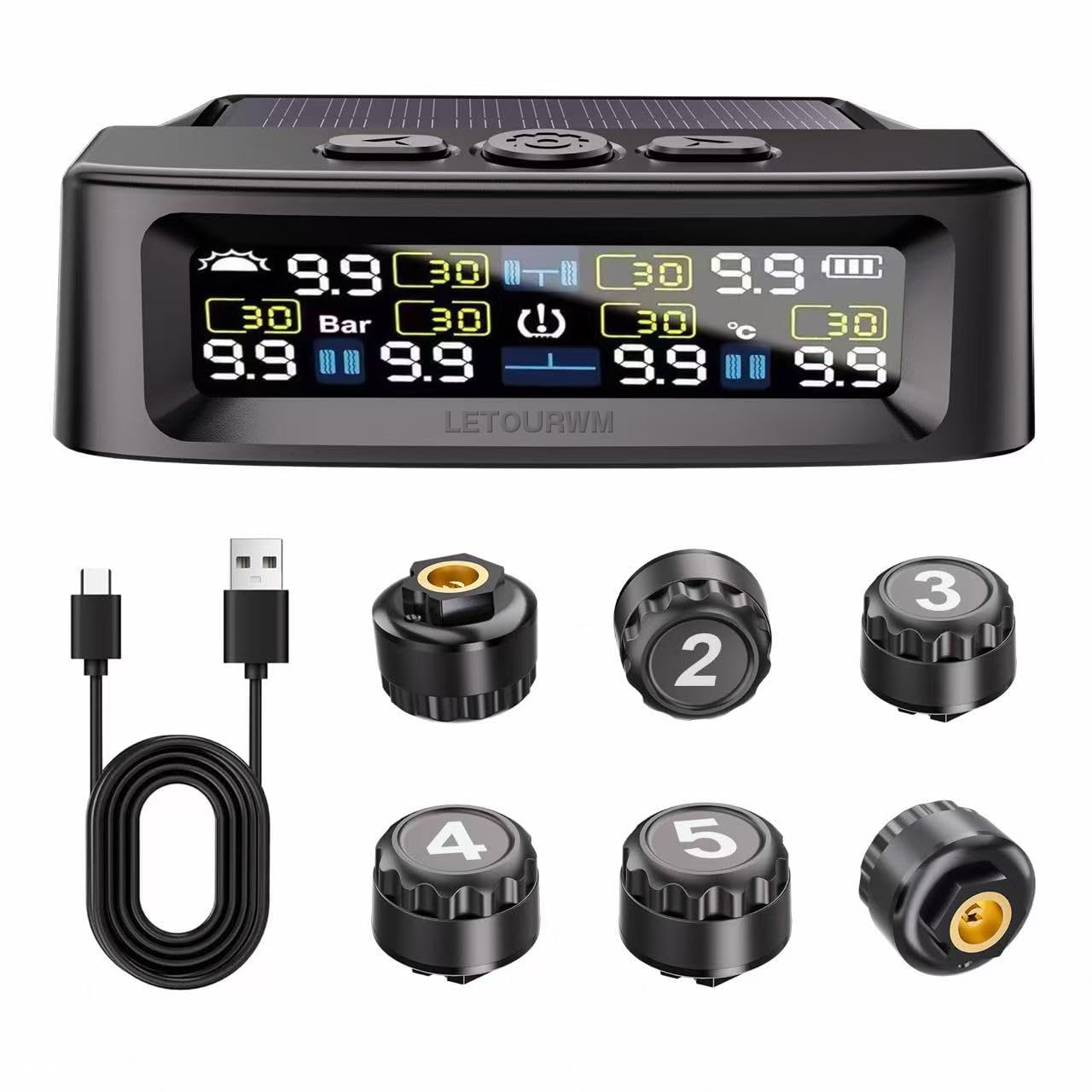
Six sensors for less than most four-sensor kits is the whole argument for the M12-3, and on a dual-axle travel trailer it's the right configuration: four trailer wheels plus the two rear truck tires on one screen.

What you trade for the sensor count is documentation. The instructions cover screwing the sensors on and almost nothing about setting thresholds or reading the display, so plan on a few minutes of menu-wandering, or find a setup video before your first trip. The screen itself is small and information-dense — fine for a periodic glance at a stoplight, not something to study at highway speed.

The 0-144 PSI range is the pleasant surprise: it covers a motorhome's tires, where several four-sensor kits in this guide stop below 100. Two conditions to know before you buy. The listed sensing distance is 65 feet, short for the longest trailers, so keep the monitor toward the back of the cab. And on a dually, the inside dual sensors are the ones that drop off first, so glance at each tile before you pull out.

Pros

  • Six sensors at the lowest price here
  • 0-144 PSI covers motorhome tires
  • Color display with auto brightness

Cons

  • Instructions barely cover setup or menus
  • 65-foot sensing distance
Our verdict

Six sensors at the lowest price here make the M12-3 the value pick for a dual-axle trailer, as long as you're ready to figure out the menus yourself.

Check Latest Price
7

Second Vehicles

XBNVGP A-0101

94 /100
LBD Score Outstanding

Key details

Power
Solar and USB-C
Alarm Modes
6
Pressure Range
0-88 PSI
Sensors Included
4 sensors
View on Amazon

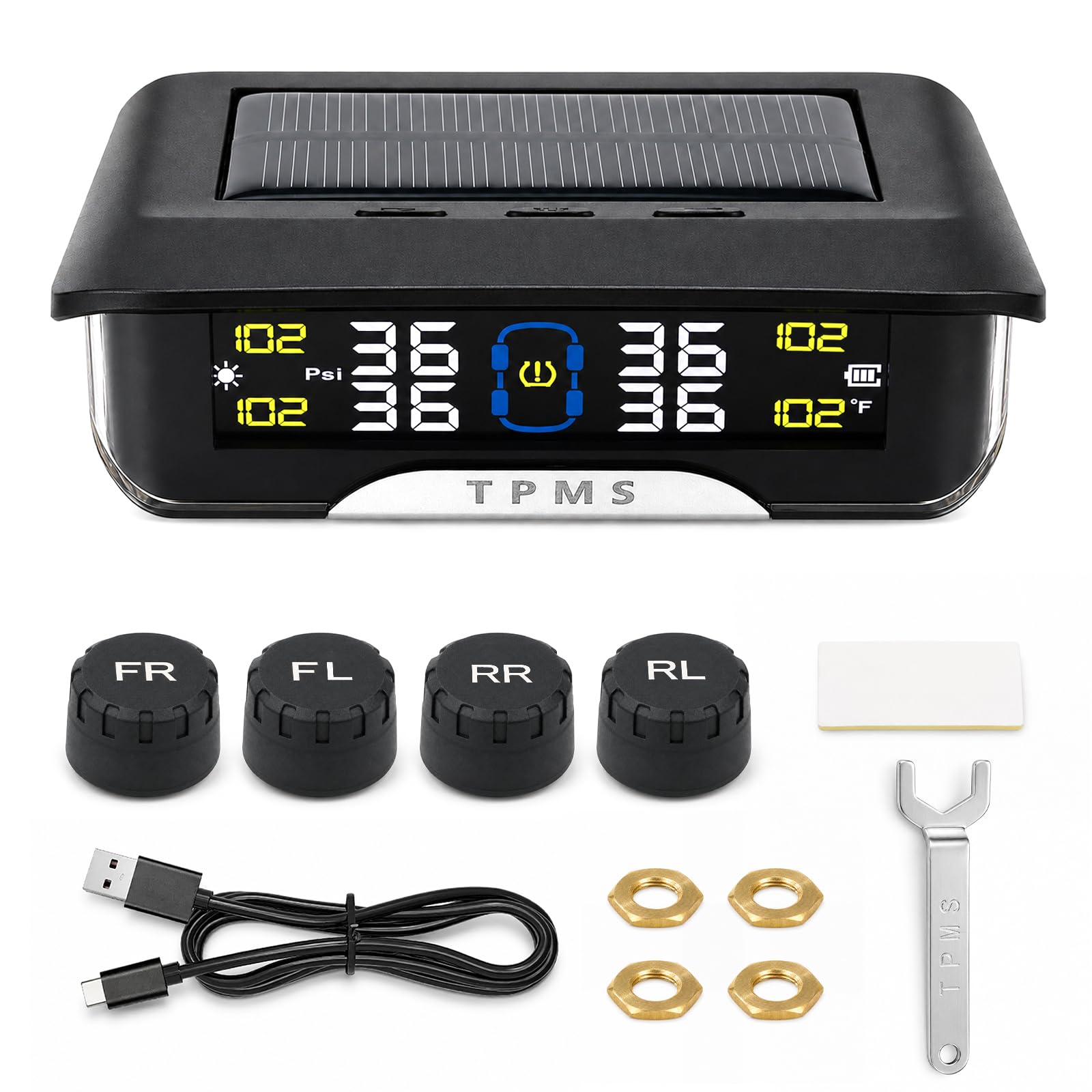
Four tires, pressure and temperature on one screen, and a color display that dims itself: the A-0101 is about as simple as a TPMS gets, and for a sedan or a small utility trailer that's the right amount of system.

The feature set is standard but complete — six alarm modes with adjustable thresholds, a solar panel plus USB-C for charging, and sensors that come paired to the monitor, so installation is screw-on and go. Nothing here asks you to learn a menu hierarchy.

Power behavior is the detail we noticed. The screen isn't always lit; it sleeps until something changes, which gives the solar panel an easy job on any dash that sees daylight, and a USB-C cable covers the rest. Set it and forget it is the entire experience.

Where it earns a place in this guide is the small stuff: a car, a work van, a utility trailer that only moves in summer, a second set of wheels that never had factory sensors. On any of those, the simplicity is the feature rather than a compromise.

Pros

  • Four tires plus temperature on one screen
  • Solar and USB-C charging
  • Adjustable alarm thresholds

Cons

  • 0-88 PSI ceiling rules out motorhome tires
Our verdict

We keep the A-0101 on this list for the car, van, or utility trailer that needs simple four-tire monitoring and nothing more.

Check Latest Price

How We Tested the Tire Pressure Monitoring Systems

We started by pulling every RV-focused system we could find and filtering for the things that decide whether it works on a real rig: enough sensors to cover the axle configuration, a pressure range that handles both camper tires and motorhome tires, a display you can read at a glance, and whether a signal booster is included or sold separately. That left 11 systems, from basic four-sensor kits to ten-sensor touchscreen units.

Each one was installed on an actual trailer or truck — a single-axle camper, a 30-foot travel trailer, a fifth wheel, and a dually — and I did the first install myself with nothing but the included manual, timing how long it took to program all the sensors from scratch. On three cold mornings in a row we compared every reading against a calibrated handheld gauge to see which units drifted and by how much.

On the road we towed two-hour highway stretches and logged dropouts, noting whether readings held with the trailer 30 feet back and whether adding the booster changed the result. In the driveway we bled a tire 5 psi at a time to catch when the alarm fired, how loud it was over diesel noise, and whether the screen identified the right tire. Readability got its own pass: parked nose into the afternoon sun, display judged from the driver's seat with sunglasses on.

Solar units spent a week with their panels shaded to see how long they'd run on a charge, and every sensor stayed on its valve for the full nine months so we could check for cracked caps, moisture after rain, and batteries that quit early. We also weighed what each kit included against what it cost, since a cheap set plus a booster you buy separately isn't cheap.

How to Choose a Tire Pressure Monitoring System

Start With Tire Count and Pressure

Four sensors cover a car, or a single-axle trailer plus its tow vehicle. Six is the number for a dual-axle trailer; ten belongs on a big fifth wheel or a rig with a spare in the rotation. Then check the pressure ceiling against your tires rather than the marketing copy. A kit rated to 88 or 99 PSI is right for a car, a pickup, or a travel trailer and wrong for a motorhome whose tires run past 100, where it will read wrong or alarm constantly. The Masoll M13 at 99 PSI and the GUTA GT80 at 188 mark the two ends of that spectrum.

Plan the Signal Run to the Dash

The sensor-to-monitor link is the part that fails quietly. A kit that holds every tire in the driveway can lose the rear axle once you're at highway speed and thirty-odd feet back. Count the distance from your dash to the farthest axle: under about 35 feet, a 50-foot system like the Tymate TM12 is fine. Beyond that, buy a kit with a repeater, such as the Masoll XM-2 and its 120-foot rating, and mount the repeater near the trailer axles rather than in the cab.

Choose Cap or Flow-Through, and Respect the Valve Stem

Cap sensors screw onto the stem and have to come off every time you add air. Flow-through caps let a chuck pass straight through, which is worth real money on a ten-tire rig you top off often, like the GUTA GT80. Either way, thread the supplied lock nut and check each sensor at the stem with soapy water the day you install it. A metal sensor left on a metal stem for a season can seize, and a sensor you can't remove is a tire you can't fill.

Judge the Screen in Daylight, Not Indoors

Almost every kit looks crisp in a store or a garage. What separates them is backlight headroom and how the panel behaves with sun falling across it. A monitor with automatic dimming and a brightness setting you can raise does better than one with a fixed backlight, and mounting angle matters as much as the screen: angle it down and out of the windshield's reflected light rather than laying it flat on the dash. If you can't read the numbers at noon, you'll stop checking them by the second trip.

Add Up What It Costs After the Sale

Two things decide the long-term bill. Sensor batteries are either standard cells you replace — the TST 507 takes CR2032s — or sealed units you swap whole. And warranty coverage varies more than it should, from three years on the TST to one year on the monitor and six months on the sensors for the Masoll M13. On a kit that lives outdoors and gets rained on, that coverage is worth more than a slightly larger screen.

Frequently Asked Questions

Final Verdict

The TST 507 is our pick for anyone towing a trailer or driving a motorhome: a display you can read at speed, sensor batteries you replace yourself, and three years of warranty behind it.

Run ten tires and top them off constantly and the GUTA GT80's flow-through sensors are the better tool. For four tires on a car or a small trailer, the Masoll M13 does the job for far less.