Best Standing Desk Mats of 2026

A standing desk is a great idea for about forty minutes — that's roughly when your heels ache and you catch yourself shifting weight foot to foot like you're waiting in a slow line. A mat costs less than any other part of the setup and quietly decides whether you actually keep standing. What you're buying is more time on your feet before your knees vote to sit down.

Our team spent six months with 12 mats underfoot in home offices, kitchens, and a cold garage workbench. Thickness alone tells you nothing — a mat can be an inch and a half tall and still bottom out under your heel by lunch. And grip matters as much as cushion: one that slides across hardwood every time you reach for your coffee is worse than bare floor.

Memory foam and molded foam feel like different products after an hour, sizing is trickier than it looks once you account for where your feet actually land, and a mat you can't wipe clean goes gray within a month. The picks below are sorted by how long you stand, not by which one is thickest.

1

Best Overall

ComfiLife Anti-Fatigue Mat

96 /100
LBD Score Outstanding

Key details

Care
Wipe with damp cloth
Backing
Non-slip
Material
Foam, Memory Foam, Rubber
Dimensions
39"L x 20"W x 0.75"Th
View on Amazon

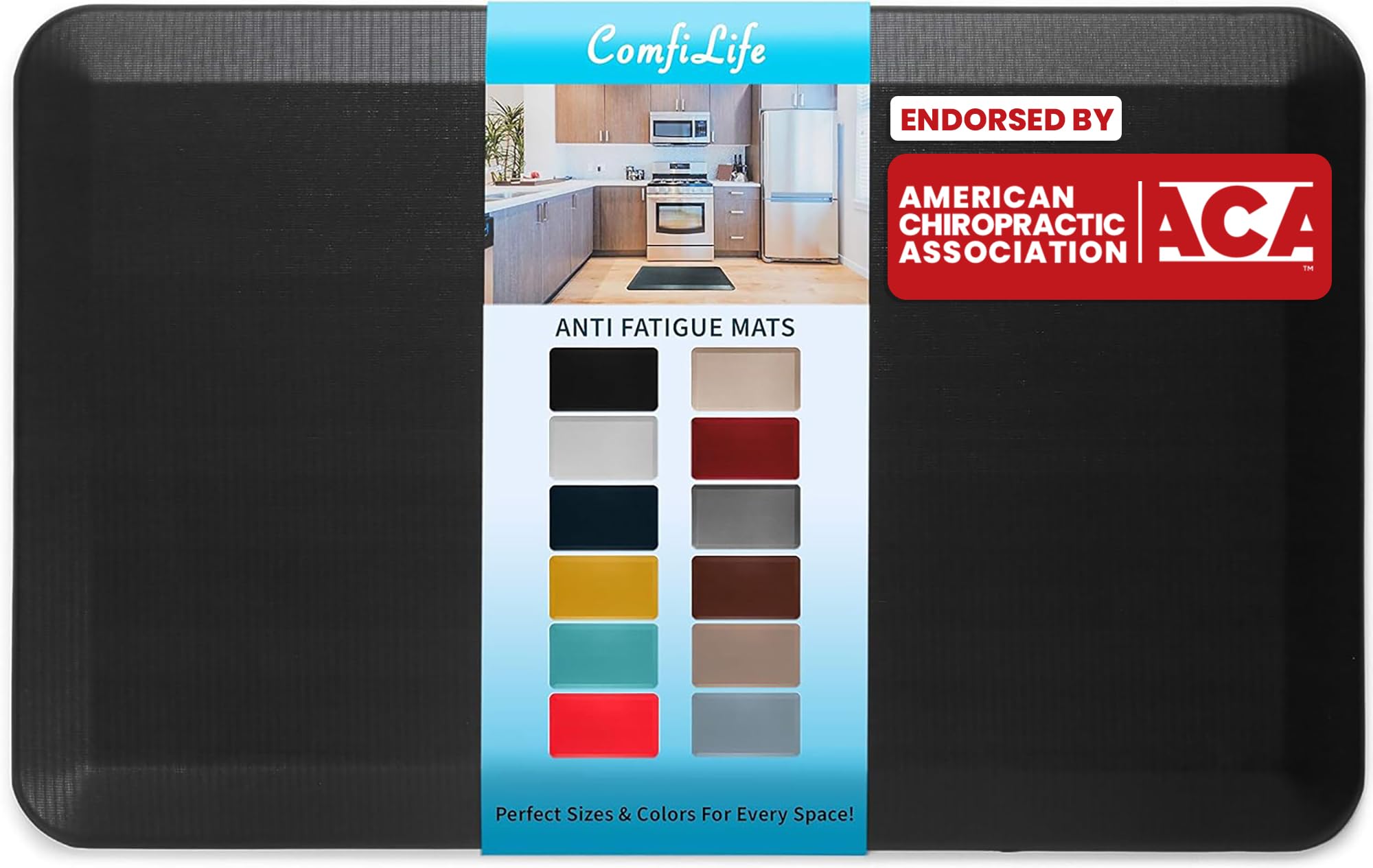
The ComfiLife is the mat we recommend first for a standard standing desk, and the reason is not a single flashy feature. Its 39-by-20-inch surface is wide enough to shift your stance and long enough to feel like a defined standing zone, while the 0.75-inch memory-foam core gives you cushion without turning the floor into a trampoline. We think that middle ground is what makes it the best default here: it is more supportive than a thin budget mat and less of a commitment than a thick contoured one.

The surface is easy to live with. A damp cloth handles most spills, and the non-slip backing kept the mat from wandering when we stepped on and off. We also appreciate that the mat is flat rather than sculpted: there is nothing to trip over and nothing that forces a particular foot position. For a desk where you simply want to stand and work, the ComfiLife's predictable surface is the advantage.

The size is worth a quick check against your chair. At 39 inches long and 20 inches wide, it fits a normal desk opening without swallowing a small office, but it is not a tiny pad you can kick under the desk and forget. The ComfiLife earns its place because it covers the everyday need—cushion, grip, easy cleaning—without asking you to pay for a terrain you may not use. It is the one we point to when you want the floor to stop being the problem.

Pros

  • Roomy 39-by-20-inch standing area
  • 0.75-inch memory foam balances cushion and support
  • Wipe-clean surface and non-slip backing
  • Midrange price for the size

Cons

  • Flat surface does not encourage movement
Our verdict

We recommend the ComfiLife as the default standing desk mat for most people: it cushions a long, flat surface without the premium price or the big footprint of a contour mat.
Check Latest Price
2

Best for Active Standing

Ergodriven Topo

95 /100
LBD Score Outstanding

Key details

Weight
8 lb
Surface
3D calculated terrain
Material
Polyurethane (PU)
Dimensions
29"L x 26.25"W x 2.7"Th
View on Amazon

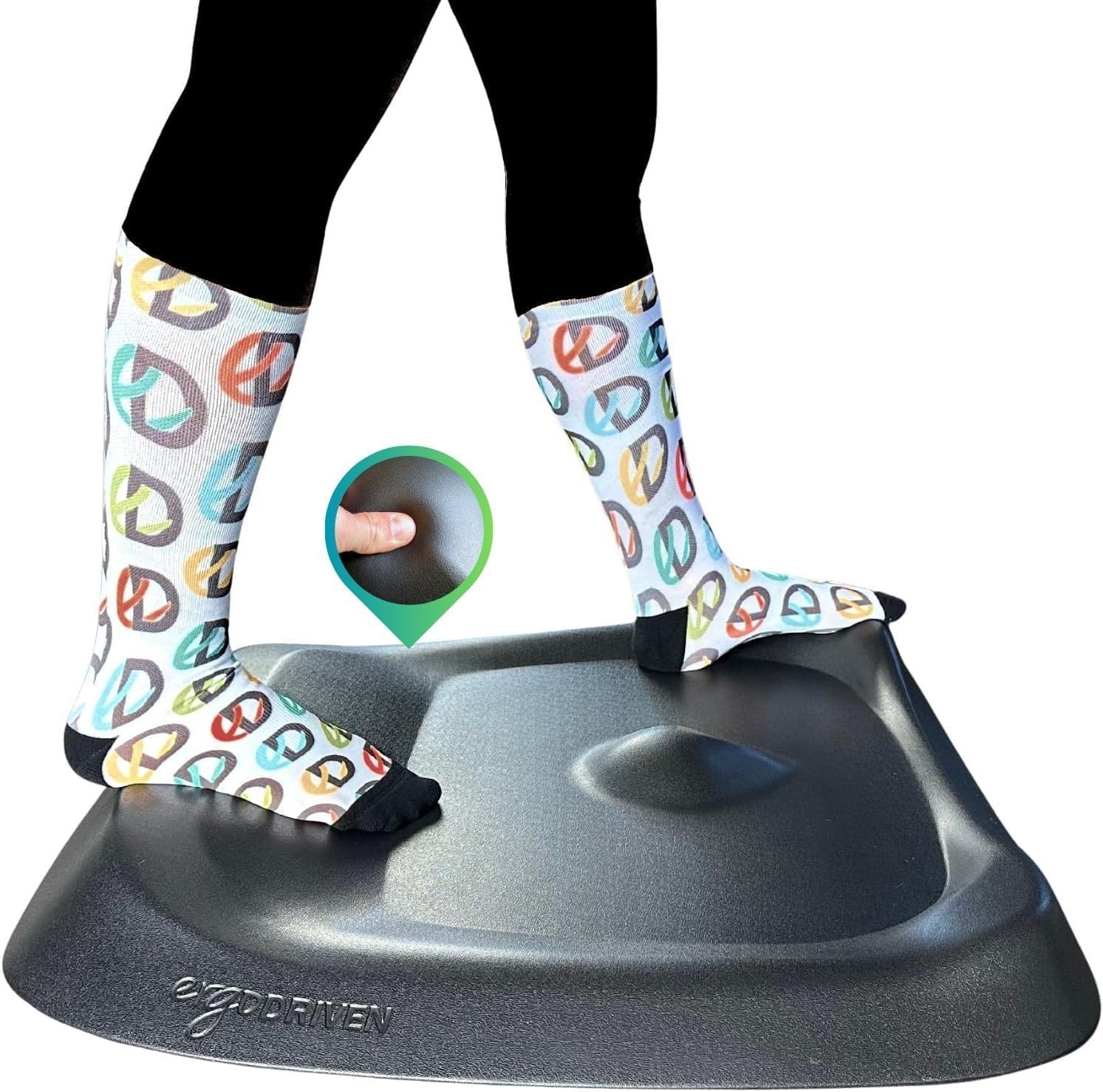
The Topo is not a flat mat, and that is the whole point. Raised edges, a center dome, and a 2.7-inch-thick surface give your feet somewhere to go without stepping off the mat. The first time you stand on it, the terrain feels busy; after a while, that busyness is what keeps a long standing session from turning into a locked-knee stare at the monitor. We like it most for the days when standing still is the problem.

The 29-by-26.25-inch footprint is generous enough for a wide stance, and the PU foam is firm enough that the contours support rather than swallow your feet. We found ourselves shifting onto the edges and rocking a heel without thinking about it, which is exactly what a mat like this should do. It is also easy to wipe down, and the 8-pound weight keeps it from sliding around.

For a fidgeter, the Topo is the one that works with your restlessness instead of fighting it. If you want a stable flat pad to stand on, the ComfiLife is the easier recommendation; the Topo is for the person who wants the mat to do something.

Pros

  • Contoured terrain encourages shifting and stretching
  • 2.7-inch foam stays supportive
  • Easy to wipe clean
  • 8-pound weight helps it stay put

Cons

  • Large 29-by-26-inch footprint
  • Premium price
Our verdict

For anyone who fidgets at a standing desk, the Topo is our pick: its contoured terrain keeps your feet moving and turns standing into something closer to active idle.

Check Latest Price
3

Best Extra-Thick

FEATOL Anti-Fatigue Mat

93 /100
LBD Score Outstanding

Key details

Weight
5.3 lb
Material
High Density Foam
Dimensions
48"L x 20"W x 0.9"Th
Edge Profile
Low-angle beveled
View on Amazon

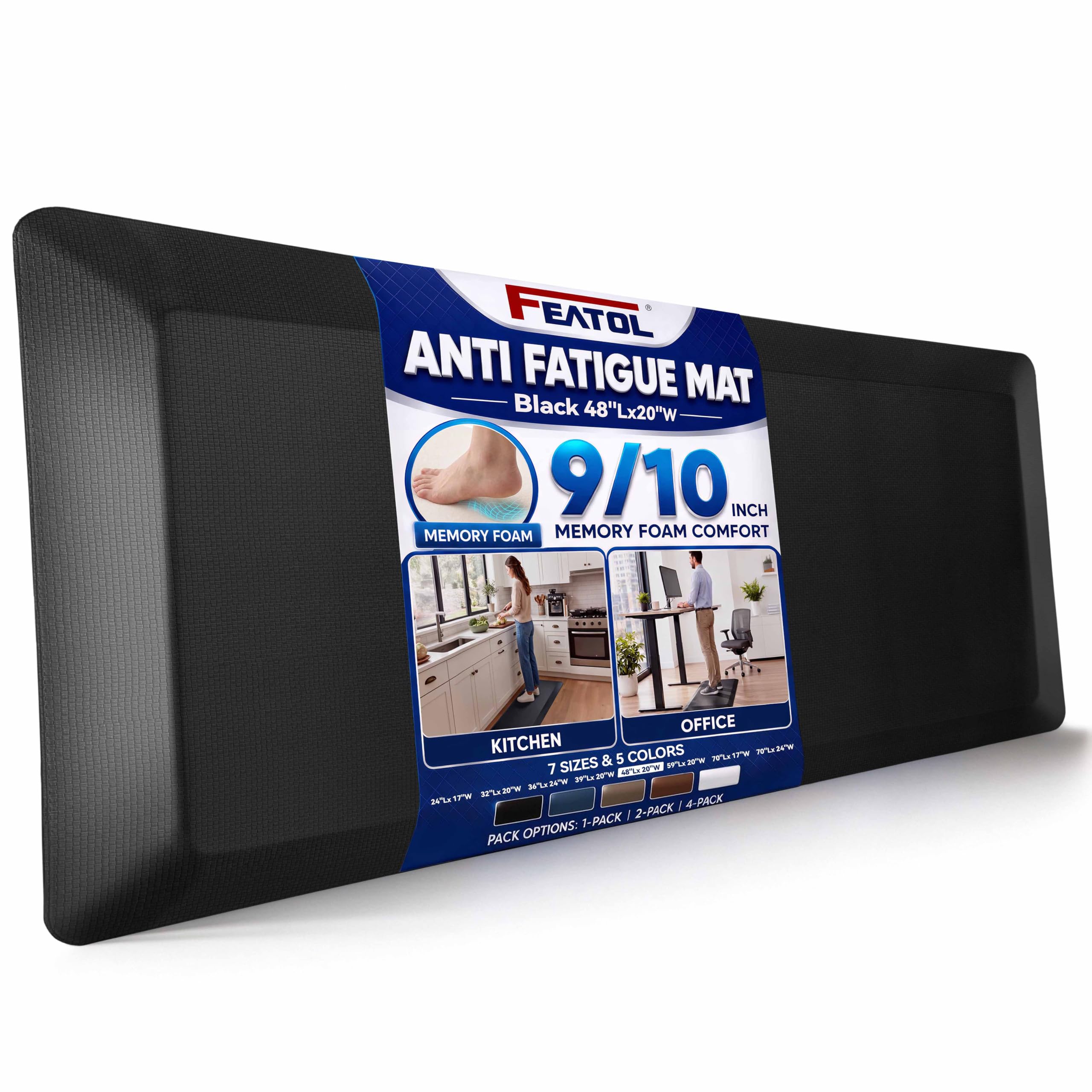
FEATOL's mat is the one to look at when your standing surface is long. At 20 by 48 inches, it gives you room to take a half-step sideways without dropping a foot onto the hard floor, and the 0.9-inch high-density foam is thick enough to feel substantial underfoot. We like that combination for a long desk or a kitchen counter where you slide between tasks; the mat becomes a runway rather than a small target.

The thickness is the feature that earns the most attention. It gives you a deeper cushion than the 0.75-inch mats here, but it is not a soft, sinking foam; the surface stays firm enough that you can push off it. The beveled edges matter on a mat this thick, because a blunt drop at the edge is exactly what catches a toe. At 5.3 pounds, it is light enough to move for cleaning.

The extra length is the reason to choose it over the shorter Ophanie or ComfiLife: you can move laterally, and the mat still supports a wide stance. For a long work surface, that is a better fit than a small pad you have to recenter.

Pros

  • 48-inch length for side-to-side movement
  • 0.9-inch high-density foam
  • Beveled edges reduce trip risk
  • Light enough to move for cleaning

Cons

  • Long footprint needs open floor
Our verdict

The FEATOL is the mat we point to when your standing surface is long: 48 inches of 0.9-inch foam lets you shift sideways without stepping onto the hard floor.

Check Latest Price
4

Best Value Upgrade

Ophanie Anti-Fatigue Mat

93 /100
LBD Score Outstanding

Key details

Delivery
Flat-packed
Material
High Density Foam
Dimensions
20"L x 32"W x 0.8"Th
Top Surface
PVC leather
View on Amazon

The Ophanie arrives flat rather than rolled, and that small logistics choice makes a real difference. You do not spend the first days working around corners that refuse to lie down, and the mat looks settled as soon as you put it in place. At 20 by 32 inches and 0.8 inch thick, it is sized for a home office rather than a long kitchen run, with enough cushion to feel like an upgrade over a thin utility mat.

The foam is firm and supportive, not the sinking kind, and the PVC leather top wipes clean without much fuss. We think it hits a useful middle: thicker than the budget KitchenClouds, smaller and less expensive than the FEATOL, and easier to place than the wide Topo. The 32-inch length gives you a defined standing spot without demanding that the whole floor belong to the mat.

For a small office where the mat has a fixed spot, the flat-packed shape and supportive foam are the stronger arguments. It is the value upgrade in this group: you get most of the thickness and surface quality of the premium flat mats without the premium price. On a smooth floor, check that the backing grips before you rely on it.

Pros

  • Arrives flat with no curled corners
  • 0.8-inch supportive foam
  • 32-inch length fits small offices
  • Wipe-clean PVC surface

Cons

  • Seams can wear with heavy use
Our verdict

The Ophanie is the best value upgrade here: a 0.8-inch mat that arrives flat, covers a small office nicely, and costs far less than the premium picks.

Check Latest Price
5

Best Portable

ergohead Standing Desk Mat

91 /100
LBD Score Outstanding

Key details

Weight
1.9 lb
Features
Handle and massage points
Material
Polyurethane (PU)
Dimensions
22"L x 17"W x 0.75"Th
View on Amazon

The ergohead mat has a built-in handle, and that handle is not a gimmick. At 1.9 pounds and 17 by 22 inches, it is small enough to lift aside when you want your chair back, hang on a hook, or carry to another standing spot. We appreciate that kind of flexibility in a shared office or a room where the desk has to do more than one job.

The 0.75-inch PU foam gives it more cushion than its size suggests, and the raised massage points add a little texture under bare feet. The surface is firm enough to stand on without feeling like a bar of soap, and the 1.9-pound weight makes it easy to lift with one hand.

We kept coming back to the handle as the detail that makes it useful, because most mats are only movable by dragging or kicking them out of the way. The ergohead is the one to choose when storage matters as much as cushioning, or when the mat has to move between rooms. It solves a different problem: a mat that can be moved, stored, and put back without a fight.

Pros

  • Built-in handle makes it easy to move
  • 0.75-inch cushion in a small footprint
  • Massage points add texture
  • Light enough to hang or store

Cons

  • Small surface limits side-to-side movement
Our verdict

The ergohead is the mat we reach for in a shared or compact workspace: the handle makes it easy to move aside, and the 17-by-22-inch pad still gives your feet a defined spot.

Check Latest Price
6

Best Budget

KitchenClouds Kitchen Mat

89 /100
LBD Score Excellent

Key details

Care
Hand wash only
Backing
Diamond-pattern non-slip
Material
PVC foam
Dimensions
28"L x 17.3"W x 0.5"Th
View on Amazon

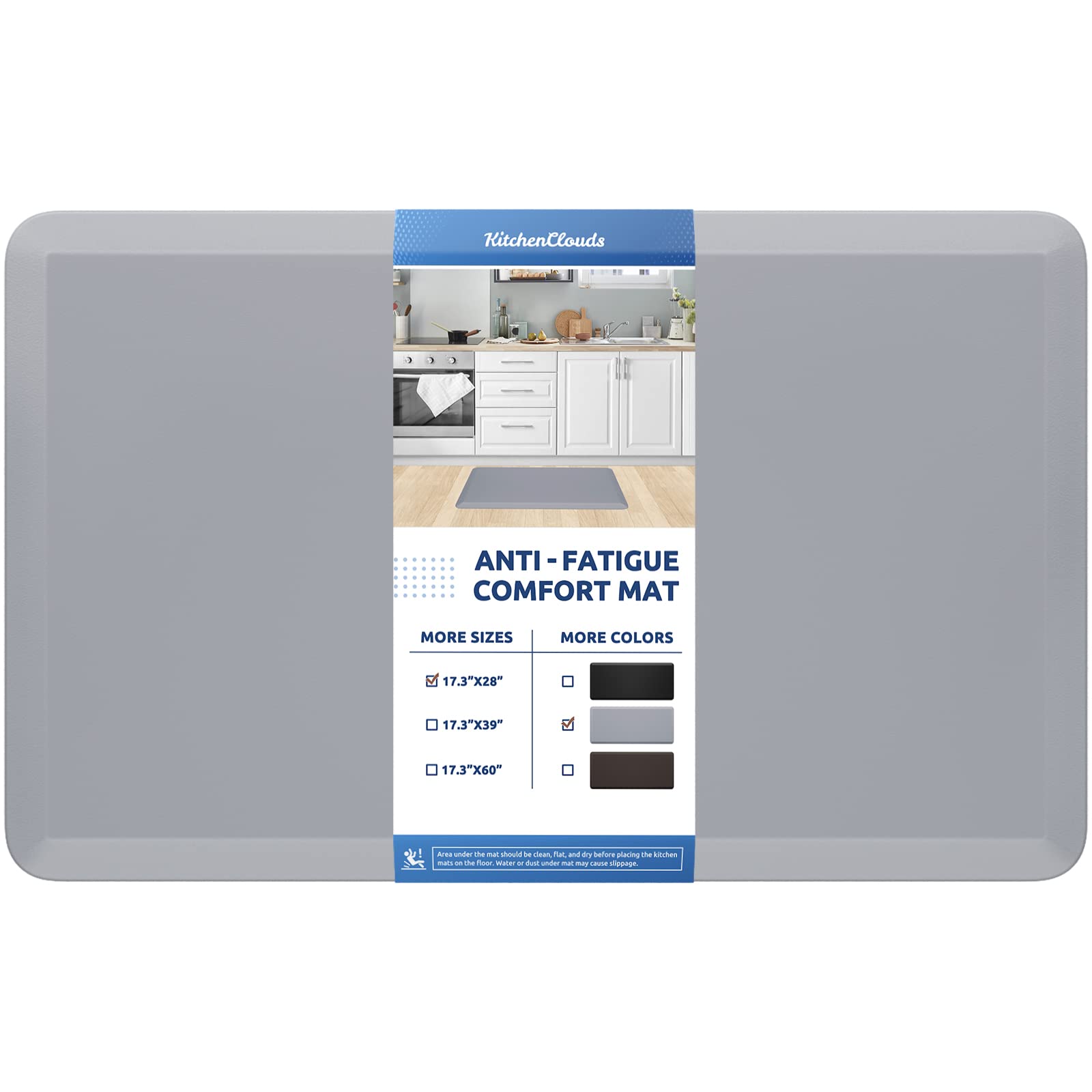
The KitchenClouds is the least expensive mat in this group, and that is the first thing to understand about it. It measures 17.3 by 28 inches and uses a 0.5-inch PVC foam core. For a quick dishwashing session or a secondary desk, it gives you a defined spot without much outlay.

The surface is waterproof and wipes clean, and the diamond-pattern backing is meant to hold it in place. On a smooth floor, it can slide, so check that the backing grips before you rely on it; if it moves, the mat is better on a textured surface or a different spot. We found it comfortable enough for short tasks, and the compact size makes it easy to put away.

This is the one to buy when the mat is an experiment rather than a daily fixture, or when a second mat for the kitchen is all you need. It earns its keep on price and easy cleaning, and the compact size makes it easy to put away. For a short task, that is a sensible trade.

Pros

  • Lowest price in this set
  • Wipe-clean waterproof surface
  • Compact 17.3-by-28-inch size

Cons

  • Thin 0.5-inch cushion for all-day use
Our verdict

The KitchenClouds is the budget pick for light standing duty: it is the least expensive mat here and gives you a wipe-clean cushion for short tasks without much outlay.

Check Latest Price

How We Tested the Standing Desk Mats

The list started with research rather than standing. We read through customer reviews for dozens of mats, kept the ones that came up again and again, then filtered by thickness (anything under half an inch got cut), footprint, surface material, and whether the maker published a weight or density figure. That left 12 mats, which we rotated through six months of ordinary working days: a home office with a standing desk on hardwood, tile in front of a kitchen sink, and a garage workbench where the floor is unforgiving.

Thickness got measured with calipers the day each mat arrived, because the number on the box and the number under a heel are two different things. We stood on each one for timed stretches in socks, then again in shoes, shifting weight forward and back, and noted when a mat began to feel like standing on a mattress instead of standing on a yoga block. Cushioning was judged by heel pressure after 30 minutes, not by squeezing it with a hand.

Grip we tested by stepping on and off 20 times in a row to see whether the mat crept toward the desk or the counter; a few skated on hardwood and tile, while the ones with ridged or textured undersides stayed where we put them. Ease of cleaning came from real spills — coffee, a spoon of tomato sauce, muddy boots — wiped with a damp cloth and checked the next morning for a ring.

Durability got the unglamorous treatment: same spot, both feet, every day, watching for compression dents, curled corners, and cracks along the bevel. Any mat still holding a footprint-shaped dip after a weekend with nobody on it lost points. Value we judged at the end, against how much of the surface actually sat under a full stance and how it looked after six months of that.

How to Choose a Standing Desk Mat

Thickness and Support

Thickness is the first number shoppers reach for, but support matters more than the fraction of an inch. A very soft mat can let your heels sink until you are effectively standing on the floor; a very thick one can feel unstable under a chair or at a low desk. For all-day standing, we look for something in the 0.75- to 0.9-inch range, with high-density foam or PU rather than a loose, pillowy fill. A 0.5-inch mat can work for short tasks or a tight budget, but it will not give the same relief over a long afternoon.

Footprint and Chair Clearance

Measure the space where you actually stand, not the whole desk. A 20-by-39-inch mat suits a normal stance; a 48-inch mat invites side-to-side movement but can crowd a small office, while a 17-by-22-inch pad is easy to tuck away. Also check what happens when you sit: a thick mat can block chair casters or make the chair feel as if it is parked on a slope. If the mat has to live under the desk all day, leave enough clearance for your feet and the chair.

Flat or Contoured

The choice is really about how you stand. A flat mat is predictable: you step on, you work, you step off. A contoured mat, like the Topo, gives you ridges and a center dome to press into, which can keep you shifting without a balance board. We prefer the contoured surface for fidgeters and the flat one for people who want a stable, unobtrusive base. Neither is better for everyone; the mistake is buying a wobble board when what you want is cushioning.

Grip, Edges, and Flatness

On a hard floor, the backing is doing as much work as the foam. A mat that slides is worse than no mat, especially when you step on and off in a hurry. Look for a non-slip backing, a beveled edge that tapers to the floor, and a mat that arrives flat or relaxes quickly. If a rolled mat still has lifted corners after a few days, do not train yourself to step over them; flatten it properly or replace it.

Cleaning and Wear

Most standing mats are wipe-clean, and that is the right routine: a damp cloth for spills, a vacuum or sweep for crumbs, and no harsh cleaners that can break down the surface. The bigger question is what happens at the seams. Foam can compress, PVC can tear, and the top layer can start to separate after months of daily use. Press a heel into the mat and check that it springs back; if it stays compressed or the edges lift, it has stopped doing its job.

Frequently Asked Questions

Final Verdict

For most standing desks, the ComfiLife is the mat we recommend. It gives you a broad, flat, well-cushioned surface, wipes clean, and stays put without asking you to pay a premium. It is the easiest one to live with day after day, and it does not try to turn standing into a workout.

If you fidget or want movement, the Ergodriven Topo earns its premium. If your desk is long, the FEATOL gives you more runway; if space is tight, the ergohead is the one that tucks away. Start with the ComfiLife unless one of those specific needs is yours.