Best Speaker Stands of 2026

Speaker stands are the least glamorous purchase in audio and do more for the sound than most of the gear sitting on them. Raise the tweeter to ear height, get the cabinet off the bookshelf, and speakers you already own open up. Get it wrong — a stand that flexes, a top plate that's too small — and you've paid to make things worse.

The questions I care about aren't printed on the box. It's whether the collar clamps hard enough to hold a 25-pound cabinet at full height without creeping, whether assembly is a fifteen-minute job or a two-person wrestling match, and whether it reads as furniture or as a tripod from a school gym. We spent six months with 12 stands, from low bookshelf models to tall adjustable tripods.

One thing worth knowing first: "universal" means very little. Check your speaker's footprint against the top plate, and check whether it wants a flat plate or a 35mm pole insert — the formats aren't interchangeable, and a mismatch is the most common reason a stand goes back.

1

Best Overall

Kanto SPH

93 /100
LBD Score Outstanding

Key details

Top Plate
5.9 x 7.9 in
Height Range
24–42 in
Load Capacity
30 lb per stand
Cable Management
Internal column
View on Amazon

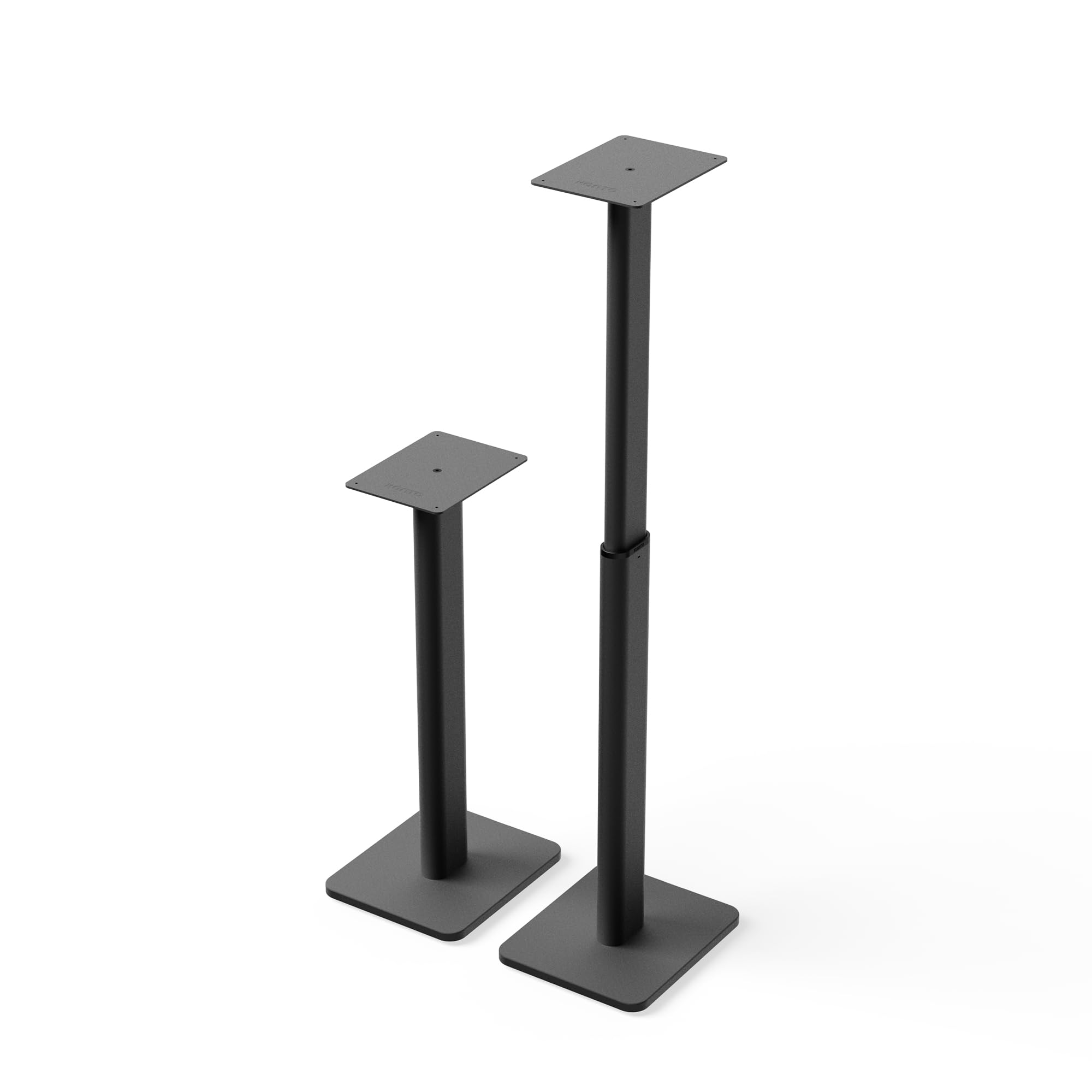
Ear height changes with the chair. Sit upright at a desk and your ears land near 40 inches off the floor; sink into a recliner and it is closer to 30. The Kanto SPH covers both, adjusting from 24 to 42 inches with a dual-screw clamp that locks the nested steel columns together at any point in the span. That range is what makes it the most versatile stand here for speakers that live indoors.

Each stand carries 30 lb on a 5.9-by-7.9-inch top plate drilled for four mounting screws, and the pair weighs about 34 lb, most of it in the base. Set one down and the mass explains itself: a bookshelf speaker with real bass does not walk across the plate or ring through the column. Carpet spikes and domed rubber feet both thread into the base, so moving from a rug to hardwood is a two-minute swap rather than a shopping trip.

Cables disappear properly. Speaker wire and a power cord both run up the hollow column and exit at the base, with room for the cord on a powered monitor rather than just bare speaker wire. We threaded a chunky connector through ours without swearing, which is more than we can say for every stand in this group.

Assembly is a handful of bolts per stand, and the hardware kit includes the screws for the top plates, so there is nothing else to buy. Once they are up, they are the rare piece of AV furniture you stop noticing.

Pros

  • 18-inch height range covers desk and recliner
  • Heavy base resists resonance and walking
  • Carpet spikes and rubber feet both included
  • Column routing fits a power cord

Cons

  • 30 lb per stand suits bookshelf speakers only
Our verdict

The pair we recommend to anyone putting bookshelf or studio speakers in a room they care about: 18 inches of adjustment, a base heavy enough to stop resonance, and clean cable routing.
Check Latest Price
2

Best for Surround Rears

Mounting Dream MD5402

89 /100
LBD Score Excellent

Key details

Base Size
11 x 11 in
Height Range
33–43 in
Floor Options
Carpet nails and plastic feet
Load Capacity
22 lb
View on Amazon

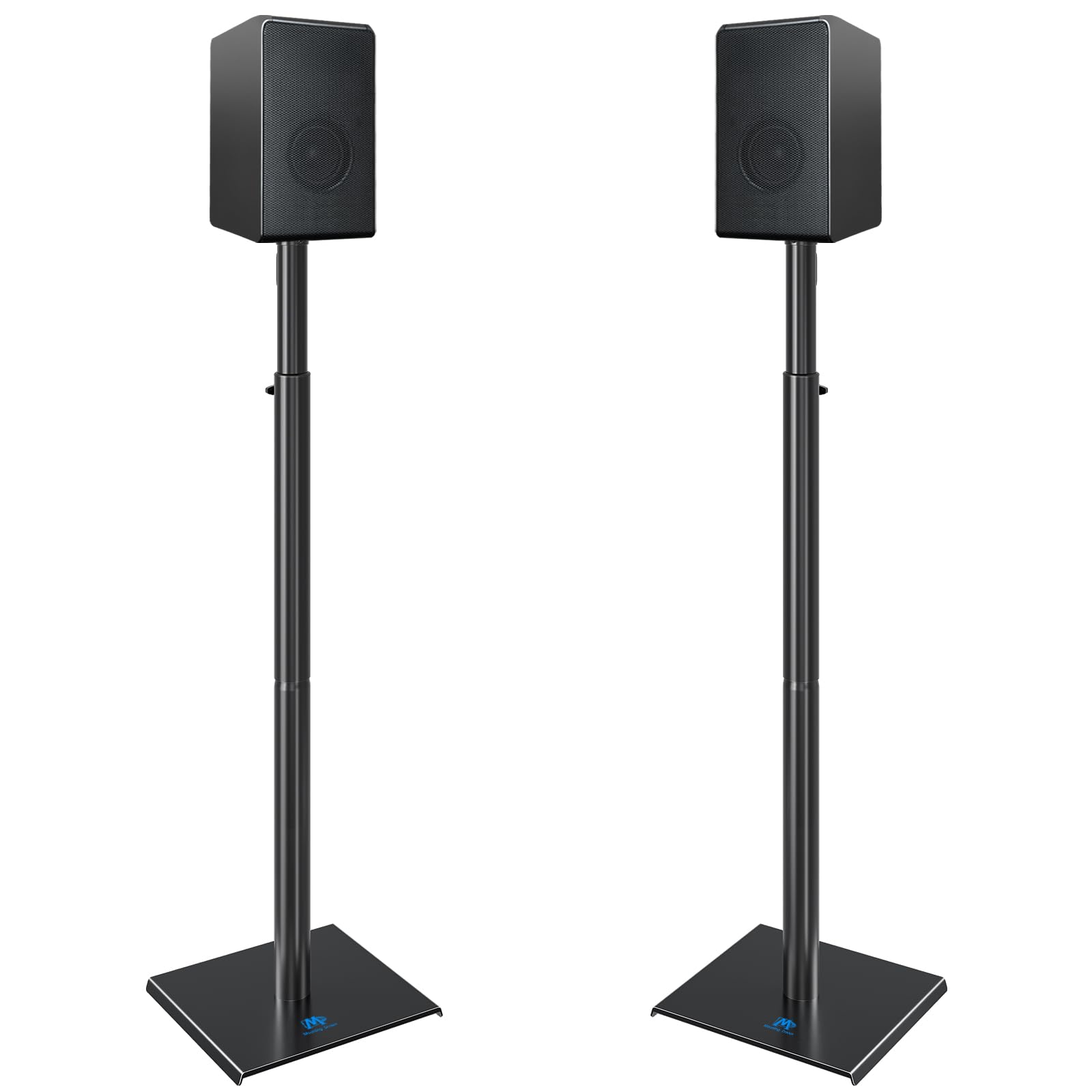
Rear speakers have a bad job: they sit behind the sofa where feet find them, and they are usually light enough that a narrow stand tips when someone brushes past. Mounting Dream's answer is an 11-by-11-inch base under a 4.7-inch top plate — footprint on the floor, barely any under the speaker.

That shape is exactly right for a 5.1 or Atmos setup. The 22 lb capacity covers most satellites and small bookshelf speakers, and the height is set by screws in the tube rather than a friction collar, so a setting survives the vacuum cleaner. We set a pair behind a couch and stopped thinking about them, which is the best thing a rear stand can achieve.

Carpet nails and adjustable plastic feet both come in the box, so the same stands sit level on a rug or a hardwood floor. The cable route is a slot rather than a round hole — 0.8 inch wide by 1.73 inches tall — generous for bare wire and tight for a molded plug. Feed the wire through before you mount the speaker, not after.

Pros

  • 11-inch base holds its footing behind a sofa
  • Screw-fixed height will not creep
  • Carpet nails and hard-floor feet included
  • 22 lb capacity covers most satellites

Cons

  • 33-inch minimum is high for low seating
Our verdict

The pair to buy when the job is rear speakers: a wide base that survives being kicked, screw-set height that does not drift, and 22 lb of capacity for the money.

Check Latest Price
3

Best Budget for Small Satellites

PERLESMITH PSSS2

88 /100
LBD Score Excellent

Key details

Height Range
33.3–45.1 in
Cable Opening
1.18 x 0.59 in
Load Capacity
11 lb
Top Plate Width
4.5–9 in
View on Amazon

Satellite speakers are an awkward shape: narrow cabinets, off-centre mounting points, and a back that curves away from anything flat. PERLESMITH's top plate slides between 4.5 and 9 inches wide, so the bracket meets the cabinet instead of hovering around it. For surrounds that were never designed to sit on a stand, that adjustability does more than any other feature here.

The rest is conventional in a useful way. Height runs 33.3 to 45.1 inches on a locking collar, the base is 9.72 inches across, and the hollow pole takes cable through a 1.18-by-0.59-inch opening. Assembly is a screwdriver job, with mounting hardware in the box. We paid close attention to the pole at full extension, because that is where small stands usually give.

The load rating is what decides whether these are for you. They are excellent with satellites and compact bookshelf speakers, and clearly out of their depth with anything that has a real woofer behind it. The collar also wants a firm hand at the top of the range; tightened properly the stand is steady, left loose the pole has some give.

Pros

  • Sliding plate adjusts from 4.5 to 9 inches
  • Hollow pole hides speaker wire
  • Wide 9.72-inch base for the size

Cons

  • 11 lb per stand suits small speakers only
Our verdict

A first pair for a surround system with small satellites: the sliding plate grips cabinets a fixed plate cannot, and the price leaves room for cable.

Check Latest Price
4

Best Budget PA Pair

NiuNyuNeu Tripod Pair

91 /100
LBD Score Outstanding

Key details

Mount
35mm pole insert
Height Range
43.7–70.8 in
Load Capacity
99 lb
Height Settings
6
View on Amazon

Seventy inches is roughly where a PA speaker stops firing into the backs of the front row. These reach 70.8 inches and are rated to hold 99 lb, and the pair weighs about 10.5 lb — light enough to carry one in each hand from the car. That combination is why they are our budget pick for anyone with a van and a small PA.

Six height settings lock with a pin and a knob, and each post wears a sleeve at the top that takes up the slack between pole and socket. That sleeve is the detail we appreciate most: a loose fit is what lets a speaker rotate and buzz at volume, and it is easy to leave out when a manufacturer is trimming costs.

Steel tube with nylon joints, legs that fold flat, and a height you set when you arrive rather than mid-set. At full extension with a heavy box up top there is less margin than the JBL set gives you, so keep the load sensible when the stand is at its tallest and drop it a setting when you can. For a small-to-mid PA, a monitor rig, or a ceremony setup, that is a fair trade.

Pros

  • 70.8-inch reach with a 99 lb rating
  • Top sleeve keeps speakers from rocking
  • About 10.5 lb for the pair
  • Folds flat for transport

Cons

  • Nylon collars are the wear point
Our verdict

The pair we hand to anyone loading PA speakers into a hatchback: 70 inches of reach, a 99 lb rating, and a price that leaves money for cables.

Check Latest Price
5

Best for Gigging

JBL Speaker Stand Set

89 /100
LBD Score Excellent

Key details

Material
Aluminum
Pole Fit
35mm and 38mm
Height Range
48–81 in
Load Capacity
60 lb
View on Amazon

Thirty-five millimeters is the standard pole, right up until you meet a speaker that wants 38. JBL's inner tube takes both, which means one set of stands covers a mixed backline instead of a drawer of adapters that go missing.

The rest is built for the van. Aluminum keeps the carry weight down, height runs 48 to 81 inches, and each stand is rated for 60 lb. The red trim on the feet pulls off if the color is not for you, and the double bag has two compartments — one stand each — so they do not wear against each other in transit. One fit note: the PartyBox 310 does not seat on this pole, so check the socket on your speaker before ordering.

Three things justify the price: aluminum instead of steel tube, a three-year warranty, and a set that packs into a single bag. What we did not expect is how much of the argument that bag carries — it is the difference between stands that still look new after a season of load-ins and stands that do not. For a player setting up twice a week, the arithmetic works.

Pros

  • Dual 35mm and 38mm pole fits more speakers
  • 81-inch maximum height
  • Two-compartment carry bag included
  • Aluminum keeps carry weight down

Cons

  • 60 lb rating is below the cheaper tripods
Our verdict

For anyone loading in twice a week: a light aluminum set, 81 inches of height, a pole that fits 38mm sockets, and a bag that keeps them looking new.

Check Latest Price
6

Budget PA Setup

Rockville RVES1

94 /100
LBD Score Outstanding

Key details

Carry Bag
Included
Leg Spread
0–32 in
Height Range
40–71 in
Load Capacity
100 lb per stand
View on Amazon

Two tripods, a carry bag, and 100 lb of capacity per stand. The RVES1 set is the value play in PA stands, and the bag is the reason to pick it over a bare pair — folded stands rattle around a van and lose their finish fast.

Setup is tool-free. The legs spread from closed to a 32-inch footprint, height runs 40 to 71 inches, and the collars are the usual push-and-lock arrangement. For a music room, a rehearsal space, or a rig that stays in one place, that covers everything you need.

Push them harder and the compromise shows. At full height with a heavy box the legs feel busy, and the whole stand has more movement than the JBL set. Keep the load modest at 71 inches and it stops mattering — we rate this as a solid first PA pair rather than a road-warrior set.

Pros

  • 100 lb capacity per stand
  • Carry bag included
  • Legs spread to 32 inches for uneven ground

Cons

  • Bag and finish age faster than the stands
Our verdict

A good first PA pair for the money, best kept at a set height in a room rather than folded and unfolded every weekend.

Check Latest Price
7

Low Wood Setup

Rimous Wood Pair

87 /100
LBD Score Excellent

Key details

Top Plate
12.2 x 9.1 in
Cable Clips
Included
Height Range
18–28 in
Load Capacity
50 lb
View on Amazon

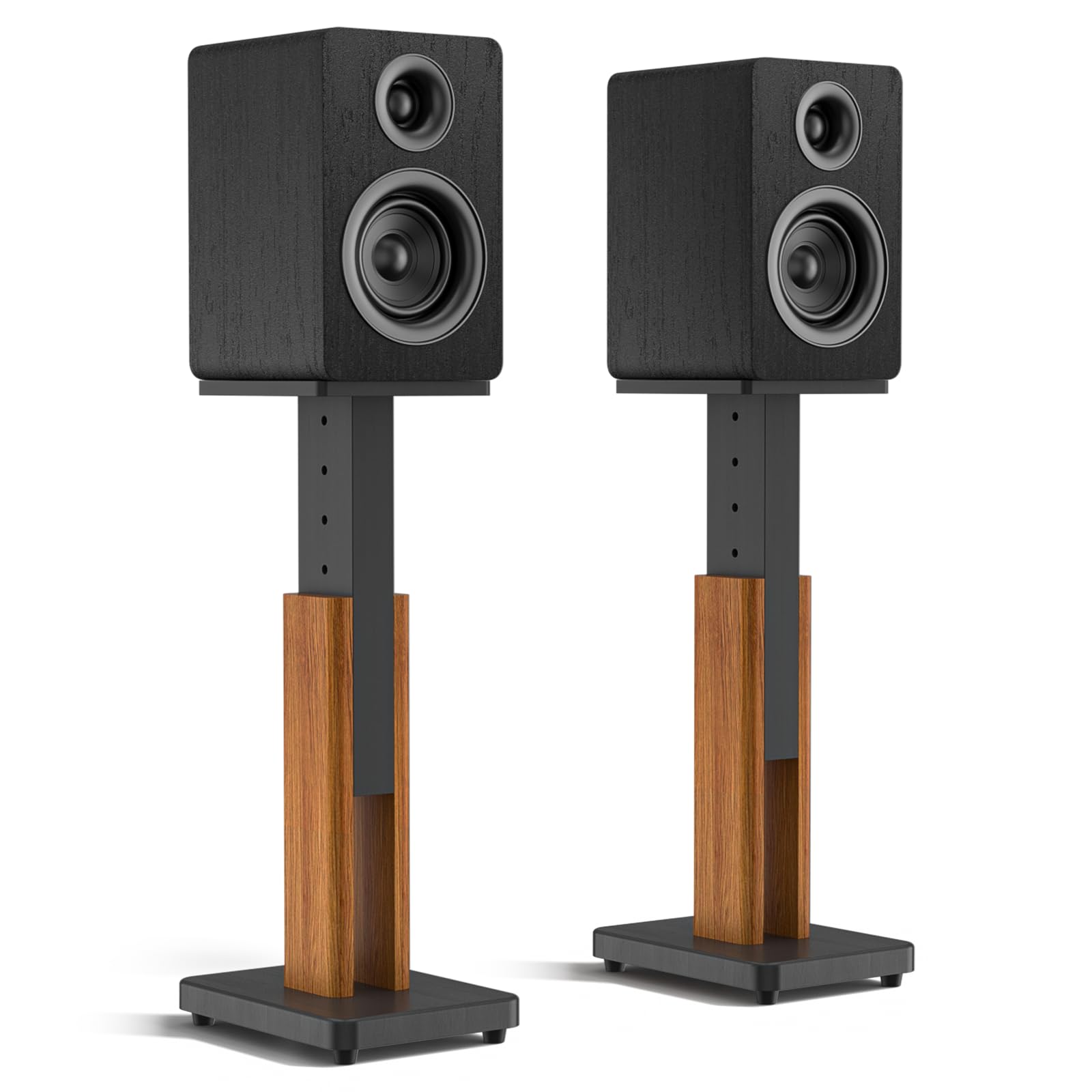
Wood grain does something in a living room that black steel cannot, and this pair also sits lower than anything else here: 18 inches at the bottom of its range, which is where speakers end up when they flank a low console rather than a sofa.

The top plate is 12.2 by 9.1 inches, big enough for a proper bookshelf cabinet rather than a satellite, and six settings run up to 28 inches. Threaded leveling feet take out a wobble on a floor that is not flat, and cable clips come in the box along with the mounting hardware.

The grained finish is the reason we kept these in the roundup: they read as furniture rather than stage gear, and the low height is a genuinely useful alternative to a 33-inch column. Buy them for the look and the 18-inch floor, and treat assembly as a careful ten minutes rather than a race.

Pros

  • Height range starts at 18 inches
  • 12.2-inch plate holds real bookshelf speakers
  • Leveling feet for uneven floors
  • Cable clips included

Cons

  • Soft wood marks and strips at the screws
Our verdict

The pair for a low console and a room where the speakers are on show, as long as you handle the wood like furniture rather than stage gear.

Check Latest Price
8

Low Monitor Placement

futrue-wolker Tripod Pair

87 /100
LBD Score Excellent

Key details

Mount
35mm insert
Height Range
24–50 in
Storage Bags
2
Load Capacity
55 lb
View on Amazon

Not every speaker wants to be six feet in the air. These go down to 24 inches, low enough to put a monitor beside a drum kit or a keyboard where the player can actually hear it, and they fold to roughly 17 inches for the trip.

The insert is the standard 35mm, capacity is 55 lb, and the range tops out at 50 inches — enough for a small PA box or a powered monitor without pretending to be a main-stage stand. Two storage bags come in the box, one per stand, and the tripod feet have rubber pads so they do not skate on a polished floor.

Light stands have a limit and these find it sooner than the heavier tripods: with a top-heavy box up high, the whole thing has more movement than we like. Keep them low and the speaker modest, and they do a job the tall stands here cannot.

Pros

  • Reaches down to 24 inches
  • Two storage bags included
  • 35mm insert fits standard speakers

Cons

  • Plastic collars are the wear point
Our verdict

The pick for small monitors that need to sit low — a keyboard rig, a practice corner, a booth — rather than for anything tall and heavy.

Check Latest Price
9

Single Party Speaker

Amazon Basics SB400L

96 /100
LBD Score Outstanding

Key details

Height Range
4.1–6.6 ft
Load Capacity
99.2 lb
Pole Diameter
35mm (1.4 in)
Stands Included
1
View on Amazon

Read the listing twice: this is one stand, not a pair. For some buyers that is exactly right — a single party speaker in the yard, a replacement for one bent leg, a stand that lives in the garage. One is cheaper than a pair you will store.

What you get is a 35mm steel tripod rated to 99.2 lb, adjustable from roughly four to six and a half feet, with a safety pin through the collar. It arrives assembled, and we had a speaker mounted without reaching for a tool.

The pole is 35mm, so a 38mm socket needs an adapter sleeve; check that before you order. Otherwise it is a straightforward, sturdy stand, and the only real question is whether you wanted two of them.

Pros

  • 99.2 lb capacity from a single stand
  • Arrives assembled
  • Folds for storage

Cons

  • Four-foot minimum rules out seated listening
Our verdict

Buy one for a party speaker or a garage rig; if you want a matched pair for a living room, look elsewhere on this page.

Check Latest Price
10

Heavy Stand-Mounts

Monolith 24-Inch

91 /100
LBD Score Outstanding

Key details

Height
24 in
Spikes
Adjustable
Load Capacity
75 lb
Stands Included
1
View on Amazon

Four steel tubes, a plate, and enough mass that a bookshelf speaker on top stops exciting the floor. The tubes are hollow and can be filled with shot or sand, which is the oldest cheap trick in hi-fi and still the most effective one for a stand-mount speaker with real bass.

Height is fixed at 24 inches, which suits a low chair, a desk-side setup, or a center channel under a screen, and matches nothing that needs a tweeter at ear height over a sofa. Adjustable spikes bite into carpet; there are no pads in the box for hardwood, so plan on felt.

The powder coat is even and the plate edges are finished properly, which we do not take for granted at this price. Assembly is a handful of bolts and about as complicated as a bookshelf. Set it up, fill it, and it stops being something you think about.

Pros

  • 75 lb capacity per stand
  • Tubes can be filled with shot or sand
  • Adjustable spikes for carpet
  • Even powder-coated finish

Cons

  • No cable routing through the column
  • Sold as a single stand, not a pair
Our verdict

For a heavy stand-mount speaker on a low stand, nothing here is steadier — just buy two, since it ships singly.

Check Latest Price

How We Tested Speaker Stands

We built the shortlist by filtering for the three things that actually gate a purchase: a stated height range, a stated weight capacity, and a mounting format — flat top plate or 35mm pole insert — that matched the speakers most people own. That left us with 12 stands, which we assembled, loaded, and lived with over six months.

Each stand went into a real room: flanking a couch on carpet, at the sides of a desk, and in a basement corner where a PA pair gets set up and torn down for parties. I timed assembly solo with only the included hardware and noted where the instructions stalled. Then I loaded each one to its limit, raised it all the way up, and gave the cabinet a firm nudge to see how much the top swayed. On carpet I checked whether the spikes bit; on hardwood I checked whether they left marks.

For wiring, I ran cable through the internal channels where they existed and judged whether the exit hole lined up with my amp and whether the connector fit through. I checked the top plate against three speaker footprints to see what overhung, and looked closely at the finish where the collar clamps down, since that's where scuffs appear first. After six months I re-checked every joint for creep and wobble, broke each stand down into its carry bag, and hauled it up a flight of stairs to see how it traveled.

How to Choose Speaker Stands

Match the mount before you shop

Turn the speaker over. A round socket means you want a tripod with a matching pole — 35mm is standard, and a few sets take 38mm as well. A threaded insert or keyhole means you want a flat plate with a bracket, which is what the Mounting Dream and PERLESMITH pairs provide.

Get this wrong and no amount of height adjustment rescues you: a 35mm pole in a 38mm socket lets the speaker rotate and buzz, and a keyhole cabinet will not sit still on a bare plate.

Height starts at your ears

Seated ear height is usually somewhere between 36 and 42 inches, and it drops by several inches when you lean back. Pick a stand whose range brackets that number with slack on both sides; the Kanto pair covers 24 to 42 inches, which handles most of the positions you will actually sit in.

The figure shoppers overlook is the minimum. A tripod that starts at four feet cannot serve a sofa, and a 24-inch column will not clear a crowd. Match the range to the room, not to the tallest number on the box.

Stability is mass and footprint

A wide base and a heavy plate do more for steadiness than any locking collar. Tripods earn their keep through leg spread, which is why they get nervous at full extension with a heavy box up top; if you need height and weight together, look at a column stand or one whose tubes can be filled with shot.

On carpet, spikes. On hardwood, rubber feet or felt. Both come in the box with the Kanto and Mounting Dream pairs, so the swap costs nothing but a couple of minutes.

Cable routing only works if the plug fits

Internal routing is the difference between a clean corner and a snake pit, but the opening is often smaller than the connector. The holes on these stands run from about 0.6 to 1.7 inches, which passes bare wire and smaller banana plugs and stops at a molded power connector.

Thread the cable before you bolt the speaker down. If the plug will not go, run the wire up the back and clip it — a visible cable beats a stand you have to take apart again.

Decide whether it travels

If the stands live in one room, buy mass and forget folded length. If they go in a van twice a week, weight and a bag matter more: the JBL set is aluminum with a two-compartment bag, and the futrue-wolker pair folds short enough for a car trunk and drops to 24 inches for a monitor rig.

A bag is the cheapest way to keep a finish looking new, and the two sets here that include one are worth picking over a bare pair.

Frequently Asked Questions

Final Verdict

Most people should buy the Kanto SPH. The 18-inch range covers a desk chair and a recliner, the base is heavy enough that bass does not walk the speakers around the plate, and the cable routing takes a power cord as well as speaker wire.

When the job is specifically rear speakers behind a sofa, the Mounting Dream pair does it with a wider footprint for less money. And if the stands travel, the JBL set is the one that survives load-in.