Best Keyboard Stands of 2026

A keyboard stand looks like a solved problem until you lean into a chord and feel the whole rig flex. That wobble is the difference between practicing freely and bracing yourself at the keys. The right stand disappears under the instrument, adjusts to your height, and leaves you thinking about music rather than physics.

I've played everything from lightweight synths to 88-key digital pianos at home, and I've learned that width adjustment matters as much as height. A frame that fits a 61-key board can feel tippy under a full 88-key piano. Over the past six months, my team and I have set up and lived with 12 stands, from folding X-frame models to Z-style platforms, in living rooms, lesson spaces, and on stage.

We looked at how each one locked into place, how small it folded, and whether the finish held up after being moved from room to room. A stand can be sturdy and still be a nuisance if the height pins stick. The picks below stayed steady under real playing and still felt reasonable to own.

1

Best Overall

Liquid Stands Z-Style Stand

96 /100
LBD Score Outstanding

Key details

Width Range
22.5 to 33.5 inches
Height Range
22.5 to 33.5 inches
Stand Weight
14 lb
Weight Capacity
250 lb
View on Amazon

Most inexpensive stands fail on geometry rather than strength. An X-frame puts its crossbar exactly where your knees go when you sit close to the keys, which is why so many home setups end up being played from a chair pushed too far back. This Liquid Stands frame puts the bracing behind the player instead, and within a week of daily use we had stopped noticing the stand at all — which is the highest compliment one of these can earn.

Height and width each adjust from 22.5 to 33.5 inches on spring-loaded knobs, and the range covers a bench seat with room to spare. What we watched for was behavior at the top of that range: the frame stays square, and leaning into a chord doesn't send a shiver up through the keyboard. Four adjustable feet cope with a floor that isn't level, and the foam pads plus two anchoring straps stop an 88-key slab from creeping forward.

The 250-pound rating is far more than anything you'll put on it, and it's what makes this a credible stand for a weighted stage piano rather than just a controller. At 6.35 kg it's heavier than the folding X-frames here, and that weight is what buys the composure — you can carry it between rooms, but it's happiest left where you set it up. The headphone hook gets more use than we expected it to.

The three-year warranty is the longest of any stand here, and it covers the knobs and locks that are the usual failure point on cheap frames. Setup is a matter of opening the frame, setting two knobs and attaching the straps, with nothing to align and nothing to adjust afterward. That's the pattern with this stand: the good engineering is all in what it doesn't do — it doesn't crowd you, it doesn't wander, and it doesn't need attention.

Pros

  • Z bracing leaves the player's knees clear
  • 250-pound rating suits a weighted 88-key piano
  • Spring-loaded knobs adjust height and width fast
  • Headphone hook and two anchoring straps included

Cons

  • Tops out at 33.5 inches, low for tall standing players
Our verdict

The stand we recommend to most players: the Z frame keeps your knees clear, 250 pounds of capacity covers a weighted piano, and it stays put while you play.
Check Latest Price
2

Best Stand and Bench Set

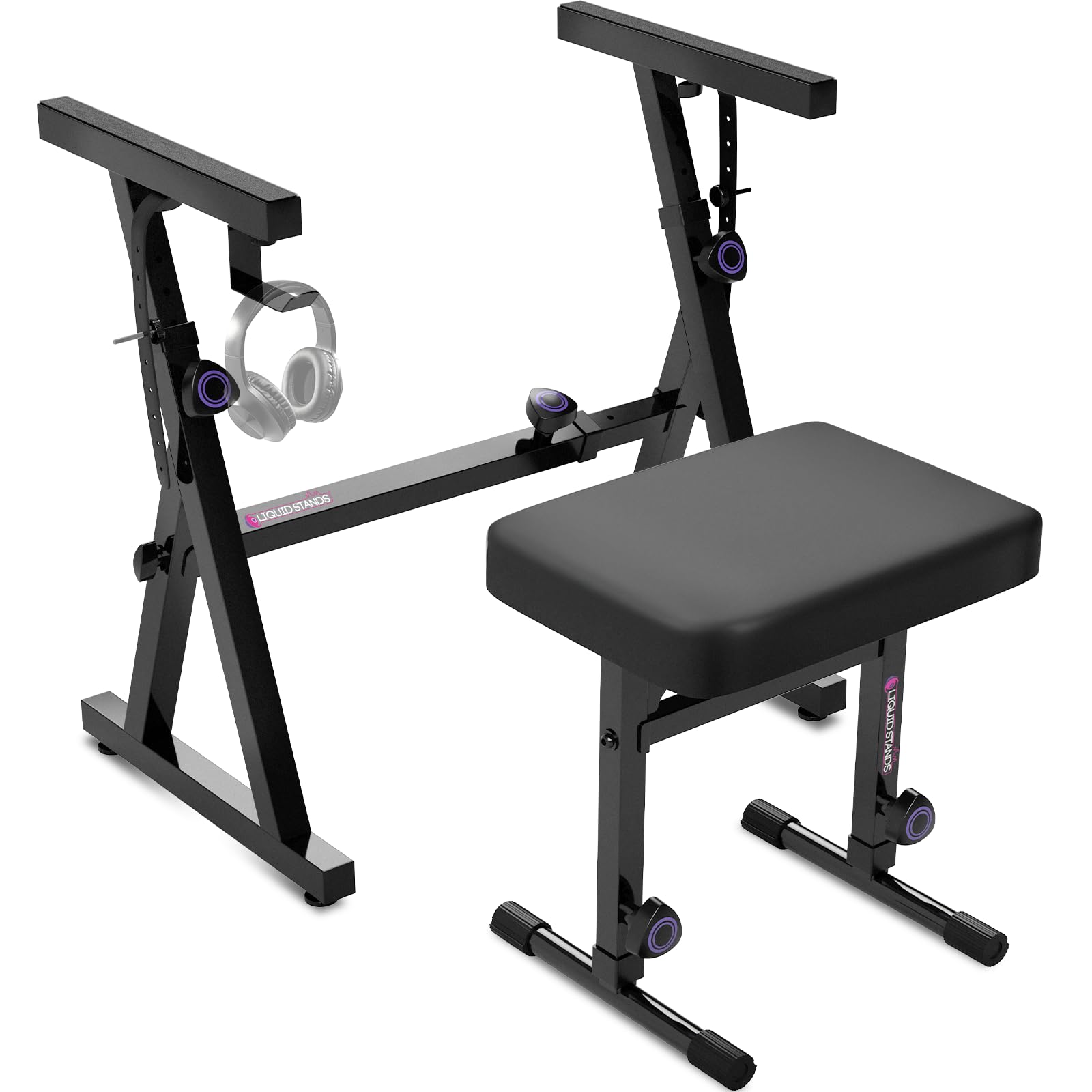
Liquid Stands Stand and Bench Set

94 /100
LBD Score Outstanding

Key details

Width Range
22.5 to 33.5 inches
Bench Weight
9 lb
Height Range
22.5 to 33.5 inches
Weight Capacity
250 lb
View on Amazon

The stand in this kit is the one we recommend above, so the interesting part is the second box: a nine-pound bench that adjusts through the same range and slides underneath the frame when you're done. That last detail matters more than it sounds. A bench that has to live somewhere else is a bench that ends up under a pile of laundry.

We set both pieces up in one session and came away convinced the pairing is the real product. The bench adjusts through a range that puts an average adult at the right height for the stand's lower settings, and the seat is firm rather than plush — which is what you want, since a soft bench lets you sink and reach. Assembly for the pair runs about twenty minutes.

Everything the stand does on its own, it does here: 250 pounds of capacity, four adjustable feet, foam pads, a headphone hook and two anchoring straps, all under the same three-year warranty. What the kit adds is the piece you can't buy separately without guesswork, a seat whose height range is known to line up with the frame. If you already own a bench that works, buy the stand alone; if you don't, starting here saves a decision.

Pros

  • Bench and stand share one height range
  • Seat slides fully under the frame between sessions
  • Firm padding that doesn't flatten mid-practice
  • Same 250-pound capacity and three-year warranty

Cons

  • Anchor-strap fitting is the fiddly part of assembly
Our verdict

The same Z-frame stand with a bench that matches it, so you set your playing height once and stop wondering whether a chair is close enough.

Check Latest Price
3

Best Budget X-Frame

RockJam RJX29 X-Frame Stand

95 /100
LBD Score Outstanding

Key details

Folds Flat
Yes
Height Range
29 to 91 cm
Stand Weight
6.1 lb
Weight Capacity
20 lb
View on Amazon

Twenty pounds. That's the load rating RockJam publishes for this stand, and it's the number we check before anything else — plenty of weighted 88-key pianos weigh more than that on their own, and no amount of bracing changes a published limit. Put a 61-key arranger or a MIDI controller on it, which is what most people shopping at this price own, and the rating stops being interesting.

The frame is a double-braced X with a quick-release lever that moves between five heights from 29 to 91 cm, and it folds flat enough to slide behind a door, which is the part we appreciate most. Locking straps are included, the legs have non-slip caps, and the whole stand weighs 6.1 pounds. The crossbar sits where an X-frame's crossbar always sits, so if you play with your knees together and close to the keys, you'll feel it.

Where this stand makes sense is the case you can carry in one hand: a weekly lesson, a rehearsal in a church hall, a keyboard that goes back in the cupboard on Sunday night. It's the cheapest metal X-frame worth recommending here, it arrives with everything you need, and it takes up almost no room folded. What it isn't is a permanent home for a heavy stage piano.

Pros

  • Quick-release lever changes height in seconds
  • Folds flat for a cupboard or a car boot
  • Locking straps and non-slip leg caps included
  • Two-year manufacturer warranty at a budget price

Cons

  • Only five fixed height positions, no fine adjustment
  • Top rails don't line up with every keyboard's screw points
Our verdict

A folding X-frame that earns its low price on light keyboards: five heights, a quick release, and straps that keep a 61-key board tied down.

Check Latest Price
4

Best for Tight Spaces

Pyle PKST38.5 Z-Frame Stand

92 /100
LBD Score Outstanding

Key details

Arms
Foam padded
Stand Weight
9.7 lb
Weight Capacity
85 lb
Width Adjustment
Infinitely adjustable
View on Amazon

Most stands adjust in steps, which is fine until your keyboard doesn't cooperate. The Pyle sets its width with a sliding lock instead of notches, so the arms land wherever the instrument's chassis wants them — worth having if the mounting holes underneath sit closer together than standard spacing, or if you're putting a synth or a DJ controller up there rather than a piano.

The arms are foam-padded, which matters more than it sounds: a glossy plastic keyboard on bare metal rails will slide and will scuff. There's a headphone hook on the frame, a safety lock on the folding mechanism, and the whole stand collapses into a Z compact enough to stand in a closet between sessions. At 4.4 kg it moves with one hand.

It's rated to 85 pounds, comfortably above a weighted 88-key piano, and the top rails are wide enough for a full-size board. Folding stands live or die on their knobs, and this one is no exception — we tighten every lock in order before the keyboard goes back on, which takes a few seconds and removes the doubt.

For all that flexibility it stays simple: two knobs and a slider, no tools, no ritual. Of the stands here, it's the one that adapts to an odd-sized keyboard and then folds away into a closet, and that pairing is rarer than it should be.

Pros

  • Width locks anywhere rather than in fixed notches
  • Foam-padded arms hold a glossy keyboard without scuffs
  • Folds into a slim Z for storage between sessions
  • 85-pound rating covers a weighted 88-key piano

Cons

  • Sits low, so tall players will want more height
Our verdict

Infinitely adjustable width and a frame that folds into a slim Z make this the stand for small rooms, and the foam arms protect a glossy keyboard.

Check Latest Price
5

Best Furniture Look for Yamaha Pianos

Yamaha L85 Keyboard Stand

93 /100
LBD Score Outstanding

Key details

Fits
Yamaha P45, P71, P115
Attachment
Secures to the instrument
Stand Weight
26.5 lb
View on Amazon

The mechanism is simple: the instrument attaches to the stand's brackets, so the two read as a single piece rather than a keyboard perched on a frame. We set one up beside a folding stand and the difference wasn't subtle — one looks like furniture, the other looks like equipment.

The stand weighs 26.5 pounds on its own and doesn't fold, so it stays where you put it, and it ships with stabilizing feet for carpet. Putting it together is a matter of attaching the brackets and standing the whole thing up, after which the piano and the stand come and go as one object.

What you give up is flexibility, and what you get for it is a corner that looks intentional rather than improvised. It costs furniture money to do a stand's job, which is fair only if you care how that corner looks — and if you do, nothing else here comes close.

Pros

  • Turns a slab piano into furniture
  • Keyboard mounts securely to the stand
  • Ships with stabilizing feet for carpet

Cons

  • Fits only the Yamaha P45, P71 and P115
  • Fixed height sits low for taller players
Our verdict

The least flexible stand here, and the best-looking: buy it when the piano stays in one room and you want that room to look like it has a piano in it.

Check Latest Price
6

Standing Players

GrowDaily ZJ-1 Keyboard Stand

89 /100
LBD Score Excellent

Key details

Width Range
24 to 33.8 inches
Height Range
22 to 37 inches
Stand Weight
10.3 lb
Weight Capacity
250 lb
View on Amazon

Four buckles is what separates this from every other Z frame here. The GrowDaily clips the keyboard down at the corners of the top rails as well as strapping it, so a board that likes to creep forward under heavy playing stays where you put it. If you've ever pushed a stage piano back into place mid-song, you know why that caught our eye.

It's also the tallest Z-style stand in the group at 37 inches, which is enough for standing play, and the width runs out to 33.8 inches. The frame carries a 250-pound rating, the crossbar is sponge-padded where the keyboard rests, and every contact point has a non-slip pad. At 10.3 pounds it's light enough to shift around a room without feeling hollow.

None of this is exotic engineering — it's the same Z geometry as the rest with more thought about how a keyboard behaves when you play hard. Against the Liquid Stands it gives up some refinement and gains three and a half inches of height, and for a standing player that's the trade that counts.

Pros

  • Four corner buckles stop the keyboard creeping
  • 37-inch height supports standing play
  • Padding and non-slip pads at every contact point
  • 250-pound rating with a 10.3-pound frame

Cons

  • Four buckles and two straps slow every setup
Our verdict

The most security-minded Z frame here: four corner buckles, padding wherever the keyboard touches, a 250-pound rating and a 37-inch ceiling.

Check Latest Price
7

Budget 88-Key Setups

Amazon Basics Double-X Stand

93 /100
LBD Score Outstanding

Key details

Frame
Double-X steel
Height Range
27.5 to 38.2 inches
Stand Weight
10.5 lb
Weight Capacity
88.2 lb
View on Amazon

Forty kilograms, about 88 pounds, is the figure that separates this from the other budget frames here: more than four times the rating on the RockJam RJX29, and more than enough for a weighted 88-key piano. On the numbers alone it's the best value in the group.

The double-X layout puts two sets of legs under the instrument, which is the difference between a stand that shivers on a bass note and one that doesn't. Height runs from 27.5 to 38.2 inches, the highest top setting of any stand here, so it covers a child on a low bench and an adult playing on their feet. It weighs 10.5 pounds and goes together with a wrench and the usual bolts.

We rate it as the sensible cheap stand for a piano that stays in one room. It's steady enough for a weighted keyboard, plain enough to disappear against a wall, and light enough to carry out to the car. If you want the most capacity for the money in this group, this is where the search ends.

Legroom is the other thing it gets right: the double-X leaves the space under the keyboard open, so you can sit close without a crossbar in your shins. A full-size 88-key board sits with room to spare on the rails; a shallow keyboard will leave the rails proud at the back, which is worth knowing if the stand goes against a wall.

Pros

  • 88-pound rating is high for a budget stand
  • Highest top setting here at 38.2 inches
  • Double-X frame opens up legroom underneath

Cons

  • Less settled than the Z frames at full height
Our verdict

The value pick among the plain frames: an 88-pound rating, a 27.5-to-38.2-inch range and a double-X that holds a weighted keyboard without drama.

Check Latest Price
8

Portable Practice

Stage Rocker Single-X Stand

87 /100
LBD Score Excellent

Key details

Folds
Slim-line fold
Frame
Single-X, bolted
Adjustment
Height and width
Stand Weight
6.37 lb
View on Amazon

At 2.89 kg this is the lightest stand in the group, and the fold is genuinely slim — it disappears behind a sofa or into the back of a car without being planned around. Carry a 61-key board to a rehearsal every week and the difference between this and a steel Z frame is the difference between one trip and two.

The frame is a single-X with bolted joints, adjustable for both height and width, and it comes with the Allen wrench you need plus a holder on the frame to keep it there. Assembly is four steps, and we had ours standing in a few minutes without opening the instructions.

Width and height both adjust, and a 61-key board sits comfortably with room at each end. The bolted construction is what decides how long it lasts, and the wrench living on the frame makes tightening the joints a thirty-second job rather than a hunt through a drawer.

That makes it a good second stand, a sensible first stand for a kid, and the one that lives in a cupboard and comes out on Sundays. It's the least expensive way into a metal stand that adjusts both ways, and it does the basic job without asking for storage space.

Pros

  • Lightest stand here at 2.89 kg
  • Adjusts for both height and width
  • Allen wrench stores on the frame

Cons

  • Moves under your hands at full height
Our verdict

The lightest stand here: a bolted single-X that folds slim, adjusts for height and width, and suits a 61-key board carried to a weekly rehearsal.

Check Latest Price

How We Tested Keyboard Stands

We started by gathering the stands that keep showing up in player forums, lesson studios, and gig bags, then narrowed by the specs that change daily use: whether the stand adjusts wide enough for an 88-key board, how tall it goes, how small it folds, and whether it uses an X or Z frame. That left us with 12 stands, which we rotated through six months of practice, teaching, and moving between rooms.

At home, I played scales and dense chords on a weighted 88-key keyboard, watching for side-to-side sway and listening for creaks at the joints. During lessons, we raised and lowered each stand between a seated adult and a standing teenager, noting whether the quick-release levers or pins caught smoothly and whether the height stayed put. For travel and stage use, we folded each one, carried it up and down stairs, and set it up alone in a dim room.

We also loaded and unloaded keyboards repeatedly, checked locking straps and padded arms where they appeared, and inspected welds, joints, and finish after weeks of use. We tracked whether a cheap stand felt cheap in the hand—sharp edges, thin tubing, wobble where the legs meet—and whether sturdier models earned their extra bulk. Appearance got a fair look too: we noted which stands blended into a living room and which only made sense under stage lights.

How to Choose a Keyboard Stand

Frame Shape Decides How It Feels to Sit At

The X-frame is the classic cheap answer, and it has a flaw you can't see in a product photo: the crossbar sits exactly where a seated player's knees want to be. A double-X moves the bracing outward and stiffens the frame. A Z frame puts the load behind the player instead of under the keyboard, which is why the Liquid Stands and the GrowDaily feel so open when you sit close.

If you play seated with your knees under the instrument, start with a Z and work backward. If the stand spends most of its life folded in a cupboard, a single-X is still the lighter, cheaper answer — just accept that it gets less settled the higher you set it.

Height: Measure Before You Shop

Don't shop by the advertised maximum. Sit on the bench you'll actually use, let your forearms hang level, and measure from the floor to the underside of your forearm — that's roughly where the top of the keys should land. The stands here run from about 22 inches at the bottom to 38 at the top, so most cover a seated adult.

Standing play narrows the field quickly. The Amazon Basics reaches 38.2 inches and the GrowDaily 37, which is enough to play on your feet; a stand topping out near 33 inches, like the Liquid Stands, is a sitting stand for most people.

How the Keyboard Is Held On

Two things keep a keyboard in place: straps and gravity. The anchoring straps bolt or clip to the stand and hook through the keyboard's own screw holes, so they only work if your model has holes in matching places — a stand that fits one 88-key piano perfectly can miss the next one. Look at the underside of your keyboard before you order, and check the depth too: a shallow board leaves the top rails poking out behind it.

The second number is the load rating, and the spread here is enormous, from 20 pounds on the RockJam RJX29 to 250 on the Z frames. Weigh your keyboard and buy with margin rather than trusting how sturdy the frame looks.

Where It Lives: Folding, Weight and Floor

Stands get bought for a room and then moved. If the keyboard stays put, weight is free stability — the Yamaha L85 at 26.5 pounds and the double-X frames sit planted in a way a six-pound folder never will. If the stand travels weekly, folded bulk and setup time matter more than capacity, and the Stage Rocker's slim fold is the whole reason to own it.

Floor matters as much as frame. Adjustable feet, like the four on the Liquid Stands, deal with an old uneven floor; on deep carpet, a heavier stand with wide feet settles best, and the Yamaha ships stabilizing feet for exactly that.

Frequently Asked Questions

Final Verdict

The Liquid Stands Z-Style is the stand we point most players to, and the reason is simple: it puts the bracing behind you instead of in your knees, and 250 pounds of capacity means you stop thinking about the rating. Buy the kit version if you don't already own a bench that works.

If your piano is a Yamaha P45, P71 or P115 that never leaves the living room, the L85 is the better-looking answer to the same question — just don't expect to adjust anything about it.