Best Smart Wi-Fi EV Chargers of 2026

Pulling into your own driveway at 9 p.m. with 14 percent left and a 6 a.m. departure on the calendar is its own kind of panic. A Level 2 charger fixes that: instead of a handful of miles a night, you get real range every hour, and the car is full by morning. The smart part is why you pay more — scheduling for off-peak rates, and a look from the couch at whether the car is actually charging.

I've had one bolted to my garage wall for two years, and the lesson is that the app, not the cable, decides whether you like the thing. The hardware is a contactor and a heavy cord; the brains, and most of the complaints, live in the Wi-Fi radio. Over eight months my team has charged with seven of these overnight, and the ones we kept were the ones that quietly worked. One thing buyers get backwards: the amperage on the box matters less than what your panel can feed it. The picks below are the ones that held up.

1

Best Overall

Emporia Level 2 Charger

94 /100
LBD Score Outstanding

Key details

Cable
25 ft
Plug Type
NEMA 14-50
Max Output
48 A hardwired
Certification
UL, ENERGY STAR
View on Amazon

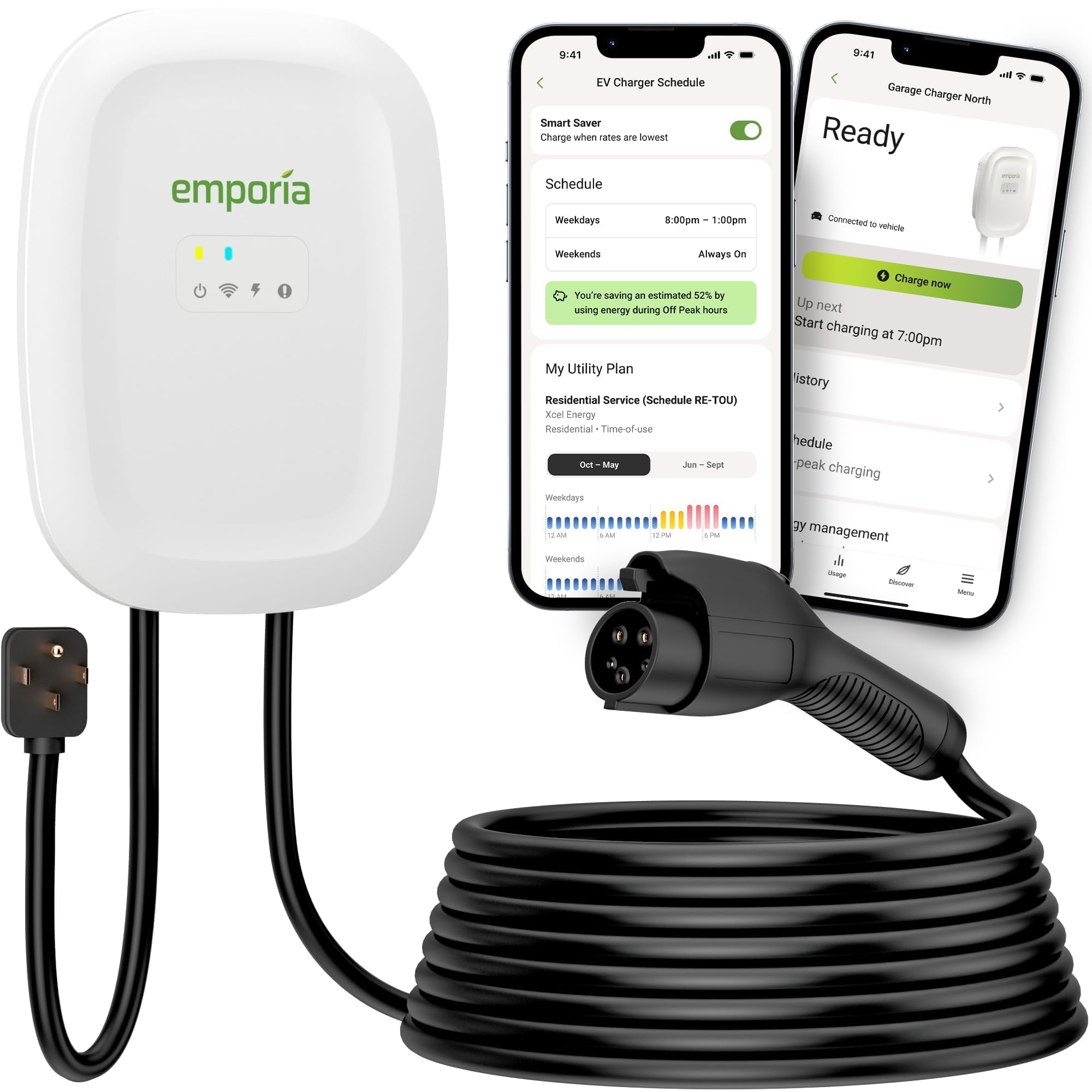
Two wiring options in one box is why the Emporia ends up at the top of this list. Out of the carton it's a NEMA 14-50 plug-in limited to 40 amps; convert it to a hardwired connection and it runs the full 48, which is up to 46 miles of range an hour on a car that can accept it. That's not a marketing nicety. It's the difference between a charger that fits the outlet already on your garage wall and one that sends you back to the electrician.

On the wall it's a plain white box with a 25-foot cable, a holster, and a mounting bracket in the box. At 16.6 pounds it's heavier than the plug-in units here, and we took that as a good sign rather than a chore. The cable is thick, the J1772 connector seats with a solid click, and nothing about the assembly feels like it will rattle loose in a cold garage. UL listing and ENERGY STAR certification are both there, and the three-year warranty matches most of the field.

The app earns the smart label. Real-time energy data, scheduling, and a running cost estimate all work, and the energy dashboard shows more than most of the others do. Set one off-peak window and the rest is automatic.

One practical note before you order: the plug-in path wants a 14-50 outlet on a 50-amp breaker, and the hardwired path wants a 60. Check which one your panel has room for, because that single fact decides which version of this charger you're actually buying.

Pros

  • Works as a 40 A plug-in or a 48 A hardwired unit
  • 25 ft cable reaches across a two-car garage
  • App tracks energy use and schedules off-peak charging
  • UL listed and ENERGY STAR certified

Cons

  • Wi-Fi runs on 2.4 GHz only
  • Some units have failed inside the warranty window
Our verdict

The charger we recommend to most households: plug it in at 40 amps today, hardwire it for 48 later, and let the app handle the schedule.

Check Latest Price
2

Most Powerful

Autel MaxiCharger 50A

87 /100
LBD Score Excellent

Key details

Cable
25 ft
Max Output
50 A (12 kW)
Certification
CSA
Weather Rating
NEMA 4
View on Amazon

Fifty amps is the number that separates the Autel MaxiCharger from everything else on this page. Hardwired, it delivers 12 kW — the highest output in this group — from a sealed dark-gray case rated NEMA 4 for snow, rain, hail, and sleet. If your car can accept that much power, nothing here charges it faster.

Adjustability is what makes those 50 amps usable rather than aspirational. You can dial the unit from 16 to 50 amps in the app or on the box, so a house with a 40- or 50-amp circuit gets a fast charger running below its ceiling instead of a slow one running flat out. That's the version of speed we like best: headroom you can grow into rather than a number you have to rewire for.

The Autel Charge app handles schedules, off-peak windows, and session history, and it pulls in local electricity rates so the cost per charge is more than a guess. Bluetooth gives you a second way in when Wi-Fi is being difficult — worth knowing, because pairing is the fussiest few minutes of setup. Once it's connected, the scheduling has been dependable.

Installation is an electrician's job, since this one is hardwired only, and the front cover takes real effort to get off. We count that as a twice-a-decade annoyance rather than a daily one. CSA certification and the three-year warranty round it out.

Pros

  • Highest output here at 50 A and 12 kW
  • Dials down to 16 A to fit smaller circuits
  • NEMA 4 case for exposed outdoor walls
  • Bluetooth as a backup when Wi-Fi misbehaves

Cons

  • Wi-Fi and Bluetooth pairing can be stubborn
  • Housing finish has peeled on some units
Our verdict

Buy it if your car can take 50 amps and your wall is exposed to weather — this is the fastest, hardest-wearing unit here.

Check Latest Price
3

Best Budget

AIMILER 32A Charger

91 /100
LBD Score Outstanding

Key details

Cable
25 ft
Plug Type
NEMA 14-50P
Max Output
32 A (7.68 kW)
Adjustable Current
16–32 A
View on Amazon

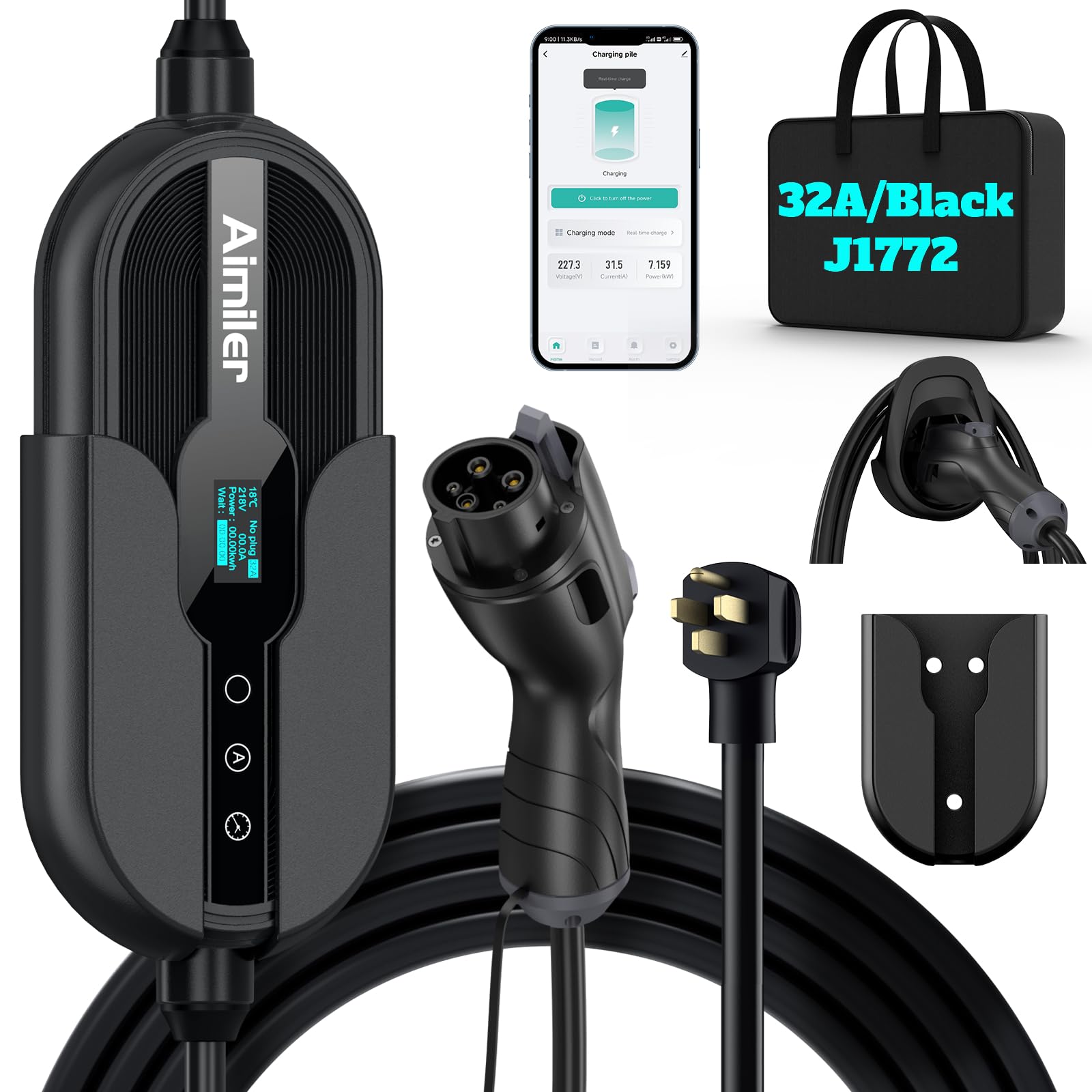
Thirty-two amps is the honest headline here, and it's also why this AIMILER costs what it does. On a 40-amp breaker it adds 7.68 kW, which is a full overnight charge for most cars but not the near-50-amp pace of the Emporia or the Autel. We're comfortable with that trade. For a household with a spare 40-amp circuit, or a plug-in hybrid that can't use more anyway, this is the smart charger we point people toward first.

The adjustability is the sleeper feature. You can step the current down from 32 amps in increments, which is what makes an ordinary 30-amp dryer circuit workable — set it to 24 and stay inside the breaker instead of paying for a new run. The touch screen on the front shows amps, voltage, and delay time without opening the app, and plug-and-charge is the default mode, so the car starts charging even if your phone is in the house and the Wi-Fi is out.

Around the box you get a 25-foot cable, a wall holster, a mounting bracket, and a soft carry bag. That last item tells you what this thing is for. It unplugs, goes in the bag, and comes back out at a rented cabin or a relative's 14-50 outlet. ETL and FCC certification are both there, and the three-year warranty is a year longer than the Lectron's.

What it won't do is grow with you. There's no hardwired path to a higher amperage here — 32 amps is the ceiling, full stop. If a panel upgrade is on your five-year plan, the Emporia is the smarter purchase; if it isn't, this one covers the commute for years.

Pros

  • Steps down to 24 A on a 30 A dryer circuit
  • Plug-and-charge works with no app involved
  • Carry bag makes it genuinely portable
  • 25 ft cable with a 3-year warranty

Cons

  • App is basic next to Autel and Emporia
  • 32 A maximum with no higher-output option
Our verdict

The smart charger we point to when the budget or the breaker is small: 32 amps that dial down to fit the circuit you already have.

Check Latest Price
4

Best for Tight Panels

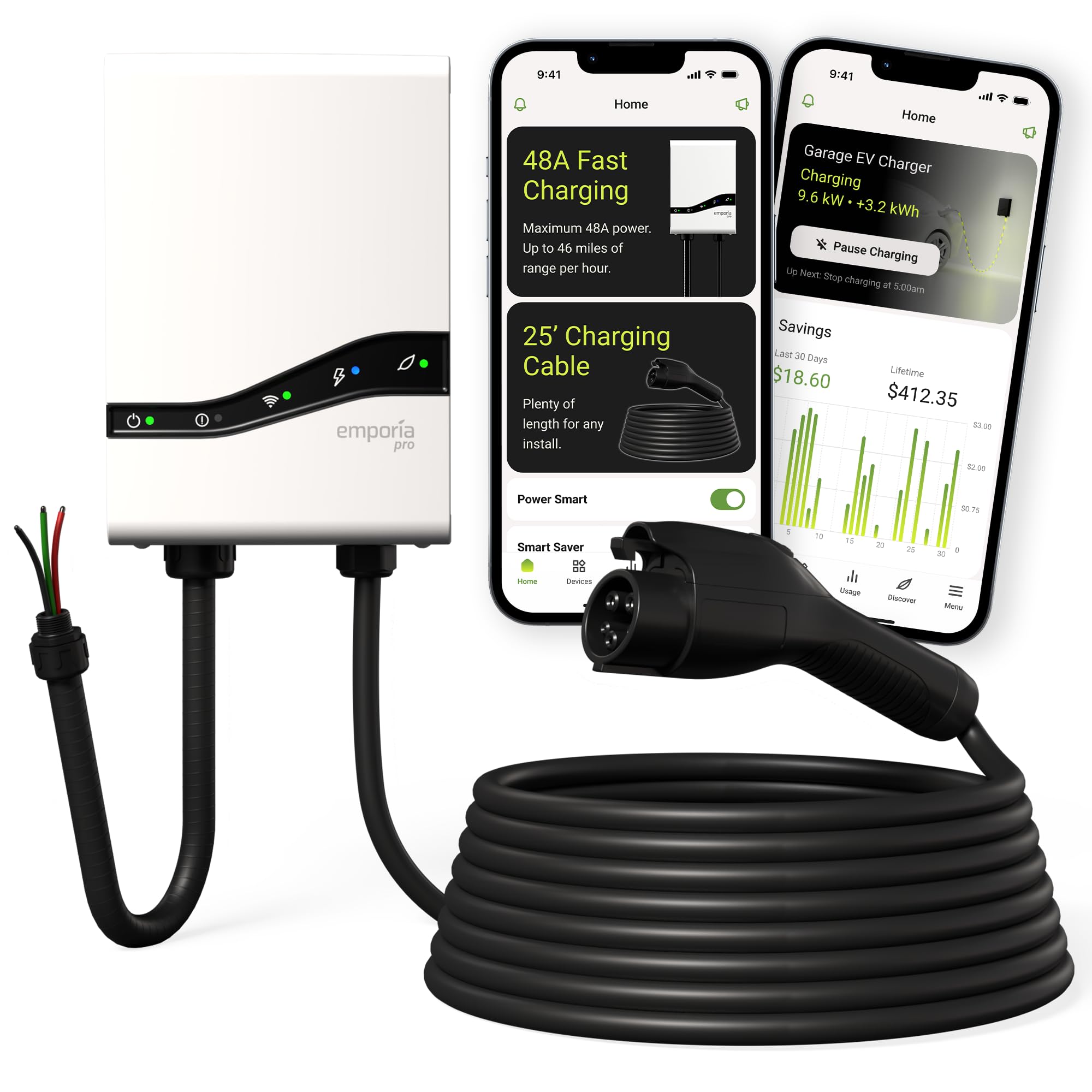
Emporia Pro with PowerSmart

91 /100
LBD Score Outstanding

Key details

Cable
25 ft
Max Output
48 A
Certification
UL
Load Management
PowerSmart with Vue monitor
View on Amazon

If your electrical panel is already full, the Emporia Pro is the one on this list built for you. PowerSmart watches the whole house's draw through the included Vue monitor and throttles the charger when the oven, the dryer, and the AC all come on at once, so a 48-amp charger can live on a service that couldn't otherwise carry one.

That's a real capability, not a checkbox. Every other charger here makes you pick an amperage and live with it; this one can run at full output on a quiet Sunday and back off on a Tuesday evening without you touching anything. The same Vue hardware gives you circuit-by-circuit energy data in the app, and the charger underneath is the same 48-amp, hardwired-or-14-50 unit Emporia already sells, with a 25-foot cable and a three-year warranty.

We think this is the most useful piece of energy management in the group, and also the one most people don't need. If your service has room for another 60-amp circuit and your utility isn't pushing time-of-use rates, the standard Emporia does the same charging for a lot less money.

The support side is worth knowing about too. Emporia's team works out of Colorado and takes questions about specific panel setups, which is exactly the conversation you want before committing to load management. Ask them what your service can carry — that answer is the reason this unit exists.

Pros

  • PowerSmart throttles charging to protect a tight panel
  • Includes the Vue home energy monitor
  • Same 48 A charging hardware as the standard Emporia
  • Circuit-level energy data in the app

Cons

  • The Vue adds a second install job in the panel
  • Costs noticeably more than the standard Emporia
Our verdict

Worth the premium only if your panel is the obstacle — PowerSmart lets a 48-amp charger live on a service that can't spare the amps.

Check Latest Price
5

Best Portable

Lectron WiFi Charger

84 /100
LBD Score Excellent

Key details

Form
Portable with carry case
Cable
16 ft
Max Output
40 A (9.6 kW)
Certification
ETL, FCC
View on Amazon

Sixteen feet is short. On a wall between two cars it's fine; from an outlet on the far side of a two-car garage to a charge port on the near side, it may not reach. The Lectron WiFi charger is the travel unit of this group, and the short cord is what lets it coil into its carry case.

We liked it anyway, for the reason it exists: it's a 40-amp charger that comes home in a bag. On a 14-50 outlet it delivers 9.6 kW, and the app offers three modes — manual, plug-and-charge, and scheduled — so at a rental with a 14-50 outlet you plug in and walk away. Scheduling turned out better than we expected at this level: pick a window, and the car tops up at off-peak rates with no further input.

The case is sized for the cable and the handle together, which sounds trivial until you've tried to coil a stiff EV cable into a grocery bag. The handle carries a UL 2251 mark and the unit is ETL and FCC certified, which is the reassurance we want from something that spends half its life in a trunk.

Pros

  • Carry case makes it a genuine travel charger
  • Manual, plug-and-charge, and scheduled modes
  • 9.6 kW on a standard NEMA 14-50 outlet

Cons

  • Two-year warranty is the shortest here
Our verdict

For renters and road trips: a 40-amp charger that unplugs, packs into its own case, and still schedules off-peak charging.

Check Latest Price
6

Hot Garages

IYILO 40A Charger

84 /100
LBD Score Excellent

Key details

Max Output
40 A (9.6 kW)
Temp Sensors
Input and output plugs
Certification
UL 2594, ETL, ENERGY STAR
Weather Rating
NEMA 4
View on Amazon

Heat is what kills charging connectors, and the IYILO is the only charger in this group that shows temperature at both ends. NTC sensors in the wall plug and in the J1772 handle feed live readings to the app, so you can watch a connector working harder than it should and drop the amperage before anything gives.

The rest of the hardware is solid without being remarkable: 40 amps and 9.6 kW on a 14-50 plug, a NEMA 4 housing, a built-in GFCI, and the full certification set of UL 2594, ETL, and ENERGY STAR — the paperwork that decides whether a rebate application goes through.

The app is built for people who like numbers. Enter time-of-use rates, see what each session cost, and give each schedule its own current limit — a gentler rate for a long weekend window, full power when you need it fast. That per-schedule control is more than we expected at this price.

Where it lands: if your garage runs hot, whether it's a south-facing wall, a tight cabinet, or an outlet in direct sun, the temperature readout is worth more than another 8 amps of headroom. If you're wiring fresh and want the fastest charge on the block, the Emporia and the Autel are the better buys.

Pros

  • Monitors temperature at both plugs
  • Per-schedule current limits and rate tracking
  • UL 2594, ETL, and ENERGY STAR certified

Cons

  • Utility charging program support is still expanding
Our verdict

Choose it if heat is your worry: dual temperature sensors and per-schedule current limits make it the most watchful charger here.

Check Latest Price
7

Rugged Outdoor Walls

Grizzl-E Classic Connect

85 /100
LBD Score Excellent

Key details

Cable
25 ft
Enclosure
Metal, NEMA 4X
Max Output
40 A (9.6 kW)
Certification
UL
View on Amazon

The Grizzl-E arrives as a white metal box with a 25-foot cable and a handle that feels like it belongs on a commercial unit. There's no plastic shell to crack and no painted finish to peel, and the NEMA 4X enclosure is rated fire-resistant as well as water-resistant. In an unheated garage that bakes in July and freezes in February, that build is the whole argument.

It's a 40-amp, 9.6 kW unit on a 14-50 plug, adjustable from 16 to 40 amps, so it settles onto a 40- or 50-amp circuit without drama. The plug-in design means it hangs on a bracket, comes off when you move, and doesn't need an electrician on the way out.

What we appreciate most is that the smart layer stays out of the way. Grizzl-E Connect covers live charging data, schedules, consumption history, and firmware updates, and the app opens quickly. It's a shorter feature list than Emporia's or Autel's, and we didn't mind, because the things we touch every week are all there.

Pros

  • Metal NEMA 4X enclosure built for outdoor walls
  • Adjustable 16–40 A to fit smaller circuits
  • Plug-in mount comes off when you move

Cons

  • 40 A is the maximum on a 50 A breaker
Our verdict

For an exposed garage wall, this is the one we trust: metal, NEMA 4X, adjustable to fit the circuit, with the everyday smart features.

Check Latest Price

What Eight Months of Overnight Charging Taught Us

We started with every Level 2 charger we could find with a Wi-Fi radio and a J1772 plug, then narrowed by what actually shapes the purchase: whether it plugs into a 14-50 outlet or has to be hardwired, amperage, cable length, indoor/outdoor rating, and how actively the app is maintained. Seven made the cut, and each spent at least a month as the only charger on the wall.

Real duty looked like a 40-mile weekday commute, a Sunday top-up before a road trip, and one full charge the night before a long drive. We logged how much range each added per hour at its top setting and again at a reduced one, then checked those numbers against the energy the car reported and the kWh on our utility bill. Every charger also ran an eight-hour overnight session while we watched whether it held steady or dropped out and left the car short of its target by morning.

Connectivity got its own abuse. We rebooted the router mid-session, walked to the far end of the driveway to see if the app still responded, and noted which chargers rejoined the network by themselves and which needed a breaker flip. Scheduling was tested the same way: set a start time for 11 p.m., then check at 11:15 whether the session had actually begun.

Ease of use got judged at 6 a.m. in the dark: plugging in one-handed, holstering the connector, reading the status light from across the garage, and handling a stiff cable in the cold. Chargers that lived outdoors got rained on, hosed down, and left in the sun for months; we watched for discolored cases, stiffened cables, and loosened connectors. On value, a plug-in unit you can install yourself competes hard with a hardwired one that needs an electrician.

How to Choose a Smart Level 2 Ev Charger

Start With the Circuit, Not the Charger

An EV charger draws 80% of its breaker's rating, continuously. That's why a 40-amp charger wants a 50-amp breaker, a 32-amp unit wants 40, and a 48-amp unit wants 60. Find the spare breaker in your panel, or the one an electrician can free up, and that number decides what you buy. A 48-amp charger on a 40-amp circuit isn't a faster charger; it's a tripped breaker.

The good news is that most of the units here can be dialed down, and we think buying for the circuit you have beats buying for the one you might add. The AIMILER steps from 32 amps to 16, which is what lets it share a 30-amp dryer circuit at 24 amps and still cover a commute overnight.

Plug-In or Hardwired

A NEMA 14-50 plug is the cheaper path: the outlet goes in, the charger hangs on its bracket, and you can take it with you when you move. That convenience has a ceiling, and it's 40 amps — which is why the Emporia tops out at 40 in plug form and reaches 48 only when it's hardwired.

Hardwiring costs more up front and gives you the full amperage, a cleaner install, and no outdoor outlet to protect. Rebate rules vary, and some programs tie eligibility to a hardwired, network-connected unit, so read your utility's requirements before the electrician arrives.

The Smart Part Depends on Your Wi-Fi

Scheduling, time-of-use rates, and energy history are the reason to buy a connected charger at all, and all three need a signal that reaches the garage. Check the strength where the unit will actually hang — a bar of Wi-Fi in the kitchen tells you nothing about a detached garage.

Check the band, too. The Emporia connects on 2.4 GHz only, which reaches further through walls but is the band most mesh systems try to steer devices away from. Split your bands or give the charger its own 2.4 GHz network if the app can't find it.

Cable Length and Where It Hangs

Twenty-five feet is the working standard here and covers a two-car garage from most wall positions; the Lectron's 16 feet is a travel compromise, not a garage one. Measure from the outlet to the charge port with the cable hanging in a loop rather than pulled straight, and measure with the car parked where you actually park it.

The holster matters more than it sounds. A handle that rests at chest height and a cable that coils without kinking is the difference between a tidy wall and a heap on the floor every morning.

Weather Ratings, Enclosures, and Certification

An indoor-rated charger on an exposed driveway wall is the mistake to avoid. NEMA 4 handles rain and hose spray; NEMA 4X adds corrosion resistance. The Grizzl-E's metal 4X box and the Autel's sealed 4 case are built for exterior walls, and a plastic indoor unit is not.

Look for a UL, ETL, or CSA mark on the unit itself, because that's what an inspector and a rebate form ask about. ENERGY STAR is a bonus that tells you the standby draw is low when the car isn't plugged in.

Frequently Asked Questions

Final Verdict

Buy the Emporia. It's the only charger here that works with the outlet already on your wall at 40 amps and grows to 48 when you hardwire it, and its app does more with your energy data than anything else in this group.

If your panel can't take another 60-amp circuit, the Emporia Pro's PowerSmart is the reason to spend up. If you're working with a 30- or 40-amp circuit and no plan to change it, the AIMILER's adjustable 32 amps is the better use of your money.