Best Smart Water Shutoff Valves of 2026

A pinhole in a supply line can push hundreds of gallons into a basement before you get home. That's the fear these devices are built for: a motorized valve that reacts to a leak sensor or an abnormal flow reading and shuts the water off while you're reaching for your phone. The catch is that "smart shutoff" covers two different installs — an actuator that clamps onto the ball valve you already have, and a full replacement valve spliced into the pipe. One is a Saturday project; the other often isn't.

Connectivity is the second fork. Some run on Wi-Fi, some need a hub, and some use long-range radio that reaches a detached garage. Then there's leak detection — a floor sensor versus flow-based monitoring that can catch a running toilet or a slow drip. We spent six months with nine of these setups, and the keepers shut off reliably, installed without drama, and sent alerts that told us something useful. The picks below are sorted by fit, not by feature count.

1

Best Overall

YoLink Water Shutoff Kit

93 /100
LBD Score Outstanding

Key details

Range
Up to 2,034 ft open-air
Connectivity
LoRa hub; Alexa, Google Assistant, IFTTT
Installation
Retrofit; no pipe cutting
Included Sensors
4 leak sensors
View on Amazon

Not every household wants to cut into the main line, and the YoLink kit earns our top spot because it doesn't ask them to. The EVO operator mounts over an existing valve, while the X3 controller, hub, and four leak sensors arrive together. That combination is the closest thing here to a complete DIY leak-defense package: you place sensors under the water heater, behind the washing machine, and near the bathrooms, and the system can close the valve when one detects water.

The no-cut mount is the first thing we check on a kit like this, and YoLink's design is the least fussy in the group. Once the devices are paired, the device-to-device control can shut the valve during a Wi-Fi or internet outage, and the LoRa radio reaches up to 2,034 feet in open air. In a basement or a vacation house, that matters more than another app dashboard. The four included sensors also save you from buying them one at a time, and the hub leaves room to add more YoLink devices later.

The app is the main interface, and Alexa, Google Assistant, and IFTTT are supported for voice and routines. We like the system for straightforward protection, not water-use analytics. If water-use data matters, the FlowSmart kit below is the better fit; if you want the simplest path to automatic whole-home shutoff, this is the kit we keep coming back to.

Pros

  • No pipe cutting; mounts over existing valve
  • Four leak sensors and hub included
  • Offline device-to-device shutoff after pairing
  • Long LoRa range up to 2,034 feet

Cons

  • No flow or usage monitoring
Our verdict

For most houses, we recommend this kit because it adds automatic main-line shutoff and four leak sensors without cutting a pipe.
Check Latest Price
2

Best for Micro-Leak Detection

Frizzlife LP365

87 /100
LBD Score Excellent

Key details

Monitoring
Flow, temperature, usage reports
Valve Size
3/4 in and 1 in
Valve Type
Inline motorized ball valve
Leak Detection
Ultrasonic down to 0.01 GPM
View on Amazon

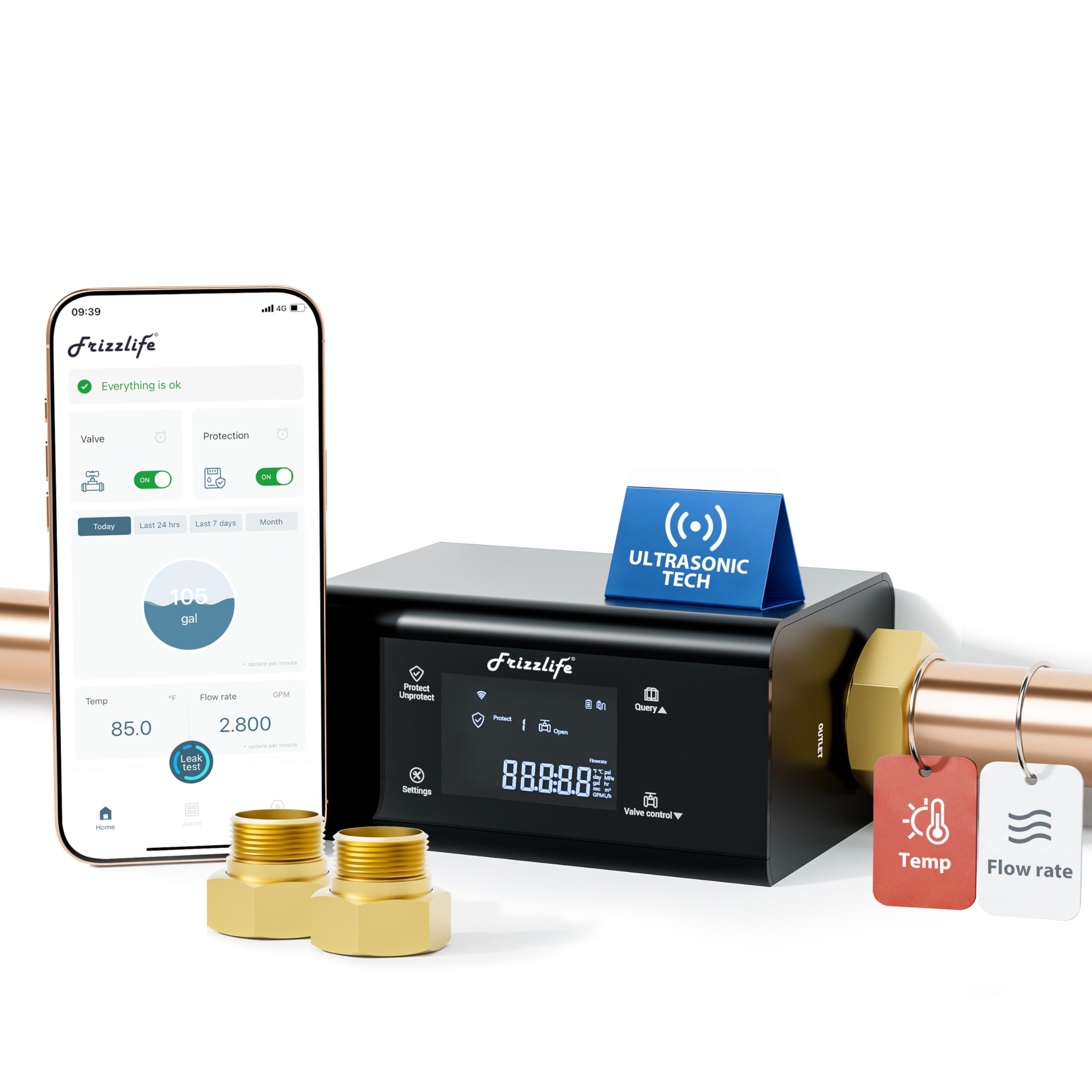
The number that matters on the Frizzlife LP365 is 0.01 GPM. That's the tiny flow it is designed to notice with ultrasonic sensing, which is a different kind of protection from a sensor sitting on the floor. The valve installs inline on a 3/4-inch or 1-inch main, watches flow and temperature continuously, and can close automatically or from the app. For a household that wants to catch a slow drip inside a wall or a supply line before it becomes a stain on the ceiling, that sensitivity is the reason to pay attention.

We think the LP365 is the strongest pick here for water monitoring, not the easiest first install. It needs a place in the plumbing, a power outlet, and enough Wi-Fi at the valve. The unit is certified to NSF/ANSI 61 and 372, the potable-water standards, and it reports flow, temperature, and usage from the Smart Life app. Alexa, Google Assistant, SmartThings, and IFTTT are listed as integrations. The value is the daily data: a toilet that keeps running or a slow leak shows up as a pattern, not just as a puddle.

The installation is more involved than a clamp-on actuator, and the corded design means you need an outlet near the main. A wired leak sensor is not part of the box, so you are relying on flow detection rather than point-of-leak detection. That is the trade-off for the finer flow data, and it is why this sits below the YoLink kit for a straightforward DIY job.

Pros

  • Ultrasonic sensing down to 0.01 GPM
  • Tracks flow, temperature, and daily usage
  • NSF/ANSI 61 and 372 certified
  • Works with Alexa, Google Assistant, and SmartThings

Cons

  • Remote alerts depend on Wi-Fi at the valve
Our verdict

We recommend the LP365 for households that want micro-leak detection and water-use data and can put a valve in the main line.

Check Latest Price
3

Best for Z-Wave Homes

Zooz Titan ZAC36

84 /100
LBD Score Excellent

Key details

Hub
Z-Wave hub required
Mounting
No-tool over ball valve
Protocol
Z-Wave Long Range 700 series
Valve Type
Retrofit actuator
View on Amazon

A stiff old ball valve is where most retrofit actuators give up, and the Zooz Titan's pitch is that it won't. The unit uses a strong motor and calibrates on each run, and it mounts over an existing ball valve without tools. That combination is why we like it for older homes and for anyone whose main valve takes two hands and a grunt. The Z-Wave Long Range 700-series radio also gives it a place in a Ring, SmartThings, or Z-Box setup without adding another Wi-Fi bridge.

The Titan is not a standalone device. You need a Z-Wave hub that supports the platform, and the external water probe is a single point of coverage rather than a room-full of sensors. In our view, that is a fair trade for the torque and local control: Z-Wave automation can close the valve when a leak sensor trips, and the valve can be controlled from the hub. The included probe is useful right at the valve, but you will want more sensors for bathrooms and appliances.

Connectivity is the part to manage. Z-Wave Long Range needs a compatible hub, and pairing and calibration can be fussy if the valve is stiff or the mount is not square. The no-tool bracket is quick, but alignment still matters; a crooked mount turns a strong motor into a strained one. If your valve is a ball valve that moves, the Titan is the most capable retrofit actuator in this group.

Pros

  • High-torque motor for stiff ball valves
  • No-tool retrofit mounting
  • Z-Wave Long Range 700 series
  • Works with Ring Alarm and SmartThings

Cons

  • Only fits ball valves
Our verdict

For a Z-Wave home with an existing ball valve, we recommend the Titan for its torque and tool-free mounting.

Check Latest Price
4

Best for Remote Properties

YoLink FlowSmart Kit

85 /100
LBD Score Excellent

Key details

Meter Size
0.75 in
Monitoring
Live flow and usage totals
Connectivity
LoRa hub; Alexa, Google Assistant
Certification
NSF certified meter
View on Amazon

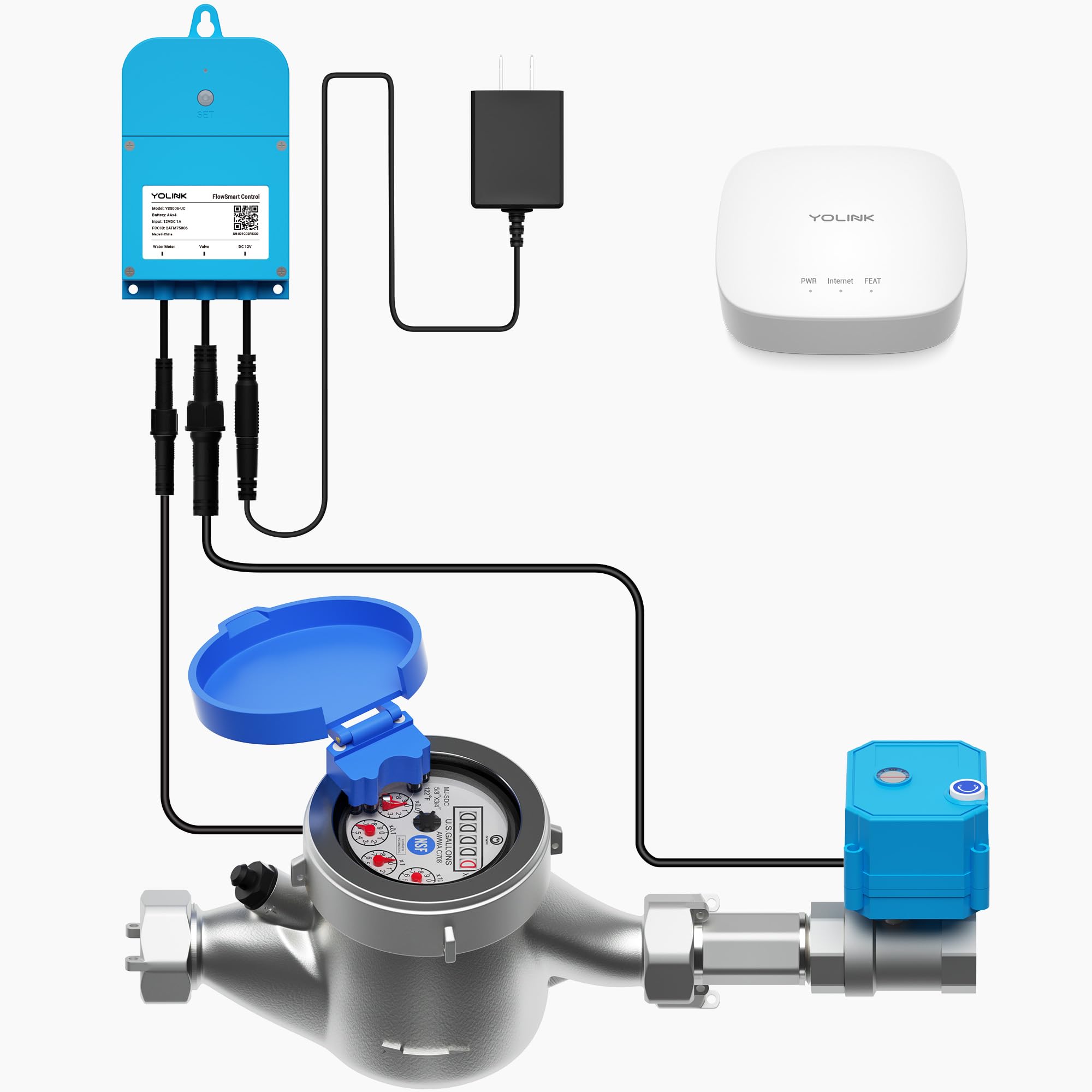
The FlowSmart kit is the YoLink system for someone who wants the water meter, not just the shutoff. It pairs a 0.75-inch pulse meter with the same style of motorized valve and hub, so the app can show live flow and usage totals, set volume or time thresholds, and close the valve when a limit is crossed. That is a more specific job than the standard YoLink leak kit, and it is the reason this one costs more and earns a separate place here.

The meter is NSF certified for potable water, and the LoRa radio is the practical advantage: up to 2,034 feet open-air, which is the kind of range that reaches a meter pit, a pump house, or a detached garage where Wi-Fi struggles. The hub also lets the system shut off offline after device-to-device pairing. We like it for a rental cabin, a farm building, or a house with a long run from the main to the router.

The catch is that this is a monitoring-first kit. Leak monitoring is the weaker part: the kit is designed around flow thresholds and sensor triggers, and the meter's digital totals can disagree with the physical dial. It also needs a 0.75-inch meter installed in the line, which is a bigger plumbing job than a clamp-on actuator. If you want to watch usage, this is the most complete option here; if you mainly want leak shutoff, the standard YoLink kit is easier to justify.

Pros

  • Pulse meter tracks live flow and usage
  • LoRa range up to 2,034 feet
  • Offline device-to-device shutoff
  • NSF-certified potable-water meter

Cons

  • 0.75-inch meter limits larger main lines
Our verdict

We recommend the FlowSmart kit for remote properties and heavy water users who want live usage data alongside automatic shutoff.

Check Latest Price
5

Simple Auto Shutoff

iSpring LS43WL

87 /100
LBD Score Excellent

Key details

Sensors
1 wired + 1 wireless
Valve Size
1 in MNPT / 3/4 in FNPT
Shutoff Time
20 seconds
Sensor Capacity
Expandable to 8
View on Amazon

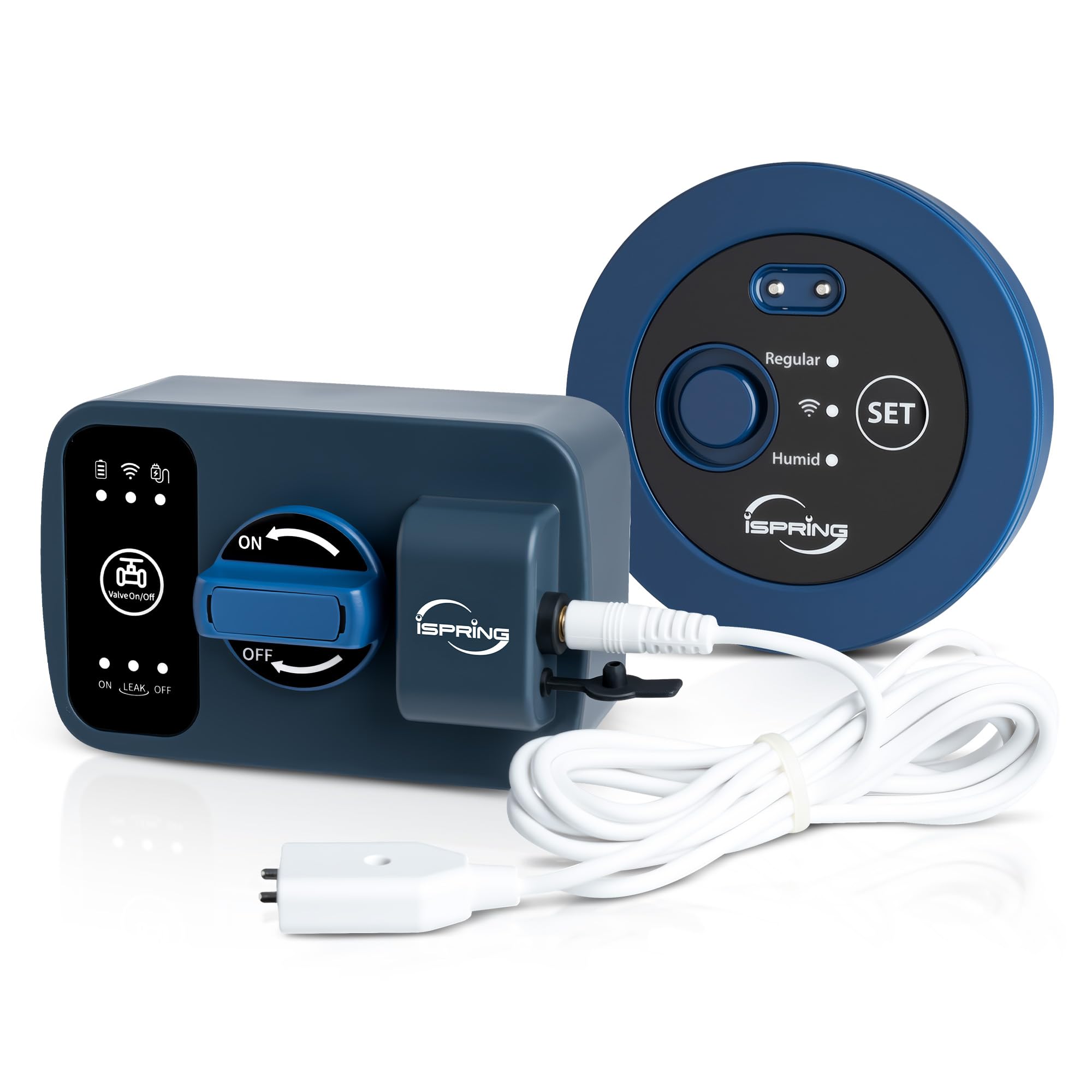
The iSpring LS43WL is the straightforward option: when a sensor gets wet, the motorized ball valve closes the main water supply within 20 seconds. There are no app controls to configure, no Wi-Fi pairing, and no hub. The box includes one wired and one wireless leak sensor, and the system accepts up to eight sensors. For a buyer who wants automatic protection without another account or notification stream, that simplicity is the appeal.

We recommend it for a simple whole-home install where the valve can go on a 1-inch MNPT or 3/4-inch FNPT line and the priority is automatic shutdown, not remote control. The push-button setup is easy to understand, and the 20-second close is quick enough to matter. What you give up is visibility: there is no app to check status from away from home, no usage data, and no voice control. The system also depends on the sensors being placed where water will reach them, so put the wired unit near the valve and the wireless one in the room you worry about most. If you travel often and want to confirm the valve is open or closed from your phone, the YoLink kit is the better fit. For a set-and-forget shutoff at the main, the iSpring earns its place.

Pros

  • Closes in 20 seconds
  • Includes wired and wireless sensors
  • Expandable to eight sensors
  • No app, hub, or Wi-Fi required

Cons

  • Requires main-line plumbing work
Our verdict

We recommend the LS43WL for a no-app, sensor-triggered whole-home shutoff where simple automatic protection matters more than remote control.

Check Latest Price
6

Branch Lines

CREECHWA Smart Valve

81 /100
LBD Score Excellent

Key details

Power
12V adapter
Material
Brass
Valve Size
1/2 in NPT
Connectivity
Wi-Fi; Alexa, Google Home
View on Amazon

A 1/2-inch NPT valve is not going on most main water lines, and that is the first thing to understand about the CREECHWA. It is a brass motorized ball valve with a 12V adapter, Tuya app control, schedules, and Alexa/Google support, sized for branch lines, pools, spas, and garden irrigation. If you have a dedicated line you want to open and close on a timer, this is a tidy and inexpensive way to do it.

The app side is familiar Tuya/Smart Life territory: four timing modes, manual open/close, multi-user access, and voice control. The brass body feels more substantial than the plastic actuators here, and the threaded connections are standard NPT, so a competent DIYer can install it with the right fittings and sealant. We like it for a pool fill line or a garden zone because those are exactly the jobs where a full whole-home system is overkill.

We don't recommend it as a main-line safety valve. The 1/2-inch size limits flow, and the valve is built for scheduled or remote control of a secondary line. For a pool fill, a garden zone, or a single fixture, it is the least expensive smart valve in this group and the one we reach for when the job is irrigation. Just confirm the thread size and that your line is not the main before you order.

Pros

  • Brass body with standard NPT threads
  • Four timer modes and app control
  • Alexa and Google voice support
  • Low-cost smart valve for secondary lines

Cons

  • No leak sensor included
Our verdict

We recommend the CREECHWA for a timed branch line, pool fill, or irrigation zone, not as a whole-home main shutoff.

Check Latest Price

How We Tested Smart Water Shutoff Valves

We started with a long list of smart valves and actuators, then read the spec sheets and installation manuals to sort them by pipe size, valve type, radio protocol, hub requirements, and what came in the box. That cut the list to nine units, which we installed on working plumbing and lived with for six months.

Two of us fit each one — clamp-on actuators in a rental where cutting pipe wasn't an option, inline valves on copper and PEX lines in a single-family house — and timed the job with basic hand tools. We noted whether it needed a union, a plumber, or a free hand to hold a flashlight, and how much clearance it left under the sink. For connectivity, we paired each unit to Wi-Fi or its hub, walked to the far end of the house and the detached garage, and checked where alerts still arrived; then we pulled the router to see whether an offline shutoff still worked.

To test leak response, we puddled water around the sensors, opened a drain valve to mimic a burst, and timed how long the valve took to close. We also let a toilet flapper run and an outdoor spigot drip to see whether flow-based monitoring caught slow waste, and noted any false alarms. Every day we opened the app to arm, disarm, and check history; during a planned power cut, we reached for the manual override. At the end, we cycled each valve through dozens of open-and-close cycles and checked for motor whine, corrosion, and a full seal. We also compared what came in the box — sensors, hub, meter — against buying those pieces separately, since a cheap valve that needs three add-ons isn't a value.

How to Choose a Smart Water Shutoff Valve

Retrofit Actuator or Inline Valve

A retrofit actuator sits over an existing ball valve and turns the handle for you. That is the least invasive route: no pipe cutting, no draining the line, and nothing to solder. It only works if you have an accessible ball valve with room around it, and the mount has to line up squarely with the valve stem. A crooked install can make even a strong motor struggle.

An inline valve replaces a section of pipe with a motorized ball valve. It is the better answer when the existing valve is a gate or globe type, when the main is in a tight space, or when you also want flow monitoring. Budget for a plumber unless you are comfortable with main-line work. For most DIYers with a modern ball valve, the retrofit path is the easier and more reversible choice. The YoLink kit and Zooz Titan both use it.

Match the Radio to the House

Wi-Fi is the easiest system to understand: the valve joins your home network and you control it from an app. The catch is signal. A main valve in a basement, crawlspace, or detached garage is often the worst place in the house for Wi-Fi, and a weak link makes remote control unreliable. If you go Wi-Fi, check the signal at the valve before you mount anything.

Z-Wave is the better fit if you already have a hub such as Ring Alarm or SmartThings. It keeps automation local and does not crowd your Wi-Fi, but it requires a compatible hub and a device that supports your region's frequency. LoRa, used by YoLink, trades a proprietary hub for much longer range and battery-friendly devices. Choose the ecosystem you can support, not the one with the longest feature list.

Sensors, Flow, and What Triggers Shutoff

A point leak sensor catches water where it pools: under a water heater, behind a washing machine, inside a vanity. A flow monitor catches water that never reaches a sensor: a running toilet, a dripping supply line, a zone valve stuck open. The two solve different problems. A bundled sensor kit is the simpler start; a flow-monitoring valve is the more complete answer for hidden leaks.

Place sensors at the fixtures most likely to fail, not one in every room. Water heaters, washing machines, dishwashers, and under-sink cabinets earn their spots first. If you want automatic shutoff from a running fixture, look for a valve that watches flow rate or volume, not just a puddle. The Frizzlife LP365 is the micro-leak pick here; the YoLink FlowSmart kit is the usage-tracking pick.

Power, Valve Travel, and the Away Test

A smart valve is only useful if it can close when the house is empty. That makes power and offline behavior part of the purchase, not an afterthought. Battery-backed controllers can keep device-to-device automation alive during an internet outage; a corded inline valve needs an outlet and a network path for remote alerts. Check what happens after a power cut: does the valve stay put, reopen, or close?

Valve travel matters too. Test the existing valve by hand before buying an actuator; if it is stiff, choose a high-torque model rather than a cheap one. After installation, run a test cycle and confirm the valve fully closes and fully reopens. For a vacation property, set up an alert and a weekly test so a stuck valve does not become a silent failure.

Frequently Asked Questions

Final Verdict

Most homes should start with the YoLink Water Shutoff Kit. It gives you the valve operator, hub, and four leak sensors in one box, and it can still close the valve when the internet is down. That combination is the best balance of DIY installation and real protection in this group.

If you want to see flow data and catch a slow hidden leak, choose the Frizzlife LP365 and plan for main-line plumbing. If you already run Z-Wave through Ring or SmartThings and have a stiff ball valve, the Zooz Titan is the actuator to choose.