Best Security Camera DVRs of 2026

A DVR is the least glamorous box in a security setup: it's the recorder that quietly writes everything your cameras see to a hard drive, so three nights later you can still pull up the car that slowed down outside your house. It's also the piece people most often buy wrong. The question that decides it isn't how many channels it has — it's whether it will talk to the cameras you already own, and whether you can find the clip you need without hunting through a manual.

My team and I have spent the past six months installing 10 of them in houses, a garage, and a small shop office. Two things I didn't expect: whether a hard drive comes in the box matters more to most buyers than channel count does, and AI human/vehicle detection is only worth paying for if it doesn't fire every time a cat crosses the driveway.

The ten that earned their shelf space are below, sorted by who they actually suit rather than by spec sheet.

1

Best Overall

TIGERSECU 8CH Hybrid DVR (2TB)

83 /100
LBD Score Excellent

Key details

Channels
8
Audio Inputs
4
Camera Formats
2MP/5MP TVI, AHD, CVI, CVBS, IP, RS485 PTZ
Included Storage
2TB HDD, 16TB max
View on Amazon

An afternoon with a new recorder usually means an evening on the phone. This TIGERSECU came up on the first pass: cameras detected, menus in plain English, remote view open on a phone without a contract. Where a lot of these boxes fight you over format matching, this one covers 2MP and 5MP TVI, AHD, CVI, CVBS and IP across the same eight inputs, with RS485 there for a moving camera.

That breadth is why it is our top pick rather than a spec-sheet winner. Most people buying a DVR already have cameras screwed to a wall, often from two different eras, and the recorder's job is to accept all of them without a converter in the middle. Add the fitted 2TB surveillance drive — good for roughly ten days of continuous recording at top resolution, expandable to 16TB — and there is nothing else to buy on day one.

The detail we appreciated most is the cooling. Instead of a fan it uses a heat-sink design, so there is no whine from a shelf in the office or a cabinet in the hall. Four channels take audio inputs, numbered 1 through 4, and three monitor outputs — HDMI, VGA and composite — make a local screen as easy as the app.

It is the most expensive 8-channel box here, and part of what that buys is the drive already fitted and the quieter case. Run the arithmetic against a bare recorder plus a 2TB surveillance drive and the gap narrows to something reasonable for the least fiddly install in this guide.

Pros

  • Runs fanless, so it stays quiet in living space
  • 2TB surveillance drive fitted, expandable to 16TB
  • Takes 2MP and 5MP TVI, AHD, CVI, CVBS and IP
  • No contract or monthly fee for remote viewing

Cons

  • Mobile app is the weakest part of the package
  • RS485 PTZ control can be fussy to configure
Our verdict

We recommend it to anyone replacing an eight-channel recorder that serves a mix of cameras: it came up fast, runs silent, and arrives with a 2TB drive already inside.

Check Latest Price
2

Best Budget

ANNKE 8CH 3K Lite DVR

85 /100
LBD Score Excellent

Key details

Channels
8 analog + 2 IP
Footprint
8.66 x 8.38 x 1.73 in
Compression
H.265+
Included Storage
None, 10TB max
View on Amazon

There is no hard drive in the box, which is the first thing to know and the reason the price looks the way it does. Fit a surveillance-grade drive and this becomes the cheapest route here to eight recorded channels, with formats that cover almost anything already on a wall.

What it accepts is the reason it earns a place at all. Eight analog inputs take TVI, AHD, CVI and CVBS, and two more are reserved for IP cameras, so a half-modernized system does not need a second box. H.265+ compression is doing the quiet work in the background, stretching how much footage a modest drive holds.

Human and vehicle detection is the other thing we rate at this price: alerts can be limited to people and cars instead of every moth and branch. Playback marks motion on the timeline, which turns a midnight scan into a thirty-second check. The interface is plain enough that we had the thing configured without opening the manual.

Longevity is the open question. The hardware record on this model is patchier than the top pick's, and the two-year warranty is doing real work in the decision. Buy it as a capable, inexpensive recorder with support behind it rather than the last DVR you will ever install.

Pros

  • Eight analog formats plus two IP inputs
  • Human and vehicle detection cuts nuisance alerts
  • Motion is marked on the playback timeline
  • Two-year warranty on a budget unit

Cons

  • 10TB drive ceiling is the lowest here
  • Browser access does not work in every browser
Our verdict

The budget choice if you have a spare surveillance drive: eight channels across every analog format plus two IP inputs, for very little money.

Check Latest Price
3

Best with a Drive Included

ZOSI 8CH 3K Lite DVR (1TB)

82 /100
LBD Score Excellent

Key details

Channels
8
Compression
H.265+
Camera Formats
Analog, TVI, CVI, AHD up to 1080p
Included Storage
1TB HDD
View on Amazon

A terabyte of surveillance storage, fitted and formatted. That answers the most annoying question in a recorder swap — which drive do I buy — and it is why this ZOSI is the easy recommendation for a small system that just needs to work again. Eight channels take analog, HD-TVI, CVI and AHD cameras up to 1080p, which covers a typical four- or six-camera house wired in the last decade.

H.265+ keeps the drive from filling as fast as it otherwise would, and each channel runs its own recording mode, so the driveway can record continuously while the shed only wakes on motion. This is the middle of the group and it sits there honestly: less format range than the TIGERSECU, more finished than the bare budget boxes, and a 1080p ceiling that is fine today and limiting in three years.

Setup is straightforward and the on-screen interface is easy to drive with a mouse. For replacing a failed recorder on a modest wired system, plug the BNC connectors in, let the formats negotiate, and you are done in an afternoon.

Pros

  • 1TB surveillance drive already installed
  • Per-channel recording modes
  • Takes analog, TVI, CVI and AHD cameras
  • H.265+ compression on a modest drive

Cons

  • AI person/vehicle detection needs ZOSI cameras
  • App exposes fewer settings than the on-monitor menu
Our verdict

A sensible small-system box: the drive is already in it, the formats cover older cameras, and it stops short of the top pick only on flexibility.

Check Latest Price
4

Best 16-Channel Value

ANNKE 16CH 3K Lite DVR (2TB)

82 /100
LBD Score Excellent

Key details

Weight
4.4 lb
Channels
16 analog + 2 IP
Recording
3K Lite / 5MP Lite
Included Storage
2TB HDD
View on Amazon

If your building has more cameras than a house does and the budget stops short of our large-system pick, start here. Sixteen analog channels, two more for IP cameras, and a 2TB drive sitting inside the case.

It is a five-in-one, so the old composite runs on the far side of the building still count, and 3K Lite recording means newer 5MP cameras are not wasted on it. At 1.77 inches tall and about four and a half pounds, it is the easier of the two 16-channel boxes here to tuck onto an existing shelf, and ANNKE backs it with two years of warranty and lifetime support.

The limit to understand before you buy is that the two IP channels are exactly that — two. A hybrid recorder is not an NVR with analog bolted on, and if your plan is to migrate to eight network cameras over the next couple of years, this box will not take them. For a system staying analog with a couple of IP additions, the mix is right, and it is the best value among the 16-channel recorders here.

Pros

  • Sixteen analog channels plus two IP
  • 2TB drive included at the lower 16-channel price
  • Compact and light for a 16-channel unit
  • Two-year warranty with lifetime tech support

Cons

  • Motion alerts need tuning to avoid false triggers
  • Remote access over the internet can be hard to get working
Our verdict

The 16-channel box to buy when the big TIGERSECU is out of reach: two IP inputs on top of sixteen analog channels and a 2TB drive already fitted.

Check Latest Price
5

Best for Large Systems

TIGERSECU 16CH Hybrid DVR (4TB)

84 /100
LBD Score Excellent

Key details

Channels
16
Footprint
13.9 x 9.1 x 1.8 in
Camera Formats
2MP/5MP TVI, AHD, CVI, CVBS, IP, RS485 PTZ
Included Storage
4TB HDD, 32TB max
View on Amazon

Most large installations are not tidy. There is a bullet camera from 2016, a dome someone inherited from the previous tenant, and a PTZ that speaks RS485. Sixteen channels across 2MP and 5MP TVI, AHD, CVI, CVBS and IP, with the drive already inside, is what makes this the box we trust with that mess.

Storage is the headline: 4TB fitted, expandable to 32TB, and rated for more than ten days of continuous recording at top resolution before it starts overwriting. Sixteen cameras is also a lot of BNC connectors, so the menus matter — channels here can be added, named and arranged without leaving the screen. Four channels take audio, and three monitor outputs make a live wall as straightforward as a phone.

In exchange for the extra width and the higher price you get a recorder that is not fussy about whose cameras are on the other end of the cable — which, in a building that has grown camera by camera, is worth more than another line on the spec sheet.

Pros

  • 4TB fitted, expandable to 32TB
  • Accepts mixed camera brands and formats
  • Silent heat-sink cooling with no fan
  • Four audio inputs alongside 16 video channels

Cons

  • Nearly 14 inches wide, so shelf depth matters
  • Remote viewing wants about 1 Mbps of upload
Our verdict

For a building with cameras from three different makers, this is the one we put in: sixteen channels, a 4TB drive and the broadest format tolerance here.

Check Latest Price
6

5MP on a Budget

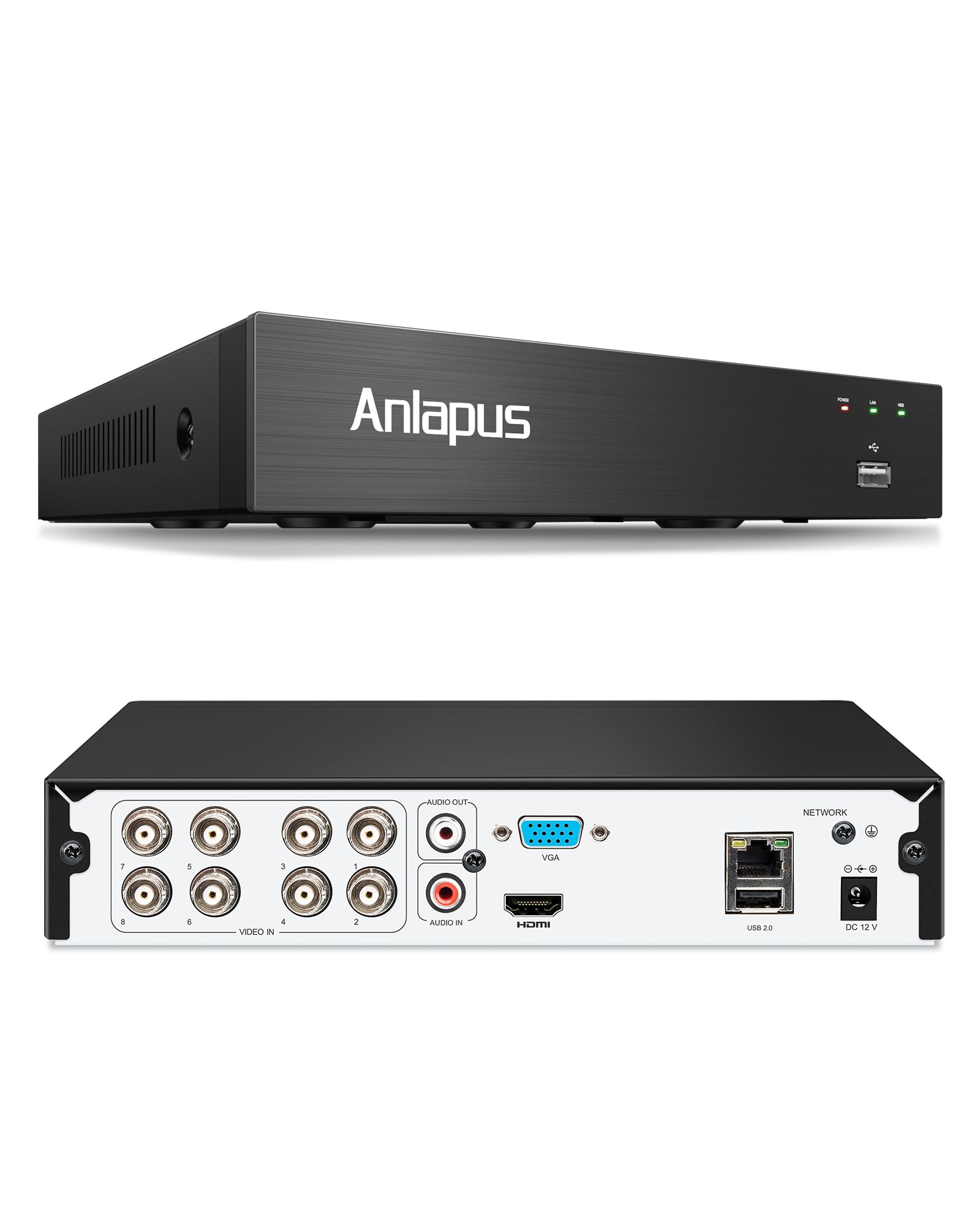
Anlapus 8CH 5MP DVR

80 /100
LBD Score Excellent

Key details

Channels
8
Compression
H.265+
Camera Formats
AHD, TVI, CVI, CVBS up to 5MP
Included Storage
None
View on Amazon

The pitch is simple: five megapixels on each of the eight channels, at the lowest price in this group. For anyone moving to 5MP analog cameras on a fixed budget, that combination is the entire argument.

It is a four-in-one, taking AHD, TVI, CVI and CVBS up to 5MP per input, with H.265+ compression and AI person-and-vehicle detection that you can confine to specific areas of each frame. Every channel gets its own recording mode — continuous, alarm or manual — and local viewing over HDMI or VGA works with no internet connection at all, which is more than some of the pricier boxes manage gracefully.

The catch is that you are buying mostly on the spec sheet. This is a newer name with a far shorter history than ANNKE, ZOSI or TIGERSECU, and the two-year warranty is the reassurance to lean on. Nothing on the sheet looks like a shortcut: the formats, the compression and the detection zones all match what the money suggests.

Where it makes sense is a workshop, garage or small shop where the cameras are already 5MP and the budget is genuinely fixed. For that buyer the arithmetic still works out: the recorder is the cheapest part of the job and the cameras are already on the wall.

Pros

  • Up to 5MP on all eight channels
  • Local HDMI/VGA viewing needs no internet
  • Per-channel detection areas and record modes
  • Two-year warranty on the cheapest unit here

Cons

  • No published maximum drive size
  • Ships without a drive, mouse or HDMI cable
Our verdict

Worth a look if you are recording 5MP analog cameras on a tight budget — a modern spec sheet from a newer name, backed by a two-year warranty.

Check Latest Price

How We Tested These Recorders

We started by narrowing the field on paper to 8- and 16-channel recorders that could handle more than one camera format, since most people are adding to an existing setup rather than starting from scratch. From there we cut anything that couldn't record 2MP or better, and deliberately kept a mix of units with a hard drive included and units without, because that one difference swings the real cost more than the sticker price does.

Ten of them went into service for six months — three in my own house, one in a dusty garage, one on a shelf in a small shop office, and the rest with team members who already had cameras on their walls. Each was set up solo and timed, then connected to an awkward mix on purpose: an old analog bullet, an AHD camera, a PTZ over RS485, and an IP camera on the network. We noted whether the recorder detected each format on its own or made us pick from a menu.

After that we just lived with them. We power-cycled every unit, pulled the plug mid-recording to see whether the timeline came back with a gap, and checked for missing hours after a week of unattended running. Picture quality was judged on real things — a license plate at 30 feet, a face at the front door, a raccoon at 2 a.m. — reviewed on a laptop rather than on the box. On the app side, we watched live from a different network, timed how long a push alert took to reach a phone, and counted the taps it took to export a clip to a USB stick. Setup was scored on the first hour, since that's where most of the complaints we read seem to live.

How to Choose a Security Camera Dvr

Match the recorder to the cameras you already own

Every wired camera speaks one of four analog formats — TVI, AHD, CVI or CVBS — or it is a network camera, and the DVR has to accept that exact one. Most recorders here are hybrids that take all four, which is why a dome from 2014 and a bullet from last year can share a box.

The trap is the IP figure. A listing that says it supports IP cameras often means two extra channels, not eight, and that number is fixed at purchase. Count your cameras, write down each format, and treat the IP count as its own line in the budget rather than a bonus.

Decide on 8 or 16 channels

Eight channels covers a house with room to spare: four outside, two inside, two spare. Sixteen is for a building, a warehouse or a property already running ten cameras with more coming.

Buy for the count you will have in two years rather than the count working today, but do not over-buy — an empty channel costs money and does nothing. A channel deficit, by contrast, means replacing the whole recorder, which is why our 16-channel picks earn their places.

Drive included, or drive yourself

Some recorders arrive with a surveillance-grade drive fitted; others ship bare. Bare is cheaper up front and lets you size the drive to the retention you actually want; fitted means the job is finished the day the box lands.

For scale, the manufacturer's figure for a 2TB drive is about ten days of continuous recording at top resolution, so a month of continuous footage needs a bigger drive or motion-triggered recording. H.265+ compression stretches all of those numbers, and every pick here uses it.

Noise, heat and shelf space

These are wired recorders, not Wi-Fi cameras: they want a network cable to the router, a power outlet and a little clearance because they run warm. Fanless designs that cool through an external heat sink — both TIGERSECU models use one — can live on a shelf in a room you actually use without a fan humming at you all evening.

Check the footprint as well as the noise. The small units run under nine inches wide, while the 16-channel TIGERSECU is nearly 14, which is the difference between reusing the old shelf and building a new one.

Remote viewing is where they differ

Every recorder here streams to a phone through a free app, and the hardware is more alike than the software. The internet-facing setup is the step most likely to eat an evening, and app quality ranges from genuinely pleasant to barely serviceable.

Budget around 1 Mbps of upload at the router for a usable remote picture; below that, expect a slideshow rather than video. Wired ethernet to the recorder itself, not a Wi-Fi bridge, is the other thing that keeps remote access boring.

Frequently Asked Questions

Final Verdict

Start with the TIGERSECU 8-channel. It is the recorder we put in a house where the cameras are of two or three different vintages, and the 2TB drive inside means the job is finished the day it arrives.

If money is the obstacle, the ANNKE 8-channel does much of the same format juggling for a fraction of the outlay — you supply the drive. And if your wall already carries sixteen cameras, the TIGERSECU 4TB is the one that tolerates a mixed-brand mess.