Best RV Inverters of 2026

The first time an inverter quit on me, the microwave died mid-reheat, a fault light blinked red, and my coffee went cold. An inverter turns the 12-volt DC sitting in your battery bank into the 120-volt AC that runs a coffee maker, a laptop, a CPAP, or the furnace blower on a cold night — and the cheap ones fold exactly when you ask them for real power.

After enough nights in vans and trailers to be picky, I know which specs actually decide that. Over the past eight months, my team and I have run 12 inverters, from a 400-watt car unit up to 4,000-watt models that hardwire into a breaker panel, and the pattern held every time: pure sine wave output isn't a luxury, and a huge peak rating means nothing if the continuous number is small. Remote controls look like a frill until your inverter is buried under the camp chairs.

The picks below run from a glovebox unit for laptops and air compressors to full-size boxes built for an off-grid setup, and each one earned its place on the same basics: honest ratings, tolerable fan noise, and the ability to hold a load for an hour without cooking itself.

1

Best Overall

Giandel 4000W Pure Sine

88 /100
LBD Score Excellent

Key details

Waveform
Pure sine wave
Surge Power
7,000W
Battery Types
12V lead-acid, LiFePO4, ternary lithium
Continuous Power
4,000W
View on Amazon

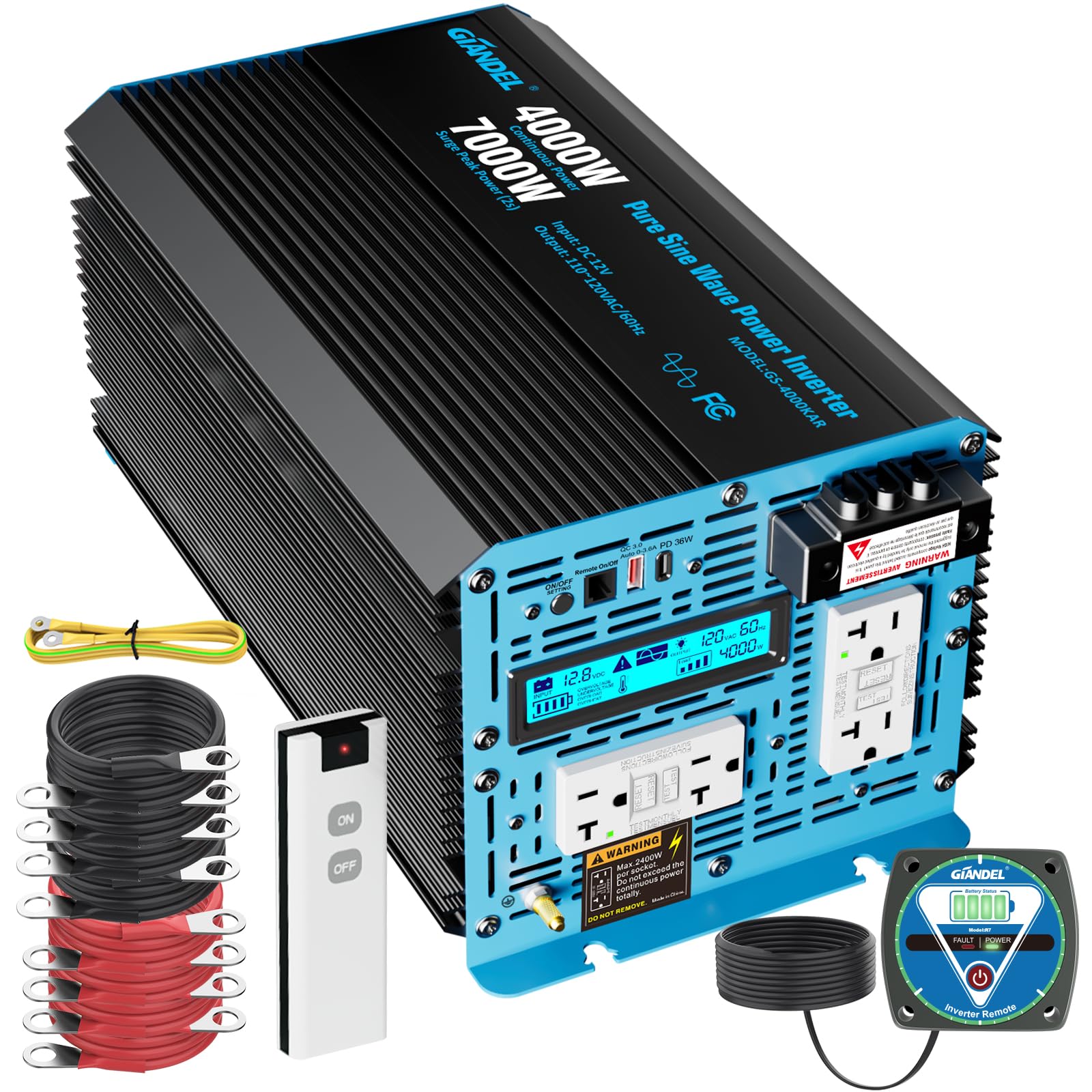
A roof air conditioner is the load that decides most RV inverter purchases, and the Giandel is the unit here built to answer it. It holds 4,000 watts continuously and 7,000 watts of surge for two seconds, enough to start a 15,000 BTU unit and keep the fridge, the coffee maker, and a laptop charger going behind it. That headroom is the whole argument for it at the top of this list: the cheaper units here are either smaller, modified sine wave, or both.

What we appreciated most sits on the input side. You select the battery type — lead acid, LiFePO4, or ternary lithium — and the low-voltage cutoff moves to match. On a lithium bank that is the difference between using the capacity you paid for and watching the inverter trip offline at a voltage a lead-acid profile expects. The big LCD reports input and output voltage, load watts, frequency, and protection codes, so a fault arrives as a code rather than a dead outlet, and the outlets themselves are GFCI.

The catch is physical and financial. It measures 14.6 inches long and weighs about 16 pounds, so it wants a real mounting location with air around it rather than a shelf behind the couch. It is also the most expensive unit in this group, which is the honest trade for the extra thousand watts and the lithium-aware cutoff. If your biggest load is a coffee maker and a television, you are buying headroom you may never use, and the LANDERPOW covers that coach for much less.

Pros

  • 4,000W continuous, 7,000W surge for startup
  • Selectable low-voltage cutoff for LiFePO4
  • LCD shows load watts and fault codes
  • GFCI outlets and dual remote control

Cons

  • Fan noise under heavy load
  • Included cables undersized for 4,000W
Our verdict

If your trips depend on a roof air conditioner starting, this is the one: 4,000 watts, 7,000 of surge, and a battery profile that keeps a lithium bank from tripping offline.

Check Latest Price
2

Best Certified Install

Renogy P2 3000W

87 /100
LBD Score Excellent

Key details

Outlets
3 AC plus hardwire terminal
Waveform
Pure sine wave
Surge Power
6,000W
Continuous Power
3,000W
View on Amazon

Renogy is the only brand here that names the exact standards its inverter is built to: UL 458 and CSA C22.2 No. 107.1, the certifications written for power converters and inverters installed in vehicles. Around that sits a straightforward 3,000-watt pure sine unit with 6,000 watts of surge, three AC outlets plus a hardwire terminal block, one 5V/2.1A USB port, a 16.4-foot wired remote, and a metal case.

If the inverter is going into a coach someone sleeps in, that certification is what you are paying for, and we rank it above a longer feature list every time. You are certainly not paying for features: there is no USB-C, no app, no Bluetooth, and the front panel uses indicator lights rather than a screen that reports the load in watts. What you get instead is a plain, listed box from the brand that was already in a lot of RV solar systems before the cheaper direct-import units showed up.

The terminal block is the part that separates it from every plug-in inverter here. Hardwired to a sub-panel or a dedicated circuit, it feeds the coach's outlets instead of an extension cord draped across the floor, and it is the arrangement an inspector will recognize. Budget for cable and a fuse sized to the full 3,000 watts — at 12 volts that is roughly 250 amps, and the DC side is where these installs succeed or fail.

Pros

  • UL 458 and CSA C22.2 No. 107.1 certified
  • 3,000W pure sine with 6,000W surge
  • Hardwire terminal plus three AC outlets
  • 16.4 ft wired remote included

Cons

  • No USB-C or app monitoring
  • Premium price for a plain feature set
Our verdict

Buy it when the install has to be certified and hardwired into the coach — the UL and CSA listings are worth the premium, even without USB-C or an app.

Check Latest Price
3

Best Value Pure Sine Wave

LANDERPOW 3000W

88 /100
LBD Score Excellent

Key details

Outlets
3 AC, USB-C, USB-A, hardwire
Waveform
Pure sine wave
Surge Power
6,000W
Continuous Power
3,000W
View on Amazon

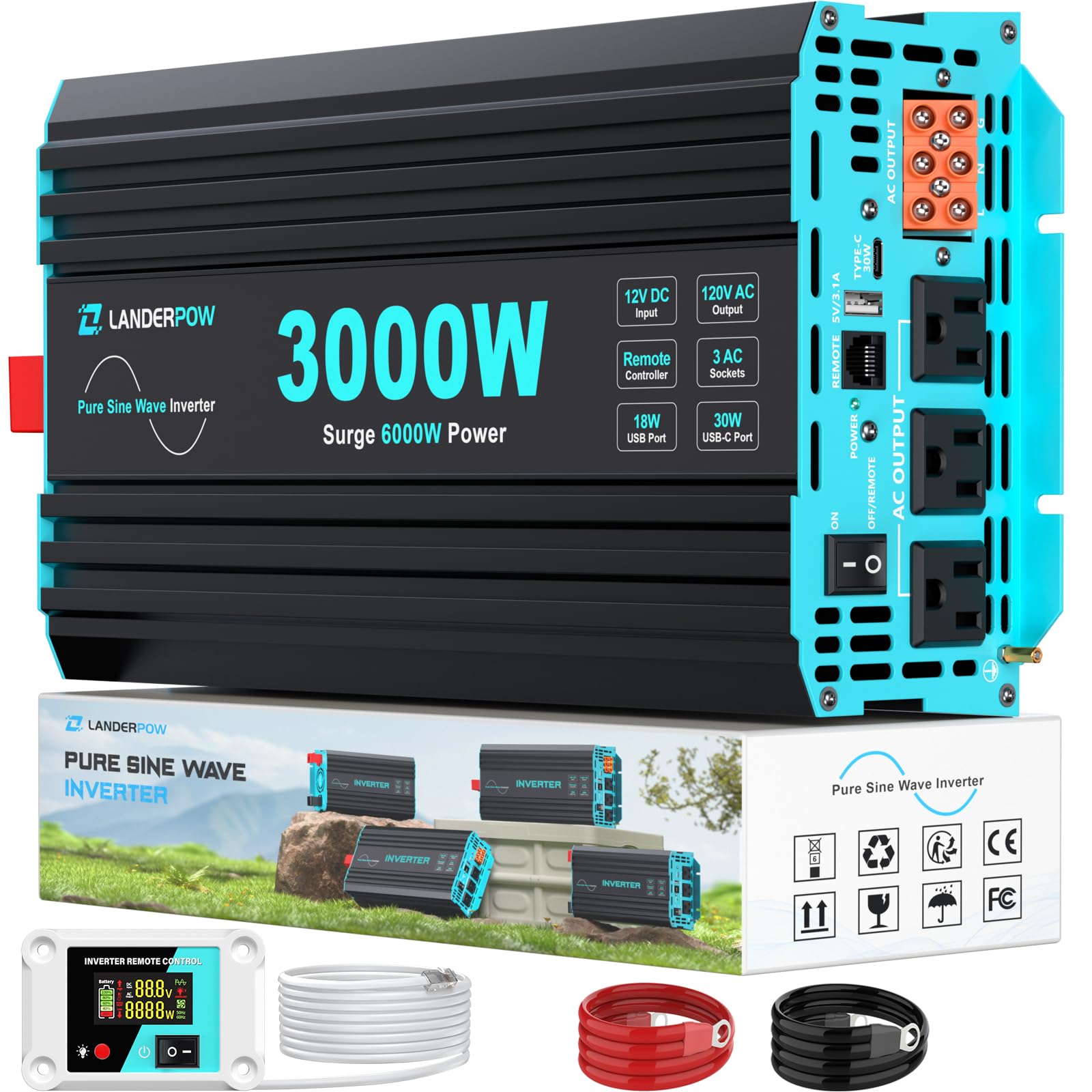
The LANDERPOW is the least expensive pure sine inverter in this group, and it does not read like a cost-cut unit: 3,000 watts continuous, 6,000 of surge, better than 91 percent efficiency, three AC outlets, a hardwire terminal, a 30-watt USB-C port, a 5V/3.1A USB-A port, and a 15-foot wired remote with an LED screen showing battery level, demand, and output.

That remote is the feature we kept coming back to. Seeing the draw in watts while you switch things on tells you what a coffee maker or an induction cooktop actually costs you, without adding a shunt or a battery monitor to the system. Three thousand watts covers a 10,000 BTU air conditioner and still has headroom for a hair dryer on medium, which is more than most weekend coaches ask of an inverter.

Three years of coverage — a year of replacement plus two of extended support — is the longest promise on this page, and on a budget unit that counts for more than an extra outlet. Otherwise this is the sensible middle: it does what our top pick does for a coach without a roof air conditioner, and it leaves money for the cable, fuse, and mounting you still have to buy.

Pros

  • Least expensive pure sine unit here
  • 3,000W with USB-C and hardwire terminal
  • Remote displays battery level and wattage
  • Three-year replacement and support coverage

Cons

  • Two-foot battery cables limit placement
Our verdict

Our value pick for a coach that runs a fridge, a TV, and a coffee maker: clean 3,000-watt sine power, USB-C, and a remote that shows the watts.

Check Latest Price
4

Best with a Built-In Transfer Switch

ZETAWALE 2500W ATS

88 /100
LBD Score Excellent

Key details

Waveform
Pure sine wave
Surge Power
5,000W
Transfer Switch
Built-in automatic
Continuous Power
2,500W
View on Amazon

The transfer switch is the reason to look at the ZETAWALE. It is built in, so the unit picks between shore power and the battery on its own, with no separate box to buy, mount, and wire in series. In a van conversion or a small coach, that turns an afternoon of electrical work into a single install. Behind it sits 2,500 watts continuous and 5,000 of peak, pure sine output, two AC outlets, USB-A and USB-C, a hardwired AC connection, an LCD remote, and a 24-month warranty on a unit that weighs just over eight pounds.

2,500 watts covers a 5,000 BTU window unit, a fridge, a television, and a laptop at once, and the LCD remote reports incoming and outgoing voltage so you can see a sagging bank before the inverter shuts itself down. Seamless shore-to-battery switching is a small convenience you notice every single time you plug in, and it is why this one holds a place on our list despite giving away capacity to the bigger units.

Pros

  • Built-in automatic transfer switch
  • Pure sine output with USB-A and USB-C
  • LCD remote shows input and output voltage
  • 24-month warranty

Cons

  • 2,500W won't start a big roof air conditioner
  • Only two AC outlets
Our verdict

For a van or small coach where shore power and battery power should swap without you touching a switch, the built-in transfer switch makes this the simplest install here.

Check Latest Price
5

Best Budget High-Wattage

TOPBULL 4000W

90 /100
LBD Score Outstanding

Key details

Outlets
4 AC plus 3 terminal blocks
Waveform
Modified sine wave
Surge Power
8,000W
Continuous Power
4,000W
View on Amazon

Eight thousand watts of surge is the number on the box, and it is the least interesting thing about this inverter. The line that matters is modified sine wave. That stepped output is fine for heaters, incandescent lights, power tools, and simple chargers, and it is wrong for anything with a compressor or a fussy power supply.

What you get for the money is a lot of capacity: 4,000 watts continuous, four AC outlets, two USB-A ports, three AC terminal blocks for hardwiring, a color display, and a wireless remote with a 200-foot range.

That remote is the detail nothing else here matches. A wireless control with that range means you can cut the inverter from the truck cab or from inside the camper, and no other unit in this group offers a wireless option at all. The terminal blocks are the second draw, because they let this box feed real circuits instead of a power strip.

Think of it as a work-trailer or toy-hauler inverter. For a setup where the biggest loads are a heater, a box fan, and a battery charger for power tools, it does everything the pure sine units do for less money — and it shoulders the startup of a table saw or an air compressor that would trip a smaller box.

Pros

  • 4,000W with four AC outlets
  • 200 ft wireless remote
  • Three terminal blocks for hardwiring
  • Quiet operation under load

Cons

  • Modified sine wave limits sensitive gear
  • No USB-C port
Our verdict

A work-trailer inverter: 4,000 watts and four outlets for heaters, fans, and tools, provided nothing sensitive is plugged in.

Check Latest Price
6

Big-Display Hardwired Installs

BELTTT 3000W

88 /100
LBD Score Excellent

Key details

Waveform
Pure sine wave
Surge Power
6,000W
Included Cables
Two 1/0AWG, 3 ft
Continuous Power
3,000W
View on Amazon

Two 1/0AWG battery cables, nine spare 45-amp fuses, and a spanner come in the BELTTT box, which is the sort of thing you appreciate at nine at night with the panels off and the hardware store closed. It is the only inverter here that ships its own fuse kit.

The unit itself is a 3,000-watt pure sine inverter with 6,000 watts of surge, dual AC sockets plus a 20-amp outlet, a 5V/2.1A USB port, a hardwire port, and a 23-foot wired remote — the longest wired remote in this group. The LCD reports input and output voltage along with battery and load status, and the protection list includes reverse connection, which is the mistake most likely to kill an inverter during a first install.

Durability is the reservation: failures at a few months old are the pattern here, and the warranty runs a single year. That is why it sits below the top pick despite the better display and the box of parts. If you want the diagnostics and the included hardware, it is a reasonable buy; if you want the longest service life, the extra money goes elsewhere.

Pros

  • Ships cables, fuses, and a spanner
  • 3,000W pure sine with a full LCD
  • 23 ft wired remote
  • 20A outlet plus hardwire port

Cons

  • Failures at a few months old are the pattern
  • One-year warranty
Our verdict

It arrives with the cables and fuses most installs end up chasing, and the LCD tells you what is flowing; the durability record is what keeps it out of our top tier.

Check Latest Price
7

Small Loads, Weekends

YSOLX 1000W

88 /100
LBD Score Excellent

Key details

Waveform
Modified sine wave
Surge Power
2,000W
12V Plug Limit
150W
Continuous Power
1,000W
View on Amazon

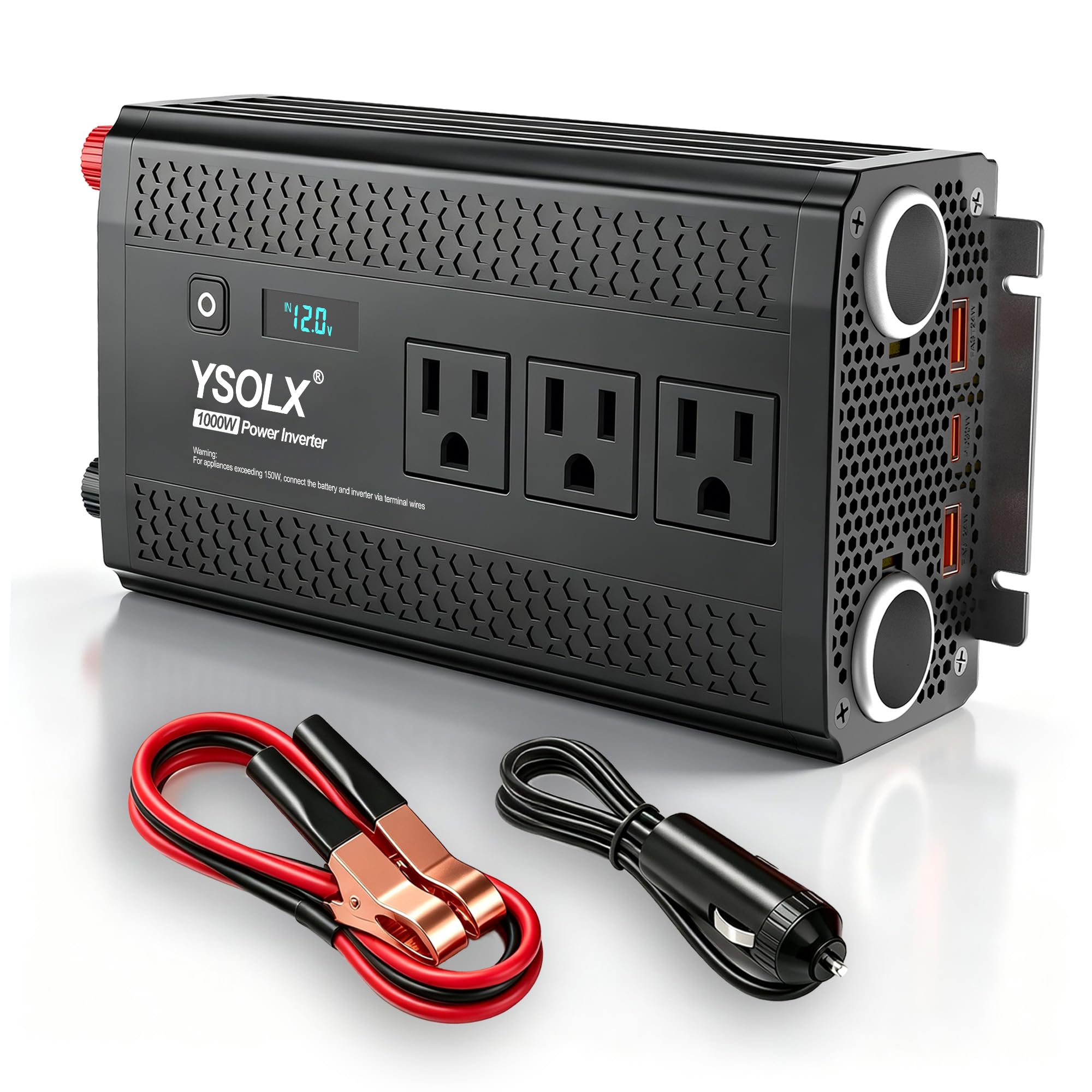
YSOLX prints the most useful number on this inverter in the fine print: 150 watts through the 12V plug. We like that the ceiling is stated rather than discovered, because it sets the honest scope of a 1,000-watt box that most people will run from a dash socket.

Clipped to a battery, it carries 1,000 watts continuous and 2,000 of surge to a television, a laptop, a fan, and a couple of camera chargers at once, and the 30-watt USB-C port fast-charges a phone or tablet from the same unit — a charging feature the bigger budget boxes here skip. Through the plug, treat it as a phone charger. The LED readout shows battery voltage, and the E1 through E6 codes tell you which protection tripped, which is more diagnostics than this corner of the market usually offers.

Pros

  • 30W USB-C PD plus two USB-A ports
  • Light enough to move between vehicles
  • Error codes identify what tripped

Cons

  • Modified sine wave output
Our verdict

A small second inverter for a television, a laptop, and a fan — clip it to a battery for weekend trips rather than wiring it as the coach's main supply.

Check Latest Price
8

Road-Trip Charging

Pro Chaser 400W

89 /100
LBD Score Excellent

Key details

Outlets
2 AC plus 4 USB
Waveform
Modified sine wave
Surge Power
800W
Continuous Power
400W
View on Amazon

At 14 ounces and about the size of a phone, the Pro Chaser disappears into a glovebox or a door pocket, and its 30-inch cord reaches from a dash socket to the passenger seat. Two AC outlets and dual USB ports cover a laptop, two phones, and a camera battery at once.

The rating needs translating. Four hundred watts at 12 volts is roughly 33 amps, and a vehicle's 12V socket is usually fused at 15 to 20, so through the plug you get somewhere near 150 to 200 watts rather than the number on the box. That is still a laptop and a phone, which is exactly what this is for.

Modified sine wave is the other boundary. Laptop bricks, phone chargers, and most small electronics are content on it; a mini fridge, a microwave, or anything with a compressor is not, and none of those belong on a 400-watt unit anyway.

The gamble is durability. Early failures are part of the record for this one, so we treat it as a glovebox item rather than a permanent fixture. Bought on those terms, it is the least expensive way here to get AC power on the road, and that is precisely the job it does.

Pros

  • Fits in a glovebox at 14 ounces
  • Dual AC and dual USB from one socket
  • Quiet enough to leave plugged in

Cons

  • 400W covers chargers, not appliances
  • Durability is the weak point at this size
Our verdict

Keep it in the glovebox for laptop-and-phone duty; it is the smallest thing here that turns a 12V socket into two AC outlets and a pair of USB ports.

Check Latest Price

How We Tested the Best RV Inverters

We started with about 40 models and cut the list on spec sheets: continuous versus peak wattage, true sine wave output, a hardwire port for tying into a trailer's breaker panel, what kind of remote came in the box, and cost per continuous watt. Twelve made the cut, from 400 to 4,000 watts.

Each one was clamped to a 400-amp-hour lithium bank using the cables that shipped in its box, and we measured those cables first — gauge and length both — since undersized or oddly short leads are the most common reason a capable inverter underperforms. We added load in steps: a laptop and LED lights, then a 900-watt microwave and a coffee maker, then a 1,500-watt space heater, watching a clamp meter to see whether output held steady or sagged as the draw climbed. Surge-hungry tools like a circular saw got three starts in a row to see what tripped.

Heat and noise got their own pass. Every unit ran at roughly 70 percent of its continuous rating for a full hour, with surface temperatures taken by infrared thermometer every 15 minutes and fan noise judged from three feet away — the gap between a fan you forget and one that hums through the bunk wall is wide. Two derated themselves; one shut off completely. Then we worked the remotes from the driver's seat, through the trailer wall, and 30 feet out in the open, and checked whether each display washed out in direct sun.

After that, they went into real rigs. The finalists stayed installed through weekend trips and one long summer loop, started cold, left running for days at a stretch, and inspected afterward for anything that rattled loose on washboard roads. Value, in the end, had little to do with the wattage printed on the box.

How to Choose an Rv Inverter

Pure Sine or Modified Sine

Pure sine wave output matches what a shore pedestal supplies, which is why it runs compressors, variable-speed motors, and electronics with switching power supplies without complaint. Modified sine wave is a stepped approximation and it costs less; heaters, incandescent lights, power tools, and plenty of laptop bricks are perfectly happy on it, while some motors hum, some chargers run hot, and a few devices simply refuse to start.

If the inverter is going to feed the coach's own outlets, buy pure sine. A 3,000W unit like the LANDERPOW or the Renogy P2 costs less than replacing one appliance it damaged. If it is running a heater and a drill charger in a work trailer, the TOPBULL is money well spent.

Size for the Surge, Not the Sticker

The number that decides whether a load starts is the surge rating, because almost everything worth running has a startup spike. A 15,000 BTU roof air conditioner pulls roughly 1,600 watts while running and can demand more than twice that for a second or two when the compressor kicks in. Add up what runs at once, then leave headroom over the biggest motor.

That is why the Giandel's 7,000-watt peak sits above its 4,000-watt rating, and why a 2,500W unit like the ZETAWALE suits a small window air conditioner rather than a roof unit. Under-sizing shows up as a shutdown the moment the compressor engages, not as a slow, gentle failure.

The 12V Side Is Where Installs Go Wrong

Divide the wattage by 12 and allow for losses: a 3,000-watt inverter pulls roughly 250 to 300 amps at full load, which is battery-cable territory, not cigarette-lighter territory. Keep the DC run short, fuse it within a foot or two of the battery, and match the gauge to both the current and the length. A long, thin run drops voltage under load, and low-voltage shutdown is the usual result.

If all you need is a laptop charger, a plug-in unit like the Pro Chaser sidesteps the whole job. Anything that feeds the coach needs lugs, a fuse, and a mounting point with air around it.

Idle Draw, Fans, and Where It Sleeps

An inverter is never free to leave on. The electronics draw current even with nothing plugged in, and that drain runs all night off the same bank that should start your morning. A remote switch matters more than most spec-sheet features, because it lets you kill the unit without crawling to it.

Mount it where the fans are not pointed at a bunk. Fan noise is the most consistent complaint about these boxes, and in a small coach it is as much a placement decision as a product one.

Outlets, Hardwire, or Transfer Switch

There are three ways to get power into the coach. You can plug a device straight into the inverter's outlets, hardwire the AC terminal block to a sub-panel or a dedicated circuit, or buy a unit with a built-in automatic transfer switch that chooses between shore power and the inverter for you. Hardwiring is what lets a 3,000W unit feed real circuits instead of an extension cord, and the transfer switch is the tidy answer for a van conversion — the ZETAWALE builds one in.

Whichever route you take, never feed an inverter's output back into a shore-power inlet. That is how you energize a pedestal someone else is working on.

Frequently Asked Questions

Final Verdict

Buy the Giandel 4000W if your coach has a roof air conditioner and a bank big enough to feed it. It carries the most surge of any pure sine unit here, it delivers the wattage it claims, and the selectable battery profile removes a real headache for anyone running lithium.

If your loads top out at a fridge, a television, and a coffee maker, the LANDERPOW does the same job with a watt meter on the wall for a lot less money. Choose the Renogy P2 when the install has to be certified and hardwired into the coach, and the ZETAWALE when you want shore power and battery power to swap without you touching anything.