Best Refractor Telescopes of 2026

A first telescope should pay off on that first clear night. Too often it doesn't: the image trembles, the finder points at a different patch of sky than the tube does, and the focuser shifts every time a finger touches it. A good refractor fixes all of that — it goes out the door in one trip, holds its aim, and shows lunar craters sharp enough that you're back outside the next night.

Aperture does the real work, and that enormous magnification number printed on the box is mostly marketing; a steady mount matters as much as the glass sitting on it. I've spent six months with eight refractors, from a 70mm starter to a 102mm ED doublet, and that pattern never broke.

We set them up in the dark, on driveways, on a light-polluted balcony, and at a campground with no lights at all, then handed the eyepiece to people who had never focused a telescope in their lives. The picks below are the ones that made the Moon look like the Moon and stayed pointed while we swapped eyepieces.

1

Best Overall

Celestron StarSense Explorer DX 102AZ

84 /100
LBD Score Excellent

Key details

Mount
Altazimuth with slow-motion controls
Weight
14.2 lb
Aperture
102 mm
Focal Length
650 mm
View on Amazon

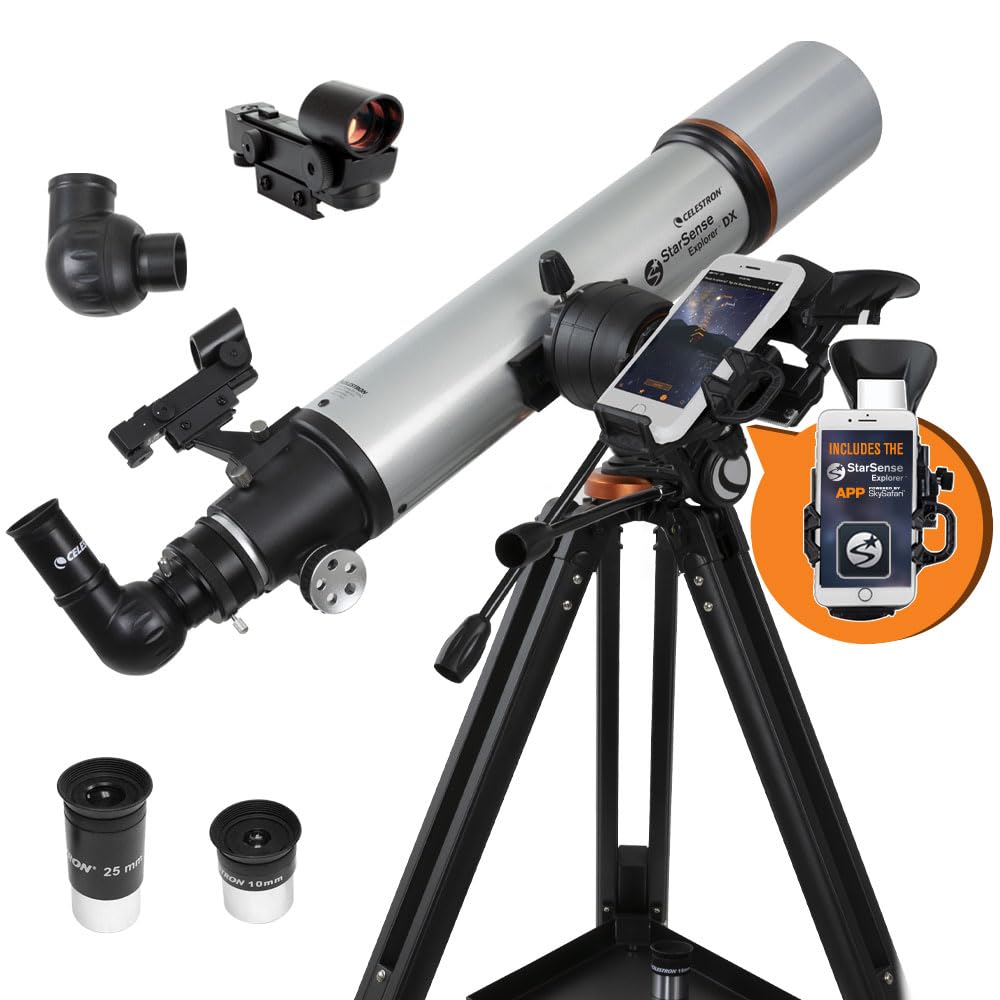
The hard part of a first telescope isn't the telescope, it's the sky: a red-dot finder shows you a patch with two hundred stars in it and no labels. The DX 102AZ takes that step away. Dock your phone in the mount's cradle, point the tube roughly skyward, and the StarSense app compares what the camera sees against its star map and puts arrows on the screen. When the bullseye turns green, the object is in the eyepiece.

We've star-hopped with printed charts and we've used this, and the app is the difference between an hour of hunting and an hour of looking. Underneath it sits a 102mm refractor, the most aperture of any ready-to-use package here, with fully XLT-coated glass that shows the Trapezium in Orion and the brighter Messier clusters from a suburban yard. The mount is the other half of the sale: dual-axis slow-motion controls let you nudge the tube in fractions instead of shoving it, which is how you keep Jupiter centered at 65x while the sky drifts.

Two things to plan around. StarSense needs recognizable stars, so under heavy city light it can hunt without ever locking on, and a darker site is worth the drive. The phone dock is also a small, losable plastic part, so give it a home in the accessory tray rather than a drawer.

At 14.2 pounds with an 81.3cm tube, this is a car-trunk telescope rather than a backpack one, and it is happiest set up on ground instead of a deck that flexes under a footstep. What that weight buys is the least frustrating first year of stargazing in this group.

Pros

  • App-guided finding removes the star-hop learning curve
  • 102mm aperture is the largest here in a complete package
  • Dual-axis slow-motion controls hold a target steady
  • Mount and tripod arrive preassembled

Cons

  • App can fail to lock on in bright city skies
  • 14.2 pounds and an 81.3cm tube rule out backpacking
Our verdict

The DX 102AZ is the one we hand most beginners: an app that finds objects for you, plus the most aperture in a ready-to-use package here.

Check Latest Price
2

Best for the Moon and Planets on a Budget

Celestron AstroMaster 70AZ

89 /100
LBD Score Excellent

Key details

Mount
Altazimuth with panhandle
Weight
10.8 lb
Aperture
70 mm
Focal Length
900 mm
View on Amazon

Nine hundred millimeters of focal length behind a 70mm lens is an old combination, and it still earns its keep: at f/12.9 the AstroMaster is gentle on eyepieces and throws a big, high-contrast lunar image. We think it is the best cheap telescope here for the Moon and the planets, and the reason isn't the glass. It's the mount.

That mount is a metal altazimuth head with a panhandle you squeeze and steer, sitting on a tripod whose locking accessory tray braces the legs. It settles quickly after a touch, which is more than the lightest tripods in this group manage. Setup takes a few minutes and no tools: legs out, tube on, red-dot finder aligned in daylight against a distant roof.

The two eyepieces give 45x and 90x, and 90x is enough to trace the Moon's terminator and pull Saturn's rings out as a clean ellipse when the air is steady. Where it runs out is faintness. Seventy millimeters doesn't gather much light, so galaxies stay smudges and most nebulae are out of reach, and the long tube's narrow field makes the red dot and a little patience mandatory.

It doubles as a daytime scope, since the erect-image diagonal puts the view right way up, and at 10.8 pounds with the tripod already assembled it is the one here an adult can carry out one-handed along with a mug of coffee.

Pros

  • Rock-steady metal mount with a panhandle
  • 900mm focal length gives sharp high-power lunar views
  • No tools needed; tripod arrives assembled
  • Erect-image diagonal makes daytime viewing easy

Cons

  • 70mm aperture runs out on galaxies and nebulae
  • Narrow field slows down star-hopping
Our verdict

For Moon-and-planet viewing on a tight budget, we pick the AstroMaster: a steady metal mount and a long 900mm tube make it the crispest cheap view in this group.

Check Latest Price
3

Best Value Complete Package

Dianfan 90mm/800mm Refractor

85 /100
LBD Score Excellent

Key details

Tripod
Stainless steel, adjustable
Weight
10.4 lb
Aperture
90 mm
Focal Length
800 mm
View on Amazon

Stainless steel tripod legs are the first thing we look for on an inexpensive refractor, and the Dianfan has them. Aluminum legs at this price flex and ring, and a 90mm tube on a flexing mount is worse than a 70mm on a solid one.

The rest of the kit is just as complete: a 90mm objective on an 800mm tube, two Kellner eyepieces, a 3x Barlow, a phone adapter, and a carry bag that swallows all of it. At f/8.8 the scope is easy on those eyepieces, and 80x with the 10mm holds a clean lunar image without the view swimming while you focus. The stainless legs plus the accessory tray are what make that possible.

Where it beats the top pick is simple: it costs a fraction and still shows the Moon's craters, Jupiter's four bright moons, and Saturn's rings. We think this is the right first telescope for a family that isn't certain the hobby will stick. What we don't buy is the magnification headline, since 240x comes from stacking the Barlow on the 10mm, and a 90mm lens can't hold a usable image that high on an ordinary night.

The phone adapter is the weak accessory: a fiddly clamp that takes longer to center over the eyepiece than the photo is worth until you've practiced it. Assembly runs about fifteen minutes the first time and less after that.

Pros

  • Stainless steel tripod steadies high-power views
  • Bag, Barlow, and phone adapter all included
  • Tool-free assembly in about fifteen minutes
  • Sharp lunar and planetary views for the outlay

Cons

  • 240x claim outruns what a 90mm lens can resolve
  • Phone adapter is fiddly to center
Our verdict

We send first-time buyers here when the top pick is out of reach: 90mm of aperture on a steel tripod, with the bag and accessories already in the box.

Check Latest Price
4

Best Budget Travel Kit

Koolpte 80mm/600mm Refractor

87 /100
LBD Score Excellent

Key details

Mount
Altazimuth
Aperture
80 mm
Included
Carry bag, phone adapter, remote
Focal Length
600 mm
View on Amazon

The Koolpte folds down into a padded shoulder bag with the tripod, eyepieces, and phone adapter inside, and it comes back out in a couple of minutes without a single tool. That's the whole pitch: a telescope light enough to leave by the door and compact enough to throw in a car for a weekend.

We think that's worth more than the spec sheet suggests, because the telescope that gets used is the one that's easy to carry outside. The 80mm f/6.7 tube is short enough to swing onto a bird feeder in daylight and wide enough to sweep the Milky Way at 24x without hunting. The wireless remote and phone adapter also mean a kid can photograph the Moon without gripping the tube and blurring the shot.

The trade for that wide field is color. A fast achromatic doublet like this one leaves a violet halo around the Moon's bright limb and around Jupiter, and the planets stay small at 60x. The aluminum tripod is the lightest-duty in this group too, so pushing the 3x Barlow to 180x mostly shows you the mount's weaknesses rather than the sky's.

Keep it at 24x and 60x, on short legs, and this is the scope that ends up in the trunk on every clear weekend. That is not a small thing for a first telescope.

Pros

  • Packs into an included carry bag with the accessories
  • No-tool assembly that novices finish in minutes
  • Wide 80mm field is forgiving to aim
  • Phone adapter and wireless remote included

Cons

  • Fast achromat shows violet fringing on bright targets
  • Practical magnification tops out well below the Barlow's 180x
Our verdict

The Koolpte is our pick for a telescope that travels: it packs into its own bag, sets up without tools, and shows the Moon cleanly on night one.

Check Latest Price
5

Wide-Field Scanning

Gskyer AZ90600 Refractor

83 /100
LBD Score Excellent

Key details

Weight
17.5 lb
Aperture
90 mm
Eyepieces
Three, plus 3x Barlow
Focal Length
600 mm
View on Amazon

Seventeen and a half pounds is heavy for a 90mm telescope, and the Gskyer's heft is the first thing you notice lifting it out of the box. We think the weight buys something real: an aluminum tripod that doesn't shiver the way the lightest ones here do, and a scope that holds its aim while you swap eyepieces.

The tube is 90mm at f/6.7, the same aperture as the Dianfan in a much shorter 600mm package. That means a wide field: the Pleiades fit in the view, Andromeda's core and its two companions fit, and sweeping the Milky Way at 24x actually works. Three eyepieces come in the box, at 24x, 60x, and 120x, along with a 3x Barlow, and the 6x30 optical finder shows faint stars a red dot can't.

What holds it back is the top end. The 5mm eyepiece's 120x sits close to what a 90mm lens can manage on an average night and higher than this mount makes comfortable, so that last eyepiece spends more time in the case than in the diagonal. Start at 24x, learn the finder, and step up only when the air is still.

For clusters, the Moon at quarter phase, and the wide comet that turns up every few years, the field and the finder earn the lifting. For a scope that goes camping, this isn't it.

Pros

  • Wide 600mm field frames clusters and the Milky Way
  • 6x30 optical finder beats a red dot on faint stars
  • Three eyepieces and a 3x Barlow included
  • Heavy aluminum tripod holds steady

Cons

  • 17.5 pounds is a two-handed carry
  • 120x eyepiece is beyond most nights' seeing
Our verdict

We recommend the Gskyer to observers who want a wide, bright field and a real finder scope, as long as its 17.5 pounds stay near the yard.

Check Latest Price
6

Astrophotography

SVBONY SV503 102mm ED

91 /100
LBD Score Outstanding

Key details

Weight
8.71 lb
Aperture
102 mm
Focal Length
714 mm
Optical Glass
S-FPL51 ED doublet
View on Amazon

There is no mount, no eyepiece, and no finder in the SV503's box, just the tube, a pair of rings, a dovetail plate, and a 2-inch to 1.25-inch adapter. That isn't an oversight. It's what this telescope is: an optical tube for someone who already owns a mount and a case of eyepieces.

What you pay for is glass. The 102mm objective is an S-FPL51 ED doublet, the specification that suppresses the violet fringing fast achromats leave on the Moon's limb and the edges of bright stars. The dual-speed 1:10 focuser makes fine focus possible at high magnification and with a camera hanging off the back, the 360-degree field rotator lets you frame a shot without rotating the tube in its rings, and the retractable dew shield is one less thing to pack.

We think this is the best telescope here for imaging and the wrong one for a first night. On a capable mount it produces crisp, true-color views and takes a camera without complaint; aimed at the sky with nothing attached, it shows you nothing at all. The 90mm of focus travel is generous for visual use but worth checking before you add a filter wheel or an off-axis guider.

The build is what earns it a place: all-metal fittings, a focuser that doesn't shift under load, and rings that hold the tube where you put it. Budget for the mount before the telescope.

Pros

  • ED doublet suppresses color fringing on bright objects
  • Dual-speed focuser and field rotator suit cameras
  • All-metal build with rings and dovetail included
  • Retractable dew shield cuts glare and dew

Cons

  • No mount, eyepiece, or finder included
  • Slight fringing still appears in long exposures
Our verdict

Our pick for astrophotography, and only for that: the SV503 needs a mount, eyepiece, and finder before it shows you a single star.

Check Latest Price

How We Tested These Refractors

To build the shortlist, I read through spec sheets for a few dozen refractors and cut anything whose listing led with a magnification figure while saying little about aperture, focal ratio, mount type, or included accessories. What came in the box counted as much as the glass — eyepieces, a Barlow, a phone adapter, a carry bag — because a scope that makes you buy the basics separately isn't the bargain it appears to be. That left eight refractors, which we lived with for six months.

Each one got assembled from the carton on a driveway at dusk, manual read by phone light, and I timed how long it took me to get from sealed box to first look, working alone. Setup ease came down to whether I could carry the whole rig outside in one trip and whether the finder could be aligned in daylight on a distant chimney before dark.

After sunset we started wide on the Moon, then pushed magnification until the image fell apart, noting where crater walls stopped resolving and whether a purple fringe crept along the bright limb. We tapped the tripod and turned the focuser knob to see how long the view shook, and left each scope aimed at a single object untouched for ten minutes to count how often it drifted out of the field — which is really a verdict on the mount. Faint targets got a turn too: whether a globular cluster broke into stars or stayed a smudge, whether Jupiter showed more than its two main belts.

Because most of these ship with a phone adapter or guided alignment, we strapped a phone in, centered the Moon on the screen, and took a picture, then handed the eyepiece to friends who had never used a telescope and watched how far they got without instruction. Some needed a two-minute explanation; others needed twenty.

How to Choose a Refractor Telescope

Aperture Is the Number to Shop On

The figure beside the millimeter sign on the objective lens decides how much light you collect, and light is what turns a smudge into a galaxy. Seventy millimeters shows the Moon and the planets well; 90mm adds globular clusters and the brighter nebulae; 102mm starts pulling in faint galaxies from a dark site. Put your budget into the front lens.

Magnification is only focal length divided by eyepiece focal length, so any scope can print 240x on the box. A 90mm lens tops out near 180x on a perfect night, and most nights the atmosphere won't allow half of that. When two scopes cost the same, take the bigger lens and the plainer claim.

Decide How You'll Find Things

Two systems do the work. A finder aligned with the tube, red dot or small optical scope, gets you close while charts or an app finish the job; or a phone-based plate solver like Celestron's StarSense recognizes the sky and points you in with on-screen arrows. App guidance shortens the learning curve enormously, and it is the single biggest reason our top pick is our top pick.

The trap is that plate-solving needs a working camera, recognizable stars, and a phone that isn't frozen, so under heavy city light it can hunt without locking on. Whatever you buy, align the finder in daylight against a distant roof before your first session.

The Mount Decides Whether You See Anything

A 90mm tube on a flexing tripod is worse than a 70mm on a solid one. Look for an altazimuth head with slow-motion controls, knobs that move the tube by fractions while your eye stays at the eyepiece, and a tripod with a leg brace or an accessory tray tying the legs together.

Test it by tapping the tube and counting: if the image still swims after two seconds, high magnification will be a fight every night. Equatorial mounts track the sky properly, but the polar alignment step defeats a lot of beginners in the dark.

What's Actually in the Box

Two eyepieces cover the range: a 25mm for wide, bright views and a 10mm for close-ups, with the actual magnification depending on the tube's focal length. A 3x Barlow triples whatever you have, which sounds better than it is, since stacking it on a 10mm gets a small scope to 240x it cannot use. Put it on the 25mm instead and you have a useful 12.5mm.

A diagonal, a finder, and a phone adapter are worth having. A carry bag quietly decides whether the scope travels or lives in a closet.

Weight, Length, and Where It Lives

The telescope you use is the one that is easy to carry out. At one end, the Dianfan's 4.7 kg and short tube come out for a quick look; at the other, the Gskyer's 17.5 pounds makes every session a deliberate trip. Tube length matters as much as weight: the DX 102AZ's 81.3cm tube wants a back seat, not a shelf.

Measure the car trunk and the doorway on the way to the yard, and think about stairs. A scope stored in a basement rarely makes it outside.

Frequently Asked Questions

Final Verdict

Start with the Celestron StarSense Explorer DX 102AZ. It pairs the largest aperture in a complete package with the one feature that decides whether a beginner keeps going: an app that finds objects for you. If the budget won't stretch that far, the Dianfan 90mm gives up aperture and the app but keeps a steady steel tripod, a bag, and sharp lunar views.

If you already own a mount and eyepieces, the SVBONY SV503 is the better instrument by a wide margin, an ED doublet that images and views without the color fringing the achromats here show. Buy the mount before the telescope, not after.