Best Overall

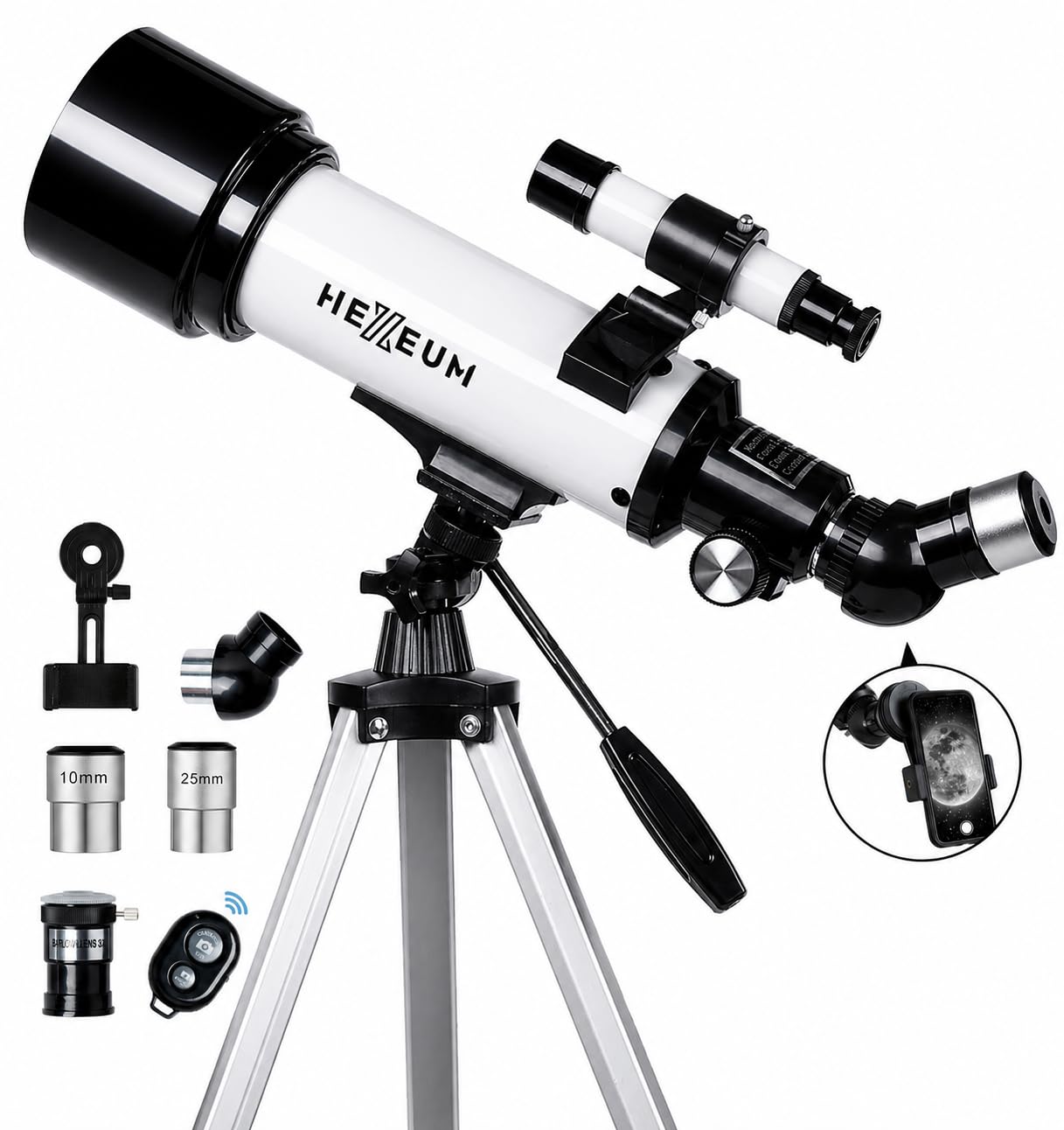
Gskyer 70mm Refractor
Key details
- Mount
- Altazimuth
- Weight
- 5.7 lb
- Aperture
- 70mm
- Focal Length
- 400mm (f/5.7)
Tube, tripod, eyepieces, phone adapter and remote all go back into the same padded bag, and the loaded bag weighs a little under six pounds. That is the whole case for a beginner scope that lives by the back door: it comes out for twenty minutes on a clear night and goes back without turning into a project.
For a first telescope we keep coming back to this one. There is nothing to collimate, the alt-azimuth head is a single arm you swing by hand, and the finder takes a couple of minutes to line up in daylight — after that, the Moon lands in the eyepiece on the first swing. The 70mm fully coated lens is the same glass most beginners start on, mounted here with fewer ways to go wrong than usual.
What you see with it is the honest beginner list. Lunar craters and the terminator are sharp, Jupiter shows as a small disc with its four bright moons in a line, and Saturn's rings read as an elongation rather than a solid ball. The tube is short at 400mm, so the highest power comes from the shortest eyepiece plus the 3x Barlow, and that pairing is a clear-night-only view.
The aluminum tripod is light because that is what you are buying; rest a hand on the tube while you focus and the image settles faster. The detail that changed our mind about phone adapters is how much of the hobby it returns to a group — clamp a phone over the eyepiece and everyone standing behind you sees the Moon on the screen at once.
Pros
- Sets up in minutes with no tools
- Whole kit travels in one padded bag
- Phone adapter and wireless remote included
- 5.7 pounds, easy to carry outside
Cons
- Short 400mm focal length caps magnification
- 70mm aperture leaves faint deep-sky objects out
The safest first telescope we can hand a beginner: no tools, no collimation, one bag, and a Moon that looks like the Moon.