Best Power Inverters of 2026

A power inverter looks like a simple little box: 12 volts in from your cigarette lighter, 110 volts out to whatever needs charging. The trouble is that the number on the front is only half the story — every unit has a continuous rating and a surge rating, and the gap between them is where people get burned. Buy too small and you'll trip a fuse the first time you plug in a tire inflator; buy too big and bulky and it lives in the trunk instead of the glovebox.

I started keeping one in the car after a camping trip where my laptop died at 8 p.m. with a deadline still open. Since then my team and I have tested 14 inverters over six months, from palm-sized 150-watt units to a hardwired pure sine wave model built for off-grid setups, and the differences come down to less obvious things than wattage.

The compact ones are the ones you'll actually carry, but they tend to run hotter and whine louder than the spec sheet suggests. Pure sine wave matters more than most shoppers expect if you're running a CPAP or a picky laptop brick, and it costs more. Below are the ones that held up — sorted by what they're actually good at.

1

Best Overall

vansoet 400W

88 /100
LBD Score Excellent

Key details

USB-C PD
30W
Waveform
Modified sine wave
Peak Power
800 watts
Continuous Power
400 watts
View on Amazon

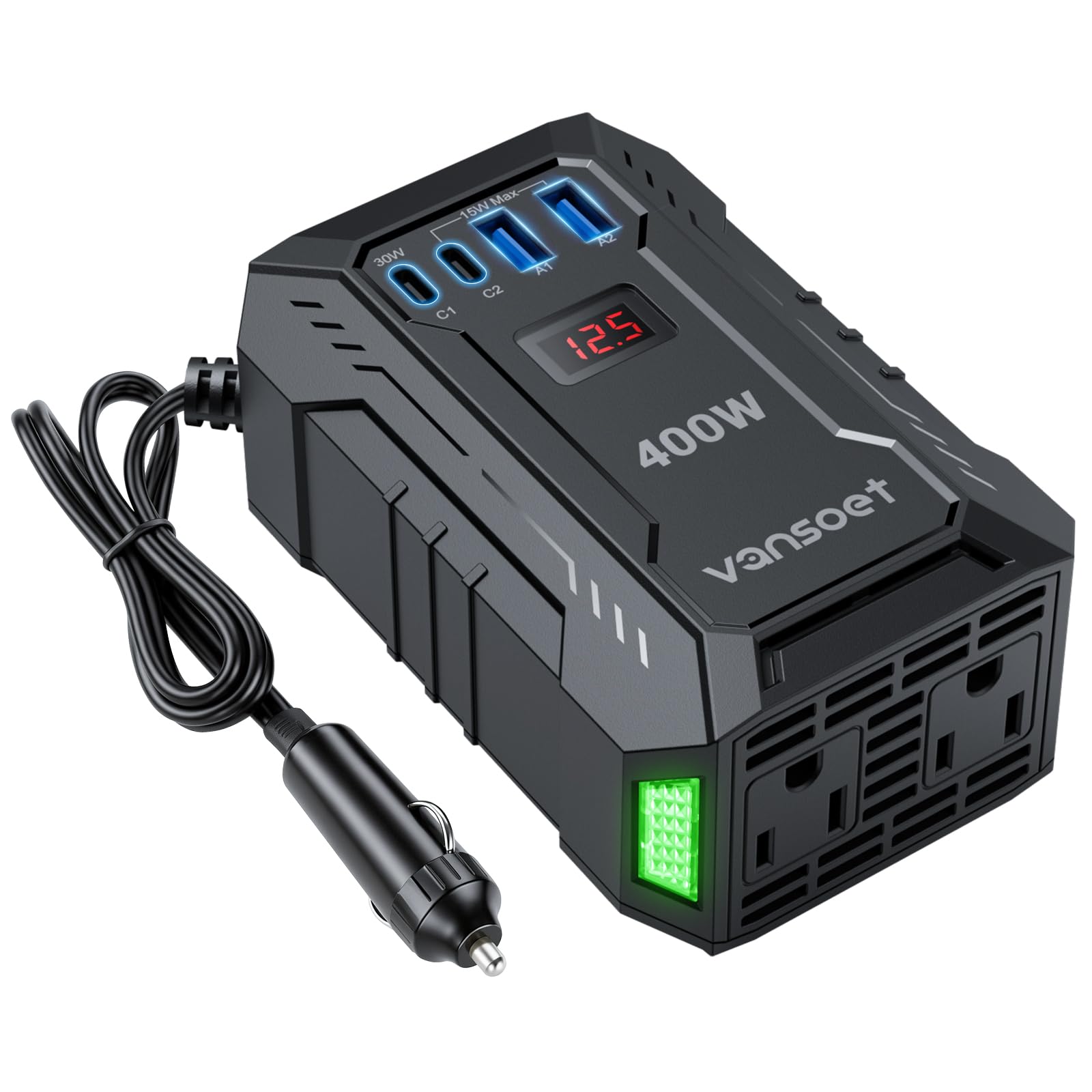
The useful detail on the vansoet 400W is the 30W USB-C PD port. It can fast-charge a phone or top up a small laptop while the AC side runs something else, and that is not always true of car inverters with a USB badge. You also get 400W continuous, 800W peak, two AC outlets, and a dedicated AC switch so the outlets can stay off while the USB side works.

We think that combination makes it the best default here for a car, SUV, or small RV. The 400W rating covers a laptop, a tablet, a couple of phones, and a camera battery without pushing into the battery-clip class, and the independent switch is the kind of small control we appreciate when the inverter stays plugged in. It is modified sine wave, so it belongs with everyday electronics rather than a CPAP or sensitive audio gear.

The body is small enough to live in a console or glovebox, and the layout keeps the outlets reachable without a tangle of adapters. The 30W port is enough to make a phone useful again in a short drive, while the AC side handles the laptop.

On a long drive, the dedicated AC switch is the feature we came back to: leave the laptop charged, switch the outlets off, and keep the USB ports live for phones. That is a small thing that makes the unit easier to live with than a single on/off button for everything.

Pros

  • 400W continuous, 800W peak
  • 30W USB-C PD plus USB-A
  • Independent AC switch
  • Compact console-friendly body

Cons

  • No battery clips for higher-draw use
Our verdict

For most cars, this is the inverter we point to first: 400W, a 30W USB-C port, and independent AC control in a compact body.

Check Latest Price
2

Best Pure Sine Wave

BESTEK 300W Pure Sine

91 /100
LBD Score Outstanding

Key details

Waveform
Pure sine wave
AC Outlets
2
Peak Power
700 watts
Continuous Power
300 watts
View on Amazon

If the thing you need to power has a motor, a heating element, or a sensitive circuit, the waveform matters more than the wattage. The BESTEK 300W Pure Sine gives you a true sine wave at a car-friendly size, with 300W continuous, 700W peak, two AC outlets, and two USB ports. We think it is the right pick here for a CPAP, a laptop dock, or small audio gear that complains when fed a modified wave.

The trade-off is capacity and size. At 8.1 by 5.3 by 2.6 inches and 1.4 pounds, it takes more console space than the tiny 150W plugs, and 300W is not enough for a hair dryer or a space heater. For a sensitive device that needs clean power, that is a fair exchange; for a family charging four phones, a modified-sine model with more outlets is simpler.

Longevity is the open question. The reliability record is mixed, with some units shutting down early, so keep the receipt and run it through a real load before a trip. The 18-month warranty is a useful backstop, and the 40A fuse is the first place to look if it goes quiet.

The 1.4-pound body is still easy to move between vehicles, and the two USB ports mean you do not need a separate charger for a phone. It is the specialist in this group, and it earns that role.

Pros

  • Pure sine wave output
  • 300W continuous, 700W peak
  • Two AC and two USB ports
  • 18-month warranty

Cons

  • Premium price for 300W
  • Fan noise under load
Our verdict

When the device is sensitive, this is the pure-sine pick we trust: 300W, a true sine wave, and a car-friendly size.

Check Latest Price
3

Best Budget 300W

BESTEK 300W

91 /100
LBD Score Outstanding

Key details

USB Ports
2
AC Outlets
2
Peak Power
700 watts
Continuous Power
300 watts
View on Amazon

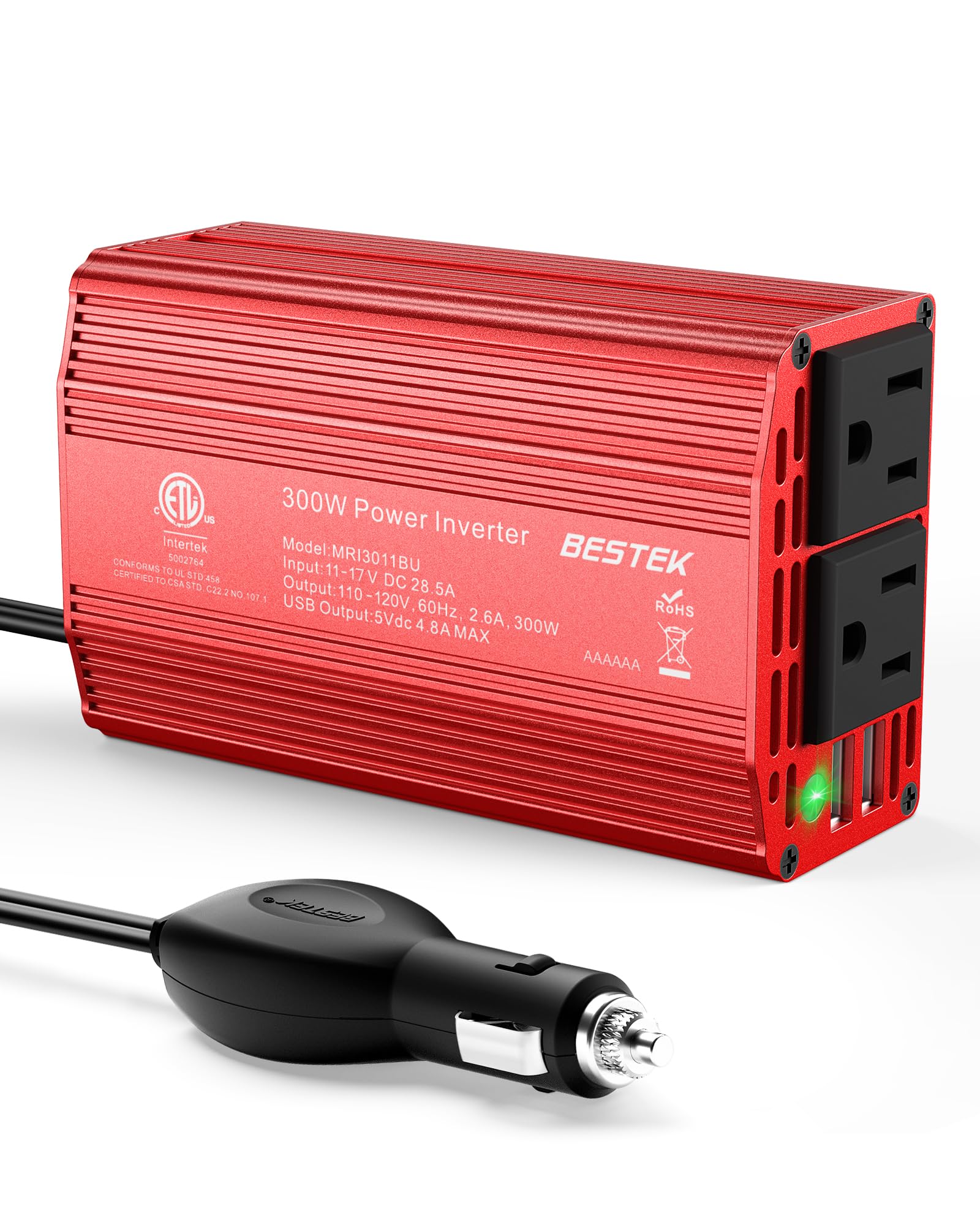
The first thing you notice about the BESTEK 300W is the housing: a 4.8 by 3.1 by 1.9-inch aluminum body that feels more substantial than its size suggests. Inside the case, you get 300W continuous, 700W peak, two AC outlets, and two USB ports with 4.8A total. A 32-inch cigarette-lighter cord gives it more reach than the stubby adapters, and the built-in 40A fuse is the basic protection you want.

We like it as the affordable everyday pick: it covers a laptop, a tablet, and a couple of phones without the premium of pure sine. The dual USB ports are genuinely useful, and the 32-inch cord means the outlets can sit on the seat instead of dangling by the dash.

What keeps it from the top spot is the reliability picture. The record is mixed, with some units failing early, so this is a good first inverter or a spare rather than the one to trust with a work deadline.

Against the vansoet, it gives up 100W and USB-C, but it is smaller and less expensive. If your back seat is full of phones and one laptop, it is enough.

Pros

  • 300W for laptops and tablets
  • Two AC and two USB ports
  • Aluminum housing and 32-inch cord
  • Lower cost than pure-sine picks

Cons

  • Modified sine wave limits sensitive gear
  • Fan noise can be noticeable
Our verdict

We like it as the affordable everyday choice for phones, tablets, and a laptop, provided sensitive electronics stay on the pure-sine pick.

Check Latest Price
4

Best Ultra-Compact

FOVAL 150W

91 /100
LBD Score Outstanding

Key details

Waveform
Modified sine wave
Peak Power
300 watts
Total Outlets
3
Continuous Power
150 watts
View on Amazon

At 3.2 by 2.5 by 1.5 inches, the FOVAL is small enough to live in a cup holder or glovebox and disappear until you need it. It delivers 150W continuous and 300W peak, with dual USB ports and an AC outlet for a laptop, all in an aluminum shell that should survive being knocked around.

We think this is the right inverter for the person who wants a phone, tablet, or laptop charged on the road and does not want a brick in the console. It is a personal-device tool, not a whole-car power station, and it is happiest with a phone, tablet, and one laptop.

The compact size is the point, but it comes with a trade-off in heat. The fan is quiet in normal use, and the body stays out of the way; just do not bury it under a pile of bags where it cannot breathe.

Long-term reliability is the question mark. The record is mixed, so buy it for trips and occasional use rather than a permanent wiring job.

Pros

  • Credit-card size fits a cup holder
  • Dual USB plus one AC outlet
  • Quiet in normal use
  • Aluminum shell

Cons

  • 150W won't run small appliances
  • Only one AC outlet
Our verdict

Our pick for tight spaces: a phone-and-laptop inverter that fits a cup holder, with no pretense of running appliances.

Check Latest Price
5

Best for Work Vehicles

Pro Chaser 400W

89 /100
LBD Score Excellent

Key details

USB Ports
2
AC Outlets
2
Peak Power
800 watts
Continuous Power
400 watts
View on Amazon

The 30-inch cord is the practical difference here: it lets you leave the plug in a rear 12V socket and bring the outlets up front, or vice versa. The Pro Chaser delivers 400W continuous and 800W peak through two AC outlets and two USB ports, and we like it for a work vehicle or a family trip where two laptops might be plugged in at once.

The 400W rating gives you headroom for a laptop, a monitor, a phone, and a camera battery, but the cigarette-lighter plug is still the limiter in many vehicles. A high-draw air compressor is not a realistic load through a 12V socket; the Ampeak's battery clips are the better route for that.

We also appreciate the compact body and the safety protections, though heat is the thing to watch: the fan kicks in at 113°F and the unit can get warm under a sustained load. Give it air rather than stuffing it behind a seat.

Durability is the caveat. The record is mixed, with some units breaking after a couple of weeks, so keep the return window open and test it on your actual devices before a trip.

Pros

  • 400W continuous, 800W peak
  • 30-inch cord reaches rear sockets
  • Two AC and two USB ports
  • Compact body with safety protections

Cons

  • Modified sine wave limits sensitive gear
Our verdict

The longer cord and 400W of headroom make this our choice for a work vehicle or a family trip with several devices.

Check Latest Price
6

Best for Camping Appliances

Ampeak 750W

89 /100
LBD Score Excellent

Key details

USB Ports
2
AC Outlets
2
Peak Power
1,500 watts
Continuous Power
750 watts
View on Amazon

Two connection methods are what make the Ampeak 750W useful: a cigarette-lighter plug for smaller loads and battery clips for the full 750W continuous and 1,500W peak output. The clips are the important part, because they let you run a small pump, a fan, or a power-tool battery charger from a deep-cycle battery without asking the vehicle's 12V socket to carry the full load.

It has two AC outlets, two USB ports, and two replaceable 50A external fuses. At 2.2 pounds and roughly 5.2 by 2.6 by 7.9 inches, it is still a carry-inverter rather than a permanent install. The smart fan only runs when needed, which keeps it quiet for light loads.

We think this is the best step-up here for camping and truck use: it gives you enough power for appliances the 150W and 300W models cannot touch, and the clips make that power usable. The trade-off is that 750W is not whole-house backup, and modified sine wave is not for sensitive electronics. For a CPAP, stay with the pure-sine BESTEK.

The orange housing is not subtle, but that matters little in a truck bed or a campsite, where the capability is the point.

Pros

  • 750W continuous, 1,500W peak
  • Battery clips plus cigarette plug
  • Replaceable 50A fuses
  • Light enough to move

Cons

  • Fan noise under heavy load
Our verdict

For camping appliances and truck tools, this is the step-up we choose: 750W, battery clips, and replaceable fuses.

Check Latest Price
7

Best for Off-Grid Systems

BELTTT 3000W

88 /100
LBD Score Excellent

Key details

Waveform
Pure sine wave
AC Outlets
3
Peak Power
6,000 watts
Continuous Power
3,000 watts
View on Amazon

A 23-foot remote and a real-time LCD are the two features that make the BELTTT 3000W feel like an installed power system rather than a plug-in gadget. It delivers 3,000W continuous and 6,000W peak, pure sine wave, with dual AC outlets, a 20A outlet, a hardwire port, USB, and the wired remote.

The included 1/0AWG battery cables and nine 45A fuses matter at this power level; you are connecting to a battery bank, not a cigarette lighter. At 9.9 pounds and 17 by 7.7 by 3.9 inches, it needs a dedicated spot and real ventilation.

We see this as the off-grid and RV pick in this group, and the pure sine output is why: it can run a fridge, a microwave, or a smart TV without the waveform caveat. It is also the most expensive and the most install-heavy inverter here, so it belongs in a planned system rather than a commuter car.

Durability is mixed, so leave room around the case and buy from a seller with support. If you have the battery bank and the space, it is the most capable pure-sine option here.

Pros

  • 3,000W continuous, 6,000W peak
  • Pure sine wave output
  • LCD and 23-foot remote
  • Heavy-duty cables and fuses included

Cons

  • Fan noise can be loud
Our verdict

Our off-grid pick is this pure-sine workhorse, provided you have a battery bank and a place to mount it.

Check Latest Price
8

Battery-Box Camping

YSOLX 500W

88 /100
LBD Score Excellent

Key details

USB Ports
2
AC Outlets
2
Peak Power
500 watts
Continuous Power
500 watts
View on Amazon

The 500W on the box is the number to read carefully. Through the cigarette-lighter plug, the YSOLX 500W is meant for loads under about 150W; the full 500W comes into play when you connect the included battery clips to a deep-cycle battery. That is not a flaw so much as the nature of a 12V socket, but it changes how you use the inverter.

The package includes both a cigarette-lighter cable and a clip cable, plus two AC outlets and dual USB ports. That makes it more flexible than the 150W plug-in models: you can use it in the car for a laptop and phone, then move it to a battery for lights, a fan, or a small TV at camp.

The weak spot is consistency. Output and reliability are mixed, with some units delivering well under the rated voltage and others stopping early, so test it on your gear before a trip and keep the return window open.

We see it as a value battery-box inverter for camp lights and small devices, not a mission-critical power source. If you already own a deep-cycle battery and want a second AC source for occasional use, it earns a place.

Pros

  • 500W with battery clips
  • Cigarette plug and clip cable included
  • Two AC outlets and dual USB
  • Useful for battery-box camping

Cons

  • Modified sine wave limits sensitive gear
Our verdict

We see this as a value battery-box inverter for camp lights and small devices, not a mission-critical power source.

Check Latest Price

How We Tested Power Inverters

We started with a list of about 40 inverters sold at major retailers and narrowed it to 14 by filtering out anything with vague wattage claims, no listed protections, or a plug that wouldn't seat firmly in a standard 12V socket. We deliberately kept a mix of price tiers and both pure sine wave and modified sine wave units, since the choice between them is the one most buyers get wrong.

Testing ran across six months of ordinary driving and the occasional long haul: a two-week road trip, a tailgate, a work truck hauling tools, a weekend at a campsite, and plenty of commutes. At each stop we plugged in a 65W laptop charger, phones over both USB-C and USB-A, camera batteries, a CPAP, a small fan, and a tire inflator, timing how long each device took to come up to normal charging speed.

The observations that separated the picks had little to do with the box numbers. We noted how quickly the casing got too warm to hold comfortably, whether the fan kicked on in the first five minutes and whether we could hear it from the driver's seat with the engine off, and how firmly the plug stayed seated after three swaps between vehicles with worn sockets.

We also pushed each unit right to its rated ceiling, then slightly past it, to see whether it shut itself down cleanly or blew the vehicle fuse. Two modified sine wave inverters refused to charge a laptop at all, and one ran so hot under load that we unplugged it early. Those are the failures a spec sheet will never show you.

How to Choose a Power Inverter

Start with the socket, not the wattage

The cigarette-lighter socket is the bottleneck in most cars, and it usually tops out around 150 to 180 watts. A 400W or 500W inverter can be useful, but only if you use the battery clips it comes with for the full output. For phone, tablet, and laptop charging, a 150W to 300W plug-in model is enough. For a cooler, a pump, or power tools, choose a model with battery clips, like the Ampeak, and connect it directly to a deep-cycle battery.

Pure sine or modified sine

Modified sine wave is fine for laptops, phones, lights, and most small electronics; it is the cheaper and more common output here. Pure sine wave costs more, but it is the better match for CPAP machines, audio gear, variable-speed motors, and anything with a sensitive power supply. If you are buying for one specific device, check its manual for sine-wave requirements before you choose. The BESTEK 300W Pure Sine is the smallest pure-sine option in this group, while the BELTTT handles the same job at a much higher power level.

Outlets, USB, and control

Two AC outlets are more useful than one, especially on a family trip, but the USB side deserves equal attention. A 30W USB-C PD port can fast-charge a phone or top up a small laptop, while a pair of older USB-A ports is fine for accessories. An independent AC switch, like the one on the vansoet, lets you keep the outlets off while the USB ports stay live. A visible fault light or display is a small convenience that saves you from guessing when a load is too much.

Heat, noise, and placement

Inverters make heat, and the fan that clears it is the sound you will notice. Give the unit open space rather than burying it under a seat or in a closed console, and expect the fan to cycle on under load. A longer cord, such as the 30-inch cable on the Pro Chaser, helps you place the outlets where you need them. For a built-in system like the BELTTT, plan ventilation and a permanent mounting spot before you connect the battery bank.

Reliability and returns

These are electronic devices that live in hot, bumpy places, so a generous return window matters as much as the spec sheet. Test a new inverter on the device you actually plan to run, and do it before a trip rather than at the campsite. Replaceable fuses, like the external 50A fuses on the Ampeak, are a practical advantage because a blown fuse does not have to end the inverter's life. If a unit shuts down repeatedly or smells hot, stop using it and return it.

Frequently Asked Questions

Final Verdict

For most cars, the vansoet 400W is the inverter we recommend first. It has the wattage for a laptop and a few small devices, a 30W USB-C port that is actually useful, and a dedicated AC switch, all in a body that does not take over the console. The lack of battery clips is the one limitation that matters: if your load goes above the cigarette-lighter circuit, move up.

If your device is sensitive, the BESTEK 300W Pure Sine is the safer choice, even with less power. For a camper or work truck running appliances, the Ampeak 750W is the step-up that makes sense. The right answer depends on the socket you have and the device you refuse to leave behind.