Best Power Inverters for Trucks of 2026

Somewhere along the way the truck cab became an office: a laptop that needs a charge before the next stop, a phone running navigation and dispatch, and, on overnighters, a fan or a lamp. A power inverter is what turns that lonely 12-volt socket into a real household outlet. The catch is that a cheap one whines, runs hot, or pops the accessory fuse the first time you plug in a laptop brick.

I've run inverters in my own truck for years, and the lesson I keep relearning is that the wattage on the box is a wish, not a promise — peak ratings last about a second, and a socket fused at 15 or 20 amps can only give up so much before it taps out. Over the past five months, we've put 14 inverters through highway hauls, campsites, and tailgates, timing charges, listening for fan noise, and checking how hot the housings got.

The picks below are the ones that earned a permanent spot in the cab. Different trucks, different jobs — but each one is honest about what it can actually deliver.

1

Best Overall

BESTEK 500W Car Power Inverter

93 /100
LBD Score Outstanding

Key details

Waveform
Modified sine wave
Peak Power
1,000 W
Connections
Lighter plug and battery clips
Continuous Power
500 W
View on Amazon

Two cables come in the box — a 27.5-inch cigarette lighter plug and a pair of 24-inch alligator clamps — and that pair of options is why this is our top pick. A truck's 12V socket hands out roughly 180 watts before its fuse calls it a day, so a 500-watt inverter that can only plug into the dash is a 180-watt inverter with a bigger number printed on the side. Clip this one to the battery and the full 500 watts is there; leave it on the lighter plug and it behaves like the pocket units, which is all a laptop needs.

The hardware around that is unglamorous and correct. Two AC outlets, two USB ports rated to 2.4 amps each, a 1,000-watt peak to cover the instant a motor kicks over, and a variable-speed fan that ramps with load rather than screaming from the first second. We noticed the fan under a heavy draw and barely otherwise, which is the behavior you want in a cab. ETL listing, two internal 40-amp fuses, and an 18-month warranty make it easy to leave in the truck year-round.

The waveform is the trade-off. Modified sine output is fine for laptops, lamps, pumps, and chargers, and wrong for a CPAP, audio gear, or anything with a fussy power supply — the pure sine pick below exists for exactly that. If your load list is road-trip gear rather than medical equipment, the waveform costs you nothing and the clips buy you real power.

Pros

  • Ships with both a lighter plug and battery clips
  • Full 500 W off the battery, 1,000 W peak
  • Variable-speed fan stays quiet for light charging

Cons

  • Console-sized at 2.2 lb and 7.3 inches
Our verdict

Our top pick: the only inverter here that gives you a usable 500 watts through battery clips and a 180-watt everyday mode through the dash socket.

Check Latest Price
2

Best for Power Tools

Ampeak 750W Power Inverter

89 /100
LBD Score Excellent

Key details

Waveform
Modified sine wave
Peak Power
1,500 W
External Fuses
Two 50 A, replaceable
Continuous Power
750 W
View on Amazon

Seven hundred fifty watts continuous with a 1,500-watt peak is enough for a circular saw's startup, a half-inch drill, a work light, or a tire inflater, and it's a step above everything else in this group that plugs into a truck. Ampeak ships both connection methods — a lighter plug cable and a battery clip cable — so the same unit covers a phone in the cab and a pump at the tailgate.

The detail we appreciate most is the pair of 50-amp external fuses. Inverters usually die because something popped, and swapping a fuse on the side of the case beats boxing the whole thing up and waiting. The fan is load-triggered, coming on around 122°F or under heavy demand, which keeps it silent for laptop duty and audible when it's actually working.

Two AC outlets and two 2.4-amp USB ports, 2.2 pounds, ETL listed, 18-month warranty. The weak point is the lighter plug: it's the part that gets yanked, and it's the part that decides how much power you see. Treat the plug as your 180-watt channel and the clips as the real thing, and the unit delivers what the rating promises.

Pros

  • 750 W continuous, 1,500 W peak for tools
  • Two replaceable 50 A fuses on the case
  • Lighter plug and battery clip cables both included

Cons

  • Lighter plug end can separate if pulled hard
Our verdict

If your truck hauls tools rather than phones, this is the one: 750 continuous watts, replaceable fuses on the outside, and both cables included.

Check Latest Price
3

Best for Everyday Cab Charging

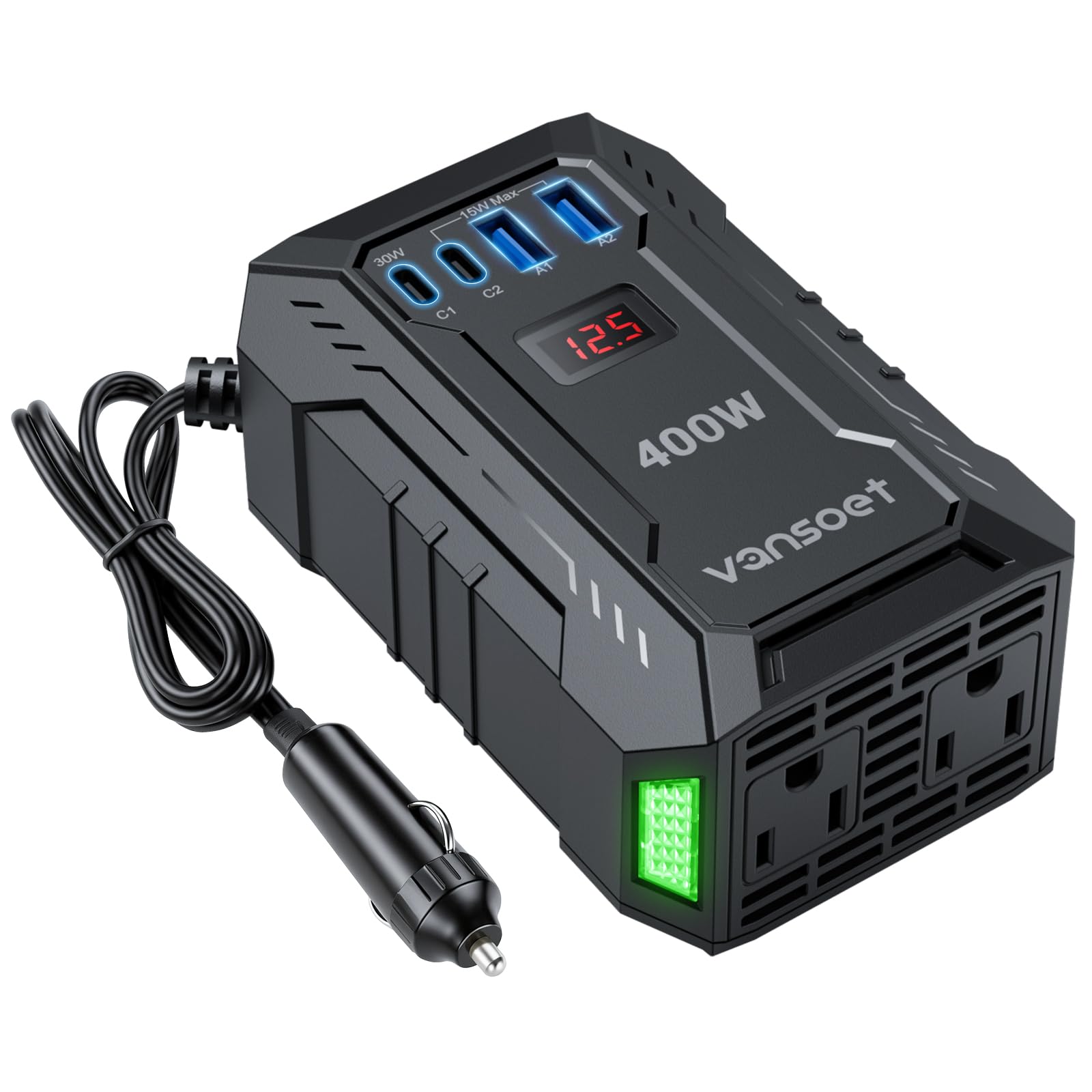
vansoet 400W Car Power Inverter

88 /100
LBD Score Excellent

Key details

USB-C
30 W PD
Weight
0.97 lb
Peak Power
800 W
Continuous Power
400 W
View on Amazon

A separate switch for the AC outlets sounds like filler until you've left something plugged into a live inverter for a week. On this one the AC side goes dark without unplugging from the socket, and a status LED tells you what's going on — steady green for normal, red for a fault. It's the sort of detail that suggests someone at the drawing board actually used the thing.

The port mix is the most current in this group: two AC outlets, a 30-watt USB-C PD port that fast-charges a phone or keeps a small laptop alive, plus USB-A ports for everything older. At about a pound and roughly the size of a paperback, it drops into a console, a door pocket, or a cupholder and stays out of the way until you need it.

Four hundred watts continuous and 800 peak covers laptops, tablets, cameras, and a passenger seat full of phones. It is not a hair dryer or a kettle, and the lighter plug caps you below the rating regardless. For daily cab charging we kept reaching for this one over the bigger units, and the 18-month warranty costs you nothing to have.

Pros

  • Dedicated AC switch with green/red status LED
  • 30 W USB-C PD plus USB-A ports
  • About a pound and easy to stash

Cons

  • Modified sine output rules out sensitive electronics
Our verdict

The one we leave in the truck every day: a pound in weight, USB-C PD, and a switch that kills the outlets without unplugging anything.

Check Latest Price
4

Best Pure Sine Wave

BESTEK 300W Pure Sine Inverter

91 /100
LBD Score Outstanding

Key details

Weight
1.4 lb
Waveform
Pure sine wave
Peak Power
700 W
Continuous Power
300 W
View on Amazon

Pure sine wave output is the whole point of this one, and it's the only inverter in the group that has it. The AC coming out matches what a wall outlet delivers — a smooth curve rather than a stepped approximation — which is what a CPAP, a monitor, audio equipment, or a fussy laptop supply wants to see. If nothing you carry falls into that category, you're paying for a feature you won't use.

Everything else is modest and sensible: 300 watts continuous, 700 peak, two AC outlets, two USB ports at up to 2.4 amps each, a 40-amp fuse, and protection against over-voltage, under-voltage, and overload. At 1.4 pounds and eight inches long it moves between truck, trailer, and kitchen table without complaint, which is more than the heavier units here can claim.

Two honest points before you buy. Three hundred watts is not a big number, and the lighter plug trims it further, so this is a laptop-and-CPAP inverter rather than a tool one. Longevity is the other: some units shut down early in their life, so register the 18-month warranty and keep the receipt where you can find it.

Pros

  • Pure sine wave output at 300 W continuous
  • 1.4 lb, easy to move between vehicles
  • 40 A fuse and full protection set

Cons

  • Fan noise climbs under a real load
Our verdict

The least expensive clean power here: pure sine output in a 1.4-pound body, best for a CPAP, audio gear, or a laptop you baby.

Check Latest Price
5

Big Loads, Wired in

YSOLX 2000W Power Inverter

90 /100
LBD Score Outstanding

Key details

Weight
3.9 lb
Waveform
Modified sine wave
AC Outlets
3
Cable Length
16 in
View on Amazon

Ten inches long and just under four pounds, this is the only inverter here built for loads the others can't touch: a chest fridge, a small microwave, a space heater on low, a saw. We treat it as a mounted unit rather than something you toss in the console — it belongs on a fused cable to a battery, with the vehicle's own wiring out of the picture.

Three AC outlets instead of the usual two is the practical detail we noticed first; you stop shuffling plugs when the fridge, a light, and a phone charger all want a home. The modified sine output puts it in the same camp as the cheaper units: wrong for a CPAP, fine for motors, heaters, and anything with a chunky power supply.

Before you buy, confirm two numbers. The wattage figures in the listing don't quite line up with each other, so check the continuous rating on the unit before you plan a load around it, then size the cable and fuse to that rather than to the peak. Vehicles with a second battery are where this makes sense; asking a cranking battery to feed it for an hour is how people end up needing a jump.

Pros

  • Three AC outlets instead of the usual two
  • Built for loads the pocket units can't take

Cons

  • 16-inch lead limits where it can sit
Our verdict

Buy it only if you're wiring it in and need to run a fridge, a microwave, or real tools — through a 12V socket it's wasted money.

Check Latest Price

How We Tested Power Inverters Where They Actually Get Used

We started by reading through listings and owner reviews for close to 60 inverters, then narrowed by plug type (lighter plug versus hardwired clamps), continuous wattage, outlet and USB layout, and price. We wanted a spread, from small 300- to 400-watt units that live in a cupholder up to a 2,000-watt box meant for tools or a small appliance. Fourteen made the cut, and each one stayed with us for five months.

Testing happened where inverters actually live: idling in a work truck over a lunch break, on 300-mile highway runs, at a campsite with no hookups, and in a tailgate lot on a Saturday. We charged a dead phone from zero to full and logged the time, ran a laptop through a full workday, and powered a small fan and a camp light overnight. With the engine off, we timed how long each unit ran before its low-voltage alarm chirped — the honest measure of battery life, since an inverter left running on a parked battery is how you end up stranded.

Noise got measured the crude way: radio off, engine off, a decibel app held a foot away, then again with a load plugged in. We checked housing temperature by hand after 30 minutes of hard work, watched whether the plug stayed seated over washboard gravel, and noted how each unit looked after a few months rattling around a toolbox. Portability mattered more than expected — the compact ones with a short cord got used constantly and the bricks stayed home. Two of the fourteen quit inside the first month, which is reliability data no spec sheet will give you, and value came down to whether the claimed continuous output matched what the outlets actually delivered.

How to Choose a Power Inverter for Your Truck

The 12V Socket Sets Your Real Ceiling

Most truck outlet circuits are fused somewhere around 15 to 20 amps, which works out to roughly 180 to 240 watts at 12 volts. Above that, the truck's fuse lets go long before the inverter's own protection notices. So a 500-watt unit that only plugs into the dash is a 180-watt unit wearing a bigger number.

Decide before you buy whether you will open the hood. A unit with battery clips, like our top pick, can use its full rating on a fused cable; a plug-only unit cannot. If you want the number on the box to mean anything, buy the clips.

Match Continuous Watts to What You Plug In

Continuous is the figure that matters; peak only covers the second or two a motor or compressor surges on startup. Add up your real load. A laptop charger is usually under 100 watts, phones are a fraction of that, a tool battery charger a few hundred, and an air mattress pump around 150.

Resistive loads are the ones that bite: a heater or kettle pulls its full rating steadily and trips protection fast. Buy for the total, then apply the socket ceiling above — the two numbers together are what you can actually run.

Modified Sine or Pure Sine

Modified sine wave is a stepped approximation of household AC. Laptops, lamps, pumps, and most chargers don't care. Motors, audio equipment, CPAP machines, and some laptop bricks do — they can buzz, run hot, or refuse to start.

Pure sine costs more for the same wattage, which is why we only pay for it when something specific in the cab needs clean power. If you're charging phones and running a work light, put the difference into watts instead.

Cables, Footprint, and Ports

Battery clips and lighter plugs are short — 24 to 32 inches on the models here — so work out where the unit will live before it arrives. A 2-pound block doesn't sit in a cupholder; a phone-sized one does, and that difference decides whether the thing stays in the truck or ends up in a drawer.

On ports, USB-C PD is the one worth having now: 30 watts fast-charges a phone and keeps a small laptop alive. Older USB-A ports top out far lower, so two of them are not the same as one good USB-C.

Frequently Asked Questions

Final Verdict

Our pick is the BESTEK 500W. It's the only inverter here that gives you an everyday mode through the dash socket and the full 500 watts on battery clips, which is exactly the split a truck asks for. Nothing else in this group covers both halves of the job.

If your loads are tools rather than laptops, step up to the Ampeak 750W for the headroom and the replaceable fuses. If the inverter never leaves the cab, the vansoet 400W is lighter, less expensive, and easier to live with.