Best Portable Solar Panels of 2026

A solar panel's watt rating is a promise made at noon in the desert. Most of us are not in the desert at noon — we're under a cottonwood at a campsite, or on a tailgate in hazy October light, and the number on the box stops meaning much. What matters is how much of that rating actually reaches your power station on an ordinary afternoon, and whether the panel is light and quick enough that you bother setting it up at all. Get that balance right and a folding panel keeps a cooler, a CPAP machine, or a week of phone batteries alive without a hookup in sight.

My team has spent the last eight months with ten panels, from a pocket-sized phone charger to a 450-watt folding array, and the pattern held: the ones that earn their place unfold in seconds, prop at an angle without fighting you, and plug straight into whatever you brought. Paying for watts you'll never actually see is the quiet trap in this category, so we spent as much time on what each panel delivered as on what it promised. The picks below are sorted by how you'll use them, not by the sticker on the box.

1

Best Overall

HQST 200W Portable Solar Panel

87 /100
LBD Score Excellent

Key details

Weight
11 lb
Max Power
200 W
Cell Efficiency
25%
Waterproof Rating
IP67
View on Amazon

Eleven pounds is the number that decides this one. Every other 200-watt folder here runs between 14 and 18 pounds, and the gap is the difference between carrying the panel a few hundred yards to the sunny side of camp and leaving it in the car. Our top pick is the one a single person can move, aim and fold alone, and it does all three without a second pair of hands.

The rigid frame is the other half of it. Panels that flop between segments are fussy to aim; this one holds its shape, and the buckles keep the fold shut in the trunk. IP67 covers rain, the N-type cells are rated to 25 percent efficiency, and the 3-in-1 lead ends in XT60, DC7909 and DC5521 — the plugs that fit most Jackery, EcoFlow and Bluetti inputs. In strong, square-on sun it gets close to its 200-watt rating rather than stalling well below it.

What we can't promise is a decade of service. The laminate is what ages first on any folding panel, and a stiff frame does nothing to spare the surface from hundreds of fold-and-unfold cycles. Ours has held up. The rest is reassuringly uneventful: unfold it, angle it into the sun, plug the lead into the station, and it's charging before you've finished setting up the chair.

Pros

  • Lightest 200W panel here at about 11 pounds
  • Reaches close to its 200W rating in strong sun
  • IP67 body with a rigid, non-floppy frame
  • 3-in-1 adapter covers the common station inputs

Cons

  • Only two kickstands to set the angle
  • 4.9 ft cable is short for positioning
Our verdict

For one-person camps and weekend power stations, this is the panel we point people to: light enough to move alone, honest about output, and cheap enough that a second one is an easy upgrade.
Check Latest Price
2

Best for Large Power Stations

ZOUPW 450W Portable Solar Panel

89 /100
LBD Score Excellent

Key details

Weight
29.5 lb
Max Power
450 W
Waterproof Rating
IP68
Open-circuit Voltage
45.9 V
View on Amazon

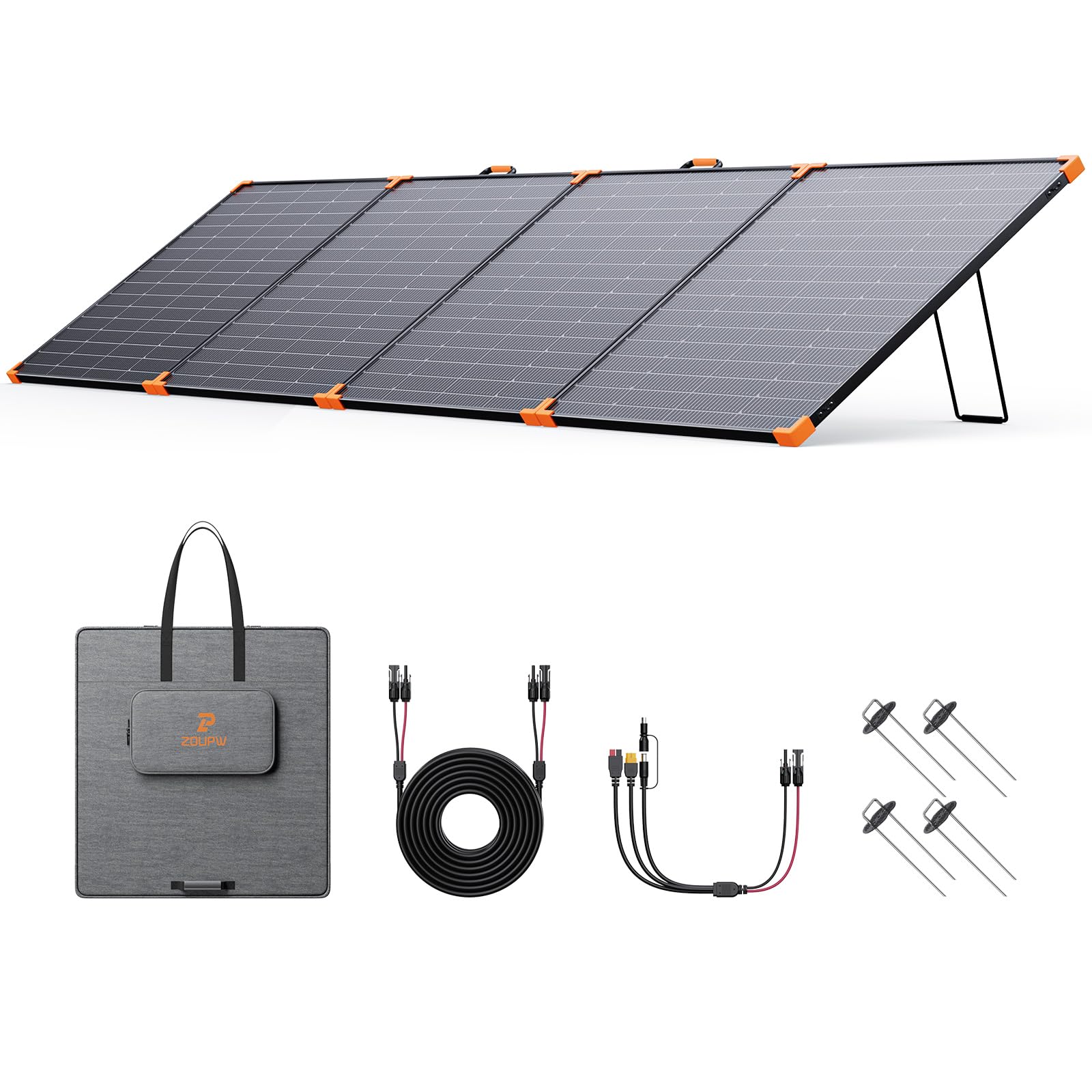
Rain is the test most folding panels fail quietly. This one is sealed to IP68, with an ETFE coating over the cells and laminated edges, so a passing shower isn't a reason to break camp and haul it inside. The 4-in-1 lead in the box ends in XT60, Anderson, DC7909 and DC8020, which covers the big station brands without an adapter hunt.

Output is what earns it a place. At 450 watts it delivers more than twice what our top pick manages, and it feeds a large station the way a wall outlet does — steadily, rather than the slow crawl you get from a 200-watt panel on a hazy afternoon. Twenty-five percent N-type cells and a 16-busbar layout put it at the top of this group on efficiency, and it shows in thin light.

Setup is delightfully dull. Unclip the latches, unfold, set the wire legs, run the lead, and it's feeding the station — no app, no pairing, nothing to configure. For an RV or a basecamp where the panel stays out from breakfast to dusk, that simplicity is worth more than a handful of extra watts.

Pros

  • Highest output in this group at 450W
  • IP68 sealing for rain and marine air
  • 4-in-1 lead covers the major station brands
  • Padded storage bag with a cord pocket

Cons

  • 29.5 pounds to move and set up
  • Needs a station with a 40 to 60 volt solar input
Our verdict

If your station takes 40 to 60 volts and lives in an RV or a basecamp, we think this is the panel to buy: it delivers big-station power in something you can still move.

Check Latest Price
3

Best for Charging Devices Directly

Renogy 200W Portable Solar Panel

89 /100
LBD Score Excellent

Key details

Weight
13.9 lb
Max Power
200 W
Built-in USB
USB-C PD 45W, dual USB-A
Cell Efficiency
25%
View on Amazon

A USB-C port would be unremarkable on a power bank. On a solar panel it's the reason to choose this one: the USB-C PD port pushes 45 watts and two USB-A ports sit beside it, so a phone, a tablet and a headlamp can charge from the sun with no station in the middle.

The rest is competent rather than exceptional. Cells are in the same 25 percent N-type band as our top pick, and four kickstands click into 40, 50 and 60 degree stops — more angle choice than anything else here. The magnetic closure snaps the fold shut, the grommets take a stake, and a two-year warranty sits behind it.

The legs are the weak point. They're the thinnest stands in this group, and on uneven ground the panel settles out of the angle you set; wedging the frame against a cooler or a rock fixes it, and that's what we ended up doing on soft ground. Annoying rather than fatal — the port selection and the UL 61730 listing are what you're paying for, and both hold up.

Pros

  • USB-C PD 45W and dual USB-A built in
  • Four kickstands with three angle settings
  • 25 percent N-type cells with a UL 61730 listing
  • Two-year material and workmanship warranty

Cons

  • 13.9 pounds, heavier than our top pick
Our verdict

Buy it when you want to charge phones and a laptop straight from the panel; the built-in USB-C PD port is the reason to pick this one over our top pick.

Check Latest Price
4

Best for Uneven Ground

EBL 200W Portable Solar Panel

0 /100
LBD Score Fair

Key details

Weight
18 lb
Max Power
200 W
Folded Size
25.31 x 20.87 x 2.17 in
Cell Efficiency
23.5%
View on Amazon

Heavier and pricier than our top pick, the EBL makes its case with hardware: four kickstands instead of two, and an MC4-to-4-in-1 cable in the box ending in XT60, Anderson, DC7909 and an aviation plug. If you've ever unrolled a panel and found the lead didn't fit your station, that kit is worth real money.

The four kickstands are what we appreciate most. A folding panel lives or dies on being aimed properly, and four legs give a steadier base on gravel and sand than the two-legged designs here — on a breezy afternoon it held its angle while a two-leg panel needed a rock on the frame. Output is honest rather than spectacular: it climbs toward its rating in good sun and drops into the low hundreds at a lazy angle, like everything else in this guide.

The back is 840D Oxford cloth with PET lamination over the cells, and the cable and connectors tuck into a pocket sewn into it — trivial until you've spent ten minutes hunting an XT60 plug in the dark. It's a sensible panel for a truck bed or a gravel pitch where nothing sits level.

Pros

  • Four kickstands hold an angle on soft ground
  • MC4 to 4-in-1 cable included
  • Cable pocket sewn into the back panel
  • 23.5 percent monocrystalline cells

Cons

  • 18 pounds, the heaviest 200W here
  • IP65 backing rather than IP68
Our verdict

The one we reach for on gravel, sand and sloped ground, where four kickstands and a proper cable kit matter more than a couple of pounds.

Check Latest Price
5

Wet-Weather Charging

SOKIOVOLA 220W Portable Solar Panel

85 /100
LBD Score Excellent

Key details

Max Power
220 W
Folded Size
23 x 22.24 in
Included Cable
10.49 ft, 5-in-1
Waterproof Rating
IP68
View on Amazon

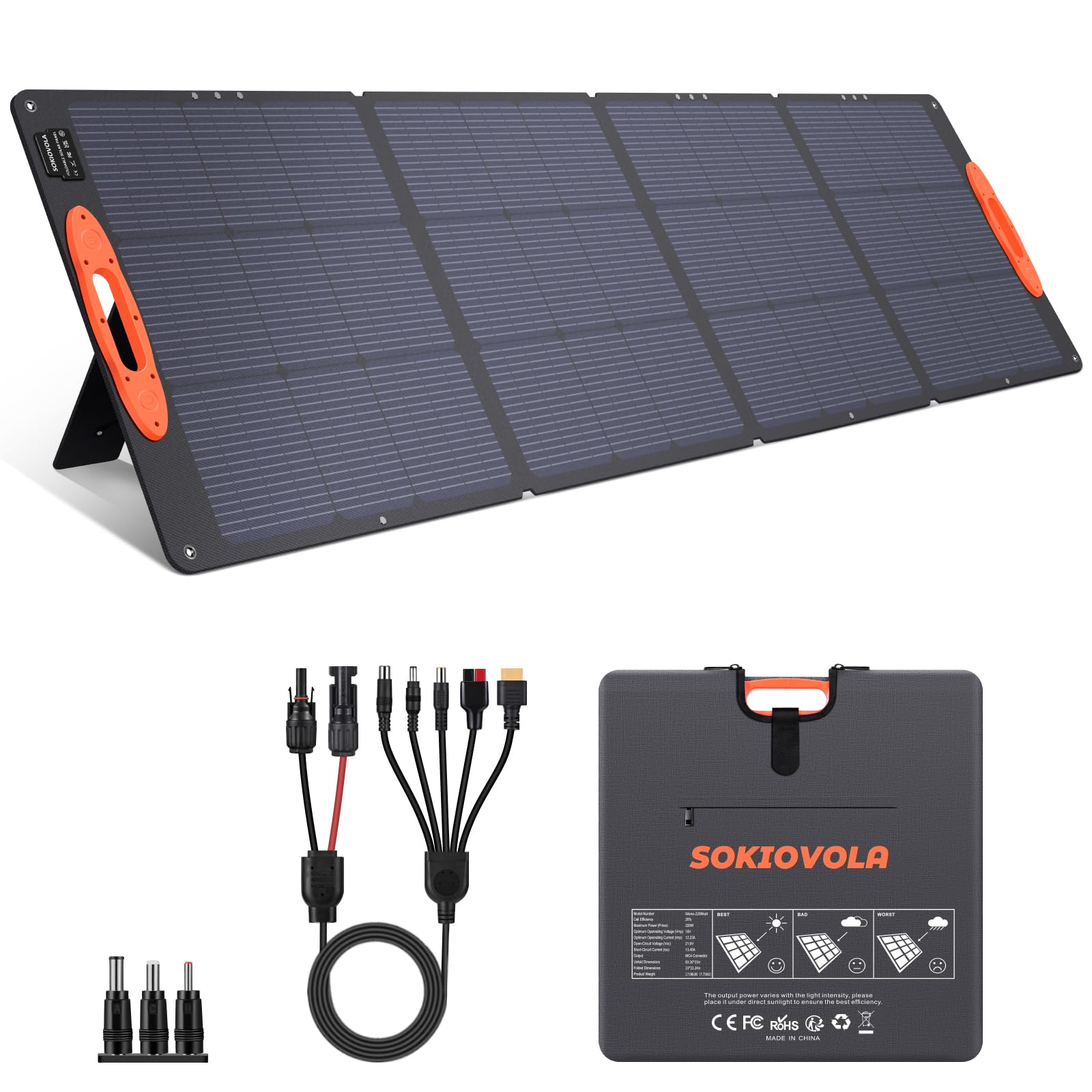
Ten and a half feet of cable is the sort of detail that decides whether a panel is useful. The SOKIOVOLA ships with a 5-in-1 lead — XT60, DC5521, DC7909, Anderson, DC8020 — long enough to leave the panel in the sun at the edge of a site while the station sits under the awning, and that, more than the extra 20 watts, is why we kept coming back to it.

IP68 and an ETFE surface make it one of the most weather-ready panels here, and the magnetic handle snaps the fold shut one-handed. Folded, it's the size of a briefcase, and the three hanging holes let you lash it to a rail or a fence when the ground is wet.

Consistency is the frustration. Output swings more from unit to unit than it does on our top pick, and some sessions ended with the station taking power in fits rather than a steady flow. When it's good, 220 watts of rated capacity leaves headroom for a laptop and a cooler at once; we've learned to watch the station's input reading for the first few minutes of every session.

Pros

  • 10.5 ft 5-in-1 cable in the box
  • IP68 and ETFE for wet weather
  • Magnetic handle and three hanging holes
  • 220W gives a little more headroom than 200W

Cons

  • Short pigtails on the panel itself
  • Leg rivets can give out early
Our verdict

For a wet, shaded pitch where the station has to stay under cover, the long cable and full IP68 sealing make this the obvious choice.

Check Latest Price
6

Big-Station Output

TWELSEAVAN 400W Portable Solar Panel

81 /100
LBD Score Excellent

Key details

Weight
22 lb
Max Power
400 W
Connector Kit
5-in-1 MC4 plus 3 adapters
Cell Efficiency
24%
View on Amazon

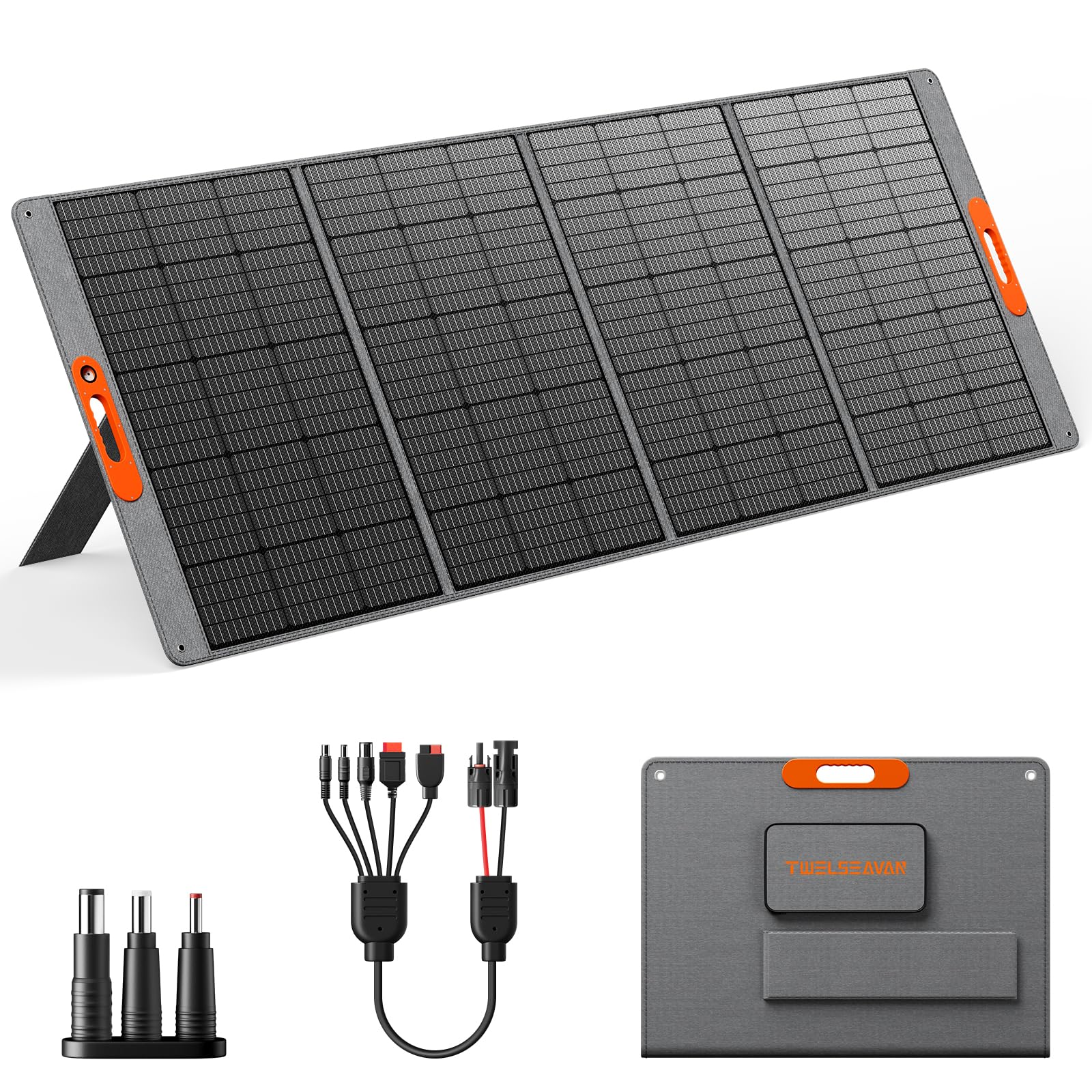
Eight connector ends, not one: a 5-in-1 MC4 cable plus three DC adapters means this panel plugs into almost anything without a follow-up order. On a first solar purchase, that kit removes the most common source of frustration — the unboxing that ends with the wrong plug in your hand.

The numbers are respectable. 400 watts from 24 percent cells, 46.9 volts open-circuit, 10.6 amps, 22 pounds, a fiberglass back and a magnetic closure. That places it between the 200-watt panels and the 29.5-pound ZOUPW: more than a third more power than the smaller panels, and seven pounds lighter than the big one.

The 400-watt figure is a ceiling, not a promise. A 400-watt folder in real sun typically gives you something nearer two-thirds of the label, and this one is no different — which still puts it well ahead of any 200-watt panel here once the sun is high and the panel is cool.

Where it fits is between the extremes: a serious harvest in something one person can still move, with an adapter kit that ends the guessing. Check that your station's solar input takes 40 volts or more before you order — that's the gate, and everything else about this panel is straightforward.

Pros

  • 8-in-1 connector kit in the box
  • 22 pounds for a 400W panel
  • 24 percent cells with a two-year warranty
  • Folds with a magnetic closure

Cons

  • No stakes or tie-downs included
  • Unsteady in gusty wind
Our verdict

For a large station and a basecamp, we think this is the better-balanced route to 400 watts: lighter than the big alternative, with an adapter for almost anything in the box.

Check Latest Price
7

Backpacking Phones

BigBlue 28W Solar Charger

88 /100
LBD Score Excellent

Key details

Ports
Two USB-C, one USB-A
Weight
About 1.5 pounds
Max Power
28 W
Folded Size
11 x 6 x 1.4 in
View on Amazon

Twenty-eight watts won't run a camp. It will keep a phone and a headlamp alive on a five-day walk, which is the job this panel was built for — folded to 11 by 6 by 1.4 inches and about a pound and a half, it's the difference between carrying a charger and leaving one at home.

Two USB-C ports and a USB-A sit on the face, each rated 5V/3A, so a phone and a headlamp can charge at once. Panels this size produce usable current only when they're square to strong sun, which makes positioning everything: clip it to the top of a pack and it will trickle all day, lay it flat in the shade and it does nothing at all.

The hinge fabric is the part that ages, and it's the reason to fold the panel away rather than leave it strapped to a pack in the sun for a week. Treated as a slow top-up for small devices, ours has been reliable. For a phone-and-headlamp trip it earns its place in the pack; for anything with a battery big enough to run a camp, it simply isn't in the conversation.

Pros

  • Folds to 11 x 6 x 1.4 inches
  • Two USB-C ports and one USB-A
  • About a pound and a half to carry

Cons

  • 5V output, so phones charge slowly
  • Too small to charge a power station
Our verdict

For backpackers keeping a phone alive, this is the one to carry; for anything with a battery big enough to run a camp, it is too small to bother with.

Check Latest Price

How We Tested Portable Solar Panels in Real Sun

We started with research, scanning spec sheets across several dozen listings and narrowing to ten panels that covered the real spread of the category: small USB phone chargers, 200-watt suitcase-style panels, and 400-plus-watt arrays meant to sit beside a power station. Panels claiming similar cell efficiency but weighing noticeably more got cut early, and we favored ones with built-in kickstands and adapters that fit more than one station brand.

Testing ran from spring into fall. On clear days we laid each panel flat, then tilted it toward the sun, and logged output on a watt meter to see how close it came to its rating — the gap between flat and angled was often wider than the gap between two different panels. We timed charges from 20 percent to 80 percent on a mid-size power station, then repeated the run on a hazy morning and with a branch casting partial shade over one corner, because that's what a real campsite looks like.

Every panel got carried, not just deployed. We weighed each one, folded it back into its case, and walked a quarter mile with it to see how it rode on a pack; the smallest charger went on a day hike clipped to a shoulder strap. We hosed each panel down for five minutes and checked behind the junction box for moisture, dropped them corner-first onto pavement, and worked the hinges and latches through repeated folds to see what loosened. Finally, we plugged each cable into power stations from three different brands and noted which needed an adapter, which needed a proprietary tip, and which simply worked.

How to Choose a Portable Solar Panel

Start With Your Station's Solar Input

A panel that can't plug in is an expensive tarp. Two figures on your generator's spec sheet decide this: the maximum solar input voltage and the connector it expects. The ZOUPW 450W runs at 45.9 volts open-circuit and needs a station that accepts 40 to 60 volts, such as a big EcoFlow or Anker; a small unit capped near 30 volts will refuse it. XT60 and DC7909 (8mm) cover most Jackery, Bluetti and EcoFlow inputs, with Anderson and DC8020 on others.

Buy the cable kit at the same time as the panel. A 4-in-1, 5-in-1 or 8-in-1 lead in the box saves a week of waiting on an adapter, and it's the difference between a panel that works the day it arrives and one that sits in the garage.

Weight and Folded Size Decide How Often It Leaves the Car

An 11-pound panel goes to the beach; a 29.5-pound one stays beside the RV. Weight predicts use more reliably than any other figure here, because the trip where you skip the panel is usually the trip where carrying it felt like too much work. Folded dimensions tell you where it stows — behind a seat, on a shelf, across the top of a pack — and thickness matters as much as footprint.

Read 'compact' as compact for a car, not for a hiker, until you've checked the numbers. A 2-inch folded thickness slides into gaps that a 3.5-inch package won't.

Expect Well Under the Rating

Ratings are measured under standard test conditions: cool cells, direct sun, panel square to the light. Real camps give you a hot panel at a lazy angle with a shadow across one segment, and output falls accordingly — a good day lands well short of the label, sometimes by a third or more.

Plan around that rather than around the box. If you need 100 watts going into a battery, buy 200 watts of panel; that headroom is what covers the angle, the haze and the afternoon heat.

Kickstands, Wind and Water

The stand is what turns a panel into a generator, and it's usually the first hardware to let you down. Two-leg designs need careful balancing on soft ground; four legs hold an angle with far less fiddling. Whatever the stand, an unfolded panel is a sail — stake the grommets or weight the frame, and bring it in when the wind gets serious.

On water, IP65 handles spray only, while IP67 and IP68 panels shrug off rain. None of those ratings cover the plugs, so keep connectors off wet ground.

Cells, Laminates and Shelf Life

Most panels here use monocrystalline N-type cells between 23 and 25 percent efficiency, and that spread matters less in practice than the marketing suggests. What separates a panel that lasts from one that doesn't is the laminate and the hardware: ETFE surfaces and sealed edges take sun and rain better than thinner coatings, and a rigid frame protects cells that a floppy one lets flex. Compare efficiency, but buy on construction.

Frequently Asked Questions

Final Verdict

Most people should buy the HQST 200W. At about 11 pounds it's the one 200-watt folder here a single person can carry, aim and fold alone, it comes close to its rating in strong sun, and it costs less than every other panel on this list that can charge a station.

Change the answer if your station is a big one: the ZOUPW 450W turns a 40-to-60-volt input into serious power. And if phones and a laptop need charging without hauling the station out of the tent, the Renogy's built-in USB-C PD port makes it the better buy.