Best Office Chairs of 2026

Somewhere around hour six of a long Tuesday, a chair stops being furniture and becomes a back problem. I've done the slow slump in enough home offices to know it isn't a discipline issue. The right chair holds you upright without nagging; the wrong one sends the bill to your lower back by Thursday.

Over the past six months my team has logged full workdays in 11 chairs, from mesh-backed task seats to small armless numbers, and the gaps show up fast. Mesh breathes through a warm afternoon but has to be tensioned correctly; padded upholstery feels cozier and takes longer to spring back. I check the arms first — flip-up arms let you pull right up to the desk, while fixed ones that catch a drawer make a good chair feel wrong all day.

Assembly is where budget chairs out themselves, and lumbar support is where expensive ones do. The picks below run from tall to small and broad to narrow, so there's one for however you actually sit.

1

Best Overall

X XISHE Ergonomic Office Chair

90 /100
LBD Score Outstanding

Key details

Back
Mesh
Armrests
Flip-up
Seat Height
20.5 inches
Weight Capacity
300 lb
View on Amazon

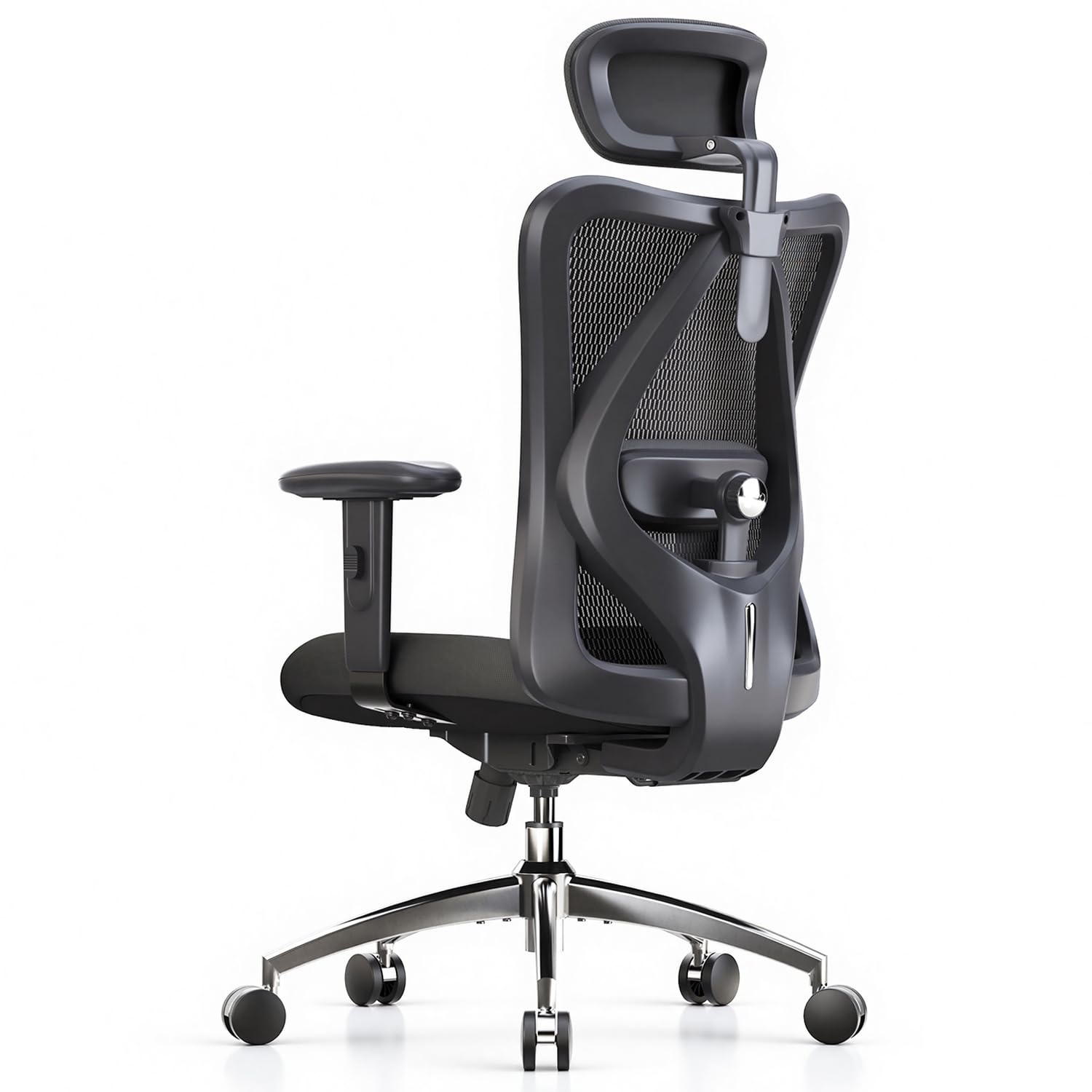
The X XISHE gets the basics right in a way that matters more than any single headline feature: the lumbar support moves up and down, the arms flip out of the way, and the seat has enough padding for a long afternoon. We think that combination makes it the best all-around chair here for most home offices. It is not the flashiest pick, but it is the one we kept coming back to when we wanted to sit down and work rather than fiddle with settings.

The flip-up arms are the detail we appreciate most. They let you push the chair under a desk when you are done, and they also make it easier to get close to a keyboard without the armrests crowding your elbows. The mesh back breathes well, while the PU leather seat is easy to wipe clean. That seat is the trade-off: it can feel warmer than an all-mesh chair after a few hours, so hot runners may prefer the SIHOO or ELABEST.

At 300 pounds, the weight capacity is generous for a midrange chair, and the five-point base feels planted when you lean back. The lack of a headrest is the main thing missing if you like to recline between calls. For everyone else, the X XISHE is the sensible default: supportive, adjustable where it counts, and easy to live with.

Pros

  • Adjustable lumbar support finds the right height
  • Flip-up arms free up desk space
  • Thick, supportive seat for long sessions
  • 300-pound capacity and stable base

Cons

  • No headrest for reclining
Our verdict

We recommend the X XISHE as the best all-around office chair here for most home workers, thanks to its adjustable lumbar support, flip-up arms, and supportive cushion.
Check Latest Price
2

Best for Back Support

SIHOO M18 Ergonomic Office Chair

88 /100
LBD Score Excellent

Key details

Headrest
Adjustable
Seat Material
Memory foam
Lumbar Support
Adjustable
Weight Capacity
330 lb
View on Amazon

If your lower back is the reason you are shopping, the SIHOO M18 is the chair to put on your short list. The lumbar support is adjustable, the headrest moves through a useful range, and the mesh back keeps air moving. We like that combination for long workdays, especially for taller or heavier users who need a chair rated to 330 pounds.

We think the M18 is the best chair here for back support because the lumbar pad sits where you need it instead of disappearing into the backrest. The headrest is also more useful than most: it adjusts high enough to meet the back of your neck rather than pushing your chin forward. The seat is the catch. It is firm, and after several hours it can feel harder than the cushioned seat on the X XISHE. If you want a soft landing, that is the trade-off.

The 2D armrests adjust up and down, but they do not move in and out, so the chair rewards a fairly standard desk setup. Assembly is straightforward, and the mesh back is easy to wipe down. For a firm, supportive chair that encourages you to sit up rather than sink in, the M18 earns its place.

Pros

  • Adjustable lumbar support for lower-back relief
  • Headrest adjusts to fit your neck
  • 330-pound capacity suits bigger users
  • Breathable mesh back

Cons

  • Firm seat may feel hard after hours
  • Armrests adjust only up and down
Our verdict

Buy the SIHOO M18 if you want firm, adjustable lumbar and headrest support for long workdays, especially if you are taller or heavier.

Check Latest Price
3

Best Premium Upgrade

ELABEST X100 Ergonomic Office Chair

91 /100
LBD Score Outstanding

Key details

Armrests
5D flip-up
Footrest
18-inch extendable
Lumbar Support
3D adjustable
Weight Capacity
300 lb
View on Amazon

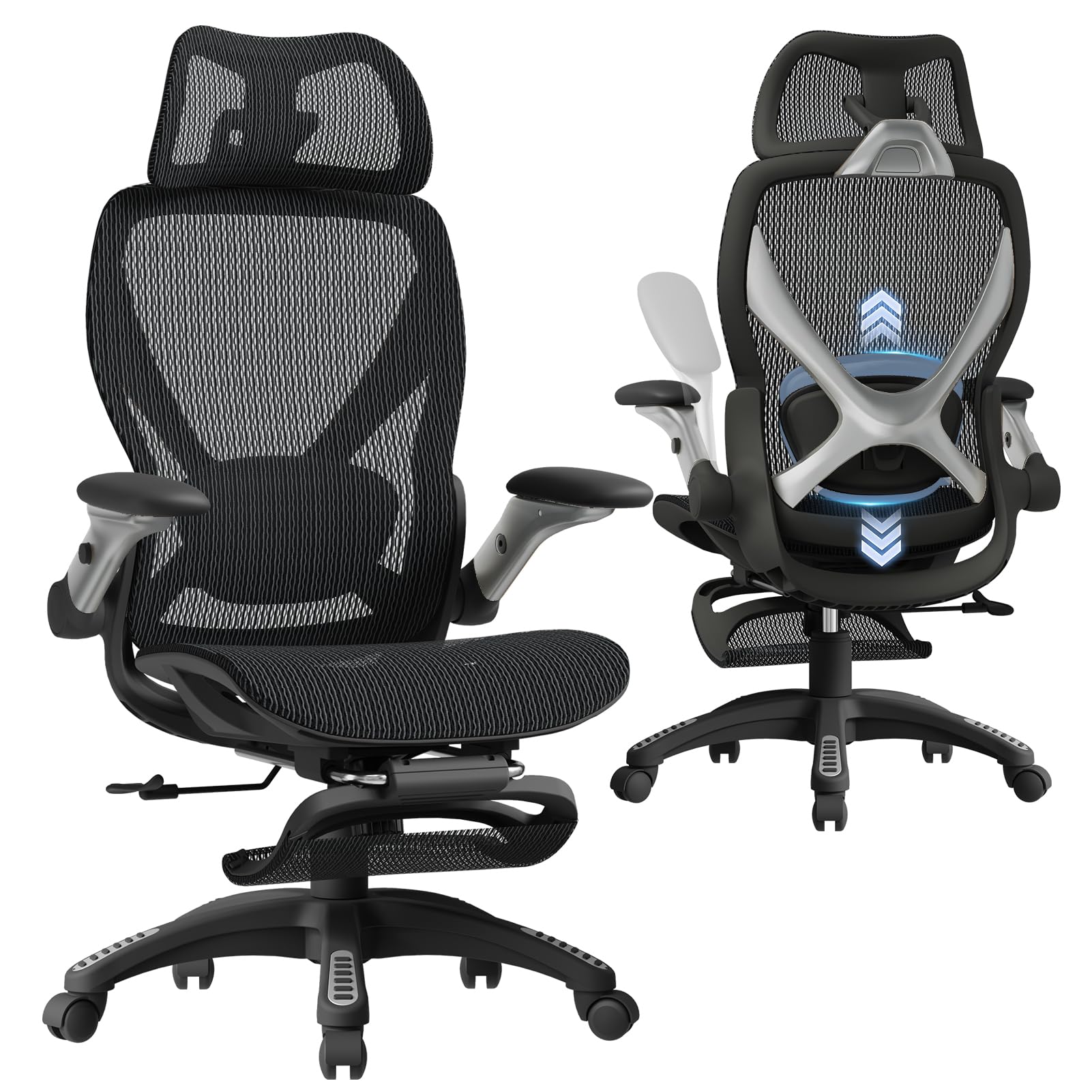
The ELABEST X100 comes with the longest feature list in this group: a footrest that extends to 18 inches, 5D arms that flip up and move in several directions, and 3D lumbar support that adjusts for height, depth, and angle. It is the premium option here, and it looks the part.

The footrest is the feature that surprised us most. It extends far enough to support your calves rather than just poke at them, so the chair works for a real break between meetings. The 5D arms are similarly practical: they flip up when you want to tuck the chair under a desk and adjust in more directions than most people will ever need. The mesh seat and back breathe well, and the 300-pound rating is solid for a chair this adjustable.

We recommend the X100 for the buyer who wants a premium chair that can shift from work mode to lounge mode without getting up. The fixed seat depth is the main compromise: taller users cannot slide the seat forward or back, so check that the 18-inch depth fits your legs. It is also heavy at 43 pounds, which matters if you move it between rooms. For a dedicated office where it stays put, those are reasonable trade-offs.

Pros

  • Footrest extends to 18 inches
  • 5D flip-up arms adjust in multiple directions
  • 3D lumbar support adjusts height, depth, and angle
  • Breathable mesh and 300-pound capacity

Cons

  • Fixed seat depth limits taller users
  • Heavy at 43 pounds
Our verdict

Choose the ELABEST X100 if you want the most adjustable chair here and will use the footrest and recline; it is a premium buy for long workdays.

Check Latest Price
4

Best Budget

BestOffice Ergonomic Office Chair

88 /100
LBD Score Excellent

Key details

Back
Mesh
Seat Width
18 inches
Seat Height
17.1–20.3 inches
Weight Capacity
250 lb
View on Amazon

The BestOffice chair is the one to buy when the chair has to fit a tight corner and the budget is tight too. It is 18 inches wide, rated to 250 pounds, and adjusts from 17.1 to 20.3 inches at the seat, which puts it in the right range for a small desk or a teenager's room. We think it is a sensible budget pick as long as you are not expecting a full-day chair for a larger adult.

The mesh back is the best part. It keeps air moving, and the sponge seat has enough padding for short sessions without feeling like a rock. The frame is basic, but it rolls smoothly and the mesh back keeps it from feeling stuffy. At this price, long-term durability is the trade-off, so the return window matters.

We recommend it for a compact home office, a dorm room, or a desk that gets light use. Assembly is simple, the chair swivels cleanly, and the height range covers most standard desks. Just do not expect it to replace a midrange ergonomic chair for eight-hour days.

Pros

  • Compact 18-inch frame fits tight spaces
  • Breathable mesh back
  • Easy height adjustment from 17.1 to 20.3 inches
  • Low-cost budget option

Cons

  • Narrow 18-inch seat
  • Limited to height adjustment
Our verdict

Buy the BestOffice for a small home office or occasional use, where its compact frame and low price matter more than long-day ergonomics.

Check Latest Price
5

Tight Budgets

PayLessHere Ergonomic Office Chair

90 /100
LBD Score Outstanding

Key details

Back
Mesh
Seat Width
18 inches
Seat Height
20.7 inches
Weight Capacity
300 lb
View on Amazon

At the very bottom of the price range, the PayLessHere chair is a reminder that a small footprint can matter more than a long feature list. It is 18 inches wide, rated to 300 pounds, and built with a mesh back and a foam seat. That makes it a better fit for a sewing room, a vanity, or a kid's desk than for a serious ergonomic setup.

We think it works best as a light-duty seat. The 300-pound rating is unusually high for a chair this small, so it can handle more weight than its footprint suggests. The back is short, though, so taller users will not get the upper-back support they need for a long day.

For occasional use, the PayLessHere is easy to live with: it rolls, swivels, and adjusts at the seat. Assembly is simple, and the mesh back keeps it from feeling stuffy in a small room. The height range should fit a standard desk, and the small base is easy to tuck into a corner. Just go in knowing it is a compact seat, not a full-time ergonomic chair.

Pros

  • 300-pound capacity in a small frame
  • Mesh back keeps air moving
  • Rolls and swivels smoothly
  • Low-cost budget chair

Cons

  • Short back limits upper-back support
  • Firm seat for long sessions
Our verdict

The PayLessHere is a smart buy for a tight corner or light-duty desk, not for eight-hour ergonomic sessions.

Check Latest Price
6

Vanity or Sewing

DUMOS Small Desk Chair

92 /100
LBD Score Outstanding

Key details

Armrests
Armless
Back Height
Low back
Seat Height
21.45 inches
Weight Capacity
250 lb
View on Amazon

Armless and low-backed, the DUMOS is less an office chair than a compact task seat for the corner where a full-size chair will not fit. It is 18.11 inches deep and 22.83 inches wide, rated to 250 pounds, and covered in PU leather. The small footprint is the point: it can slide under a vanity or sewing table that a high-back chair can overwhelm.

The seat is comfortable for short sessions, and the 360-degree swivel and smooth-rolling casters make it easy to move around a work surface. We like the armless design for a sewing room because nothing catches on the table edge. The PU leather is easy to wipe clean, which matters if the chair doubles as a vanity seat.

We recommend the DUMOS for a vanity, a sewing room, or a short-session desk, not for a full workday. It is light enough to move out of the way when you need the floor space, and the height adjustment covers a range of tables. It is a specialized seat, and it does that job well.

Pros

  • Compact armless frame fits tight spaces
  • Smooth-rolling casters and 360-degree swivel
  • Easy-to-clean PU leather
  • 250-pound capacity

Cons

  • No armrests
  • Low back lacks upper-back support
Our verdict

The DUMOS is a good small-space seat for a vanity, sewing table, or short desk sessions; it is not the chair for a full workday.

Check Latest Price

How We Tested 11 Office Chairs Over Six Months

We built the shortlist from chairs that published a real seat-height range, a weight capacity, and some form of adjustable lumbar support, then sorted by price so the group covered budgets instead of stacking up near-identical high-end seats. That left 11 chairs: mesh backs and padded backs, high-back models with headrests, one big-and-tall option, and two small armless seats for tight corners.

Each chair arrived in a box and was assembled by one person with a timer running and only the tools in the box. We noted how legible the instructions were, whether the bolts lined up without a fight, and how long it took to go from flat to sit-able — most came together in under half an hour, one needed a second set of hands. A month in, we re-tightened every bolt to see which chairs had started to loosen or squeak.

Then came the part that matters: eight-hour workdays, video calls, leaning back to think, rolling between a desk and a printer across hardwood and low-pile carpet. Three testers — 5'2", 5'9", and 6'3" — rotated through every chair for at least a week, moving the lumbar pad and arm height as they worked and reporting whether the settings held. We watched for what you notice at hour six: seat foam flattening, a mesh edge digging into the thighs, a seat that felt narrow across the hips.

Firmness got checked honestly, with a palm pressed into each cushion on day one and again at three months, and every chair was rolled over a doorway threshold to see how the casters took a bump. Quality showed up in stitching, wobble in the gas lift, and arm pads that scuffed within a week. Chairs that squeaked, sank, or needed re-tightening every seven days fell off the list.

How to Choose an Office Chair

Start With Fit, Not Features

Measure the distance from the floor to the underside of your desk before you shop. You want a seat height that lets your feet rest flat and your thighs roughly parallel to the floor; a range such as 17 to 20 inches covers many standard desks, while a taller seat suits a standing-desk converter or a higher table. Check seat depth too: if the front edge presses behind your knee, the chair is too deep. Weight capacity is a separate limit, not a comfort score.

Decide Which Adjustments Matter

Adjustable lumbar support is the one feature we prioritize, because a fixed pad that lands in the wrong spot is worse than no pad at all. Arms should at least move up and down, and flip-up arms are useful if the chair has to tuck under a desk. A headrest earns its space only if you recline; if you sit upright all day, spend the money on lumbar depth instead.

Choose the Right Seat Material

Mesh backs breathe better and keep you cooler, but mesh seats can feel firm and leave pressure points. PU leather is easy to wipe clean and looks more executive, though it can run warm. A thick foam seat is comfortable at first, but cheap foam can flatten; look for high-density foam or a seat with a shape that supports your thighs. We prefer a mesh back with a padded seat for most home offices.

Check Stability and Long-Term Support

A chair can feel fine in the store and still develop a sinking gas lift or a wobbling recline after a few months. Look for a metal or reinforced base, a weight rating that leaves room above your own, and a warranty you can actually use. Before you buy, test the height lock and the recline at the settings you use most; a chair that drifts or rocks is not a bargain.

Plan for Assembly and Space

Most office chairs arrive in a box with the base, gas lift, seat, back, and arms separate. Give yourself a clear hour, a second pair of hands for the heavier pieces, and a spot where you can flip the chair over. Check the footprint against your desk and door swing, especially if you want to roll it into a corner. A heavy chair is stable but harder to move; a light one is easier to tuck away but may feel less planted.

Frequently Asked Questions

Final Verdict

We recommend the X XISHE as the best office chair for most people here. Its adjustable lumbar support, flip-up arms, and supportive seat cover the daily basics without asking you to pay for features you may never use.

If lower-back support and a headrest matter more, the SIHOO M18 is the better fit; if you want a footrest and the most adjustability, the ELABEST X100 earns the upgrade.