Best Microscopes of 2026

A microscope is two systems working against each other: the glass that bends light and the light you feed it. Skimp on either and the biggest magnification on the box gives you a dim, milky circle that won't sit still long enough to focus. What you want is a scope that stays sharp at the powers you'll actually use and holds that image while you nudge the slide a hair to the left.

Over six months, my team and I kept 14 in rotation — starter kits bundled with slides and phone adapters, mid-range binocular models, a few research-grade trinocular scopes — and the gap between good and maddening rarely came down to magnification.

That number is the least useful spec on the box. Past roughly 400X, most household subjects — pond water, onion skin, a strand of hair — get emptier rather than more revealing, and a weak lamp just magnifies the blur. What separated the favorites was clean glass, a focus knob that moves in small predictable steps, and light that stays even across the whole field. Below, the picks are sorted by what you'll be looking at, and who's doing the looking.

1

Best Overall

Swift SW380T

88 /100
LBD Score Excellent

Key details

Head
Trinocular, 30° Siedentopf
Stage
Mechanical stage
Eyepieces
WF10X and WF25X
Magnification
40X–2500X
View on Amazon

The third tube on the back of the head is the reason this one leads the list. On a monocular or binocular scope, only the person at the eyepieces sees anything; the trinocular port takes an eyepiece camera, so a class, or a parent helping with homework, can watch on a laptop while someone else keeps both eyes on the slide. You supply the camera. What you don't have to do is clamp a phone against an eyepiece and hope it stays put.

Under that head is the most serious optical package here: four DIN achromatic objectives on a revolving turret, wide-field 10X and 25X glass eyepieces, and six steps from 40X to 2500X. The 2500X figure comes from pairing the 25X eyepieces with the highest-power objective, and that is exactly where light gets scarce, so the working range is 40X to 1000X. What we came to rely on is the separate fine-focus wheel. At 400X, a fraction of a turn is the difference between a cell wall and a smudge.

It is the most expensive microscope in this group, and the money goes into things you feel rather than read: a metal body that doesn't walk across the desk when you turn a knob, a mechanical stage that tracks a specimen instead of losing it, and a Siedentopf head that rotates so the eyepieces swing toward whoever needs them. Light comes from under the stage only, which is right for slides and useless for a coin, so plan on a desk lamp angled in from the side for opaque specimens.

One thing to do the day it arrives: look through each eyepiece at a blank slide. Specks that stay in the same spot at every magnification are inside the optics rather than on the slide, and no amount of lens paper will move them.

Pros

  • Camera port lets a group watch
  • Mechanical stage tracks the specimen
  • Fine focus stays usable at 400X
  • Rotating head suits shared use

Cons

  • Camera for the trinocular port is extra
Our verdict

For coursework, teaching, or a serious hobbyist, this is the one we reach for: a rigid metal stand, a mechanical stage, and a camera port that lets a room see what you see.

Check Latest Price
2

Best for Beginners

PalliPartners Compound Microscope

86 /100
LBD Score Excellent

Key details

Head
Monocular
Illumination
Top and bottom LED
Magnification
100X–2000X
Included Slides
28
View on Amazon

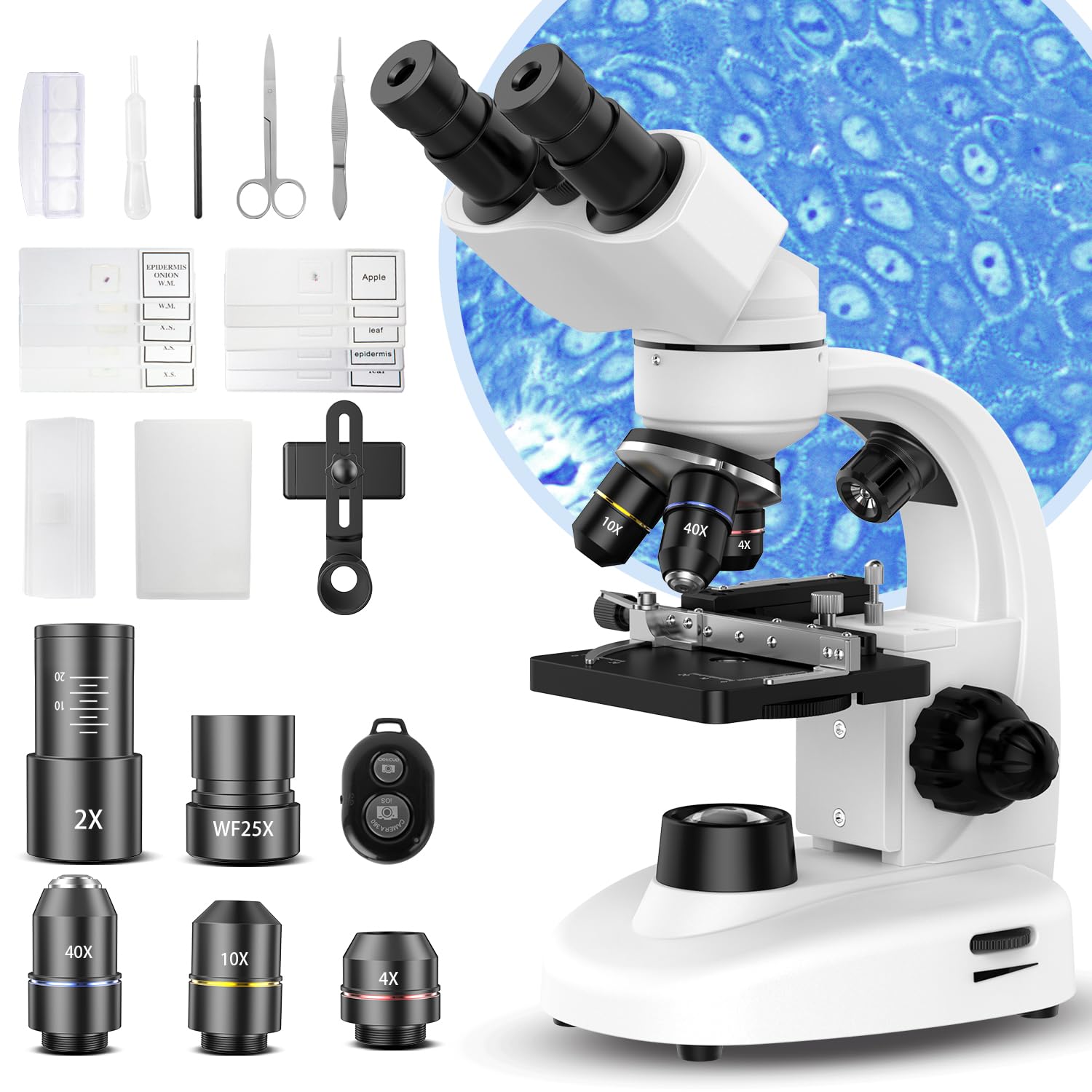
The box does most of the persuading. Ten prepared slides are already mounted, a phone adapter and a wireless shutter sit in there with the scope, and the first evening involves looking at something rather than hunting for consumables. For a household testing the waters, that is worth more than a bigger magnification number.

What we didn't expect at this price is the dual illumination: a top LED for opaque subjects like coins, leaves, and insect wings, and a bottom LED for slides, switched independently. That is the feature that stops a cheap microscope from being a prepared-slide viewer and nothing else. The monocular head is the compromise — one eye, one eyepiece, and a bit of squinting after twenty minutes. Children settle into it faster than adults do, and the whole thing runs on batteries, which is one less cable across the kitchen table.

The 2000X on the box is arithmetic rather than a working power: a 2X lens doubles whatever the eyepiece and objective are already doing, so 40X through the 10X eyepiece is the setting you will actually live at, with the 25X eyepiece and the 2X lens topping out well before the number suggests. Somewhere around 400X the image stops rewarding the extra power, and that ceiling is fine for pond water and prepared slides.

Pros

  • Prepared slides and phone adapter included
  • Separate top and bottom LEDs
  • Set-up is simple for beginners
  • Runs on batteries, no cable needed

Cons

  • Blank slides in the kit are flimsy plastic
Our verdict

If you want a first microscope that works on day one without a trip to the store, this is the kit we recommend — slides, phone adapter, and all.

Check Latest Price
3

Best Binocular Value

Herwicm Compound Binocular

85 /100
LBD Score Excellent

Key details

Head
Binocular
Stage
Two-layer mechanical stage
Illumination
Dual LED, top and bottom
Magnification
40X–2500X
View on Amazon

Two eyepieces is the whole point of this one. Binocular viewing lets you keep both eyes open, and anyone who has spent an hour squinting down a single tube notices the difference in their shoulders before they notice it in the image.

That is why this Herwicm is our pick for a scope that lives on a shared desk. The two-layer mechanical stage moves the slide with knobs instead of fingertips, the coaxial coarse and fine focus sit on both sides of the base so a left-handed user isn't reaching across, and the 40X objective is spring-loaded, so it gives rather than grinds if it meets a slide. Small thing, but it saves both a cracked slide and a scratched lens. Magnification runs 40X to 2500X across the two eyepiece pairs, with dual top and bottom LEDs for opaque subjects as well as slides.

Getting a crisp picture at the top of that range takes patience and a very thin specimen; the 40X objective paired with the 10X eyepiece is where this scope sits comfortably sharp. It is also corded, so it needs a spot near an outlet, and the body mixes plastic panels into the metal frame — acceptable at this price, but you can feel where the savings went.

Pros

  • Binocular head is easier on the eyes
  • Focus knobs on both sides of the base
  • Spring-loaded objective protects slides
  • Top and bottom LED illumination

Cons

  • Manual barely covers set-up
  • Plastic panels in an otherwise metal body
Our verdict

A comfortable, well-equipped binocular scope for a shared desk, as long as you are buying it for 100X to 400X rather than the number on the box.

Check Latest Price
4

Best Digital Scope

TOMLOV DM301 Pro

84 /100
LBD Score Excellent

Key details

Output
USB/HD and Wi-Fi
Capture
8MP photos, 1080P video
Display
7-inch IPS screen
Magnification
Up to 1200X
View on Amazon

The first thing you notice is your neck. There is no eyepiece to bend to, the 7-inch IPS screen sits at eye level and tilts, and a session that would have left us stiff at a compound scope felt like watching a video. It is also the only scope here you can hand to three people at once.

That is the case for buying it: a classroom, a co-op, or a family where the point is to show someone else what is on the slide. The screen shows up to 1200X through three achromatic lenses on a turret, with dual LEDs and an iris under the bottom light for contrast. Capture is the part we appreciated most — 8MP stills and 1080P video written straight to a card, nothing to align, no phone clamped to an eyepiece drifting out of frame. Wi-Fi is handy for sharing with a tablet, and the USB/HD port puts the picture on a TV or projector with no pairing step at all.

Where it stops being the right tool is at the fine end. The detail you see is the sensor's version of the image, so a blood smear or pond water at 100X to 400X looks great while anything needing the resolution of real glass eyepieces does not. The kit itself is generous for a scope of this type: a case, five prepared slides, five blanks, and a card already installed.

Pros

  • 7-inch screen at eye level, no squinting
  • Captures 8MP photos and 1080P video
  • USB/HD output for a TV or projector
  • Case and prepared slides included

Cons

  • No eyepiece: you see a camera image, not optics
Our verdict

Buy it when the point is showing other people what you are looking at: the big screen and easy capture make it the friendliest microscope here.

Check Latest Price
5

Best Portable Compound

MAXLAPTER Compound Microscope

88 /100
LBD Score Excellent

Key details

Head
Monocular, aluminum frame
Power
USB-C rechargeable
Magnification
40X–2000X
Included Slides
5 prepared
View on Amazon

A microscope with a battery is a different kind of object. There is no outlet to negotiate with, so it can live on the kitchen table, go into a classroom with no spare socket, or travel in a car, and it runs about four hours on a USB-C charge. The frame is aluminum alloy rather than the polycarbonate of the cheapest scopes in this guide, and at 0.62 kg with a shockproof box it is the one here that genuinely travels.

Optically it is a conventional compound scope: WF10X and WF25X eyepieces, a 2X lens, and 4X, 10X, and 40X achromatic objectives, with dual illumination and a phone holder for snapshots. The metal body matters more than it sounds, because at 40X a light plastic stand picks up every bump on the table.

With a short track record behind it, this is the pick we call promising rather than proven — but the specifications and the build are doing the right things at a price that undercuts most of this field. The kit is thin: five prepared slides, a phone holder, and a bag, with no blanks, no dissecting tools, and no camera port. Add glass slides and coverslips to the first order and you have a compact scope you can carry to a class and set up on any flat surface.

Pros

  • USB-C rechargeable, about four hours per charge
  • Aluminum alloy frame holds steady
  • 0.62 kg with a shockproof box
  • Phone holder included

Cons

  • Only five prepared slides, no blanks
  • Monocular head means one-eyed viewing
Our verdict

For a scope that moves between rooms or rides in a bag, this is the one: aluminum frame, USB-C charging, and a genuinely small footprint.

Check Latest Price
6

Adding a Camera

Herwicm Trinocular Microscope

80 /100
LBD Score Excellent

Key details

Head
Trinocular, 30° tilt
Optics
195 flat-field achromatic
Weight
9.35 lb
Magnification
40X–5000X
View on Amazon

A trinocular head for less than the best overall pick costs: that is the pitch here. The third tube accepts an electronic eyepiece, the viewing head tilts 30 degrees, and the rest is conventional bench anatomy — a double-layer mechanical stage, coaxial coarse and fine focus, an Abbe condenser to manage light intensity, and 195 flat-field achromatic objectives.

The 4.24 kg metal body is the giveaway that this is an instrument rather than a kit. It doesn't shift when you advance the stage, which is the thing you notice most at 400X and above. Magnification is quoted up to 5000X, and that figure arrives by stacking eyepiece multipliers onto high-power objectives; the specimen sets the real ceiling, so expect to spend your time between 100X and 1000X and treat the rest as headroom.

Against the Swift, the saving comes out of the head rather than the mechanism, and you supply the camera either way. Buy it if you already own an eyepiece camera and want a rigid stand and a mechanical stage to hang it on; pay the extra for the Swift if you want the rotating head and the wide-field glass that make sharing the eyepieces easier.

Pros

  • Trinocular port accepts an electronic eyepiece
  • Double-layer mechanical stage
  • Heavy metal body sits still
  • Abbe condenser controls light intensity

Cons

  • Camera for the port is not included
  • Hinged head, not a rotating Siedentopf
Our verdict

If you want a trinocular port without paying top-pick money, this is the sensible compromise: rigid, mechanical, and ready for a camera you already own.

Check Latest Price
7

Two-Eyed Viewing

PalliPartners Binocular Microscope

82 /100
LBD Score Excellent

Key details

Head
Binocular
Extras
Bluetooth camera remote
Magnification
40X–2000X
Included Slides
10 prepared, 18 blank
View on Amazon

Two eyepieces, 28 slides, and a phone adapter for a household that has never owned a microscope: that is the shape of this kit, and it is the cheapest binocular head in this group. The dual top and bottom LEDs follow the same logic as the monocular version — top light for coins and insect wings, bottom light for slides — and the 40X to 2000X range comes from 4X, 10X, and 40X objectives with a WF25X eyepiece and a 2X Barlow lens.

The binocular head is the reason to pick this over the monocular PalliPartners. Both eyes open, no squinting, and a much easier sell to a kid who has decided microscopes are boring. The kit is where the value sits: ten prepared slides and 18 blanks, dissecting tools, a phone clip, and a Bluetooth shutter, so a first afternoon doesn't stall waiting on an order.

That Bluetooth remote is the detail we appreciate most, because firing the shutter without touching the table is the difference between a sharp photo at 400X and a blurred one. As a starter instrument for a family it does the job; as a long-term scope for a serious student it doesn't, since the molded plastic body and the multiplier-driven 2000X figure put it firmly in the first-scope bracket. Upgrade when the interest outlasts the novelty.

Pros

  • Cheapest binocular head in this group
  • Ten prepared and 18 blank slides
  • Bluetooth remote avoids camera shake
  • Dissecting tools included

Cons

  • Body is molded plastic, not metal
  • 2000X relies on the 2X Barlow lens
Our verdict

For a family buying their first binocular microscope, this kit has the slides, the tools, and the remote to make the first month work.

Check Latest Price
8

Quick Close-Ups

Skybasic Wireless Digital Microscope

86 /100
LBD Score Excellent

Key details

Lighting
8 adjustable LEDs
Connection
Wi-Fi and USB
Focal Range
3-60 mm
Magnification
50X–1000X
View on Amazon

This is not a microscope you sit at. It is a camera on a short stand that streams to your phone, and what it does better than anything else here is go to the subject — a leaf still on the plant, a coin on the table, a fabric seam, a bug on a windowsill. At 0.31 kg it lives in a drawer and comes out for two minutes at a time.

The connection is its own Wi-Fi hotspot. That means no router and no network setup, but it also means your phone leaves your home network while you are paired, and if pairing stalls, the USB cable gets you the same picture on a laptop. The eight adjustable LEDs are the genuinely useful part, because the things you point this at are usually in whatever light they happen to be in.

Set expectations on the number. The 1000X on the box is digital zoom layered onto the optics, and at the distances this thing actually focuses the result is a very good magnifying glass rather than a compound scope. Stay inside the 3-60 mm working distance and the 1080p image is clear enough to see the structure of a leaf or the mint mark on a coin; drift outside it and you will hunt for focus with nothing to show.

Pros

  • Streams to a phone over its own Wi-Fi
  • 8 adjustable LEDs for awkward angles
  • Shoots 1080p stills and video
  • Fits in a pocket at 0.31 kg

Cons

  • Digital zoom, not true optical 1000X
Our verdict

A pocket-sized way to look closely at something and show it to someone else; buy it for quick inspection, not for biology homework.

Check Latest Price
9

Kids and Travel

BMDSAE Handheld Digital Microscope

89 /100
LBD Score Excellent

Key details

Camera
2MP
Screen
2.0-inch IPS
Storage
32M onboard
Magnification
Up to 1000X
View on Amazon

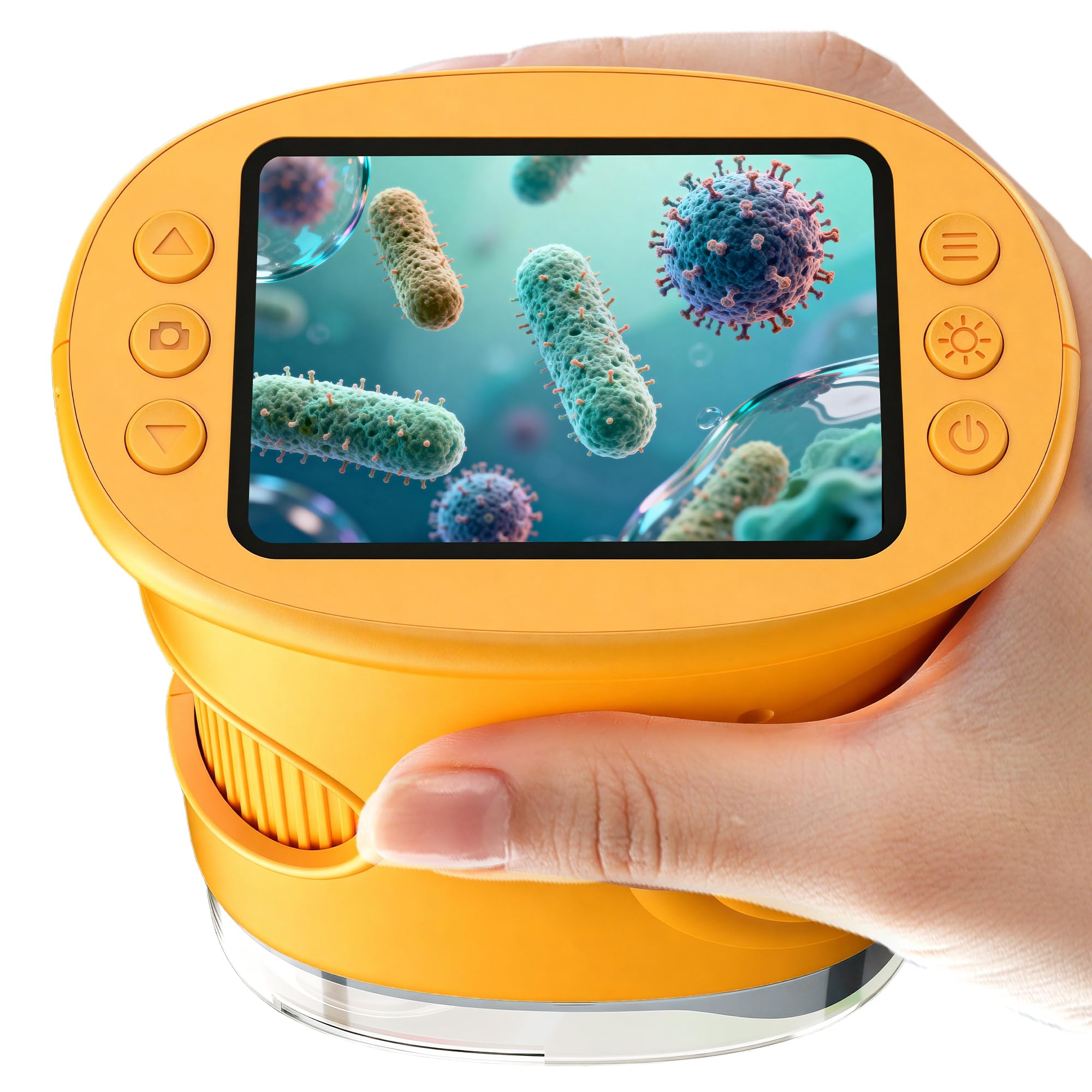
Hand it to a child and watch what happens. The 2-inch screen means there is no eyepiece to line up with a small face, the lanyard means it survives a lap around the yard, and the shutter sits where a thumb expects it. That is a different design brief from every compound scope here, and it is why this one keeps earning its place.

What we like is that it works alone. Photos and video go to 32M of built-in storage, roughly 200 shots, so there is no app, no pairing, and no phone handed to a child just to make the toy function. Eight LEDs across three brightness settings mean it still focuses in a dim room, and the 2MP sensor is plenty for a bug's leg on a small screen.

The 1000X figure is optical plus digital, and the digital half is doing a lot of the work, so the fine detail goes soft at the top of the range. That is fine for what this is: leaves, coins, fabric, insects, and a screen that makes a five-year-old gasp. The ABS body is the right call for something that gets dropped, and it charges over the same USB-C cable as everything else in the house.

Pros

  • 2-inch screen, no phone or eyepiece needed
  • Stores about 200 photos on board
  • 8 LEDs with three brightness settings
  • USB-C cable included

Cons

  • 1000X mixes optical and digital, so detail softens
Our verdict

For a kid who wants to look at everything and show someone, this is the scope that actually gets carried around, with no phone required.

Check Latest Price

How We Tested 14 Microscopes at the Kitchen Table

We started with a shortlist of about 40 scopes pulled from manufacturer spec sheets, retailer listings, and the reviews that mention stiff focus knobs or washed-out images, then cut it down by price, usable magnification range, and whether the thing could feed a phone or a laptop screen. Specs alone eliminate a lot of candidates: a scope that advertises enormous magnification but ships with one fixed lamp and a plastic stage rarely survives the first pass. Fourteen made it to the bench.

Testing ran six months, in the places microscopes actually live — my kitchen table, a friend's classroom, and a run of late nights with a box of prepared slides. We looked at pond water, onion skin, salt crystals, a hair from my own head, and the fibers in a bill, swapping slides back and forth until the novelty wore off and only the annoying scopes were obvious.

For image quality we compared what we saw through the eyepiece against the photos we shot through each phone adapter, watching for color fringing at the edges and whether the center drifted out of focus when we moved the stage. We tested brightness by dialing the lamp down to its lowest setting and checking whether cell walls were still visible, and ran every scope through its full objective range to find where the image stopped being worth looking at. Ease of use got a crude but reliable test: a total beginner and a ten-year-old each set up a scope cold, one reading the manual and one refusing to. We also widened eyepieces to fit different faces and noted which stages crept or held. Value came down to what was in the box — slides, adapters, dust cover, spare bulb — not what was printed on it.

How to Choose a Microscope

Read past the magnification figure

The 2000X and 5000X numbers on these boxes are assembled by stacking an eyepiece multiplier, a 2X lens, or digital zoom on top of the objective. A 40X objective with a 10X eyepiece is 400X, and that is where most home microscopy lives: cells, pond water, onion skin, prepared slides, all resolve between 40X and 400X. Anything past 1000X wants a thinner specimen and more light than a kit provides.

So when two scopes cost roughly the same and one advertises twice the power, look instead at the illumination and whether the stage moves with knobs. Those are what make the difference between a scope that gets used and one that sits on a shelf.

Match the head to how you'll look

Monocular is the cheapest way in and it works, but an hour with one eye pressed to a tube is an hour of squinting. Binocular heads let you keep both eyes open, which matters most on a shared desk where a parent and a student take turns. Trinocular adds a third tube for a camera, so a group can watch on a screen while someone keeps both eyes on the slide.

Assume the camera is extra. Both of the trinocular scopes here give you the port and leave you to supply the eyepiece camera, so budget for it before you commit to that head.

Light and stage decide what you can see

Bottom LED light passes through a slide; top light bounces off opaque things like coins, leaves, and insect wings, and a scope with both is far more useful than one with a single lamp. Look for a brightness control and, on the better models, an iris or Abbe condenser to manage contrast.

The stage matters just as much. A mechanical stage moves the slide with knobs, so you can follow a specimen across the field at 400X instead of nudging it with a fingertip and losing it. Coarse and fine focus as separate knobs are worth paying for; a single knob is a compromise you feel at high power.

What the kit is really worth

Prepared slides get you started in minutes and are the reason a first session goes well. The blank slides that come with budget kits are usually thin plastic that flexes under a coverslip, so add a box of glass slides and coverslips to the same order.

A phone adapter is genuinely useful if it holds alignment, since it turns the scope into something you can share. Dissecting tools and a carry case are conveniences. None of them substitute for a mechanical stage and adequate light.

Optical or digital?

Screen microscopes replace the eyepiece with a sensor. That is easier on the neck, lets a room watch, and makes recording trivial, which is why a screen scope is the right answer for teaching and for anyone documenting what they find.

What a sensor can't do is out-resolve good glass. At the top of its range you are watching a camera's version of the image, so if the goal is real cellular detail rather than a shared picture, buy optics and add a camera later. A cheap handheld is a fine magnifier with a screen and not a biology instrument.

Frequently Asked Questions

Final Verdict

The Swift SW380T is the microscope we point people to when the budget stretches: a rigid metal stand, a mechanical stage, a rotating head, and a trinocular port that turns a solo session into something a room can watch. It is the most money here, and it is the one that behaves like an instrument rather than a kit.

If the budget is tighter, the PalliPartners monocular gets a beginner looking at prepared slides on day one. And if nobody in the house wants to bend to an eyepiece, the TOMLOV's screen is the difference between a scope that gets used and one that collects dust.