Best Integrated Amplifiers of 2026

An integrated amplifier is the simplest good idea in hi-fi: the preamp that handles switching and volume and the power amp that drives your speakers, sharing one chassis and one power supply. One box instead of two, shorter signal paths, less money spent on metalwork and cables. It's the single purchase that turns a pair of passive speakers into a working system.

The catch is that "integrated" now covers everything from a paperback-sized streaming amp to a heavy tube model with its own phono stage, and the right one depends on what you're plugging in — a turntable, a TV, a phone over Bluetooth, or all three. Over the past eight months my team and I have lived with 12 of them, rotating each through a living room with floorstanders, a desk with small bookshelf speakers, and a TV over HDMI ARC. Power ratings are the number everyone compares and the one that tells you least; clean headroom and a quiet phono stage do more for your listening than a bigger figure on the box.

The picks below are the ones we'd buy with our own money, sorted by what they're actually good at.

1

Best Overall

WiiM Amp Ultra

90 /100
LBD Score Outstanding

Key details

Dimensions
7.87 x 8.3 x 3 in
Connectivity
Wi-Fi 6, Bluetooth 5.3, HDMI ARC
Power Output
100W per channel at 8 ohms
Room Correction
RoomFit auto-calibration
View on Amazon

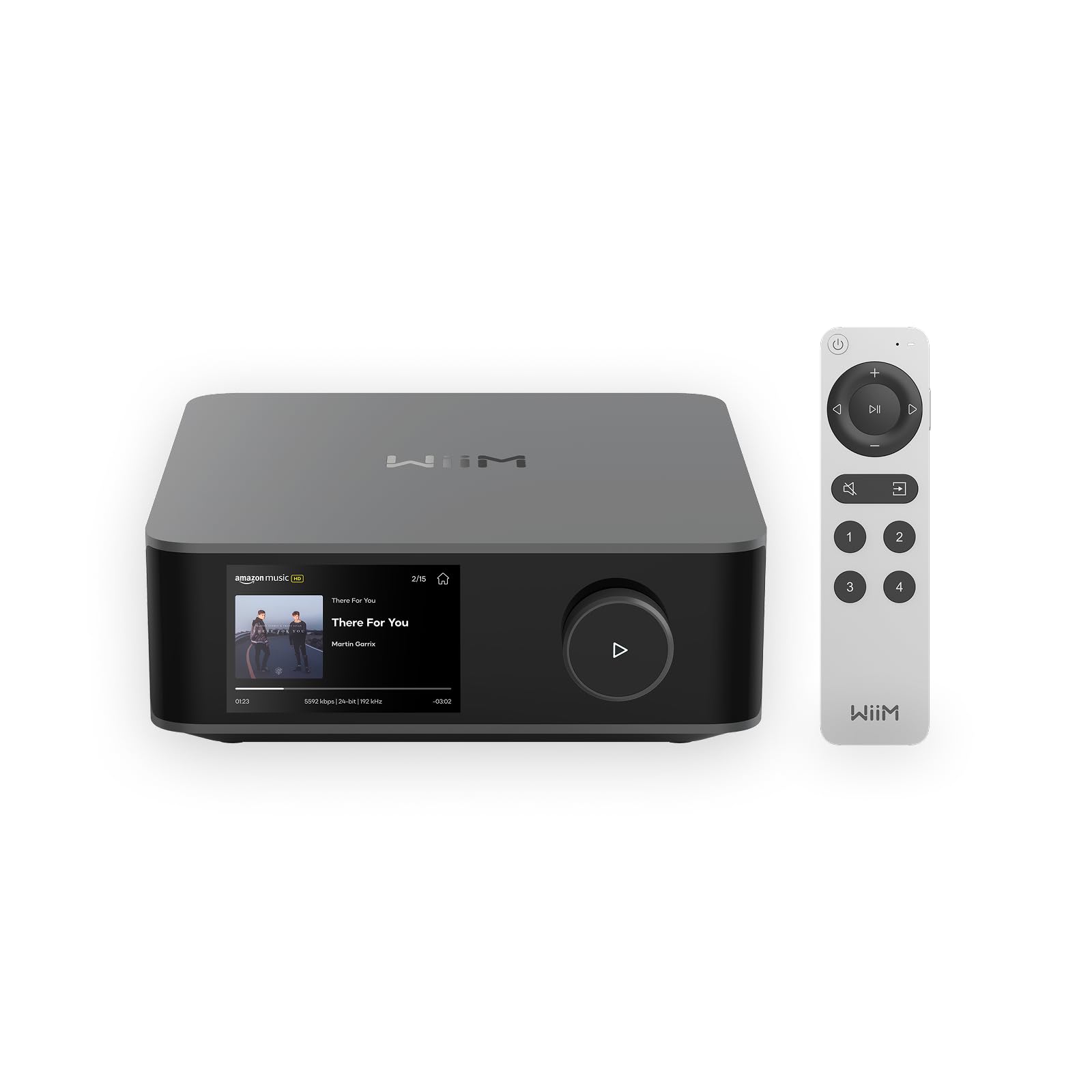
Streamer, DAC, television input, and 100-watt power amplifier: the WiiM Amp Ultra does four jobs in a case the size of a hardback, and that is why it is the integrated amplifier we recommend first. Feed it a pair of passive speakers and it plays from Spotify, from a phone over Bluetooth 5.3, and from the TV over HDMI ARC without another box in the chain. For anyone stepping up from a soundbar, that single-box simplicity is worth more than any one specification on the sheet.

The power rating is the one we trust most. WiiM quotes 100 watts per channel into 8 ohms from a pair of TI TPA3255 chips with post-filter feedback, which keeps the output consistent across different speaker loads — the practical result being that 4-ohm bookshelf speakers don't make it sound thin the way cheaper Class D amps do. The whole unit weighs 5.4 pounds and measures roughly 8 by 8 by 3 inches, small enough to sit beside the speakers instead of in a rack.

RoomFit, the built-in calibration, is what justifies buying a streaming amplifier rather than a plain one. It adjusts the output to your room and speakers, which is the difference between a bass boom in a corner and a system you can listen to all evening without fatigue. The 3.5-inch touchscreen handles volume and input switching without a phone, and the app goes deeper when you want it to.

The gaps are Apple-shaped. There is no AirPlay here, so an iPhone streams through the WiiM app or Bluetooth instead, and in a house full of Apple gear that becomes a daily annoyance rather than a footnote. The supplied remote is the least reliable piece in the box. Neither changes how it sounds, and the app covers most of what the handset misses.

Pros

  • 100W per channel with stable 4-ohm drive
  • HDMI ARC, Wi-Fi 6, and Bluetooth 5.3 together
  • RoomFit room correction built in
  • Compact 5.4-pound aluminum chassis

Cons

  • No AirPlay support
  • Bluetooth remote can lose its connection
Our verdict

The integrated amp we recommend first for most people: 100 watts, HDMI ARC, streaming, and room correction in one small box that makes passive speakers the center of the room.

Check Latest Price
2

Best for Vinyl and Bluetooth

Denon PMA-600NE

90 /100
LBD Score Outstanding

Key details

Inputs
2 optical, 1 coaxial, phono, Bluetooth
Warranty
3 year manufacturer
Power Output
70W x 2 at 4 ohms
Chassis Height
4.76 in
View on Amazon

At 4.76 inches tall and 12.1 inches wide, the Denon PMA-600NE slides into places the full-size amplifiers can't: a media console, a low shelf, the gap under a turntable. That footprint is the first reason to look at it, but not the best one.

The best one is that Denon squeezed a phono stage, a DAC, and Bluetooth into that chassis without making any of them feel like an afterthought. The phono input takes a moving-magnet cartridge directly, the DAC covers two optical and one coaxial source, and Bluetooth handles everything else. Analog Mode shuts the digital circuitry down when you want the shortest path from the turntable to the speakers, and we think that switch earns its place more than another streaming badge on the front panel.

Power is where the money went elsewhere. Denon quotes 70 watts per channel into 4 ohms, which is comfortable for the efficient bookshelf speakers this amp is usually paired with and thin for genuinely hungry floorstanders — if you already own those, one of the 100-watt Yamahas is the safer match. The rest of the ownership case is strong: a subwoofer output for a 2.1 setup, a supplied remote, and a three-year manufacturer warranty.

Pros

  • Phono, two optical, coaxial, and Bluetooth inputs
  • Slim 4.76-inch chassis fits shallow shelves
  • Analog Mode disengages digital circuits
  • Three-year manufacturer warranty

Cons

  • Bluetooth is its only wireless input
Our verdict

The vinyl-and-Bluetooth answer: a real phono stage, a DAC, and a slim chassis, backed by the longest manufacturer warranty in this group.

Check Latest Price
3

Best for High-Res USB Audio

Yamaha A-S801

89 /100
LBD Score Excellent

Key details

Weight
26.7 lb
USB DAC
DSD 5.6 MHz, PCM 384 kHz/32-bit
Power Output
100W + 100W (20 Hz-20 kHz, 0.019% THD)
Digital Inputs
Optical, coaxial
View on Amazon

A USB-B port on the back of an integrated amplifier is still a buying reason, and the A-S801 has the most capable one here: DSD to 5.6 MHz, PCM to 384 kHz/32-bit, and WAV and FLAC alongside. Plug in a laptop or a network player and the Yamaha becomes both the DAC and the amplifier for a desktop or a small listening room.

What we like is how much amplifier comes attached to that port. Yamaha rates it at 100 watts per channel from 20 Hz to 20 kHz at 0.019% THD rather than quoting a peak, and backs it with a custom transformer, a 12,000 µF capacitor bank, and extruded aluminum heat sinks. It weighs 26.7 pounds, and the weight is the argument: this is a conventional, heavy, analog-feeling amplifier that happens to have a modern digital board inside.

The rest is old-school in the best sense — gold-plated coaxial and optical inputs, a phono stage for a turntable, A/B/A+B speaker terminals, and tone controls with a Pure Direct bypass for when you want them out of the circuit. It is a component you keep when the sources around it change twice over, which is not something you can say about most of the boxes on this page.

Pros

  • USB DAC handles DSD 5.6 MHz and PCM 384/32
  • 100W per channel, 20 Hz-20 kHz at 0.019% THD
  • Phono stage and gold-plated digital inputs
  • 26.7-pound chassis with a 12,000 µF capacitor bank

Cons

  • No Bluetooth or network streaming
Our verdict

The best USB DAC in this group bolted to a serious 100-watt amplifier — the pick for a laptop-and-turntable system rather than a phone-first one.

Check Latest Price
4

Best Value Full-Size Amp

Yamaha A-S301

89 /100
LBD Score Excellent

Key details

Weight
19.8 lb
Power Output
60W + 60W (20 Hz-20 kHz, 0.019% THD)
Digital Inputs
Optical, coaxial
Speaker Outputs
A, B, A+B with subwoofer out
View on Amazon

The A-S301 is the entry point of Yamaha's integrated line, and it keeps nearly everything that makes the bigger models work: a phono stage, coaxial and optical digital inputs, A/B/A+B speaker terminals, and a subwoofer output. What it gives up is power — 60 watts per channel instead of 100 — and that is the right thing to give up for most first systems.

Sixty watts goes further than the number suggests. Yamaha rates it across the full 20 Hz to 20 kHz band at 0.019% THD rather than quoting a peak, and in a bedroom, a study, or a living room with efficient floorstanders we never found ourselves near the top of the dial. The 19.8-pound chassis is easier to place than the 26.7-pound A-S801, and the layout is simple enough to have wired up and playing in a few minutes.

The digital side is where it stops: no USB input, no Bluetooth, no network streaming, so a phone or a laptop needs a cable or a small streamer feeding the optical socket. If your sources are a turntable, a CD player, and a television with an optical output, that limitation never comes up — and the money you didn't spend on wireless is money that goes into the part of the system you actually hear.

Pros

  • 60W per channel rated 20 Hz-20 kHz at 0.019% THD
  • Phono stage plus coaxial and optical inputs
  • A/B/A+B terminals and a subwoofer output
  • 19.8-pound chassis, simpler to place than the 100W models

Cons

  • No Bluetooth, USB, or network streaming
Our verdict

The full-size amp we point first-time buyers to: phono, digital inputs, A/B speakers, and 60 honest watts that leave money for the speakers.

Check Latest Price
5

Best Budget Tube Hybrid

Dayton HTA200

89 /100
LBD Score Excellent

Key details

Inputs
Bluetooth 5.0, USB DAC, optical, coaxial, RCA, phono
Outputs
Subwoofer, headphone
Dimensions
15.91 x 15.51 x 9.61 in
Power Output
100W per channel at 4 ohms
View on Amazon

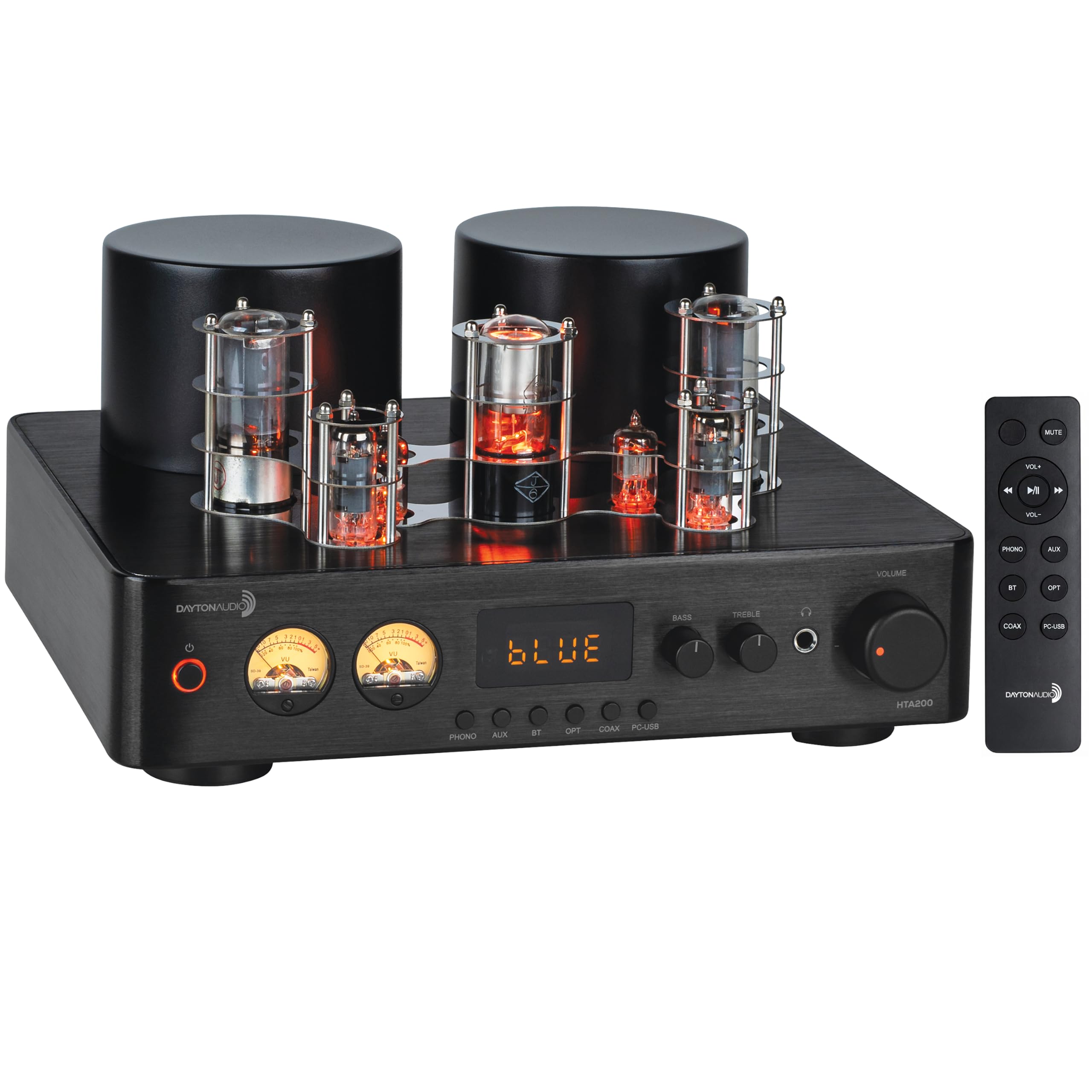
Amber tubes and moving VU meters on the front panel make the HTA200 the one amplifier here that looks worth showing off rather than merely owning. It is also the least expensive route to a complete tube-flavored system: Bluetooth 5.0, a USB DAC, optical, coaxial, RCA, and a phono input, plus a subwoofer output, a headphone jack, and a remote in the box.

The tubes sit in the preamp stage; the output stage is Class A/B, rated at 100 watts per channel RMS into 4 ohms. That hybrid layout is the thing to understand before you buy. You get the warm, slightly rounded midrange people mean when they say tube sound, and enough solid-state grip to drive real floorstanders, but this is not a single-ended triode amplifier and it won't have the midrange bloom of one.

Where it lets itself down is the remote, which is the weakest handset in this group: presses that don't register, inputs that need a second try, and a narrow enough beam that you learn to aim it. It is a strange place to economize on an amp that gets everything else right, and the practical fix is the front panel, which is right there and pleasant to use.

As the center of a small 2.1 system it makes a great deal of sense. The subwoofer output is full-range, so a powered sub fills in the bottom without extra hardware, and the headphone jack means a late-night session doesn't wake the house. It is a first tube amplifier that doesn't ask you to give up a phono stage or a subwoofer output to get the glow.

Pros

  • Tube preamp with 100W Class A/B output at 4 ohms
  • Phono, USB DAC, optical, coaxial, and Bluetooth 5.0
  • Subwoofer output and headphone jack
  • Tubes and VU meters look the part

Cons

  • Remote often misses presses
  • Roughly 10 inches tall with tubes exposed
Our verdict

A complete tube-flavored system in one box — phono, USB DAC, optical, Bluetooth, sub out, and 100 watts — for anyone who wants warmth and VU meters without the tube-amp price.

Check Latest Price
6

System Upgrade Path

Audiolab 6000A

80 /100
LBD Score Excellent

Key details

DAC
ESS 9018K2M
Dimensions
13 x 17.5 x 3.15 in
Power Output
50W x 2 into 8 ohms
Operating Modes
Integrated, preamp, power amp
View on Amazon

Three operating modes are the reason the 6000A exists: it runs as a normal integrated amplifier, as a preamplifier feeding a bigger power amp, or as a power amplifier for a separate preamp or an AV processor. If you expect the system to grow, that means the Audiolab can stay in it — front end now, power later, or the other way around.

Inside is an ESS 9018K2M DAC and a Bluetooth receiver, in a case 3.15 inches tall and shallower than the Yamahas. The presentation is the balanced British one: clean through the midrange, even-handed, and easy to listen to for hours. The casework is a large part of the appeal, and it feels like a more expensive component than the badge suggests.

There are no tone controls, so a bright room or a bass-light shelf stays that way, and only one pair of speakers can be connected — no second zone, no kitchen pair. The 50-watt-per-channel rating into 8 ohms is the lowest of the full-size solid-state amplifiers here, which is fine with efficient speakers in a normal room and not fine with something hungry.

So this is an amplifier to buy for how it sounds and for what it can become, not for the feature list. It suits someone assembling a system in stages who would rather have a clean 50 watts and a genuine upgrade path than a drawer full of inputs — and who can live without bass and treble knobs.

Pros

  • Runs as integrated, preamp, or power amp
  • ESS 9018K2M DAC and Bluetooth onboard
  • Slim 3.15-inch chassis
  • Clean, even-handed presentation

Cons

  • No tone controls
  • Single pair of speakers only
  • 50W into 8 ohms is modest for the money
Our verdict

Buy it for the sound and the three operating modes rather than the feature list — a clean 50-watt integrated that can become a preamp or a power amp later.

Check Latest Price
7

Vinyl on Tubes

MUZISHARE X7

86 /100
LBD Score Excellent

Key details

Modes
Triode and ultralinear
Tubes
KT88 x 4, 12AX7, 12AU7
Inputs
MM phono, balanced XLR, preamp input
Power Output
45W maximum
View on Amazon

Two switches on the front, triode and ultralinear, change the character of the X7 more than any tone control could. Triode is sweeter and more intimate, the setting for voices and acoustic music; ultralinear opens up and adds grip for rock and larger-scale pieces. Choosing that per record rather than per purchase is the reason to own a tube amplifier instead of admiring one.

Around those switches is serious construction: four KT88s in push-pull, 12AX7 and 12AU7 driver valves, hand-wired point-to-point assembly, Japanese EI output transformers, and a Z11 toroidal power transformer. It is rated at 45 watts maximum — push-pull tube watts, which are a different currency from the 100-watt solid-state numbers elsewhere in this group.

It is also the most complete analog amplifier here: an MM phono stage, balanced XLR inputs, a preamp input that lets it work as a power amp, and a headphone output. For a vinyl-first listener with efficient speakers, it turns a stereo into a ritual — and the point-to-point wiring is the sort of construction you notice every time you look at the back of it.

Plan the space before you order. It measures 16.14 inches wide, 13.19 deep, and 7.8 tall, with the valves exposed on top, so it wants open air above it and nothing combustible alongside; a closed cabinet is the wrong home. Treat the tube set as a running cost the way you would treat a stylus, and the rest of the ownership experience is refreshingly simple.

Pros

  • Switchable triode and ultralinear modes
  • MM phono, balanced XLR, and headphone output
  • Hand-wired point-to-point build with KT88 outputs
  • 45W push-pull drives efficient speakers

Cons

  • Tubes are consumables needing bias checks
  • 45W maximum suits efficient speakers
Our verdict

A hand-wired KT88 amplifier with switchable triode and ultralinear modes for vinyl-first systems — buy it for the sound and the build, and accept the tube upkeep.

Check Latest Price
8

Patio and Desk

Fosi BT20A Pro

90 /100
LBD Score Outstanding

Key details

Weight
1.25 lb
Bluetooth
5.0
Power Supply
32V/5A
Amplifier Chip
TI TPA3255
View on Amazon

It weighs 567 grams and fits in a palm, and that is the entire proposition. The BT20A Pro is for the patio, the garage, the workshop, or a desk where a 17-inch amplifier is never going to live. Wire a pair of outdoor speakers to the terminals, pair a phone over Bluetooth 5.0, and you have a working system before the coffee finishes brewing.

The chip is a TI TPA3255 with a feedback design, the same family used in amplifiers costing many times more, and Fosi runs it from a 32V/5A supply. That supply is the honest number: the 300-watts-per-channel headline is the chip's ceiling, not something a 32-volt brick sustains into real speakers. Treat this as a small-room and outdoor amplifier rather than a party amplifier. The bass and treble controls matter more than usual outside, where bass disappears.

Tinkerers get replaceable op-amps — the two NE5532s can be swapped for something warmer — and a pairing memory that reconnects without fuss. The behaviour to know about is that Bluetooth takes priority over the wired input, so a phone connecting from inside the house can interrupt whatever is playing on the patio. Annoying next to a television, less so next to a grill.

As a second or third system, or a first one where space and budget are the real constraints, it is the sensible buy — modest enough to put one in the garage and another on the deck. It is not the amplifier for a listening chair and a pair of serious speakers, and it does not pretend to be.

Pros

  • Palm-sized 567-gram case
  • Bluetooth 5.0 with long pairing memory
  • TI TPA3255 chip with bass and treble controls
  • Replaceable op-amps for tuning

Cons

  • 300W claim is a chip ceiling, not real output
  • Bluetooth overrides the wired input
Our verdict

A palm-sized amplifier for the patio, garage, or desk — buy it as a second system, not as the heart of a listening room.

Check Latest Price

How We Tested a Dozen Integrated Amps

We started with about 40 amplifiers pulled from spec sheets, owner reviews, and reader questions, then cut the list to 12. The filters were unglamorous: the inputs people actually use — a phono stage, an optical or USB DAC, Bluetooth, HDMI ARC on the streaming models — whether it would drive real speakers instead of a test resistor, and whether the price made sense for what's in the box. We mixed formats on purpose, including a mini Class D amp, a hybrid tube design, a streaming-first unit, and several traditional analog integrateds.

Each amp spent at least two weeks in a living room system with floorstanding speakers, fed by a turntable, a streamer, and a CD player, then moved to a desk with small bookshelf speakers for nearfield listening. Where there was an HDMI ARC input, it ran the TV for a week of movies and late-night shows, and we listened for whether dialogue held up at low volume. The same handful of tracks played on every unit — dense orchestral passages, bass-heavy electronic, close-miked vocals, a scratchy LP — and we noted which ones turned bright, muddy, or ran out of steam when pushed.

Controls and connectivity got separate passes: volume knobs turned without looking, the level nudged one click at a time at night to check whether the steps were coarse, and every remote used from across the room and in the dark to see whether one tap moved the volume one notch or five. Bluetooth meant carrying a phone into the next room, listening for dropouts and watching for lag against video. Durability came down to long weekend sessions — a hand on the casework after four hours, an ear to the tweeter with nothing playing to catch transformer hum — plus a look at whether the binding posts would survive a decade of cable swaps.

How to Choose an Integrated Amplifier

Match the Power to Your Speakers, Not the Spec Sheet

Watts tell you less than the load they are delivered into. An amp quoted at 100 watts into 8 ohms and one quoted at 70 into 4 ohms are closer than the numbers suggest, because a 4-ohm speaker draws more current for the same output voltage. What matters more is how the figure is quoted: the Yamaha A-S301 and A-S801 both specify theirs across the full 20 Hz to 20 kHz band at 0.019% THD rather than as a peak.

For efficient bookshelf speakers in a normal room, 50 to 60 honest watts is enough and the rest is headroom. Low-sensitivity floorstanders want the 100-watt models. Before you buy, check your speakers' nominal impedance — an amplifier without a 4-ohm rating is the wrong partner for a 4-ohm load played loud.

Count Your Sources Before You Count Features

Every input you don't have is another box and another cable. A turntable without a built-in phono stage needs an amplifier with a phono input, which in this group means the Denon PMA-600NE, both Yamahas, the Dayton HTA200, and the Muzishare X7. A television is easiest over HDMI ARC, or optical if the amp has no ARC. A laptop is best served by USB, which here points to the Yamaha A-S801.

The common mistake is assuming Bluetooth covers a television. It doesn't: the delay between lip movement and dialogue is visible, and no amount of fiddling fixes it. Use Bluetooth for music from a phone and keep the TV on a wired digital connection.

Decide Whether Streaming Should Live Inside the Amp

Built-in streaming buys convenience and, increasingly, room correction. The WiiM Amp Ultra is the clearest case — Wi-Fi 6, Bluetooth 5.3, HDMI ARC, and RoomFit calibration inside one 5.4-pound case, which is more than a separate streamer and DAC would give you in one place.

The catch is that streaming ages faster than amplification. An amp with a fixed streaming module is a different kind of purchase from a plain amp you can feed from anything, so think about which half of the system you expect to replace first.

Plan for Size, Heat, and Ventilation

Amplifier designs have different housing needs. The big Class A/B units, including the 26.7-pound Yamaha A-S801, want shelf depth behind them and open air above the heat sinks. Slim models such as the 4.76-inch Denon PMA-600NE fit consoles the full-size amps simply can't. Compact Class D and streaming amps usually run cooler, but their cases still warm up in use and need breathing room.

Tube amplifiers are their own category. Exposed valves get hot enough to mark a shelf and need open space above them, not a closed cabinet. Measure the space before you order, not after.

Weigh Tone Controls, Remotes, and Upkeep

Tone controls are a tool, not a compromise: they rescue a bright room or a bass-light shelf, and both Yamahas add a Pure Direct bypass for when you want them out of the circuit entirely. The Audiolab 6000A omits them as a deliberate purist choice, so decide whether you would miss the adjustment.

Then look at the parts that age. The remote is the most common letdown in this group, from fussy handsets to Bluetooth ones that lose their connection. And if you are drawn to tubes, budget for valves and bias checks the way you would budget for a turntable stylus — it is part of owning one.

Frequently Asked Questions

Final Verdict

The WiiM Amp Ultra is the integrated amplifier we recommend to most people. It delivers 100 watts per channel, takes the television over HDMI ARC, streams over Wi-Fi, and corrects for your room — all in a case small enough to disappear on a shelf beside the speakers. If your sources are digital and you want one box, this is the one.

Two requirements change the answer. If a turntable is central to how you listen, the Denon PMA-600NE's phono stage, slim chassis, and three-year warranty make it the better fit. If you want a heavy analog amplifier with the most capable USB DAC in this group, the Yamaha A-S801 is worth the step up.