Best Generator Transfer Switches of 2026

A transfer switch is the safe middleman between a portable generator and your home's wiring: it lets you run selected circuits without backfeeding the grid. The first time a three-day outage left our fridge warm and the sump pump dead, I learned that the shortcut—a suicide cord into a dryer outlet—isn't a shortcut at all. Over the past eight months, we've installed and lived with 12 transfer switches, and the differences come down to whether the thing makes a tense job feel straightforward.

Sizing matters more than brand: a 30-amp switch can carry a furnace, fridge, and a few lights, while a 60-amp panel only makes sense with a bigger generator and more circuits. The real differences are whether the kit arrives prewired, includes an inlet box and hardware, and is rated for indoor or outdoor mounting. We read the instructions like a first-timer, checked how the breakers threw and how the enclosures felt, and compared price against circuit count and what came in the box. The picks below are the ones that got those details right.

1

Best Overall

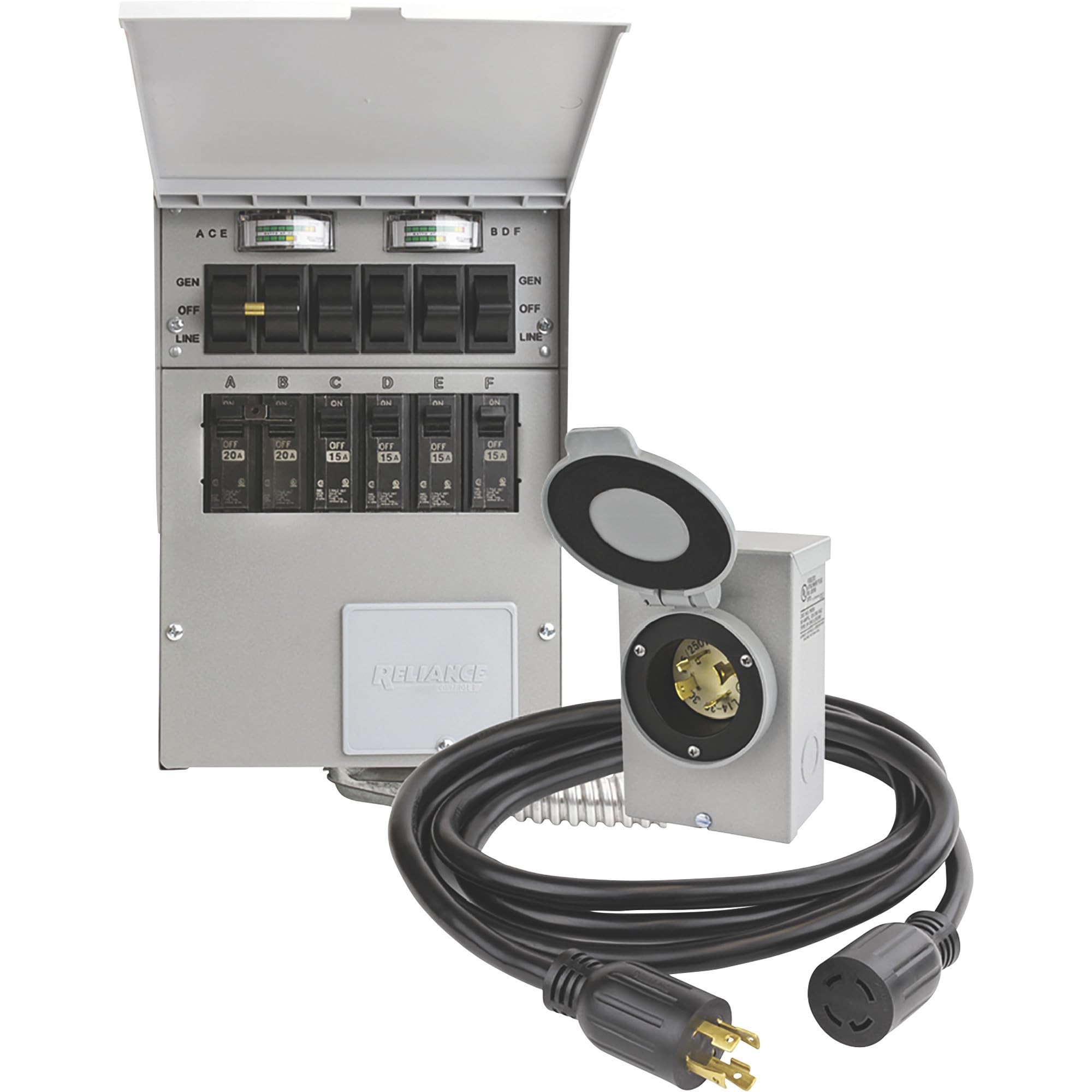
Reliance Controls 306CRK

89 /100
LBD Score Excellent

Key details

Circuits
6
Safety Listing
UL, cUL
Generator Input
30 A
Generator Output
7,500 W
View on Amazon

Six pre-wired circuits, 120/240-volt capability, a 7,500-watt ceiling, and a UL/cUL listing in one box—that is the combination we want for a typical 30-amp portable generator. The 306CRK is our top pick because it turns a panel project into a predictable parts list instead of a scavenger hunt.

Six positions are the useful part. They let you keep a furnace, refrigerator, some lights, and a couple of outlets live, or trade two spaces for one 240-volt circuit. The 7,500-watt ceiling is enough for a modest portable generator, and the pre-wired panel mounts beside the load center instead of asking you to build a subpanel from parts.

Installation still belongs with an electrician, but the kit is built for it: the panel is pre-wired, the included inlet and cord shorten the parts chase, and the UL/cUL listing is the paperwork an inspector wants to see. The detail to check is the branch rating: the circuit switches are 20-amp devices, so the 30-amp generator feed does not make every circuit a 30-amp circuit. Match the wire and breaker to the load, not to the inlet.

Pros

  • Complete pre-wired six-circuit kit
  • 120/240V support up to 7,500W
  • UL and cUL listed
  • Mounts beside the load center

Cons

  • Premium price for a 30-amp kit
Our verdict

We recommend the 306CRK as the default for a 30-amp portable generator because its six pre-wired circuits, 240-volt support, and UL/cUL listing cover a real outage without a parts scramble.

Check Latest Price
2

Best for Larger Homes

Generac HomeLink 50A

85 /100
LBD Score Excellent

Key details

Wattage
11 kW
Circuits
8-16
Enclosure
Indoor NEMA 1
Amperage / Voltage
50 A / 120-240 V
View on Amazon

Fifty amps and 120/240 volts put the HomeLink in a different class from the six-circuit kits. With 11 kW, it can carry a well pump, a furnace, and a run of ordinary circuits—provided your generator has the matching 50-amp outlet and your panel has room for the larger enclosure.

The mechanical interlock is the feature that sold us: the utility and generator contacts cannot close at the same time, so the switch does the backfeed protection as a physical action rather than a procedure you have to remember. We also like the split location—the transfer panel is indoor-rated, while the included inlet box is NEMA 3R outdoor-rated—so the switching gear stays inside and the connection point goes where the cord reaches.

The 8-16 circuit range gives you room to grow, and the panel accepts common Siemens, Eaton, and Square D one-inch breakers, which makes it easier to match what is already in the house. It is a bigger panel than the six-circuit kits—15.4 by 15.8 by 4 inches and 26 pounds—so measure the wall beside the load center before you commit. This is the one to choose when the load list has grown past a six-circuit kit.

Pros

  • 50A, 120/240V capacity for larger loads
  • Mechanical interlock prevents backfeed
  • Indoor panel with outdoor inlet
  • Accepts common 1-inch breakers

Cons

  • Premium price for a portable-generator kit
Our verdict

We reach for the HomeLink when a 240-volt well pump or a larger circuit count is part of the plan; it is the most capable multi-circuit kit here, at a premium.

Check Latest Price
3

Best Budget Six-Circuit Kit

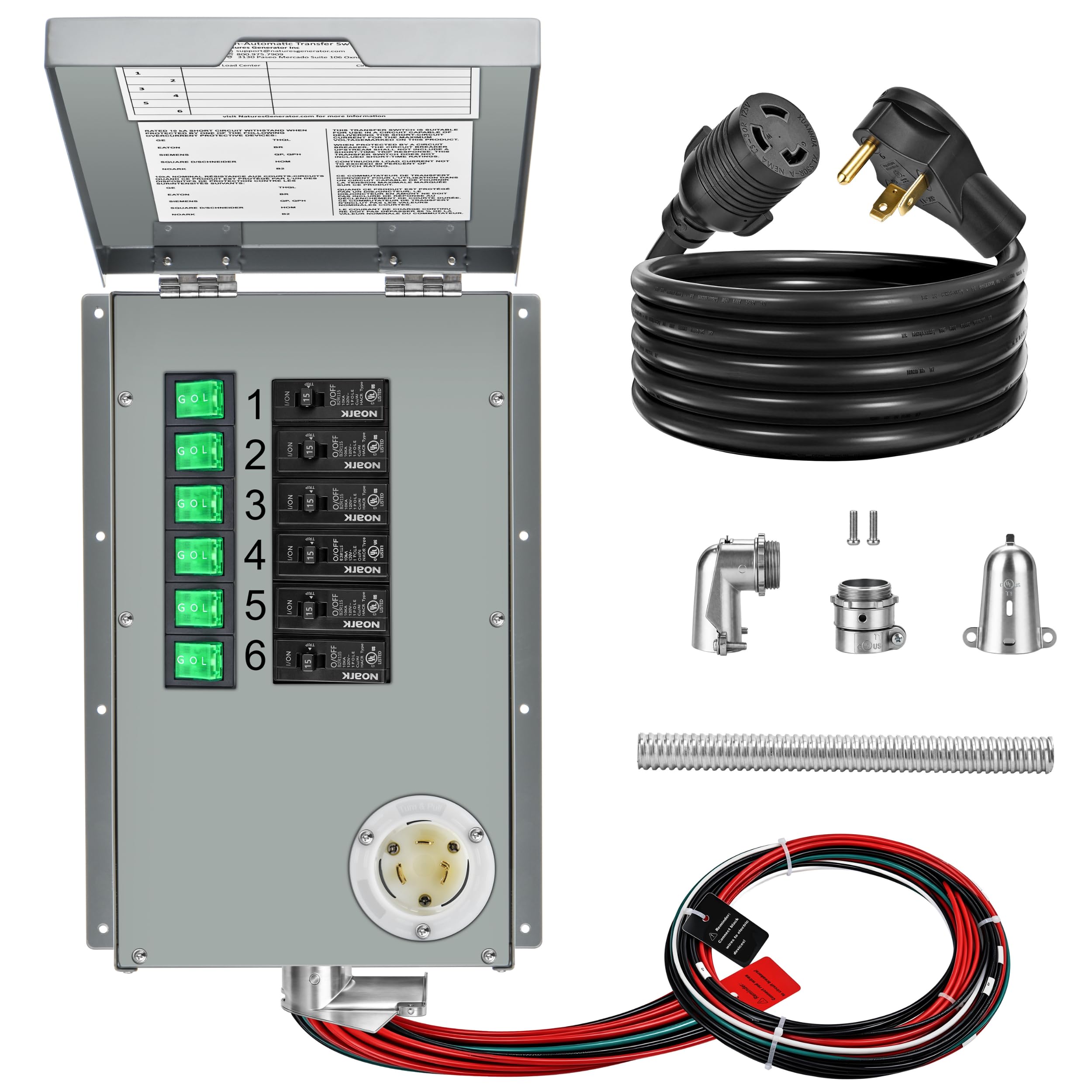
Nature's Generator 30A

87 /100
LBD Score Excellent

Key details

Wattage
3,600 W
Circuits
6
Safety Listing
UL listed
Amperage / Voltage
30 A / 120 V
View on Amazon

A complete six-circuit kit with an inlet, a cord, and a UL listing—that is the value case for the Nature's Generator switch. If your generator is a 120-volt unit, this is the kit that gets a furnace, refrigerator, lights, and a few outlets back on without pushing you into a 240-volt panel.

Having the inlet and cord in the box matters more than it sounds. That is one less trip to match a generator plug to a switch, and the pre-wired panel removes another set of decisions. The six circuits are enough for a focused outage plan, and the illuminated rocker switches make it obvious which circuits are on generator power.

The ceiling is 3,600 watts at 120 volts, so this is not the kit for a well pump, a dryer, or a 240-volt furnace. It shines with a smaller inverter generator and a short list of essentials. We also appreciate that the enclosure is pre-wired and the inlet is included, because the installation is less about assembly and more about getting the inlet and panel connections right.

Pros

  • Complete six-circuit kit with inlet and cord
  • UL listed
  • 30A, 3,600W for 120V essentials
  • Illuminated rocker switches

Cons

  • 120V only; no 240V loads
Our verdict

We like the Nature's Generator kit for a 120-volt portable generator: it is a complete, UL-listed six-circuit package, provided you do not need 240-volt loads.

Check Latest Price
4

Best for One Critical Circuit

EZ Generator Switch

92 /100
LBD Score Outstanding

Key details

Wattage
1,800 W
Circuits
1
Safety Listing
UL / CSA / ETL
Amperage / Voltage
20 A / 120 V
View on Amazon

One breaker, one essential load, one small switch: that is the job the EZ Generator Switch is built for. At 20 amps and 120 volts, it is not a panel replacement, but it is the simplest way to keep a furnace, sump pump, fridge, or a few lights alive, and that is why it stays in this guide.

Bonded or floating neutrals are handled here, which is the detail that trips up inverter owners. The plug-in rocker and screw terminals are straightforward, and the UL, CSA, and ETL approvals give it a stronger safety paper trail than most single-circuit switches. The 1,800-watt ceiling tells you the load class: a furnace blower, a refrigerator, or a sump pump, not a 240-volt well pump.

The install videos are the real instructions here; the paper documentation can be thin, so plan on watching the wiring sequence before you open the panel. We also appreciate the small 4-inch cube and 1-pound weight, which make it easy to tuck beside a panel or in a tight utility space. The small footprint is the part we keep coming back to when a panel is already crowded.

Pros

  • Keeps one 120V circuit powered
  • UL, CSA, and ETL approved
  • Works with bonded or floating neutrals
  • Compact 4-inch cube, 1-pound weight

Cons

  • One 120V circuit only
Our verdict

We keep the EZ switch in the conversation for one critical 120-volt circuit; it is simple, listed, and compact, but it cannot carry a panel or a 240-volt load.

Check Latest Price
5

Best for a Heavy 240V Load

Generac 6333 60A

79 /100
LBD Score Very Good

Key details

Loads
Single load or subpanel
Wattage
15,000 W
Generator Range
3,000-25,000 W
Amperage / Voltage
60 A / 250 V
View on Amazon

A dedicated 60-amp double-pole switch is a different tool from a circuit-by-circuit panel. The 6333 is for one load or a subpanel, which makes it the right choice when a well pump, shop subpanel, or other 240-volt load needs a dedicated transfer point without rebuilding the whole emergency panel.

The generator range is broad: the switch is compatible with portable generators from 3,000 to 25,000 watts, so it does not lock you into one size of machine. The double-pole switching isolates both legs, which is what you want on a 240-volt load, and the indoor enclosure can be flush- or surface-mounted. The 15,000-watt rating gives it more headroom than the 30-amp kits here.

Installation is where we slow down. The wiring is straightforward for an electrician, but the job can grow if the existing circuit has to be rerouted. The switch is a dedicated single-load device, so the planning happens before the panel cover comes off.

Pros

  • 60A, 15,000W single-load capacity
  • Works with 3,000-25,000W generators
  • Double-pole switching isolates both legs
  • Indoor flush or surface mount

Cons

  • No extra branch-circuit spaces
Our verdict

We choose the Generac 6333 when a single 240-volt load needs a dedicated 60-amp switch.

Check Latest Price
6

Weather-Ready Kit

VEVOR 50A 10-Circuit

85 /100
LBD Score Excellent

Key details

Circuits
10
Enclosure
NEMA 3R
Generator Output
Up to 12,500 W
Amperage / Voltage
50 A / 240 V
View on Amazon

Outdoor mounting changes the shopping list, and the VEVOR kit answers it with a NEMA 3R enclosure and a CS6375 inlet with a protective lid. Add the pre-wired 50-amp, 10-circuit panel, and you have a kit that covers a larger portable generator and a weather-exposed wall without sourcing the inlet separately.

The 10 circuits are the draw. Six-circuit kits cover a fridge and a furnace; this one gives you room for a few more outlets, a garage circuit, or a basement freezer. The double-throw switch is mechanical, and the analog watt meter is a useful touch during an outage—you can see the load without adding a digital gadget to the wall.

We also appreciate that the wiring is pre-labeled. It shortens the install and makes the panel easier to trace later, which matters when the cover goes back on and you are working from memory. The enclosure is built for rain and snow, and the inlet lid is a small detail that keeps the contacts dry when the generator is not plugged in.

The capacity and weather protection are the reasons to look at this kit. It is a lot of switch for the money, and the 10 circuits give you room that the six-circuit kits cannot match. If your load list has outgrown a basic panel, this is the value alternative to the premium 50-amp kits.

Pros

  • 50A, 10-circuit capacity
  • NEMA 3R outdoor enclosure
  • CS6375 inlet with protective lid included
  • Pre-wired with labeled wiring

Cons

  • No UL/ETL mark stated; verify approval
Our verdict

We see the VEVOR kit as the weather-ready value choice for a 50-amp generator, with 10 circuits and an included inlet for a larger outage plan.

Check Latest Price
7

Small 120V Loads

BOYISEN 15A

88 /100
LBD Score Excellent

Key details

Inlet
NEMA 5-15P
Circuits
1
Safety Listing
ETL listed
Amperage / Voltage
15 A / 125 V
View on Amazon

A transfer switch and inlet in one small enclosure is the appeal of the BOYISEN. It handles a 15-amp, 125-volt circuit, includes a pre-wired breaker, and adds an LED that tells you generator power is live. It is the kind of kit you use when the outage plan is one refrigerator, one furnace, or a few lights on a single circuit.

Compactness is the point. The box is 3.93 by 2.75 by 5.51 inches and 2.2 pounds, so it fits in tight spots where a panel-mounted switch is overkill. The ETL listing to UL 498 and 514A is the reassuring part, and the weatherproof NEMA 5-15P inlet means you are not adding a separate inlet box. The LED is a small convenience, but it saves a trip back to the generator to confirm power.

Wiring is straightforward once you identify line, load, and neutral, but the documentation is not the strong suit; plan on using the diagram and a tester. For the narrow job it is built for, the compact enclosure is the reason to choose it over the EZ switch.

Pros

  • ETL listed to UL 498 and 514A
  • Built-in 15A breaker and LED indicator
  • Compact inlet-and-switch enclosure
  • Weatherproof NEMA 5-15P inlet

Cons

  • 15A, 125V only; no 240V loads
Our verdict

The BOYISEN is our pick for one small 120-volt circuit when you want the inlet, breaker, and switch in a single compact, ETL-listed box.

Check Latest Price

How We Tested Generator Transfer Switches

We started by researching the category: amp ratings from 15 to 60, circuit counts from two to sixteen, indoor and outdoor enclosures, prewired kits, and models that bundled an inlet box. We ruled out anything without a recognized safety listing or with vague installation instructions in the product description, then narrowed the field to 12 units.

Over eight months, we installed each switch in a utility room or garage, working alongside a licensed electrician. We timed the rough-in and trim-out, counted how often we had to stop and consult the instructions, and checked whether the hardware in the box—wire nuts, labels, screws, inlet box—matched what the job required. During storm-season dry runs, we connected portable generators and switched selected loads on and off, watching for breakers that felt vague, terminals that warmed up, and lights that flickered.

Build quality showed up in the feel of the enclosure and the action of the breakers—flimsy doors, sharp edges, and breakers that felt mushy were marks against. Design showed up in the layout and labeling: could we fit the wires without cursing, and did the circuit labels line up with the panel? We compared price against circuit count and included parts to judge value, because a cheaper kit that needs a separate inlet box and extra hardware isn't actually cheaper.

How to Choose a Generator Transfer Switch

Start With the Generator Outlet

The first number to check is not the switch's amperage—it is the shape of your generator's outlet. A 30-amp 120-volt L5-30P outlet calls for a different kit than a 30-amp 120/240-volt L14-30 or a 50-amp CS6375. An adapter can make a cord fit, but it cannot turn a 120-volt generator into a 240-volt source.

This is why two 30-amp kits here are not interchangeable: the Nature's Generator kit is 120-volt only, while the Reliance 306CRK is a 120/240-volt panel. Read the generator's outlet label and the switch's inlet label together, then match the cord and inlet. If the labels do not match, stop before you buy.

Choose the Right Scope: One Circuit, a Panel, or a Service Switch

A single-circuit switch is the smallest useful tool: the EZ switch keeps a furnace or sump pump alive, and the BOYISEN adds an inlet and breaker in one box. A multi-circuit panel is the better fit for a normal outage plan, because it lets you choose six, 10, or 16 circuits and switch them individually.

A 100- or 200-amp double-throw switch is a different animal: it transfers a whole service or subpanel, not a list of branch circuits. Do not buy a big service switch because it looks like more capacity for the money; it does not give you branch-circuit breakers. For most portable-generator owners, a six- or 10-circuit panel is the sweet spot.

Match Amperage and Wattage to the Load

Amperage and wattage are two views of the same ceiling. A 30-amp 120-volt kit tops out around 3,600 watts; a 30-amp 120/240-volt kit can reach about 7,200 watts; a 50-amp 240-volt kit is in the 12,000-watt class. The switch's rating is a maximum, not a promise that every circuit can run at once.

Add up the running watts of the essentials, then leave room for motor starting—furnace blowers, well pumps, and refrigerators draw a surge. The Generac 6333 is the dedicated option when one 240-volt load needs its own 60-amp switch; the 50-amp kits are better when you want a spread of circuits. Match the generator's continuous output to the switch, not just its peak.

Treat the Listing and Enclosure as Part of the Product

A transfer switch is safety equipment. Look for a recognized listing such as UL, ETL, or CSA, and match the enclosure to the location: NEMA 1 for indoors, NEMA 3R for a weather-exposed wall. An outdoor box is not a substitute for a listing, and a listing is not a substitute for the right enclosure.

We prefer to pay for a listed switch rather than save on an unknown, because the inspector will ask for the mark and the insurance question is not worth the gamble. If the product does not name a recognized mark, treat that as a pre-purchase question for your electrician, not a detail to discover at inspection. The Reliance, Nature's Generator, EZ, and BOYISEN picks all state a recognized listing.

Plan the Installation and the Parts List

A pre-wired kit saves time, but it does not remove the panel work. Check whether the box includes the inlet, the cord, the breaker, and the conduit fittings; the Reliance and Nature's Generator kits are complete packages, while the Generac HomeLink includes the inlet but needs a compatible 50-amp generator outlet.

Breaker compatibility matters too: the HomeLink accepts common Siemens, Eaton, and Square D one-inch breakers, which helps if your panel is already one of those brands. Before you buy, write the parts list—switch, inlet, cord, wire, breaker, conduit—and confirm the wire gauge and torque specs with the installation instructions. The instructions can be thin; the installation videos are often the better guide.

Frequently Asked Questions

Final Verdict

For most homes with a 30-amp portable generator, we recommend the Reliance Controls 306CRK. It is the most complete listed six-circuit kit here, and its 120/240-volt capability covers a furnace, refrigerator, lights, and one 240-volt load without turning the install into a parts chase.

If your generator is 120-volt only, the Nature's Generator kit is the better fit. If a well pump and a longer circuit list are part of the plan, the Generac HomeLink is the step up. The EZ switch remains the simple answer for one critical circuit.