Best Forehead Thermometers of 2026

The worst thing a forehead thermometer can do is lie to you at 2 a.m. A reading that runs half a degree hot sends you reaching for the fever reducer; one that runs cold lets you put a genuinely sick kid back to bed. So the question I ask of every model is simple: does it hand me a number I trust, on a wriggling toddler, in about a second, without a fight?

My team and I have spent the past six months living with 14 of them, using each one on adults, kids, and a couple of very patient babies. The differences rarely live in the sensor spec — they show up on the third night of a fever, when you're squinting at a display without your glasses, hoping the beep doesn't wake the baby and that your thumb finds the right button on the first try.

The features that actually matter turn out to be the quiet ones: a mute setting, a color-coded fever alarm, memory recall long enough to show whether a temperature is climbing or breaking, an object mode that doubles as a bathwater check, and batteries that don't quit mid-illness. Everything below earned its spot on those terms.

1

Best Overall

Goodbaby No-Touch FC-IR202

91 /100
LBD Score Outstanding

Key details

Memory
35 readings
Weight
2.36 oz
Batteries
2 AAA (included)
Response Time
1 second
View on Amazon

Two buttons, a color screen, and nothing to set up — that is the whole pitch, and it is why this is the thermometer we reach for first. A forehead scan has to work at 2 a.m., in the dark, with one hand, on a child who is half asleep, and every extra step is another chance to fumble it. A screen that turns green, yellow, or red does more for that than any menu, and this one does it without a single setting to change.

The reading lands in about a second, fast enough that a wriggling kid does not have time to object, and the number stays on the display long enough to read without leaning in. What we appreciated more over several days was the 35-reading memory: at three or four checks a day that covers a multi-day fever without writing anything on the back of an envelope, and you can read the sequence out to a nurse over the phone. The silent mode does the same job for the beep — scan a sleeping child, read the color, walk out.

Two AAA cells and a drawstring pouch come in the box, which not every unit here manages, and the object mode will read a bath, a bottle, or the room. At 2.36 ounces and about six inches long it disappears into a kitchen drawer, which is where we want a thermometer to live: close enough to grab without a search.

One habit worth adopting while the box is still open: drop a spare pair of AAA cells into the pouch. The worst version of a sick night is a thermometer that lights up, flashes, and dies.

Pros

  • One button and a color screen readable in the dark
  • 35 stored readings cover a multi-day fever
  • Cells and a carry pouch included
  • Object mode reads a bath or a bottle

Cons

  • Readings can drift from a core thermometer
Our verdict

The one we recommend to most households: one button, a color screen we can read at a glance, and 35 stored readings — as long as you treat the number as a trend, not a lab value.

Check Latest Price
2

Best Budget

ANMEATE Non-Contact Forehead

91 /100
LBD Score Outstanding

Key details

Memory
35 readings
Weight
2.36 oz
Response Time
1 second
Temperature Range
89.6 to 109.2 °F
View on Amazon

This is the least expensive thermometer in the group, and it is not a stripped-down version of the idea: one second per reading, a green-yellow-red backlight, 35 stored readings, and a °F/°C switch. The savings show up around the edges rather than in the measurement. There is no pouch in the box, the body is plain, and the whole thing weighs under 70 grams, which makes it feel like a spare rather than an heirloom.

A spare is exactly how we treat it: one in the car, one in a diaper bag, one in the drawer at a grandparent's house, so nobody is hunting for the good thermometer while a child is burning up. Readings drift the way they do on every non-contact unit here; hold the same distance from the same patch of forehead and it settles into a number you can follow. For the money, that is the whole argument.

Pros

  • Cheapest here without losing the core features
  • 35-reading memory and three-color fever screen
  • Batteries included and ready out of the box

Cons

  • No carry pouch in the box
Our verdict

We keep one in a bag as the spare: a second per reading, 35 stored readings, and a color-coded fever screen, with no pouch in the box.

Check Latest Price
3

Best Ear-And-Forehead

GoodBaby Ear & Forehead FC-IR100

88 /100
LBD Score Excellent

Key details

Memory
35 readings
Weight
2.33 oz
Response Time
1 second
Measurement Sites
Forehead and ear
View on Amazon

The ear probe is the reason this one exists. Forehead scanning is fast, hands-off, and the reading most likely to look strange after a child has been lying on one side of their face or has just come in from the cold, so an ear mode gives you somewhere else to look without hunting for a second device. Both modes read in about a second and both feed the same 35-reading memory.

We prefer this one for the recheck rather than the first pass. The forehead is what you do at 3 a.m. without moving anyone; the ear is what you do when the color on the screen does not match how the child looks, and the gap between the two numbers tells you more than either one alone. The display is large, the three-color backlight carries over from the rest of the family, and the mute mode means the second reading does not wake anybody up.

The trade is that ear readings need a still head and a probe actually seated in the canal, which some small children fight harder than a forehead scan. It is also one of the bulkier bodies here at 66 grams and just over six inches, so it takes a little more drawer. For a household with one child who hates being scanned, that is a fair exchange; for two adults and no children, the second mode is money you do not need to spend.

Pros

  • Forehead and ear readings in one device
  • One 35-reading memory shared by both modes
  • Mute mode and a large three-color display

Cons

  • Ear mode needs a still head and a seated probe
Our verdict

A second measurement site in the same device: we recommend it for households where a forehead reading often looks off and a child will not sit still for another one.

Check Latest Price
4

Best for Tracking a Fever

hetaida HTD8813

93 /100
LBD Score Outstanding

Key details

Memory
50 readings
Weight
5.28 oz
Response Time
1 second
Temperature Range
93 to 109 °F
View on Amazon

Fifty readings sounds like a strange thing to get excited about until you have spent three nights writing temperatures on the back of an envelope. This thermometer holds the whole sequence, and you can scroll back through it while a nurse asks what the numbers have done since Tuesday. At three checks a day for two children, the memory takes about a week to fill.

The rest of the design is quietly sensible. The digits are big, the backlight comes on with the same button that takes the reading, and the body is heavier than the featherweights here at 5.28 ounces — which we do not mind, because it sits steadier in the hand while you aim at a moving forehead. Body and surface modes both run off that one button, and the °F/°C switch is there for anyone who thinks in Celsius.

Readings behave like the rest of the non-contact group: scan the same patch twice and the numbers land close enough to follow a trend, not to settle an argument. That is exactly what the memory is for. The cells in the box are ordinary, so we swap in a fresh name-brand pair before the thermometer goes in the drawer — a device that dies mid-illness is worse than no device at all.

Pros

  • 50-reading memory, the largest in this group
  • Large digits and a backlit display
  • Body and surface modes with °F/°C switching

Cons

  • Surface mode stops at 93 °F, so no fridge or freezer checks
Our verdict

Fifty stored readings — the largest memory here — make this the one we hand anyone charting a fever across several days rather than taking one number and hoping.

Check Latest Price
5

Out-Of-Box Kit

Viproud Touchless FC-IR202

91 /100
LBD Score Outstanding

Key details

Modes
Forehead and object
Batteries
2 AAA (included)
Response Time
1 second
Temperature Range
89.6 to 109.2 °F
View on Amazon

Open the box and there is nothing else to buy: the thermometer, two AAA cells, a pouch, a quick guide, and a year of replacement cover. That sounds like small stuff until you have bought a thermometer that arrived without batteries on the night someone spiked a fever.

The device itself is the familiar one-second, three-color formula, with forehead and object modes and a backlight that stays legible in a dark room. One button does everything, which is the right call for something you operate half asleep, and the display is white on black rather than a dim grey — easier to read at a glance than several screens here.

Where this one earns its place over the cheaper picks is the packaging of the whole thing: pouch, cells, warranty, and a screen that reads clearly at night. The pouch is not a gimmick. It is the difference between a thermometer that lives in the medicine drawer and one that ends up loose in a handbag with a scratched lens.

Pros

  • Pouch, cells, and 12-month replacement included
  • One-button, one-second operation
  • Backlit display readable in a dark room

Cons

  • Readings can vary between consecutive scans
Our verdict

We like the complete package here — cells, a pouch, and a year of replacement cover — for anyone who wants to buy once and put it in a drawer.

Check Latest Price
6

Room and Food

Berrcom JXB-178

91 /100
LBD Score Outstanding

Key details

Memory
32 readings
Batteries
2 AA (not included)
Temperature Range
50 to 109.2 °F
Measuring Distance
3 to 5 cm
View on Amazon

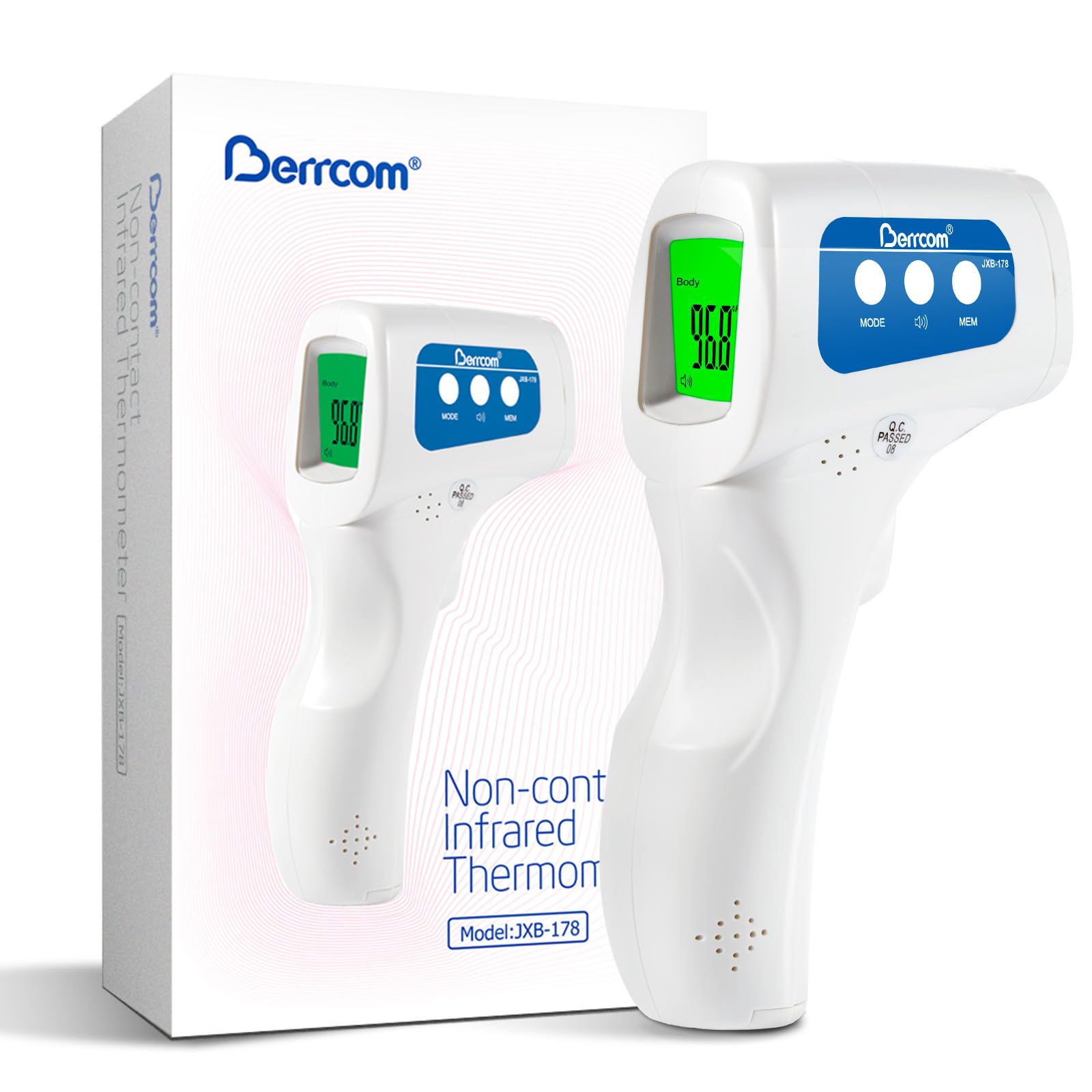
Most thermometers in this group tell you what they do and leave the how to the manual. This one leads with the two figures that actually decide whether a reading is any good: hold it 3 to 5 cm from the forehead, and the sensor covers 50 to 109.2 °F. That lower end is what makes the 3-in-1 claim real — it can read a room, a bottle, or a bath without running out of range.

The rest is standard issue and none the worse for it: one-second readings, a green-orange-red fever alarm on the LCD, 32 stored readings, °F/°C switching, and a five-inch body. Two AA cells are not included, which is worth knowing before the first sick night rather than during it.

Distance is where forehead readings go wrong, and a device that tells you to hold it three to five centimetres away has handed you the technique along with the hardware. We rate that above an extra mode we would never open. It is also the thermometer here most likely to be borrowed for the bath thermometer job and handed back.

Pros

  • States a 3-5 cm measuring distance
  • Range starts at 50 °F for room and food
  • 32-reading memory and a three-color fever alarm

Cons

  • Two AA batteries are not included
Our verdict

We put weight on devices that state their measuring distance, and this one does: 3 to 5 cm, with a range that starts at room temperature for milk and bath water.

Check Latest Price
7

One-Handed Scans

femometer DET-306

89 /100
LBD Score Excellent

Key details

Modes
Forehead and object
Weight
0.19 lb
Response Time
1 second
Temperature Range
93.2 to 109.4 °F
View on Amazon

The shape is the first thing you notice: a waist in the body that your fingers wrap around, so the thermometer sits in the palm instead of balancing on top of it. That sounds like styling until you try to scan a two-year-old who has decided your arm is a climbing frame. At 0.19 pounds it adds nothing to a bag either.

Readings take about a second and resolve to 0.1 °F, and the backlit LCD uses the same green-yellow-red scheme as the rest of the group. Body and object modes are both here, and the °F/°C switch is there for anyone who thinks in Celsius rather than Fahrenheit.

What it does not do is resolve the thing every non-contact thermometer struggles with. The number is a skin reading over the temporal artery, and it moves with distance, hair, and how long someone has been lying down. Take the reading twice, in the same spot, and follow the direction rather than arguing over a tenth of a degree.

For a household with small children, the grip is the reason to pick this over a cheaper unit. It is the one here that feels designed around a single hand, and the rest — the memory, the modes, the fever colors — is table stakes in this group, done properly.

Pros

  • Contoured, non-slip body for one-handed use
  • Clear backlit display with 0.1 °F resolution
  • Body and object modes with °F/°C switching

Cons

  • Cell life can run short
Our verdict

The contoured body sits in one hand without slipping, which is what we want when the other hand is holding a toddler — and the screen is one of the clearest here.

Check Latest Price
8

Workplace Screening

THERMOBIO Touchless

89 /100
LBD Score Excellent

Key details

Memory
32 readings
Auto Shut-Off
30 seconds
Response Time
1 second
Temperature Range
Up to 113 °F
View on Amazon

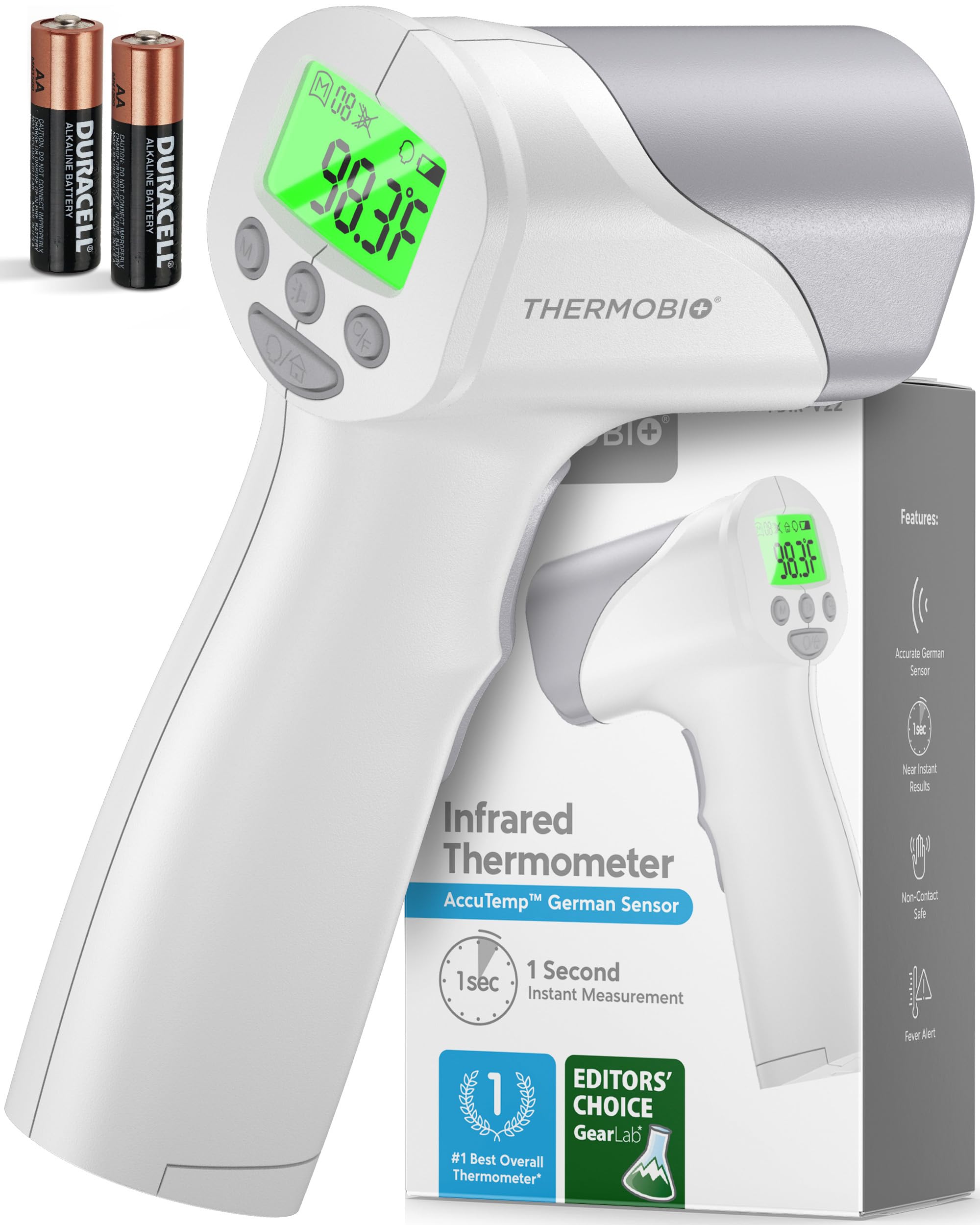
This is the most expensive thermometer in the group by a wide margin, and the only one here that argues for the money with hardware: three sensors, more than 150 data points per second, and a claimed 1,000 hours of use. On paper it is the most serious instrument in the roundup.

The rest of the package is conventional — one-second readings, 32 stored readings, a backlit display, a °F/°C toggle, and a 30-second auto-off, with a top of 113 °F that runs higher than most here. It also carries a longer list of compliance marks than anything else in the group, which matters if you are buying for a workplace rather than a nursery.

Its accuracy is the strongest showing in this group, which still is not saying much: non-contact forehead readings move around, and the extra hardware does not put this in a different class of measurement. That is the awkward part of paying a premium in this category. A household is still going to scan twice and watch the trend.

So our recommendation is narrow. If you are screening staff, students, or visitors all day, the build and the sensor array make sense of the price. If you are checking two children before school, the top pick does the same job with a pouch and a much smaller bill.

Pros

  • Three sensors with high-rate sampling
  • 32-reading memory and 113 °F top range
  • Long compliance list for workplace use

Cons

  • Battery compartment can let cells work loose
  • Several times the price of the other picks
Our verdict

Buy it if you are screening a room full of people and want the extra sensor hardware; for a family of four, we cannot see what the premium buys.

Check Latest Price

How We Tested the Best Forehead Thermometers

We started with a wide pool of touchless and forehead models with substantial review histories, then filtered on what a listing can honestly tell you: roughly one-second readings, a fever alarm, a mute mode, memory recall, forehead-versus-object modes, and standard battery types. From that group we bought 14 units and ran them for six months.

Each one did a morning check before school, an evening check after baths, and a run of readings on a toddler with no interest in holding still. We timed the gap between pressing the button and seeing a number, then repeated it in a dark room to judge whether the backlight was genuinely readable or just bright. We took three consecutive readings on the same adult forehead to see how far the numbers drifted, and compared them against a standard oral thermometer taken at the same moment.

Object mode got its own workout on bathwater, a warmed bottle, and a bedroom that had been closed up all afternoon, since a device claiming two modes should hold up in both. We noted which units slid easily into a diaper bag pocket or bedside drawer and which were too bulky to keep within reach, and we logged how long each battery lasted, which ones arrived with batteries in the box, and whether the low-battery warning gave any real notice.

A few units took accidental tumbles off the changing table, which told us something about build quality and whether the battery door stayed shut or the readings wandered afterward. Value came last: what each one cost against how much it actually delivered.

How to Choose a Forehead Thermometer

Accuracy Is Mostly About Technique

Every non-contact thermometer in this group reads infrared from the skin over the temporal artery, and every one of them gives you a slightly different number if you move your hand. That is less a defect than the nature of the measurement. The fix is boring and effective: same spot, middle of the forehead, hair pushed back, same distance every time, then a second scan a moment later to see whether the two agree.

Take a baseline reading for each person in the house while everyone is well and write it down. A number that means nothing on its own becomes useful next to a known normal. Keep a core thermometer — oral or under-arm — for the moment when the screen and the way someone looks disagree, because a forehead reading screens temperature; it does not diagnose anything.

How Much Memory You Actually Need

Memory is the least glamorous feature here and the one you use most during a real illness. Three checks a day across four days is twelve readings; two children under the weather at once is twenty-four. A ten-reading memory fills before the fever breaks, 32 or 35 covers an ordinary household illness, and the 50-reading model here suits anyone charting temperatures to show a doctor.

When two devices otherwise look equal, take the larger memory. You will never regret having the last three days stored on the device when a nurse asks how long the fever has been running.

One Measurement Site or Two

A forehead-only thermometer is fine for most homes. The case for adding an ear mode is specific: a child who will not hold still for a second scan, a cold room, or a forehead number that does not match how someone looks. The FC-IR100 does both, and the gap between a forehead and an ear reading on the same person is information in itself.

What the second site costs you is compliance. An ear reading needs the probe seated in the canal and a head that stays still, which some small children fight harder than a forehead scan. If nobody in your house tolerates that, the second mode is a feature you pay for and never touch.

Cells, Cases, and What Is in the Box

Check the box list before you order, because it varies more than you would expect. Some ship with two AAA cells; the Berrcom takes two AA cells that are not included. Cells are the most common thing to fail on a thermometer you have not touched in six months, so a spare pair in the drawer is worth more than an extra mode.

A pouch is a small thing that changes where the device lives. Thermometers without one end up loose in a bag with a scratched sensor window; the ones with a case go back in the same drawer every time, which is why you can find them on the night you need them.

Frequently Asked Questions

Final Verdict

The Goodbaby FC-IR202 is the one we point most people to: a single button, a screen that reads at a glance across a dark room, 35 stored readings, and cells and a pouch in the box. Nothing about it is exotic, and that is the point — on the night you need it, you want the thermometer that asks the least of you.

If your child fights a second scan, the GoodBaby FC-IR100 adds an ear mode and gives you a second number to compare against the first. If budget decides it, the ANMEATE reads just as fast for less, as long as you can live without a case.