Best Fish Finders of 2026

A fish finder is a simple idea wearing a complicated screen: a transducer ticks out a sound pulse, and the display draws whatever bounces back. That's the whole trick. Which is exactly why two units that look identical on the shelf can behave nothing alike over a brush pile — one sketches a clean arch where the other leaves a smear you'll argue with all afternoon. What you're actually buying is fewer blank hours on the water and a better guess about where to drop a line.

I've fished the same few reservoirs long enough to know where the ledges sit, so what I mostly wanted to know was whether these units would show me the fish holding on them. Over the past six months my team and I ran 12 fish finders, from a 3.5-inch entry unit strapped to a kayak up to 9-inch chartplotters with side imaging and live sonar, through spring turnover, heavy summer weed growth, and a few windy mornings I'd rather forget. Ease of use surprised me more than anything: a menu you have to fight is a menu you stop using.

One piece of advice I'd give any first-time buyer — resolution beats screen size, and a good transducer beats both. A big display fed by a weak transducer just shows you a bigger blur. Below are the units that earned a permanent mount, sorted by how and where you actually fish.

1

Best Overall

Garmin STRIKER 4

93 /100
LBD Score Outstanding

Key details

GPS
Waypoint map
Sonar
CHIRP with ClearVü
Max Depth
1,600 ft freshwater; 750 ft saltwater
Display Size
3.5 inches
View on Amazon

The first thing we noticed about the STRIKER 4 is how little space it asks for. At 8 ounces and 3.5 inches across, it fits a kayak, a canoe, or the corner of a small console without becoming the center of the boat. The tilt-and-swivel mount makes it easy to angle toward you, and the keyed interface means you can learn the main screens without a manual open on your lap.

The sonar is the real story. CHIRP and ClearVü give you a clean look at fish arches and bottom structure, and the built-in flasher is the sleeper feature for ice fishing or vertical jigging. The depth range is serious for a unit this size: 1,600 feet in freshwater and 750 feet in saltwater. We think that matters most for anglers who fish deep reservoirs or saltwater flats, while the 3.5-inch screen is the trade-off. Single-view sonar is readable, but split-screen mapping gets tight.

GPS is waypoint-focused rather than a full chartplotter. You can mark a brush pile, a dock, or the ramp and navigate back, which is the feature that makes the STRIKER 4 more useful than a plain depth finder. It does not carry the preloaded lake charts or side-scan views of the larger units here, so treat it as a compact sonar and waypoint tool rather than a mapping station.

For a first unit, a kayak, or a second display on a small boat, that balance is hard to beat. We keep coming back to the flasher view, too: it turns the same screen into a vertical-jigging tool when the fish are tight to the bottom.

Pros

  • Compact 8-ounce body fits kayaks and small boats
  • CHIRP and ClearVü sonar without a big console
  • GPS waypoints and a built-in flasher
  • Simple keyed controls and tilt-swivel mount

Cons

  • 3.5-inch screen is cramped in split view
Our verdict

The STRIKER 4 earns our first recommendation because it covers CHIRP sonar, GPS waypoints, and a flasher in a package that fits kayaks and small boats.
Check Latest Price
2

Best for Side Imaging

Humminbird HELIX 7 G4

84 /100
LBD Score Excellent

Key details

Imaging
MEGA Side and Down, 125 ft
Recording
AutoChart Live, 8 hours
GPS Mapping
Basemap, 10,000+ lakes
Display Size
7 inches
View on Amazon

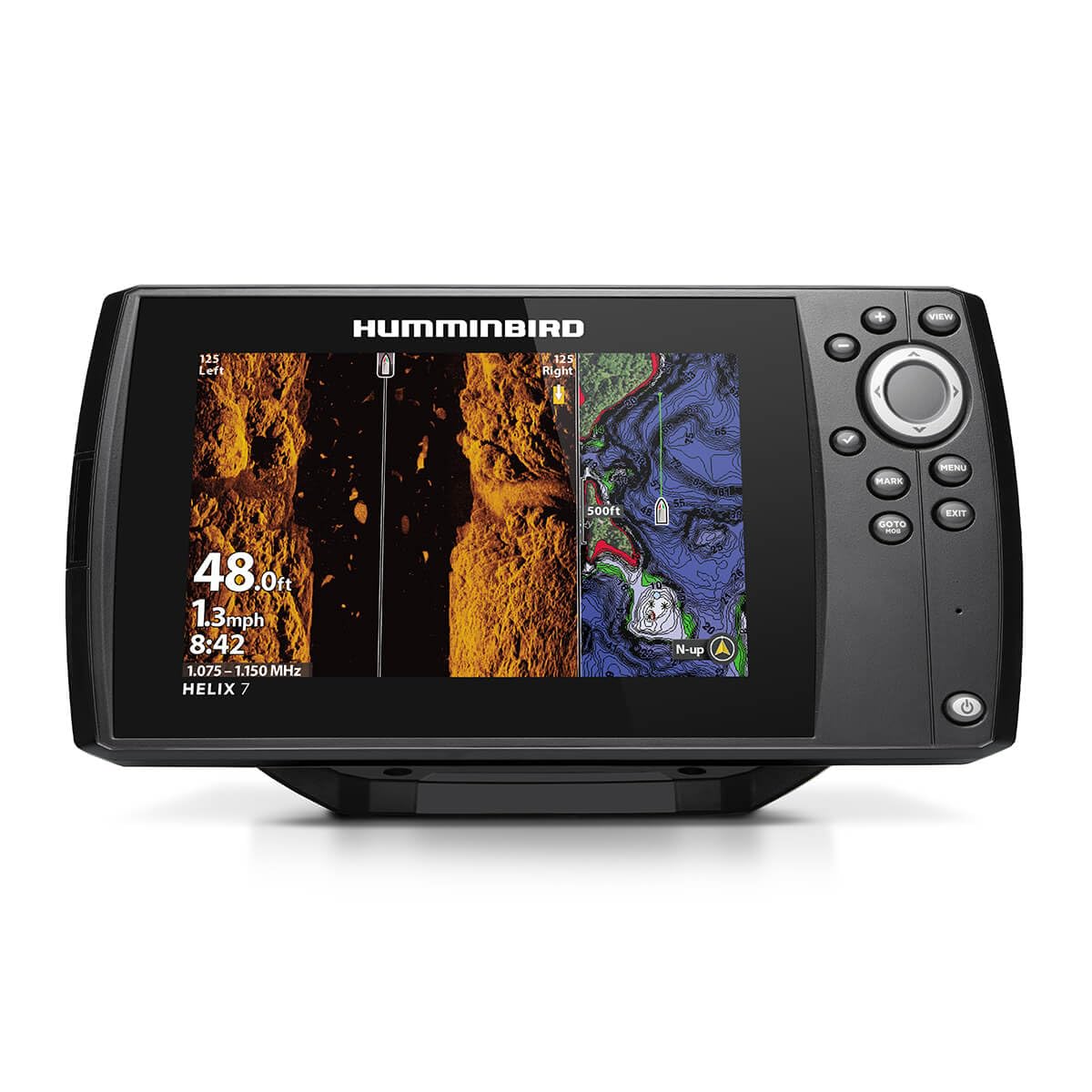
Side imaging is the reason to step up to the HELIX 7, and the 7-inch screen is why it works. MEGA Side Imaging covers 125 feet on each side of the boat, while MEGA Down Imaging covers 125 feet below. We like that range because it lets you read a weed edge, a bridge piling, or a brush line before you run over it. The wider screen also gives those side returns room to breathe, which a 5-inch unit cannot do as comfortably.

Dual Spectrum CHIRP gives you wide and narrow search modes, and the Humminbird Basemap covers more than 10,000 lakes and coastal water. AutoChart Live records depth contours, bottom hardness, and vegetation for eight hours, so you can build a map of your own spots. The keypad controls are a deliberate choice: they work with wet hands and in weather that makes a touchscreen fussy.

The catch is that side imaging is not live sonar. It shows structure and fish positions, but it will not show a fish following your lure. The HELIX 7 also asks for careful transducer placement to keep a clean bottom reading. For an angler who wants a dedicated structure-reading unit on a bass boat or larger aluminum boat, though, this is the most direct route in this set.

Pros

  • 125-foot side and down imaging
  • 7-inch screen makes side returns readable
  • Basemap and AutoChart Live
  • Keypad controls work in weather

Cons

  • Depth can drop out at speed or in chop
Our verdict

Side imaging is the reason we pick the HELIX 7: its 125-foot coverage and 7-inch screen make structure easier to read than the smaller units here.

Check Latest Price
3

Best Midrange GPS

Humminbird HELIX 5 CHIRP GPS

88 /100
LBD Score Excellent

Key details

Sonar
Dual Spectrum CHIRP
Recording
AutoChart Live, 8 hours
GPS Mapping
Basemap, 10,000+ lakes
Display Size
5 inches
View on Amazon

The HELIX 5 sits in the useful middle: it adds GPS and lake maps without the console footprint of a 7- or 9-inch unit. The 5-inch display is bright enough to read in direct sun, and the softkey controls are arranged for quick changes rather than deep menu dives. For a 16- to 20-foot boat with limited dash space, that combination makes more sense than a bare depth finder.

Dual Spectrum CHIRP gives you wide and narrow search modes, and the Humminbird Basemap covers more than 10,000 lakes plus coastal water. AutoChart Live records eight hours of depth contours, bottom hardness, and vegetation, so you can improve the map on water the preloaded charts do not cover well. Installation is straightforward with the transom transducer, gimbal bracket, and power cable in the box.

The 5-inch display is best used as one view at a time; we keep the map full-screen when running and switch to sonar when fishing. What we appreciate most is the balance: the HELIX 5 gives you GPS waypoints and mapping without forcing you into a larger screen or a more complex chartplotter. The softkey system is quicker to learn than a touch menu, and the unit stays out of the way on a small helm. We choose it when mapping matters but dash space does not.

Pros

  • 5-inch GPS unit with 10,000-plus lake maps
  • Dual Spectrum CHIRP sonar
  • AutoChart Live records eight hours
  • Softkey controls are simple to learn

Cons

  • Depth tracking can stumble at speed
Our verdict

For a small console that still needs GPS and lake maps, the HELIX 5 is our manageable 5-inch choice.

Check Latest Price
4

Best Chartplotter

Garmin ECHOMAP UHD2 93sv

89 /100
LBD Score Excellent

Key details

Maps
Navionics+ 18,000+ lakes
Sonar
GT56 traditional, ClearVü, SideVü
Connectivity
Wi-Fi, Force trolling motor
Display Size
9 inches, touchscreen
View on Amazon

The ECHOMAP UHD2 93sv is the navigation-first pick: a 9-inch touchscreen with Navionics+ inland maps and a GT56 transducer in the box. The screen is bright and wide, with the kind of viewing angle that stays readable when you are standing at the console rather than sitting in front of it. Built-in maps cover more than 18,000 lakes with up to 1-foot contours, which is the difference between guessing at a point and following a breakline.

The GT56 transducer gives you traditional Garmin sonar, ClearVü, and SideVü scanning, so the same unit can read depth, structure, and fish positions. We appreciate the built-in Wi-Fi more than we expected: it lets you share sonar, waypoints, and routes with another ECHOMAP chartplotter without swapping cards. The wireless connection to a Force trolling motor is another useful layer if you already run that system.

This is a console boat unit, not a kayak accessory. At 8.1 pounds and roughly 10 by 6.5 inches, it needs real dash space and a secure mount. The payoff is a chartplotter that can run a route, show side-scan structure, and keep your waypoints organized on one screen. It is the unit we choose when the day starts with a run to a waypoint and ends with side-scanning a ledge.

Pros

  • 9-inch sunlight-readable touchscreen
  • GT56 traditional, ClearVü, and SideVü sonar
  • Navionics+ maps cover 18,000-plus lakes
  • Wi-Fi sharing and Force trolling motor control

Cons

  • Setup and mapping take time to learn
Our verdict

We point navigation-first anglers to the ECHOMAP UHD2 93sv, where the 9-inch touchscreen and Navionics+ maps make new water less intimidating.

Check Latest Price
5

Best Live Sonar

Lowrance Eagle Eye 9

89 /100
LBD Score Excellent

Key details

Maps
C-MAP 17,000+ lakes
Sonar
Live Forward, Live Down, CHIRP, DownScan
Max Depth
500 feet
Display Size
9 inches IPS
View on Amazon

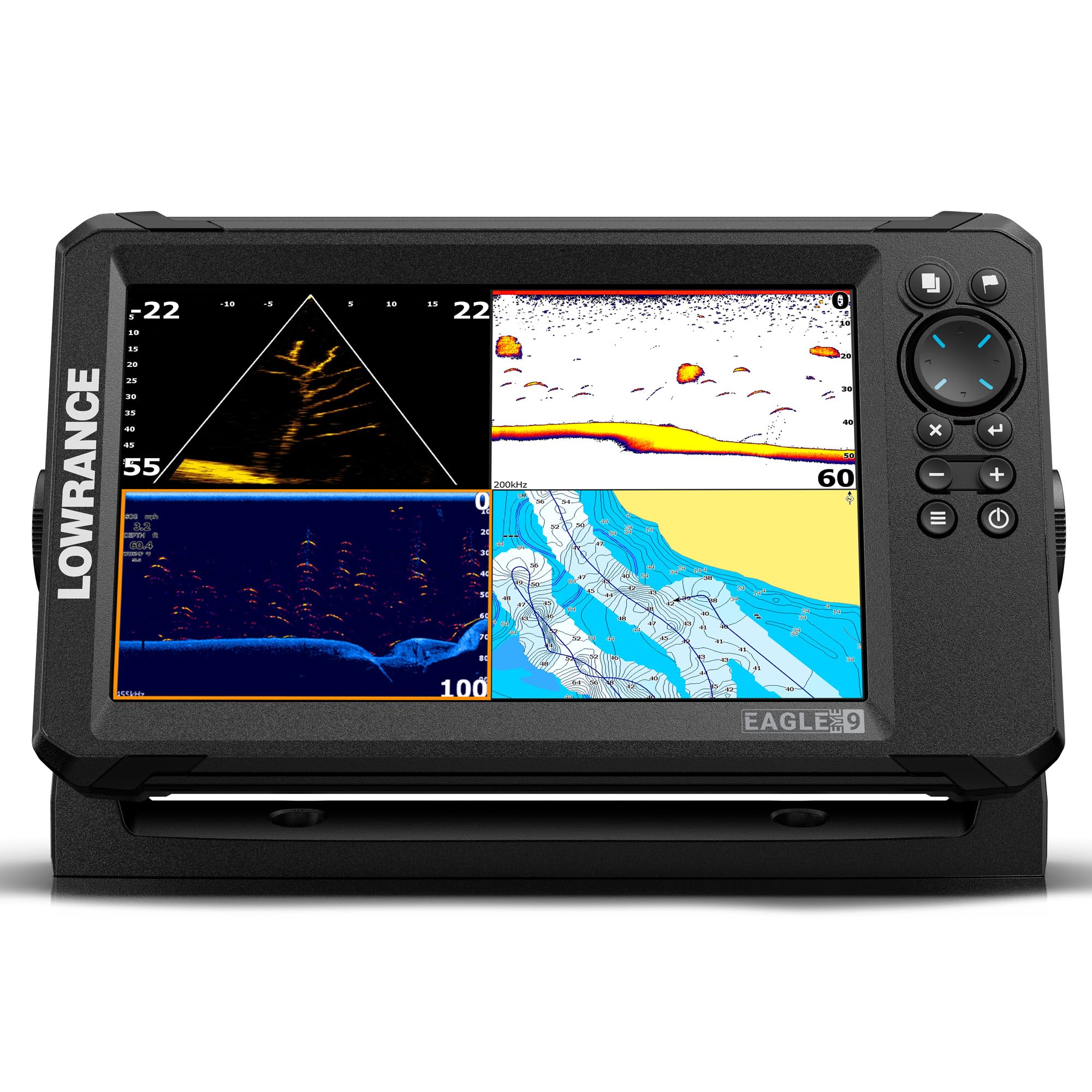
The Eagle Eye 9 is for the angler who wants to watch a fish react, not just mark an arch. Live Forward and Live Down views show movement around your lure in real time, and the 9-inch IPS display gives those views enough space to be useful. We like that the live transducer connects directly to the display, with no separate sonar module to mount and wire. That simplicity matters on a boat where dash space is already tight.

One included transducer also handles CHIRP sonar and DownScan with FishReveal, so you can switch between live views and a more conventional read of structure. C-MAP charts cover more than 17,000 U.S. lakes, and Genesis Live mapping lets you add detail where the charts are thin. The forward view is the star: it is strongest in shallow to mid-depth water, where you can see fish approach and decide whether to change the presentation.

The C-MAP charts are useful but not the strongest mapping in this set, so we treat navigation as a secondary job here. This is a live-sonar tool first. For an angler who already knows where fish should be and wants to see whether they will commit, the trade is worth it. We reach for it when casting to cover is the plan, not when we are running a long route.

Pros

  • Live Forward and Live Down in one transducer
  • 9-inch IPS display with direct connection
  • C-MAP charts cover 17,000-plus lakes
  • FishReveal combines CHIRP and DownScan

Cons

  • Live Down view is less compelling than Live Forward
  • Detail fades in deeper water
Our verdict

We reach for the Eagle Eye 9 when watching fish react matters more than scanning structure, because its live views show the strike in real time.

Check Latest Price
6

Down Imaging

Lowrance HOOK Reveal 5

82 /100
LBD Score Excellent

Key details

Sonar
SplitShot CHIRP and DownScan
Mapping
C-MAP, almost 4,000 lakes
Recording
Genesis Live
Display Size
5 inches
View on Amazon

The HOOK Reveal 5 is the down-imaging alternative in this group. Its SplitShot transducer combines wide-angle CHIRP sonar with DownScan, and FishReveal overlays the two so fish targets stand out from structure instead of disappearing into it. The 5-inch screen is compact enough for a small boat, and the autotuning sonar takes some of the guesswork out of gain and sensitivity.

Preloaded C-MAP charts cover almost 4,000 U.S. inland lakes, and Genesis Live lets you add contour detail where the built-in map is thin. The unit also includes a SplitShot transducer, mounting bracket, power cable, fuse, and corner clips. That is a complete install in the box, which saves a trip for parts.

The 5-inch screen is best used as one view at a time; we keep the map full-screen when running and switch to FishReveal when fishing. What we appreciate most is how quickly FishReveal makes sense of a brush pile: the down-scan detail gives the fish arches a context that plain CHIRP misses. For an angler who wants down imaging and inland maps without a larger console unit, it earns a place.

Pros

  • SplitShot CHIRP and DownScan with FishReveal
  • C-MAP charts for almost 4,000 inland lakes
  • Genesis Live contour mapping
  • Complete install hardware in the box

Cons

  • Setup instructions are thin for first-time wiring
  • GPS and transducer issues can appear
Our verdict

The HOOK Reveal 5 is our down-imaging alternative for a small boat, pairing FishReveal with inland maps in a compact 5-inch unit.

Check Latest Price

How We Tested the Best Fish Finders

We started with every unit we could find that shipped with a transducer and either GPS or preloaded charts, then filtered by screen size, mounting style, and price so there was at least one real option at every budget. That left 12 units. We ran them for six months off two kayaks and a 17-foot aluminum boat on inland lakes and a slow river, swapping units between hulls so no single boat skewed the results.

Every unit went over the same three pieces of structure: a sunken brush pile, a bridge pilaster, and a weedline that tops out around eight feet. We lowered a jig and watched whether the screen separated it from the cover or swallowed it, and whether it held its mark on a fish as we drifted past. Depth readings got checked against a weighted line on a flat we'd sounded by hand, then against each other, and we noted which units drifted a foot or more in the shallows.

For ease of use, I handed each unit to a friend who'd never run one and timed how long it took to reach a screen worth looking at — then repeated it at midday with the sun flat on the display. Installation meant mounting the transducer on a trolling motor and through a kayak scupper: how much of the manual we needed, whether the bracket held at speed, and whether we had to drill. On the imaging units we watched for lag between the jig moving and the screen moving. Reliability was the boring part — full days on one battery, GPS lock dropping under tree cover, anything that fogged or rebooted.

Then we emptied the boxes. A unit that needs a separate transducer or a chart card before it's useful isn't the bargain its sticker suggests, so we scored value on what it actually took to fish with it.

How to Choose a Fish Finder

Match the sonar to your water

CHIRP sonar is the baseline: it gives you fish arches and a clean bottom reading. Down imaging adds a picture-like look at structure directly under the boat, side imaging scans left and right, and live sonar shows movement in real time. We think most first-time buyers should start with CHIRP and add imaging only if they will use it. The STRIKER 4 proves how much a simple CHIRP unit can do; the HELIX 7 is the step up when reading side structure is the point.

Size the screen to your boat

Screen size is a space decision as much as a visibility decision. A 3.5- or 4-inch display suits a kayak, ice shelter, or tiny skiff; a 5-inch unit fits a small console; 7- and 9-inch screens are easier to read in split views but need real dash space and power. Check sunlight readability and viewing angle, not just inches. The Eagle Eye 9's IPS panel is easy to read from an angle, while a 5-inch unit like the HELIX 5 keeps the helm clear.

Decide how much mapping you need

A waypoint map gets you back to a brush pile or the ramp. Preloaded lake charts help on new water, and live contour mapping lets you improve the chart as you fish. Do not pay for mapping you will not use on a farm pond, but do check coverage before you buy if you trailer to different lakes. The HELIX 5 covers more than 10,000 lakes; the ECHOMAP UHD2 93sv covers more than 18,000 with Navionics+ data.

Plan the transducer install

The transducer is where most performance complaints start. It needs clean water flow, a secure mount, and a cable route that will not get pulled. On a transom, small adjustments in height and angle matter; on a kayak, a dedicated mount keeps the beam pointed down. Check the mounting hardware and test the reading at low and high speed before the first full trip. A clean install does more for your sonar than an extra menu mode.

Spend where it changes your fishing

Budget buys a small screen and basic sonar; midrange adds GPS, mapping, and down or side imaging; premium buys live sonar or a large touchscreen chartplotter. We prioritize a readable screen, reliable depth, and a transducer that suits the boat over extra modes we will not use. If you fish the same small lake, a simple unit is enough. If you chase structure across new water, mapping and imaging earn their keep.

Frequently Asked Questions

Final Verdict

Start with the Garmin STRIKER 4. It covers the core job of depth, fish arches, GPS waypoints, and a flasher for ice season in a package that fits a kayak or a small console. If reading structure to the side is the priority, the Humminbird HELIX 7 is the next step; if navigation is the main event, the Garmin ECHOMAP UHD2 93sv is the clearer long-term choice. The Lowrance Eagle Eye 9 is the live-sonar specialist when watching fish react justifies the premium.