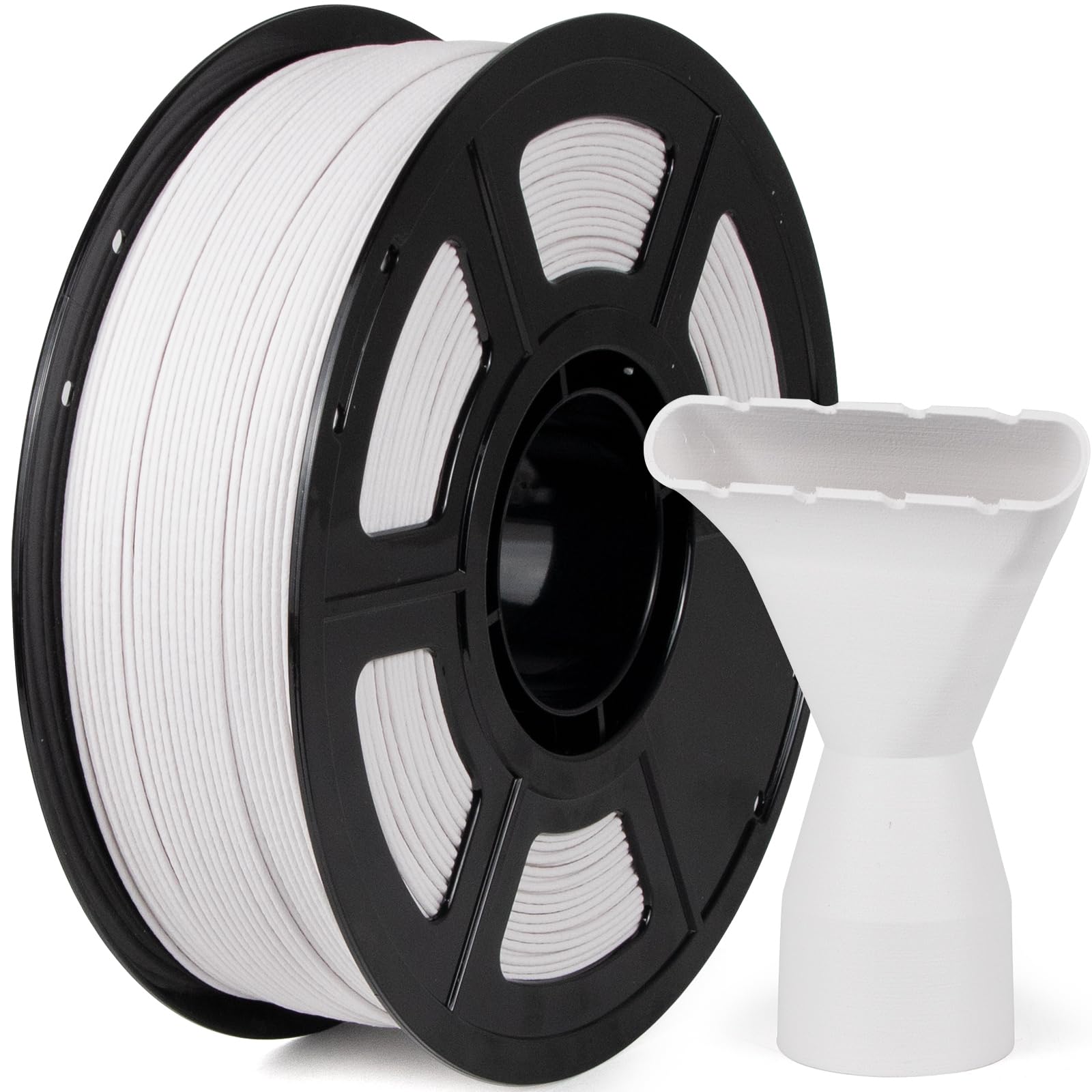
Best Filament for Outdoor Use of 2026

A bracket that looks flawless coming off the bed can be chalky and cracked by August. I learned that with a set of PLA planter hooks that went soft in a heat wave. The plastic is the whole story here: PLA sags in a hot car and breaks down under UV, PETG softens earlier than most people expect, and ASA is basically ABS with the weathering weakness engineered out. Get it right and a functional part survives years of sun and freeze-thaw; get it wrong and you reprint it every season.

My team spent eight months running 16 spools of outdoor-rated filament through our printers, then leaving the printed parts outside. What separated them wasn't a spec-sheet claim — it was whether a large flat print stayed flat, whether layers held when we snapped a coupon, and whether white was still white after a summer on the railing. We calipered each spool at several points, since filament that drifts mid-print jams or blobs no matter how good the chemistry is. What held up is below.

1

Best Overall

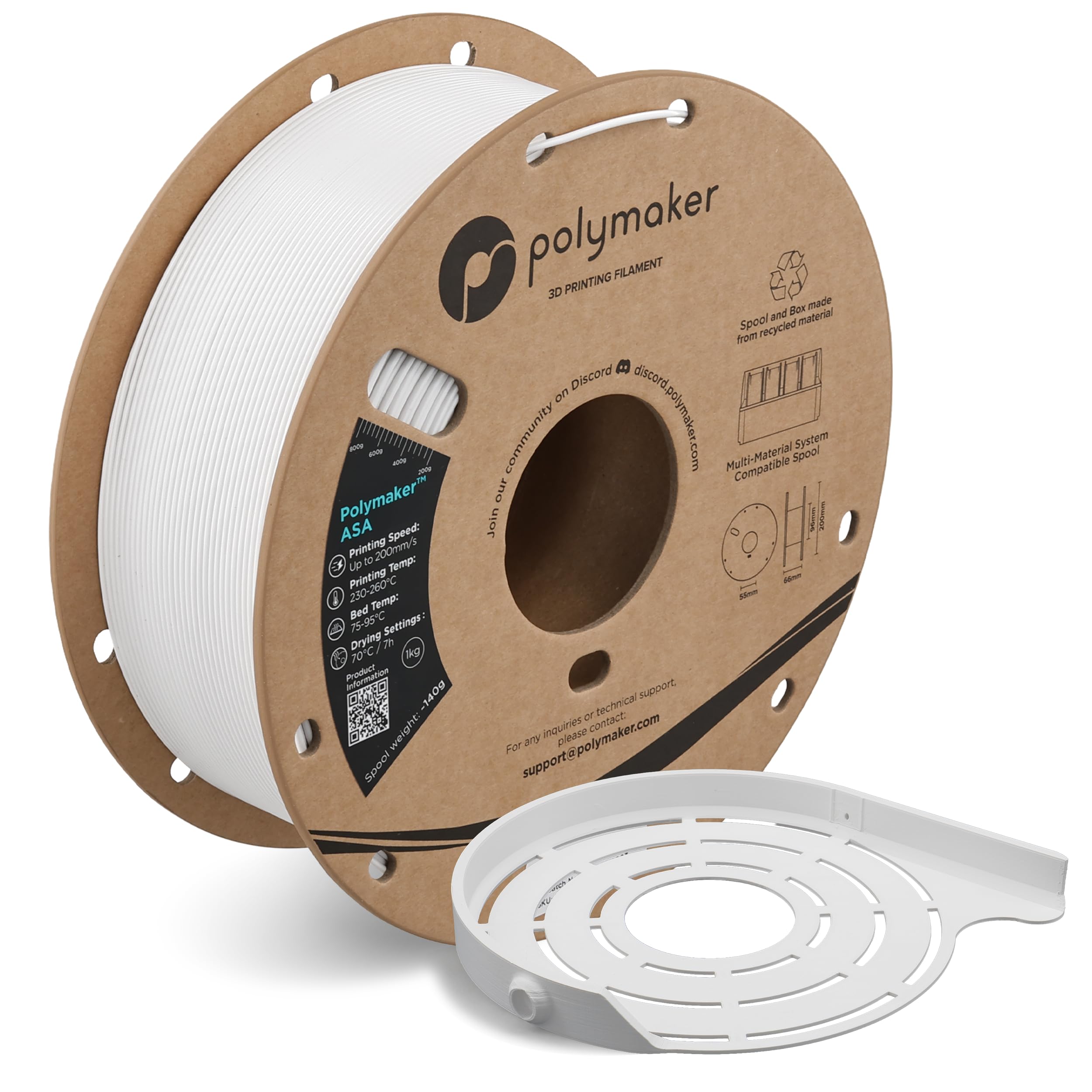
Polymaker ASA

90 /100
LBD Score Outstanding

Key details

Material
ASA
Bed Temperature
90°C
Heat Resistance
Up to 100°C (212°F)
Nozzle Temperature
250°C
View on Amazon

A hundred degrees Celsius is the number that put this spool on top. That's the highest stated heat resistance of any filament in this guide, and for outdoor work it's the figure that matters most: a bracket on a sunny wall or a mount near a windshield can run far hotter than the air around it, and ASA that softens early lets the part bow out of shape. Polymaker pairs that ceiling with UV and weather resistance, and the listing gives you somewhere to start at a 250°C nozzle, 90°C bed, and 50 mm/s.

In the printer, our attention went to the flat parts, because that's where ASA usually embarrasses itself. Small brackets came off clean; a sign blank lifted at two corners until we got the chamber properly warm and added a brim. That's the material rather than the spool, but it's worth knowing before your first print, and it's why we treat an enclosure as part of the purchase instead of an upgrade.

What the extra spend buys is consistency across the reel, a white that photographs cleanly, and settings you don't have to reverse-engineer. Light-colored parts also stay cooler in direct sun than black ones and hide dust and pollen better, so if you're printing trim, a house number, or a garden bracket, that's a more useful property than the color swatch suggests.

If your part is a shaded planter or a cover that never meets serious heat, the budget spools below will do the job for less. If it will sit in the sun and carry load, this is the roll we reach for.

Pros

  • Highest stated heat resistance in this group
  • UV and weather resistance for permanent outdoor parts
  • Listed starting settings of 250°C nozzle and 90°C bed

Cons

  • Costs more than the budget ASAs here
Our verdict

Our top pick: nothing else here pairs a 100°C heat ceiling with UV resistance this convincingly, so it's the spool for a part that has to last a summer outdoors.
Check Latest Price
2

Best for First ASA Spools

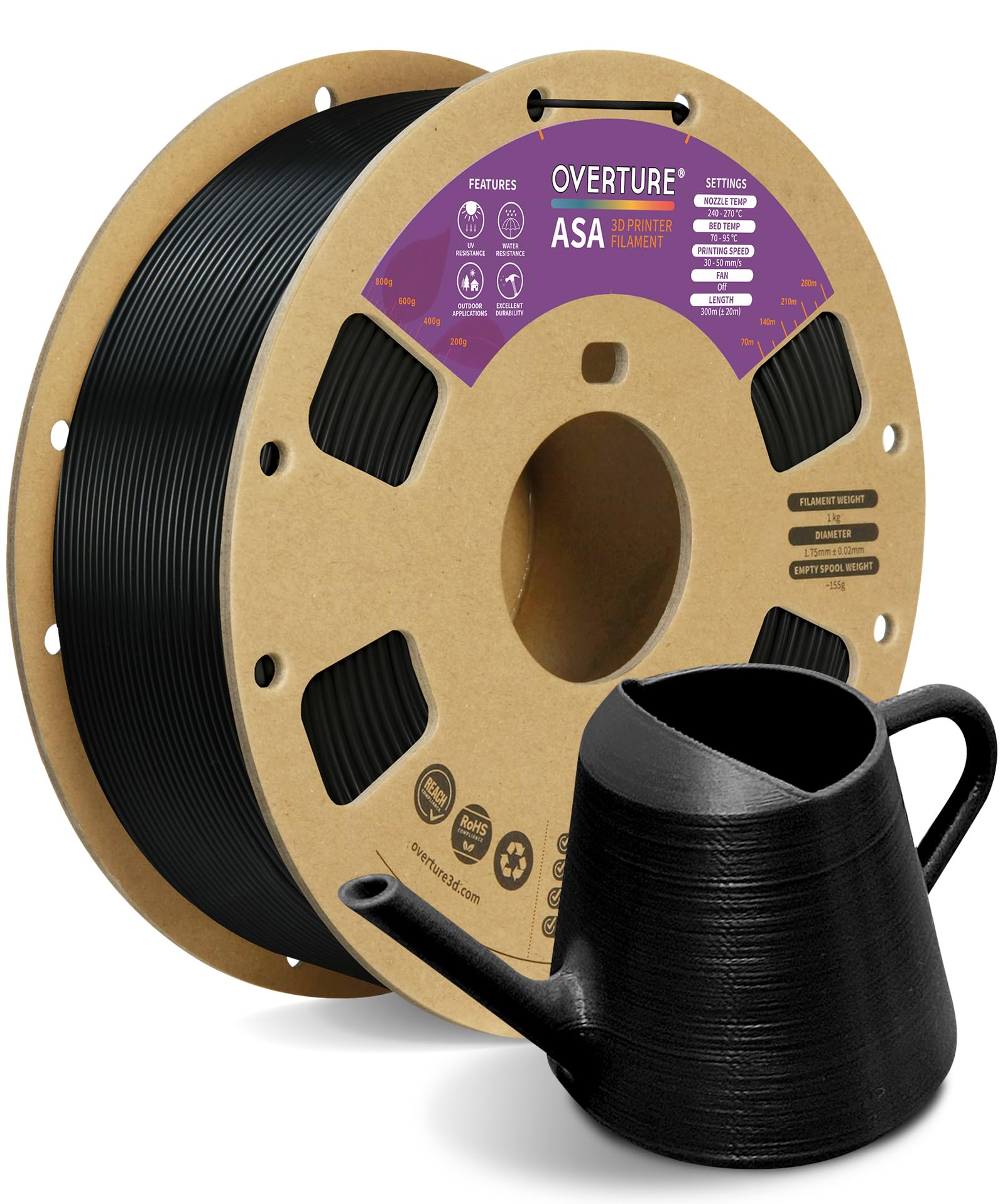
OVERTURE ASA

90 /100
LBD Score Outstanding

Key details

Spool
1 kg cardboard
Material
ASA
Warranty
1 year
Heat Resistance
Up to 96°C
View on Amazon

There's a version of this decision that's only about the number on the label: 96°C of stated heat resistance, a step under the top pick and comfortably above the cheap end of this group. But what earns this spool its place is the first hour. Of the ASAs here, it behaves closest to the ABS profile already sitting in your slicer, which means fewer wasted evenings spent chasing a starting temperature.

We recommend it to anyone buying a first spool of ASA. Prints came out clean with sharp corners and little stringing, and it held layer to layer on tall pieces, which is no small thing for a material that likes to split. Rigid, dense parts are where it shines; anything that has to flex is a job for the glass-filled spool further down.

Two smaller things we appreciated: the reel is cardboard, so it breaks down for recycling instead of going in the bin whole, and the spool ships dried with a stated one-year shelf life as long as it stays sealed. The black is not a deep black, reading charcoal in flat light, which matters only if the part will sit beside true-black hardware.

Pros

  • Starts clean from a generic ABS profile
  • Cardboard spool is easier to recycle
  • Dried and sealed with a stated one-year shelf life
  • 96°C stated heat resistance

Cons

  • Heat ceiling sits just under the top pick
Our verdict

The ASA we hand to first-timers: it starts from a generic ABS profile, prints clean, and the cardboard reel is one less piece of plastic to deal with.

Check Latest Price
3

Best Spool for Heated Chambers

SUNLU ASA

90 /100
LBD Score Outstanding

Key details

Spool
1 kg high-temp, fits AMS/AMS Lite
Material
ASA
Diameter Tolerance
±0.02 mm
View on Amazon

Most of us pick filament by material and never look twice at the spool. Print ASA in an enclosure and that changes, because a standard plastic reel softens and warps at chamber temperatures, and a reel that has gone out of round drags for the rest of the print. SUNLU's spool is built for that heat, with a multi-hole hub so air can move through the wound filament while it dries.

The plastic is what you'd expect at this level: ±0.02 mm diameter tolerance, UV, rain, and heat resistance claimed for outdoor mechanical parts, and a full kilogram on the reel. Walls came out smooth with a fine matte surface that sands easily, which is useful on a visible part, and ASA takes sanding and paint better than most of the alternatives here.

The reel is what keeps it in the guide. If your printer lives in an enclosure, or you feed through an AMS, this is the least fussy ASA in the set, since the spool keeps its shape and is sized to fit the AMS and AMS Lite without a printed adapter. Filament that doesn't fight the machine is worth more than a slightly better number on the box.

Pros

  • Heat-resistant spool holds shape in a hot chamber
  • Sized to fit AMS and AMS Lite
  • ±0.02 mm diameter tolerance
  • UV, rain, and heat resistance for outdoor parts

Cons

  • Layer bonds need a hot chamber to be dependable
Our verdict

Buy it for the reel as much as the plastic: a heat-resistant spool that holds its shape in a hot chamber and loads into an AMS without adapters.

Check Latest Price
4

Best for Stiff, Load-Bearing Parts

IEMAI ASA-GF

89 /100
LBD Score Excellent

Key details

Spool
2.2 lb
Finish
Matte white
Material
ASA with glass fiber
View on Amazon

If the part you're printing is a bracket that must not flex, or a hinge that has to hold a panel open season after season, plain ASA is the wrong end of the shelf. Glass fiber changes the character of the material: parts come out stiffer, more dimensionally stable, and far less willing to creep under a constant load. That's the whole reason this spool is here, and it is a genuinely different product from the plain ASAs around it.

The finish is the surprise. Glass-filled filament has a reputation for rough, hairy surfaces, and this one lays down a matte white with layer lines that nearly disappear, good enough that we stopped thinking of it as a hidden structural part. The trade-off is the tooling: glass fill is abrasive, so a hardened nozzle belongs on the machine before you open the bag, and a brass one will not last the reel.

While we haven't put the same hours on this blend as on the plain ASAs here, nothing in printing it gave us pause. Our reservation is about toughness rather than stiffness. Thin walls and snap-fit tabs are likelier to crack under a knock than the plain ASA parts we printed, so use this where rigidity is the point and leave the flexing clips to another material.

Pros

  • Glass-fiber fill raises stiffness and stability
  • Matte finish hides layer lines
  • UV and weather resistance for demanding outdoor use

Cons

  • Stiff parts can crack in thin walls under impact
Our verdict

For brackets, hinges, and mounts that must not flex, the glass-fiber version is the one to order, as long as you budget for a hardened nozzle first.

Check Latest Price
5

Best Budget ASA

iSANMATE ASA

87 /100
LBD Score Excellent

Key details

Material
ASA
Print Speed
30–100 mm/s
Diameter Tolerance
±0.02 mm
Nozzle Temperature
240°C–270°C
View on Amazon

Cheapest of the ASA spools in this guide, and the listing doesn't read like a compromise: ±0.02 mm diameter tolerance, a 240°C to 270°C nozzle window, 30 to 100 mm/s, and a kilogram vacuum-sealed with desiccant. What the numbers don't tell you is that it wants to be printed near the top of that window.

We recommend it for anything big, cheap, and outdoors. Layer strength tightened noticeably when we ran it around 270°C instead of the middle of the range, and a slow first layer with a warm chamber kept corners down on parts that wanted to curl. Run it cool and you'll conclude it's poor filament; run it hot and it behaves like the good stuff.

The compromises are the usual budget ones. The black reads slightly grey in daylight, and the wind is not always tidy enough to leave a twelve-hour print fully unattended, so we watch the first hour. Neither is a dealbreaker on a planter or a set of fence brackets, which is exactly what this spool is for.

Pros

  • Cheapest ASA spool in this group
  • Strong layer bonds at the top of its range
  • ±0.02 mm tolerance and a wide 240°C–270°C window

Cons

  • Brittle enough to snap in a long feed path
Our verdict

The budget ASA we keep on hand: cheapest of the ASA spools here, and it still feeds and prints without the fuss that usually comes with cheap filament.

Check Latest Price
6

Fast Decorative Prints

CHCKX ASA

86 /100
LBD Score Excellent

Key details

Material
ASA
Print Speed
30–300 mm/s
Bed Temperature
80°C–100°C
Heat Resistance
Up to 86°C
View on Amazon

Thirty to 300 mm/s is the widest stated speed range of any filament here, and on a modern printer that isn't a marketing line. Most ASA asks you to slow down; this spool kept pace when we pushed the profile, and the extrusion stayed even instead of thinning out in patches.

The finish is the other reason it's on the list: a deep gloss black that reads almost wet, smooth walls, and layer lines that mostly vanish on vertical surfaces. If you're printing something that will be looked at rather than bolted under a bench, that counts for more than a tenth of a degree. The high-temperature spool is a sensible touch too, given the bed wants 80°C to 100°C.

Where we landed: this is the spool for fast, decorative outdoor parts, not for anything that lives somewhere genuinely hot. Its stated ceiling is 86°C, well below the rest of the ASA field, so a planter in partial shade is a yes and a bracket under a hood is a no. Keep inside that boundary and the budget price makes it an easy call.

Pros

  • Widest stated print-speed range here
  • Gloss black finish with smooth walls
  • High-temperature spool for a hot bed

Cons

  • Bed adhesion can fail on smooth plates
Our verdict

A fast, glossy ASA for decorative outdoor work like planters, house numbers, and garden stakes, with one of the lowest heat ceilings in this group.

Check Latest Price
7

Warm-White Trim

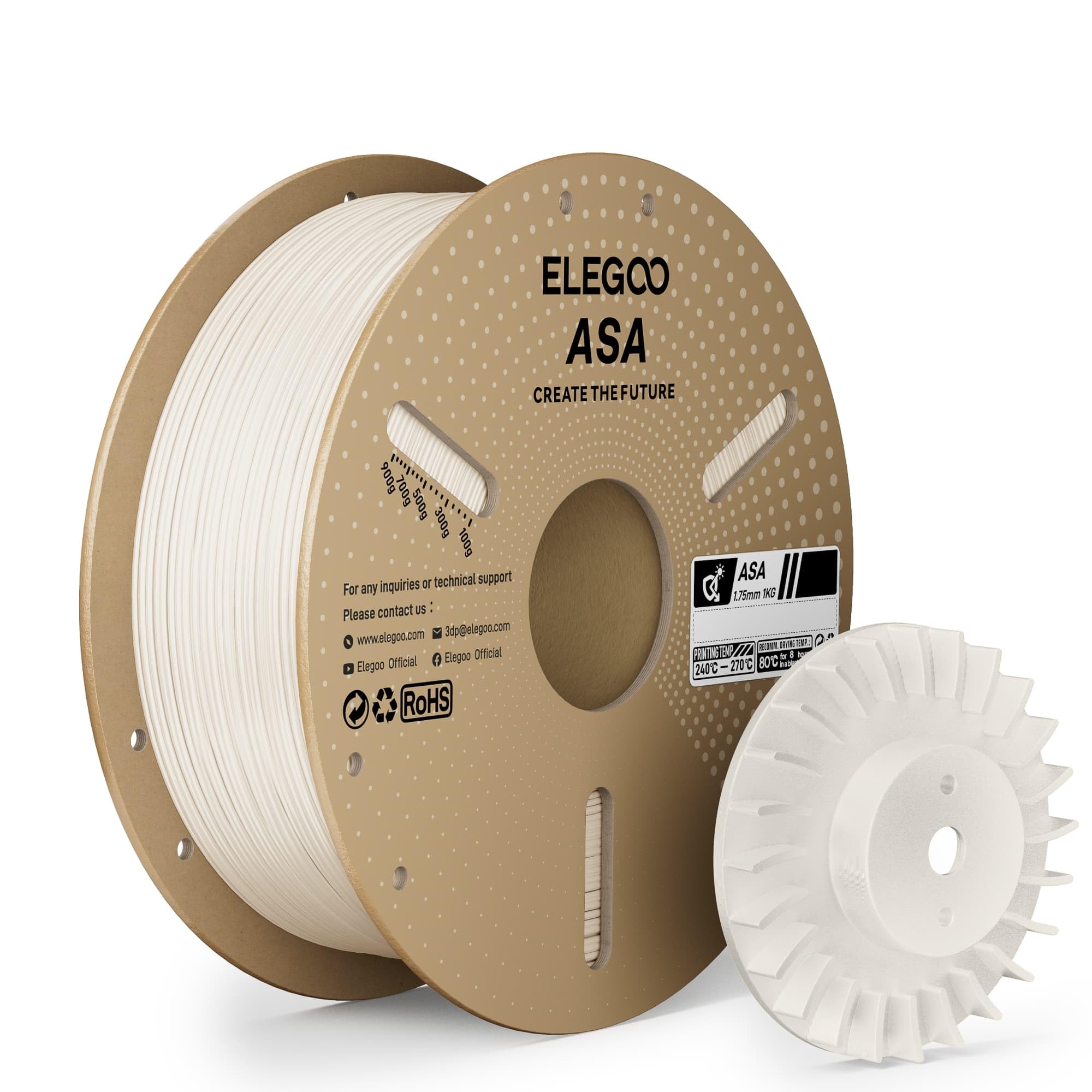
ELEGOO ASA

81 /100
LBD Score Excellent

Key details

Color
Warm white
Spool
2.2 lb
Material
ASA
Heat Deflection
Up to 99°C / 210°F
View on Amazon

The color is the reason to look at this one first. It's a warm white, closer to cream than the bright white in the product photos, and on weathered cedar, galvanized brackets, or stone it looks like it belongs there instead of like a plastic part bolted on. Soft light and matte surfaces suit it; beside bright white trim it will read slightly yellow.

The specification isn't decorative either: 99°C of stated heat deflection, second only to the top pick, plus claims for prolonged sun and rain exposure. That's a lot of heat tolerance for a spool sitting this far down the list.

In the printer it was uneventful in the way we want: even extrusion, no popping or bubbles from moisture, and a first layer that held on a clean plate at a hot bed. ASA rewards patience more than technique, and this one gave us nothing extra to solve.

For garden trim, warm-toned fixtures, and anything where the finish is half the point, this is the spool we order. For a black replacement part on a car, look elsewhere.

Pros

  • 99°C stated heat deflection
  • Warm-white tone suits wood and stone
  • Even extrusion with no moisture popping

Cons

No notable drawbacks to flag.

Our verdict

A warm-white ASA with a 99°C ceiling, and the one to order when the part is visible and the color has to sit next to wood or stone.

Check Latest Price
8

Shaded Fixtures

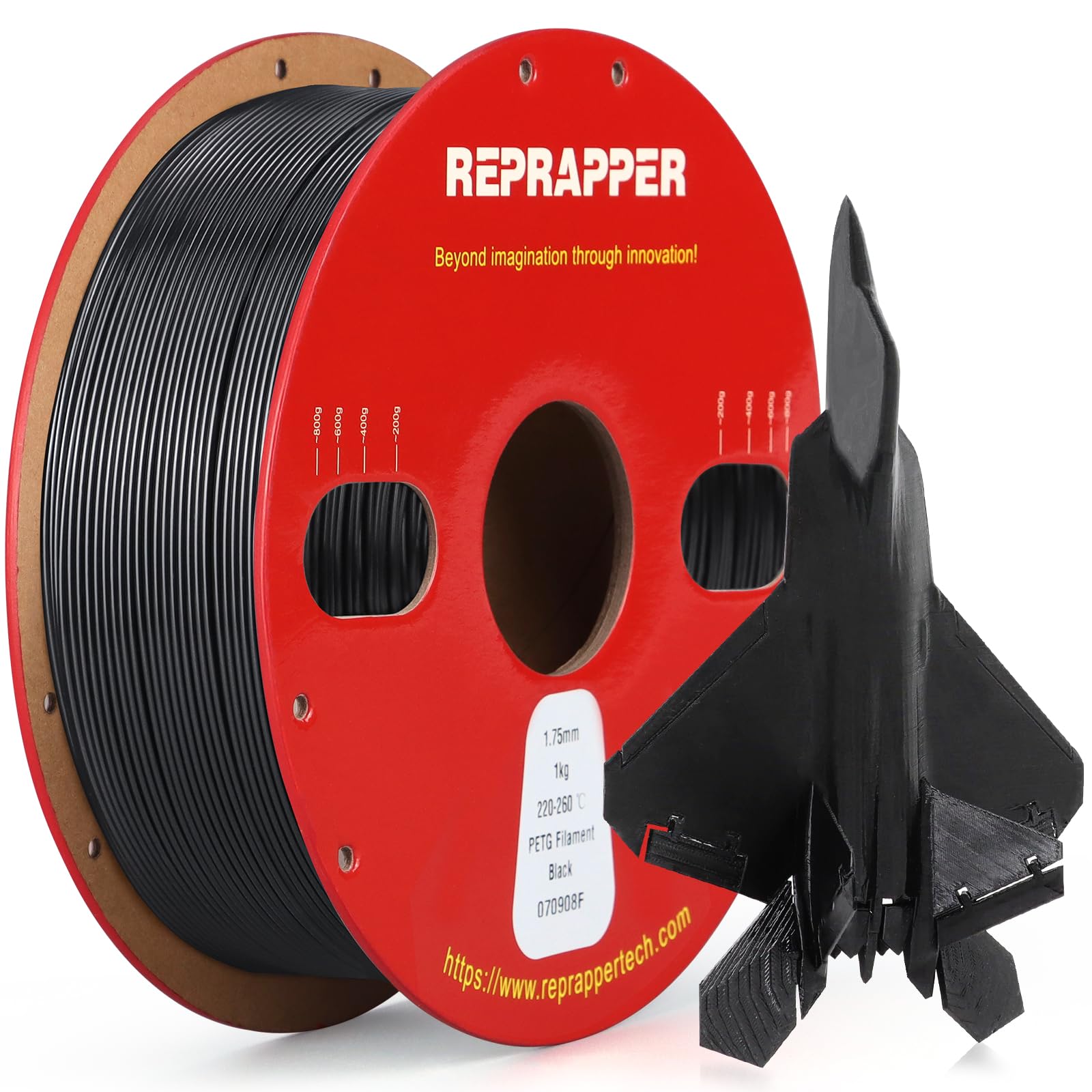
RepRapper PETG

79 /100
LBD Score Very Good

Key details

Material
PETG
Heat Resistance
Up to 75°C
Diameter Tolerance
±0.02 mm
Nozzle Temperature
230–240°C
View on Amazon

Not every outdoor part needs ASA. If you're printing a hose guide, a shaded planter, or a cover that never sees direct sun, PETG does the job with less trouble: it's tough, it shrugs off water, and it prints on an open machine with no chamber at all. What it won't do is hold its shape in heat. This spool states 75°C, the lowest ceiling in this guide, and PETG also chalks and fades under years of UV in a way ASA is formulated to resist.

Printing is as easy as the material gets: 230°C to 240°C nozzle, 60°C to 70°C bed, ±0.02 mm tolerance, and a profile close enough to PLA that your first print will probably come out. Ours did, with minimal stringing, which is much less than the PETG reputation warns about.

The catch arrives after a season. A PETG part in full sun will fade, and one that reaches 75°C under load will creep and sag, so a black part on a patio in July is exactly the wrong assignment. Stringing and the occasional snag in the wind are the other things to manage, and both calm down once the spool is dry and the feed path is short.

We keep it for shaded, low-load work where the part matters less than the budget: trellis clips, gutter spacers, plant labels. Anything going on a south-facing wall is worth the upgrade to ASA.

Pros

  • Cheapest spool in this guide
  • Prints on an open printer with no chamber
  • Tough and water resistant

Cons

  • 75°C heat resistance is the lowest here
  • Strings and can snag on the spool
Our verdict

The budget PETG route: fine for shaded, low-load outdoor parts, and the wrong choice for anything that sits in full sun or gets hot.

Check Latest Price

How We Tested: Eight Months, Sixteen Spools, One Backyard

To build the shortlist, I combed through ASA and PETG spools marketed for outdoor use and set aside anything without a stated UV or weather claim, anything with a diameter tolerance looser than plus or minus 0.05mm, and any spool too small for a long print. I kept a spread of price points too, since the cheapest outdoor filament stops being cheap once you count failed prints. That left 16 spools, white and black, which we ran for eight months.

Printing happened on enclosed and open FDM printers using the same profiles we'd use for a real job. Each spool started with a first-layer patch and a large flat plate, and we measured corner lift against a straightedge once it cooled — the fastest read on which spools wanted to warp. For layer adhesion we printed identical test bars and snapped them with pliers, noting whether they broke cleanly or peeled apart in sheets. We logged jams, stringing, and surface finish on every print, calipered filament at the start, middle, and end of each spool, and weighed each one to see how the net filament compared with the label.

Anything with a plausible job went outside: a hose hanger bolted to the fence, deck railing clips, a mailbox bracket, a solar light stake, and paired white and black coupons clipped next to an indoor control. Those parts sat through a summer of sun and rain, a stretch of 100-degree days, and a cold snap, and we checked them monthly for chalkiness, color shift, cracking along layer lines, and whether the hanger still held a full reel of hose.

How to Choose Filament for Outdoor Prints

ASA first, PETG second

ASA is ABS with the UV problem engineered out, and it's the default for anything that lives outside and carries load. PETG is the budget alternative: tougher on impact, easier to print on an open machine, but softer at a lower temperature and less stable under years of sun.

The heat figures in this group run from 75°C on the PETG to 100°C on our top pick, and that spread tells you more about where a spool belongs than anything on the front of the box. Shaded and low-load, PETG is enough. Sun and load, pay for ASA.

Read the heat number, then leave margin

Heat resistance is stated as a deflection temperature, the point where a loaded bar starts to give, not the point where the plastic melts. That distinction matters because a dark part in direct summer sun can run well above air temperature, so a 96°C spool on a black south-facing bracket is working nearer its limit than the number suggests.

Treat the figures as a ranking rather than a promise. Choose the highest ceiling you can justify for the location, then print the part in a light color if it will sit in the sun all day.

Plan for warp before you order

Every ASA here will lift at the corners of a large flat part if you let it, and the fix is environmental rather than chemical: an enclosure, a chamber kept warm, a bed at the hot end of the listed 80°C to 120°C range, and a brim on anything wide.

The trap is the phrase prints like PLA. It can, once the chamber is hot and the plate is clean, but not on an open printer in a cool room. If you have no enclosure, PETG is the forgiving route and a small part in ASA is the second-best compromise.

Spools, moisture, and color

The reel is a component when you print ASA. A standard spool can soften in a hot chamber, a heat-resistant one such as the SUNLU holds its shape, and the cardboard reel on the OVERTURE is easier to break down for recycling. Keep the desiccant that ships with the spool, and dry any filament that pops, strings, or looks misty on the surface.

On color, think about the sun. White and ivory stay cooler and hide dust, black hides layer lines but soaks up heat, and a matte surface disguises layer lines better than a gloss one.

Frequently Asked Questions

Final Verdict

The Polymaker spool takes the top spot because it gets the two things that decide an outdoor part right at once: the highest stated heat ceiling in this group and UV resistance that's the whole point of the material rather than a footnote. Everything else here is a specialization.

Buy the OVERTURE if you want a first ASA that behaves itself, the iSANMATE if the print is large and the budget is small, the IEMAI if the part must not flex, and the RepRapper PETG if the part lives in shade and you'd rather not run a chamber at all. Start with the temperature your part will actually see, then pick the spool.