Best Electric Guitars Under $500 of 2026

A cheap electric guitar used to be a gamble — sharp fret ends, a neck that fought your hand, tuning that sagged the first time you bent a note. That's changed. My team and I have spent the past six months with 12 electric guitars under $500, and the surprises ran the good direction: dressed fret ends, tuners that held through a whole rehearsal, finishes that don't announce their price.

What you're paying for isn't the spec sheet. Most of these share a pickup layout and a control plate; the real difference is setup, fretwork, and hardware that stays where you put it. A guitar that arrives in tune and stays there gets picked up — one that doesn't becomes a closet ornament by February.

Playability is where beginners get quietly discouraged, so that's where we spent the most time. Whatever you buy, budget for a setup; it's the cheapest upgrade in the category. Below are the ones we'd hand to a friend, first guitar or fifth.

1

Best Overall

Squier Debut Stratocaster

90 /100
LBD Score Outstanding

Key details

Weight
6.7 lb
Scale Length
25.5 in
Body And Neck
Poplar body, maple neck
Pickup Configuration
S-S-S
View on Amazon

At 6.7 pounds, the Debut Strat is light enough to hold through a long practice session, and the thin C-shaped neck gives a beginner's hand an easy place to start. The 25.5-inch scale and poplar body feel familiar rather than toy-like. The light weight is the first thing we noticed, because a first guitar has to be comfortable before it can be inspiring.

Three single-coil pickups and a five-way switch cover the classic Strat range: bell-like cleans, a little quack in the in-between positions, and enough bite for garage rock. It is not the guitar for tight high-gain rhythm, but it handles blues, funk, indie, and most of what a new player wants to learn. The tremolo works, and the controls are simple enough to understand in an afternoon.

The Debut is sold as the guitar alone, so you need to budget for an amp and a bag. That is also why it makes sense as the center of a setup rather than a box of accessories: the money goes into the instrument. Fender backs it with a two-year limited warranty and includes a Fender Play subscription, which gives a beginner a clear place to start.

What settles it for us is the neck and the weight. The guitar disappears a little when you play it, and that is exactly what a beginner needs. If you want one cable and one box, a kit makes more sense; if you want the best instrument to learn on, start here.

Pros

  • Light 6.7-pound body is comfortable for long practice
  • Thin C-shaped neck suits beginner hands
  • Classic Strat tones from three single-coils
  • Two-year warranty and Fender Play lessons

Cons

  • Tremolo can pull tuning sharp
Our verdict

The Debut Strat is our top pick for a first serious electric: light, comfortable, and built around classic Strat tones, with a two-year warranty. Add your own amp.

Check Latest Price
2

Best Complete Starter Kit

Donner DST-100S

93 /100
LBD Score Outstanding

Key details

Scale Length
648 mm
Body And Neck
Poplar body, maple neck
Included Accessories
Amp, bag, tuner, capo, strap, cable, picks, extra string
Pickup Configuration
H-S-S
View on Amazon

The DST-100S is the closest thing here to a one-box start. Inside are the guitar, a mini amplifier, a 600D bag, a capo, a strap, an extra string, a digital tuner, a cable, and picks. We appreciate that completeness because a missing cable or tuner is enough to stop a first practice before it starts. The H-S-S pickup layout adds a humbucker at the bridge, so it can move from clean chords to thicker rock tones.

The 39-inch body, Canadian maple C-shaped neck, and purpleheart fingerboard make it feel like a familiar Strat-style guitar rather than a scaled-down toy. The 22 copper-nickel frets and simple volume and tone controls are easy to live with. We noticed the guitar itself is the steady part of the package; the extras are there to get you started.

For a beginner who wants everything in one order, the value is hard to beat. The H-S-S layout covers clean chords and thicker rock tones, and the included bag and capo mean fewer separate purchases. It is not the last guitar you will own, but it removes the friction that stops a lot of first attempts.

Pros

  • Complete kit includes amp, bag, tuner, and capo
  • H-S-S pickups cover clean and rock tones
  • 39-inch maple-neck guitar feels familiar
  • Strong value for a first setup

Cons

  • Included amp can stop working
  • Digital tuner is not the easiest to use
Our verdict

For a first-timer who wants to plug in the day the box arrives, the DST-100S is the most complete package we recommend; treat the amp as a starter extra.

Check Latest Price
3

Best for Rock and Metal

Ibanez GRX20Z

92 /100
LBD Score Outstanding

Key details

Bridge
T106 tremolo
Weight
9 lb
Scale Length
25.5 in
Pickup Configuration
Two humbuckers
View on Amazon

If your playlist leans toward distorted chords rather than clean Strat chime, start with the GRX20Z. Its two humbucking pickups give it a thicker, fuller voice than the single-coil guitars here, and the basswood body and 25.5-inch scale put it in familiar rock-guitar territory.

The T106 tremolo is a basic unit, but the guitar feels solid and the action is easy. We found the neck comfortable for both barre chords and single-note runs, and the simple pickup layout is forgiving under gain. We think it is the best hard-rock starting point in this set.

The reward is a stable, substantial feel and a tone that sits well with distortion. If you want clean sparkle, look elsewhere; if you want to plug into a dirt channel and riff, this is the one. The dual-humbucker design also means fewer switches to learn, which suits a beginner who prefers playing to fiddling.

Pros

  • Dual humbuckers deliver thicker rock tone
  • Comfortable, easy-playing neck
  • Solid feel for the money
  • Simple controls suit beginners

Cons

  • Nine pounds can wear on a long standing session
  • No amp or gig bag included
Our verdict

We recommend the GRX20Z to rock and metal beginners who want humbucker punch and a solid feel; it is the most direct route to a heavy sound in this set.

Check Latest Price
4

Best Semi-Hollow for Blues

Grote MG-404

90 /100
LBD Score Outstanding

Key details

Body
Semi-hollow basswood
Frets
22 stainless steel
Scale Length
24.75 in
Pickup Configuration
P-90
View on Amazon

A semi-hollow body with P-90 pickups is an unusual find in this group, and that is exactly why the Grote earns a place. The basswood body and maple top give it a warm, resonant voice, while the 24.75-inch scale and 22 stainless steel frets make it feel friendly under the fingers.

We were struck by how much guitar it looks like for the money. The P-90 pickups sit between single-coils and humbuckers: clear and punchy, with a little grit when you push the amp. That makes the Grote a natural for blues, roots, indie, and classic rock. It is not the choice for tight modern metal, and the hollow body will feed back at high volume, but that is the nature of the design.

The setup is the gamble. Some arrive close to ready, while others need a truss-rod tweak, a string change, or a few minutes of fret-end attention. We treat that as part of buying an affordable semi-hollow, not a dealbreaker. The tuners are the other weak spot; they work, but they are not the most precise.

Pros

  • Warm semi-hollow voice with P-90 bite
  • 24.75-inch scale feels friendly
  • 22 stainless steel frets
  • Distinctive looks for the money

Cons

  • No manufacturer warranty listed
Our verdict

Our pick for blues and roots players is the Grote: its semi-hollow body and P-90 pickups give it the most distinctive voice in this group.

Check Latest Price
5

Lead and Metal

Ibanez GRG131DX

90 /100
LBD Score Outstanding

Key details

Frets
24 jumbo
Bridge
F106 fixed
Scale Length
25.5 in
Pickup Configuration
Two Infinity R humbuckers
View on Amazon

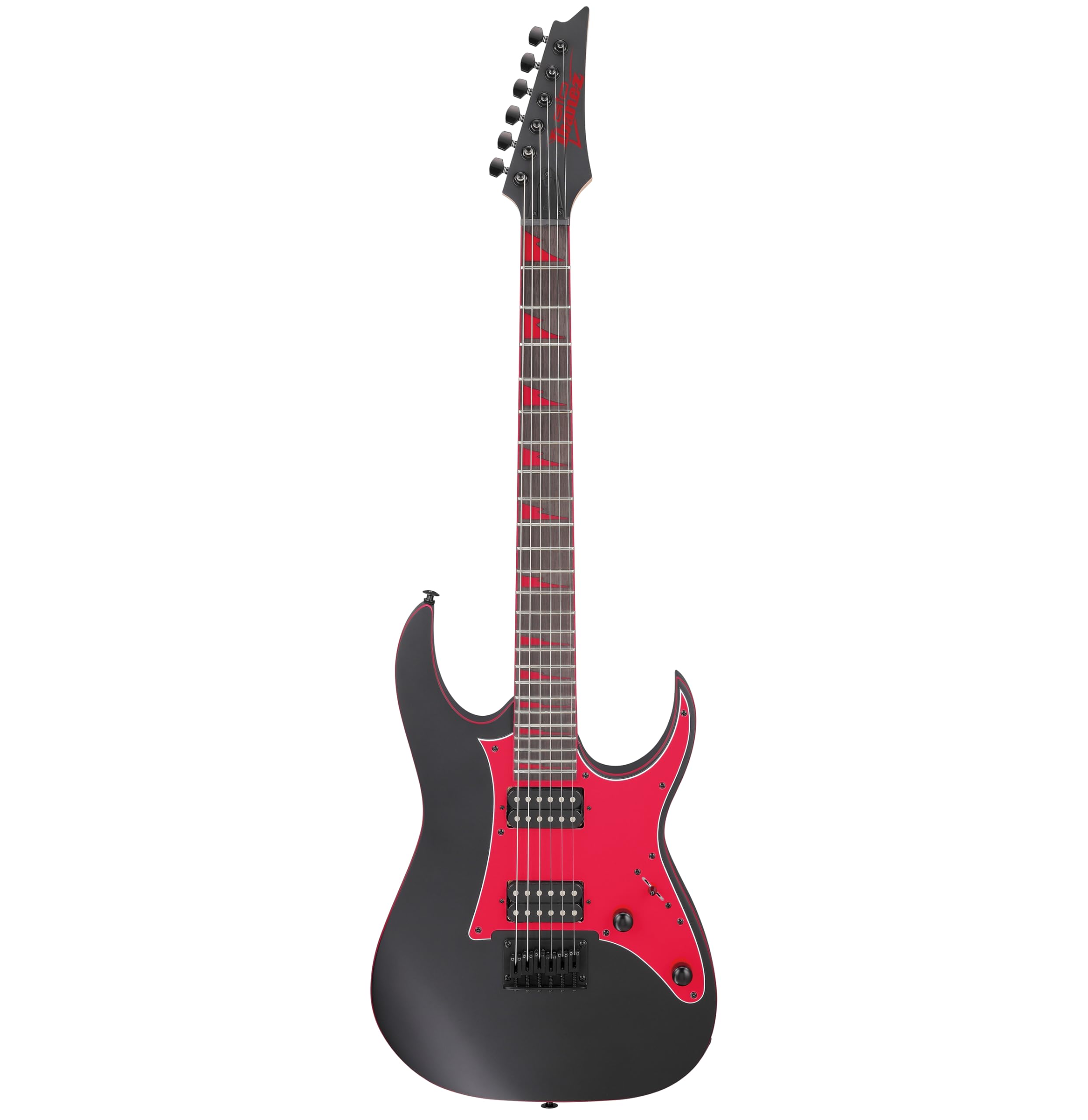
Twenty-four frets is the first clue that the GRG131DX is built for lead playing. The high-output Infinity R humbuckers and five-way selector give it more tonal options than the simpler rock guitars here, and the flat black finish with red sharktooth inlays gives it a stage-ready look.

The neck is fast and the upper fret access is the point. We found it encouraging to move up the board, and the fixed bridge keeps the tuning side of things simple. The pickups push an amp harder than the single-coil guitars, which is useful for metal and hard rock without a pedal board full of gain.

For a player who wants to learn lead lines, the 24-fret board and hotter pickups are a meaningful step up from the GRX20Z. The factory setup can be uneven, so check the action and intonation when it arrives. It is a focused guitar rather than an all-rounder, and that is why it earns its place.

Pros

  • 24 jumbo frets for lead playing
  • High-output Infinity R humbuckers
  • Five-way selector adds tonal options
  • Fixed bridge keeps tuning simple

Cons

  • No amp or bag included
  • Factory strings may need changing
Our verdict

The GRG131DX is our pick for a player who wants to learn lead guitar and heavier styles; the 24-fret neck and hot humbuckers make it feel purpose-built.

Check Latest Price
6

Hardtail Beginners

Squier Debut Telecaster

87 /100
LBD Score Excellent

Key details

Bridge
Hardtail
Weight
6.7 lb
Scale Length
25.5 in
Pickup Configuration
S-S
View on Amazon

The Telecaster's hardtail bridge is the reason to choose it over the Strat if you never use a tremolo. Fewer moving parts mean fewer ways for tuning to wander, and the two single-coil pickups deliver the bright, snappy twang that defines the model. The layout is simple: one switch, two knobs, and a guitar that asks you to play rather than adjust.

The satin urethane finish and lightweight poplar body make it comfortable, and the slim C-shaped neck is easy for smaller hands. The fret ends are the first thing to check. A sharp edge can cut a fretting hand, and some arrive needing a few minutes with a file. That is a fixable annoyance, but it is worth inspecting before the return window closes.

The Debut Tele is not as flexible as the Strat for tremolo effects or high-gain rock, but it is the more stable and simpler guitar for a beginner who wants a bright, clean sound. What we appreciate most is the two-year limited warranty, which is the same coverage Fender gives the Strat.

Pros

  • Hardtail bridge helps tuning stability
  • Classic Tele twang from two single-coils
  • Lightweight poplar body and slim C neck
  • Two-year limited warranty

Cons

  • No amp or gig bag included
Our verdict

For beginners who want a hardtail, bright twang, and fewer moving parts, the Debut Telecaster is the Squier we point to first.

Check Latest Price

How We Chose and Tested a Dozen Electric Guitars Under $500

We started with a long list of about 40 guitars from the brands that dominate this price bracket, then cut anything that was out of stock everywhere, priced past $500 once shipping was added, or built in a size that wouldn't suit an average adult. That left 12: solid-body and semi-hollow, standalone and starter-kit.

Testing ran across six months, and each guitar got the same first day — fresh strings, tuned with a clip-on tuner, then twenty minutes of bends and chord work while I noted how far the pitch drifted. Then it went into a gig bag, rode in a trunk to rehearsal, and came back out the next morning for a re-check. I turned every tuner through its full range by hand to feel for wobble, and wiggled each selector and knob listening for crackle.

Fretwork got hands-on scrutiny: I ran a fingertip along both edges of every fretboard hunting for sharp ends, bent strings at the 12th fret until they choked out, and measured action height there with a ruler. Then I handed each guitar to two people who had never played a barre chord and watched them try, since beginner-friendliness doesn't show up on a spec sheet.

For sound, we played each guitar clean through a small practice amp and dirty through a modeling amp, listening for hum, mud, and whether the bridge pickup stayed usable with the tone rolled back. Looks we judged in daylight and under a lamp at night; a few finishes photographed well and looked flat in person. Value came last — we weighed price against what each guitar still needed to be gig-ready, because a cheap guitar that wants fretwork and a setup isn't cheap.

How to Choose an Electric Guitar

Start with the Neck and Setup

We put neck comfort ahead of pickup count. A guitar can have great pickups and still be a chore if the neck is uncomfortable or the action is too high. Look for a C-shaped or slim profile that fills your hand without cramping it, and check the fret ends for sharp edges before the return window closes. Scale length matters too: 25.5 inches feels familiar for Strats and Teles, while 24.75 inches makes bends a little easier. Budget for a setup if the action or intonation is off; it is the best money you can spend on a beginner instrument.

Match the Pickups to Your Music

Single-coils give you the bright, glassy Strat and Tele sounds; humbuckers are thicker and quieter under gain; P-90s sit in between with a little more grit. An H-S-S layout is the flexible choice if you want one guitar for clean chords and rock, while a dual-humbucker guitar is the more direct route to metal. We think beginners should choose the voice that matches the music they actually play, not the one with the most switching options.

Decide Between a Kit and a Guitar

A starter kit removes the guesswork: the Donner DST-100S includes an amp, bag, tuner, capo, strap, cable, and picks, so you can plug in on day one. The trade-off is that the included amp and accessories are basic. If you already have an amp or want a better instrument for the same total outlay, buy the guitar alone and choose the extras yourself. We prefer the second route when the guitar is the part you want to keep.

Tremolo, Hardtail, and Tuning Stability

A tremolo lets you add vibrato and dive effects, but it also adds parts that can pull the guitar out of tune. A hardtail bridge is simpler and usually more stable, which is why the Squier Debut Telecaster is a smart first choice if you never use a whammy bar. If you do want a tremolo, plan to retune after heavy use and check the nut and tuners. We favor a hardtail for a first guitar unless the player specifically wants tremolo.

Leave Room for an Amp and Upkeep

The guitar is only part of the cost of playing. A practice amp, a spare cable, a strap, and a couple of sets of strings add up, and a professional setup can transform a budget instrument. We tell new players to spend less on gadgets and more on a comfortable neck and a reliable amp. If the budget is tight, a complete kit gets you started; if it stretches, a better guitar and a separate amp will serve you longer.

Frequently Asked Questions

Final Verdict

The Squier Debut Stratocaster is the guitar we recommend first. It is light, comfortable, and built around the classic Strat tones that suit most beginners, and the two-year warranty adds peace of mind. If you need a complete setup in one order, the Donner DST-100S is the practical alternative. If your music is heavier, the Ibanez GRX20Z is the better match for humbucker punch.