Best Electric Callus Removers of 2026

Every spring I dig out my sandals, look at my heels, and wince. Sneakers and barefoot laps around the kitchen have left me with skin that snags on socks, and an electric callus remover is the fix — a couple of minutes of spinning grit and your heels are smooth again. The wrong one either stalls against thick skin or takes off more than you wanted.

I've filed my own feet for years, and over the past four months my team and I have lived with 14 of these, from battery-powered models that live in a drawer to rechargeable ones with interchangeable roller heads. What separates them isn't the motor spec on the box. It's whether the battery makes it through both feet, whether the roller is aggressive enough to work and gentle enough to reach for again, and whether replacement heads still exist when the grit goes flat.

Here are the ones that earned a spot in my cabinet, judged on how my heels looked and felt afterward — not on how many attachments came in the box.

1

Best Overall

Elmchee Rechargeable Callus Remover

93 /100
LBD Score Outstanding

Key details

Heads
3 quartz-sand rollers
Speeds
2
Power Source
Rechargeable, 1200mAh
Waterproof Rating
IPX7
View on Amazon

The Elmchee's motor cuts out the moment you lean on it. That reads like a fault until you have spent five minutes grinding a heel with a tool that does not stop — the roller grabs, the skin warms up, and you are the one deciding when to quit. Here the file decides for you, and you learn inside one pass to let the grit work instead of your arm.

That is the detail that settled it for us. Three quartz-sand heads cover coarse, medium and fine; IPX7 means the whole body goes under the tap afterward; and the 1,200mAh battery carries a charge readout on the face, so you know where you stand before you sit down. Of the files in this guide, it is the most complete out of the box.

In use, the low speed handled weekly upkeep and the high speed took a first pass at a rough heel without the sting we braced for. The fine head is the one people skip and it is the one that matters: a minute of it after the coarse pass is what takes a heel from filed to smooth. Ours arrived with charge in it, so we used it the day it landed rather than the day after.

What it will not do is rescue a rock-hard heel in one sitting. Ours took a few weekly passes before the skin stopped catching on sheets, which is normal for a file this size and worth knowing before you decide it is not working. The 8-ounce body sits in the hand like a large computer mouse — steady on a heel, a bit blunt working around the arch.

Pros

  • Three grits, from coarse to polish
  • IPX7 body rinses under the tap
  • Charge readout on the front
  • Motor stops before you over-sand

Cons

  • No spare head in the box
Our verdict

We recommend the Elmchee to almost everyone: three grits, a body that rinses clean, and a motor that stops before you overdo it, in a size that is easy to hold.

Check Latest Price
2

Best Roller Selection

IWEEL Electric Foot File

93 /100
LBD Score Outstanding

Key details

Heads
5 roller heads
Display
LCD battery readout
Power Source
Rechargeable, USB
Waterproof Rating
IPX7
View on Amazon

Two of the IWEEL's five roller heads are coarse, and that is the reason to pick it over our top pick. The head you wear out first is the aggressive one, so a second coarse roller roughly doubles the working life of the kit before you go looking for refills.

Everything else is close to the Elmchee: two speeds, the same rinse-clean IPX7 shell, and a fine plus two regular heads for finishing. What it adds is the LCD strip on the front, which shows the charge left without a guess. Small thing, but it is the difference between starting a session and starting a charging cable.

It is heavier at 10.2 ounces, which we did not mind on a heel and did notice working around the arch, and the roller takes a beat to bite before it starts cutting. Neither is a reason to skip it — both are reasons to hold it loosely and let the speed do the work rather than bearing down.

Pros

  • Five heads, two of them coarse
  • LCD shows charge remaining
  • IPX7, so it rinses clean

Cons

  • Motor can quit within a few months
Our verdict

If you want the widest choice of grits, this is it: two coarse rollers, a charge readout on the body, and the same rinse-clean shell as our top pick.

Check Latest Price
3

Best for Travel

Dr. Scholl's Electric Callus Remover

91 /100
LBD Score Outstanding

Key details

Head
360-degree rotating roller
Format
Compact travel size
Power Source
4 AAA batteries included
View on Amazon

If your bathroom already has three chargers plugged into it, the Dr. Scholl's file asks for nothing but four AAA batteries — and they come in the box. It is the smallest tool here, and the rotating head is narrow enough to sit on one callus, the one on the side of a toe say, instead of skating across the whole heel. It pulls as it turns, so you steer it rather than press it, and the head brushes clean in a few seconds.

This is the one that goes in the bag. No cable, no adapter, no waiting for a charge, and replacement batteries come from any drugstore, which matters more on a trip than raw power does. Because power is what you give up: it is a maintenance tool, good for keeping on top of skin between pedicures, and it makes slow work of a heel that has been hard for years. For a fortnight away, that is the right trade.

Pros

  • Batteries included; no charger to pack
  • Narrow head targets a single callus

Cons

  • AAA batteries run down with regular use
Our verdict

For a bag, a hotel room, or a drawer with no free outlet, this is the file we pack: batteries in the box, nothing to charge, and enough power for upkeep.

Check Latest Price
4

Best for Gentle Filing

Amopé Pedi Perfect

89 /100
LBD Score Excellent

Key details

Head
Extra-coarse diamond-crystal roller
Safety
Integrated pressure stop
Speeds
2
Power Source
4 AA batteries included
View on Amazon

Amopé sets its roller with diamond crystals rather than quartz sand, and the difference shows in the surface it leaves: a fine, even scuff instead of a coarse one. Add the integrated safety stop and it is the one we hand to anyone nervous about taking too much skin off.

The stop is the part to understand before you buy. Lean on the handle and the roller simply halts — a design feature, not a fault — which means you cannot rush a hard heel. Two speeds give you a slower pass for the first go and a quicker one for upkeep, and the extra-coarse roller in the box is where to start. It is splashproof rather than waterproof, so rinse the head and dry it; this is not a shower tool.

What you get in exchange is the most controlled file in this group. It takes longer, it does not grab, and it is forgiving on the thin skin at the edge of a heel where the faster tools can sting. Anyone who has over-sanded with a rasp and felt it for two days will recognise what that is worth.

Pros

  • Diamond-crystal roller cuts evenly
  • Safety stop prevents over-sanding
  • Two speeds, splashproof body

Cons

  • Battery-only; no rechargeable version
Our verdict

It is the one we hand to anyone worried about taking too much skin off; the diamond roller and the safety stop make a slow, controlled job of it.

Check Latest Price
5

Best Corded

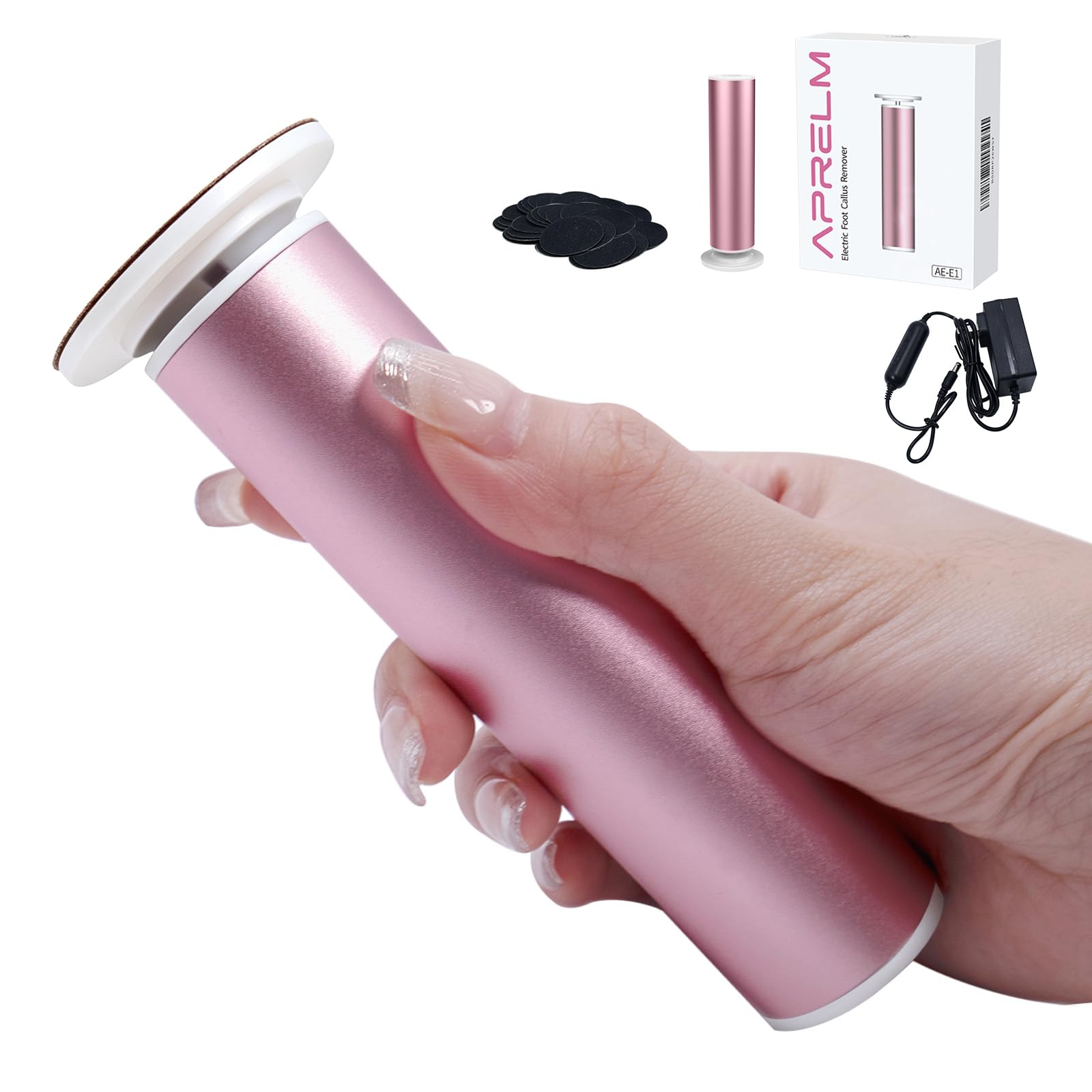
APRELM Electric Foot File

89 /100
LBD Score Excellent

Key details

Body
Aluminum alloy
Discs
60 sandpaper discs, 3 grits
Speed
Stepless, up to 800 rpm
Power Source
Corded
View on Amazon

There is no battery inside the APRELM, and that is most of the argument for it. A cordless file that stops holding a charge is a drawer ornament; a corded one has one fewer thing to fail. The body is sandblasted aluminum and 4.8 inches long, so it sits in the hand like a fat pen, and the whole thing weighs 8.8 ounces.

Instead of molded rollers it uses sandpaper discs — 60 of them, 20 each in 80, 120 and 180 grit — that press on and peel off. That changes how you work: start at 120 on an ordinary heel, drop to 80 for the stubborn patch, finish at 180, then throw the disc away. The speed dial is stepless up to 800 rpm, so you can slow it right down at the end rather than lurching between two settings.

It suits a bathroom with a free outlet and a heel that needs real work; for travel, take a battery model. The discs are also why it is easy to keep clean — peel the used one off and there is no grit packed into a roller.

Pros

  • No battery to lose its charge
  • 60 discs across three grits
  • Stepless speed up to 800 rpm

Cons

  • Needs an outlet within reach
Our verdict

For anyone done with batteries: a cord you never think about, discs in three grits, and a dial you can fine-tune in the middle of a pass.

Check Latest Price
6

Long Sessions

CIVYPRO 13-in-1 Pedicure Kit

93 /100
LBD Score Outstanding

Key details

Kit
13-piece pedicure set
Runtime
Up to 90 minutes
Power Source
Rechargeable, 1200mAh
Waterproof Rating
IPX7
View on Amazon

Thirteen pieces arrive in the CIVYPRO box, and the file is the part that earns its place. The stainless add-ons — small clippers, a cuticle tool, a brush — are the sort of thing that ends up at the back of a drawer by the second week.

The file itself is a serious bit of kit: a 1,200mAh battery rated for up to 90 minutes, a charge in about an hour and a half, IPX7 so the body rinses under the tap, and two speeds. Both feet on one charge, with enough left that we stopped checking.

The thing to sort out before you commit is where replacement rollers come from. The roller is the part that wears, and the ones that fit this model take some tracking down — worth doing at the same time you buy the tool rather than the week it goes bald.

Buy it as a well-made file that happens to come with a kit, not as a pedicure set that includes a file, and the arithmetic makes sense. Of the bigger packages here, this is the one whose motor and shell we trust for a long session.

Pros

  • Up to 90 minutes per charge
  • IPX7 body rinses clean
  • Two speeds and fast charging

Cons

  • Add-on tools feel flimsy
  • LED is too dim to be useful
Our verdict

A strong file with a kit attached: buy it for the file and the 90-minute runtime, and treat the extra stainless tools as a bonus.

Check Latest Price
7

Small Spaces

Haootadiy Electric Callus Remover

92 /100
LBD Score Outstanding

Key details

Kit
File plus 12-in-1 tool set
Heads
2 roller heads
Speeds
2
Weight
3.53 oz
View on Amazon

The Haootadiy weighs 3.5 ounces, and you notice that before you notice anything about how it files. Held between two fingers it is light enough to keep at heel height for a whole session without your wrist complaining, and the whole lot — file, second roller, 12-in-1 stainless tool set — drops into the storage bag it ships with.

Two speeds, a rough head and a fine one, and a USB cable: the spec list is short, and that is fine. The stainless tools handle the edges and the nail sides, the places a roller cannot reach, and having them in the same bag is the reason this one gets packed rather than left at home.

This is the one for a gym bag, a carry-on or a guest bathroom drawer, and for anyone who finds a heavier file tiring to hold at the angle a heel needs. It has lived in a toiletry bag since the second week, which is the highest compliment we can pay something this small.

Pros

  • 3.5-ounce body is easy to hold
  • Storage bag keeps the kit together
  • Two rollers and two speeds

Cons

  • Light build; a drop could finish it
  • Charge does not always hold
Our verdict

Light, tidy and easy to hold at heel height, this is the kit we keep in a gym bag or a guest bathroom rather than on a shelf at home.

Check Latest Price
8

Shower Use

Essy Electric Foot File

89 /100
LBD Score Excellent

Key details

Heads
5 rollers, 3 grits
Safety
Pressure-lock auto-stop
Runtime
Up to 120 minutes
Charging
USB, 90 minutes
View on Amazon

Five rollers come in the Essy box, and the finest of them is gentle to the point of doing almost nothing. On a heel that needs work, that is not a fault — it is the head you finish with, after a normal or coarse one has taken the hard layer down. Start at fine and you will conclude the tool is weak; work down to it and it is the pass that leaves skin smooth rather than scuffed.

The rest of the design is aimed at people who want to be careful. The pressure lock stops the roller when you push, the two speeds sit under a thumb, and the motor is quiet enough to use while something else is going on in the room.

It is fully waterproof rather than merely rinseable, and 90 minutes on the charger buys up to 120 minutes of running — the longest per charge in this guide. Do the work over the tub or on a towel; the dust goes everywhere.

If your feet are sensitive, or you want one tool that lives by the bath and needs charging a handful of times a year, this is the pick. Five rollers mean the coarse one stays reserved for the heel while the fine one handles the parts that would sting with anything else.

Pros

  • Up to 120 minutes per charge
  • Fully waterproof; wet or dry use
  • Five rollers in three grits

Cons

  • Some units stop working within weeks
Our verdict

If you want to file over the bath and charge it rarely, this is the pick; five rollers give you a gentle pass and a serious one.

Check Latest Price

How We Tested 14 Electric Callus Removers

We started by rounding up every model we could find with replaceable rollers or grinding heads — if the grit wears out and you can't buy a refill, the tool is disposable, which is a bad deal at any price. From there we narrowed by charging setup and how the head is covered, and ended up with 14 units we handed out to testers with very different feet: thick heel calluses, thin skin that marks easily, and one person who only ever needs work on the sides of the big toes. Testing ran four months, long enough for each of us to wear through at least one roller.

Most of the work happened after showers, on Saturday mornings, and in the weeks before anyone's first sandal day. We worked on heels, the balls of the feet, and toe edges, counting passes until the skin felt smooth to the back of a hand and stopping the moment anything stung. We noted which tools bogged down and stalled under light pressure — a slow-spinning head on thick callus was the most common letdown — and which ones had a second, higher speed that held up instead of just buzzing louder.

Battery life got its own log. Each tester wrote down how many full foot sessions they got per charge or per set of batteries, and whether the unit died mid-heel. We rinsed the waterproof ones under a running faucet, dried them, and checked the roller housing for trapped water and grit. Durability came down to the rollers themselves: we tracked how many sessions passed before the grit went slick, and priced refills so we knew what a year of smooth heels would actually cost. The ones we kept reaching for after the test ended, without thinking about it, were the ones that felt least like a chore.

How to Choose an Electric Callus Remover

Start With Where You'll Use It

The room decides the power source. A rechargeable file is the most capable thing to keep in a bathroom, but the cell is its weak point — a tool that stops holding a charge is finished, and that is how most of these end up in a drawer. A corded model like the APRELM sidesteps it entirely, at the cost of an outlet within reach. AAA models such as the Dr. Scholl's file trade power for portability: less torque, but fresh batteries come from any drugstore. Pick by room first, then by specification.

Match the Grit to the Heel

Almost every file here ships with a rough, a medium and a fine head, and the common mistake is starting rough and staying there. Work down instead: coarse to take the hard layer off, medium to even it out, fine to polish. The heads wear, too — a bald roller spins without cutting — so check the grit before you blame the motor. Two coarse heads in the box, as on the IWEEL, means the grit you use hardest has a spare.

The Auto-Stop Is Doing Its Job

Most models in this guide cut out when you push, and that is the tool telling you that you are using pumice-stone pressure on something that wants light passes. If your callus is thick and your patience is not, the stop feels like an obstacle; a corded file with an aggressive disc gets through faster. If you are the type to keep going until it feels smooth, the stop is worth more than the speed it costs.

Rinsing, Dry Sanding, and the Part That Wears

Waterproofing is usually about cleaning rather than soaking. IPX7 means the body can go under the tap; splashproof models like the Amopé should be wiped and dried instead. Sand dry skin unless the maker says otherwise — a soaked heel clogs the grit and hides what you have taken off. Before you buy, work out where replacement rollers or discs come from, because heads wear out in months and a tool with no refills is a disposable.

Frequently Asked Questions

Final Verdict

Our pick is the Elmchee. It is the most complete file in this group — three grits, a body you can rinse, a charge readout, and a motor that stops before you take too much off — and there is no technique to learn beyond letting it do the work.

The IWEEL is the one for a spare coarse roller and a charge display, the Dr. Scholl's file is the one for a bag rather than a bathroom shelf, and the APRELM suits anyone who would rather not own another battery at all.