Best Electric Pizza Ovens of 2026

A standard kitchen oven tops out around 500°F, and that ceiling is what makes homemade pizza disappointing — the crust sets before it can puff, and the cheese dries out before the bottom chars. A countertop electric oven fixes that by parking a stone over a dedicated element and pushing it past 800°F, which turns out a 12-inch pie in a few minutes.

My team and I have cooked through 11 of these ovens over the past eight months — weeknight pies from store-bought dough, weekend cold-fermented rounds, frozen backups. The number on the dial mattered far less than whether the stone held heat evenly from edge to center, and whether the top element could be turned down when the cheese raced ahead of the crust.

Nearly all of them now ship with a stone and a peel, and most offer presets, which help on a Tuesday night but won't beat knowing your own oven for a pie or two. Here's what earned the counter space.

1

Best Overall

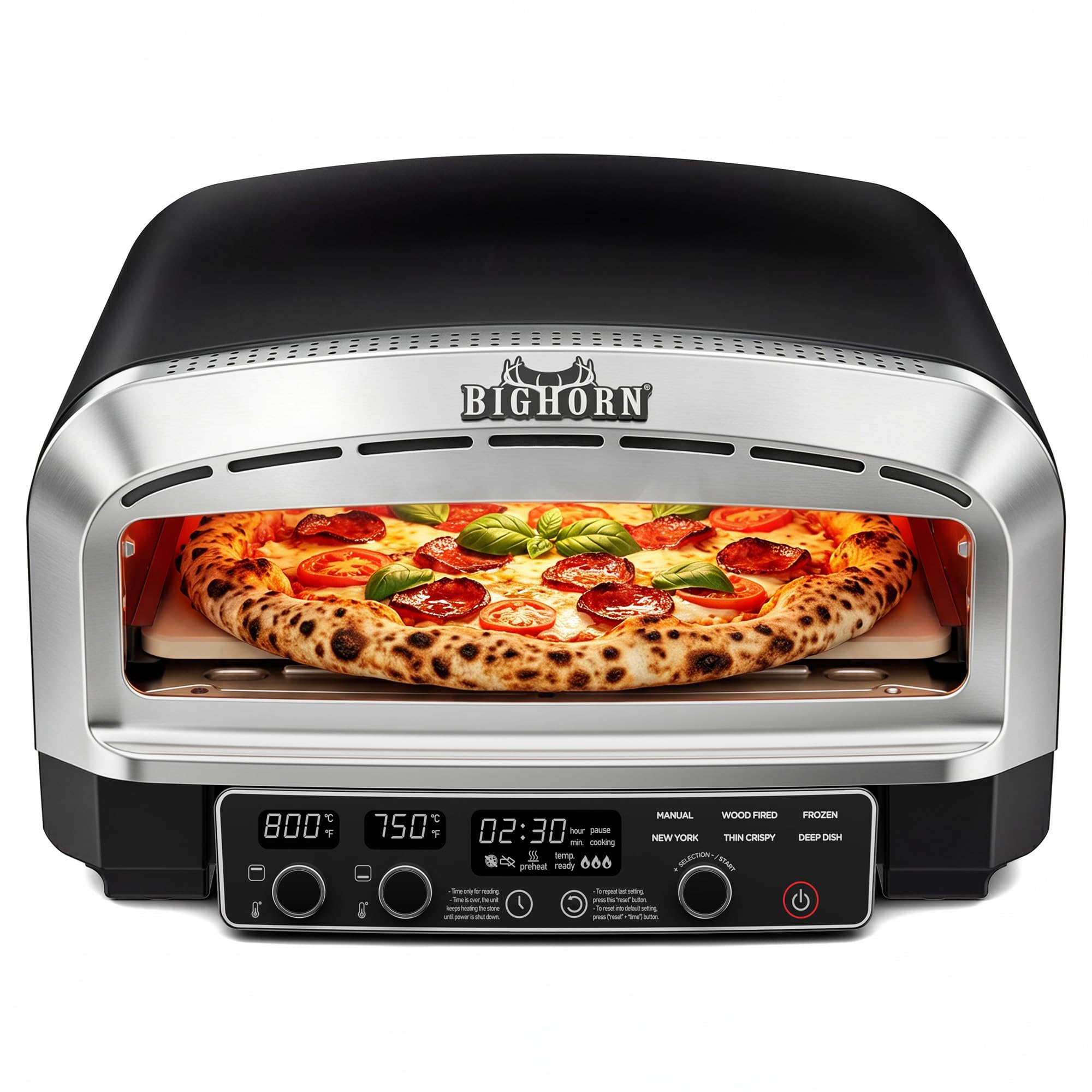
BIG HORN 14-Inch Indoor Pizza Oven

85 /100
LBD Score Excellent

Key details

Presets
6
Dimensions
20.31"D x 18.86"W x 10.44"H
Pizza Size
14 inches
Max Temperature
850 °F
View on Amazon

Fourteen inches is where this one starts, and nothing else here comes close. Every other pick tops out at 12, and those two inches are the difference between a pizza that feeds one person and one you can put in the middle of the table. It's also the hottest oven in this set at 850°F, and the only one with PID control, which holds the temperature you chose instead of cycling around it. Big stone, high heat, steady heat — that's why it's the one we recommend first.

The six presets — Manual, Wood Fired, Frozen, New York, Thin Crispy, Deep Dish — are more useful than preset menus usually are, mostly because Manual hands the top and bottom elements to you separately. A Neapolitan wants a hard blast from below and a gentler top; a deep dish wants the reverse. Setting those independently at a temperature the oven actually maintains is what makes the fifth pizza as good as the first, and the stone lifts out in one piece when you're finished.

The trade-off is real estate: this wants microwave depth rather than toaster depth, so measure the run of counter you have in mind before you commit. The flip-up body helps, since folded the footprint is roughly half, and that's the difference between a permanent resident and something that goes back on the shelf between pizza nights. Once it's hot it stays hot, and it works through a queue of dough balls without much recovery time between pies.

The peel in the box is serviceable, though a second one makes back-to-back pies easier. And the capacity only pays off if you actually cook 14-inch pizzas; for two people sharing one pie at a time, a 12-inch oven here does the same job in less space.

Pros

  • Fits 14-inch pizzas, the largest here
  • 850°F with separate top and bottom heat
  • PID control holds a steady set temperature
  • Flip-up body roughly halves the footprint

Cons

  • Largest counter footprint in this set
  • Preheat runs past the stated 15 minutes
Our verdict

We think it's the best electric pizza oven in this guide for anyone cooking full-size pies: 14 inches of stone, 850°F, and top and bottom heat that stays where you set it.
Check Latest Price
2

Best for Small Kitchens

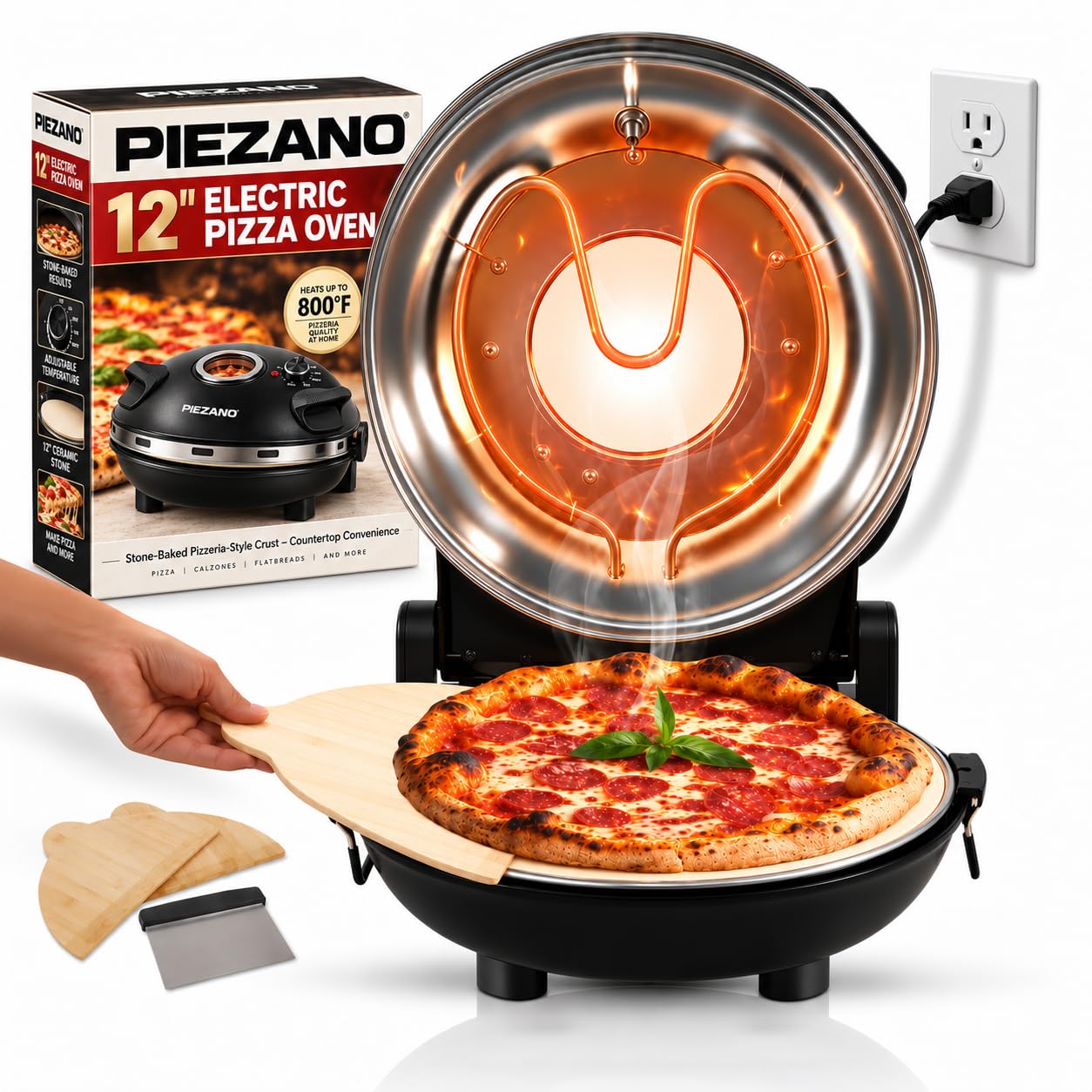
PIEZANO 12-Inch Electric Pizza Oven

86 /100
LBD Score Excellent

Key details

Weight
8.3 lb
Pizza Size
12 inches
Heat Control
Separate top and bottom knobs
Max Temperature
800 °F
View on Amazon

PIEZANO is the oven we suggest to anyone who wants to find out whether high-heat pizza is for them without turning it into a project. You get a 12-inch ceramic stone, an 800°F ceiling, separate knobs for the top and bottom elements, and a glass window with a lid thermometer — the full set of things that matter — in a body that weighs 8.3 pounds and stands about six and a half inches tall. It goes on the shelf with the stand mixer when the counter has to be a counter again.

The two knobs are why it earns a place. Run the bottom hot and the top moderate and you get a crisp underside with cheese that's melted rather than carbonized, which is the trick that separates a pizza oven from a hot box. The stone is real ceramic rather than a coated plate, and it pulls moisture out of the dough instead of steaming it. We also came to appreciate the window more than we expected: checking the pie through glass beats opening the door and dumping 800 degrees onto your forearms.

What you're accepting is unevenness. The stone runs hotter in the middle than at the edges, so plan on turning the pie once and start checking the underside early on your first few bakes, because the crust goes from golden to scorched faster than a wall oven teaches you to expect. Cheese that slides off the crust and lands on the stone will smoke, so scrape it between pies. And the exterior gets genuinely hot while it runs; load with the paddles and keep small hands back from the front of the counter.

Pros

  • Real ceramic stone, not a coated plate
  • Separate top and bottom heat knobs
  • Window and lid thermometer for checking the bake
  • 8.3 pounds, light enough to store

Cons

  • Uneven stone heat; pies need turning mid-bake
Our verdict

Our pick for a first stone oven: it reaches 800°F with separate top and bottom knobs, as long as you'll turn the pie and watch the base.

Check Latest Price
3

Best for Frozen Pizza

Presto Pizzazz Plus Rotating Oven

95 /100
LBD Score Outstanding

Key details

Tray
Continuous rotating nonstick pan
Weight
7.6 lb
Pizza Size
12 inches
Heat Control
Separate top and bottom elements
View on Amazon

The first thing that happens with the Pizzazz Plus is that nothing happens: no preheat, no stone to soak, no waiting around. You set a frozen disc on the nonstick pan, choose the top element, the bottom element, or both, and the pan starts turning. That rotation is the whole idea. The pie passes under the top element and over the bottom one at a steady rate, so it browns evenly without anyone opening anything to spin it. Ours came out with a crisp base and properly melted cheese, which is more than the same supermarket pie manages in a wall oven.

What it isn't is an 800-degree oven. Heat comes from elements above and below rather than from a soaked stone, so you get an even, crisp bake instead of a blistered, charred one, and a wet, high-hydration dough is not going to work here. Frozen pies, take-and-bake, a thin homemade crust, garlic bread, wings, and leftovers all do, and the timer switches the elements off when the time is up so you can walk away.

For the household whose pizza mostly arrives in a box from the freezer aisle, this is the one we recommend without hedging. It's the highest-rated oven here, it has been in kitchens long enough to have a track record worth trusting, and the rotating tray takes the babysitting out of the job. The rotation has no off switch, so you unplug it, and the top element sits low enough that careless hands can bring a loaded pan into it. Neither changes what it's good at.

Pros

  • Rotating tray browns without turning
  • No preheat before a frozen pie goes on
  • Timer switches the elements off
  • Nonstick pan lifts out for cleaning

Cons

  • Rotating tray stops only by unplugging
  • No stone or high heat, so no char
Our verdict

For a freezer-aisle household, this is the one we reach for: a rotating tray, no preheat, and an even crisp bake without anyone standing over it.

Check Latest Price
4

Best for Versatility

Wisco 421 Pizza Oven

91 /100
LBD Score Outstanding

Key details

Wattage
1500 watts
Crumb Tray
Removable
Dimensions
15"D x 18"W x 7.75"H
Temperature Range
150-500 °F
View on Amazon

Five hundred degrees is the ceiling, and that's where any conversation about the Wisco 421 has to start. It won't give you a 90-second bake or much in the way of leopard spots; if that's the goal, the 850°F BIG HORN is the oven you want. What the 421 does instead is act as a second oven that happens to be very good at pizza: a thermostat you can set anywhere from 150 to 500°F in 25-degree steps, a one-touch 450°F setting that runs for 10 minutes, and a digital display that remembers what you used last time.

We ended up using it for far more than pizza: frozen pies, wings, fries, onion rings, reheated leftovers. That's the case for it. An 800-degree stone oven does one thing beautifully and leaves the kitchen smelling like a pizzeria; the Wisco does five things well and never needs a peel. Build is the other reason we like it: 19 pounds of stainless steel, a crumb tray that slides out for cleaning, and a flip-up handle that makes it easier to put away than its shape suggests.

It's a permanent-counter appliance rather than a shelf one. Eighteen inches wide and nearly eight inches tall, it doesn't tuck under a cabinet the way the flat 12-inch ovens do. Where it earns that space is a weeknight: set 450, ten minutes, and something hot comes out without firing up the big oven or heating the kitchen. If your pizza ambitions stop at frozen and your oven ambitions are broader, that's a good trade.

Pros

  • Dial from 150 to 500°F in 25-degree steps
  • One-touch 450°F setting for 10 minutes
  • Remembers the last temperature setting
  • Stainless body with a slide-out crumb tray

Cons

  • Center of the cavity runs cooler than the edges
Our verdict

We keep it around as a second oven that happens to do pizza well; at 500°F it won't char a crust, and it isn't trying to.

Check Latest Price
5

Preset-Guided Baking

Chefman Indoor Pizza Oven

83 /100
LBD Score Excellent

Key details

Weight
23.3 lb
Controls
5 touchscreen presets
Pizza Size
12 inches
Max Temperature
800 °F
View on Amazon

Five presets behind one touchscreen and a double-paned window make the Chefman the most hands-off oven here: tap Neapolitan, New York, Thin-Crust, Pan, or Frozen, and both elements set themselves. For anyone who doesn't want to learn what running 725 on the bottom and 650 on top does to a dough ball, that's the point, because the presets skip the trial and error the knob-only ovens ask for. On results we have no argument: crisp base, evenly browned top, and a window wide enough to watch it happen without opening the door.

It's a serious piece of equipment: stainless, 23.3 pounds, with a stone and a peel in the box, and 300 to 800°F available on both elements. It also takes longer than most to come up to temperature, so start it before you stretch the dough rather than after. Loading is the part that takes practice, since the opening is snug around a 12-inch pie and it's easy to catch an edge on the way in. Flour the peel lightly, go in at a shallow angle, and by the third pie it's routine.

Where it fits is a household that wants pizza on a schedule without thinking about element settings. The presets take the guesswork out, the window takes the door-opening out, and the stone takes the soggy base out. If you'd rather set two temperatures yourself and watch the crust instead of a menu, the BIG HORN gives you more oven for the money, but it asks you to learn it first.

Pros

  • Five touchscreen presets plus manual
  • 300-800°F on both elements
  • Double-paned window stays clear
  • Stone and peel included

Cons

  • Some units stop heating within a month or two
Our verdict

We rate it for anyone who wants the oven to make the decisions: five presets, a wide window, good results, with durability the open question.

Check Latest Price
6

Compact Second Oven

PYY Electric Pizza Oven

79 /100
LBD Score Very Good

Key details

Wattage
1200 watts
Dimensions
14"D x 17.9"W x 7.5"H
Pizza Size
12 inches
Temperature Range
50-300°C (122-572°F)
View on Amazon

Think of the PYY as a second oven for a small kitchen rather than a pizzeria in a box. It's a 12-inch stainless unit with a side-swinging door, which keeps the counter in front of it clear in a way the dropdown doors on most of these don't, plus a removable crumb tray and a dial covering 122 to 572°F.

That ceiling is the number to understand. It's hot enough for a crisp base on a preheated stone and a properly melted top, and nowhere near the 800°F ovens here that turn out a blistered crust. What you get in exchange is a box that also bakes a tray of vegetables or a batch of cookies, and a stone you can lift out and wash. It heats quickly, and the stainless finish wipes down without much fuss.

For a kitchen that doesn't have room for much, it's a lot of oven, and the price makes it an easy experiment. It just won't make the pizza the high-heat ovens make, and it isn't trying to; this is the box you buy when pizza shares counter space with everything else. If pizza is the whole point of the purchase, put the money toward a stone and real heat instead.

Pros

  • Side-swing door keeps the counter clear
  • Removable crumb tray
  • Bakes cookies and vegetables too
  • 1200W element heats quickly

Cons

  • Dial doesn't hold a precise temperature
  • Timer reminds but doesn't switch the oven off
Our verdict

We like it as a tidy, inexpensive second oven for a small kitchen, though it isn't the one to buy if a blistered, high-heat crust is the whole point.

Check Latest Price
7

Starter Kit

ECUMFFY 12-Inch Electric Pizza Oven

87 /100
LBD Score Excellent

Key details

Pizza Size
12 inches
Heat Control
Independent top and bottom
Included Tools
Two peels, scraper, cutter
Max Temperature
800 °F
View on Amazon

The box is the first surprise: two half-round wooden peels, a scraper, and a pizza cutter come with this one, which is more kit than most ovens here include and enough to start from nothing but dough.

The oven itself is the familiar twelve-inch shape: 1200 watts, an 800°F ceiling, separate buttons for top and bottom heat, a glazed ceramic stone that wipes down more easily than a raw one, a viewing window, and an indicator light that shows when the elements are cycling.

In use it does what the spec sheet promises. It heats fast, the bottom button lets you push the base without scorching the cheese, and the window saves you from opening the oven to check. The half-round peels are the practical detail, shaped to slide under a pie in a tight stone, and having two means one can be floured while the other is loaded.

Where we land: as a first pizza oven it's an easy yes, because 800°F, a stone, and the tools arrive in one box. It's a newer name with less of a track record than the PIEZANO or the Presto, and that's the only thing keeping it out of our top picks. Nothing we've seen suggests it won't hold up.

Pros

  • Two peels, scraper, and cutter included
  • 800°F with independent top and bottom buttons
  • Glazed ceramic stone wipes clean
  • Viewing window and indicator light

Cons

No notable drawbacks to flag.

Our verdict

We recommend it as a first pizza oven on a tight budget: 800°F, a stone, and the tools in the box, from a name with less history behind it.

Check Latest Price

How We Tested: 11 Ovens, Eight Months, a Lot of Dough

We started by pulling every countertop electric model we could find that claimed 700°F or higher and could plausibly live under a standard cabinet, then cut the list by footprint, wattage, stone size, and whether the top and bottom elements were controlled separately. That left 11 ovens, which we cooked in for eight months and roughly 200 pizzas.

Every pie went in on the same recipe and the same dough weight so the variables stayed small. We timed each preheat with an infrared thermometer aimed at the stone's center and corners, since uneven heat shows up at the edges first. Then we watched the first 90 seconds of every bake: whether the underside set and spotted before the cheese browned, whether a loaded stone recovered for pie number two, and how a frozen pizza fared against fresh dough.

Ease of use got tested the way it actually happens — one hand on a dial while holding a peel, thumbing through presets, digging out the manual to find a starting temperature. We slid out crumb trays, wiped cooled stones, and checked each unit for wobble, hot side panels, a peel that flexed under a topped pie, and stone cracks after a dozen heat cycles. Everything here was cooked, eaten, and cleaned up after in a home kitchen.

How to Choose an Electric Pizza Oven

Heat, and Who Controls It

A real pizza bake needs 700°F or more at the stone. That's what sets a crust in a few minutes, before the interior dries out and the base goes pale. The ovens here split into two camps: the ones that reach 800 to 850°F, and the ones that top out around 500°F and work more like a second oven. Separate top and bottom controls matter as much as the ceiling, because the useful move is running the base hard while backing the top off. PID control, which the BIG HORN uses, holds a chosen temperature instead of swinging around it.

The trap is treating the box's maximum as its working temperature. A listed 800°F is a ceiling, and a stone that never quite gets there bakes a steamed crust. Give any of these longer than the stated preheat on the first pie of the night, and judge by the underside of the crust rather than by the dial.

Twelve Inches or Fourteen

Twelve inches is the default here and it's ample for most households: a 12-inch stone comfortably takes a 10- or 11-inch pie, which leaves room to get a peel under the edge. Fourteen inches, which only the BIG HORN offers in this guide, is a genuinely bigger dinner, and you pay for it in counter space.

Measure depth and height before you buy, including clearance to the cabinet above. Read a listing's dimensions as the working size rather than the shipping size, and note what folds: a flip-up body can halve what an oven takes up in storage but does nothing for it while it's hot.

Stone, Pan, or Bare Elements

Three designs do the job differently. A ceramic stone gives the crispest base and needs a full preheat plus a peel; that's the approach in the PIEZANO, the BIG HORN, the Chefman, and the ECUMFFY. A rotating nonstick pan, which is the Presto's whole idea, browns a frozen pie evenly with no preheat and no turning. A radiant oven with a rack or tray, like the Wisco, is the most versatile and the least crisp.

Pick by what your pizza actually is. Frozen and take-and-bake: rotating pan or radiant oven. Fresh dough you stretched yourself: stone, every time. And check the box contents, because several ovens here ship with a peel and some leave you to buy one.

Smoke, Cleaning, and Where It Lives

An 800°F oven with cheese and flour landing on a hot stone will smoke, and no amount of window glass changes that. Plan for a spot under a hood or near a window that opens, and scrape the stone between pies instead of letting debris carbonize. A removable stone and a slide-out crumb tray turn cleanup into a two-minute wipe.

These are indoor countertop appliances, and the ones with hot exteriors need clear space around them and nothing within reach of small hands. Storage matters too: the light 12-inch ovens go on a shelf, while the larger ones need a permanent home on the counter or a cabinet with height to spare.

Frequently Asked Questions

Final Verdict

If you want the best electric pizza oven here, it's the BIG HORN: 14 inches of stone, 850°F, and PID control that keeps the heat where you set it, which is the difference between a repeatable crisp base and a burnt-bottom experiment.

For a small counter or a smaller budget, the PIEZANO does the same high-heat job in a much smaller box, as long as you're willing to turn the pie. And if the freezer aisle supplies most of your pizza, take the Presto instead, which needs no preheat and no attention at all.