Best DSLR Cameras Under $500 of 2026

Your phone can handle a birthday party in daylight, but hand it a dim restaurant or a kid sprinting across a soccer field and the cracks show. A DSLR under $500 won't match a pro body, but it gives you an optical viewfinder, interchangeable lenses, and a sensor that handles low light better than any phone. This price bracket mixes refurbished older models with entry-level kits that look similar on paper but feel different in your hands.

I've spent eight months shooting with seven DSLRs in this range—family dinners, weekend hikes, kids' soccer games, and more than one gloomy living room—and the real differences in picture quality, autofocus behavior, menu design, battery stamina, and Wi-Fi come down to how they handle a normal day. For a first-time buyer, value isn't the lowest sticker price—it's ease of use and a battery that doesn't quit; a camera that fights you stays in the bag.

The picks below are the ones I'd hand to a friend who wants to learn without spending a fortune.

1

Best Overall

Canon EOS Rebel T7

95 /100
LBD Score Outstanding

Key details

Sensor
24.1MP APS-C CMOS
Kit Lens
18-55mm IS II
Warranty
1 year
Autofocus
9-point AF
View on Amazon

The Rebel T7 is the only camera here that arrives new with a full manufacturer warranty, and its 24.1MP APS-C sensor is the main reason it leads this set. That combination matters if you want to learn on a camera without inheriting someone else's wear. The body is light, the grip is comfortable for a beginner, and the mode dial keeps the scene presets close at hand.

We spent most of our time looking through the optical viewfinder rather than the 3-inch LCD, and the 95% coverage is easy to live with once you learn to leave a little room at the edges. The 9-point autofocus has a center cross-type point, and we kept the camera on that point for most of our shooting. The viewfinder makes framing deliberate in a way a phone screen does not, and that is a big part of why this camera is pleasant to learn on.

Wi-Fi and NFC are useful for sending JPEGs to a phone, and for a full card we still preferred pulling the SD card. The 18-55mm IS II lens is the quiet advantage. Its 18-55mm range covers wide groups and short portraits, and the stabilizer helps indoors at the long end, so you can shoot for a while before buying a second lens.

The file options are more generous than the price suggests: JPEG and 14-bit RAW, with ISO 100-6400 that expands to 12800. We shot RAW for anything we cared about and switched to JPEG when we wanted to hand off photos quickly. That flexibility is the difference between a starter camera you outgrow in a season and one that can follow you into a class.

Pros

  • New body with a one-year manufacturer warranty
  • 24.1MP APS-C sensor and 14-bit RAW files
  • Optical viewfinder and beginner scene modes
  • Wi-Fi and NFC for phone transfers

Cons

  • 9-point autofocus hunts in low light and video
  • Wi-Fi pairing can be inconsistent
Our verdict

We think the Rebel T7 is the safest new-camera choice for a first DSLR: 24.1MP, an optical viewfinder, Wi-Fi, and a one-year warranty.

Check Latest Price
2

Best Budget Canon

Canon EOS Rebel T6 (Renewed)

89 /100
LBD Score Excellent

Key details

Sensor
18.0MP APS-C CMOS
Kit Lens
18-55mm IS II
Warranty
1 year
Autofocus
9-point AF
View on Amazon

The renewed Rebel T6 is the budget route into the same Canon EF-S mount and 18-55mm IS II kit lens as the T7, with an 18MP APS-C sensor and Digic 4+ processor standing in for the newer hardware. It keeps the 3-inch 920k-dot LCD, the 9-point autofocus system with a center cross-type point, and built-in Wi-Fi and NFC. It is a renewed body with a one-year warranty.

We think it is the right Canon for a shopper who wants the system and the lenses more than the newest sensor. The 18MP files are plenty for prints and social posts, and the control layout is the same friendly Rebel arrangement. You give up cropping room and the T7's extra resolution, not the ability to learn on a DSLR. For daylight stills, that is a trade we can live with.

The one-year warranty gives you a cushion, and the 18-55mm IS II lens is the same stabilized zoom as the T7's, so the money you save can go toward a second lens rather than a replacement. The T6 is not the camera for someone who needs the latest autofocus or video features, but it is a sensible way to get the Canon lens mount under a tight budget.

Pros

  • Same EF-S mount and 18-55mm kit lens as T7
  • Renewed kit with a one-year warranty
  • Wi-Fi and NFC for easy phone transfers
  • Beginner-friendly Canon controls

Cons

  • Renewed unit rather than a new camera
Our verdict

We like the renewed T6 for budget-minded Canon shoppers: same mount and Wi-Fi, older 18MP sensor, lower cost.

Check Latest Price
3

Best High-Resolution Value

Nikon D3200 (Refurbished)

88 /100
LBD Score Excellent

Key details

Sensor
24.2MP DX-format CMOS
Kit Lens
18-55mm VR
Warranty
90 days
Autofocus
11-point AF
View on Amazon

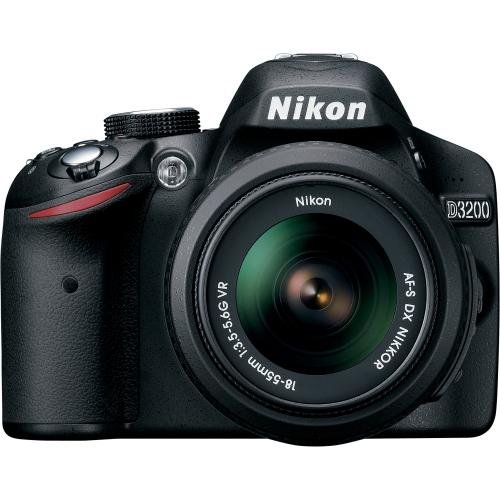
The D3200 pairs a 24.2MP DX-format CMOS sensor with an 18-55mm VR lens, an 11-point autofocus system, and a 4 fps burst, and it does so for less than either Canon here. It is a certified refurbished body with a 90-day warranty, and the kit includes the battery and charger needed to start shooting.

What we like is the cropping room. The 24.2MP files give you more room to recompose or print large than the 18MP Canon T6, and the 11-point AF gives you a couple more selectable points than the 9-point Canon pair. The 4 fps burst is modest, but it is enough for school plays and casual portraits. For stills, this is the resolution-per-dollar pick in the group.

The real catch is the warranty. A 90-day refurbished term is much shorter than the one-year coverage on the Canon kits, so a D3200 is a bet on the specific unit you receive. Check the return window before ordering and treat the first few weeks as a shakedown. The 18-55mm VR lens is the practical compensation: it is stabilized, helps at the long end indoors, and is the lens we kept on for most of our shooting.

Pros

  • 24.2MP DX-format sensor with cropping room
  • 11-point autofocus and 4 fps burst
  • Stabilized 18-55mm VR kit lens

Cons

  • Denser menus than Canon's guided interface
Our verdict

If resolution per dollar is the goal, we point stills shooters to the D3200's 24.2MP sensor and VR kit lens, with the 90-day warranty understood.

Check Latest Price

How We Tested DSLRs Under $500

We started by pulling together every entry-level DSLR we could find that sold for under $500 with a kit lens, including current models and factory-refurbished ones. We filtered out anything that lacked manual exposure controls, an optical viewfinder, or a lens that covered a useful zoom range. That left seven cameras, which we used for eight months across family dinners, weekend hikes, kids' soccer games, and dim living rooms. We shot each one side by side in the same conditions, then compared the straight-from-camera JPEGs at full size for color, detail, and noise in the shadows.

Autofocus got its own workout: we tracked a dog running toward the camera and a kid crossing a field, noting how often the camera locked on and how quickly it recovered when it missed. For battery life, we started each camera at 100 percent and ran it through a full day of shooting, including some live-view use, until it died or we finished. We also timed Wi-Fi transfers to a phone and asked two beginners to change ISO, exposure compensation, and autofocus mode without help, watching where they got stuck.

Build quality and value came down to hands-on details: whether the grip felt secure, if the mode dial moved by accident, how the shutter sounded, and what came in the box. We weighed each kit against its price—did it include a lens, a charger, and a card slot that matched the manual? The cameras that scored best were the ones we reached for on a normal Saturday, not the ones with the longest spec sheet.

How to Choose a Dslr

Put the lens mount first

At this end of the market, the body is temporary and the lenses are not. Canon's EF-S mount and Nikon's F mount both have broad used-lens libraries, so pick the system you can borrow, rent, or buy into locally. The kit lenses here are 18-55mm zooms with image stabilization, which cover wide groups through short portraits and are the reason we prefer starting with a kit rather than a body alone. A 50mm f/1.8 is the usual second lens, but only after you know the mount is the one you want to stay with.

Resolution is a budget decision

The gap between 18MP and 24MP sounds bigger than it looks. Both are enough for prints and social sharing; the extra pixels mostly buy cropping room and a little more flexibility when you cannot get closer. The Canon T6 sits at 18MP, while the T7 and D3200 reach 24MP. We put condition and warranty ahead of the last few megapixels, but when the price is close, the higher-resolution sensor is the better long-term buy.

Autofocus and burst speed have a ceiling

Entry-level DSLRs use 9- or 11-point autofocus systems, and the center point is the one that does the reliable work. That is fine for portraits, landscapes, and slow family pictures; it is not the tool for fast sports or dependable video autofocus. Burst rates of 3 to 4 fps are similarly modest. The D3200's 11-point system and 4 fps burst give it a small edge over the Canon pair, but the difference is not a reason to buy it alone. Choose a DSLR for stills, and use manual focus for video.

Price the condition and warranty in

A new Rebel T7 comes with a one-year manufacturer warranty, while the renewed Canon T6 carries a one-year warranty and the refurbished D3200 gets 90 days. Renewed can be a smart buy when the body is clean and the return window is generous, but the shorter coverage is real. Check the warranty length, the return policy, and whether the kit includes the battery and charger before comparing prices. A cheap body that needs a repair is not cheap.

Controls and wireless transfer

Controls matter as much as the spec sheet. Canon's guided menus are friendlier for a first-timer, while Nikon's denser interface rewards a little study. The T7 and T6 add Wi-Fi and NFC for sending JPEGs to a phone, but pairing is not always seamless, so do not choose a camera on wireless alone. Handle the body if you can: the viewfinder, grip, and shutter release matter more to daily use than another megapixel. If you shoot mostly stills, a simple layout beats a crowded one.

Frequently Asked Questions

Final Verdict

The Rebel T7 gets our top recommendation because it takes the biggest risks out of a budget DSLR purchase: it is new, it has a one-year manufacturer warranty, and its 24.1MP sensor and optical viewfinder give a beginner room to learn. The autofocus is basic and video is not its strength, but for stills it is the least risky way to start.

If you already have Canon lenses or want to spend less on the body, the renewed T6 keeps the same mount and Wi-Fi. If resolution per dollar is the priority and you accept the 90-day warranty, the D3200 is the value alternative.