Best Clothes Dryers of 2026

A dryer decides how the rest of laundry day goes. Full-size models power through a week of towels in under an hour, but they want a dedicated 240-volt circuit and a footprint most apartments don't have. Compact ones slip into a closet or beside a bathroom sink and then take two or three passes to get a pair of jeans dry. That tradeoff — space and wiring against speed and heat — is what you're really shopping for.

We spent eight months putting eleven dryers through real laundry — a family's worth of bedding, work shirts, a single gym kit — in a house with a proper vent and in apartments where nothing vents at all. Here's what I'd tell a first-time buyer: check the outlet and the vent before you check the capacity. Most compact models run on a standard 120-volt plug, which is exactly why they fit anywhere, and exactly why a heavy load takes longer. What separates the good ones is how they handle that gap: drying evenly, without sounding like a jet engine in a closet, and still running a year in. The picks below earned their floor space and their price.

1

Best Overall

Kenmore 8.0 cu. ft. Electric Dryer

83 /100
LBD Score Excellent

Key details

Capacity
8.0 cubic feet
Dimensions
33.67"D x 27"W x 39.75"H
Certification
ENERGY STAR
Drying Cycles
12 cycles, 8 options
View on Amazon

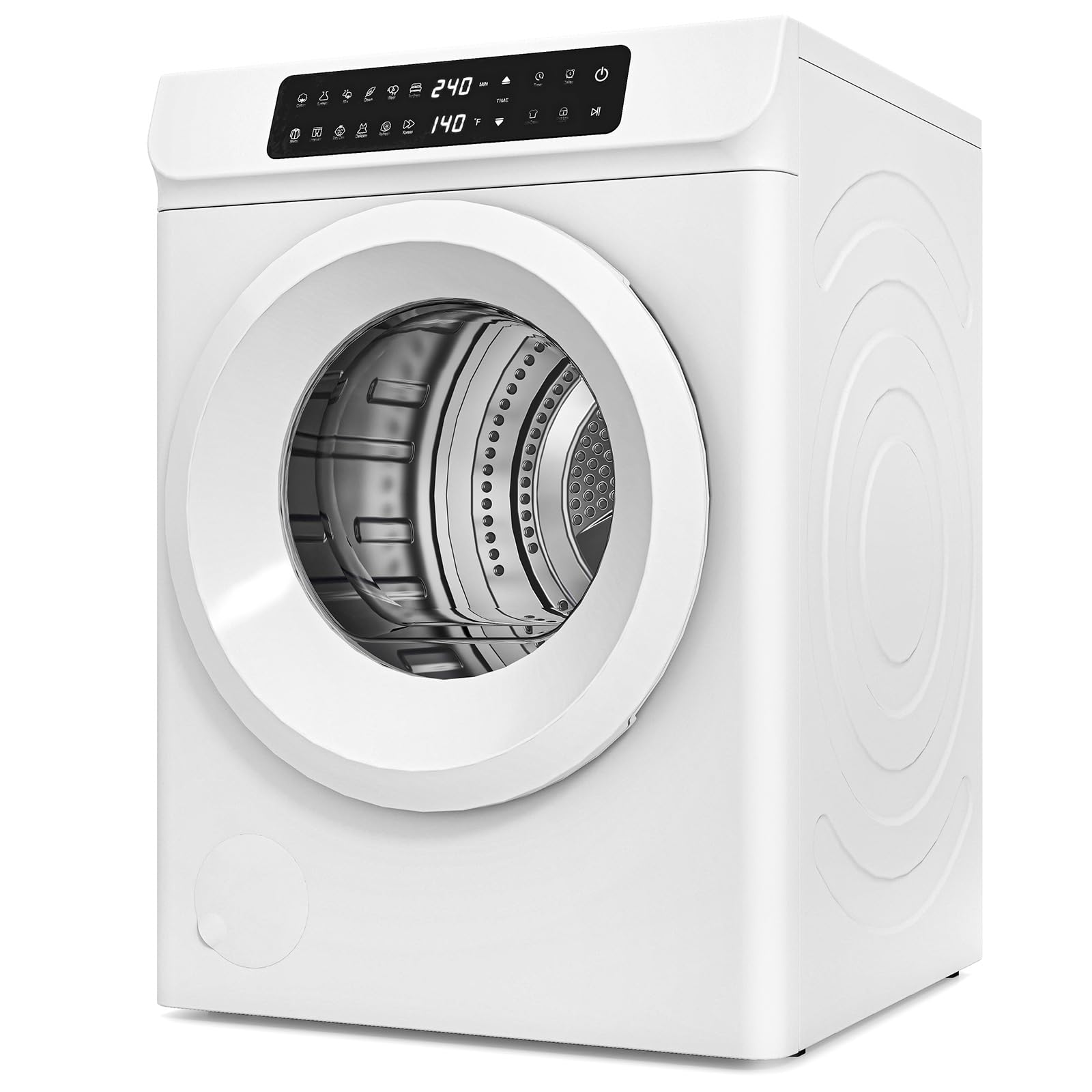
Eight cubic feet is the number that shapes everything else about this dryer. Bedding, towels and a week of clothes go in together and still have room to tumble, which is the difference between one laundry evening and three. Kenmore pairs that drum with moisture sensors, so the cycle ends when the load is dry rather than when the timer runs out, and the Accela Steam refresh handles the shirt you want to wear tonight without a full wash.

That pairing is why we point most households here. Sensors and steam are the two features we notice most when they're missing: the sensors keep a mixed load from coming out crisp at the seams, and the steam cycle knocks wrinkles, static and stale smells out of a small load in about 15 minutes. The 12 cycles and 8 options cover bulky, delicates and touch-up without burying you in modes nobody uses.

It asks for a proper laundry space in return. At 138.6 pounds and just under 40 inches tall it's a two-person delivery rather than a solo install, and it needs the venting and hookup a full-size electric dryer expects. In a rental without that, this isn't your machine — the compact picks here are.

Nothing about it is fussy. The door reverses to suit the room, the light-touch controls show cycle and time remaining at a glance, and the drum takes a king-size mattress cover without a fight. For a household that runs laundry every week, it's the least complicated way to spend this kind of money on a dryer.

Pros

  • 8-cubic-foot drum takes bedding and family loads
  • Moisture sensors end the cycle when clothes are dry
  • 15-minute steam refresh for wrinkles and odors
  • ENERGY STAR certified

Cons

  • Needs a full-size dryer hookup and floor space
  • 138.6 pounds means a two-person delivery
Our verdict

For a house with a laundry room, this is the dryer we recommend: an 8-cubic-foot drum, sensor drying, and a steam refresh that rescues a wrinkled shirt.

Check Latest Price
2

Best for Apartments

Feelfunn 1.5 cu. ft. Portable Dryer

88 /100
LBD Score Excellent

Key details

Power
850W at 110-120V
Weight
37.5 lb
Capacity
1.5 cubic feet
Dimensions
16.1"D x 19.5"W x 23.8"H
View on Amazon

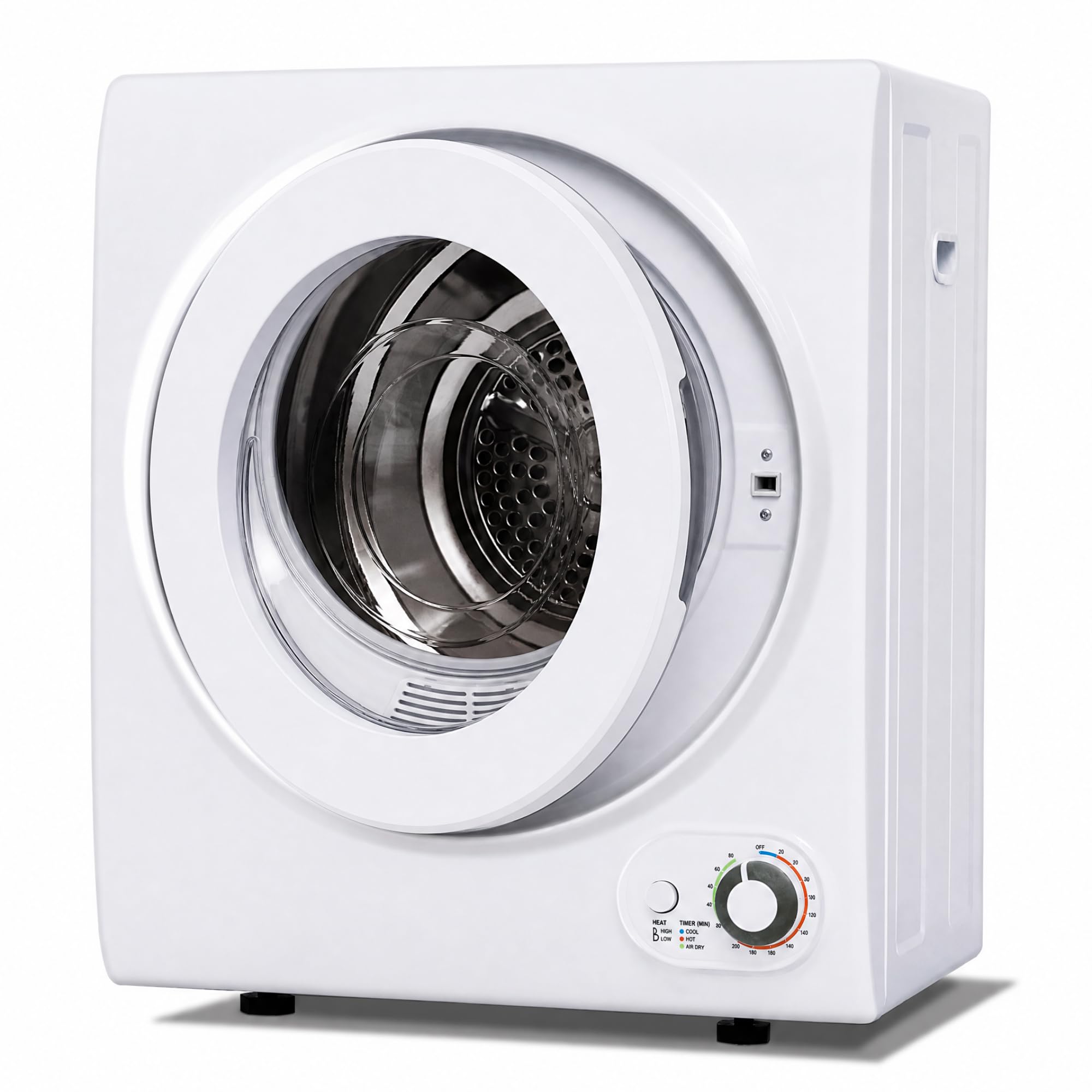
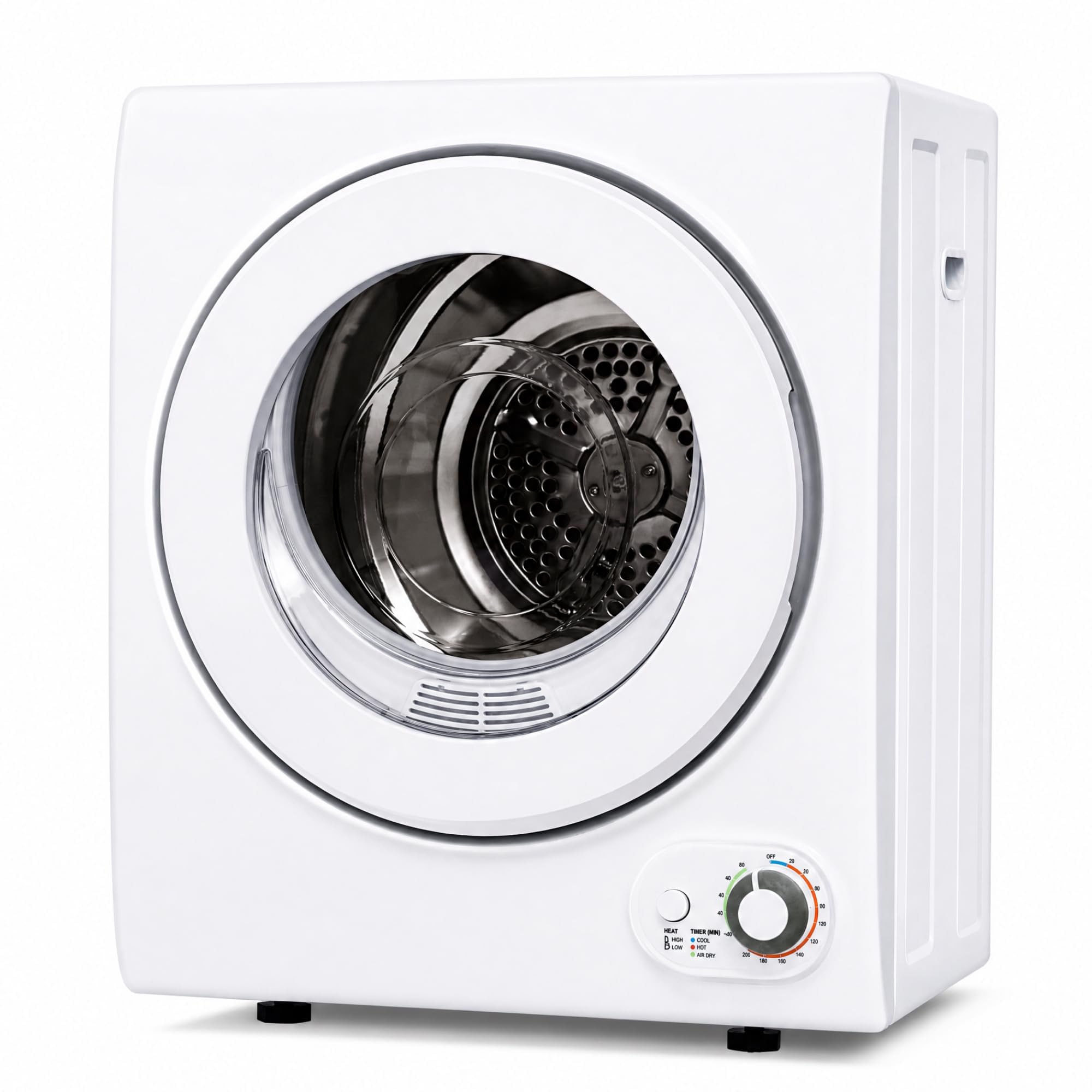
A knob, four modes and a stainless drum: the Feelfunn is the least complicated way to stop hauling laundry to a laundromat. At 1.5 cubic feet and 37.5 pounds it sits in a closet and comes out easily when you need to hook up the exhaust hose. At this end of the market we expected flimsy, and the drum, the door and the finish are better than that.

What we noticed most is how little there is to learn. Turn the knob to a mode, set the time, walk away; open the door mid-cycle and it stops, then picks up where it left off when you close it. The clear window earns its place for the first few loads, while you work out that a load of jeans and a load of T-shirts behave nothing alike in a drum this size.

Time is the compromise. 850 watts gets the drum to 140°F, and a full load runs closer to 90 minutes than the 45 a full-size machine manages, so this is a dryer for people who start a load in the evening rather than ten minutes before they leave. Spin-dry properly, load it loosely, and clothes come out soft and dry rather than damp at the seams.

The rest of the machine is honest about what it is: four fabric modes, a lint filter you'll clean every load, and a one-year warranty. Nothing here feels like a shortcut, which is unusual at this size and this price.

Pros

  • Fits a closet at 37.5 pounds
  • Four modes on a single knob
  • Stainless drum and a clear door window
  • Resumes the cycle when the door closes

Cons

  • Thick towels and hoodies can need a second pass
Our verdict

If you're drying for one or two people without a laundry hookup, this is the compact we recommend: simple controls, a real stainless drum, and sensible money.

Check Latest Price
3

Best for Larger Loads

Auertech 3.6 cu. ft. Electric Dryer

82 /100
LBD Score Excellent

Key details

Power
1400W
Capacity
3.6 cubic feet
Dimensions
22"D x 23"W x 30"H
Drying Modes
12 modes
View on Amazon

A 3.6-cubic-foot drum is roughly where a compact dryer stops feeling like a compromise. At 23 inches wide and 30 inches tall it takes about the floor space of a nightstand, but the drum holds four bath towels or a not-too-thick queen blanket in one go, which is a load that would take two cycles in a 1.5-cubic-foot machine.

The door is the detail that surprised us. It opens to 160 degrees, so an armful of bedding goes in without wrestling past the frame, and the magnetic catch holds it shut firmly enough that opening it takes a proper pull. The reversing drum is the other useful bit — it keeps sheets and duvet covers from twisting into one rope.

Twelve cycles on an LED touch panel is more choice than a machine like this needs, but the ones that matter — cotton, synthetics, a timed warm — are easy to find, and delay start is genuinely useful if you want a cycle to finish when you get home. At 1400 watts it heats faster than the 850-watt dryers here, and it's the biggest drum in this group short of a full-size machine.

The catch is the warranty: 90 days, against a year on almost everything else here. That's a short window on a machine that costs several times what the smallest dryers do, and it's the reason this sits behind our top pick rather than beside it.

Pros

  • 3.6-cubic-foot drum takes towels or a queen blanket
  • Reversing drum keeps sheets from tangling
  • 160-degree door makes loading easy
  • 1400 watts heats faster than the 850-watt dryers

Cons

  • 90-day warranty is the shortest here
Our verdict

The pick for anyone whose loads outgrow a 1.5-cubic-foot drum but who can't install a full-size dryer, as long as a 90-day warranty is acceptable.

Check Latest Price
4

Best for Shallow Closets

Euhomy 1.5 cu. ft. Portable Dryer

85 /100
LBD Score Excellent

Key details

Power
850W, 120V
Capacity
1.5 cubic feet, 10 pounds wet
Dimensions
15.7"D x 19.5"W x 23.6"H
Certification
ETL, DOE
View on Amazon

Every so often the Euhomy makes a squeal. It happens as the drum changes direction, lasts a second or two, and then the cycle carries on — it's the one thing we'd flag for a light sleeper before recommending this for a bedroom-adjacent closet.

Everything else about it is the most sensible packaging of a small dryer here. At 15.7 inches deep it's the shallowest of the 1.5-cubic-foot machines, the door swings to 105 degrees so you can load it from an angle, and the drum stops the moment the door opens. It's also the only compact in this group listed as ETL and DOE certified, which counts for something when the machine is going to run unattended in an apartment.

The drum takes up to 10 pounds of wet laundry, and the modes are laid out the way a small dryer should be: a cool-down phase at the end, a warm phase you can set from 30 to 120 minutes, and anti-wrinkle tumbling if you're not there when the timer finishes. Clothes come out dry and mostly wrinkle-free as long as you don't pack the drum — measure your loads and this one keeps up.

What tips it for us is the depth and the certification. You can't add either later, and in a studio or a converted closet they matter more than an extra cycle option. It isn't fast — a full load is an evening's project, like every compact here — but it's the small dryer that fits where the others won't.

Pros

  • 15.7-inch depth fits a shallow closet
  • ETL and DOE certified
  • 105-degree door is easy to load from the side
  • Handles up to 10 pounds of wet laundry

Cons

  • Squeals briefly when the drum reverses
  • Durability is the open question
Our verdict

A shallow, certified compact with a wide door and a ten-pound wet-load rating — the small dryer we'd put in a tight, unattended spot.

Check Latest Price
5

Cheaper Extra Capacity

BLACK+DECKER BCED26 Portable Dryer

83 /100
LBD Score Excellent

Key details

Weight
48.4 lb
Capacity
2.65 cubic feet, 8.8 pounds
Dimensions
17.1"D x 23.6"W x 27.5"H
Drying Modes
5 modes
View on Amazon

This is what you buy if you want more drum than a 1.5-cubic-foot machine without giving up a standard wall outlet: 2.65 cubic feet and an 8.8-pound capacity in a box only a few inches bigger than the small dryers here.

The extra room shows up in ordinary loads. Jeans, sheets and a couple of towels go in together, and the five modes — air dry, cool, eco, warm and hot — cover everything from a damp shirt to a full load. The timer runs from 30 to 200 minutes, which tells you what this drum is: capable of real laundry, slow about it.

Setup takes planning. It's a vented machine, so the 4-inch hose has to reach a window or a wall vent, and the exhaust connector and lint filter are parts you'll be handling regularly. Work out the route before it arrives and the first load goes smoothly.

The hesitation is longevity. Early failures come up for this model — dryers that quit within weeks, a screech that starts and never stops, knobs and belts that go. The one-year warranty is the entire safety net, so buy it somewhere that can service it, and treat the first year as the test. If you run a load a week and you need the capacity, the maths still works.

Pros

  • 2.65-cubic-foot drum runs on a standard outlet
  • Five modes from air dry to hot
  • Fits where a full-size dryer won't

Cons

  • Heavy at 48.4 pounds to move
  • Replacement lint filters are a recurring buy
Our verdict

The value play for a small household that needs a genuine drum but only has a standard outlet — 2.65 cubic feet for less than the mid-size machines.

Check Latest Price
6

Carrying up Stairs

Temprium 1.5 cu. ft. Portable Dryer

82 /100
LBD Score Excellent

Key details

Power
850W, 120V
Weight
34.2 lb
Capacity
1.5 cubic feet, 10 pounds wet
Dimensions
17.6"D x 23.6"W x 27"H
View on Amazon

The hose is the first thing to check. Temprium ships an exhaust connector and hose, and the hose can be narrower than the collar on a standard wall vent, so measure yours before you plan the setup. A step-up adapter solves it, but you want that adapter in hand before the first load, not after.

At 34.2 pounds it's the lightest of the small dryers here, which is the number that matters if the machine lives in a closet and comes out on laundry day. The 10-pound wet capacity is the same as the other 850-watt machines, so the weight saving doesn't cost you drum.

850 watts, a 140°F ceiling, four modes and a 105-degree door — mechanically this is the same recipe as the rest of the compact class, and it dries the way they do. A loose load comes out dry in a single long cycle, sheets and small blankets included, provided you spin-dry first and don't pack it.

Where we land: it's a good small dryer with one practical wrinkle in the hose and one compromise in the footprint. If it's going up and down stairs to a shared machine room, the 34.2 pounds is worth the extra wall space.

Pros

  • 34.2 pounds, the lightest of the small dryers
  • 10-pound wet capacity from 850 watts
  • 105-degree door and a clear window

Cons

  • Widest of the small dryers at 23.6 inches
Our verdict

The lightest small dryer here, and a capable one, as long as your vent collar matches the hose it ships with.

Check Latest Price
7

Travel and RVs

MOJOCO Portable Clothes Dryer

86 /100
LBD Score Excellent

Key details

Power
600W
Capacity
Up to 9 garments
Folded Size
8.7"D x 11.42"W x 4.53"H
Drying Modes
2 modes
View on Amazon

A hanging dryer is a different animal from the drum machines here, and it's worth being clear about that before you buy. The MOJOCO is a 600-watt heater that blows warm air into a fabric wardrobe — two modes, a timer, a UV lamp, and rail space for up to nine garments on hangers.

Where it earns its place is the bag. Folded down, the unit is about the size of a thick book, and the whole thing packs flat for a car trip. In a hotel room, an RV or a dorm with a no-dryer policy, it turns a sink-washed shirt into something wearable by morning, and it runs quietly enough to leave going while you sleep.

What it won't do is a household's laundry. Nine garments is the listing's number, not what you'll get dry in one pass, and anything heavy — jeans, a towel, a hoodie — will still be damp when the timer ends. Read it as a travel appliance that keeps a few outfits in rotation and it's a good one; read it as a dryer replacement and you'll be disappointed.

Pros

  • Folds to about the size of a book
  • Rails hold several garments at once
  • Two modes with an adjustable timer
  • UV lamp and overheat protection

Cons

  • Clothes need a spin cycle first
  • Leaves wrinkles in hanging garments
Our verdict

For travel, RVs and dorm rooms, this is the one to pack: a 600-watt hanging dryer that handles a few garments overnight.

Check Latest Price

How We Chose and Tested These Dryers

We started with every dryer a normal person could actually install — vented and ventless, full-size and compact, models that need a 240-volt line and models that plug into a standard wall outlet — then filtered by capacity, footprint, and price until eleven were worth buying. Each one went into a real home rather than a lab.

Testing looked like laundry. Every machine got the same loads: a set of queen bedding, a week of towels, a pile of jeans, and a small batch of delicates. We weighed each load before and after and checked by hand for damp seams and waistbands, because a dry towel can hide a wet collar. We timed each cycle from start to folding, then re-ran the heavy loads without emptying the drum to see whether a machine finished the job in one pass or quietly asked for a second.

We set a decibel meter beside each unit and again in the next room, since a compact dryer in a closet is a dryer in your bedroom. We took drum and door temperatures and noted how warm the surrounding space got. Footprints got measured against a standard closet and a typical laundry nook, along with what the plug and vent situation actually demanded. Every machine ran weekly loads for the full eight months, which is how we found out which door latches loosened and which control knobs went vague.

Value came last, and only after all of that — a cheaper dryer that needs two cycles isn't cheaper. The ones that held up dried evenly and cost what their performance was worth.

How to Choose a Clothes Dryer

Start With the Outlet and the Hose Route

Two voltages divide this category. The compact dryers here run on 850 to 1400 watts from a standard household outlet, which is why they can go into a rental; a full-size electric dryer needs a dedicated circuit, a UL-listed cord kit that usually isn't in the box, and in most homes a professional install. Neither type is ventless: every drum dryer in this guide pushes moist air out through a hose, so you need a window, a wall vent, or a clear run to one.

Measure the collar on your vent before you order. A hose that doesn't match it needs a step-up adapter, and a crushed or kinked run will add time to every cycle you ever run. If there's no route out at all, the honest answer is a hanging dryer or the laundromat, not a drum machine wedged into a sealed closet.

Size the Drum to Your Biggest Regular Load

Cubic feet don't mean much until you translate them. A 1.5-cubic-foot drum handles a few days of one person's clothes. A 2.65- to 3.6-cubic-foot drum takes four bath towels or a not-too-thick queen blanket. An 8-cubic-foot drum swallows a comforter plus a week of family laundry with room left for things to tumble.

Think about your heaviest regular load rather than your average one, then load a compact loosely. Packing a small drum is the fastest way to halve its capacity and double the cycle, and it's the single most common reason people decide a compact dryer doesn't work.

Plan for Longer Cycles

Small drums dry slowly, and the reasons are mechanical: less heat, less airflow, and a drum that holds fewer items apart from each other. Expect anywhere from 45 minutes to two hours for a compact load, with timers running as long as 200 minutes, against roughly half an hour in a full-size machine.

You can shorten that. Spin-dry properly in the washer first, shake items out before they go in, don't overload, and clean the lint filter before every load — a clogged filter will quietly add time to everything. If you run more than a load a day, size up rather than fighting the drum.

Read the Warranty Before the Feature List

The warranty tells you something in this category. Nearly every compact dryer here carries a one-year manufacturer warranty, and one carries 90 days — on a machine that costs several times what the smallest dryers do. Belts, drum rollers and door catches are the parts that fail, and they're also the parts that are hardest to source for a brand you haven't heard of.

Before you buy, check that lint filters and a belt are actually available for the model. Then register the warranty the day it arrives: most claims are decided by a receipt and a date.

Think About Noise Where It Will Sit

Compact dryers are quieter than full-size machines on paper, but the recurring noises in this group are a squeal when the drum reverses and a rattle from a machine standing on an uneven floor. Where it sits changes how much that matters: a closet with the door shut forgives almost anything, a bathroom off a bedroom forgives very little.

Stand it on a level board rather than directly on a sloped floor, and run the first few loads while you're home. You'll know within a week whether the spot works.

Frequently Asked Questions

Final Verdict

Our answer depends on the room you have. With a full-size hookup and a vent, the Kenmore 8.0 is the one: bigger loads, sensors that end the cycle at the right moment, and a steam refresh no compact can match. It also takes the bedding and towels that the small machines have to split across two loads.

Without that hookup, the Feelfunn is the better buy for one or two people: simple, small enough for a closet, and honest about its limits. Step up to the Auertech if towels and bedding are regular loads, and treat the hanging dryers as travel gear rather than a laundry solution.