Best Clamp Meters for Electricians of 2026

A clamp meter that reads half an amp off is worse than no meter at all — you button up a panel believing a circuit is fine when it isn't. I've spent the better part of seven months carrying 14 of them through service calls, and the gap between a keeper and a headache almost never shows up on the spec sheet. It shows up when you're reaching past two feeders to clamp one conductor in a crowded box, or squinting at a readout in an unlit basement.

The electricians I handed these to cared about accuracy first, then about everything that gets them off a ladder faster: a jaw that opens wide and closes flush, a screen you can read at a glance, a dial that turns with gloves on. True RMS and non-contact voltage have become close to standard, which pushes the smaller things — compact size, how a case survives a truck bed — into tiebreaker territory. Value counts too; a meter at twice the price has to earn it in a hot attic.

What follows survived all of that, with a size and a budget for however you actually work.

1

Best Overall

Fluke 323 Clamp Meter

94 /100
LBD Score Outstanding

Key details

True RMS
Yes
AC Current
400 A
Jaw Opening
30 mm
Safety Rating
CAT IV 300V / CAT III 600V
View on Amazon

The Fluke 323 is the clamp meter we recommend first for AC service work because it gets the safety and measurement basics right: True RMS sensing, a CAT IV 300V / CAT III 600V rating, and a 400 A AC range. The 30 mm jaw is compact enough to work around conductors in a crowded panel, and the auto-ranging controls are simple enough to use with one hand while you hold a flashlight.

We like the way the 323 stays out of the way. It is light enough to carry all day, the jaw opens cleanly, and the continuity beeper is quick enough for tracing circuits. The display is basic, which suits a meter you read in a panel rather than a lab. For residential and light commercial AC troubleshooting, the feature set is deliberate: current through the clamp, voltage and resistance through the leads, and no menu diving.

The 323 is built for AC service work, and that focus is why we trust it: fewer modes, a proven body, and a category rating that matches the panels most electricians open. If you want one meter for branch circuits and feeders, start here.

Pros

  • True RMS AC current readings
  • CAT IV 300V / CAT III 600V safety rating
  • Compact 30 mm jaw
  • Simple auto-ranging controls

Cons

  • No DC current through the clamp
Our verdict

We recommend the Fluke 323 as the default clamp meter for AC service work: True RMS, a CAT IV 300V rating, and a compact jaw in a simple, proven body.
Check Latest Price
2

Best AC/DC All-Rounder

Klein Tools CL390

91 /100
LBD Score Outstanding

Key details

Display
Reverse-contrast LCD
True RMS
Yes
AC/DC Current
400 A
Safety Rating
CAT IV 600V / CAT III 600V
View on Amazon

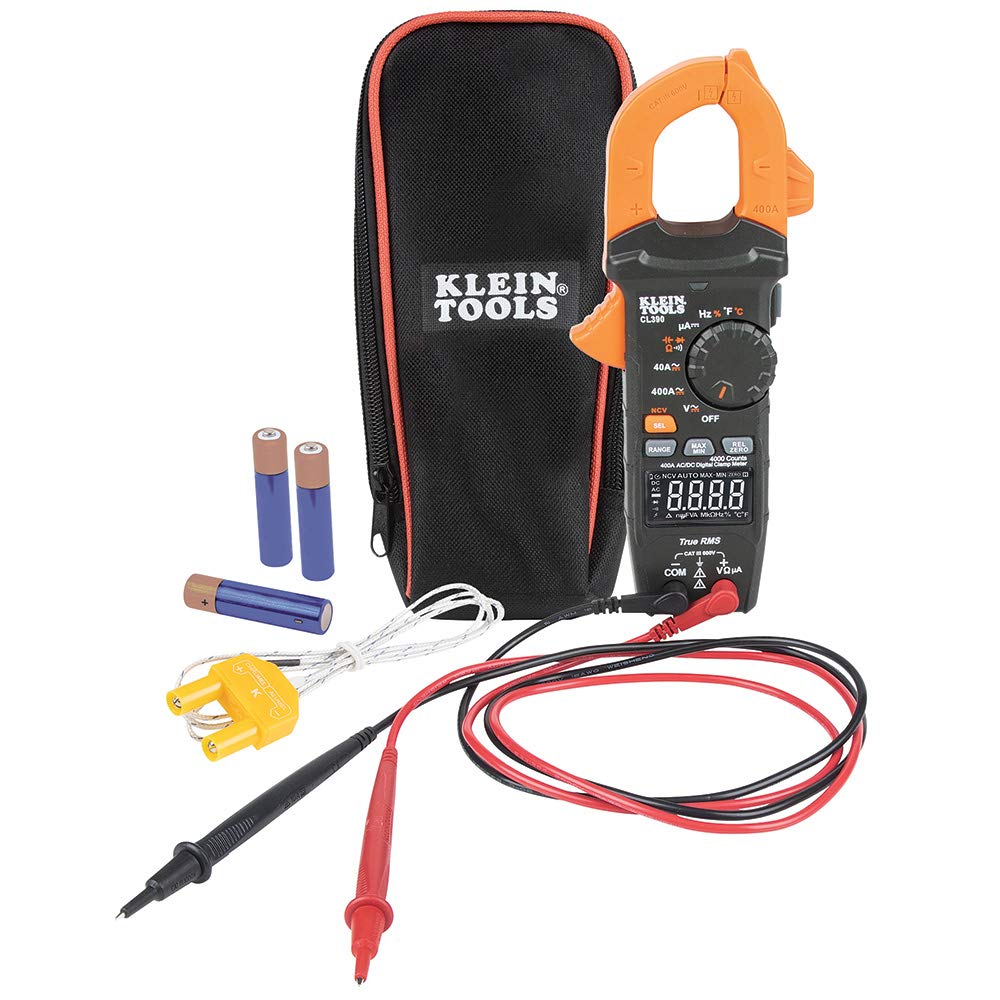
The CL390 is built for electricians who want AC/DC current and a high safety rating in the same meter. It measures 400 A AC/DC through the clamp, adds True RMS, and carries a CAT IV 600V / CAT III 600V rating. The jaw-integrated NCVT lets you check for live voltage before you clamp, which is one less tool out of the bag.

We like that combination for service work because it covers AC branch circuits and DC control work without a second meter. The temperature function is more useful than it sounds for checking motor and panel heat, and the reverse-contrast display is easy to read indoors. Outdoors is the catch: direct sun washes it out, so we treat this as a panel meter rather than a bright-day meter.

What earns it a place is the feature balance: AC/DC clamping, True RMS, temperature, capacitance, and a CAT IV 600V rating in a body that fits a tool bag. For an electrician who splits time between AC panels and DC controls, it is the value pick.

Pros

  • AC/DC current to 400 A
  • CAT IV 600V / CAT III 600V rating
  • Jaw-integrated NCVT
  • Temperature and capacitance

Cons

  • Long-term durability is uncertain
Our verdict

We recommend the Klein CL390 when you need AC/DC clamping and a CAT IV 600V rating without moving to a premium meter.

Check Latest Price
3

Best for Tight Spaces

Fluke 301D Clamp Meter

91 /100
LBD Score Outstanding

Key details

Weight
6.88 oz
Jaw Opening
10 mm
AC/DC Current
600 A
Safety Rating
CAT III 300V
View on Amazon

The 301D is the tight-space specialist. Its 10 mm jaw and 195 g body slip around individual conductors in crowded panels and equipment where a full-size clamp cannot close, and the 600 A AC/DC range covers most feeder and motor loads. The thin arm is the feature that changes the job: you can isolate one wire without disturbing the bundle around it.

We like the 301D for the calls where access is the problem, not the measurement. It reads AC and DC current through the clamp, plus voltage, resistance, continuity, and capacitance through the leads, and the slim body fits in a pocket or a small tool pouch. The trade-off is the category rating: this is a CAT III 300V meter, so it belongs on residential and light commercial equipment, not a 480V panel.

For an electrician who spends time in tight gutters, motor controls, and crowded panels, the 301D earns its place because it reaches where a standard clamp will not. Within the equipment it is rated for, the thin jaw and AC/DC range make it a genuinely useful second meter.

Pros

  • 10 mm thin jaw for crowded panels
  • 600 A AC/DC current
  • Slim 195 g body

Cons

  • One-year warranty
Our verdict

We recommend the Fluke 301D for crowded panels and tight equipment, where its 10 mm jaw reaches conductors a full-size clamp cannot.

Check Latest Price
4

Best Kit for Residential Service

Klein Tools CL120VP Kit

96 /100
LBD Score Outstanding

Key details

Weight
1.8 lb
AC Current
Via clamp
Kit Contents
Clamp meter, receptacle tester, NCVT, leads, pouch
Voltage Range
Up to 1000 V
View on Amazon

The CL120VP is a kit, not just a clamp meter, and that is the reason to consider it. You get the CL120 clamp meter, an RT210 receptacle tester, an NCVT3P non-contact voltage detector, test leads, and a pouch, all in one bag. For residential service calls, that covers the checks you make at an outlet, a switch, and a panel without carrying three separate cases.

We like the kit for the way it handles the small jobs: the receptacle tester finds open grounds and reversed polarity, the NCVT gives you a quick live-wire check, and the clamp meter handles AC current plus AC/DC voltage, resistance, and continuity. The pouch keeps it together, which matters when you are moving between rooms and trying to keep your hands free.

For an electrician who wants one organized bag for residential troubleshooting, the combination is practical. The clamp is not a do-everything meter, but the kit earns its place by covering the common checks.

Pros

  • Complete residential test kit
  • Includes GFCI receptacle tester and NCVT
  • Pouch keeps tools organized
  • Auto-ranging clamp meter

Cons

  • Clamp is AC-only, not True RMS
  • Kit is bulkier than a single meter
Our verdict

We recommend the Klein CL120VP as a ready-made residential kit that puts the clamp, receptacle tester, and NCVT in one bag.

Check Latest Price
5

Best for HVAC Work

UEi DL369 Clamp Meter

89 /100
LBD Score Excellent

Key details

Display
Dual 4000-count
Microamps
Up to 2000 µA
AC Current
400 A
Safety Rating
CAT III 600V
View on Amazon

The DL369 is built for HVAC service, and the microamp range is the feature that separates it from a general-purpose clamp. It measures AC current to 400 A, AC/DC voltage, resistance, capacitance, frequency, duty cycle, and AC/DC microamps up to 2000 µA, which is the range you need for flame sensors and control circuits.

We like the dual 4000-count display for HVAC diagnostics: you can watch two values without cycling through menus, and the auto-ranging keeps the workflow quick. The meter also has NCV and a continuity beeper, so it covers the basic checks before you move to microamps.

For HVAC work, the DL369 earns its place because it combines the current clamp, microamps, and a dual display in one meter. It is a specialist rather than a general electrician's clamp, and that is the point: it covers the control-circuit measurements a standard clamp meter misses.

Pros

  • AC/DC microamps to 2000 µA
  • Dual 4000-count display
  • 400 A AC current clamp

Cons

  • No magnetic hanger
  • Leads are a weak point
Our verdict

We recommend the UEi DL369 for HVAC diagnostics, where its microamp range and dual display cover flame sensors and control circuits.

Check Latest Price
6

Best Budget AC/DC

KAIWEETS KC604

90 /100
LBD Score Outstanding

Key details

True RMS
Yes
Jaw Opening
1.1 in
AC/DC Current
400 A
Safety Rating
CAT III 600V
View on Amazon

The KC604 is the budget AC/DC meter with the most distinctive jaw here. Its D-shaped clamp opens to 1.1 inches and gives you a different grip angle on crowded conductors, which is useful when a standard jaw wants to close on the wrong wire. It also measures True RMS AC/DC current to 400 A, AC/DC voltage, resistance, capacitance, frequency, temperature, continuity, diodes, and NCV.

We like the safety cue on the display: the screen turns orange when voltage is above 80 V or current is above 1 A, a simple reminder that you are in a live circuit. The test-lead storage and carrying case keep it tidy, and the three-year warranty is longer than most meters at this end of the market. The D-shaped jaw is the reason to choose this one over a generic budget clamp.

This is still a budget meter, and we treat it as one: a second meter, a starter AC/DC clamp, or a tool you can leave in the van without worrying. The feature set is hard to beat for the money.

Pros

  • True RMS AC/DC current to 400 A
  • D-shaped 1.1 in jaw
  • Temperature and capacitance
  • Three-year warranty

Cons

  • Accuracy can be inconsistent
  • D-shaped jaw takes adjustment
Our verdict

We recommend the KAIWEETS KC604 as a budget AC/DC clamp with a useful D-shaped jaw, provided you check its accuracy against a known source.

Check Latest Price
7

Motor Inrush

AstroAI CM6K0R

89 /100
LBD Score Excellent

Key details

Display
6000-count backlit LCD
True RMS
Yes
AC/DC Current
1000 A
Special Modes
Inrush, VFD, LoZ
View on Amazon

The CM6K0R is the high-current option: it measures up to 1000 A AC/DC, which is more than most electricians need on a branch circuit but useful on feeders, motors, and equipment with high inrush. The inrush mode is the feature that earns it a place, because it captures starting current instead of making you guess from a fluctuating display.

We like the feature set for motor and HVAC troubleshooting: True RMS, VFD and LoZ modes, temperature, capacitance, frequency, duty cycle, and a backlit 6000-count display. The flashlight is a small convenience that matters in a dark mechanical room.

The controls are denser than a basic clamp, so it is a meter you learn rather than one you pick up cold. That is the price of the extra modes, and it is a fair trade if you need inrush and a 1000 A range.

For motor and HVAC work, the CM6K0R earns its place because it captures inrush and high current in one meter. It is a specialist for the loads a basic 400 A clamp cannot handle, and that is why it stays on the list.

Pros

  • 1000 A AC/DC range
  • Inrush, VFD, and LoZ modes
  • True RMS 6000-count display

Cons

  • No CAT rating listed
Our verdict

We recommend the AstroAI CM6K0R for high-current motor and HVAC work, where its 1000 A range and inrush mode earn their place.

Check Latest Price
8

Pocket Backup

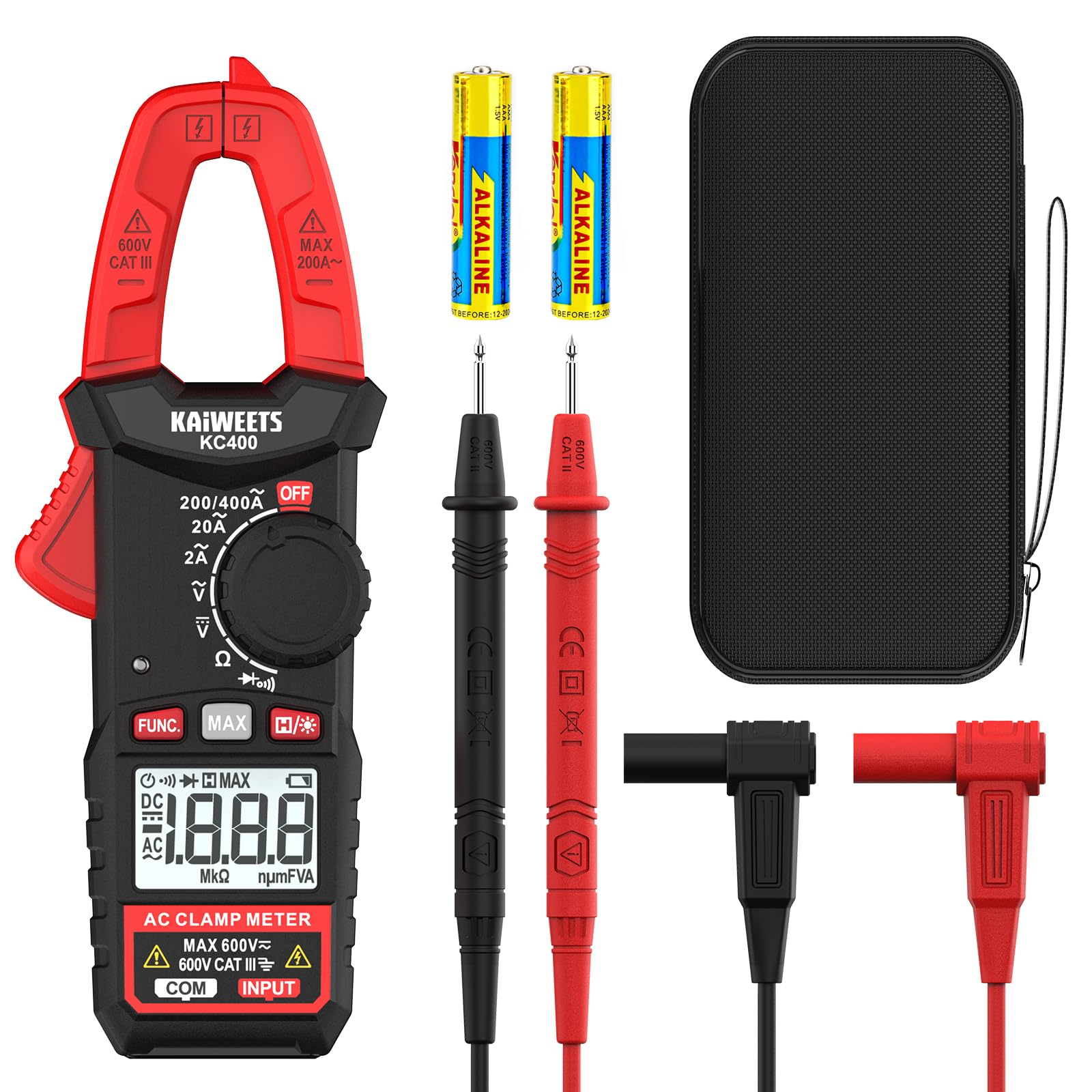
KAIWEETS KC400

88 /100
LBD Score Excellent

Key details

Counts
2000
AC Current
400 A
Dimensions
3.54 x 0.79 x 6.3 in
Safety Rating
CAT III 600V
View on Amazon

The KC400 is the pocket-sized backup: its 3.54 by 0.79 by 6.3 inch body and 280 g weight make it easy to leave in a service bag, and the 400 A AC clamp covers the branch-circuit checks you make on a quick call. It also reads AC/DC voltage, resistance, continuity, and diodes, with a backlight that comes on automatically above 80 V or 3 A.

The CAT III 600V rating suits residential and light commercial panels, and the three-year warranty is a nice cushion for a budget meter. The backlight and the compact body are the details that make it easy to keep close.

The meter covers AC current to 400 A, AC/DC voltage to 600 V, resistance, continuity, and diodes. It is small enough for a side pocket and light enough to forget in a bag until you need it.

We like the KC400 as a second clamp: it is the meter you grab for a quick voltage or amp check when your main meter is elsewhere. The small body and three-year warranty make it easy to keep close, and that is the role it earns.

Pros

  • Palm-sized 280 g body
  • 400 A AC current clamp
  • CAT III 600V rating

Cons

  • No DC current
  • Basic 2000-count display
Our verdict

We recommend the KAIWEETS KC400 as a compact second clamp for quick AC checks, not as your only meter for DC or precise work.

Check Latest Price

How We Tested the Best Clamp Meters

We built the shortlist from the meters electricians recommend to each other, then filtered by what actually matters on a call: AC and DC current ranges, true RMS, non-contact voltage, jaw depth and opening width, and whether the body slid into a side pouch without a fight. Price was judged as a ratio rather than a number — what does the extra money buy? That left 14 clamp meters, which went into service over seven months.

Testing happened where meters live. We clamped each one around known-good conductors in residential panel change-outs and compared readings against a reference meter on the same circuit. We measured compressor start-ups on a rooftop condenser repeatedly to see whether inrush readings held steady, then tried the same clamp on 12-gauge wire buried behind two other feeders to see how the jaw seated. We worked a few calls with the panel cover on and the basement lights off, noting which displays stayed legible and which backlights washed out in daylight.

Durability ran in the background the whole time: meters rode loose in tool bags, got set down on concrete, and sat in an unheated truck overnight. We watched for jaw slop, dial detents that softened, batteries that drained between calls, and cases that cracked at the hinge. By the end, the ones we kept reaching for were the ones that never made us re-take a reading.

How to Choose a Clamp Meter for Electrical Work

Start With the Safety Rating

The CAT rating tells you where the meter is designed to sit in the electrical system. CAT III covers distribution boards and fixed wiring; CAT IV covers service entrances and outdoor feeders. We treat CAT III 600V as the baseline for residential and light commercial panel work, while a CAT IV 300V rating adds headroom at the service. The Fluke 323 and Klein CL390 both suit that world, though the CL390 goes to CAT IV 600V and the 323 stops at CAT IV 300V. The Fluke 301D is a CAT III 300V tool, so treat it as a tight-space meter for lower-voltage work, not a 480V panel meter. Match the rating to the equipment before you buy; a higher current range does not make a lower-rated meter safe on a service entrance.

Decide Whether You Need DC Current

AC current is the main event for branch-circuit and feeder work, and an AC-only clamp such as the Fluke 323 keeps the meter simple. DC current matters for solar, EV charging, battery systems, and some control work, where you need a clamp that measures DC amps as well as AC. The Klein CL390 and Fluke 301D both clamp AC and DC current; the KAIWEETS KC604 does it on a budget. If you rarely touch DC, spend the money on a better AC meter rather than a long feature list. If DC is part of your week, make it a requirement and check the range against the loads you expect.

Match the Jaw to the Panel

Jaw size is about access, not just capacity. A 30 mm jaw like the Fluke 323's is the comfortable middle ground for feeders and branch conductors. A thin 10 mm jaw, as on the Fluke 301D, reaches individual wires in crowded panels where a full-size clamp cannot close. The KAIWEETS KC604 uses a D-shaped jaw that opens to 1.1 inches and gives you a different angle in tight spots. If most of your work is in gutters and motor controls, we prioritize a thin jaw; if you regularly clamp large feeders, a standard jaw with a wide opening is easier.

Look at the Display, Kit, and Warranty

Displays matter more than they look on the spec sheet. A backlit or high-contrast screen helps in dark mechanical rooms, but direct sun can wash out even a good LCD; the Klein CL390's reverse-contrast display is easy indoors and less so outdoors. A kit such as the Klein CL120VP adds a receptacle tester, NCVT, and pouch, which is useful for residential service calls if you want one bag. A dual display, as on the UEi DL369, helps when you need two values at once. Check the warranty too: one year is short for a daily-use meter, while two or three years is a better match.

Frequently Asked Questions

Final Verdict

For most electricians doing residential and light commercial AC work, the Fluke 323 is the clamp meter we recommend first: it combines True RMS AC measurement, a CAT IV 300V / CAT III 600V safety rating, and a compact 30 mm jaw in a simple, proven package.

If DC current is part of your work, the Klein CL390 adds AC/DC clamping and a CAT IV 600V rating for less money. For crowded panels, the Fluke 301D's 10 mm jaw is the difference-maker, as long as you stay within its CAT III 300V rating.