Best Camera Backpacks for Hiking of 2026

The best camera backpack for hiking is really two bags arguing with each other: a padded case that wants rigid walls, and a trail pack that wants to move with your spine. Most of them pick a side. The boxy ones protect your glass beautifully and then dig into your shoulders two miles in; the trail ones carry like a dream right up until you open one and find your lenses have swapped seats.

My team and I spent eight months hiking, flying, and commuting with 12 camera backpacks to find the ones that settle that argument. Capacity turned out to matter less than the harness — a modest bag with a real hip belt carried better than a bigger one with thin shoulder straps. And past a certain price, you're paying for that harness and for the zippers, not for more padding.

Rain covers, tripod straps, and laptop sleeves all read like spec-sheet filler until you're caught in a squall on an exposed ridge with a tripod you can't lash down. The picks below are the ones we'd actually carry up a mountain.

1

Best Overall

Think Tank Backlight Sprint

88 /100
LBD Score Excellent

Key details

Weight
2 lb 5 oz
Capacity
15 liters
Gear Access
Rear panel
Weather Protection
Water-resistant nylon
View on Amazon

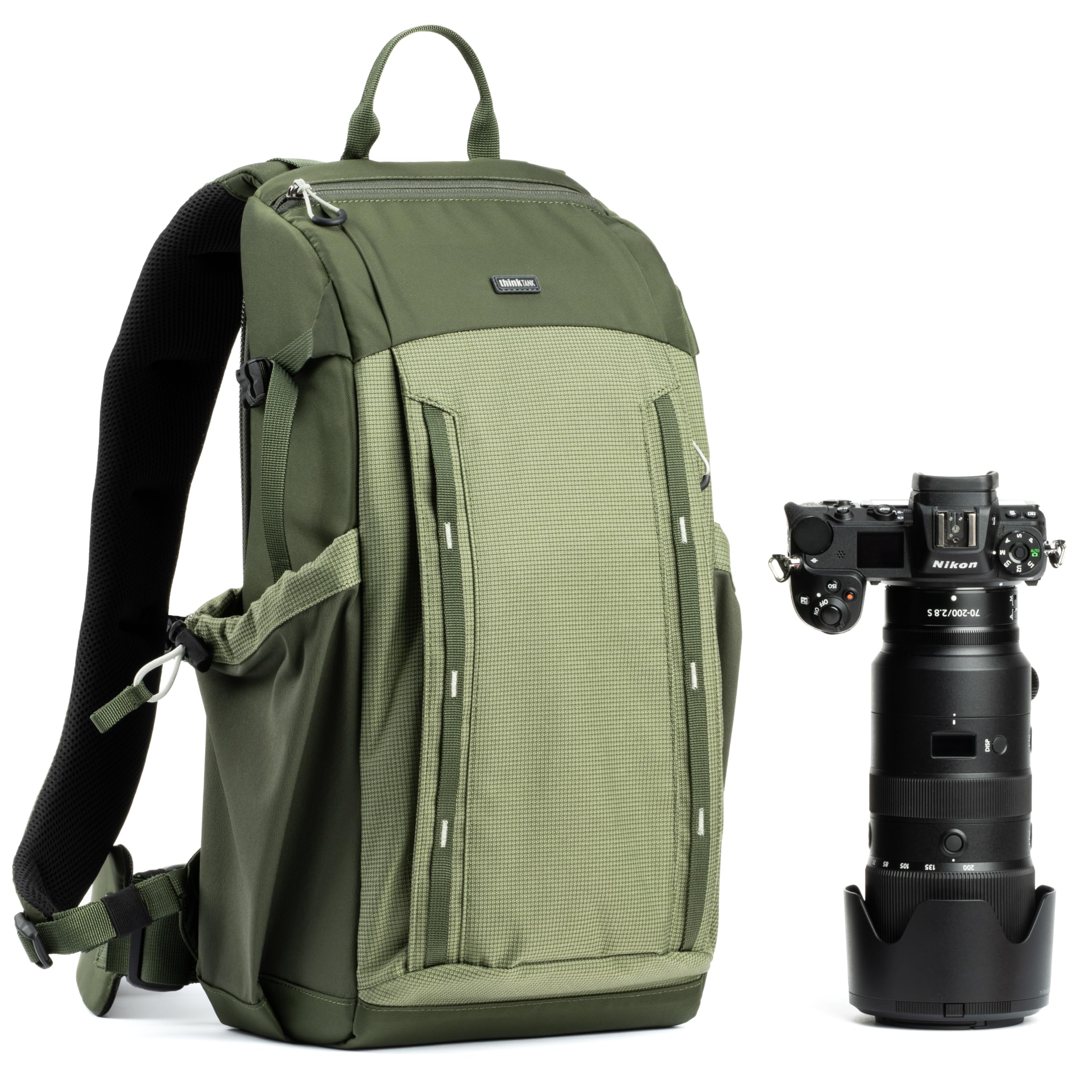
Every camera pack here has the same awkward moment: you stop to change a lens and have to decide where to put the bag down. The Backlight Sprint answers it with a rear panel that unzips flat, so the pack lies face-down with the harness in the air while you work out of it. On a wet or dusty trail that's the difference between clean shoulder straps and a muddy back for the next three miles, and it's why this is the pack we reach for first.

At 15 liters and 2 pounds 5 ounces, it's a slim bag that carries a body with a lens mounted, a couple more lenses, filters and cards, and stashes a shell or a lunch in the 2-liter front pocket, which opens vertically on the right so you can get at it without swinging the pack off. The padded waist belt takes load off your shoulders on a climb, and there are tripod straps on either side.

What it won't do is grow. The rear opening is shorter than the compartment behind it, so a long telephoto goes in at an angle or stays home, and a second body is one too many. Treat 15 liters as one camera, two lenses and a layer and the Sprint rewards you with the easiest carry in this group; keep adding to the kit and it punishes you.

Pros

  • Rear panel opens away from the harness
  • 2 pounds 5 ounces with a padded waist belt
  • 2-liter front pocket for layers
  • Tripod straps on either side

Cons

  • Rear opening is shorter than the camera compartment
  • 15 liters leaves no room to grow
Our verdict

We start here because the rear panel keeps your harness out of the mud and the pack weighs 2 pounds 5 ounces — the pick for a minimalist who wants one body and two lenses on the trail.
Check Latest Price
2

Best Ventilation

PGYTECH OneMo TAC 25L

84 /100
LBD Score Excellent

Key details

Weight
3 lb
Capacity
25 liters
Gear Access
Rear clamshell, side zip
Laptop Sleeve
16 inches
View on Amazon

A camera pack turns into a sauna on a summer climb, because the foam that protects your gear also traps every bit of heat your back puts out. PGYTECH's answer is a suspended panel that holds the bag body away from your spine and lets air move through the gap, and on a long ascent that ventilation is the whole reason to look at this one.

The rear opens a full 180 degrees and lies flat, and an anti-burst buckle keeps the panel from flopping shut while you repack — we found that small piece of hardware more useful than any pocket on the bag. A side zip gets the camera out without unshouldering, the front pocket releases a gimbal fast, and the battery pocket carries its own charge indicator so you can check power at a glance. With 25 liters, a 16-inch laptop sleeve and MOLLE webbing, it's a working pack for a full production day.

It is not light. Three pounds empty, before a body or a lens goes in, and the frame and padding that make it carry well also make it stiff and bulky when you're out for an hour with one camera. Load it the way it's built to be loaded — a body, two lenses, a gimbal and a tripod — and the weight stops being the story. Pack it half full and you'll feel every ounce of the frame.

Pros

  • Suspended back panel keeps air moving
  • Rear opens flat with a buckle to hold it
  • Side access plus a fast-release front pocket

Cons

  • 3 pounds empty before any gear
  • Framed back is bulky when lightly packed
Our verdict

For hot climbs and heavy kits, the suspended back panel and full-length rear opening make this the pack we take when the load is big.

Check Latest Price
3

Best Value

K&F Concept 20L Camera Backpack

91 /100
LBD Score Outstanding

Key details

Weight
3.42 lb
Capacity
20 liters
Gear Access
Side zip and rear panel
Laptop Sleeve
15.6 inches
View on Amazon

Twenty liters is the sweet spot for a day hike, and this K&F hits it with the two features that matter most: a side opening you can reach while the pack is on your back, and a rear panel that unzips flat when you stop. Add a 15.6-inch laptop sleeve, an included rain cover and a main compartment rated for a camera plus four lenses, and you have the pack we suggest first to anyone who doesn't want to pay premium money.

The compromises are weight and a flap. At 1.55 kg empty it's heavier than the slim 15-liter packs here, which you notice on the second climb of the day — what you get in return is a stiffer frame and more padding than those lighter bags carry. And with the rear panel open, the outer flap folds back over the compartment, so repacking takes two hands: one to hold it clear, one to place the dividers.

The shell is a high-density nylon K&F rates waterproof, and the cover handles real rain, so a grey day doesn't end the walk. The side zip is the access you'll use most, since it opens onto the same compartment without pulling the whole pack apart — for most hikers, that's the feature that decides it.

Pros

  • Side access without removing the pack
  • Rear panel opens flat for repacking
  • Rain cover included

Cons

  • Rear flap folds back over the compartment
  • 1.55 kg empty for a 20-liter pack
Our verdict

The pack we suggest to most hikers: side access while it's on your back, a rear panel that opens flat, and a rain cover in the bag.

Check Latest Price
4

Best Budget

TARION TB04 Camera Backpack

95 /100
LBD Score Outstanding

Key details

Weight
1.87 lb
Capacity
15 liters
Maximum Load
22 lb
Laptop Sleeve
15 inches
View on Amazon

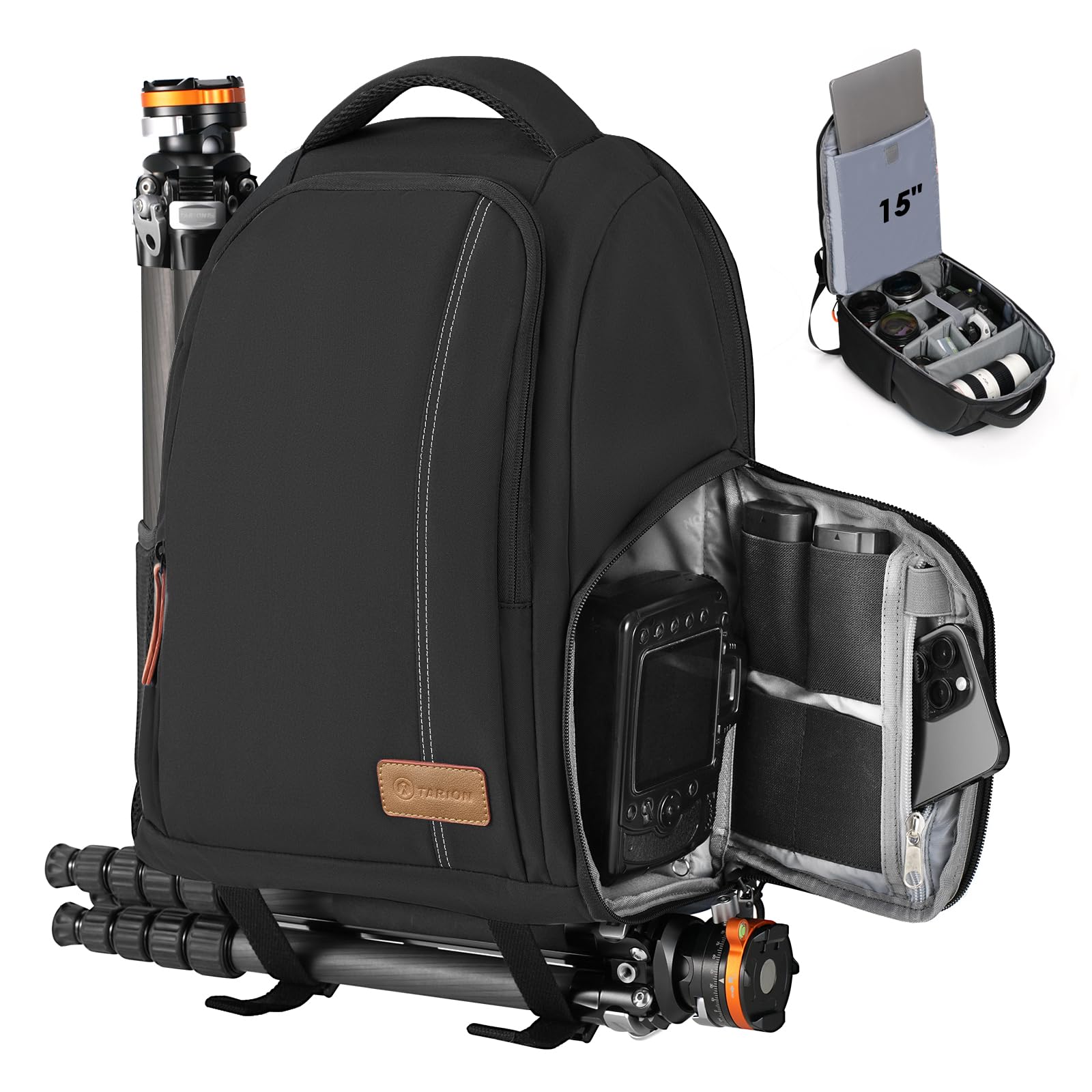
Fifteen liters, 1.87 pounds and a side zip that gets your camera out without taking the pack off: the TB04 is the least intimidating camera backpack here. The harness is a padded-strap design with a breathable mesh back panel, which suits a couple of hours on a trail better than a full day of climbing.

Inside, the padded insert takes a body with a lens mounted plus two or three more lenses, batteries and a charger, with a 15-inch laptop sleeve behind the padding. The extras are generous at this end of the market: a luggage pass-through that slides over a rolling case handle, an anti-theft pocket against your back, and a rain cover stowed in the bag.

What keeps it comfortable is restraint. With a body, two lenses and a layer inside, the padded straps and mesh back sit flat and the pack doesn't lever away from your shoulders, which is more than we can say for a loaded 28-liter bag on the same climb. It's a pack that rewards packing light, and two years of warranty means a beginner can make a mistake without it turning into an expensive one.

Pros

  • 1.87 pounds with a rain cover included
  • Side access without unshouldering
  • Two-year warranty

Cons

  • Stated 22-pound maximum load
  • Only two exterior zip pockets
Our verdict

The pack we hand to a first-time buyer: light, well backed by a two-year warranty, and small enough that you can't overload it by accident.

Check Latest Price
5

Best for Big Kits

RAINSMORE 28L Camera Backpack

90 /100
LBD Score Outstanding

Key details

Weight
3.64 lb
Capacity
28 liters
Gear Access
Front quick access
Laptop Sleeve
15.6 inches
View on Amazon

Twenty-eight liters is a lot of camera bag, and the RAINSMORE uses all of it. The main compartment's thick, shock-absorbing dividers reconfigure around two bodies and several lenses, the top pocket takes a fleece or a spare layer, and the front quick-access zip gets you to the camera without opening the whole pack.

What we appreciate most is that the weather protection isn't an afterthought. The fabric is a waterproof polyester and there's a full-coverage rain cover in the bag, so a long wet walk doesn't depend on a coating holding up. MOLLE webbing on the outside takes a pouch or a bottle, and a tripod holder and a 15.6-inch laptop sleeve round it out.

The cost is weight: 1.65 kg before a camera goes in, and 28 liters loaded is more than most day hikers need. If your usual walk is one body and one lens, the extra capacity is dead weight on your shoulders. If you shoot with two bodies or carry layers for a cold morning, it earns every gram.

Pros

  • Thick, repositionable padded dividers
  • Waterproof fabric plus a full rain cover
  • Top pocket takes a layer

Cons

  • 1.65 kg empty before gear goes in
Our verdict

For a full kit plus cold-weather layers, this 28-liter pack swallows more than anything else at the budget end of this group.

Check Latest Price
6

Maximum Protection

MOSISO Hardshell Camera Backpack

95 /100
LBD Score Outstanding

Key details

Shell
Hard front panel
Weight
3.2 lb
Capacity
35 liters
Laptop Sleeve
15.6 inches
View on Amazon

At 35 liters and 3.2 pounds, this is the biggest and heaviest pack in the group, and the molded PU front shell is the reason to consider it at all. It holds its shape, sheds rain, and takes knocks that a soft bag passes straight through to the gear inside.

The layout is generous: a padded insert that swallows a body with a lens attached plus several more, nine pockets, a 15.6-inch laptop sleeve, a tripod strap and a trolley sleeve for the airport. Packing is easy because the front opens almost completely, and the hard panel means the bag doesn't collapse on itself while you load it.

The straps and zippers are the weak hardware here, and a strap letting go on a remote day is the failure you can't work around. That's why we treat it as a car-to-short-approach pack with serious protection rather than a backcountry hauler — an odd verdict on a bag with a hiking category tag, but the right one for the way it holds up.

Pros

  • Hard front shell resists crushing
  • 35 liters takes two full-frame bodies
  • Water-resistant shell sheds rain

Cons

  • Straps and zippers are the wear points
  • 3.2 pounds empty
Our verdict

For hauling two bodies and a laptop with crush protection, this is the biggest pack here — as long as the day stays close to the car.

Check Latest Price
7

Wet Weather

Besnfoto Rolltop Camera Backpack

90 /100
LBD Score Outstanding

Key details

Weight
4.3 lb
Capacity
23 liters
Dividers
7 removable
Laptop Sleeve
16 inches
View on Amazon

A rolltop is the rare feature that changes how a camera bag behaves. Unroll it and the Besnfoto takes a shell, a lunch and a small tripod inside; roll it down and 23 liters cinches to something that sits close to your back on a fast walk.

The fabric is a TPU-coated nylon that reads more like a dry bag than a camera bag, with a rain cover as backup and seven removable dividers to shape the camera bay. A waist belt takes some of the load, side access gets the camera out on the trail, and there's a 16-inch laptop sleeve for the trip home.

Weight is the tax. At 1.95 kg empty it's heavy for a pack this size, and you feel it on a steep pitch before the camera is even in the bag.

The plastic clips and elastic retainers on the straps are the parts to watch, since a failed clip turns a good backpack into a shoulder bag halfway up a hill. Check them before a long day and the rolltop's flexibility is worth carrying a little extra to get.

Pros

  • Rolltop expands or cinches down
  • TPU-coated waterproof fabric
  • Seven removable dividers

Cons

  • 1.95 kg empty for a 23-liter pack
  • Strap clips and elastic retainers are the weak hardware
Our verdict

The rolltop grows for a jacket and shrinks for a camera-only walk, which makes it the most flexible wet-weather pack here.

Check Latest Price
8

Light Minimal Kits

CADeN Camera Backpack

95 /100
LBD Score Outstanding

Key details

Weight
1.7 lb
Capacity
17 liters
Gear Capacity
2 cameras, 4 lenses
Laptop Sleeve
14 inches
View on Amazon

At 1.7 pounds empty, the CADeN is barely there on your back — lighter than every other pack here, and light enough that you stop thinking about the bag and start thinking about the shot.

It holds more than that weight suggests: two cameras and four lenses by the manufacturer's count, with dividers that rearrange without a fight, an 18mm-padded shoulder strap, a 10mm frame, a tripod holder and a 14-inch laptop sleeve.

The 17 liters fill faster than you expect once a jacket goes in, and the 14-inch sleeve rules it out if you carry a 16-inch laptop. Those are the two places it draws the line, and both are the kind of thing you either fit inside or don't.

What we keep coming back to is the divider system. It's the quickest in this group to reset for a different kit — two bodies one day, one body and three lenses the next — and at this end of the market that's rarer than it should be. It's a starter pack that doesn't behave like one.

Pros

  • 1.7 pounds empty
  • Two cameras and four lenses by the maker's count
  • Divider system resets quickly

Cons

  • 14-inch laptop sleeve only
  • 17 liters fills fast with a jacket inside
Our verdict

For a first camera and two lenses on local trails, this is the lightest and cheapest way into a proper camera backpack.

Check Latest Price

How We Tested the Camera Backpacks

We started with a list of roughly 40 packs and narrowed it by reading specs and owner reviews, deliberately keeping a spread of sizes from small daypacks up to 25-liter bags, a mix of insert-style and panel-loading designs, and prices from budget to premium. Anything with a harness that couldn't be adjusted, or no workable place to strap a tripod, got cut before it ever shipped to us.

Each of the 12 finalists was loaded with the same kit — a mirrorless body, two lenses, a compact tripod, a rain shell, a liter of water, and snacks — then carried on day hikes of four to eight miles, on a commute, and through two airports. We also hiked a steady drizzle on purpose, with the rain cover on for one loop and stowed for the next, so we could see what the bag itself did.

Zippers came first. We opened each main compartment one-handed, with and without gloves, and noted whether the pulls snagged at the corners when the bag was packed full. Shoulder straps and hip belts were judged at hour four rather than minute four — which ones stayed flat, which hardware crept loose, where the pressure landed. To check weight distribution we loaded every bag to a deliberately uncomfortable weight and watched whether it settled onto our hips or stayed parked on our shoulders.

Storage capacity was measured by how the same kit actually fit, not by the liter count on the tag, and by whether a laptop sleeve stayed usable once the camera compartment was full. Versatility got tested by using each pack as a carry-on and as a city bag between hikes. Durability we judged over months of use, watching seams, base fabric, and the point where the shoulder straps meet the body. Value, in the end, came down to what a bag did on the trail rather than how many pockets it advertised.

How to Choose a Camera Backpack for Hiking

Start With the Harness, Not the Dividers

Any bag can pad a camera bay. Carrying a body, a couple of lenses, water and layers without wrecking your shoulders is a design problem, so look for wide padded straps that curve rather than cut, a back panel with a channel or gap for air, and a waist belt that actually wraps your hips. The heavier your kit, the more those three matter and the less the pocket count does.

This is where the premium picks earn their money. The Think Tank Backlight Sprint fits a padded waist belt to a 2-pound-5-ounce pack; the PGYTECH OneMo TAC adds a suspended frame that holds the bag off your spine. A budget pack with the same capacity carries the same gear — it just asks more of your shoulders on the climb.

Decide How You'll Get to the Camera

Three access styles show up here, and the right one depends on weather and how often you stop. Side access lets you swing one strap off and pull the camera out without setting the pack down. A rear panel opens the whole camera bay but needs the pack off your back. A front opening is quickest of all and puts the load furthest from your spine.

The trap is mud. Set a rear-opening pack down the wrong way and your harness lands in it, which is why the Sprint's panel unzips away from the straps: the bag lies face-down and your shoulders stay clean. On a dry, dusty trail that hardly matters. On a wet one it decides the pack.

Size the Camera Bay, Not the Liter Count

Liters describe the whole bag, including the space a jacket and a lunch will take, so a 28-liter pack and a 15-liter pack can hold the same camera kit. Work backwards from your longest lens instead: a body with a 70-200 mounted needs a bay at least as deep as the lens is long, and a rear panel is often shorter than the compartment behind it, so the lens goes in at an angle or comes off first.

If you drive or fly to your trailheads, a laptop sleeve is worth having. 15.6 inches covers most editing laptops, which makes the CADeN's 14-inch sleeve the one to skip if yours is bigger.

Weather Protection and What Wears Out First

Waterproof fabric and a rain cover do different jobs. The fabric handles drizzle and a damp pack bed; the cover handles sustained rain and keeps trail mud off the outside. Neither seals the zip line, which is where water actually gets in — so on a genuinely wet day, line the camera bay with a dry bag instead of trusting the shell.

Expect straps, zippers and divider backing to age first. A removable divider set can be replaced; a torn shoulder-strap anchor cannot. Compare warranties for exactly that reason: the TARION TB04 carries two years and the CADeN offers a year of replacement coverage, which is unusual at the budget end.

Frequently Asked Questions

Final Verdict

The Think Tank Backlight Sprint is the pack we recommend to most hikers, because it settles the two things that matter on a trail: a 2-pound-5-ounce carry and a rear panel that keeps your harness out of the dirt. If you run hot or shoot with a gimbal, the PGYTECH OneMo TAC's suspended back and flat-opening rear are worth the extra pound.

And if you're building a first kit, the TARION TB04 does the job for a fraction of either — just pack it light and leave the second body at home.