Best Bluetooth Turntables of 2026

The knock on Bluetooth turntables is simple: you're spending good money on analog warmth, then compressing it before it reaches your speakers. It's a fair worry—the cheapest ones make vinyl sound like a stream stuck at low volume. But the best models don't erase the compromise so much as make it irrelevant. They let you play records through the Bluetooth speaker, soundbar, or headphones you already own, with no receiver and no cable snaking across the living room.

Over the past seven months, we've spun records on 12 turntables, from all-in-one models with built-in speakers to manual decks that make you balance a tonearm. The differences came down to sound, pairing stability, finish, and whether the thing felt solid enough to keep for years. A built-in phono preamp is table stakes; USB output is the sleeper feature if you ever want to digitize a record. Automatic operation is nice when you're multitasking, but a well-damped manual tonearm is just as easy once you've done it twice. The picks below are the ones we kept reaching for.

1

Best Overall

Audio-Technica AT-LPGO-BT

93 /100
LBD Score Outstanding

Key details

Drive
Belt drive
Platter
Die-cast aluminum
Bluetooth
aptX wireless output
Operation
Fully automatic
View on Amazon

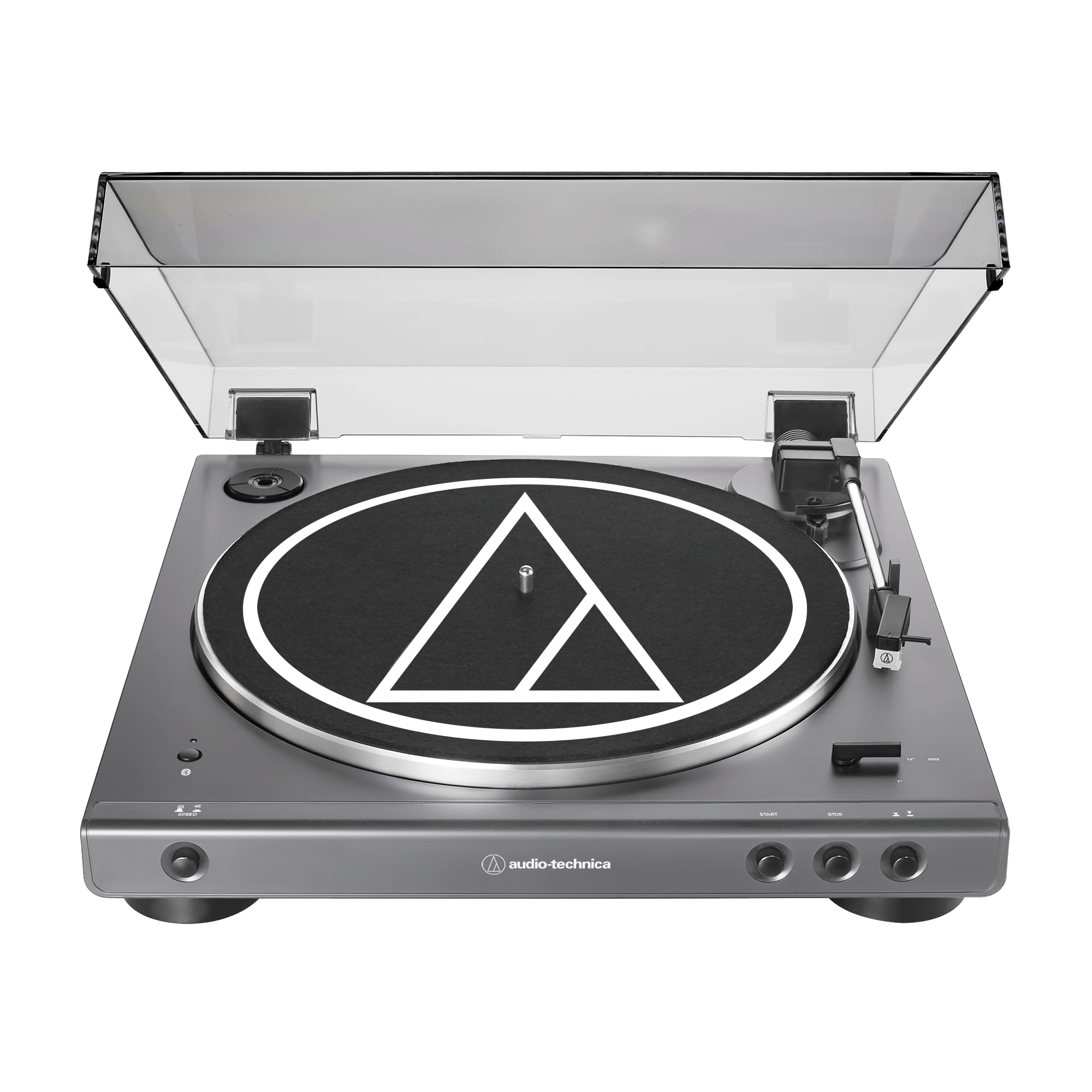
Press start and the arm lifts, swings across, and lowers onto the lead-in groove by itself; when the side ends it lifts again and the motor shuts off. That automatic cycle is the whole reason the AT-LPGO-BT is our top pick. Cueing a stylus by hand is the part of vinyl that puts people off, and this deck simply does it for you, which means a record can be playing before you've finished settling into the chair.

The wireless side punches above the price. It sends aptX, a step up from the basic Bluetooth codec most budget decks use, and the link held across a room without dropping in our testing. Pairing is a button press and a tap on your phone, and the deck connects to a soundbar and to headphones with the same lack of drama. If you've been put off wireless audio by cheap speakers cutting out mid-song, this isn't that.

It's small enough to live under a TV or on a bookshelf, and the dust cover keeps the platter clean between sessions. The plinth is where the money clearly didn't go: it's plastic and feels lighter in the hand than the price suggests. On a solid shelf that never matters. On a springy floor with a subwoofer working on the same surface, it will.

The one thing to plan for is the other end of the link. There are no speakers in the box, so the deck is only as good as the soundbar, speaker, or headphones you pair it with — give it something decent and the convenience stops feeling like a compromise, and give it something cheap and you'll hear exactly why the speaker matters more than the turntable.

Pros

  • Cues, plays, and returns at the touch of one button
  • aptX wireless keeps a cleaner link to speakers
  • Small, light footprint for a shelf or TV stand

Cons

  • Plastic plinth feels lighter than the price suggests
  • No speakers included, so budget for a speaker or soundbar
Our verdict

We recommend it to nearly everyone: it cues and returns by itself, pairs over aptX, and disappears onto a shelf without asking for a receiver.

Check Latest Price
2

Best for Serious Listening

Audio-Technica AT-LP120XBT-USB

93 /100
LBD Score Outstanding

Key details

Drive
Direct drive, DC servo
Speeds
33 1/3, 45, 78 rpm
Outputs
USB and switchable RCA
Bluetooth
aptX Adaptive output
View on Amazon

There's no belt inside the AT-LP120XBT-USB. A direct-drive motor turns the die-cast platter itself, so there's no rubber band to stretch, slip, or replace in a couple of years, and the platter comes up to speed the instant you press start. If you've owned a cheap belt-drive deck before, the difference in how solidly everything moves is obvious the first time you use it.

It's also the only deck in this guide that plays 78 rpm records, and the only one with aptX Adaptive, which is the most robust wireless connection here before you reach for a cable. Add USB output for recording a side to a computer and a switchable phono preamp that works whether or not your amplifier has a phono input, and you have the deck to buy if you plan on still buying records in twenty years. We think it earns its premium for anyone who has already caught the bug.

The cost is manual operation. You lift and place the arm yourself and nothing happens at the end of the side, which is fine when listening is the activity and mildly annoying when you're doing something else. The 78 setting has a catch, too: those records need a different stylus from the one fitted, so budget for one if you actually own shellac. At 8 kg it's also the heaviest deck here, so decide where it lives before you lift it onto the shelf.

Pros

  • Direct drive means no belt to stretch or replace
  • Only deck in this guide that plays 78 rpm
  • aptX Adaptive for the steadiest wireless link here
  • USB output records records straight to a computer

Cons

  • Fully manual, with no auto return at the end
  • 78 rpm needs a different stylus than the fitted one
Our verdict

Buy this one if you want a deck to grow with — direct drive, three speeds, aptX Adaptive, and USB — and you don't mind placing the arm yourself.

Check Latest Price
3

Best for Digitizing Vinyl

Sony PS-LX310BT

91 /100
LBD Score Outstanding

Key details

USB
Rips records to MP3
Speeds
33 1/3 and 45 rpm
Bluetooth
Wireless output
Operation
Fully automatic
View on Amazon

Sony uses the word rip, and it's the honest one: the PS-LX310BT sends a record down a USB cable into your computer as an MP3, which is how the box of LPs in the garage becomes something you can play in the car. The USB cable is in the box; the recording happens on your computer, so allow for that before you start on a stack of albums.

It's fully automatic as well, so one button starts the side and the arm returns when it's done, and it transmits over Bluetooth to a speaker, soundbar, or headphones. Three gain settings are the detail we didn't expect to care about: they let you match the deck's output to whatever it's feeding, so a quiet pressing doesn't arrive at half the volume of everything else on your phone.

That combination is what makes it our pick for digitizing. We think it's the right buy for someone with a collection and no appetite for a project: it plays records properly, it puts them on a computer, and it doesn't ask you to set up a tonearm to do either. What it won't do is flatter you — the plinth is plastic and feels ordinary for the money, and the speckled black finish surprised us in person.

Two speeds, 33 1/3 and 45, with the 45 adapter stored in a slot underneath so it doesn't vanish into a drawer. It costs about what the Audio-Technica direct-drive does, which makes the choice between them clean: automatic playback and ripping here, direct drive and 78s there.

Pros

  • One-step automatic start, stop, and arm return
  • USB rips records to MP3 on a computer
  • Three gain settings match levels to your system

Cons

  • Two speeds only, so no 78 rpm records
  • Plastic plinth feels ordinary for the money
Our verdict

Our pick for turning a shelf of LPs into files, with one-button playback that makes the turntable itself the easy part.

Check Latest Price
4

Best Budget

Retrolife HQ-KZ006

86 /100
LBD Score Excellent

Key details

Tonearm
Adjustable counterweight
Bluetooth
Wireless output
Cartridge
AT-3600L moving magnet
Recording
USB to PC
View on Amazon

The HQ-KZ006 is the least expensive deck here that gives you something to set up. There's an adjustable counterweight on the back of the tonearm and an AT-3600L moving-magnet cartridge at the front, and that pair is the difference between a deck that tracks a record properly and one that skips when the bass gets busy. For the money we think that's exactly the right place to spend it, and it's why this is our budget pick.

Wireless output works the way it should, pairing with Bluetooth speakers or headphones, and there's an RCA line output if you prefer to run a cable to a stereo. USB to a computer turns records into files. Under the detachable dust cover you get an MDF plinth and a die-cast aluminum platter, which is more hardware than the price usually buys. Setup takes longer than the automatic decks: you balance the arm, set the tracking weight, and check the belt sits properly on the platter rim before the first side.

Power-on failures are the thing to know about. Units do arrive that won't turn on, so keep the box and the receipt until you've played a record through, and buy from somewhere that takes returns without an argument. Do that and you've got a genuine turntable — adjustable, wireless, and upgradeable — for less than anything else in this guide.

Pros

  • AT-3600L cartridge with an adjustable counterweight
  • Streams to Bluetooth speakers or headphones
  • USB recording to a PC for digitizing
  • Die-cast platter and MDF plinth on a budget

Cons

  • Setup means balancing the arm and setting tracking weight
Our verdict

The budget deck we point people toward: a real cartridge and an adjustable arm for the least money in this guide.

Check Latest Price
5

Best All-In-One

Qlearsoul ONE-S

84 /100
LBD Score Excellent

Key details

Speakers
Built-in, four drivers
Bluetooth
Input and output
Cartridge
AT-3600L
Preamplifier
Switchable phono/line
View on Amazon

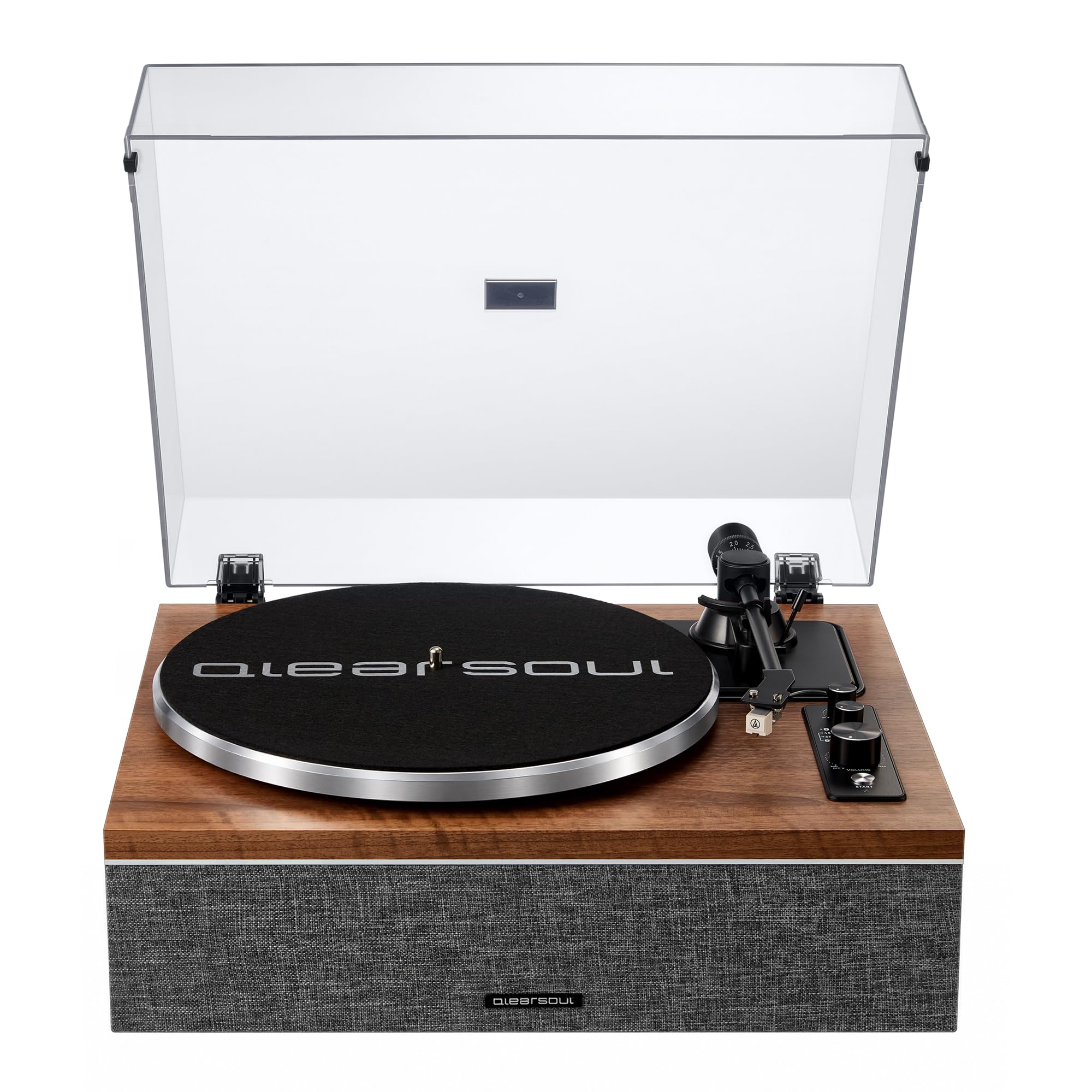
Two 15-watt woofers and two 10-watt tweeters are built into the plinth, so the ONE-S plays a record with nothing else in the room: no speaker, no soundbar, no receiver, no cable except the power cord. Unbox it, drop the platter on, and you're listening — which is not a sentence we can write about anything else here.

We think that's worth real money for a first setup or a small room. The speakers won't replace a good pair of bookshelf speakers, since the low end runs out before a bass-heavy record does, but they're clear, and the DSP keeps them from sounding thin when you're playing quietly. The walnut finish and mid-century silhouette mean it looks like furniture rather than a gadget.

Bluetooth runs both ways, which is rarer than it should be: your phone can stream into the speakers, and the deck can send a record out to Bluetooth headphones or a bigger speaker when the room fills up. The AT-3600L cartridge is the same one the budget decks here use, and the counterweight comes preset for tracking force, so there's no balancing act before the first record.

The caveat is reliability. Some units stop working within days, or start skipping across records that play fine elsewhere, so keep the packaging until you've been through a few sides and buy from somewhere with an easy return. Land a good one and this is a lot of turntable, speakers included, for the money.

Pros

  • Built-in four-speaker system needs nothing else
  • Bluetooth works in both directions
  • AT-3600L cartridge with a preset counterweight

Cons

  • Some units fail within the first few days
  • Built-in speakers run out of bass
Our verdict

Choose it when there's no speaker in the room — four built-in drivers, wireless both ways, and a walnut plinth that earns its place.

Check Latest Price
6

Wood-Plinth Value

DIGITNOW M485

88 /100
LBD Score Excellent

Key details

Plinth
High-gloss wood
Warranty
2 years
Bluetooth
Wireless output
Cartridge
AT3600L moving magnet
View on Amazon

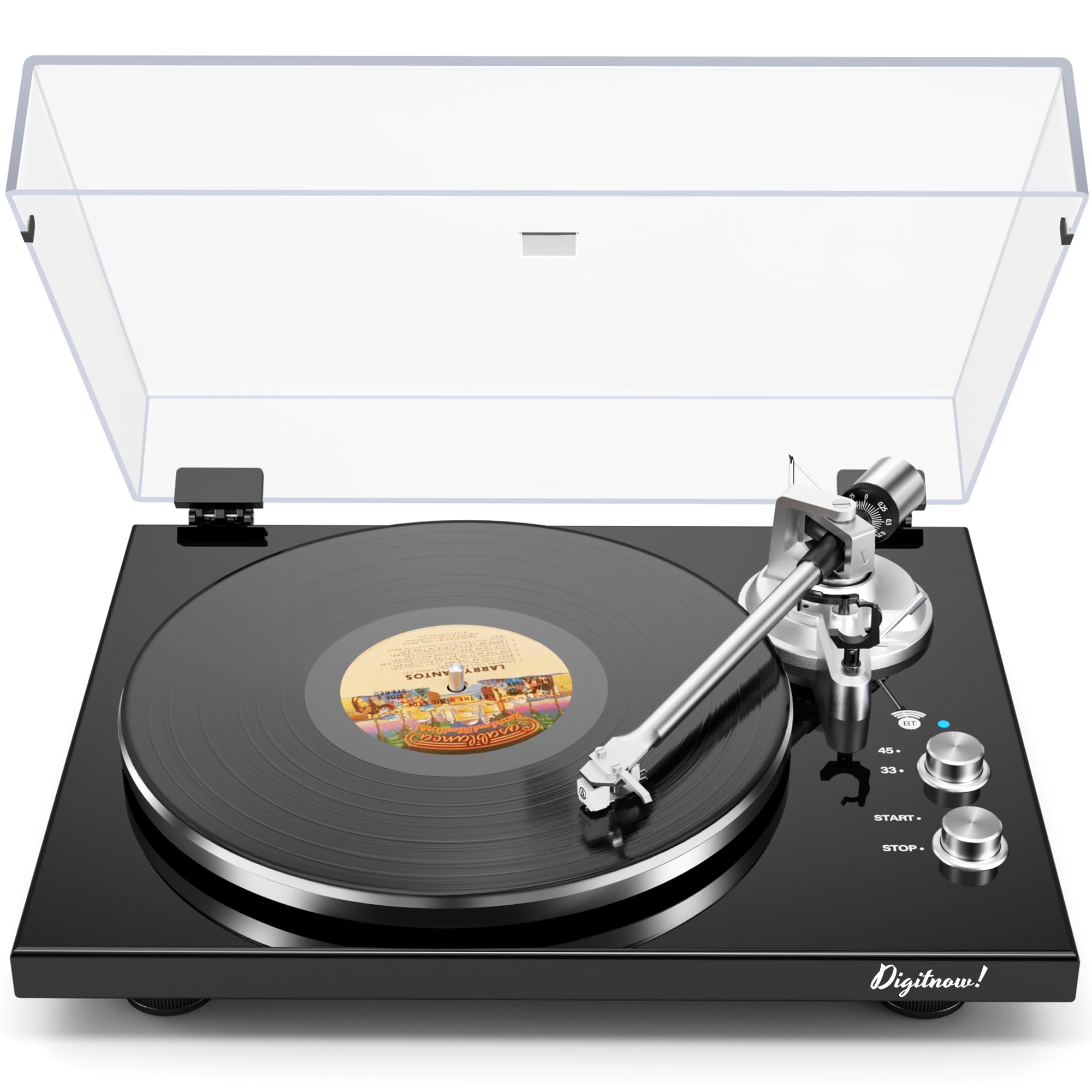
At 12.5 pounds, the DIGITNOW is the heavier of the two budget decks here, and most of that is a high-gloss wood plinth doing real work: mass is what keeps a stylus steady when someone walks past the shelf or the volume goes up.

There are no speakers inside, so plan on a Bluetooth speaker or a wired pair. What you get instead is the setup hardware. The AT3600L cartridge, an adjustable counterweight, and an anti-skate weight hanging on a thread are all things the automatic decks here don't give you, and they're what let you set the arm up properly rather than hope the factory got it right. USB out records a side to a computer, and the warranty runs two years, which is as good as it gets in this group.

The wireless link is where it falls down. Pairing took a couple of attempts in our testing and never felt as secure as the Audio-Technica's, so treat Bluetooth as the convenience and the RCA cable as the serious path. On a cable it's a sturdy, good-looking deck with room to grow, and for someone who wants wood and an adjustable arm on a tight budget, that's a fair trade.

Pros

  • Heavy high-gloss wood plinth steadies the arm
  • Adjustable counterweight plus anti-skate
  • Two-year manufacturer warranty

Cons

  • Bluetooth pairing can take a few attempts
  • No built-in speakers, so a separate system is required
Our verdict

For the money this is the most turntable in wood, as long as most of your listening goes through a cable.

Check Latest Price

How We Tested 12 Bluetooth Turntables

We started with a longer list of current Bluetooth turntables and narrowed it by reading spec sheets and owner reviews, then filtering for Bluetooth output, a built-in phono preamp, USB output where available, and a mix of belt- and direct-drive designs. We ended up with 12 units and lived with them for seven months.

Each deck spent time on a living-room credenza, paired with a Bluetooth speaker across the room and a pair of headphones at night. We set them up solo, timed how long it took to get a record spinning, and noted whether the controls made sense without the manual. We paired each one with three different speakers, walked a phone out of range to see where the signal dropped, and switched between wired and wireless to hear what Bluetooth gave up. We also checked finish and footprint against the shelf it was going on.

For sound, we played the same handful of records—dense rock, solo piano, a scratchy thrift-store find—and listened for surface noise, bloated bass, and whether vocals stayed put. We checked speed with a strobe disc at the start and end, lifted platters to feel bearing play, and worked every hinge, foot, and tonearm cue. USB models got a test transfer to a laptop to see how painless the software side was.

Reliability meant living with them: repeated pairing, auto stop and return, and whether anything drifted or developed a wobble. Then we asked whether each one justified its spot—what you got for the money and what you gave up. By the end, the ranking was less about specs than about which ones we missed when we packed them away.

How to Choose a Bluetooth Turntable

Check the direction of the Bluetooth

Bluetooth on the box tells you nothing on its own. What you want is output: the deck sends the record to a speaker, soundbar, or a pair of headphones. Input is a different feature, and it lets your phone play through the deck's own speakers instead. A player that only does input can't do the job this guide is about, however good the rest of it is. The giveaway sits in the feature list. Look for words like transmits, output, or a list of compatible Bluetooth speakers and headphones; if the only Bluetooth sentence is about streaming from your phone, keep looking.

Automatic or manual, and who else will use it

Automatic decks start the platter, lower the arm, and lift it again at the end of the side. Manual decks leave all of that to you. Automatic is the better fit for a household where more than one person will use it, and it's why the AT-LPGO-BT is our default. Manual isn't a downgrade, though: it's what lets a deck like the AT-LP120XBT-USB run direct drive, play 78s, and take a different cartridge later. If you listen to whole sides while doing something else, buy automatic. If listening is the activity, manual costs you nothing.

Wireless is convenient; the cable still sounds better

Bluetooth compresses the signal on the way to the speaker. aptX and aptX Adaptive throw away less of it than the basic codec, which is why we care about them, but a short RCA run from the same deck to the same speaker will beat the wireless link every time. That doesn't make Bluetooth a compromise so much as a placement tool: it's how the turntable lives in one room and the speaker in another, or how you listen on headphones without a cable across the floor. Use wireless day to day, and plug in when you sit down to listen properly.

Drive, speeds, and the records you actually own

Belt drive is quiet and cheap to build; direct drive holds speed without a belt to stretch. Either works at this level, and the practical difference is maintenance more than sound. Speeds matter more than buyers expect: most LPs are 33 1/3 and most 12-inch singles are 45, so two speeds covers nearly everything. 78 rpm is a separate hobby, since those records need a different stylus and only one deck here plays them at all. Don't pay for the third speed unless you own shellac.

The arm is your upgrade path

An adjustable counterweight and a replaceable moving-magnet cartridge are what make an inexpensive deck worth keeping. They let you set tracking force for the cartridge that's actually fitted and swap in something better later, instead of living with whatever the factory installed. That's the real split between the budget decks here and the automatic ones: one gives you a starting point you can build on, the other gives you a machine that works and asks nothing. Neither is wrong. Just know which one you're buying before you order.

Frequently Asked Questions

Final Verdict

Buy the Audio-Technica AT-LPGO-BT unless something specific stops you. It's the only deck here that is both fully automatic and modestly priced, the aptX link is good enough that you won't miss the cable, and it sits on a shelf without a receiver.

If you want a deck to keep and adjust, the AT-LP120XBT-USB earns its premium with direct drive, 78 rpm, and USB. If your records are mostly in a box, the Sony PS-LX310BT will put them on your computer while still playing them properly.