Best Bird Feeder Cameras of 2026

A bird feeder camera makes a simple promise: hang it outside and it tells you what visited while you were at work. What the listing photos don't show is how much rides on things you can't see — a lens sitting too high above the perch, a solar panel that never catches a winter sun, a Wi-Fi radio that can't reach the back fence. I've been let down by all three.

Over the past six months, my team and I have kept 12 of these feeders running in our own yards, and the gap between the good ones and the irritating ones came down to setup, signal, and how many gray days they could ride out on a charge. The rest — actually looking forward to the morning's clips — follows from those three.

First-time buyers tend to overrate resolution. A crisp 2K clip from a lens level with the perch beats a soft 4K one aimed down at a bird's head, and no AI label rescues a shot where the markings aren't visible. The picks below are the ones we'd hang again without hesitating.

1

Best Overall

Humbirdy SH66 4K Smart Feeder

89 /100
LBD Score Excellent

Key details

Wi-Fi
2.4GHz and 5GHz
Bird ID
Free, no subscription
Seed Capacity
1.8 liters
Video Resolution
4K at 30fps
View on Amazon

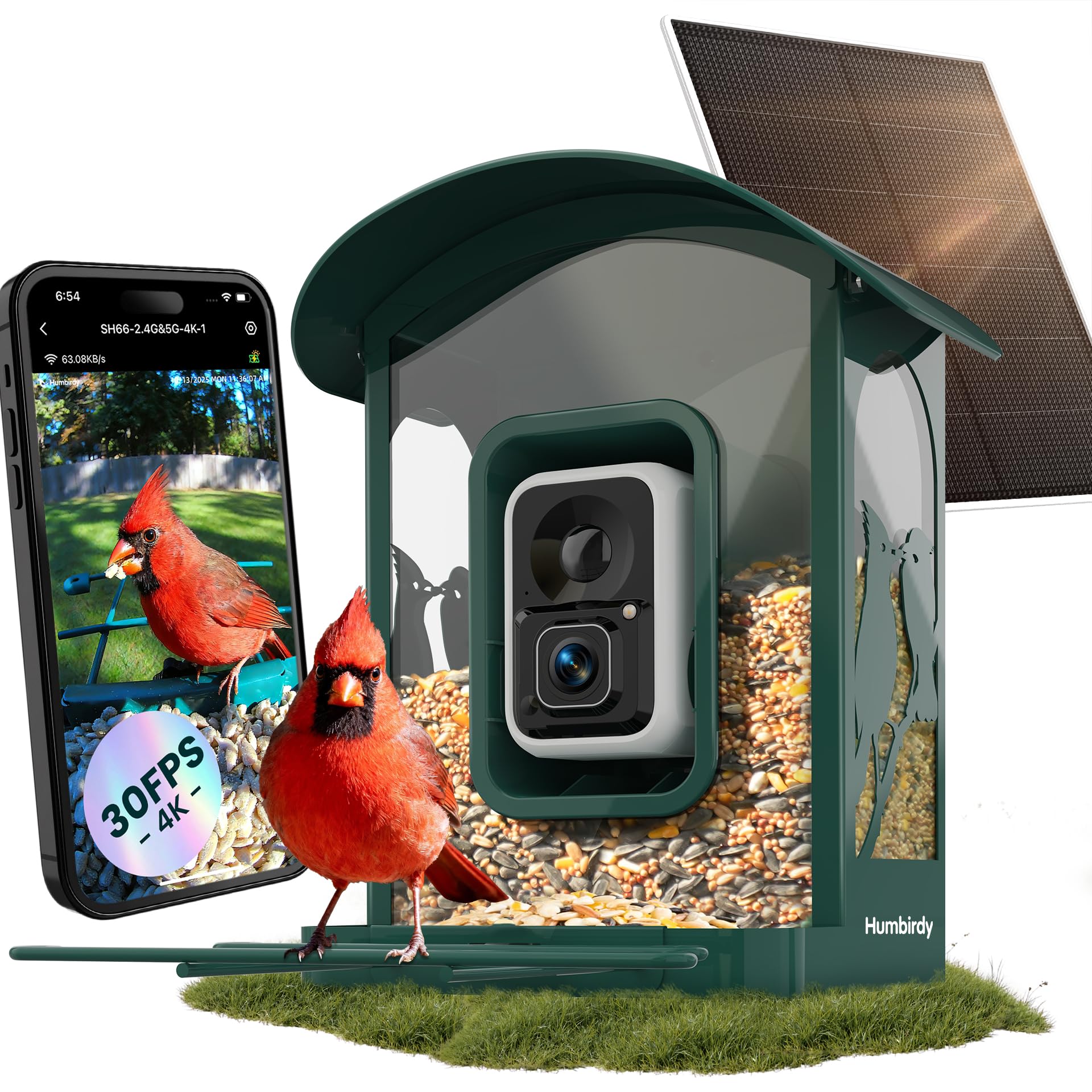
Almost every feeder camera in this group asks your router for a 2.4GHz network, and that single requirement explains most of the setup misery in this category. The Humbirdy SH66 is the exception: it joins 5GHz as readily as 2.4GHz, so a modern mesh network is not a problem. Behind that sits a true 4K sensor at 30 frames per second, 8MP stills, and a 169-degree view that takes in the whole perch rather than one corner of it.

The part we appreciate most is not the resolution, though — it is that the camera lifts out of the housing. You carry a small puck indoors to charge over USB-C instead of unbolting a feeder full of seed, and the same trick makes the lens easy to wipe. The slow-motion capture is more fun than it has any right to be: 1080p at 120fps turns a wingbeat into something you can actually study. Add free lifetime identification of 10,000-plus species with no subscription, and the case is hard to argue with.

Species ID is the least certain thing about it — mostly right, with the slips coming on similar-looking sparrows and finches. The 3W panel is a trickle charger rather than a power plant, so a spot in real shade means topping the battery up by hand. None of that undoes the recommendation for a yard with reasonable light and a router that broadcasts 5GHz, which is where this feeder is aimed.

What comes in the box helps the price land: a wall bracket, a tree strap, a 32GB card and a 1.8-liter hopper. That last figure is the one to weigh if you feed heavily — a bigger hopper means fewer trips up the ladder in July, and this one sits mid-pack next to the two-liter feeders here.

Pros

  • True 4K at 30fps with 8MP stills
  • Free lifetime bird ID, no subscription
  • Joins 5GHz and 2.4GHz networks
  • Camera lifts out for charging and cleaning

Cons

  • Species ID trips on similar-looking birds
  • Costliest feeder in this group
Our verdict

We recommend the Humbirdy to anyone who wants the sharpest footage here and no monthly bill: true 4K, free bird ID, and it connects to either Wi-Fi band.
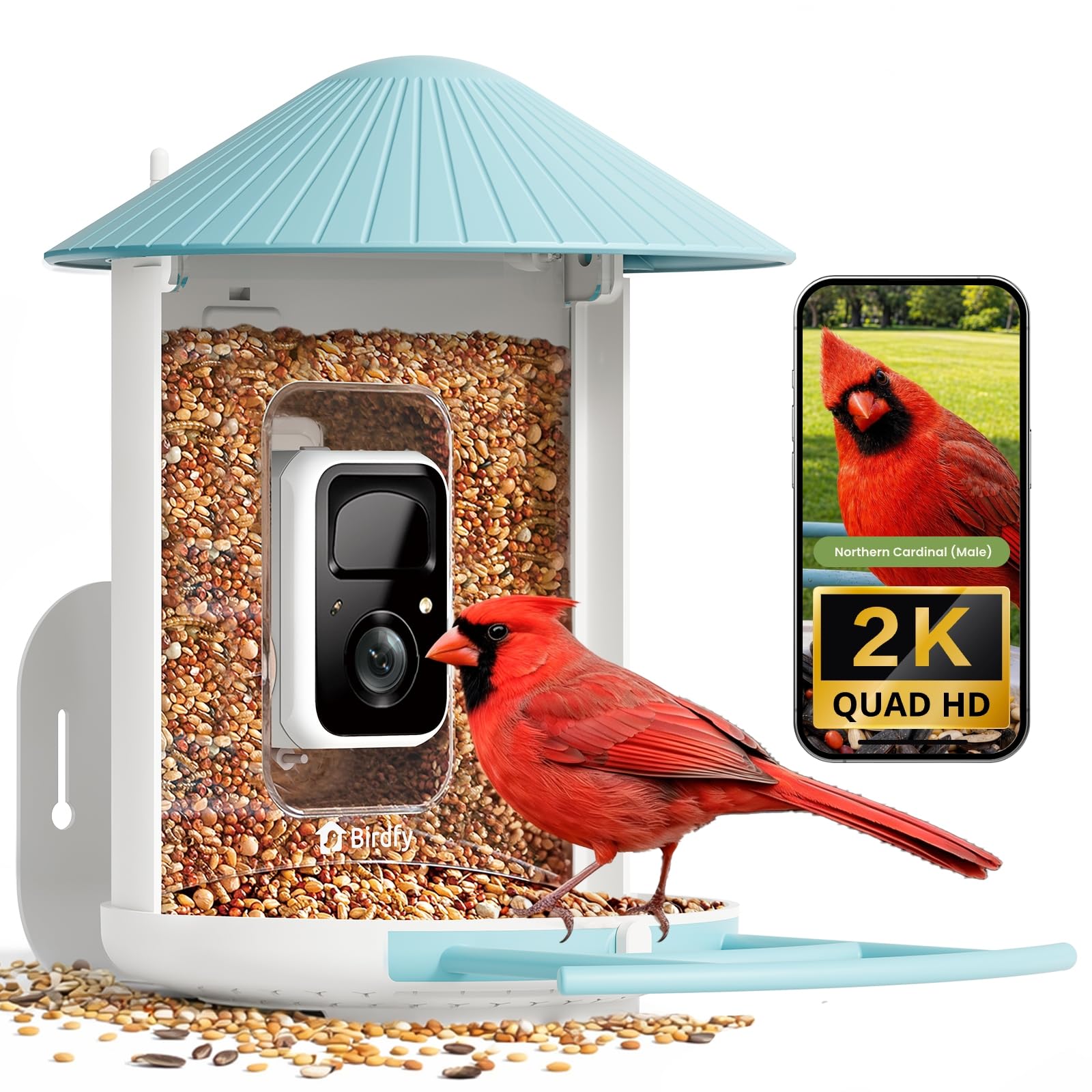
Check Latest Price
2

Best Value

HARYMOR Q8 Smart Bird Feeder

88 /100
LBD Score Excellent

Key details

Zoom
3x
Power
Built-in solar panel
Seed Capacity
2 liters
Video Resolution
2K
View on Amazon

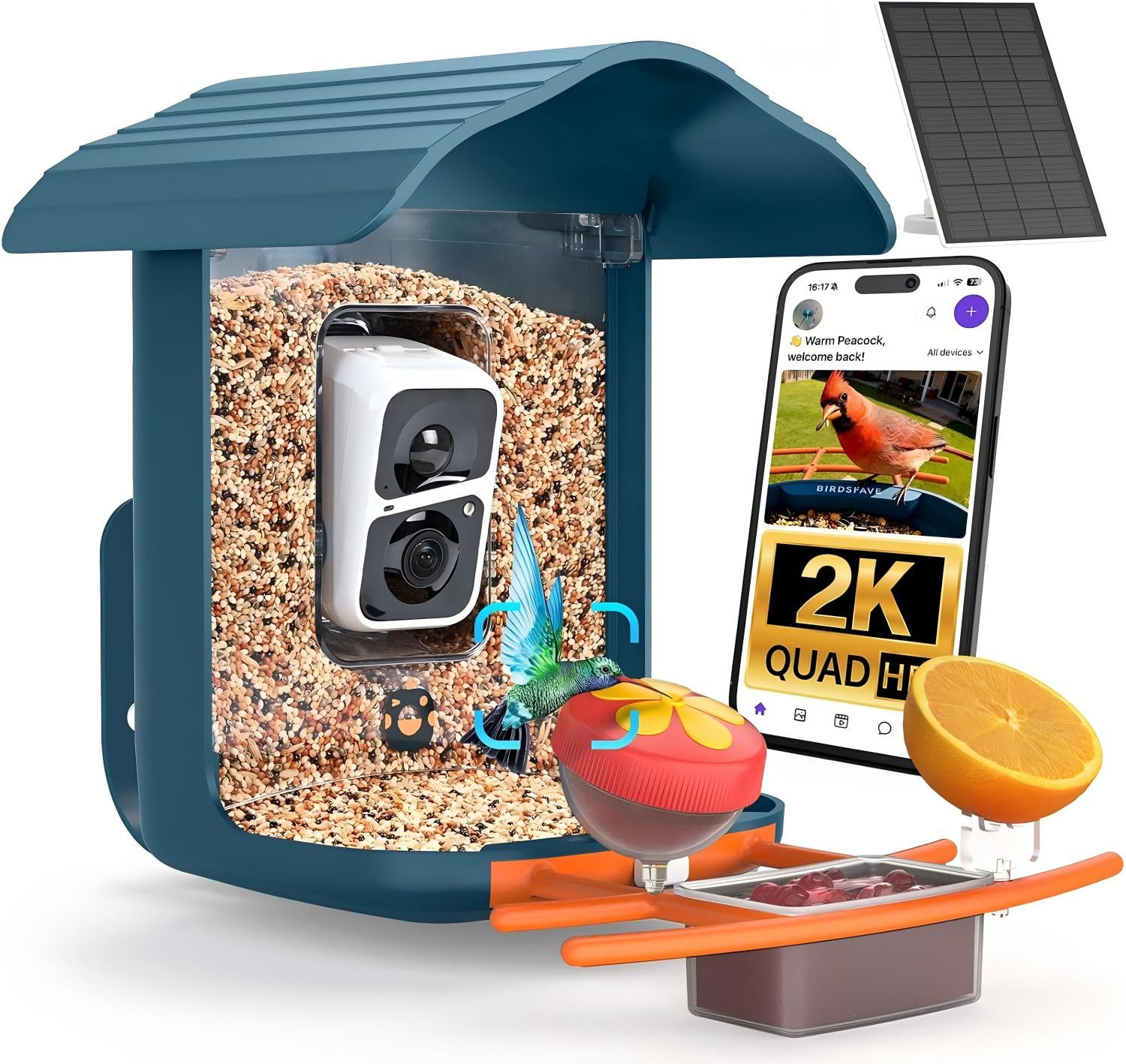
Two liters of seed, a 2K camera, night vision and a solar panel for a fraction of what our top pick costs — that is the trade the Harymor Q8 offers, and we think it is the right one for a first feeder camera. The hopper is the largest in this group, which matters more than it sounds: a full 2L keeps the birds coming through a busy week without a ladder.

Plenty of small decisions land where they should. The funnel-shaped roof sheds rain rather than letting it into the seed, the 3x zoom fills the frame with a single bird, and night vision keeps the feeder useful after dusk. Setup is a screwdriver job rather than a project, the app handles arrival alerts and clip sharing without much fuss, and a detachable mini hummingbird feeder hangs alongside for nectar season.

The caveat is identification: the camera and alerts work on their own, but the AI naming is the part that carries a subscription, so budget for it if you want names attached to clips. Video is 2K rather than 4K, and the picture is a step behind the Humbirdy's. As a feeder first and a camera second, though, a hopper the birds actually use beats a sharper one they ignore.

Pros

  • 2-liter hopper, the largest here
  • 2K video with 3x zoom and night vision
  • Funnel roof keeps rain out of the seed
  • Ships with a mini hummingbird feeder

Cons

  • Species ID requires a paid subscription
  • 2K video rather than 4K
Our verdict

If you want the biggest hopper here without paying much, buy this one: 2 liters of seed, 2K video, night vision and solar charging.

Check Latest Price
3

Best Free Bird ID

NETVUE Birdfy 1 Smart Feeder

88 /100
LBD Score Excellent

Key details

Bird ID
Free for life
Field Of View
155 degrees
Seed Capacity
3.1 lb
Video Resolution
2K
View on Amazon

Free bird identification for life is the reason the Birdfy 1 still belongs on this list. Any of these cameras can name a cardinal; the difference is whether the naming costs you a monthly fee, and this one charges nothing. It also throws in free cloud storage and a 155-degree view that captures the whole feeder rather than a tight crop of it.

Night vision here is genuinely useful rather than a checkbox — the camera switches to infrared and you get grayscale visitors at dusk, when a lot of the interesting traffic shows up. The 50-ounce hopper tops up through the lid without dismantling anything, wall, pole and tree hardware comes in the box, and it works with Alexa if you want the feed on a kitchen screen.

What we minded is the charging. There is no solar panel in the box, so you bring the feeder inside and plug it in, and battery life is the one thing that splits: a quiet yard runs for weeks, and others are hauling it in constantly. Turn the motion sensitivity down if every leaf sets it off — that accounts for most of the difference. Check your router first, too, because this one wants 2.4GHz only.

Pros

  • Species ID free for life
  • 155-degree view with infrared night vision
  • 50-ounce top-fill hopper
  • Free cloud storage and Alexa support

Cons

  • No solar panel; charge over USB
  • 2.4GHz Wi-Fi only
Our verdict

We point people to the Birdfy when a subscription is a dealbreaker: species ID is free for life, and the 155-degree view misses nothing at the perch.

Check Latest Price
4

Best for Shaded Yards

Kiwibit BW511 4K Smart Feeder

88 /100
LBD Score Excellent

Key details

Power
3W external panel, 5200mAh
Seed Capacity
1.5 liters
Video Resolution
4K HDR
Weather Resistance
IP65
View on Amazon

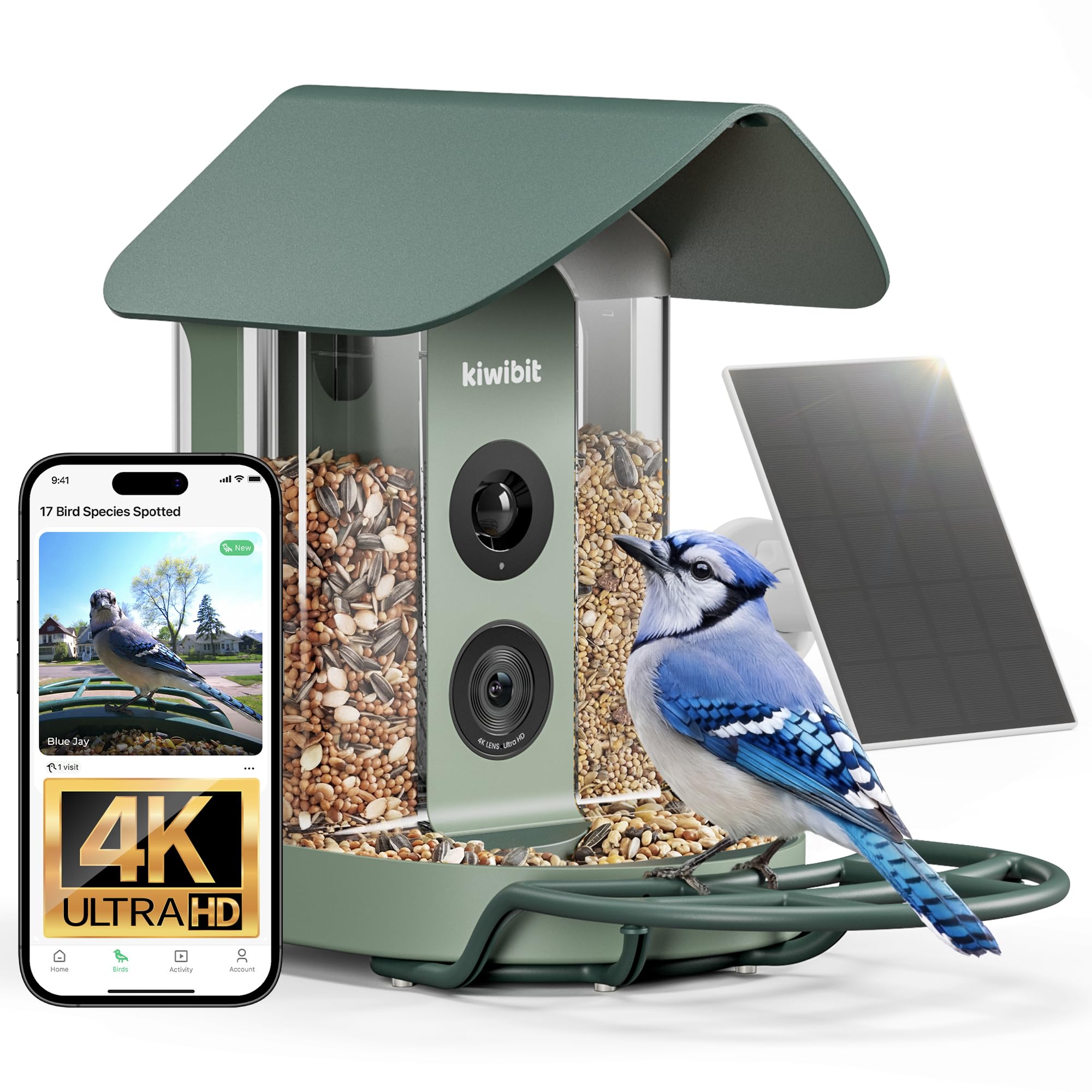
Most solar feeder cameras bolt the panel to the roof, which becomes a problem the moment your best bird spot sits under a tree. The Kiwibit BW511 puts its 3W panel on a cable, so the panel goes where the sun is and the feeder goes where the birds are — the clearest version of that idea in this group.

The camera is the other half of the pitch: 4K HDR through a 132-degree lens, with night vision and an IP65 housing that shrugs off rain. Inside there is a 1.5L dual hopper, so you can run two seed blends and find out which one the cardinals actually prefer, and the 5200mAh battery takes USB-C charging when the weather refuses to cooperate.

Two limits are worth knowing before you commit. The radio is 2.4GHz only, so a 5GHz-only network is a non-starter. And the AI identification is a 30-day trial — after that, species names sit behind a plan, which puts it a step behind the feeders here that include identification for life.

Battery life is where the reports divide, and the panel on a cable is exactly the fix: aim it south, keep it clear of the feeder's shadow, and it keeps up through short days. That combination — real 4K, a hopper you can split, and a panel you can move — is why the BW511 earns its place in a yard that never gets full sun.

Pros

  • 4K HDR video day and night
  • External 3W panel you can aim separately
  • 1.5L dual hopper for two seed blends
  • IP65 housing with USB-C charging

Cons

  • Bird ID is a 30-day trial
  • 2.4GHz Wi-Fi only
Our verdict

The shaded-yard answer: a 3W panel on a cable, 4K HDR video, and a split hopper for two seed blends.

Check Latest Price
5

Best Budget

Fazoxo B1 Smart Bird Feeder

86 /100
LBD Score Excellent

Key details

Power
Solar panel included
Wi-Fi
2.4GHz only
Seed Capacity
1.3 liters
Video Resolution
FHD
View on Amazon

If the goal is simply to see who is on the feeder, the Fazoxo B1 does it for the least money here, and starting somewhere beats talking yourself out of the hobby. The camera is FHD rather than 2K, which shows up as softer detail on small birds, but the arrival alerts and the live view work exactly the way they do on feeders costing several times as much.

The package is more complete than the price suggests: a solar panel, a 1.3L hopper, a microphone and speaker for two-way audio, and a navy housing that looks better on a fence post than most of the birdhouse-shaped cameras here. Setup runs through a straightforward app, a mounting kit is in the box, and the whole thing is light enough to hang from a branch strap.

Two things to plan around. The AI identification is a one-month trial, so free bird names are not part of the deal. And the radio is 2.4GHz only — put the feeder within sight of the router, because a weak 2.4GHz signal at the far end of a yard is where any of these setups starts dropping frames.

Pros

  • Lowest-priced feeder camera here
  • Solar panel and 1.3L hopper included
  • Two-way audio through the app
  • Arrival alerts and live view

Cons

  • FHD video, not 2K
  • AI bird ID is a one-month trial
Our verdict

For a first feeder camera on a tight budget, this does the job: FHD video and live alerts, with bird ID paid after the first month.

Check Latest Price
6

Species Variety

birdsnap 2K Smart Bird Feeder

87 /100
LBD Score Excellent

Key details

Bird ID
Free, no subscription
Seed Capacity
1.8 liters
Included Storage
32GB card
Video Resolution
2K
View on Amazon

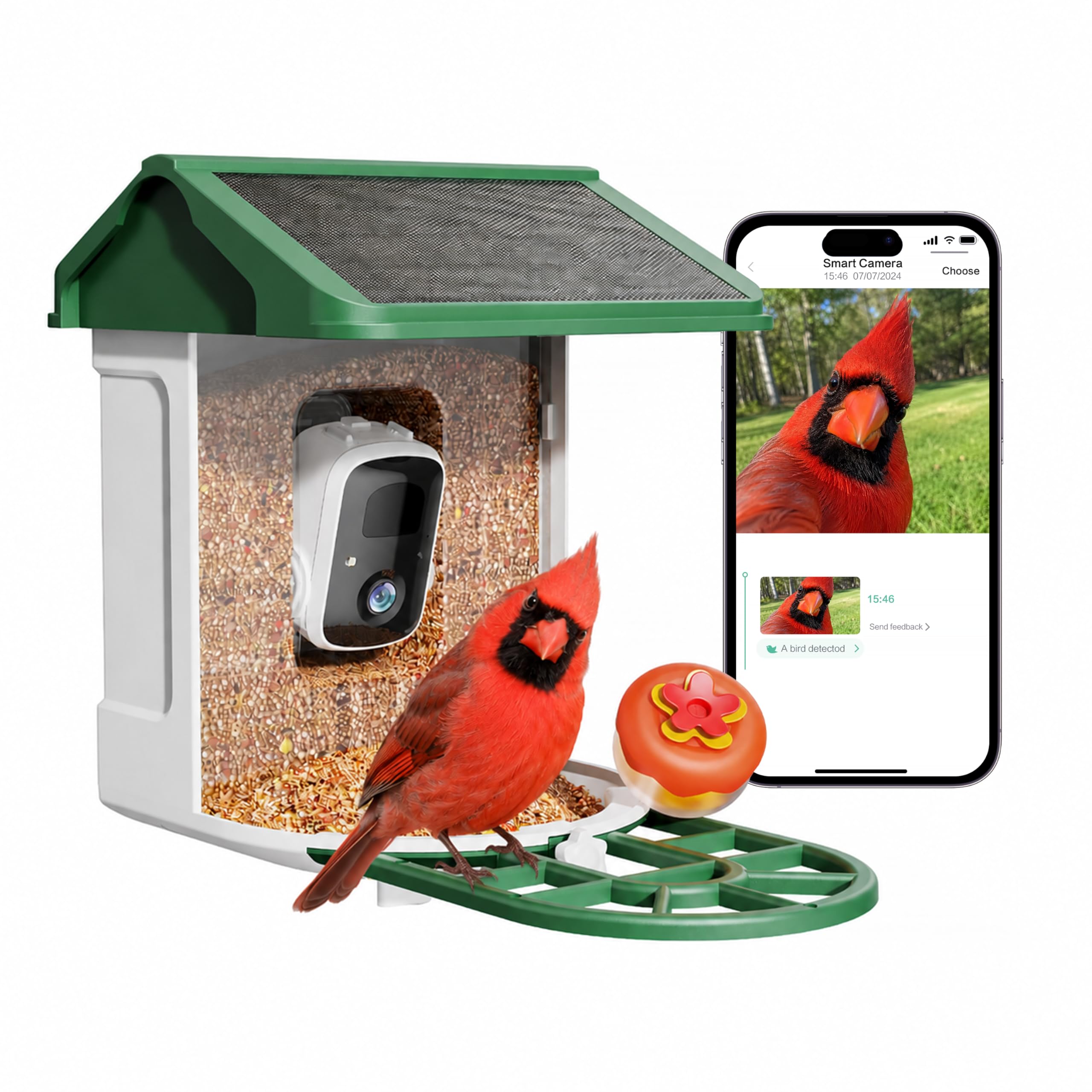
Three feeding accessories come in the box with the birdsnap — a hummingbird feeder, a fruit fork and a jelly box — and that changes what shows up. Seed brings finches and cardinals; a jelly box is what earns you orioles, and the hummingbird attachment holds its own once the nectar crowd arrives. If you want variety rather than volume at the feeder, this is the one that planned for it.

The rest holds up. There is 2K video through a 155-degree lens, a 1.8L hopper, a 3W adjustable solar panel and an IP65 housing, plus a 32GB card in the box so you are recording from the first afternoon. Identification is free, with no subscription to keep the names working, and the app is quick to learn.

Our hesitation is longevity. Some of these stop working altogether, and the solar panel is the other soft spot, with charging that quits after months of service. That is not a reason to skip it — the feature set is the most interesting here for a gardener who wants more than seed — but hang it where you can reach it without a ladder, and hold on to the receipt.

Pros

  • Hummingbird feeder, fruit fork and jelly box included
  • Free AI ID with no subscription
  • 32GB card in the box
  • 2K video through a 155-degree lens

Cons

  • Some units stop working
  • Solar charging can quit after months
Our verdict

Choose this one if you want orioles and hummingbirds as well as seed birds — free AI ID and a memory card are included.

Check Latest Price
7

Low-Sun Yards

Minikey FB-A08 Smart Feeder

87 /100
LBD Score Excellent

Key details

Battery
5200mAh
Solar Panels
Two 2W built-in, one 3W external
Seed Capacity
1.25 liters
Weather Resistance
IP65
View on Amazon

Shade is the enemy of every solar feeder, and the Minikey throws hardware at the problem: two 2W panels in the roof plus a 3W external one feeding a 5200mAh battery, which is the most charging capacity in this group. If your only good vantage point is on the north side of the house, that headroom is the difference between a camera that runs all week and one you are recharging every third evening.

Set against that, the title says 3K while the feature list says 2K, so buy it for the panels rather than the resolution. Identification runs on a subscription after the 30-day trial, the 1.25L hopper is the smallest here, and Alexa is not supported — the compatibility line worth checking before you order. We take it for a sun-starved yard and look elsewhere when the sharpest picture is the point.

Pros

  • Seven watts of solar across three panels
  • 5200mAh battery for dark stretches
  • IP65 housing with a PE funnel roof
  • 160-degree wide-angle view

Cons

  • Bird ID needs a subscription after trial
  • Title says 3K, feature list says 2K
  • Smallest hopper here at 1.25L
Our verdict

Seven watts of solar across three panels make this the feeder for a sun-starved yard; budget for bird ID once the trial ends.

Check Latest Price
8

Feeder and Bath

NAVFS BD03 Dual Camera Feeder

86 /100
LBD Score Excellent

Key details

Power
Solar powered
Cameras
Dual 2K lenses
Weather Resistance
IP66
View on Amazon

Water is the underrated half of backyard birding, and the NAVFS is the only unit here that brings a bath along with the seed. The dual-camera setup covers both, so you get the drinking and bathing traffic that a feeder alone never shows you — birds that visit the water and never touch the tray.

The housing is rated IP66, the highest weather resistance in this group, and the whole thing runs on solar with app alerts when something lands. Setup is app-based and short: mount it, fill the tray, add water, and let the notifications find you.

The published specifications are thin — there is no seed capacity or panel wattage to compare — and identification is the usual mixed bag, with less common species landing in the wrong folder. Neither is a dealbreaker when the combination is the reason to buy it rather than the numbers.

What we keep coming back to is that second camera. A bath pulls in birds a feeder will not, and watching a robin work through a proper bath in 2K on your phone is the kind of small thing that makes these cameras worth owning. If your yard already has moving water, skip this one; if it does not, it adds something none of the others can.

Pros

  • Feeder and bird bath in one unit
  • Two 2K cameras cover both
  • IP66 weather resistance
  • Solar powered with app alerts

Cons

  • No published capacity or panel wattage
  • Bird ID mislabels uncommon species
Our verdict

It is the only pick here that waters birds as well as feeds them, with two 2K lenses covering the feeder and the bath.

Check Latest Price

How We Tested These Bird Feeder Cameras

We started by rounding up every solar-powered feeder camera we could find with a stated resolution of 2K or higher, then cut anything that put live viewing or species identification behind a subscription — more listings than you'd expect. That left 12 feeders, which we ran for six months. Setup was the first test: I installed each one alone with my phone, timing from box-open to first notification and noting every point where the app nudged me toward a paid plan.

Then they went outside to live. Feeders hung from shepherd's hooks, fence posts, and one second-story window bracket, all filled with the same seed blend and refilled weekly so the traffic stayed comparable. I cleaned and refilled every hopper and noted which ones needed a screwdriver to do it. Each triggered recording went into a shared folder, and we judged clips shot at dawn and dusk, when identification is hardest, rather than in flat midday sun.

Camera and video quality we scored on species ID: could we tell a house finch from a purple finch, or was the perch covering the breast markings? We also timed the lag between a bird landing and the phone buzzing, then walked to the far corner of each yard to see whether the live stream held on 2.4GHz and 5GHz Wi-Fi or stuttered and dropped.

Solar and battery claims got a harder look than the spec sheets deserved. I logged battery percentage weekly through overcast stretches and compared flat-mounted panels with adjustable ones angled south to see which recovered faster. On value, we tallied what each feeder would cost across a year of use beyond the purchase price, counting storage and ID fees where they applied. The ones still hanging in October are the ones we never had to think about.

How to Choose a Bird Feeder Camera

Check your Wi-Fi before the camera specs

Nearly every feeder camera here runs on 2.4GHz Wi-Fi only, and a router broadcasting only 5GHz will stop you dead before a single bird arrives. The trap is that 5GHz sounds like the better number, so people assume the feeder is broken when it is simply incompatible. Only one pick in this group, the Humbirdy, joins both bands.

Before you buy, open your router app and confirm a 2.4GHz network exists. If your network broadcasts one combined name, split the bands or run setup close to the router and move the feeder afterwards.

Decide whether you are paying for bird names

Species identification is the feature that sells these feeders, and it is sold three ways: free for life on the Birdfy, the birdsnap and the Humbirdy; as a trial that expires on the Kiwibit, the Fazoxo and the Minikey; or as an optional plan you can skip entirely.

On most of these the camera, alerts and video keep working either way, so the real question is whether you want a name on the clip or just the clip. If names matter and you dislike recurring charges, buy a feeder that includes identification outright.

Match the solar panel to the spot you have

Panel wattage on these feeders clusters around 3W, which keeps a camera topped up in summer and does rather less in December. Where the panel sits matters more than the number. A roof-mounted panel is tidier, but an external one on a cable, like the Kiwibit BW511's, lets the panel chase the sun while the feeder stays where the birds are.

A three-panel unit such as the Minikey adds headroom for a north-facing yard. Whatever you choose, expect to carry the battery inside a few times over a dark winter.

Size the hopper to your season

Capacity here runs from 1.25 to 2 liters, and that range bites hardest in late spring, when a busy feeder empties in a couple of days. A 2L hopper like the Harymor Q8 buys about a week between refills; a 1.25L feeder becomes a daily habit at peak season.

Look at how it opens, too. A top-fill lid you can pop with one hand, without lifting the camera housing off, is the difference between a pleasant routine and a chore. If you travel in summer, buy capacity.

Plan the mount before you fill it

Every feeder here attaches to a tree, a wall or a pole with the hardware in the box, and some expect a pole you supply. The decision that matters is reach: refilling, charging and wiping the lens all happen at the feeder, so hang it where you can get to it from the ground or a stable step.

Keep it within comfortable range of the router as well, since 2.4GHz signal fades through fences and foliage. A spot you can reach in a coat, in February, is the right spot.

Frequently Asked Questions

Final Verdict

Start with the Humbirdy if your router broadcasts 5GHz and you want the sharpest footage here without a monthly bill — that combination is why it takes the top spot. If the price is the sticking point, the Harymor Q8 gives you a bigger hopper and 2K video for far less.

And if your only good feeder spot sits in shade, the Kiwibit BW511's panel on a cable is the difference between a camera that keeps up and one you are forever recharging.