Best Binoculars for Kids of 2026

A kid's first pair of binoculars has one job: make something far away worth staring at. Get it right and the bird at the feeder turns into a twenty-minute event. Get it wrong — murky lenses, a focus wheel that drifts, a body too heavy for small hands — and it's back in the toy bin by Saturday. My team and I handed 14 pairs to kids ages 3 to 11 over four months, and the gap between the good ones and the duds was wider than I expected.

Here's what nobody tells you: magnification is the number parents fixate on and the one that matters least. Past 10x the image shakes in small hands, and a shaky view is exactly what makes a kid hand them back. What decides it instead is eyecups that fit a small face, a focus wheel with a little resistance, and weight — a heavy pair pulls on the neck strap until someone leaves it at home. The picks below are the ones my own kids and my team's kept reaching for.

1

Best Overall

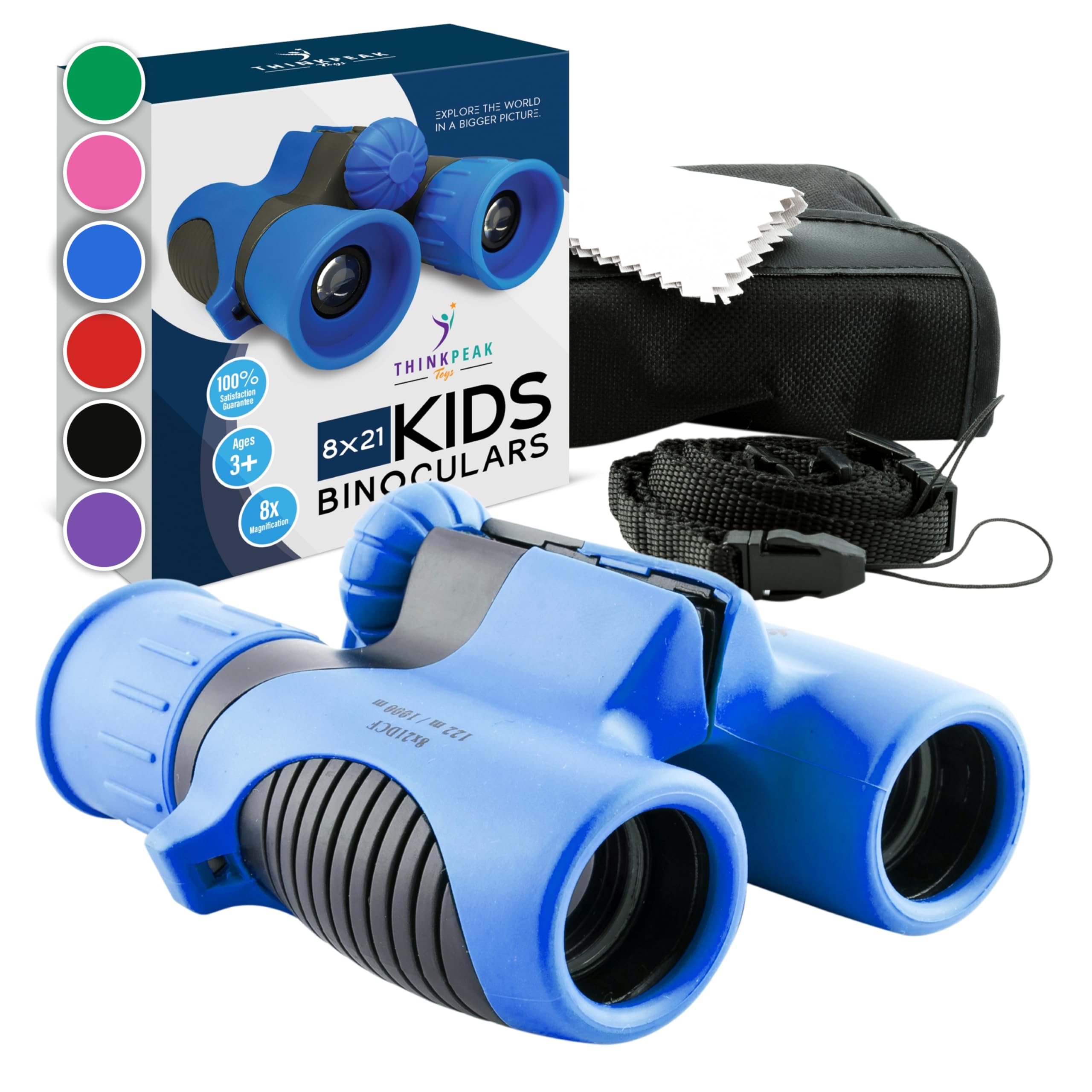
Think Peak 8x21 Kids Binoculars

93 /100
LBD Score Outstanding

Key details

Focus
Center focus
Weight
8 oz
Magnification
8x
Objective Lens
21 mm
View on Amazon

The first thing we check in a kids' binocular is whether it asks a child to do too much. The Think Peak gets the balance right: 8x magnification, a 4-inch body, and a center focus wheel that turns easily under small fingers. That combination is why it is our top pick. It is a real optic, not a toy with empty tubes, but it does not make a child feel like they are borrowing a grown-up's gear.

The 8x21 formula is the sweet spot here. Eight power brings a bird or a squirrel close enough to reward the effort, while the 21 mm objective keeps the package small. At 8 ounces, it is light enough to carry on a long walk without turning into a chore. We also appreciate the waterproof, shock-resistant body: this is a pair that can be set down on a rock or dropped in the grass and still go back to the trail.

The eyepieces are 1.5 inches across, which gives little eyes a generous target, and the barrels swivel to close the gap between them. The focus knob is covered in textured rubber, so it does not slip when fingers are cold or damp. We paid attention to that detail because a stiff focus wheel is the fastest way to lose a kid's interest.

We do not start a 3-year-old here; the fixed-focus GeoSafari is the easier handoff. For a 5- to 10-year-old, this is the pair that makes a backyard bird look genuinely closer. The focus wheel is the part we keep coming back to: it is sized and textured for small fingers, which is what turns a binocular from a grown-up tool into a kid's own.

Pros

  • Real 8x21 view with useful reach
  • Kid-sized 4-inch body and 8-ounce weight
  • Textured center focus is easy for small fingers
  • Shock-resistant and waterproof for outdoor use

Cons

  • Premium price compared with basic toy pairs
Our verdict

We recommend the Think Peak as the default kids' binocular because its 8x view is real enough to reward a child's curiosity without demanding adult-sized hands.

Check Latest Price
2

Best for Older Kids and Adults to Share

Hontry 10x25 Compact Binoculars

91 /100
LBD Score Outstanding

Key details

Weight
9.6 oz
Magnification
10x
Water Resistance
Waterproof
Interpupillary Distance
60-75 mm
View on Amazon

Most kids' binoculars are either toys or adult hand-me-downs. The Hontry 10x25 is the rare compact that can genuinely be shared: its interpupillary distance adjusts from 60 to 75 mm, so it can sit on a child's face and then fit an adult without a second pair. The palm-sized body and 9.6-ounce weight make it easy to tuck into a daypack, too.

We reach for it when an older kid wants more reach than an 8x21 kids' pair and the adults want a compact for travel. Ten power is a real step up for watching birds across a lake or picking out a player at a game. The Bak-4 prisms and fully multi-coated optics are the right specification at this size; they give the 25 mm objective a fair chance.

The waterproof body and three-year warranty are the practical bits that make it a family pair rather than a fair-weather toy. It comes with a neck strap, nylon bag, and cleaning cloth, so it is ready to ride in a glove box or backpack.

Ten power is the trade-off as well as the draw: it magnifies hand shake, so a child needs a steady two-handed grip. For a calm 8- to 12-year-old, that is a fair exchange for the extra reach. The 10x view is also the reason we do not hand this to a fidgety 5-year-old.

Pros

  • 10x compact view for older kids
  • Adjustable 60-75 mm interpupillary distance
  • Waterproof body with three-year warranty
  • Light enough for a daypack at 9.6 ounces

Cons

  • Short 10 mm eye relief is tight for glasses
Our verdict

The Hontry is our pick for families who want one compact pair older kids and adults can share, with a 10x view and a 60-75 mm interpupillary range.

Check Latest Price
3

Best for Toddlers

GeoSafari Jr. Kidnoculars

93 /100
LBD Score Outstanding

Key details

Focus
Fixed focus
Weight
7.05 oz
Magnification
2x
Objective Lens
35 mm
View on Amazon

Two times magnification is not what most parents picture when they shop for binoculars, but the GeoSafari Kidnoculars are not trying to be that pair. The oversized eyepieces and 35 mm objective are built for a preschooler's face, and the fixed focus means there is no wheel to hunt for. That simplicity is the point.

At 0.2 kg, they are light enough for a 3-year-old to wear around the neck, and the breakaway strap gives us some peace of mind when a child decides to run instead of walk. The lanyard can come untied, so retie it with a secure knot before a walk; that is a two-minute fix, not a reason to leave them in the toy bin.

For a 3- or 4-year-old, the lack of adjustment is the whole point: there is nothing to twist, nothing to misalign, and no reason to hand it back to an adult. We keep a pair in the car for zoo trips and hand it to the child who is not ready for the Think Peak's focus wheel. The 2x view is wide and forgiving, which is exactly what a first look through binoculars should be.

Pros

  • Focus-free use for toddlers
  • Large eyepieces sized for small faces
  • Breakaway neck strap for safer carrying
  • Light 0.2 kg body for preschoolers

Cons

  • 2x magnification won't satisfy older kids
Our verdict

For a 3- or 4-year-old, we reach for the GeoSafari Kidnoculars because the focus-free 2x view and big eyecups let them look without adult help.

Check Latest Price
4

Best for Glasses Wearers

Occer 12x25 Compact Binoculars

89 /100
LBD Score Excellent

Key details

Weight
13.8 oz
Eye Relief
20 mm
Magnification
12x
Water Resistance
Waterproof
View on Amazon

The 12x25 specification on the Occer reads like a pocket binocular for grown-ups, but the 20 mm eye relief is what makes it interesting for a glasses-wearing older kid. The rubber eyecups pull down to get a glasses lens close to the optic, and the large eyepiece gives a child more room to find the view.

We like it for the 9- to 12-year-old who has outgrown an 8x kids' pair and wants more reach. Twelve power brings distant birds and stadium action noticeably closer, and the waterproof body and 0.39 kg weight make it a reasonable travel companion. The center focus and +/-5 diopter adjustment let one eye be tuned separately, which helps when the pair is shared.

The catch is the view: 12x in a 25 mm body is a narrow window, so a child has to be patient about finding a bird in the first place. We treat it as a tween step-up, not a first binocular.

The Occer is heavier than the featherweight OBUBY, but that extra mass helps settle the image when the binocular is braced on a railing or a tree. It is the pair we pack when the plan is a ballgame or a hawk watch, not a casual walk around the block.

Pros

  • 20 mm eye relief suits glasses wearers
  • 12x power for distant viewing
  • Waterproof body for travel
  • Diopter adjustment for shared use

Cons

  • 12x power magnifies hand shake for younger kids
Our verdict

We recommend the Occer 12x25 for a glasses-wearing tween or teen who wants more reach than an 8x kids' pair, thanks to its 20 mm eye relief and waterproof body.

Check Latest Price
5

Best Budget Real Binoculars

OBUBY 8x21 Kids Binoculars

91 /100
LBD Score Outstanding

Key details

Weight
6 oz
Included
Case, velvet bag, cloth, instructions
Field Of View
7.2 degrees
Magnification
8x
View on Amazon

Thirteen colors, a case, and a pair of real 8x21 binoculars for a child's budget: that is the OBUBY proposition. The 8x21 view is a genuine optical view, not a pair of empty tubes, and the 6-ounce body is light enough for a kid to carry all afternoon. The color choices are a small thing that makes a big difference at gift time.

The center knob turns to focus, and the eyepieces are surrounded by soft rubber for a comfortable fit against a small face. The body feels more solid than the price suggests, and the included case, velvet bag, and cleaning cloth give a child a place to put the binoculars when the walk is over.

We like the color range for siblings and school groups: a blue pair for one child and a green pair for another avoids the usual argument. The 7.2-degree field of view gives a wide enough slice of the backyard for a young birder to find a moving target.

Once the focus is set, the view is clear enough for birds at the feeder and leaves at the top of a tree. The velvet bag is the piece we use most: it keeps the lenses clean in a backpack without adding a hard case.

Pros

  • Real 8x21 view at a budget price
  • Light 6-ounce body for kids
  • Thirteen color choices
  • Case, velvet bag, cloth, and instructions included

Cons

  • Center focus takes practice for younger kids
Our verdict

The OBUBY is the pair we choose for a budget-minded family because it delivers real 8x21 optics, a 6-ounce body, and a full accessory set without feeling like a toy.

Check Latest Price
6

Gift-Ready Young Birders

Noptix Kids 8x21 Binoculars

92 /100
LBD Score Outstanding

Key details

Weight
6.08 oz
Included
Bird sticker book
Magnification
8x
Water Resistance
Waterproof
View on Amazon

A bird sticker book is not the usual pack-in for kids' binoculars, and that is the first clue that the Noptix is aimed at a young naturalist. Under the bright pink-and-blue finish is a real 8x21 binocular with a roof prism, coated lenses, and a shockproof body. The combination is more thoughtful than most kids' sets.

The rubber coating gives small hands something to grip, and the center focus wheel is easy to reach without shifting the binocular away from the eyes. The breakaway strap is a sensible detail for a 3-year-old, and the waterproof body means a damp morning at the pond is not a disaster.

The sticker book is the part that extends the purchase: 40 bird species with names give a child something specific to look for after the novelty of the binoculars wears off. We like that it turns a backyard into a scavenger hunt without a screen.

This is the one we choose as a gift when we want the binoculars to feel special out of the box. The bird book gives the pair a second life after the wrapping paper is gone, and the shockproof body means it can go straight into a backpack.

Pros

  • Real 8x21 optics in a kid-sized body
  • Shockproof and waterproof construction
  • 40-species bird sticker book included
  • Breakaway strap and soft rubber coating

Cons

  • Small 21 mm objective favors daylight use
Our verdict

We choose the Noptix when the binoculars need to work as a gift, because real 8x21 optics, a shockproof body, and a 40-species sticker book give a child more to do than just look.

Check Latest Price
7

Nighttime Pretend Play

Little Experimenter Night Vision Binoculars

93 /100
LBD Score Outstanding

Key details

Focus
Fixed focus
Batteries
3 LR44H
Magnification
2x
Objective Lens
36 mm
View on Amazon

After-dark play is the hook here: a built-in green flashlight gives the view a night-vision look, and the 2x magnification is gentle enough for a 3- to 6-year-old to manage. The fixed focus means there is no wheel to fight with in the dark.

The 36 mm objective and rubber eyecups make the front end comfortable against a small face, and the 0.25 kg body is light enough to wear around the house or yard. The wide front end also gives a preschooler an easier time finding the view.

We treat the night vision as a play feature, not a real low-light optic: the green light is bright enough to shine back in a parent's eyes when a child turns around, and it does not intensify an image the way a military night-vision device does. For a preschooler playing explorer on the porch, that is exactly the right scope.

The 2x view is wide and easy to find, and the binoculars are simple enough that a child can use them without asking for help every minute. This is the pair we keep for dusk bug hunts and campfire pretend play, not for a real bird walk at dawn.

Pros

  • Green flashlight adds nighttime play
  • Fixed 2x focus is simple for toddlers
  • Comfortable rubber eyecups
  • Light 0.25 kg body

Cons

  • Requires three LR44H batteries
  • Not water resistant
Our verdict

We keep the Little Experimenter for 3- to 6-year-olds who want to keep exploring after dark, with a green-light play mode and a simple 2x view.

Check Latest Price
8

Adventure Kit Gifts

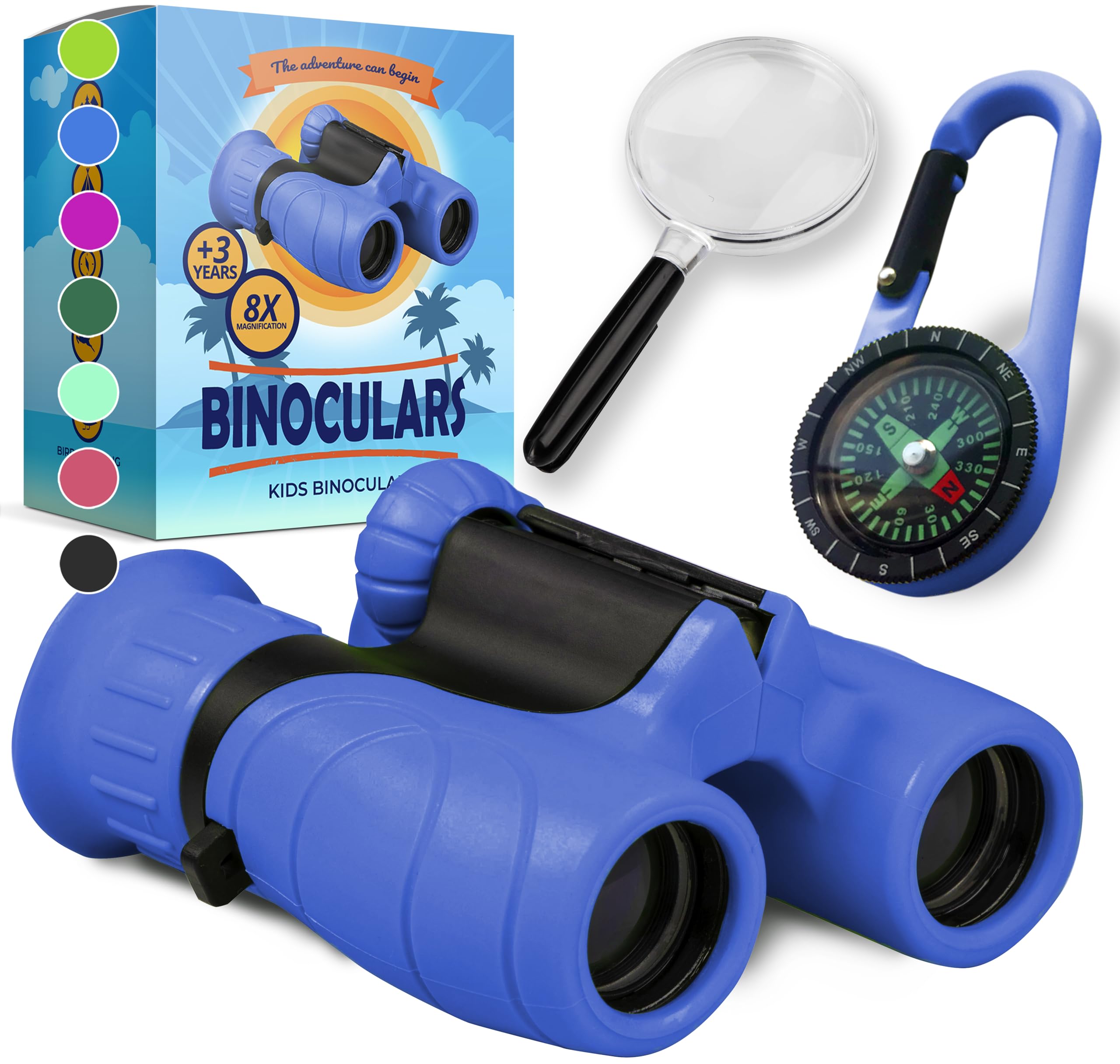
Promora 8x21 Kids Binoculars

90 /100
LBD Score Outstanding

Key details

Weight
9.17 oz
Included
Compass, magnifier, cloth bag
Magnification
8x
Objective Lens
21 mm
View on Amazon

A compass, a magnifying glass, and a cloth bag turn this 8x21 pair into a small adventure kit. The binoculars themselves are the real draw, with a rubber-coated body, center focus, and a diopter adjustment that lets each eye be tuned separately.

The 8x view is the right middle ground for a 5- to 9-year-old: more reach than a 2x toy, without the shaky image of a 12x compact. At 0.26 kg, it is light enough to carry on a short hike, and the adjustable central axis helps it fit a smaller face.

The compass and magnifier are the kind of extras that make a gift feel complete. The magnifier is handy for looking at leaves and bugs, and the clip-on compass gives a child a sense of direction on a neighborhood walk.

We recommend it when the binoculars are part of a gift set and the extras are a bonus rather than the main event. The 8x21 optic is the part that earns its place; the extras are there for the fun of it.

Pros

  • Real 8x21 view with center focus
  • Diopter adjustment for shared use
  • Compass and magnifier add adventure play
  • Light 0.26 kg body

Cons

  • Compass can arrive missing or stop working
Our verdict

We recommend the Promora as an adventure gift for a 5- to 9-year-old, pairing real 8x21 optics with a compass and magnifier, provided the extras are a bonus rather than the reason to buy.

Check Latest Price

How We Tested Kids' Binoculars

We started with a shortlist of about 40 pairs pulled from retailer listings and parent reviews, then cut by price, weight, and the specs that actually matter at this age: magnification, lens coating, eyecup size, and whether the strap and hinges suit a child. The final mix was deliberate — big-eyepiece toddler pairs with no focus wheel alongside compact 8x21 and 10x25 models meant to last from six into middle school.

Fourteen pairs then went home with my team for four months. They rode in backpacks on neighborhood walks, sat on the porch aimed at a bird feeder before school, went on a weekend camping trip, and got passed around the back seat on a drive and up in the bleachers at a kids' ballgame. Kids from 3 to 11 used them, which mattered, because a 5-year-old and a 9-year-old want completely different things from the same pair.

We wrote down what we saw, not what the box claimed. We timed how long a child needed to go from a tree at the end of the yard to a bird at the feeder, and whether the focus drifted afterward. We checked backlit leaves and a feather for color and edge sharpness, looked for fogging when a cold pair came inside, and dropped each one from waist height onto grass, then pavement, to see what cracked or knocked out of alignment. The night-vision pairs went into a dark closet and out at dusk; most are a small flashlight bolted on, which is fine once you know it.

The extras got checked too — compass against a phone, magnifying glass for real usability in small hands, sticker books for whether anyone opened them twice. After four months we rechecked hinges, strap anchors, and whether the two barrels still lined up, since a pair that drifts gives a headache instead of a view.

How to Choose Binoculars for Kids

Match magnification to the child

We treat 8x as the default for school-age kids. It brings birds and animals close enough to be exciting without turning every hand wobble into a swimming image. A 2x or 4x model is a toddler's tool: the view is wider and easier to find, but the reach is limited. Save 10x and 12x for a patient older child or teen who can brace the binoculars with two hands. A 12x25 like the Occer is a tween step-up, not a first pair.

Check the fit before the optics

Small faces need short eyepieces and a hinge that closes narrow. A 4-inch, 8-ounce body like the Think Peak's is easier for a 6-year-old to hold than a full-size adult binocular. Interpupillary distance matters too: the Hontry adjusts from 60 to 75 mm, which is why it can pass between a child and an adult. If a child sees two circles instead of one, the hinge is not set for their eyes.

Choose fixed focus or center focus

Focus-free models are the right call for ages 3 to 5: there is no wheel to hunt for, so the child can look immediately. Once a child can follow directions, a center-focus wheel opens up sharper views at different distances. Look for a wheel that is large enough to grip and a diopter adjustment if the binoculars will be shared by people with different vision. The Occer's +/-5 diopter is a useful example.

Plan for drops, damp, and carrying

Rubber armor and a secure strap matter more than a fancy finish. Waterproofing is worth paying for if the binoculars go near a pond or a boat; for a backyard, it is nice but not essential. A breakaway strap is the right choice for a preschooler. Check that the case has a belt loop or clip if the child will carry it on a hike; a loose binocular in a backpack is a scratched lens waiting to happen.

Decide what the extras are worth

A bird sticker book, compass, or magnifier can extend the play, but the optic comes first. We prefer a plain pair with a clear view over a kit whose extras are the main attraction. If you choose a set like the Promora, treat the compass as a bonus and check it before gift day. A case and cleaning cloth are the extras we actually use.

Frequently Asked Questions

Final Verdict

Start with the Think Peak 8x21 Kids Binoculars if your child is old enough to hold a real binocular steady; it gives the most useful mix of kid-sized body and usable 8x view in this set. For a 3- or 4-year-old, the GeoSafari Kidnoculars are the better first pair because there is no focus wheel to fight. If the binoculars will be shared with adults, the Hontry 10x25's 60-75 mm interpupillary range makes it the more flexible choice.