Best Binoculars for Hunting of 2026

The last ten minutes of legal light are when the buck you've been waiting on finally moves — and when cheap glass falls apart. Every stump at 150 yards sprouts antlers and every shadow turns into a body. Good hunting binoculars don't make the woods brighter so much as they make it honest.

I've carried hand-me-downs and borrowed pairs from buddies, and what separates glass you keep from glass that rides in the truck is rarely magnification. It's the coatings and prism quality that decide whether last light is usable and whether your eyes ache after an hour of scanning. My team and I have had 12 pairs in the field for six months now, from cold spring turkey mornings through late-summer scouting, and the gap between the good ones and the rest shows up fast.

Weight matters more than the spec sheet suggests once a pair has hung off your chest for six hours, and focus matters when you're wearing gloves and something is moving. The picks below are sorted by how you'll actually hunt with them.

1

Best Overall

Vortex Crossfire HD 10x42

96 /100
LBD Score Outstanding

Key details

Weight
1.4 lb
Eye Relief
15 mm
Field Of View
325 ft at 1,000 yd
Magnification
10x
View on Amazon

The warranty is the reason this one is our top pick, and it has nothing to do with optics. Vortex writes the coverage as unlimited, unconditional, and lifetime, which in practice means the company repairs or replaces the binocular even when the damage is your fault — a slip on wet rock, a tumble off the tailgate. On a tool that spends its life banging against tree stands and truck beds, that is worth more than another few percent of light transmission.

The glass holds up its end. Fully multi-coated roof prisms, nitrogen purging, and O-ring seals make this a genuinely fogproof, waterproof binocular rather than one that merely tolerates drizzle, and the 325-foot field of view at 1,000 yards is wide enough to catch an animal crossing a lane without hunting for it. We paid close attention to the focus wheel, since that is what costs you a shot — it runs from 30 yards to 300 without overshooting, and the diopter holds its setting between trips.

Eye relief comes in at 15 mm with twist-up eyecups, the tightest of our top three. The Engage X gives you 18 mm and the Triumph 17 mm. If you shoot in thick prescription glasses or a full face covering in late season, that gap is real, and it is the one place this binocular asks you to compromise.

What we did not expect to care about is the GlassPak chest pack. Bundled harnesses are usually an afterthought; this one holds the binocular flat against your chest, opens one-handed, and keeps the barrels out of the way when you climb. Add the tethered objective covers and the rainguard and you are ready for opening day without a second shopping trip.

Pros

  • Unlimited, unconditional lifetime warranty
  • Waterproof and fogproof with nitrogen purging
  • 325-foot field of view at 1,000 yards
  • GlassPak chest harness and tethered covers included

Cons

  • 15 mm eye relief is the tightest of our top picks
Our verdict

Our default hunting binocular: fully sealed, wide enough to find moving game, and backed by a warranty that covers the damage you cause yourself.

Check Latest Price
2

Best Value

Vortex Triumph HD 10x42

94 /100
LBD Score Outstanding

Key details

Weight
2.3 lb
Warranty
Lifetime, unconditional
Eye Relief
17 mm
Magnification
10x
View on Amazon

Take the top pick's spec sheet, trim the price, and you have the Triumph HD: a fully multi-coated 10x42 roof prism, nitrogen purged and O-ring sealed, waterproof and fogproof, shipping with the same GlassPak harness and the same unlimited lifetime warranty. If the difference between the two came down to image quality, this article would be shorter and less interesting.

The savings show up in details rather than in the view. The diopter range of plus or minus five is wider than the Crossfire's, which helps if your eyes are badly mismatched, and the 17 mm of eye relief clears a pair of glasses that the tighter top pick makes you work for. Focus is smooth and one-handed, and the binocular is tripod adaptable when you glass from a fixed position.

The honest arithmetic is this: the Triumph buys you the warranty, the sealing, and a very usable 10x image, and what is left over goes toward boots or gas. It is the pick we make when someone tells us their budget ends before the Crossfire's. What it asks in return is weight, and the included harness is the reason that trade is easier to live with than it looks on paper.

Pros

  • Same unconditional lifetime warranty as the top pick
  • 17 mm eye relief clears most eyeglasses
  • Wider plus-or-minus 5 diopter adjustment
  • GlassPak harness included at this price

Cons

  • 2.3 pounds makes it the heaviest pick here
Our verdict

Same 10x42 formula and the same no-questions warranty as our top pick, for less money and a couple more ounces on the strap.

Check Latest Price
3

Best for Wet Weather

Bushnell Engage X 10x42

92 /100
LBD Score Outstanding

Key details

Weight
1.37 lb
Eye Relief
18 mm
Magnification
10x
Waterproof Rating
IPX7
View on Amazon

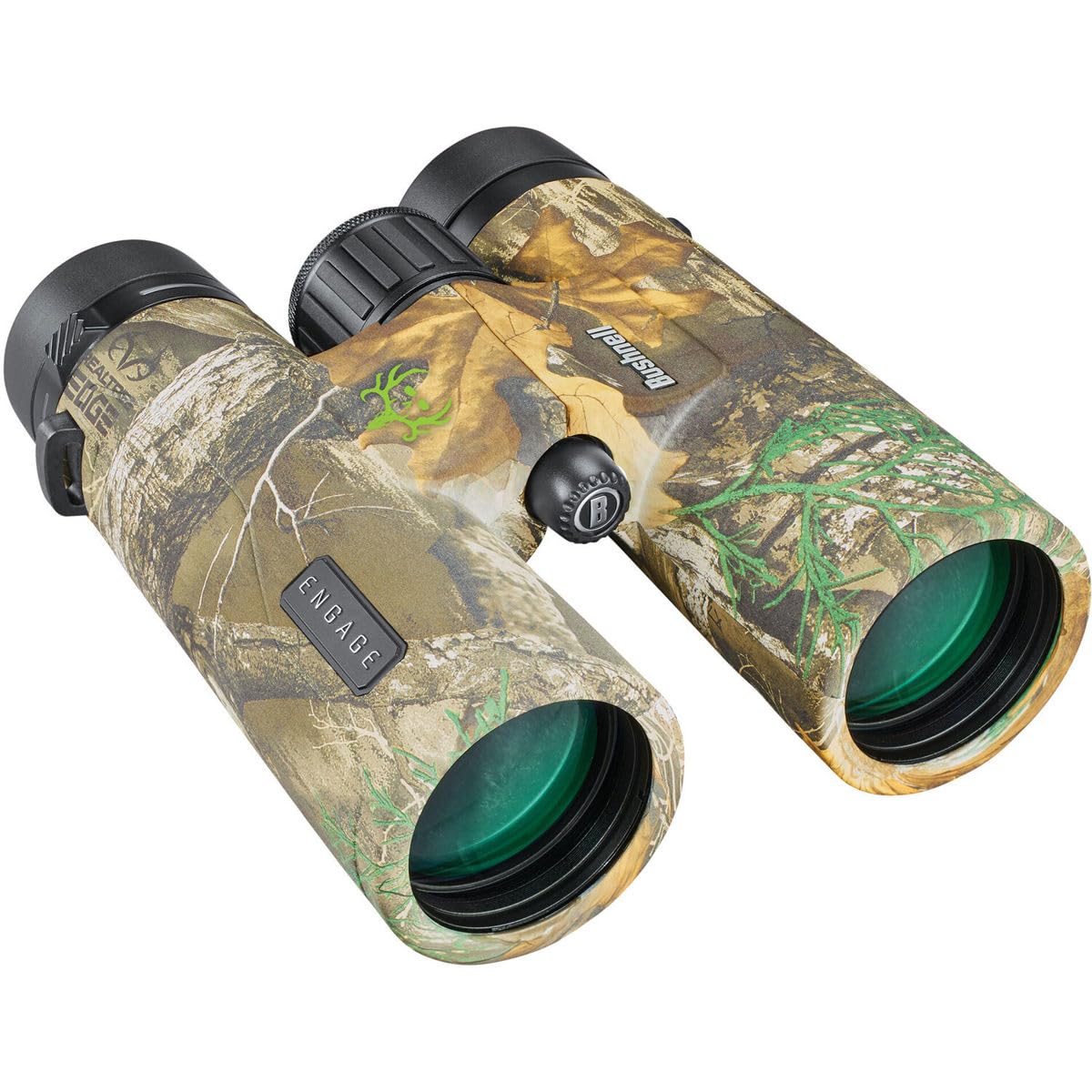
IPX7 is the number to look for when your season runs wet. It means the binocular survives being submerged, not merely splashed, and Bushnell pairs it with EXO Barrier — a permanent coating bonded to the outer lens surfaces that sheds water, oil, dust, and the condensation that forms when cold glass comes into a warm truck cab. That is a different kind of protection from sealing, and having both is why this one stands apart.

Coastal timber, late-season downpours, country where you forded something on the way in: this is our pick for all of it. BAK-4 prisms and fully multi-coated lenses keep the image bright, 18 mm of eye relief is the most generous in this group, and the 620-gram body rides on a chest strap without dragging at your shoulders by midafternoon. Twist-up eyecups and a plus-or-minus 5 diopter range round out the adjustments you actually use.

Two things to settle before you order. The price sits at the top of this article without a clear optical jump over the Vortex pair, so you are paying for the sealing. And the listing describes the binocular as tripod adaptable while a socket is not visibly confirmed on every version, so check with the seller if you plan to mount it.

Pros

  • IPX7 rated, so it survives a dunking
  • EXO Barrier coating sheds water, oil, and dust
  • 18 mm eye relief is the most generous here
  • 620-gram body carries easily all day

Cons

  • Premium price without an optical edge over the Vortex pair
Our verdict

The binocular we hand to anyone hunting in real rain: IPX7 rated, coated to shed water off the glass, and light enough to forget on a long walk in.

Check Latest Price
4

Best for Long-Range Glassing

GIGAPENGUIN 15x52

88 /100
LBD Score Excellent

Key details

Warranty
Lifetime, unconditional
Eye Relief
18 mm
Magnification
15x
Objective Lens
52 mm
View on Amazon

Fifteen power is a specific tool rather than a general-purpose upgrade. The 15x52 pairs that magnification with a 52 mm objective, roof prisms, waterproof sealing, and 18 mm of eye relief, and it ships with a phone adapter and an unlimited lifetime warranty — a package that is unusual at the bottom of this price range.

Where it earns its spot is glassing from a fixed position: a truck hood, a blind window, a ridge you already walked to. Braced properly, the extra reach turns a patch of brush across a canyon into something you can read, and the generous eye relief means eyeglass wearers are not shut out of it. The 5.8-degree field of view is the cost of that power — picking up a moving animal takes a beat longer than it does with a 10x.

The phone adapter is the same clamp-over-the-eyepiece design that shows up on budget binoculars everywhere, and it works: line the camera up with the exit pupil, brace the binocular, and you get a usable record of what you saw. We like that it comes in the box rather than as an accessory you have to remember to order.

Pros

  • 15x reaches across open country
  • 18 mm eye relief works with eyeglasses
  • Waterproof, shock-resistant aluminum body
  • Lifetime warranty and phone adapter included

Cons

  • Hard to hold 15x steady without a rest
  • 3.47 mm exit pupil gives up light at dusk
Our verdict

A fixed-position glassing tool for open country: 15x reach, 18 mm eye relief, and a lifetime warranty, as long as you have something to brace against.

Check Latest Price
5

Best Budget

Adorrgon 12x42

91 /100
LBD Score Outstanding

Key details

Weight
1.1 lb
Included
Phone adapter and tripod
Eye Relief
10 mm
Magnification
12x
View on Amazon

The price gets your attention, but the waterproof body is what makes this one easy to recommend. At the bottom of this group, weather sealing is usually the first thing to go; the Adorrgon keeps it, adds BAK-4 prisms and fully multi-coated lenses, and throws in a phone adapter and a tripod. That combination is why it is our budget pick rather than a curiosity.

The 12x42 specification is the interesting part. Twelve power pulls detail out of a treeline that a 10x will not, and the large eyepieces are comfortable to look through for long stretches — this is the pair that lives on the kitchen counter because someone keeps picking it up. The trade is steadiness: at 12x your own heartbeat shows in the image, so brace against a post or set it on the included tripod when you are counting points rather than just spotting movement.

The phone adapter is not a gimmick. It clamps over the eyepiece, lines your camera up with the exit pupil, and lets you keep a record of what you glassed — useful on scouting trips, and useful for settling arguments about how big something was.

Two years of coverage is the shortest warranty in this article, and that is the real cost of the low price: the Vortex pair will still be getting repaired long after this one's coverage ends. As a first binocular, a spare that lives behind the seat, or a gift for someone tagging along, that is an easy trade to accept.

Pros

  • Waterproof body at the lowest price here
  • BAK-4 prisms and fully multi-coated lenses
  • Phone adapter and tripod included
  • Light 1.1 pound body

Cons

  • 10 mm eye relief is tight behind glasses
  • 3.5 mm exit pupil fades early at dusk
Our verdict

The budget binocular we can recommend without a caveat about rain: waterproof, BAK-4 glass, and a phone adapter and tripod in the box.

Check Latest Price
6

Truck and Spare

Bushnell PowerView 10x50

92 /100
LBD Score Outstanding

Key details

Eye Relief
10 mm
Prism Type
Porro
Magnification
10x
Objective Lens
50 mm
View on Amazon

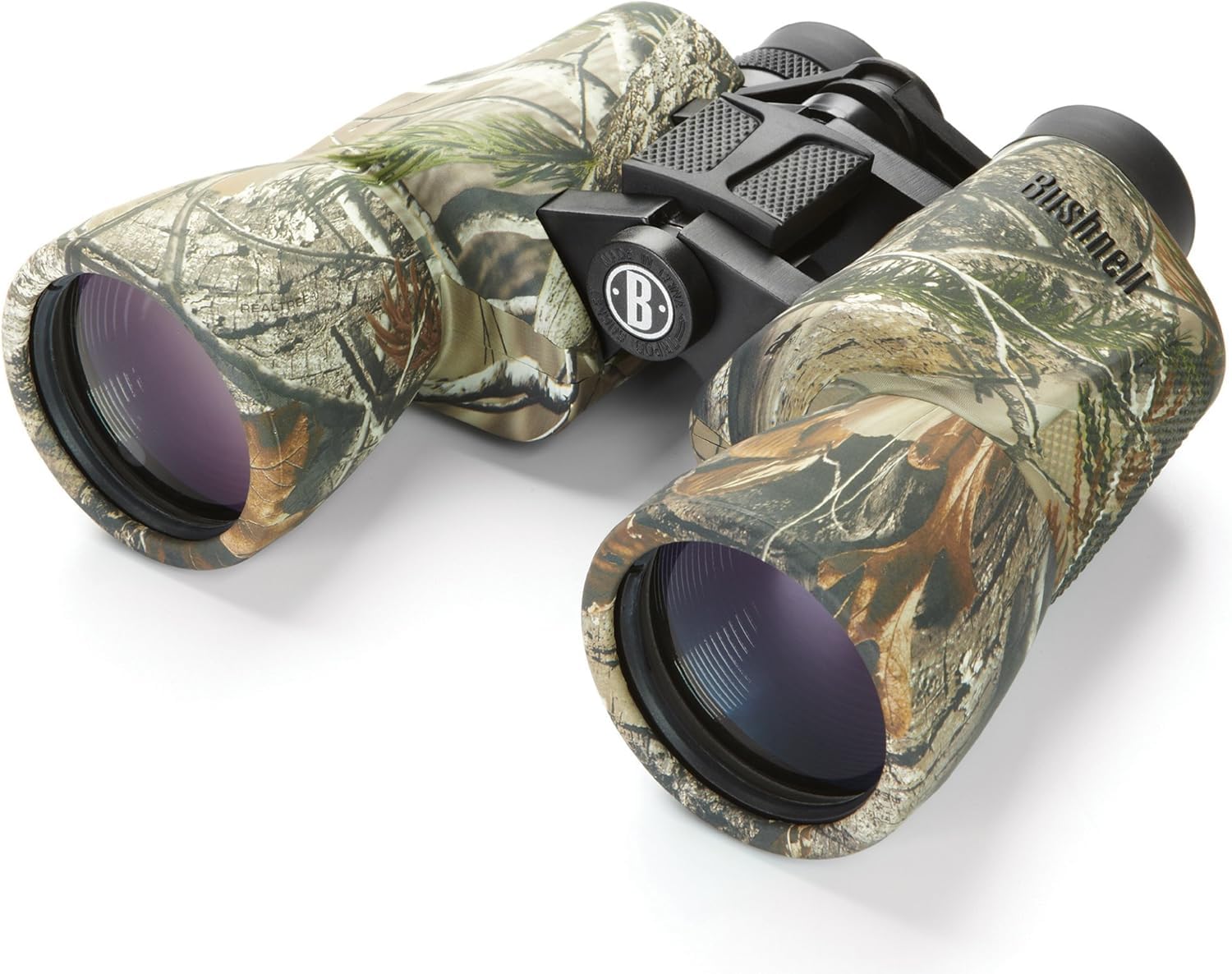
Two things push the PowerView toward hunters: a 50 mm objective behind a Porro prism, and Realtree AP camo molded into the housing. The larger front glass gives you a 5 mm exit pupil, which is the number that decides whether you can still make out antlers in the last few minutes of light, and the Porro design delivers that brightness for less than a roof prism of the same aperture would cost.

InstaFocus is the other distinctive piece. Instead of a center wheel, a lever under the barrels snaps the image into focus with one finger, which is fast in a way a wheel never quite is when something crosses a shooting lane and you have seconds. Bushnell rates the body waterproof and makes it tripod compatible, and the armored housing has survived being banged around a truck box.

We see this as the second-pair binocular: the one behind the seat, the one you hand a kid on their first hunt, the one that goes along when the good glass stays home. It is not the pair to build a season around — the optics are a generation behind the Vortex glass, and the eyecups are fold-down rather than twist-up — but as a knockaround 10x50 with real light-gathering, the price is right.

Pros

  • 50 mm objective gives a 5 mm exit pupil
  • InstaFocus lever is fast one-handed
  • Realtree AP camo and tripod compatible
  • Waterproof body at a mid-range price

Cons

  • 10 mm eye relief rules out most eyeglasses
  • BK-7 prisms dim the edges of the view
Our verdict

A camo 10x50 with a genuinely fast focus lever, best bought as the binocular that lives in the truck rather than the one you carry all day.

Check Latest Price
7

Lightweight Backup

Binoteck 10x42

89 /100
LBD Score Excellent

Key details

Weight
1.1 lb
Eye Relief
10 mm
Prism Type
Roof, BAK-4
Magnification
10x
View on Amazon

Just over a pound is the whole argument. The Binoteck 10x42 disappears into a daypack side pocket and hangs on a neck strap without reminding you it is there, and it does that for about as little as a hunting binocular can cost. If you have ever left a heavy pair in the truck because you did not want to carry it, that is the problem this solves.

The 10x42 roof-prism formula is the right one to start from: BAK-4 prisms, fully multi-coated lenses, a 5.5-degree field of view, and a center focus wheel with a separate right-eyepiece diopter so both eyes end up sharp. The lens covers are tethered rather than loose, the case and strap come in the box, and close focus is short enough to use it in the yard. We were also impressed by the eyecups, which twist rather than fold at this price.

Where it stops is the finish, not the view. The rubber armor grips well and the focus wheel turns without the grit budget roof prisms usually show, so it holds up as a knockaround pair — but this is a binocular you keep in the pack for the walk in, not the one you plan a ten-day hunt around.

Pros

  • 1.1 pound body carries all day
  • BAK-4 prisms and fully multi-coated lenses
  • Tethered covers, case, and strap included
  • Low price for a roof-prism 10x42

Cons

  • Water resistant rather than fully sealed
  • 10 mm eye relief is tight with glasses
Our verdict

A 1.1-pound 10x42 roof prism for very little money — buy it as a spare or a pack binocular, not as your only glass in wet country.

Check Latest Price

How We Tested Hunting Binoculars

To build the shortlist, I read spec sheets and hundreds of buyer reviews, then narrowed by the things that matter in the field: 10x42 and larger objectives, BAK4 prism glass, fully multi-coated lenses, waterproof and fogproof sealing, twist-up eyecups, and whether a chest harness or tripod adapter came in the box. That left 12 pairs, which we ran for six months.

Testing happened where binoculars actually live: glassing ridge lines before sunrise, sitting a ground blind with a turkey working in, still-hunting thick timber, and watching field edges until the last minute of legal light. Every pair rode a chest harness through full-day sits and came along on scouting hikes.

At first light and again at dusk, I set a resolution chart and a license plate on a fence post 200 yards out and noted how much detail each pair pulled out, and how far the sharpness held toward the edges of the view. I counted fence staples and picked apart a brush pile the way you'd pick apart a bed, which is where field of view and eye relief either help you or get in your way.

Focus got timed — 20 yards out to 300 and back, bare-handed and then in gloves — and I noted whether the wheel turned smoothly or ground through the travel. Each pair was weighed and worn for a full day. To check sealing, I dunked them in a creek, then left them in a cold truck overnight and pulled them out at dawn to see if the lenses fogged. On the tripod-adaptable and phone-adapter models, I mounted them up and watched how steady the image held at distance, and I kept an eye on eyecup positions, diopter settings that wouldn't stay put, and how the armoring survived being knocked against a truck bed.

How to Choose Hunting Binoculars

Match Magnification to the Hunt You Do

The default hunting binocular is 10x42, and it is the right answer for most people: enough power to judge an animal a few hundred yards out, a 4.2 mm exit pupil that holds up into dusk, and a size most people can hold steady without a rest. Divide the objective lens by the magnification to compare low-light performance — 42 divided by 10 gives 4.2, while 42 divided by 12 drops to 3.5.

Twelve power and up earns its place in open country when you have something to brace against; 8x is easier to hold and gives up reach. Ignore the 20x50 printed on some bargain models. That number on the body rarely matches the glass inside, and a 20x with a 2.5 mm exit pupil is unusable at last light anyway.

Read the Sealing Spec, Not the Adjective

'Water resistant' means it shrugs off a splash. 'Waterproof' with an IP rating means something specific — IPX7 is a half hour under a meter of water, and it is the version we trust when a hunt involves a creek crossing or a snow-loaded log. Nitrogen purging matters as much as the outer seals, because it is what stops the inside of the lenses fogging when the temperature swings.

If a listing offers neither a rating nor any mention of purging, treat it as splash-proof and plan around that. A permanently bonded exterior coating, like the one on the Bushnell Engage X, is a separate and useful thing: it sheds water and dust off the outer glass rather than sealing the body.

Eye Relief Decides Whether You Can Use Them

Eye relief is how far your eye can sit from the lens and still see the whole field. Below about 12 mm, eyeglasses turn the view into a keyhole, and a face mask or balaclava pushes you even farther out. Look for 15 mm or more with twist-up eyecups, which let you set the gap once and leave it alone.

This is the specification that quietly eliminates the most binoculars for the most people. Three picks here run 15 to 18 mm for exactly that reason; the 10 mm models suit bare eyes on mild days and not much else.

Prisms and Coatings: Where the Money Goes

Roof prisms are compact, tough, and the standard for hunting glass. Porro prisms are bulkier but deliver more light per dollar, which is why budget 10x50s still use them. On the glass itself, BAK-4 prisms beat BK-7 for brightness toward the edges, and 'fully multi-coated' means every air-to-glass surface is treated rather than just the ones the maker mentions.

Those two details cost money and are hard to fake in person. Point a pair at a shaded treeline and look at the corners of the image: if the center is bright and the edges go muddy, you are looking at cheap prisms.

Weight and Carry Add Up by Hour Six

A full-size binocular on a thin neck strap feels like twice its weight by the end of a long day, which is why a chest harness is worth having. Harnesses also keep the barrels off your sternum when you mount a rifle and hold the glass steady while you climb. Two of our picks ship with one.

Read weight figures carefully — shipping weight, package weight, and product weight are three different numbers, and 'compact' in a listing describes a body profile, not a scale reading. A 1.1-pound binocular and a 2.3-pound binocular are the same purchase decision only until you have carried each for a season.

Frequently Asked Questions

Final Verdict

The Vortex Crossfire HD 10x42 is the one we point most hunters toward: fully sealed, wide enough to pick up moving game, comfortable behind glasses, and covered by a warranty that outlasts the truck you carry it in.

If the price is the sticking point, the Triumph HD gives you the same sealing and the same warranty for less and asks only that you accept a heavier body. If your season runs through sideways rain or creek bottoms, step to the Bushnell Engage X and its IPX7 rating.