Best Overall
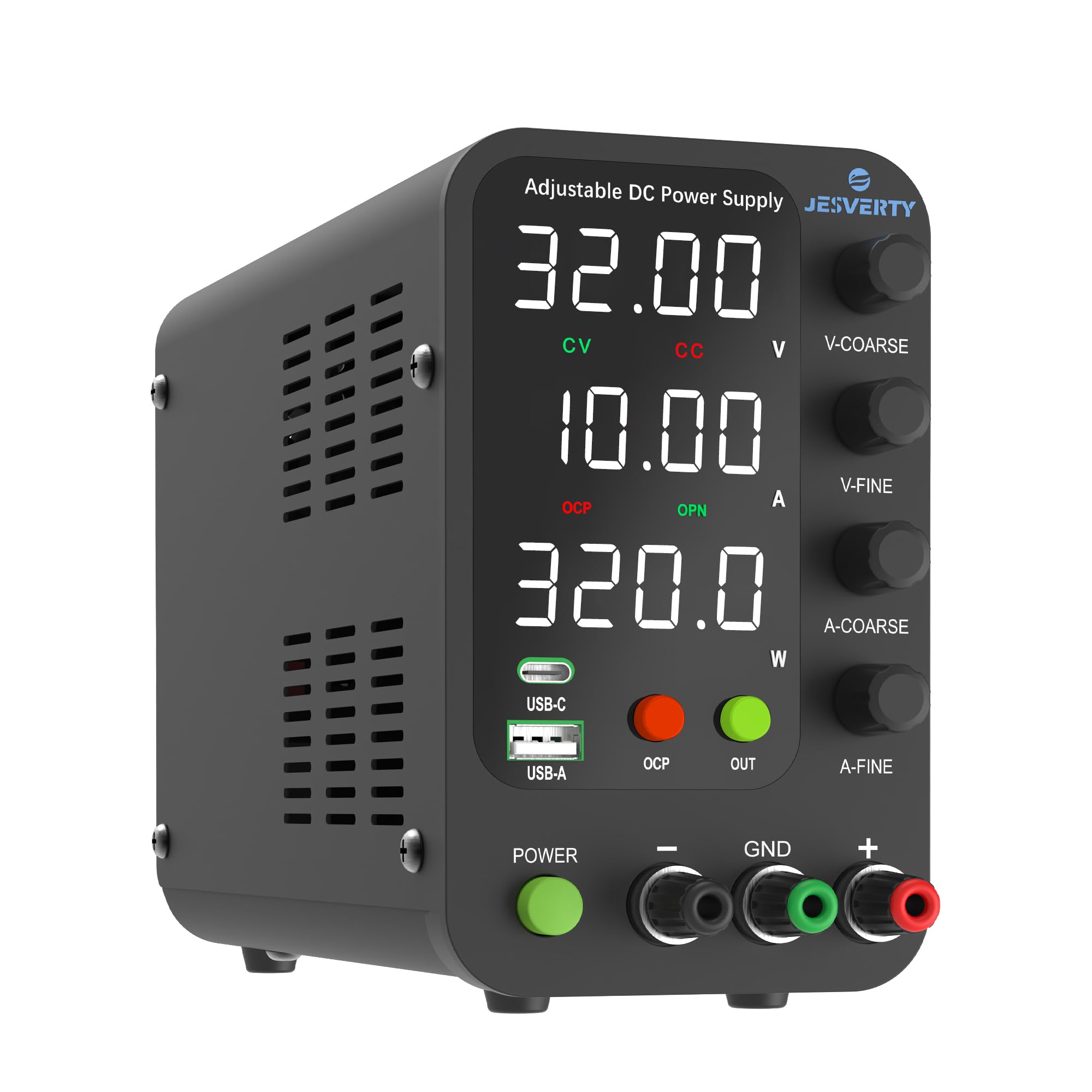
Jesverty SPS-3010V
Key details
- Max Power
- 320W
- USB Ports
- USB-A and USB-C, 20W
- Adjustment
- Encoder coarse and fine
- Output Range
- 0–32V, 0–10A
A potentiometer is the wrong instrument for setting a voltage: nudge it a hair and you jump from 3.2V to 4.1V, usually with a chip connected. The SPS-3010V replaces it with an encoder. Press the knob to pick the digit you want, turn it to move only that digit, and 3.30V becomes deliberate instead of lucky. That one change is why we recommend this one first.
The output button is the other thing we appreciate. Connect the leads, set the voltage and the current limit, then press OUTPUT, and there is no arc across the clips while you are wiring a board and no scramble for the mains switch. An OPN setting brings the output up with the power switch if you prefer, which saves a press when you are running the same test all afternoon. The display is bright and large enough to read from a step back.
Underneath is a 0–32V, 10A, 320W supply, a little more headroom than the 30V/10A standard, in a 1.53 kg case that leaves room on the bench. The supplied test leads are 18 AWG, which is thin for a 10A pull, so buy a heavier set if you plan to run near the ceiling. Beyond that there is very little to work around.
Pros
- Encoder knobs set exact values in seconds
- Output switch lets you wire up before power
- Compact 1.53 kg case with 32V of range
Cons
- USB-A and USB-C ports are limited to 20W
If you want one supply that makes exact settings easy and holds them once they are made, this is the one we point people to, especially for chasing gremlins on digital boards.