Best Portable Power Stations for Camping of 2026

The first time I brought a power station camping, I forgot about it until my phone hit 3 percent at eleven at night. A good one earns its keep quietly: it keeps a cooler cold, lanterns lit, and a CPAP running in a tent that's nowhere near an outlet. What separates the ones worth carrying isn't the biggest number on the box — it's how fast they refill, what they weigh coming out of the trunk, and whether they still hold a charge after a season in the closet.

Over six months, we put 12 of these through campsites, tailgates, and one memorably dark night at home with the breaker off, and the gaps showed up where the spec sheets don't. Chemistry beats capacity: the LiFePO4 packs in most current models are rated for thousands more cycles than the older lithium-ion ones. And those hour-long recharge times are wall-outlet-only — on a car charger, plan on several hours.

The picks below are the ones that held up, whether you're chasing a weekend in a tent or just want the lights on when the grid goes down.

1

Best Overall

Jackery Explorer 1000 v2

94 /100
LBD Score Outstanding

Key details

Weight
23.8 lb
Capacity
1,070Wh
AC Output
1,500W (3,000W surge)
Recharge Time
About 1 hour (AC)
View on Amazon

Camping power needs tend to land in one of two places: the lunchbox that keeps phones alive, and the box that runs the trip. The Explorer 1000 v2 belongs to the second group, and it's the lightest way into it here. At 1,070 watt-hours and 23.8 pounds it carries like a cooler and runs a 12-volt fridge, a laptop, a fan, and someone's CPAP through a night.

The 1,500-watt AC output covers a travel kettle or a single induction burner, and the 3,000-watt surge is what starts a fridge compressor. Two 100-watt USB-C ports, a USB-A port, and a car socket mean a couple of laptops and phones can charge while the cooler is plugged in. We paid close attention to that USB-C figure, because 100 watts is the difference between a laptop that charges at full speed and one that barely holds its level while you edit photos from the day.

Recharging is what makes it usable on a short trip. From a wall outlet it reaches full in about an hour with the app's emergency charging mode switched on, and silent mode drops the fans to a whisper for overnight charging in a van. That last feature sounds like marketing until you've slept three feet from a power station that's topping itself up.

Twenty-three point eight pounds is the number to be honest with yourself about: it's one hand from the tailgate to the picnic table, and no more than that. For anything you'll carry a mile, the VTOMAN below is the better companion. For everything short of that, this is the station that keeps the trip running, and the LiFePO4 cells are rated for 4,000 cycles to 70 percent, so the calendar rather than the camping season is what will eventually retire it.

Pros

  • 1,070Wh covers a fridge and a CPAP overnight
  • Full recharge in about an hour on AC
  • 23.8 lb with a foldable handle
  • LiFePO4 rated for 4,000 cycles

Cons

  • Three AC outlets, fewer than the other 1kWh units
  • Costs more than the Anker of similar capacity
Our verdict

Our default camping pick: 1,070Wh runs a fridge and a CPAP overnight, 1,500W handles a kettle, and 23.8 pounds is still a one-person carry.
Check Latest Price
2

Best for High-Draw Appliances

Anker SOLIX C1000

93 /100
LBD Score Outstanding

Key details

Weight
27.6 lb
Capacity
1,056Wh
AC Output
1,800W (2,400W surge)
Recharge Time
58 minutes (AC)
View on Amazon

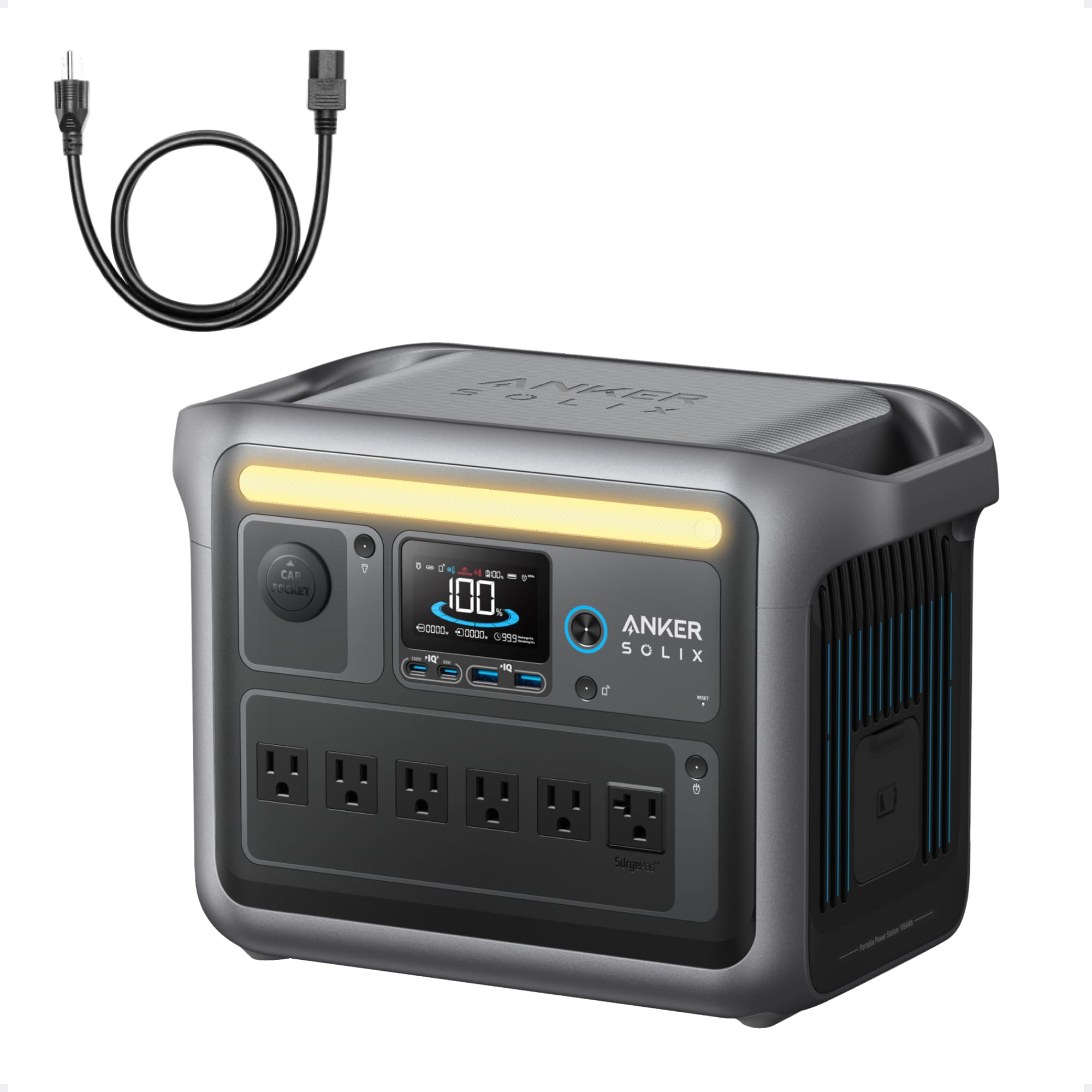
Eighteen hundred watts of continuous AC output is a different class of camping power. Most of this group tops out at 1,500; the C1000 holds 1,800 and surges to 2,400, which is enough for a coffee maker with the griddle going, or a miter saw on a site with no outlet. Eleven ports spread that around.

If your trips involve real cooking rather than a Jetboil, this is the one we pack. Capacity is within a rounding error of the Jackery's 1,070 watt-hours, the AC headroom is 300 watts higher, and a full charge takes 58 minutes from a wall outlet. The five-year warranty is the longest in this group, which counts for something on a battery that lives in a truck bed and gets rained on twice a summer.

Runtime is where the capacity number stops being impressive. A 1,500-watt appliance drains 1,056 watt-hours in well under an hour, so treat the big AC output as a short-burst capability and the battery as an overnight one. That isn't a flaw — it's the arithmetic every unit here lives with — but it's why we plan cooking around the C1000 and everything else around the battery.

Pros

  • 1,800W continuous for kettles and griddles
  • 11 ports, the most in this group
  • Five-year warranty, the longest here
  • Full charge in 58 minutes on AC

Cons

  • Heaviest of the three 1kWh units here
  • Fast-charge spec assumes 68-122°F
Our verdict

If your camping involves a coffee maker or an induction burner, this is the one we pack: 1,800 watts, 11 ports, and the longest warranty here.

Check Latest Price
3

Best for Group Camping and RV Trips

Jackery Explorer 2000 v2

87 /100
LBD Score Excellent

Key details

Weight
39.5 lb
Capacity
2,042Wh
AC Output
2,200W
Recharge To 80%
66 minutes (AC)
View on Amazon

At 39.5 pounds the Explorer 2000 v2 is not the station you carry to a tent pad, and pretending otherwise makes for a bad evening. It's a basecamp battery: it rides in the truck bed or the trailer, comes out when the group's gear needs real power, and goes back in when the trip is over.

There's plenty of it. 2,042 watt-hours and 2,200 watts of AC output will run a full-size fridge, then a microwave, then a coffee maker, and the 30-decibel silent mode means it can charge in the same room where people are sleeping. Zero to 80 percent takes about 66 minutes from a wall outlet, which is fast enough to refill during dinner.

For a family basecamp or an RV that spends weekends off hookups, this is the pick, and it's the only unit here with enough capacity to carry a group through two days without a refill. The thing to plan for is getting the energy back: replacing 2,042 watt-hours from a 100-watt panel is a multi-day project, so figure on a hookup, a generator, or a long drive between stops.

Pros

  • 2,042Wh carries a group through a weekend
  • Quiet enough to charge in the same room
  • 0-80% in 66 minutes on AC

Cons

  • 39.5 lb keeps it vehicle-bound
  • Three AC outlets for a 2,200W unit
Our verdict

For a family basecamp or an RV, this is the one: 2,042Wh and 2,200W live in the truck and run everything, as long as you don't plan to carry it.

Check Latest Price
4

Best Lightweight Option

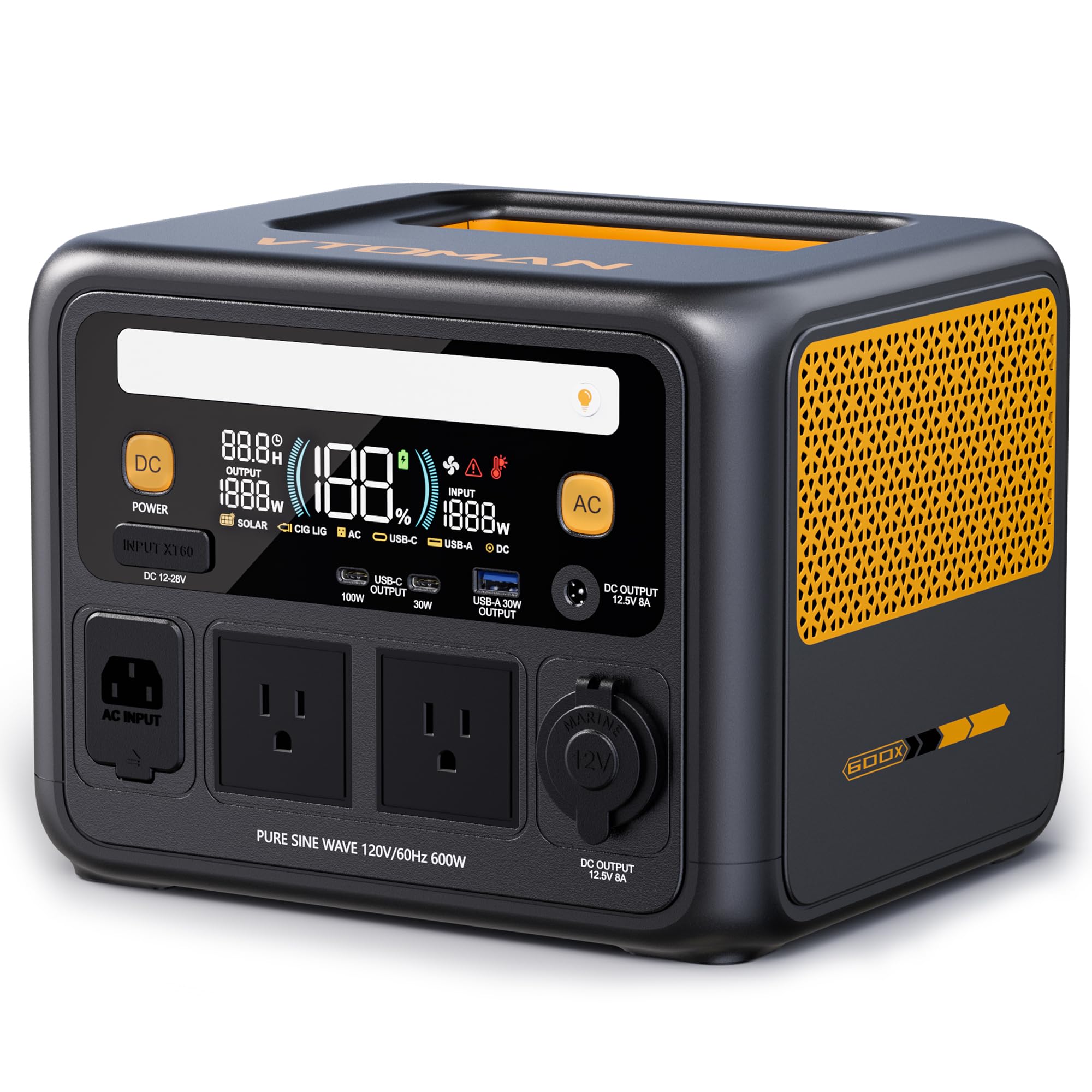
VTOMAN Jump 600X

88 /100
LBD Score Excellent

Key details

Weight
9.9 lb
Capacity
268.8Wh
AC Output
600W (1,200W surge)
Recharge To 80%
50 minutes (AC + DC)
View on Amazon

The Jump 600X went into the same tote as the camp stove and the lanterns, one-handed, and that's most of why we kept reaching for it. At 9.9 pounds and roughly the size of a lunchbox, it's the station here that disappears into the packing instead of dictating it.

The 268.8 watt-hours are the trade for that. It covers lights, phones, two laptops, and a fan through a night, or one evening of a 12-volt cooler rather than a weekend of one. The 600-watt AC output with a 1,200-watt surge will start a fridge compressor and run a small TV; a kettle or a hot plate is out of reach, and no amount of wishful thinking changes that.

What makes the small battery tolerable is how quickly it refills: 50 minutes to 80 percent with AC and DC charging running at the same time, so a lunch stop with the truck going puts most of a day's charge back. The LiFePO4 cells are rated for 3,000 cycles, the 100-watt USB-C port runs a laptop directly, and the two-year warranty is ordinary for the price class.

Pros

  • 9.9 lb, small enough for one hand
  • 0-80% in 50 minutes with AC plus DC
  • 600W continuous with a 1,200W surge
  • LiFePO4 rated for 3,000 cycles

Cons

  • 268.8Wh is a one-night capacity
  • 600W rules out kettles and hot plates
Our verdict

The one we hand to tent campers and overlanders: 9.9 pounds, a 50-minute recharge, and enough for lights, laptops, and a cooler through the evening.

Check Latest Price
5

Best Value

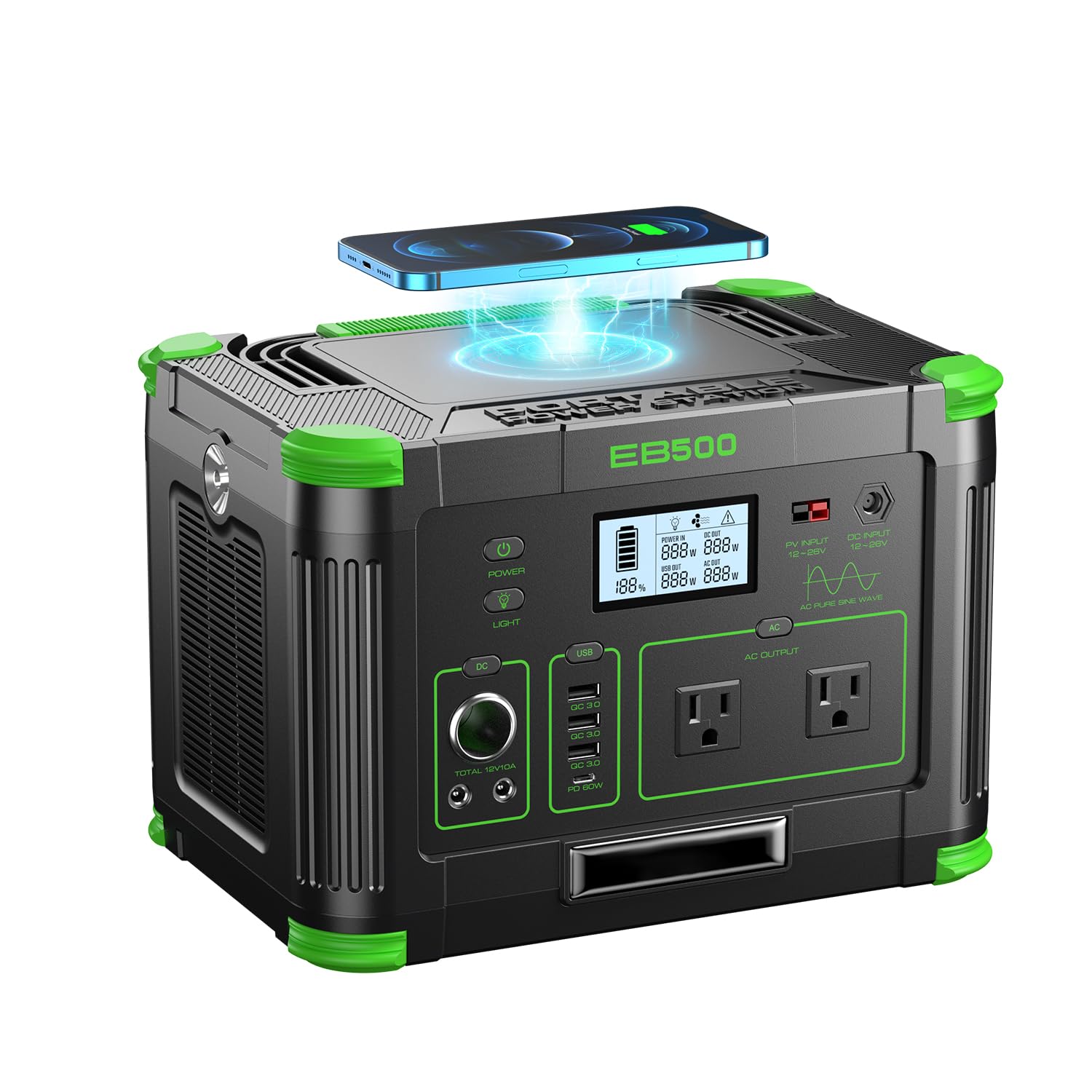
GRECELL EB500

89 /100
LBD Score Excellent

Key details

Weight
18 lb
Capacity
519.48Wh
AC Output
500W (1,000W surge)
USB-C Output
60W PD
View on Amazon

Capacity per dollar is the quiet competition in this category, and the EB500 sits near the top of this set: 519.48 watt-hours for less than half what the 1,000-watt-hour units cost, and the cheapest way here into a battery that will genuinely run a cooler overnight. At 18 pounds it's a two-hand lift but no burden, and the 10 outputs include two AC sockets, a 60-watt USB-C PD port for a laptop, and the usual USB-A and 12-volt connections.

Five hundred watts is the ceiling, and that number decides whether it suits you. It runs a 12-volt cooler, a CPAP, lights, cameras, and a laptop through a weekend; it does not run a coffee maker or an induction burner. Solar charging is a six-to-nine-hour affair, so the wall or the car is your real refill. What we appreciate is that the spec sheet is honest about the unit's job: 519 watt-hours paired with a 500-watt inverter is a camping station sized to its battery rather than a headline capacity married to a weak inverter.

Pros

  • 519.48Wh is the best capacity for the money here
  • 18 lb and 10 outputs
  • 60W USB-C PD for laptops

Cons

  • 500W won't run kettles or coffee makers
  • Slow to refill from solar
Our verdict

Our value pick for car campers who want a cooler running overnight: 519Wh and 500W at 18 pounds, for about half the price of the 1,000Wh units.

Check Latest Price
6

Van Life

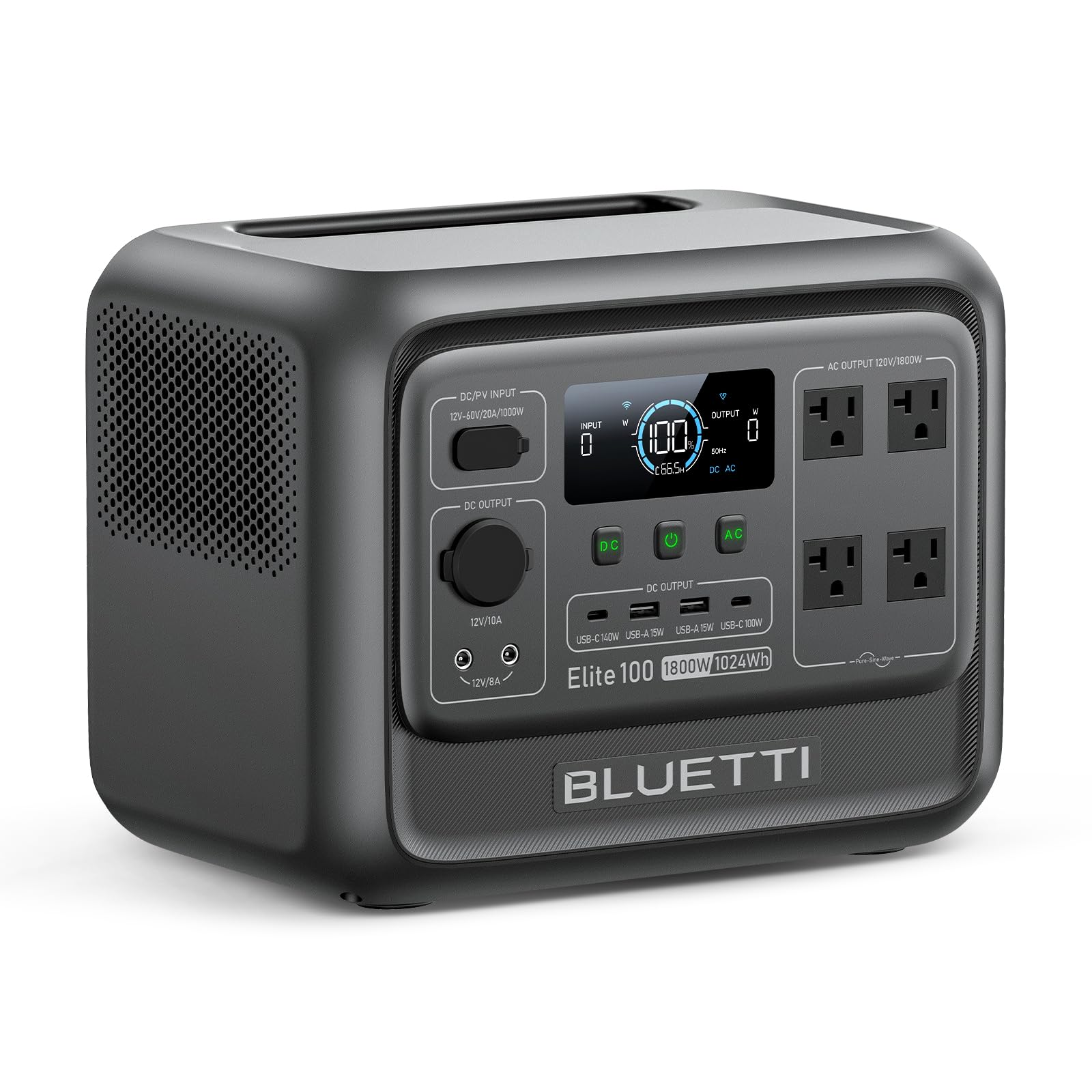
BLUETTI Elite 100 V2

90 /100
LBD Score Outstanding

Key details

Weight
25 lb
Capacity
1,024Wh
AC Output
1,800W (3,600W surge)
Recharge To 80%
45 minutes (AC)
View on Amazon

This is the one built for the person whose vehicle is the campsite. A 10-millisecond UPS switchover keeps a router and a laptop running when shore power drops, the quiet mode is calm enough for a shared van, and the app gives you battery state over Wi-Fi or Bluetooth from the front seat.

The hardware holds up its end. At 1,024 watt-hours and 25 pounds it lands between the Jackery and the Anker on weight, the 1,800-watt output surges to 3,600, and it reaches 80 percent in about 45 minutes — the fastest recharge in this group by a comfortable margin.

We like it a lot for van and SUV camping, and it doubles as home backup between trips. What keeps it out of the top slot is history: it's the newest design here by a wide margin, and the first thing to check when it arrives is that the 12-volt socket works, while the return window is still open. If that's fine, it's a quieter, faster-charging alternative to the Jackery at similar capacity.

Pros

  • 0-80% in about 45 minutes, the fastest here
  • 3,600W surge, the highest in this set
  • 10ms UPS switchover for van and home
  • 25 lb for 1,024Wh

Cons

  • Newest design here, shortest track record
  • Heavier than the Jackery at 25 lb
Our verdict

We like it for van and SUV camping, where the 45-minute recharge and near-silent running matter more than a long track record.

Check Latest Price
7

USB-Only Camping

Anker SOLIX C300 DC

90 /100
LBD Score Outstanding

Key details

Output
300W, no AC outlets
Weight
6.2 lb
Capacity
288Wh
USB-C Output
Two 140W ports
View on Amazon

There are no AC outlets on the C300 DC. If anyone in your group plans to plug in a kettle, a lamp, or a camera charger with a wall plug, this is the wrong box, and no adapter fixes that.

For gear that lives on USB-C and 12 volts, though, it's the most interesting unit here. Two 140-watt USB-C ports will charge a laptop and a drone battery at the same time, a third USB-C handles a phone, and the car socket runs a 12-volt cooler or a Starlink Mini. At 288 watt-hours and 6.2 pounds it's the lightest way in this group to carry that much power to a tent.

Two setup details are worth knowing before the first trip. There's no wall charger in the box, so you need a 65-watt-or-better USB-C brick of your own, and the unit has to be woken up with an 18-watt USB-C charger the first time before anything else works. Neither is a dealbreaker. Both are the kind of thing you discover at the campsite if nobody tells you first.

Our take is that this is a second battery for a light-and-fast camper rather than the only one. It goes in the daypack with a laptop, a headlamp, and a phone and keeps all three alive for days, and the dimmable light is genuinely useful at two in the morning. Buy it alongside an AC-capable station, or on its own only if your entire kit is USB.

Pros

  • 6.2 lb is the lightest 288Wh here
  • Two 140W USB-C ports charge laptops fast
  • Car socket runs 12V coolers and Starlink
  • Three-year warranty

Cons

  • No AC outlets at all
  • No wall charger in the box
Our verdict

We reach for this when everything in the bag is USB-C or 12-volt: 288Wh in 6.2 pounds, two 140W ports, and no AC outlets to fall back on.

Check Latest Price
8

First Power Station

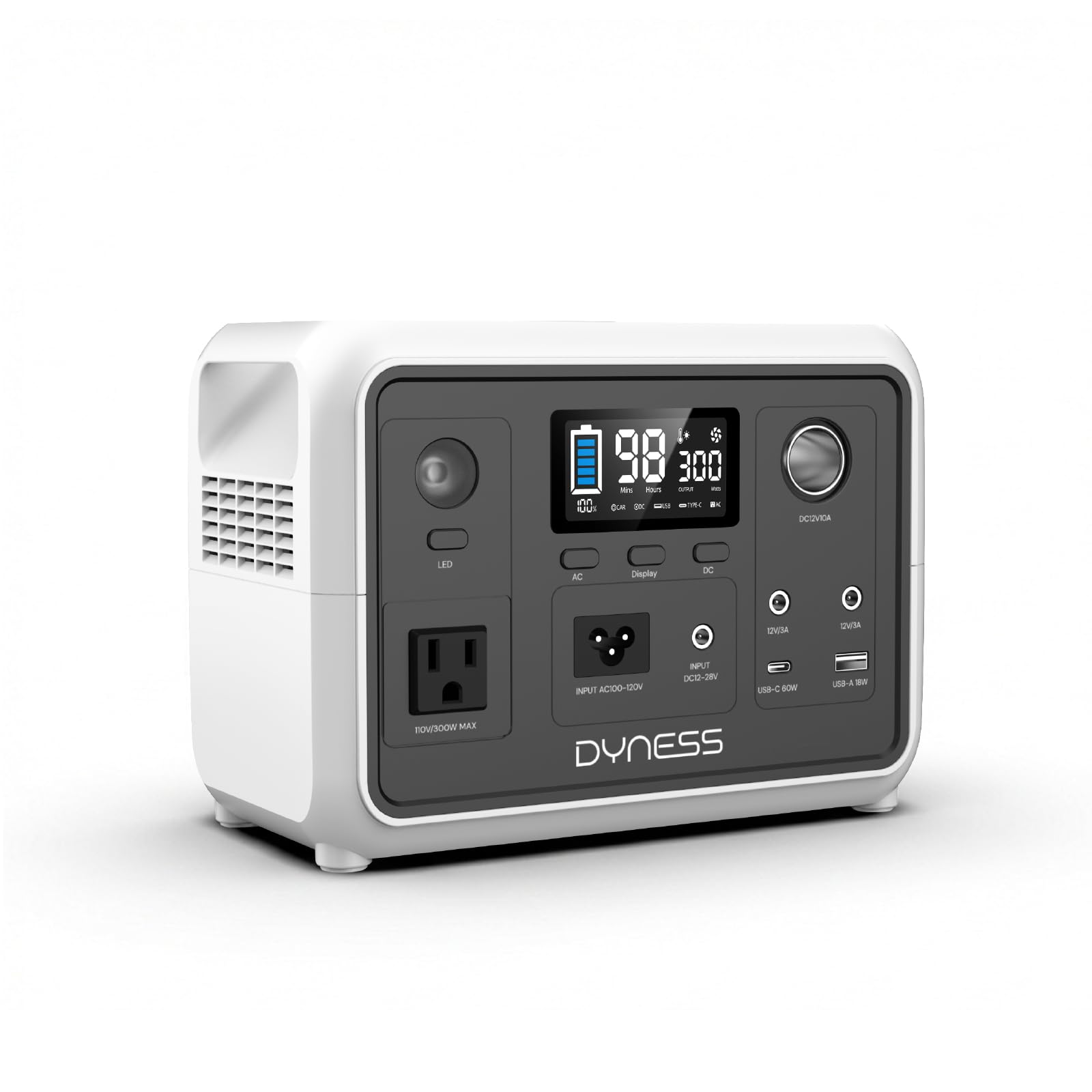
DYNESS PPS300

85 /100
LBD Score Excellent

Key details

Capacity
256Wh
AC Output
300W (600W surge)
AC Outlets
1
View on Amazon

The VTOMAN above is the better small station, and it costs about twice as much. The DYNESS is what that gap buys: a 256 watt-hour LiFePO4 battery with a 300-watt inverter, one AC outlet, USB-C and USB-A ports, two DC outputs, and a car socket, in a case that fits in the corner of a milk crate.

For a first station or a spare, that covers a lot of trips. It will charge four phones and a headlamp every night for a long weekend, run a string of campsite lights, and put a CPAP through a night with the humidifier off. What it won't do is run anything with a heating element, and the single AC outlet means one appliance at a time.

LiFePO4 at this end of the market is the part worth noticing. The chemistry is what you want in a battery that sits in a garage for eight months and then works for a week straight, and the two-year warranty matches what the other budget units here offer. The 600-watt surge will start a small cooler compressor, which is more than the running wattage suggests.

Our advice is to buy it as the glovebox battery rather than the trip's main power. It's the one that lives in the car, charges the kids' tablets on the drive, and comes out at the picnic table — and at this end of the range, a second battery is usually a better use of money than trading up the first one.

Pros

  • LiFePO4 chemistry at entry-level money
  • Six ports including a car socket
  • Two-year warranty

Cons

  • One AC outlet only
  • 300W rules out anything that heats
Our verdict

We like it as a glovebox battery and a first station: 256Wh of LiFePO4, one AC outlet, and enough for phones, lights, and a CPAP night.

Check Latest Price

How We Tested the Best Portable Power Stations

We started with the models that keep surfacing in camping forums and in our readers' questions, then trimmed the field by capacity, battery chemistry, size, and price so we were comparing like with like — a couple of 300Wh weekend boxes, a cluster of 1,000Wh units, and one 2,000Wh bruiser for people running a fridge or a medical device for days.

Each of the 12 units went home with us for six months and got used the way these things actually get used: tent camping weekends, the back of a wagon on road trips, a parking-lot tailgate, and a house with the breaker flipped for a night to see what an outage really feels like.

We timed every recharge from empty to full with a stopwatch, on a wall outlet and on 12V car power, and noted which ones got hot enough to think twice about touching. We plugged in a 12V fridge, a coffee maker, a box fan, and a laptop over USB-C, and watched how much of the rated capacity we could actually draw before the outlets cut out. A luggage scale and a flight of stairs settled the portability question faster than any spec sheet, and we checked how much charge each one lost sitting unused in a closet for a month.

Value got judged on usable watt-hours per dollar rather than the sticker price, and reliability on the small things — whether the display stayed readable in direct sun, whether the handles flexed under a full load, and whether the cooling fan whined loud enough to hear from a sleeping bag.

How to Choose a Portable Power Station for Camping

Size the Battery to Your Loads, Not to a Number

Write down what you'll plug in and for how long before you compare capacities. A 12-volt cooler draws around 45 watts, so a night of it costs roughly 350 to 400 watt-hours once the inverter's losses are counted, and a fan and a laptop add little on top. Two phones and a lantern are close to free.

That arithmetic is why a 500-watt-hour unit covers a car camper's night and a 1,000-watt-hour unit covers a family's weekend. Buy for the trip you take most often, then decide whether a second, smaller battery makes more sense than one bigger one.

Treat Weight as the Spec You'll Feel

Nothing else on the spec sheet shapes a trip like weight. Under ten pounds, a station goes in one hand alongside the cooler; around 25 pounds, it's one person for a short distance; past 35 pounds, it stays within a few feet of the vehicle and nowhere else.

Be honest about the walk from the tailgate to the tent pad. A heavy unit that never leaves the truck is a unit you paid extra not to use, which is the argument for the VTOMAN at one end of this list and against the Explorer 2000 v2 at the other.

Check Continuous Watts, Then Check the Surge

Two AC numbers matter. Continuous wattage is what the station holds all evening; surge is the brief burst that starts a compressor or a motor. A 500-watt unit runs a cooler and a laptop but not a coffee maker, while 1,500 to 1,800 watts is where kettles, griddles, and induction burners come into play.

Ignore any peak figure printed larger than the continuous one. A fridge that runs on 60 watts may pull several times that for a second at startup, and the inverter trips on the number you didn't read.

Plan the Refill Before You Leave

Every unit here charges fastest from a wall outlet, which is no help at a site without hookups. A car's 12-volt socket usually delivers around 100 to 120 watts, so topping up 1,000 watt-hours takes most of a driving day.

Solar works, but none of these stations includes a panel, and one 100-watt panel is a multi-day proposition for a big battery. Decide your recharge path first, then let it rule out the stations that can't manage it.

Buy LiFePO4 If You Want to Keep It

Lithium iron phosphate has become the default for good reasons: 3,000 to 4,000 cycles before it drops to 80 percent capacity, better tolerance for heat, and a battery you can leave in a garage between trips without much drama.

Older lithium-ion packs are lighter for the same energy but retire years sooner. If you're buying a battery to last five camping seasons, check the chemistry line before the capacity line.

Frequently Asked Questions

Final Verdict

The Jackery Explorer 1000 v2 is the station we point most campers to: 1,070 watt-hours, 1,500 watts of AC output, and 23.8 pounds, which is the point where capacity stops being theoretical and weight stops being a chore.

If your trips involve real cooking appliances, the Anker SOLIX C1000's 1,800 watts and five-year warranty make it the better buy. And if everything you carry is USB-C and 12-volt, the Anker SOLIX C300 DC is the lightest way to bring 288 watt-hours along.