Best Action Cameras of 2026

The best action camera is the one still recording when everyone else's has fogged up, died, or shaken itself into a blur. I've clamped cameras to handlebars, helmet straps, and a kayak deck that nearly swallowed one, and the clips worth keeping are rarely the ones with the biggest number on the box. A good one turns a chaotic, badly framed mess into footage that looks like the day felt.

My team and I spent seven months putting 12 cameras through that treatment. Stabilization and battery life produced more winners than resolution did, and the cameras with the fussiest mounts stayed in the bag. Ease of use counts for more than any spec sheet — if you need a manual at the trailhead, you'll stop carrying it.

So we paid attention to what actually goes wrong: a battery that quits halfway down a run, a phone pairing that takes three tries, a mount that creeps loose on rough ground. The picks below are the cameras that kept earning a spot in my bag.

1

Best Overall

DJI Osmo Action 5 Pro

92 /100
LBD Score Outstanding

Key details

Weight
5.15 oz
Max Video
4K/120fps
Battery (rated)
Up to 240 min
Built-in Storage
47 GB
View on Amazon

Four hours is the number that decided this one. DJI rates the Osmo Action 5 Pro's 1950mAh battery at up to 240 minutes, and nothing else here is close: the Insta360 X5 is next at 208, and the budget cameras sit between 90 and 150. What that bought us was a day on the hill without a spare in a pocket. Shooting 4K at 60 frames per second pulls the figure down, but the margin over the rest of this group is wide enough that it survives the drop.

Stabilization is the other half of the argument. HorizonSteady corrects through a full 360 degrees of roll, so a camera bolted to a leaning bike or a tilting helmet keeps its horizon level instead of swooping with the mount. Set it against the AKASO's electronic stabilization and the gap appears the moment the ground stops being flat — one looks like footage, the other looks like footage from a camera that was falling over. Add 4K at up to 120fps and the 1/1.3-inch sensor, and low-light clips come out clean enough to use rather than merely bright enough to see.

The details are what make it easy to live with. The magnetic quick-release mount pops off, spins vertical, and clicks back without hunting for a thumb screw, which is the difference between grabbing a shot and skipping it. OLED touchscreens on both sides mean framing yourself is not guesswork, and at 146 grams it disappears on a helmet.

It's also waterproof without a case, and that matters more than the depth rating: rain, spray, and a dunking don't require sealing the camera in plastic and giving up your audio. The 47GB of built-in storage covers the gap before a card turns up, so the camera earns its keep from the first afternoon rather than the first payday.

Pros

  • Up to 240 minutes on one battery
  • HorizonSteady holds a level horizon
  • 47GB built in, so you can shoot now
  • Waterproof without a case

Cons

  • Premium price within this set
  • No memory card in the box
Our verdict

Our pick for most people: the longest rated battery here, a sensor that copes after dark, and stabilization that keeps the horizon level when the mount leans.

Check Latest Price
2

Best 360 Camera

Insta360 X5

93 /100
LBD Score Outstanding

Key details

Lenses
Replaceable
Sensors
Dual 1/1.28-inch
360 Video
8K/30fps
Battery (rated)
208 min
View on Amazon

A 360 camera asks you to stop aiming. Mount the X5, press record, and both lenses capture everything around it at 8K30, so the run down a trail, the lap of the pool, or the whole campsite dinner is there to reframe afterwards. Dual 1/1.28-inch sensors do the work, and this is the setup that finally makes 360 footage look sharp rather than merely novel.

The trick that keeps us coming back is the invisible selfie stick. Put the X5 on a pole and the software erases the pole, so a solo rider ends up with a third-person shot that looks like it came from a chase camera. When you don't want to reframe anything, InstaFrame writes a flat, ready-to-post clip with the camera tracking you, while the full 360 file stays intact if you change your mind.

The hardware is built for the way these cameras get treated. The lens covers are replaceable, so a scratch from rock or handlebar costs you a lens instead of a camera, and FlowState with 360-degree Horizon Lock keeps the frame level through rolls that would wreck a normal action cam. The battery is rated at 208 minutes, second only to the DJI here, and a built-in wind guard handles open-air audio.

Where it stops making sense is when you never plan to reframe. A single-lens camera gives you more detail per pixel and a far simpler edit, and the X5's extra cost buys a workflow you have to actually use — which is why we point people who just want to film a bike ride at the DJI instead.

Pros

  • 8K 360 footage you reframe later
  • Invisible selfie stick effect
  • Replaceable lens covers
  • 208-minute rated battery

Cons

  • Premium price within this set
  • Every clip needs reframing first
Our verdict

The 360 camera to buy if you want to choose the angle after the ride rather than during it — sharp, steady, and built to survive a lens knock.

Check Latest Price
3

Best for Low Light

Insta360 Ace Pro 2

86 /100
LBD Score Excellent

Key details

Screen
2.5-inch flip touchscreen
Batteries
2 included
Max Video
8K
Dynamic Range
13.5 stops
View on Amazon

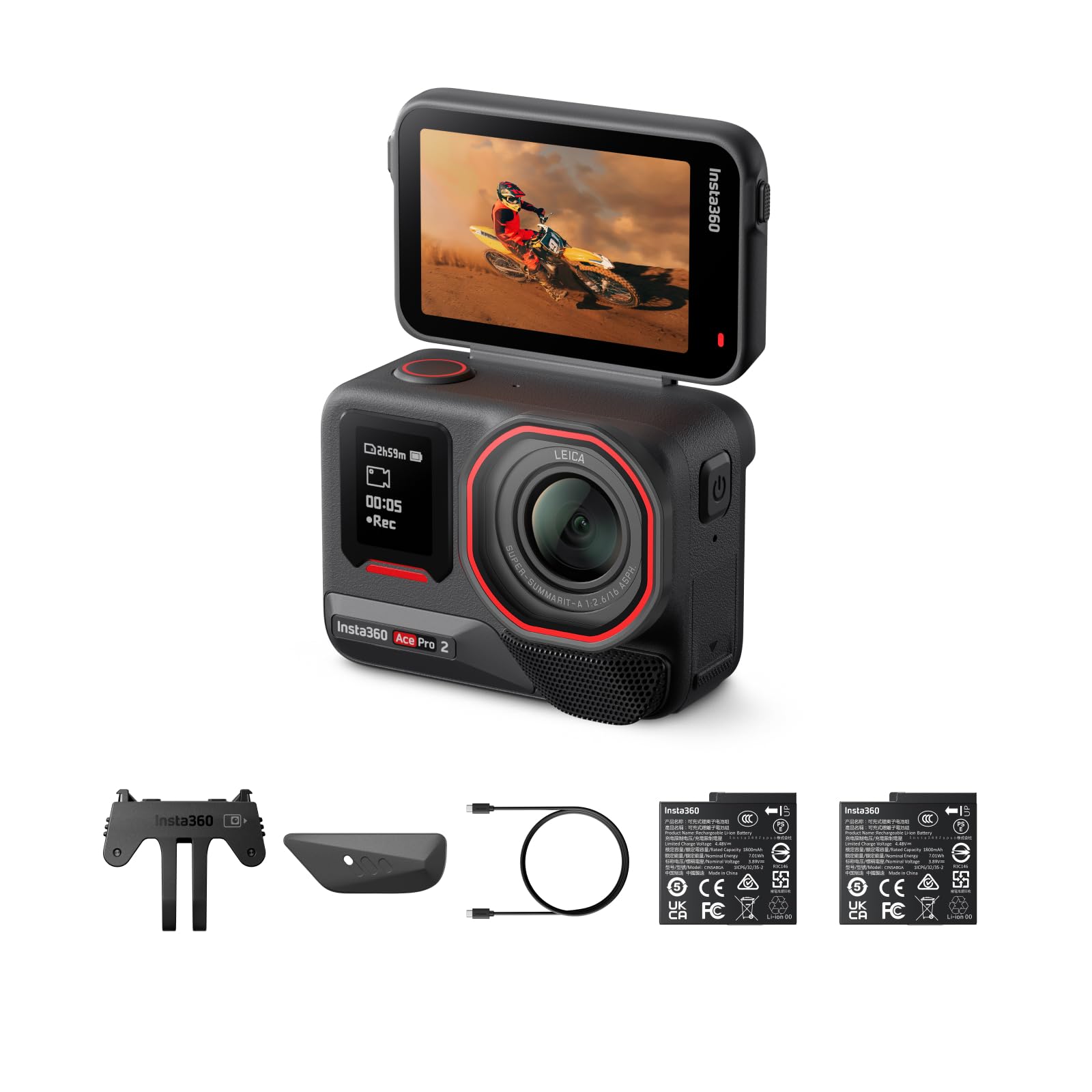
A flip screen sounds like a small thing until you've tried to film yourself with a camera whose screen faces the wrong way. The Ace Pro 2's 2.5-inch touchscreen hinges up so you can frame and monitor from in front of the lens, which makes it the most practical camera here for talking-head clips, tutorials, and anything where you're both the subject and the crew.

What we didn't expect to care about as much is PureVideo. It's Insta360's low-light mode, now up to 4K60, and the noise reduction behind it keeps detail that the small sensors in this group smear away after dusk. The 13.5 stops of dynamic range and the Leica-branded lens are the headline specs; the practical result is that evening footage is usable without dragging a light along.

Get the bundle rather than the body. Two batteries, a wind guard that clips on to tame wind noise, and a standard mount in the box is more than most of these cameras ship with, and the 8K recording with 50MP stills puts it at the top of the spec sheet. The flip screen makes the whole thing feel closer to a small production camera than to an action cam.

Where it gives ground is heat and storage: the highest modes are where warmth and battery drain show up first, and the camera wants a V90 card with room to spare. It's also the newest of this group and the one with the shortest track record behind it, so we're still watching how it holds up over a full season.

Pros

  • Flip screen makes self-framing easy
  • Low-light mode holds detail
  • Two batteries in the bundle
  • 8K capture and 50MP stills

Cons

  • Premium price
  • 8K needs a fast, high-capacity card
Our verdict

Buy it if you film yourself or shoot after dark: a screen that flips up so you can frame, and a low-light mode that holds detail past sunset.

Check Latest Price
4

Best Budget

AKASO EK7000

89 /100
LBD Score Excellent

Key details

Weight
2 oz
Batteries
2 included
Max Video
4K/30fps
Waterproof
131 ft with case
View on Amazon

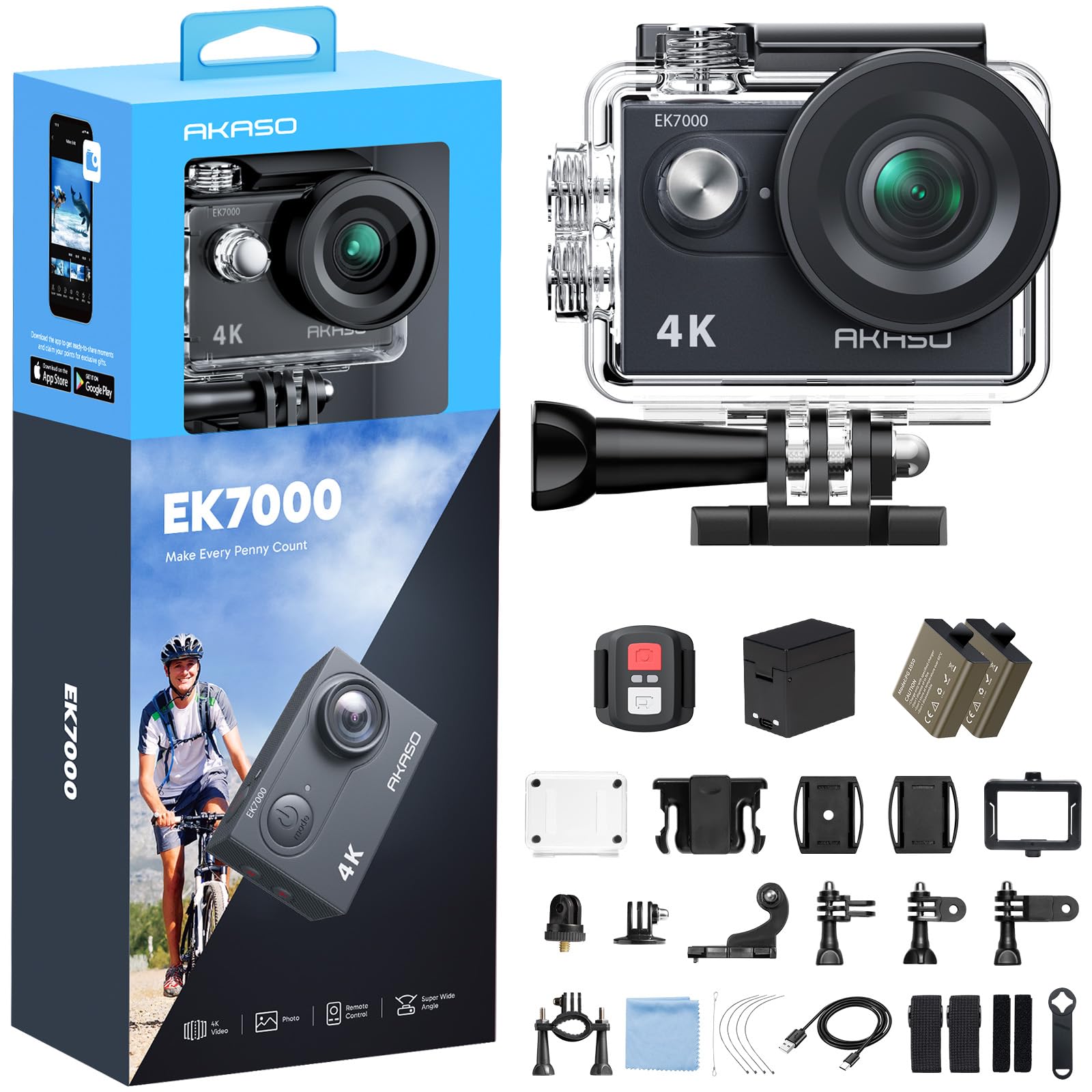
The EK7000 is what we suggest to someone who isn't yet sure an action camera is for them. It records 4K at 30fps and 2.7K at the same rate, stabilizes electronically, and arrives with two batteries, a wrist remote, a waterproof case, and enough mounts to lash it to a helmet, a bar, or a board. Nothing else here gets you filming for so little.

The boring parts are where it holds up. The case is rated to 131 feet, deeper than most people will ever go, and the 2.4G wrist remote earns its place when the camera is strapped somewhere you can't reach. The menus are plain and the buttons do what they say, which matters when you're setting up with cold hands on a hillside.

Two things to know before you order. Stabilization is electronic and modest: it cleans up walking pace and stops helping once the ground gets properly rough, so treat this as a camera that records the ride rather than one that makes the ride look smooth. And it's only waterproof inside its case, where the microphone records through plastic and voices come out boxy — the external mic support doesn't help once the camera is sealed.

Two batteries at 90 minutes each is the honest number, and rotating them is the difference between a full day and half of one. That's the whole pitch, really: a camera that does the job, a kit that gets you started, and a price that doesn't hurt if it spends most of the year in a drawer.

Pros

  • Lowest price in this group
  • Two batteries and a mount kit included
  • Wrist remote for helmet-mounted shots
  • Works to 131 ft in its case

Cons

  • 90 minutes per battery, the shortest here
  • No microSD card in the box
Our verdict

The camera we hand to anyone who isn't sure they'll use one: two batteries, a wrist remote and a full mount kit for the least money here.

Check Latest Price
5

Best Wearable

Sixmou i3

84 /100
LBD Score Excellent

Key details

Weight
1.26 oz
Max Video
4K
Waterproof
131 ft with case
Battery (rated)
150 min
View on Amazon

At 35.7 grams the i3 barely registers on a shirt collar. It's smaller than a thumb, mounts with a magnet, a lanyard pad, or a spring clip, and records 4K without you holding anything, which is the entire point. Clip it to a strap for a bike commute, tuck the lanyard under a t-shirt on a family walk, and you get POV footage that doesn't announce itself to everyone in the park.

For the size, the kit is generous. There's a 150-minute rating from an 800mAh battery, a 64GB card in the box, and a waterproof case rated to 131 feet for snorkeling. The 150-degree lens is wide enough to keep your hands and the handlebars in frame, and the magnet holds through a t-shirt.

What you trade for the size is polish. Stabilization is digital only, with no horizon lock, so running footage wobbles in a way the DJI and the Insta360 cameras simply don't. The phone connection is the fiddly part: pairing works, but it's the step where we've learned to be patient, and the app is how you reach the settings you can't get at on the camera itself.

None of that undoes what it's for. Footage from a collar will never match a 1/1.3-inch sensor on a gimbal, but the i3 gets shots the bigger cameras miss because they were in a bag at the time. That's a trade worth making at this end of the price range.

Pros

  • 35.7 grams
  • Magnet, lanyard and clip included
  • 150 minutes from an 800mAh battery
  • 64GB card in the box

Cons

  • Digital stabilization only, no horizon lock
  • Wi-Fi pairing is the weak point
Our verdict

Thirty-five grams, a magnet and a clip: this is the camera you forget you're wearing, and the easiest hands-free POV in this set.

Check Latest Price
6

Night Shooting

GoPro LIT Hero

82 /100
LBD Score Excellent

Key details

Weight
3.28 oz
Max Video
4K/60fps
Waterproof
16 ft without case
Built-in Light
3 brightness levels
View on Amazon

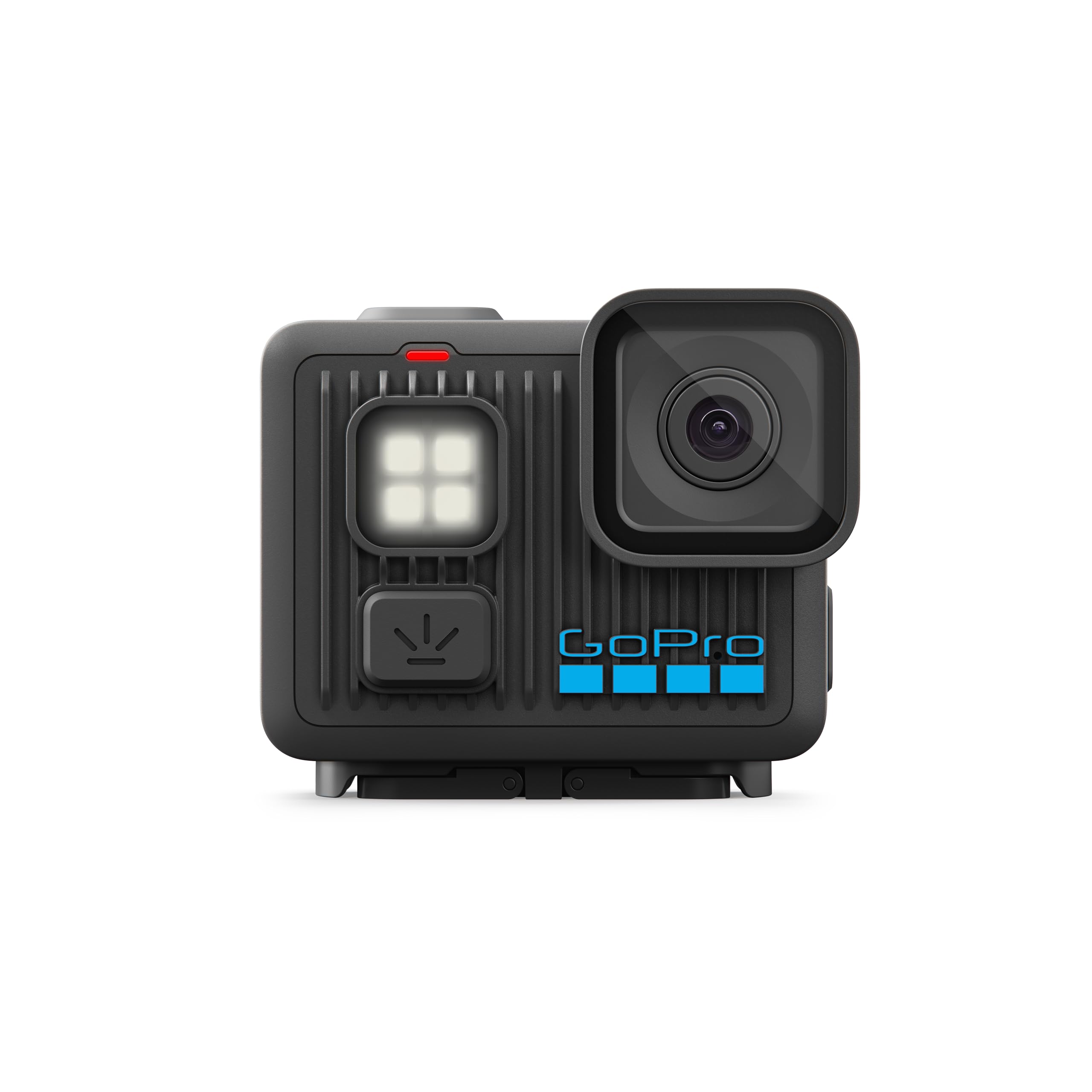
Every other camera in this guide needs you to bring the light. The LIT Hero has one built in, with three brightness settings and a diffuser in the box, and that turns it into something you can use after sunset: a tent, a night ride home, a backyard. It's the single feature no other pick here offers, and it's why we keep recommending it to people whose filming happens in the evening.

The rest is entry-level GoPro, done properly. 4K at 60fps, HyperSmooth stabilization, a 1.76-inch touchscreen, controls that cycle between video, photo, and slo-mo without a menu dive, and 93 grams in a body waterproof to 16 feet with no case at all. No case means no fogging and no muffled audio, which is more than the budget cameras here can say.

What it doesn't have is headroom. Stills top out at 12MP, the resolution ceiling is 4K, and the fine manual control the DJI and Insta360 cameras offer is largely absent by design — this is a camera to point and shoot, not to tune. For a first GoPro or a second camera that lives in a jacket pocket, that's a fair trade; for anything you plan to grade or reframe, it isn't.

Where it earns its place is the trip you'd otherwise leave the camera behind for. At 93 grams it goes in a pocket without a second thought, and the light means the second half of the day isn't written off. It's also the newest camera of this group, so we're still watching how it holds up over a season.

Pros

  • Built-in light with three levels
  • Waterproof to 16 ft without a case
  • 93 grams and pocketable
  • 4K/60 with HyperSmooth

Cons

  • 12MP stills, the joint lowest here
Our verdict

The only camera here that brings its own light, which makes it the one to pack for camping, night rides, or anywhere the sun has already quit.

Check Latest Price

How We Put 12 Action Cameras Through Their Paces

The shortlist started with research: cameras with a standard mount, a swappable battery, and a price that makes sense for someone who isn't shooting professionally. Spec sheets only got a camera so far, so we also read owner threads for what marketing copy skips — whether spare batteries and lenses are actually in stock, whether the companion app has been updated recently, whether you can bolt on third-party mounts. Twelve made it through.

Each one lived the way these cameras actually live. It went on a handlebar mount for a gravel loop, a chest rig for a trail run, and a helmet for a cold morning on the slopes; it got dunked in a pool and dragged through sand at the beach; it spent an afternoon clipped to a tote bag as a vlogging camera. We swapped batteries mid-session and noted how long each lasted and how warm the body got.

On the same bumpy descent, we compared footage side by side to see which cameras smoothed out the chatter and which left it in, then shot the same street at dusk to see how much detail survived. We timed how long each took to pair with a phone and transfer a one-minute clip, walking away from the camera until the connection dropped, and squinted at every screen outdoors to check readability in direct sun. Mounts got a hard hand-shake and a rough ride to check for creep, and we handed each camera to someone who'd never touched it, timing the run from power-on to recording.

Anything that fogged, froze, or needed a second attempt to start got flagged; those are the failures that leave a camera at home.

How to Choose an Action Camera

Decide how much aiming you want to do

Every camera here is a choice about who picks the frame. A single lens commits you the moment you press record. A 360 camera like the Insta360 X5 captures everything and lets you choose afterwards, which is worth the extra editing when you genuinely can't predict where the action goes. A flip or front screen, as on the Ace Pro 2 and the Osmo Action 5 Pro, solves the opposite problem: you're in the shot and need to see yourself.

A thumb-sized camera settles the question by clipping to you and recording whatever you're facing. If you can't say which of those fits, you'll shoot more with a single lens on a good mount than with a clever camera you leave at home.

Waterproofing: the case or the camera

Two designs, two trade-offs. A hard case is the only way a budget camera gets to 131 feet, and it protects the lens — but it seals the microphone in with the camera, and a warm body dropped into cold water fogs the glass. Bare waterproofing, as on the LIT Hero and the DJI, is rated shallower but keeps audio clean and needs no ritual before you get in the water.

Buy the depth rating only if you actually dive. For rain, spray, and a pool, a camera that doesn't need a case is the better one to own.

Battery is the number that decides your day

Rated runtimes in this group run from 90 minutes to four hours, and every one of those figures assumes a moderate setting. 4K at 120fps and 8K cut them; cold weather cuts them further; and a camera recording ten-minute clips lasts longer than one left running on a bar mount.

We treat the rating as a ceiling and plan for roughly two-thirds of it. If your longest outing lands within an hour of the rating, order a spare battery with the camera — a second battery is cheaper than a second trip.

Stabilization and horizon lock are not the same thing

Electronic stabilization smooths the shake out of a shot. Horizon lock goes further and keeps the frame level as the camera itself rolls, which is the part that matters when the mount is a bike frame, a helmet, or a wing mirror. The DJI's HorizonSteady and the X5's 360-degree Horizon Lock both do it; the AKASO and the i3 rely on plain digital stabilization and will lean into corners.

If the camera is going on anything that tilts, this is the feature worth paying for.

Budget for what isn't in the box

The camera is the visible cost; the card is the one that bites. 4K at 120fps and 8K want a V60 or V90 card, and a slow one will stall a recording halfway through. Then a spare battery, and a mount that fits your helmet, bars, or chest rather than the single adhesive pad in the box.

Put the card and the second battery in the basket alongside the camera. The EK7000 ships without a card at all, so add one to the same order.

Frequently Asked Questions

Final Verdict

The Osmo Action 5 Pro is the one we recommend to most people. Four hours of rated recording, a horizon that stays level when the mount leans, and enough built-in storage to start shooting on day one are the reasons, and the rest of this field is behind on at least one of them.

If your footage only makes sense when you choose the angle afterwards, the Insta360 X5 is worth the premium instead. And if you're not sure you'll use an action camera twice, the EK7000 plus a card is the least expensive route into 4K that still comes with two batteries.