Best 4K Security Cameras of 2026

A security camera is the one gadget in your house that has to be right on the worst night of the year. Most of the time it just sits there — then a package disappears off the porch and you're squinting at a 12-second clip that looks like weather radar. That's the promise of 4K: enough detail to tell a person from a raccoon and a plate from a blur.

We've spent the past nine months mounting a dozen 4K systems on porches, gates, and bookshelves, from solar four-camera kits to wired rigs with their own recorders. Two things stood out. 4K only holds up if your Wi-Fi does; a great sensor on a weak signal gives you a stuttering feed that quietly drops resolution overnight. And local storage matters more than the spec sheet — it's the difference between paying once and paying every year.

What separates the good ones is how few false alerts they throw and how quickly the app gets you to the moment that counts. The picks below are sorted by situation, not by who claims the biggest numbers.

1

Best Overall

eufy SoloCam E42 4-Cam Kit

84 /100
LBD Score Excellent

Key details

Power
Solar/battery
Resolution
4K UHD
Field Of View
360° pan and tilt
Local Storage
Up to 16TB with HomeBase 3
View on Amazon

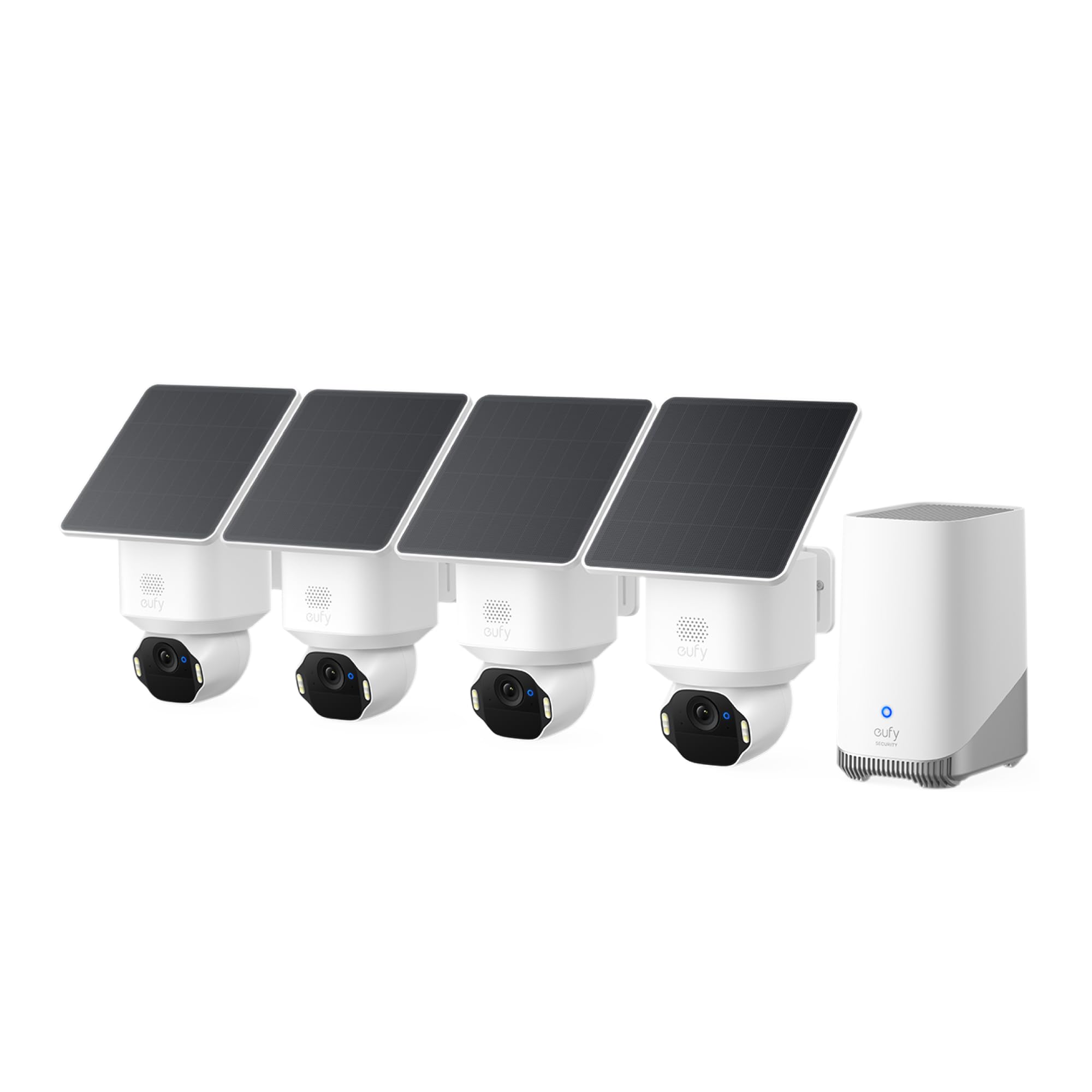
The difference between a useful 4K kit and an expensive one often comes down to what happens after the clip is recorded. The eufy SoloCam E42 keeps four cameras and a HomeBase 3 in the box, and the hub gives you local storage that can grow to 16TB instead of forcing you onto a monthly plan. That is the part that matters most for a system you plan to live with.

We ran the four cameras around a driveway and a back door, and the appeal of the E42 is how little maintenance the solar panels ask for: two hours of direct sunlight is the listed requirement. The 4K picture is the headline, but the practical win is being able to zoom into a face or a plate without the image falling apart. The 360° pan and tilt also lets one camera cover more of a yard than a fixed bullet. That combination is why it is our top pick.

Connectivity is the part to watch. The HomeBase connection is central to how this system works, so place the hub centrally and check Wi-Fi at each camera before you commit to a mount. We also wish the app's live view and event loading felt quicker; the hardware is ready before the software catches up.

For a renter or a homeowner who wants four cameras without an electrician, this is the strongest package here. If your Wi-Fi is weak at the corners of the property, a wired system is the more reliable answer. The E42 rewards a little network planning more than it rewards extra cameras.

Pros

  • Local 4K recording without a monthly fee
  • Four solar cameras in one kit
  • Useful pan, tilt, and AI tracking
  • Expandable storage up to 16TB

Cons

  • Solar charging needs direct sun at each mount
Our verdict

Our default recommendation for a four-camera 4K setup is the eufy SoloCam E42: solar power, a HomeBase for local storage, and no mandatory subscription.
Check Latest Price
2

Best Value Solar Kit

BOTSLAB W510 4-Cam Kit

84 /100
LBD Score Excellent

Key details

Power
Solar/battery
Resolution
4K (8MP)
Field Of View
360° PTZ
Local Storage
32GB base station
View on Amazon

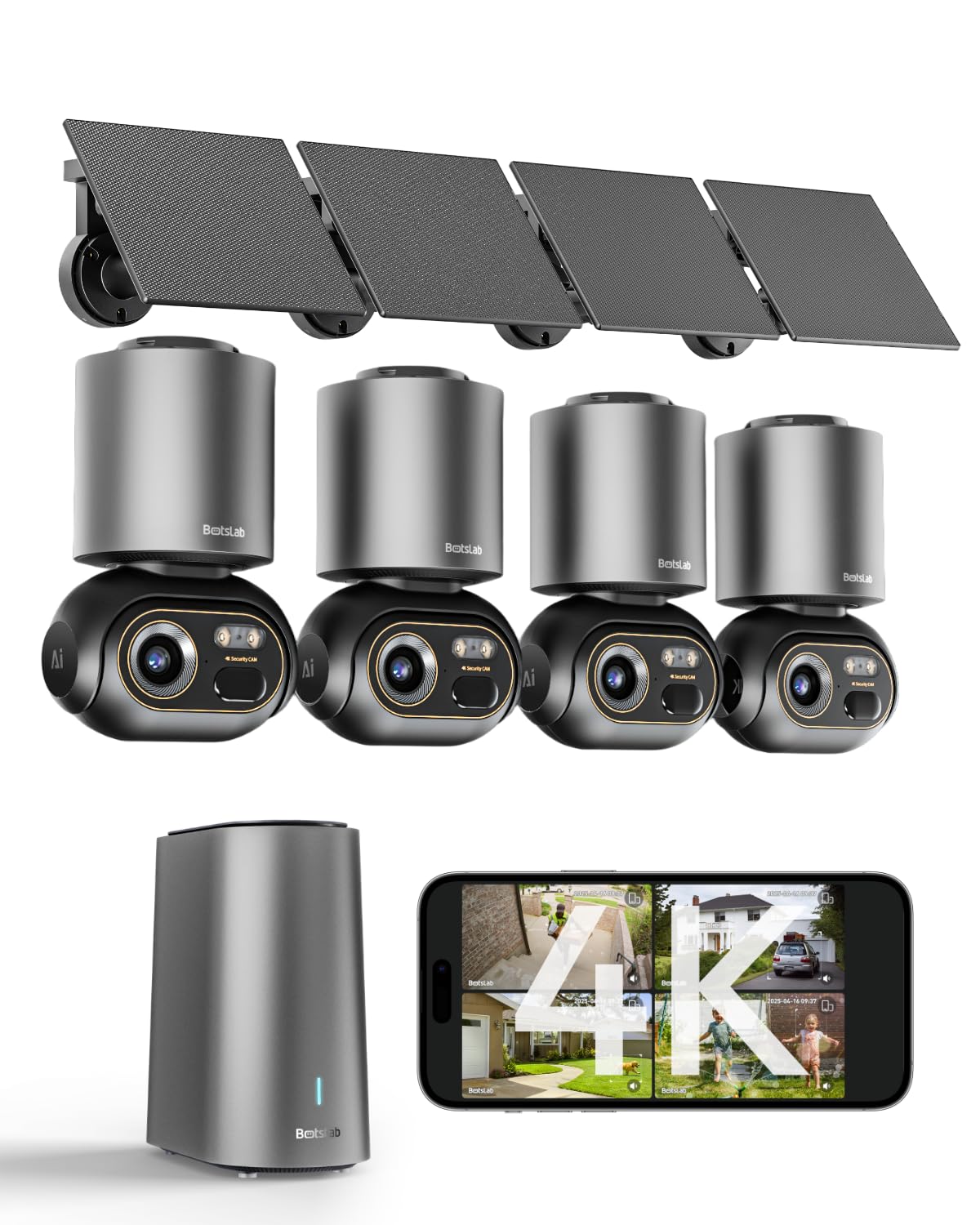
Four 4K cameras, a solar panel for each, and a base station with no monthly fee: the BOTSLAB W510 is the kit to look at when the priority is covering a full perimeter without adding another subscription. The 360° pan and tilt is more useful than a fixed lens here because one camera can sweep a side yard or driveway. The kit includes the mounting brackets and panels rather than selling them separately, which we appreciated.

The 10,000mAh battery and solar panel are meant to keep each camera running without a ladder every few weeks, and the base station keeps footage local instead of pushing you into cloud storage. At night, the color mode is the setting to check first; infrared is there, but full-color night vision depends on the light available. We noticed that the app is straightforward enough for a first-time setup, which is not true of every kit in this group.

Storage is the base station's fixed 32GB, and that fills quickly with four 4K streams. This is a kit for someone who checks alerts daily and mainly needs a clear record of the last few days. If you want weeks of clips, the eufy HomeBase is the better long-term buy. For a tight budget and a simple layout, the W510 earns its place.

Pros

  • Four 4K cameras on a no-fee base
  • 360° pan and tilt coverage
  • Solar panels included for each camera
  • Straightforward first-time setup

Cons

  • 32GB storage fills quickly with four 4K streams
Our verdict

Four 4K solar cameras and no monthly fee make the BOTSLAB W510 a strong value pick, provided short local retention suits you.

Check Latest Price
3

Best Budget Wired System

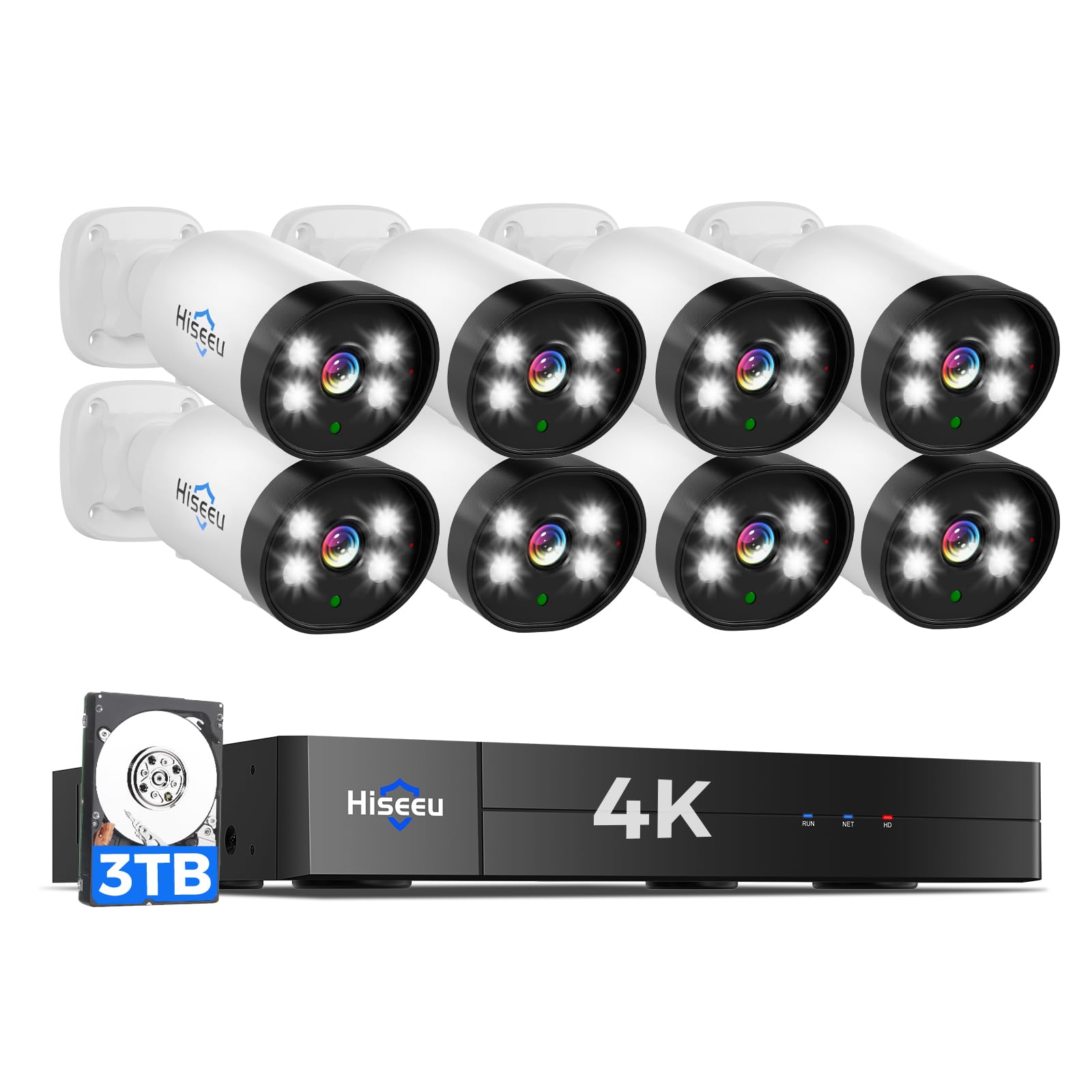
Hiseeu 8-Cam Wired 4K System

82 /100
LBD Score Excellent

Key details

Power
Wired
Cameras
8 cameras
Resolution
4K (8MP) TVI
Local Storage
3TB HDD
View on Amazon

Eight cameras, a 3TB recorder, and a price that undercuts most four-camera wireless kits: the Hiseeu system makes its case with arithmetic. The catch is the word wired. These are 4K TVI cameras that use BNC cable, so the job is not pairing them to an app but planning runs from the recorder to each mounting point.

The 15fps frame rate is the detail we noticed first, because it is lower than the 20fps or 30fps numbers on some other systems here. For a driveway or a back gate, that is usually fine; for fast-moving traffic or a busy street, the lower frame rate is a real compromise. The 3TB drive gives you a useful local buffer for eight cameras, and the system records continuously rather than only when motion trips.

We kept returning to the value per camera. If you can run cable, this is the least expensive way here to cover eight zones with 4K detail, and the DVR keeps recording without a subscription. This is not the kit for someone who wants a one-afternoon app setup; the cable runs are the project. That trade is the whole decision.

The interface is recorder-first: a mouse, an HDMI monitor, and a menu system are the natural way to manage it. The phone app is there for checking in, but this is a system that lives in a closet and does its best work on a screen.

Pros

  • Eight 4K cameras on one recorder
  • 3TB local storage included
  • Continuous recording without a subscription

Cons

  • Cameras are fixed, with no pan or tracking
Our verdict

The Hiseeu eight-camera kit is our budget pick for anyone who can run BNC cable and wants maximum coverage per dollar.

Check Latest Price
4

Best Indoor Multipack

Anona Pano 4K Indoor 4-Pack

88 /100
LBD Score Excellent

Key details

Power
Corded electric
Resolution
4K (8MP)
Field Of View
355° pan, 110° tilt
Local Storage
MicroSD up to 512GB
View on Amazon

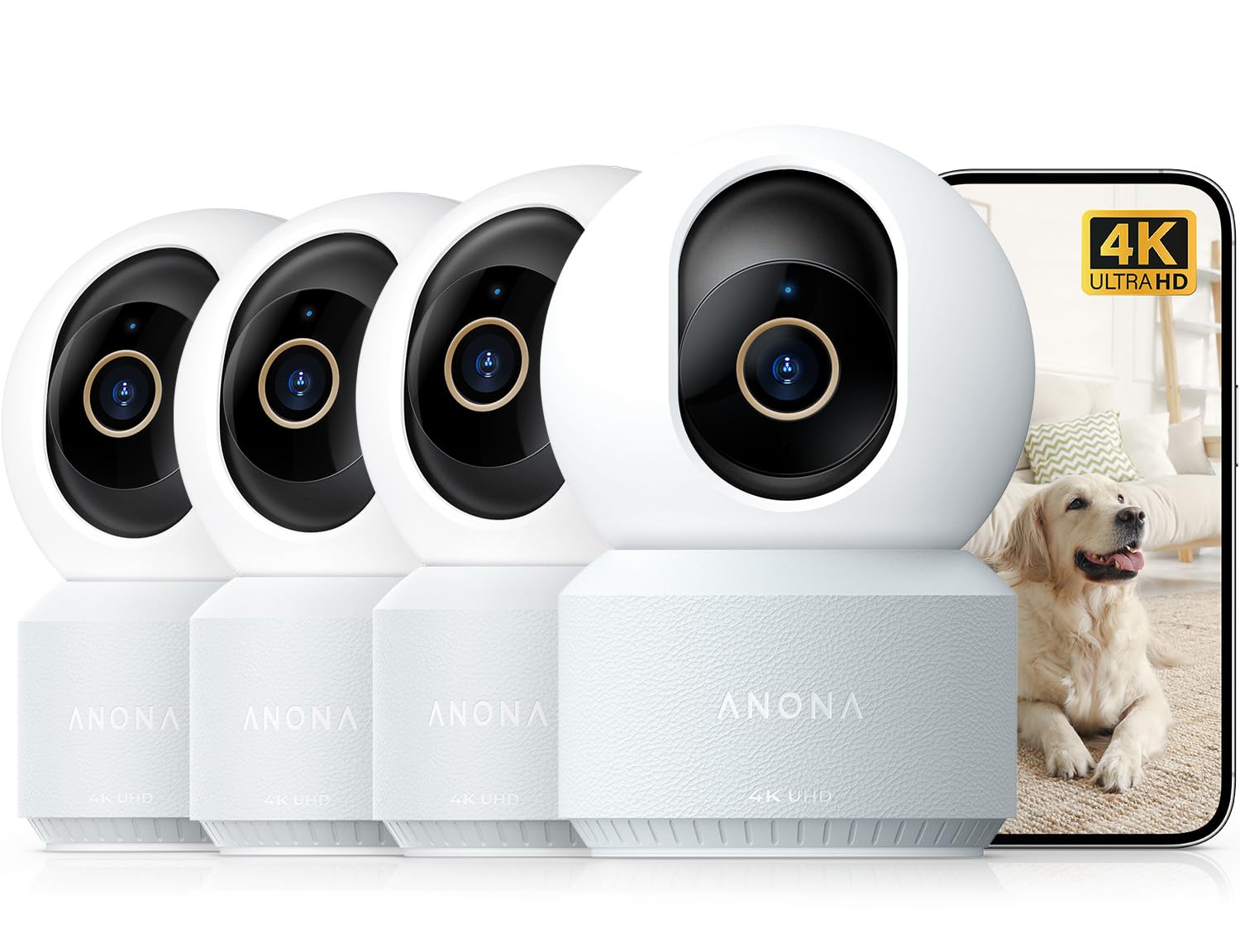
Indoor cameras have a different job from the outdoor kits here: you want a clear view of a room, a pet, or a caregiver, not a weatherproof box on a soffit. The Anona Pano four-pack is built for that job, with 4K resolution, 360° pan, and a 110° tilt on each camera. The four-pack covers several rooms for less than one premium outdoor camera, which is the value case.

The 4K detail is useful when you zoom into a pet on a sofa or check whether a child has climbed somewhere they should not be, and the auto-tracking follows movement around the room. The app's person, pet, and crying detection is the feature that earns the indoor label; it is more specific than generic motion alerts. We found the setup routine simple enough to repeat four times without a manual.

The trade-off is placement rather than performance: each camera is corded, so you need an outlet within reach of the shelf or table where you want it. The pan and tilt cover a room well, but the camera is happiest at chest height or above, not tucked behind furniture. A four-pack also means four app entries to manage, which is fine for a house but more clutter than a single-camera setup.

For a nursery, a pet room, or a small shop interior, the four-pack is the indoor value pick here. If you need one camera at a front door, spend the money on an outdoor model instead; this is the wrong tool for a porch.

Pros

  • Four 4K cameras for indoor rooms
  • 360° pan and 110° tilt
  • Pet, person, and crying detection
  • Useful local microSD storage

Cons

  • Indoor-only design, not weatherproof
Our verdict

We recommend the Anona Pano four-pack for indoor 4K coverage of pets, kids, or rooms; it is not a perimeter security system.

Check Latest Price
5

Best Floodlight Camera

Ring Floodlight Cam 4K Pro

89 /100
LBD Score Excellent

Key details

Power
Wired
Resolution
Retinal 4K
Floodlights
2,000 lumens
Field Of View
Wide-angle
View on Amazon

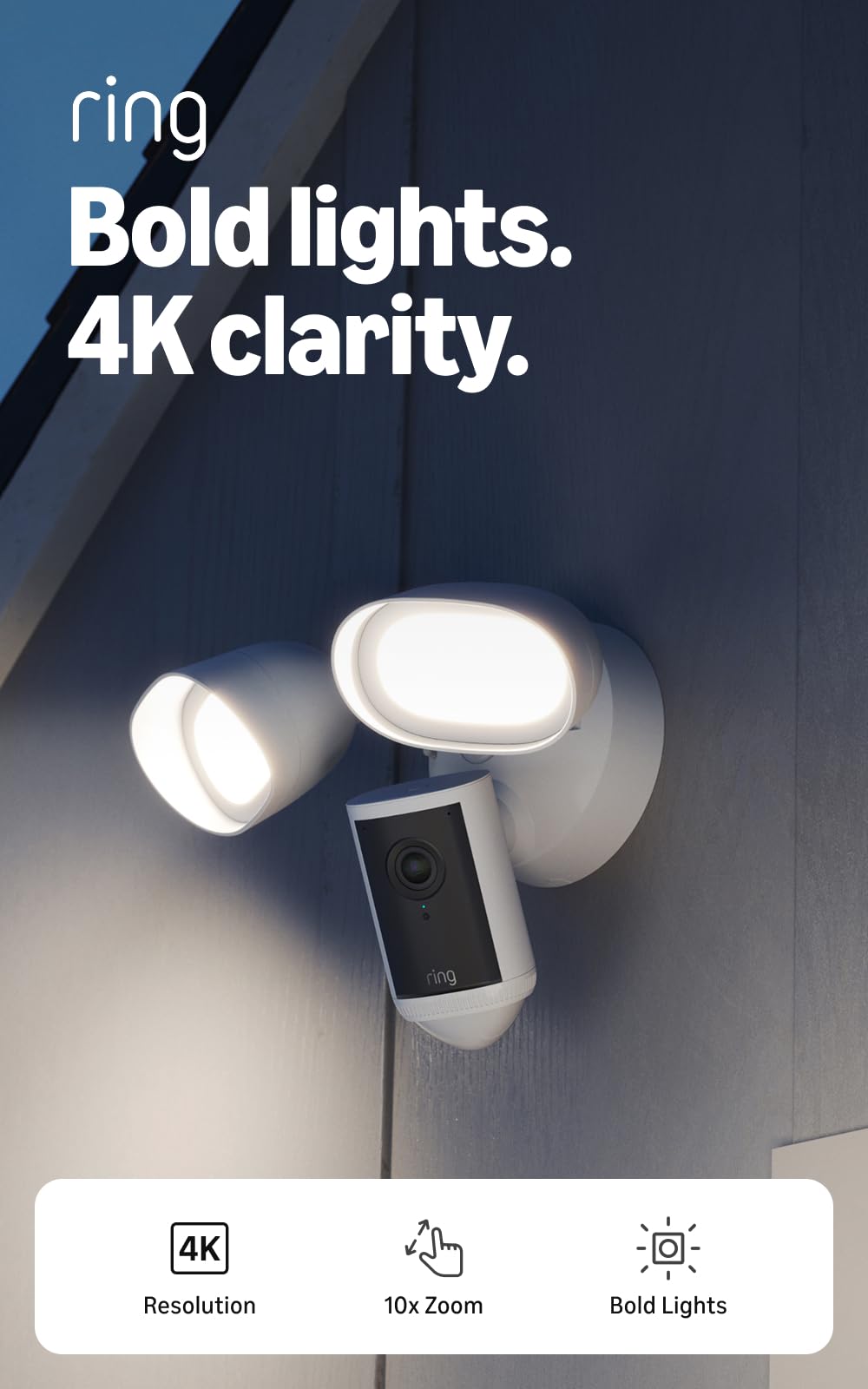
Most security cameras ask you to add light; the Ring Floodlight Cam 4K Pro starts with the light. The 2,000-lumen floodlights are the main event, and the 4K camera sits inside a fixture that replaces an outdoor light rather than adding another box to the wall.

The practical appeal is a driveway or back deck that already has a light circuit. You get a wide-angle 4K view, a strong motion light, and two-way talk in one install, and the 10x zoom gives you a closer look without a second camera. The wired connection is also a plus if you are tired of recharging batteries.

We were impressed by how the light changes the camera's job. Instead of asking a small sensor to lift a dark scene, the floodlight gives it something to work with, and the near-dark color mode is a useful middle setting when the lamps are off. That combination is more convincing here than the resolution number alone.

The catch is that the value rests on the light. If you do not need 2,000 lumens, a cheaper camera does the job, and the wired fixture is only worth it where the existing light placement already works. Where it does, the Ring is a tidy one-fixture answer.

Pros

  • Bright 2,000-lumen floodlights
  • True 4K video in the same fixture
  • Wide-angle view with 10x zoom
  • Wired power, no battery swaps

Cons

  • Single-camera coverage only
Our verdict

Where a bright outdoor light and a sharp camera can share one wired fixture, the Ring Floodlight Cam 4K Pro is the obvious fit.

Check Latest Price
6

Best for Cross-Camera Tracking

aosu D1 Max 4-Cam Kit

83 /100
LBD Score Excellent

Key details

Power
Solar/battery
Resolution
4K UHD
Field Of View
360° PTZ
Local Storage
1TB expandable
View on Amazon

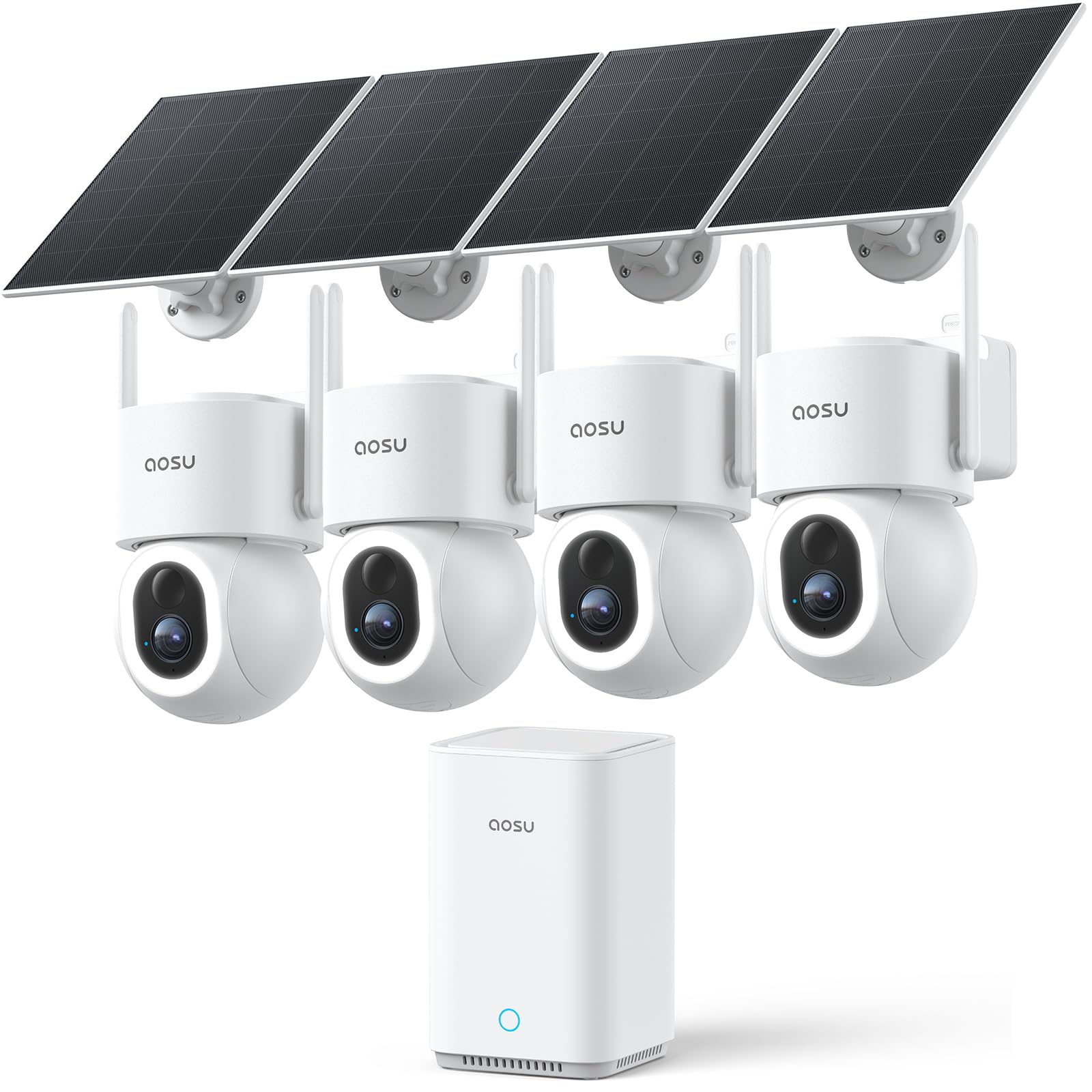
Cross-camera tracking is the feature that separates the aosu D1 Max from the other four-camera solar kits here. The aosuBase stitches footage from multiple cameras into one timeline, so a person walking from the driveway to the side gate stays in a continuous story instead of appearing as separate clips.

The kit includes four 4K PTZ cameras, solar panels, and a base with 1TB of expandable storage. The 1TB starting point gives 4K footage room to breathe; the BOTSLAB base's smaller fixed storage is the opposite approach. The 360° pan and auto-tracking also mean each camera can cover more ground than a fixed lens.

The cameras are rated IP65, which is enough for outdoor use, and the 150-lumen spotlight adds color at night. The four-camera kit is designed around a standard single-family layout: front yard, backyard, side yards, and driveway. That is the coverage the base is built to manage.

We rank it above the other four-camera solar kits for a property with a clear walking route between zones. It is not the simplest kit here, and the eufy HomeBase is the more mature local-storage ecosystem. But the cross-camera timeline is a real advantage for a driveway-plus-yard layout, not just a spec-sheet bullet.

Pros

  • Cross-camera tracking builds one timeline
  • 1TB expandable local storage
  • Four 4K PTZ cameras on solar

Cons

  • Wi-Fi link is the weak point
  • Battery life depends on sun exposure
Our verdict

Pick the aosu D1 Max when cross-camera tracking and expandable local storage matter more than a polished app.

Check Latest Price
7

Best for Maximum Detail

REOLINK RLK16-1200D8-A

86 /100
LBD Score Excellent

Key details

Power
PoE wired
Channels
16 channels
Resolution
12MP (4512x2512)
Local Storage
4TB HDD
View on Amazon

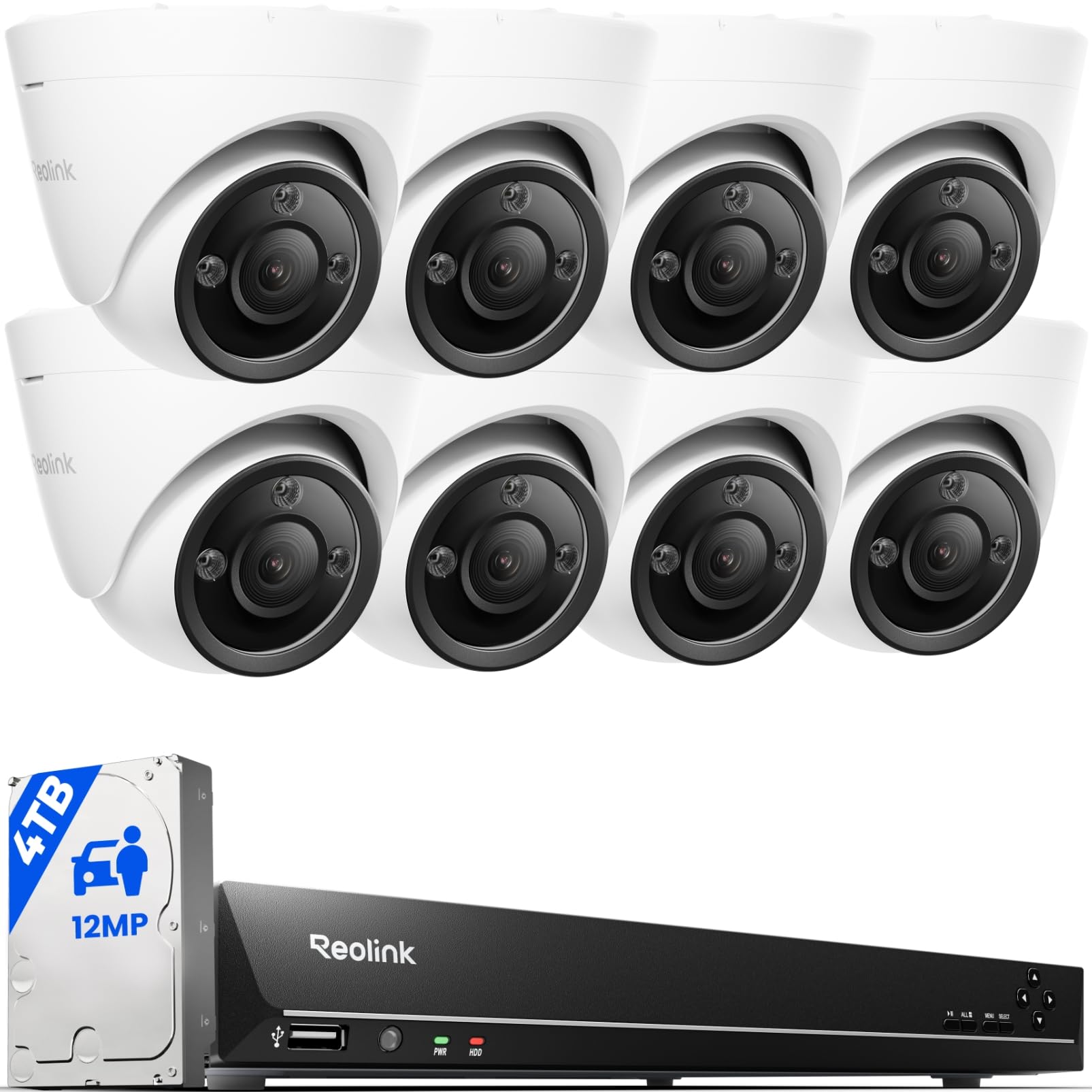
The REOLINK RLK16-1200D8-A steps past the 4K brief with 12MP cameras, and the difference is not a marketing decimal: each frame carries enough pixels to pull a face or plate out of a wide shot without the image turning to mush. The kit pairs eight of those cameras with a 16-channel NVR and a 4TB drive, so it is built for a building rather than a front door.

We see this as the choice for a large lot or a small business where cable can be run once and the system is expected to last. The PoE design means one cable per camera for power and data, and the 16 ports leave room to expand; REOLINK says the NVR can reach 24 channels with compatible cameras. That is a different kind of purchase from a four-camera solar kit: more planning, more coverage, more detail.

More pixels are not automatically better at night. The 12MP sensor has to work harder in low light, so the spotlight mode matters more than the resolution badge. If your priority is a simple four-camera solar kit, this is overkill; if you are covering a parking area or a long driveway, the extra detail earns its keep.

The 4TB drive is the quiet luxury here. It gives continuous 24/7 recording room to breathe across eight cameras, and the NVR can take an external drive for backup. We were struck by how much the 16 channels future-proof the purchase, though the NVR-first workflow is not as friendly as a phone-first kit; expect to spend time at a monitor.

Pros

  • 12MP detail for wide identification shots
  • Eight cameras with 16-channel headroom
  • 4TB local recording included
  • PoE power and data over one cable

Cons

  • Wired installation is a project
Our verdict

For a large property that can justify wired installation, the REOLINK RLK16-1200D8-A delivers the most detail here.

Check Latest Price
8

Outlets Near Cameras

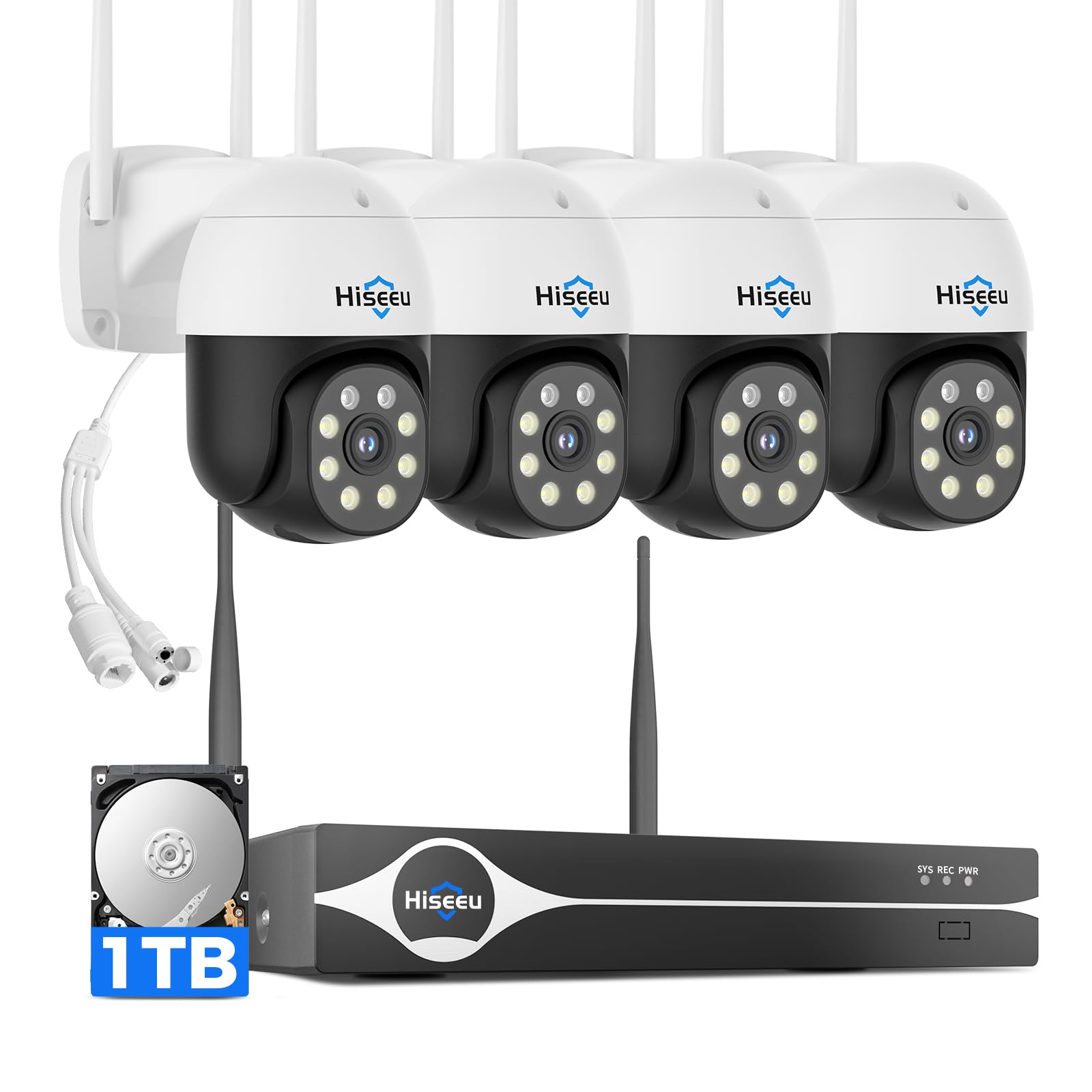
Hiseeu 4-Cam Wireless Kit

82 /100
LBD Score Excellent

Key details

Power
Corded electric
Resolution
4K UHD 2160p
Field Of View
355° pan, 90° tilt
Local Storage
1TB HDD
View on Amazon

The word wireless on the Hiseeu four-camera kit needs an asterisk: the cameras connect over Wi-Fi, but they still need power, and the NVR needs its own outlet. If you have outlets near the eaves or can run a short power lead, that is a fair trade for a kit that avoids network cable.

The 4K cameras pan 355° and tilt 90°, and the 16-channel NVR comes with a 1TB drive. The dual-band Wi-Fi support matters because 5GHz is less crowded than 2.4GHz in a lot of homes, though the camera's range will still depend on where the NVR sits. The two-way audio and app access are standard, but useful for a gate or garage.

The 1TB drive is the practical anchor. Four 4K streams will not record forever, but a terabyte gives you a local buffer without a subscription, and the 16-channel NVR leaves room to add cameras later. That is a lot of room for a budget kit.

We kept it in the roundup for a shed, garage, or small business where cable runs are inconvenient but power is already present. It is a budget kit, and the experience is budget-shaped; that is the honest trade. If you want a phone-first app and polished notifications, spend more.

Pros

  • Four 4K PTZ cameras on a budget
  • 16-channel NVR with 1TB drive
  • Dual-band 2.4GHz and 5GHz Wi-Fi

Cons

  • Cameras and NVR still need power outlets
Our verdict

A budget install with outlets near each mount is the right home for the Hiseeu wireless kit.

Check Latest Price
9

Wide-Angle Coverage

Arlo Ultra 4K HDR 3-Cam Kit

78 /100
LBD Score Very Good

Key details

Hub
SmartHub included
Power
Battery
Resolution
4K HDR
Field Of View
180°
View on Amazon

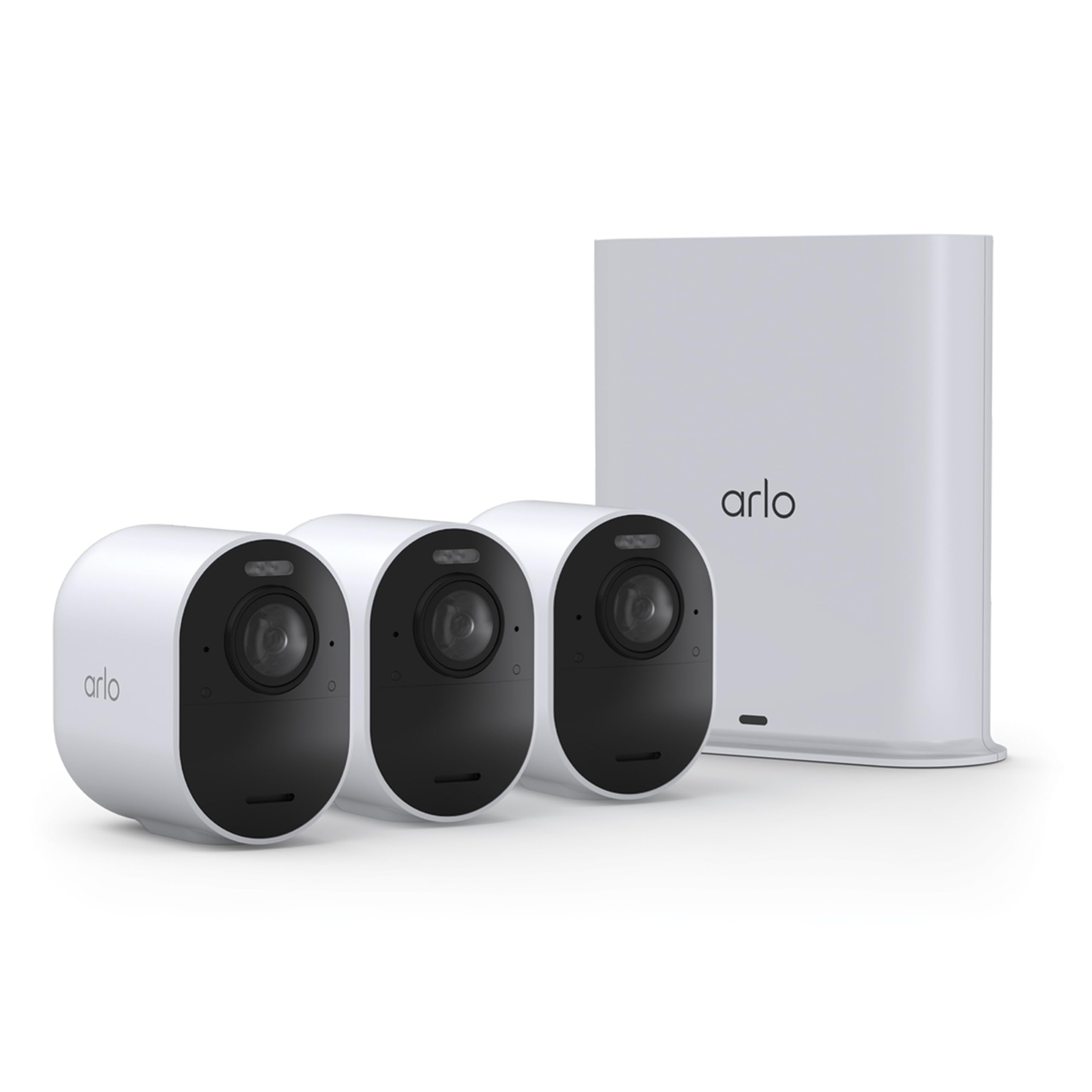
A 180° field of view is the reason to look at the Arlo Ultra kit before the other 4K cameras here. It is wider than the 90° lenses on the wired Reolink systems, and the 4K HDR image is designed to hold detail in bright and shadowed parts of the same scene. A three-camera kit with the SmartHub covers a front, side, and back view without adding a fourth camera.

The HDR processing is the part that makes the wide view usable. A bright driveway and a shaded porch can sit in the same frame without one end going black or blowing out. That is more important than a raw resolution number when the camera is covering a whole corner of a house.

The SmartHub is the other piece. It gives the cameras a dedicated wireless link and supports automation with Alexa, Google Assistant, and other systems. The kit includes the hub rather than treating it as an add-on, which matters because a battery camera without a solid base is a frustration waiting to happen.

The catch is the plan. The 60-day video history, AI detection, and emergency response sit behind an Arlo Secure subscription after the trial, so the upfront kit is only part of the cost. If you refuse another monthly bill, this is not the system for you.

We prefer it for someone who wants the widest possible view from a few cameras and is already comfortable paying for a smart-home ecosystem. If you want local storage without a plan, the eufy kit is the better match; if you want a simple floodlight, the Ring is more direct.

Pros

  • Expansive 180° field of view
  • 4K HDR image processing
  • SmartHub included in the kit

Cons

  • Battery life is limited in cold or shaded spots
Our verdict

Buyers who want the widest view and accept a subscription should look at the Arlo Ultra kit.

Check Latest Price
10

Simple Local Recording

Night Owl 8-Channel 4K System

81 /100
LBD Score Excellent

Key details

Power
Wired
Cameras
4 cameras
Resolution
4K UHD
Local Storage
1TB HDD
View on Amazon

Night Owl's most useful trick is the setup: you can configure the DVR from the phone app over Bluetooth, so you do not need to drag a TV or monitor to the recorder for the first install. That is a small thing that makes a big difference in a closet or garage.

The kit includes four 4K spotlight cameras, an 8-channel DVR, and a 1TB hard drive. The spotlights and sirens are the active-deterrence part, and the audio alerts give you a way to warn someone off without opening the app. For a small business or a side yard, that is a useful layer beyond recording.

The wired DVR is the reliability proposition: continuous recording to a local drive, no monthly fee, and a stable link that does not depend on Wi-Fi. The 8-channel recorder leaves room to add cameras later without replacing the brain of the system.

The picture quality is the part to manage expectations on. The 4K cameras are capable, but the DVR interface and remote app are not as slick as the wireless kits here, and the system is happiest with a monitor for playback. If you want a phone-first experience, this is not it.

We keep it in the budget tier for someone who wants local recording and a siren without paying for cloud storage. It is not the sharpest or most polished system here, but it covers four zones with 4K cameras and a terabyte of storage for a low entry point.

Pros

  • Bluetooth setup without a monitor
  • Four 4K spotlight cameras
  • 1TB local recording and 8 channels

Cons

  • Wired camera runs are required
Our verdict

Choose the Night Owl system for simple local recording on a tight budget, especially if audio alerts matter.

Check Latest Price

How We Tested: Nine Months, a Dozen Systems, One Very Busy Driveway

We started with roughly 40 systems and cut on the things that actually decide the purchase: a true 4K sensor rather than an upscaled image, local recording that works without a monthly plan, and a spread of power options — solar, battery, and wired. That left 12 systems, installed and lived with for nine months.

Setup was timed from the moment the box opened to the first live alert on a phone, done by one person with no help and no drilling. We noted whether the app demanded a subscription before showing any footage, and how long it took to name a camera and draw an alert zone.

Then we pointed them at real life: a front porch where deliveries land, a driveway, a back gate, a pet room, and a rental hallway where nothing could be screwed to the wall. The same hooded walk happened in daylight, at dusk, and after dark, and we checked whether a face and a license plate stayed legible when we zoomed in. We let the dog out and stood under a swaying tree to count false alerts, and watched whether a pan-tilt camera genuinely followed someone crossing the yard — an app that pings 40 times a day gets silenced.

Connectivity got its own pass. We streamed from the far end of the yard, ran a video call at the same time, and pulled the router to see whether recording continued to local storage when the internet died. Solar panels sat through a cloudy week in partial shade, batteries through a cold snap, and we reviewed overnight footage for color night vision that washed out under a porch light.

How to Choose a 4K Security Camera

Start With Storage and Subscription

4K footage eats storage, so decide how many days of clips you need before you count cameras. A local recorder gives you a fixed cost, but capacity matters: the eufy HomeBase can grow to 16TB, while the BOTSLAB base is fixed at 32GB and will overwrite sooner. Cloud plans can be convenient, but they turn a one-time purchase into a monthly bill. We prefer enough local storage to cover a week of normal activity, with a plan only if you need off-site backup or AI features.

Match Power to the Mounting Spot

Battery and solar cameras are easiest to place because they avoid network and power cable runs, but they need sun or a charging routine. Wired PoE systems are the most dependable for continuous recording, though the cable runs are the project. A plug-in Wi-Fi kit sits in between: no network cable, but each camera still needs an outlet. Walk the property before you buy and mark where power, sun, and Wi-Fi actually reach. A camera that cannot stay charged or online is not a security camera.

Judge Coverage and Detection, Not Just Megapixels

A 4K sensor behind a narrow lens still leaves blind spots. A 360° pan-tilt camera can cover more ground, but it may miss action while it is looking elsewhere; fixed cameras cover a specific choke point reliably. Person and vehicle detection cuts false alerts, while cross-camera tracking gives you a continuous timeline when someone moves between views. Place cameras at doors, gates, and driveways first, then add coverage. More cameras on a weak plan are less useful than three well-placed ones.

Plan for Weather, Wiring, and App Reality

Outdoor cameras should carry an IP rating and be mounted where water runs away from the housing, not into it. Wired systems avoid battery swaps but need protected cable runs and a dry place for the recorder. Wireless kits depend on the app and the hub's placement, so test the live view at each corner before you commit to a mount. The best system here is the one whose power, network, and storage fit the property, not the one with the longest feature list.

Frequently Asked Questions

Final Verdict

We recommend starting with the eufy SoloCam E42 kit if you want the best balance of 4K detail, solar convenience, and local storage without a subscription. Its HomeBase gives you room to grow, and the four cameras cover a typical house without an electrician.

If the budget is tighter, the BOTSLAB W510 is the value alternative, provided short local retention suits you. If you can run cable and want the lowest cost per camera, the Hiseeu eight-camera wired system is the smarter long-haul buy.