Best 3D Printer Filament of 2026

There's a particular kind of heartbreak in 3D printing that happens at hour eleven of a fourteen-hour job: the extruder starts clicking, the layers go stringy, and you're left with a half-finished part and a spool you no longer trust. Filament is the cheapest thing you buy for this hobby and the thing most likely to eat a weekend. Tangles that yank the nozzle off course, a diameter that wanders, a first layer that lifts at one corner, plastic that has quietly absorbed enough moisture to print like seltzer — the failure modes are few, but they all cost you time you can't get back.

I've spent the last four months running 18 spools through three printers — an open-frame bedslinger in the garage, an enclosed machine, and a small printer that lives on the kitchen counter — and the differences are obvious within a single print. One thing a first-timer won't know: the color you actually want often only exists in a bundle, which means committing to four kilos of something you've never printed with. Buy a 250-gram spool first when you can.

The other thing worth knowing is that a spool left open on the shelf for three weeks is not the same product as the one that came out of the vacuum bag. The picks below are the ones that held up to that reality.

1

Best Overall

ELEGOO PLA 4kg Bundle

93 /100
LBD Score Outstanding

Key details

Colors
Black, white, dark blue, true red
Spools
4 × 1 kg
Material
PLA
Diameter Tolerance
±0.02 mm
View on Amazon

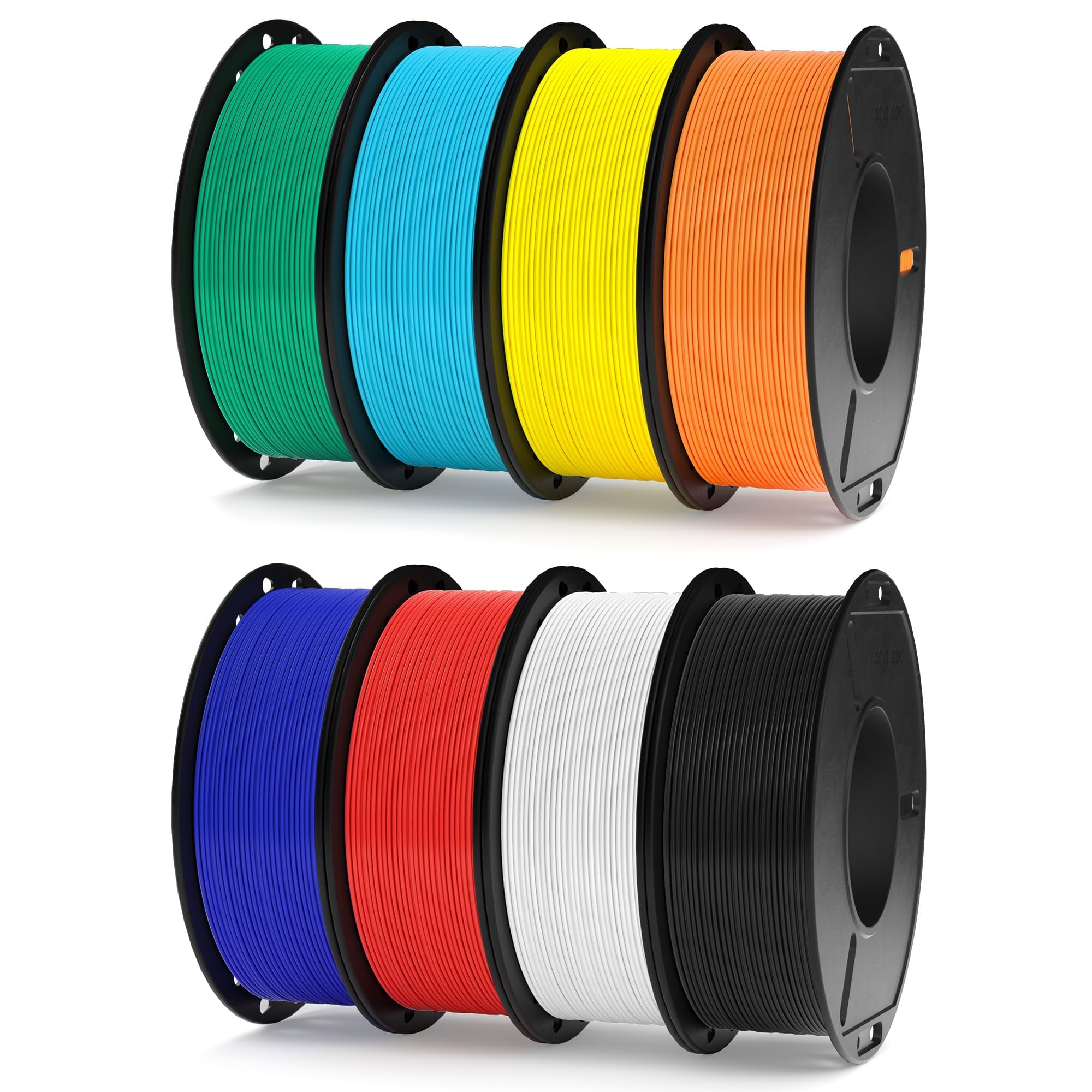
Black, white, dark blue and true red are the four colors a printer actually burns through: black and white for brackets, jigs and anything that has to blend in, blue and red for the parts you hand to someone. Getting all four in one box, a kilo each, is most of why this bundle sits at the top of our list. The rest is the ±0.02 mm diameter tolerance, which is the figure that keeps extrusion even from spool to spool and printer to printer.

Ours came out of the vacuum bags ready to print — every spool is sealed with desiccant, so there's no drying session before the first job. Through a run of long prints the feed stayed even, layer lines came out clean, and the black is properly matte rather than glossy. The white is the one to know about: it prints warm, closer to light cream than paper white, which matters if a part has to sit beside something genuinely white.

Winding is the thing to watch, and it's the same story across the budget spools here. A roll wound with a crossover will pull tight somewhere in the second hour and bury the strand under itself, which costs you the print rather than the spool. Watch the first stretch of any long job, and if the line starts to dig in, cut it, re-spool the remainder and start again — five minutes against an afternoon.

Where this bundle earns its keep is the boring middle of the hobby: boxes, brackets, replacement knobs, the fourth version of a phone stand. Four kilos covers a lot of that before restocking enters your head. If your printing leans structural instead, the SUNLU PLA+ 2.0 four-pack is the tougher formulation in much the same shape, and it comes in black only.

Pros

  • Four core colors in one order
  • Tight ±0.02 mm diameter tolerance
  • Vacuum sealed with desiccant, ready to print
  • Lowest cost per kilo of the PLA picks here

Cons

  • White prints closer to cream than pure white
  • Can arrive brittle on some spools
Our verdict

Four workhorse colors at the lowest cost per kilo of any PLA here — this is the bundle we tell most people to start with, and the one that stays loaded.

Check Latest Price
2

Best Budget

SUNLU PLA 1kg Black

91 /100
LBD Score Outstanding

Key details

Material
PLA
Spool Weight
2.2 lb
Diameter Tolerance
±0.02 mm
Nozzle Temperature
200–230 °C
View on Amazon

Every printer ends up with a black spool parked on it, and this is the cheapest way to keep one there. One kilo, 1.75 mm, ±0.02 mm, on a spool measuring 8 inches across with a 2.2-inch hub — those are the numbers that decide whether it drops straight onto your holder or needs an adapter.

The recommended window is 200–230 °C at the nozzle and 50–65 °C on the bed, wide enough to be forgiving on a machine you haven't dialled in yet. Ours printed cleanly near the low end of that range on glass. Plain PLA is also the least heat-tolerant material in this guide: a bracket that lives on a dashboard will sag, and no amount of tuning changes that.

For drafts, jigs and the fourteenth iteration of a bracket, we reach for this spool without thinking about it. A failed print costs a few grams of material rather than an afternoon and half a spool of something precious. What you give up is choice — black, plain PLA, one kilo at a time — and the winding isn't always perfect, so a roll that starts to bind is worth re-spooling before a long job rather than during one.

Against the four-kilo ELEGOO bundle you pay more per kilo for the freedom to buy a single color; against everything else in this guide, you risk the least money on a material you might not get along with.

Pros

  • Lowest entry cost of any spool here
  • Forgiving 200–230 °C nozzle window
  • Standard spool fits common holders
  • Reliable for drafts and workshop jigs

Cons

  • Plain PLA softens in a hot car
Our verdict

If you want a single spool to learn on, this is the one: the cheapest kilo here, and the roll we keep on the machine for drafts.

Check Latest Price
3

Best for Long Prints

SUNLU PLA+ 2.0 4-Pack

91 /100
LBD Score Outstanding

Key details

Spools
4 × 1 kg
Material
PLA+ 2.0
Rated Print Speed
300 mm/s
Diameter Tolerance
±0.02 mm
View on Amazon

Three hundred millimeters per second is the number on the box, and the honest read is that your printer has as much to do with hitting it as the filament does. What the claim tells you is that this is a formulation built for speed: it melts faster and flows more freely than standard PLA. If your printing is mostly one color and mostly long jobs, this is the four-pack we leave loaded on the machine that runs overnight.

The PLA+ 2.0 part is the real pitch. Standard PLA is stiff and, on a bad spool, brittle; this version is formulated to resist cracking so a part takes a knock without shattering. Ours printed with clean surface quality and a black that reads deep rather than washed out. Diameter holds ±0.02 mm, and the spools are rigid plastic instead of cardboard — a small detail that matters in a multi-spool feeder, where a soft spool can wobble and snag.

Four kilos of one color is the catch, and it's a real one. This is a bundle for someone who has settled on black: fixtures, enclosures, production runs. It's also a bundle built for long jobs, which is exactly when bad winding hurts — a crossover that binds mid-print wastes every layer you'd already laid down. Watch the first layer go down properly before you walk away.

The toughness claim is worth checking on your own parts rather than taking on faith: print a thin bracket, flex it, and see whether the corner whitens before you commit four kilos to anything structural.

Pros

  • Tougher PLA+ that resists cracking
  • Rated for 300 mm/s printing
  • Rigid plastic spools feed evenly
  • Consistent ±0.02 mm diameter

Cons

  • Sold as four kilos of a single color
Our verdict

Settle on black before you buy — but if you have, this tougher PLA+ four-pack is the one we leave running overnight.

Check Latest Price
4

Best PETG Bundle

ANYCUBIC PETG 10kg Bundle

91 /100
LBD Score Outstanding

Key details

Colors
10 colors
Spools
10 × 1 kg
Diameter
1.75 mm
Material
PETG
View on Amazon

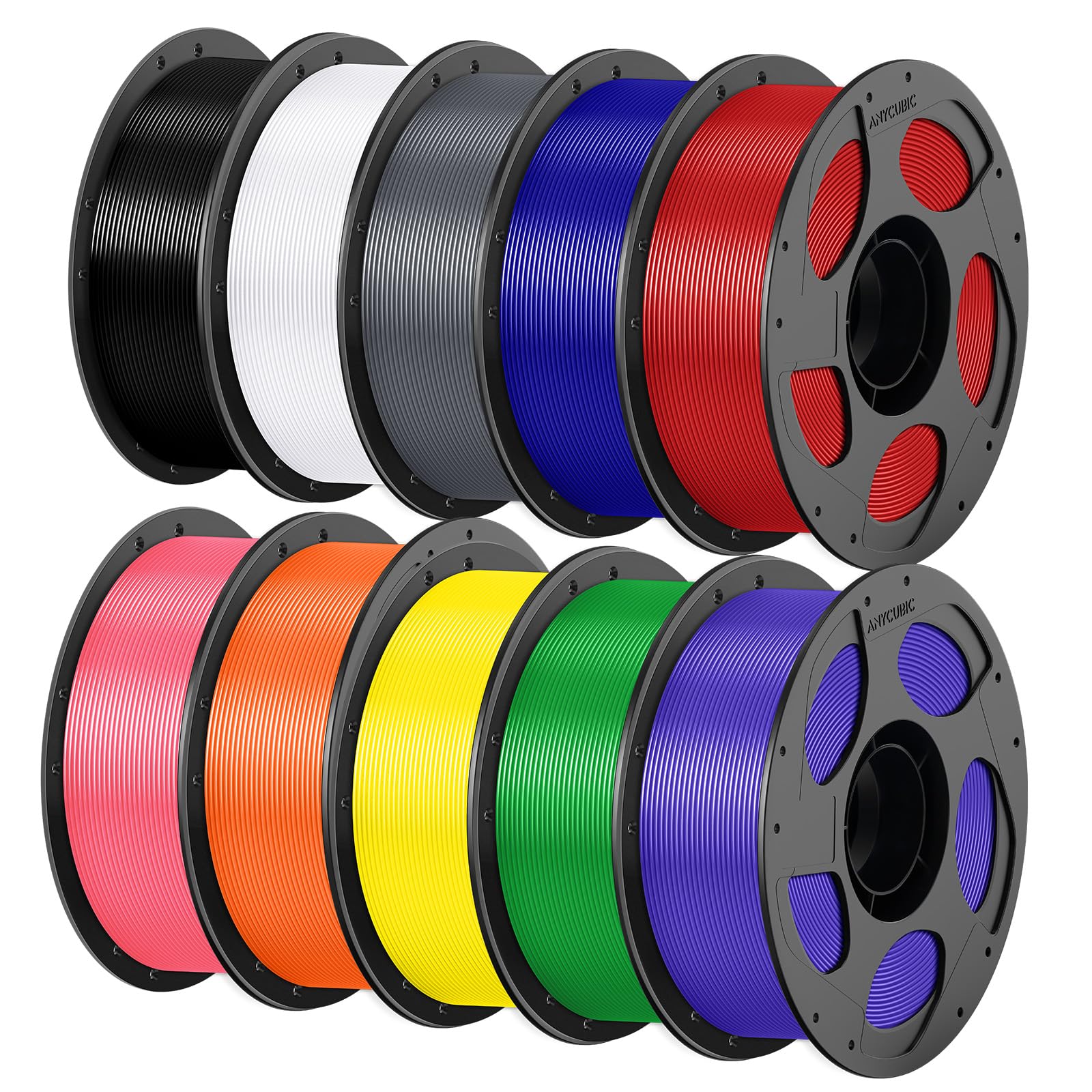
Ten kilos is a commitment, not a purchase. If PETG is already your material — the brackets that live outdoors, the parts that take a knock, the jigs that sit in a cold garage — a ten-spool set in ten colors answers most of the next year's printing in one order. PETG earns that loyalty: tougher than PLA, resistant to water and most chemicals, and stable where PLA would soften.

We think it's the right buy for a workshop already printing PETG and the wrong first purchase for everyone else, because PETG asks more of you: a slower first layer, a dry spool, and stringing that has to be tuned out rather than tolerated. Get the profile dialled in and it's the toughest material in this guide by a distance, and the only PETG set here.

The colors need an expectation reset. Purple and pink come out much paler than the product photos, closer to tinted clear than the saturated shades shown; black and white are solid, and the gloss is genuinely glossy. Ten kilos also means ten kilos of moisture risk — PETG picks up water faster than PLA, and a damp spool prints with pops and whiskers that no retraction setting will fix. Dry each spool before its first job and keep the rest sealed.

Start with black and white, keep the loud colors for parts that get looked at, and treat the reusable spools as a small bonus rather than a reason to buy.

Pros

  • Tough, water- and chemical-resistant PETG
  • Ten colors across ten kilos
  • Glossy finish straight off the plate
  • Reusable spools

Cons

  • Some colors print paler than the photos
  • A large outlay in a single material
Our verdict

Buy this if PETG is already your material and you want the whole palette in one order; start smaller if you're still tuning it.

Check Latest Price
5

Best Color Sampler

ELEGOO PLA+ 8-Color Pack

88 /100
LBD Score Excellent

Key details

Colors
8 colors
Spools
8 × 250 g
Material
PLA+
Diameter Tolerance
±0.02 mm
View on Amazon

Eight colors for the material of two: that's the trade a small spool makes. A 250 g roll carries a quarter of a standard spool, enough for a run of small models or one larger piece without committing a kilo to a color you'll use once. For anyone printing keycaps, miniatures or color-swapped parts, that's the difference between having a palette and having a shelf of half-empty black.

The material is ELEGOO's PLA+, the tougher formulation, with better impact strength than plain PLA — which is why these spools suit articulated models, clips and anything with a thin wall. Diameter holds ±0.02 mm, so one profile covers all eight, and each spool is vacuum sealed, so an unopened color keeps until the project that needs it turns up.

This is the pack we point people toward when their prints are mostly decorative and mostly multicolored, and it's the sensible way to audition a brand before buying kilos of it. What it isn't is a workhorse. Two hundred and fifty grams disappears quickly on a big model, and running out three hours from the end of a print is its own special annoyance — size your largest piece against the smallest spool.

If sixteen colors appeals more than eight, KALIDORA's pack doubles the palette, though you're then buying four kilos of small spools and one of them is PETG, not PLA+.

Pros

  • Eight colors without buying eight kilos
  • Tougher PLA+ formulation
  • One profile covers every spool
  • Individually vacuum sealed

Cons

  • Small spools run out mid-project
  • Costs more per kilo than the bulk bundle
Our verdict

Our pick for multicolor work: eight PLA+ colors in small spools, so a palette costs you two kilos instead of eight.

Check Latest Price
6

Best Silk Finish

ERYONE Silk PLA Liquid Gold

89 /100
LBD Score Excellent

Key details

Material
Silk PLA
Spool Weight
2.2 lb
Diameter Tolerance
±0.03 mm
Nozzle Temperature
190–220 °C
View on Amazon

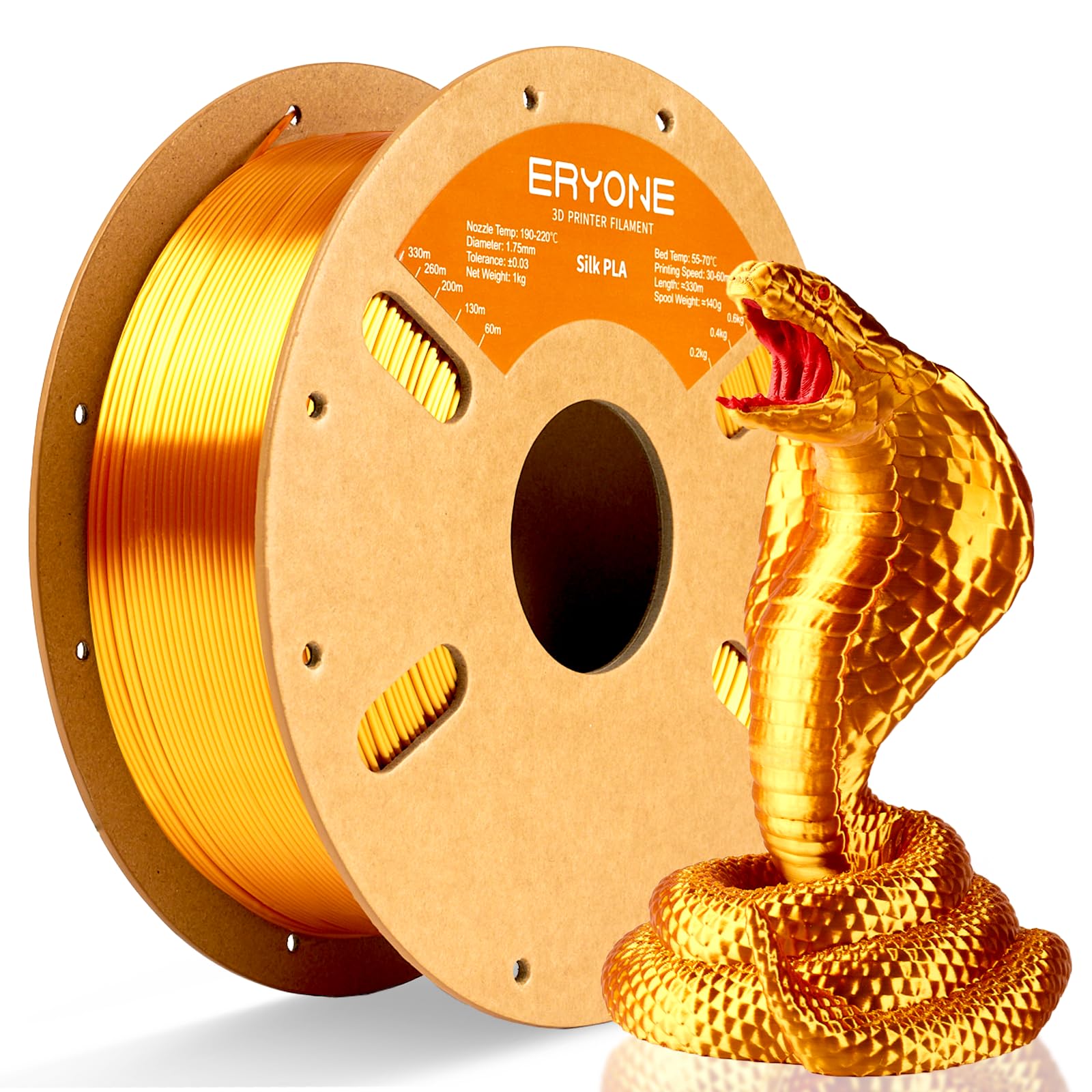
Silk PLA is the one filament where the finish does the selling: the gold comes off the bed with a brushed-metal sheen that sanding and paint won't reproduce, and it softens layer lines in a way ordinary PLA can't. ERYONE's take is the most convincing metallic here — warmer than a true yellow gold, closer to brass in daylight.

Buy it for the print you're giving away rather than the part that has to hold weight. Rated at 190–220 °C with low warp and minimal odor, it printed as smoothly as any silk we've run: no stringing to chase, no lifting at the corners on a textured plate, and a finish that reads as metal from arm's length.

Winding is the thing to watch. Silk is slicker than plain PLA, so a spool with a crossover in it will knot rather than slide free, and one knot turns a long print into a long wait for the failure. Ours needed a hand on the roll through the first few layers before it settled, then fed cleanly to the end. Keep the spool on a holder that turns freely; a tight holder plus slick filament is how knots start.

Pros

  • Convincing brushed-metal finish
  • Hides layer lines better than plain PLA
  • Low warp and minimal odor
  • Prints smoothly out of the sealed bag

Cons

  • Layer bonds weaker than plain PLA
  • ±0.03 mm tolerance is the loosest here
Our verdict

Buy it for the print you're handing to someone — the metallic finish is the whole reason, and it's the most convincing of the metallics here.

Check Latest Price
7

Widest Color Range

KALIDORA PLA+ 16-Pack

81 /100
LBD Score Excellent

Key details

Spools
16 × 250 g
Material
PLA+ with one PETG spool
Total Weight
8.82 lb
Diameter Tolerance
±0.02 mm
View on Amazon

Sixteen colors is twice the palette of the ELEGOO sampler, and every spool comes off a single production batch, so the same color matches from spool to spool. If your printing is mostly multicolor models — keycaps, miniatures, parts that change color mid-layer — that consistency is the entire argument.

The bundle holds ±0.02 mm across the PLA+ spools, and one of the sixteen is a clear PETG roll that doesn't appear in the smaller packs. That one needs its own profile and its own job; it won't share a multi-material print with the PLA+, so treat it as a bonus spool rather than a sixteenth color.

Compact spools are also the catch. A 250 g roll is short and light, and short spools don't sit well in every holder or multi-spool feeder — measure your hub and width before ordering sixteen of them, because a spool that jumps the holder mid-print is a ruined job, not a reprint.

Our read is that this is a palette extender rather than a workhorse. The strand can arrive brittle enough to snap at the feed, and four kilos of small spools is a lot of material to have on hand if the first one disappoints. Use it for models, gifts and small parts, and let a four-kilo bundle carry anything structural.

Pros

  • Sixteen colors in one order
  • Single-batch color matching
  • Tight ±0.02 mm across the set

Cons

  • Compact spools may not suit every holder
  • One spool is PETG, not PLA+
Our verdict

Treat it as a palette extender rather than a bulk buy; sixteen colors off one production batch are the reason to choose it.

Check Latest Price

How We Tested the Best 3D Printer Filament

We built the shortlist from roughly forty spools, then filtered hard: claimed dimensional accuracy, whether the spool was individually vacuum sealed, single spools versus multi-color bundles, sampler sizes versus full kilos, and the three material families most people actually choose between — standard PLA, tougher PLA+, and PETG. We also read through complaints before ordering, which is how tangling and clogging became two of our main things to watch. Eighteen spools made the cut and stayed in rotation for four months.

Every spool printed the same small benchmark model first, then a tall thin print, then a wide flat part that covers most of the bed. I measured diameter with calipers at ten points across each spool — edges, middle, and the last few meters — and unwound a couple of meters by hand to look at how the strands lay. Crossed loops showed up immediately; neatly wound spools fed for hours without the extruder ever tugging.

Adhesion got its own pass: same bed prep, same temperature, and I noted whether the wide part lifted at the corners or held. Small-nozzle detail prints flushed out clogging, and I swapped spools mid-print on purpose to see whether the tail end was taped, kinked, or clean. Halfway through, I left one PLA and one PETG spool out in the summer air for three weeks and reprinted the benchmark — the surface told the story.

For durability I printed snap-fit parts and flexed them until something gave, dropped a bracket onto concrete, and left a finished piece in a hot garage. We also weighed every spool new and again when it ran out, because a bundle is only a value if the net grams are actually there. Silk and white pigments printed differently from black in the same line, which is worth knowing before you judge a whole brand by one color.

How to Choose 3D Printer Filament

Pick the material for the part, not the printer

PLA is the easy one: low odor, low warp, stiff enough for brackets, boxes and display pieces, and it softens in a hot car. PLA+ is the same material formulated to resist cracking, and it's what the SUNLU 2.0 and both ELEGOO picks here run. PETG is the step up for anything outdoors, wet or load-bearing — tougher, chemically resistant, and fussier about speed and moisture.

Buy one material at a time and learn its profile before adding a second. A spool of PETG printed on a PLA profile is the most reliable way to waste an afternoon and conclude, wrongly, that the filament is bad.

Tolerance and winding beat marketing

The figure that matters on the label is diameter tolerance. ±0.02 mm is what the strongest picks here hold; ±0.03 mm, as on the ERYONE silk, is fine for display work but starts to show at fine detail and high speed.

Winding is the invisible one. A spool wound with a crossover will bind somewhere in hour two and take the print with it, and no tolerance figure protects you from that. Watch the first layer of any long job, and if the strand starts burying itself, stop and re-spool the remainder rather than hoping.

Spool size decides how you buy color

A kilo is the working standard: cheap per gram, fits nearly every holder, and takes hours to run out. A 250 g spool is a color decision — enough for models and gifts without committing a kilo to orange.

The trap is fit. Compact spools are short and light, and some holders and multi-spool feeders won't take them, so check hub diameter and spool width before ordering a sixteen-pack of small rolls. Small spools also run out mid-print, so size your biggest piece against the smallest roll you have.

Dry filament prints better than expensive filament

Every spool here ships vacuum sealed with desiccant, and that's worth more than most features on the box — moisture is what makes filament pop, string and delaminate, and PETG picks it up faster than PLA does.

Once a spool is open it starts absorbing again. A sealed box with fresh desiccant covers most homes; a cheap dryer pays for itself the first time it rescues a spool of PETG. If a print starts spitting and crackling, dry the filament before you touch a single other setting.

Do the per-kilo math

Bundles are where the value sits: four kilos of workhorse color costs less per kilo than four single spools, and ten kilos of PETG works out lower again. What you pay extra for in a multicolor pack is choice, not material — the eight- and sixteen-spool packs here cost noticeably more per kilo than the four-kilo bundles, and that's fair, because you're buying a palette rather than a supply.

Decide whether you're shopping for material or for color before you compare anything else, and the shortlist narrows itself.

Frequently Asked Questions

Final Verdict

Our pick is ELEGOO's four-kilo bundle. Four colors cover most of what a printer actually makes, the ±0.02 mm tolerance holds across all of them, and nothing else here beats it on cost per kilo in PLA. Start there unless you have a specific reason not to.

If you want a single spool on the machine, SUNLU's black kilo is the cheapest way to keep printing. And if the parts you're making live outdoors or take a knock, skip PLA entirely — ANYCUBIC's ten-kilo PETG set is the tougher buy, as long as you're ready to dry it and slow the first layer down.