Best 360 Cameras of 2026

A 360 camera records every direction at once and lets you pick the frame later — which sounds like a gimmick until a dog runs out in front of your bike and you realize you caught all of it without aiming. The right one turns that footage into a clip you'll actually post; the wrong one leaves a folder of files you never open.

I've been strapping action cameras to helmets for years, and I've deleted far more footage than I've kept. My team and I spent eight months shooting with six 360 cameras — a winter of ski days, a wet spring of bike commutes, one afternoon in a pool — to find the ones worth carrying. Two things mattered more than the spec sheet: whether the invisible selfie stick actually disappears, and whether a scuffed lens can be swapped.

What nobody tells a first-time buyer is that the resolution badge lies a little — a larger sensor does more for a dim chairlift than another few million pixels. Below are the cameras that held up on the mountain, on the commute, and at the desk afterward.

1

Best Overall

Insta360 X5

93 /100
LBD Score Outstanding

Key details

Sensors
Dual 1/1.28"
360 Video
8K30
Battery Life
208 minutes
Water Resistance
Waterproof
View on Amazon

Insta360 rates the X5's battery at 208 minutes, which is the longest figure on this page, and that is the number that made it our default. A 360 camera is only worth carrying if it's still recording when the light turns good, and this is the one here we stopped thinking about mid-shoot. Behind that runtime sits 8K30 spherical video from two 1/1.28-inch sensors, the largest pair here after the Osmo 360's.

Resolution does more work in 360 than anywhere else. You aren't framing a shot, you're recording everything and cropping a flat clip out of the sphere later, so every reframe throws pixels away. From 8K there's room to push in on a rider's helmet and still land something usable; from 5.7K the same crop goes soft. FlowState stabilization and full 360-degree horizon lock handle the rest, which is why footage off a bouncing handlebar mount still comes out level.

The lenses are what we worry about on any camera like this, because they sit proud of the body and take every knock going. Here they're replaceable, so a scratch costs you an accessory rather than the whole camera, and after a week of rocky trails and a crowded camera bag that's the spec we came to value most. InstaFrame adds a flat, ready-to-post video straight out of the camera on days you don't want to reframe anything.

If your footage mostly becomes 1080p social clips shot in daylight, the X3 gets you most of the way and leaves money for batteries. Cold weather and 8K recording both pull that rated runtime down, so budget for a second battery if you're shooting all day. Put the lens caps on a lanyard while you're at it; they're small enough to vanish in a jacket pocket.

Pros

  • Rated 208-minute battery, the longest here
  • 8K30 spherical from dual 1/1.28-inch sensors
  • Replaceable lenses soften the cost of a scratch
  • Waterproof with FlowState and horizon lock

Cons

  • Most expensive pick in this group
  • 8K files need fast, roomy cards
Our verdict

The 360 camera we recommend to most people: 8K30 footage, the longest rated battery here, replaceable lenses and waterproofing that means you don't plan the day around the weather.
Check Latest Price
2

Best in Low Light

DJI Osmo 360

87 /100
LBD Score Excellent

Key details

Weight
6.46 oz
Sensors
1-inch
360 Video
8K30
Water Resistance
Waterproof
View on Amazon

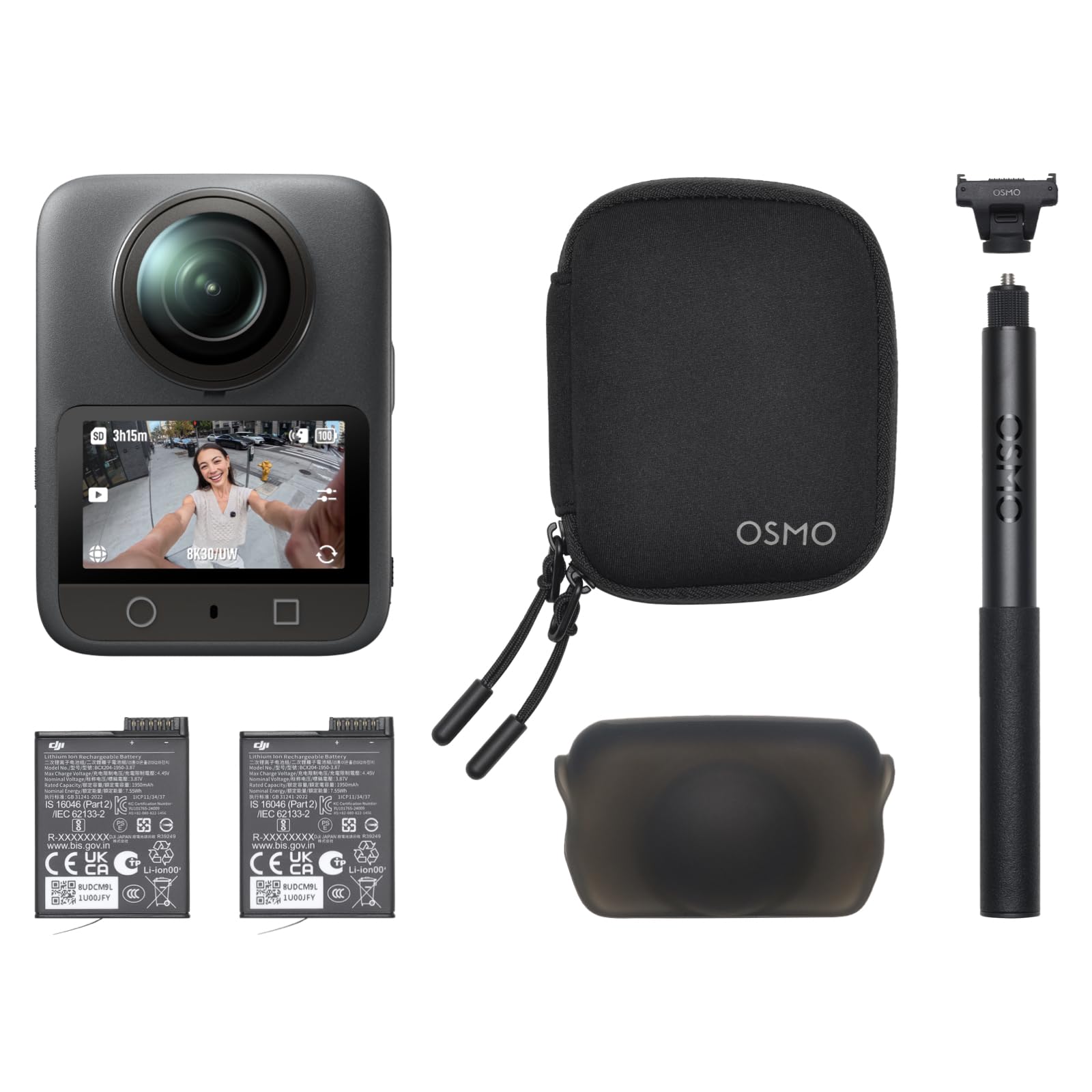
The Osmo 360 is the only camera here with a pair of 1-inch sensors, and that is the whole case for it. A bigger sensor gathers more light, so the advantage lands exactly where 360 cameras usually fall apart: city streets after dark, a dusk ride home, a dim room. It records 8K30 spherical video and 120MP 360 photos, and its boost mode shoots 4K at 120fps in a wide flat frame.

We think it's the one to pack when the day runs into the evening. At 183 g it's one of the lightest bodies here, which matters when it's hanging off a backpack strap, and the magnetic quick release swaps it between the included 1.2 m selfie stick and a standard mount in about a second. Footage comes back crisp and vivid, the sort of result that makes a phone edit look more expensive than it was.

The software is where it gives ground. Reframing and trimming in DJI's app takes longer to learn than Insta360's workflow, and the desktop studio is the tool you end up needing for anything longer than a couple of minutes. Give yourself an evening with it before a trip rather than an hour before you leave. Beyond that, the kit is complete enough to shoot the day you open the box, selfie stick and battery included.

Pros

  • 1-inch sensors, the largest in this group
  • 8K30 spherical plus 4K120 boost video
  • 183 g body with a magnetic quick release
  • Invisible selfie stick included in the combo

Cons

No notable drawbacks to flag.

Our verdict

Buy the Osmo 360 if you shoot at dusk and after dark: its 1-inch sensors are the largest here, and it's the lightest 8K camera in this group.

Check Latest Price
3

Best Value

Insta360 X3

93 /100
LBD Score Outstanding

Key details

Weight
7.05 oz
360 Video
5.7K
Water Resistance
Waterproof
Single-lens Video
4K30
View on Amazon

The X3 is the value play, and after shooting both we think the experience gap between it and the 8K flagship is narrower than the price gap. It records 5.7K 360 with Active HDR and 4K30 through a single lens, and it uses the same reframing app, the same invisible selfie stick effect, and the same FlowState stabilization with horizon lock as the camera at the top of this list.

That workflow is the reason to pick it. The 2.29-inch touchscreen is big enough to change settings without reaching for your phone, the single-lens mode turns it into a conventional action camera at 4K30, or 2.7K60 with the 170-degree MaxView field, and the app does the reframing in the phone already in your pocket. A day out doesn't have to be all sphere all the time.

Two things to know before you buy. Water is where this model is least forgiving: it's rated waterproof, but the lens covers and the battery door seal are the parts to check and dry before every dip. And stills top out at 16MP, well behind the DJI's 120MP, so treat it as a video camera that happens to take snapshots.

Pros

  • 5.7K 360 for far less than the 8K picks
  • Waterproof with stabilization and horizon lock
  • Single-lens 4K30 mode doubles as an action cam
  • Free, intuitive editing app

Cons

  • 5.7K leaves less room for tight reframes
Our verdict

The best value in 360: 5.7K footage, a waterproof body, and the same reframing workflow as the flagship for a fraction of the cost.

Check Latest Price
4

Best for First-Timers

AKASO 360

86 /100
LBD Score Excellent

Key details

Sensors
Dual 1/2" 48MP
360 Video
5.7K
Battery Life
2 hours
Water Resistance
Water resistant
View on Amazon

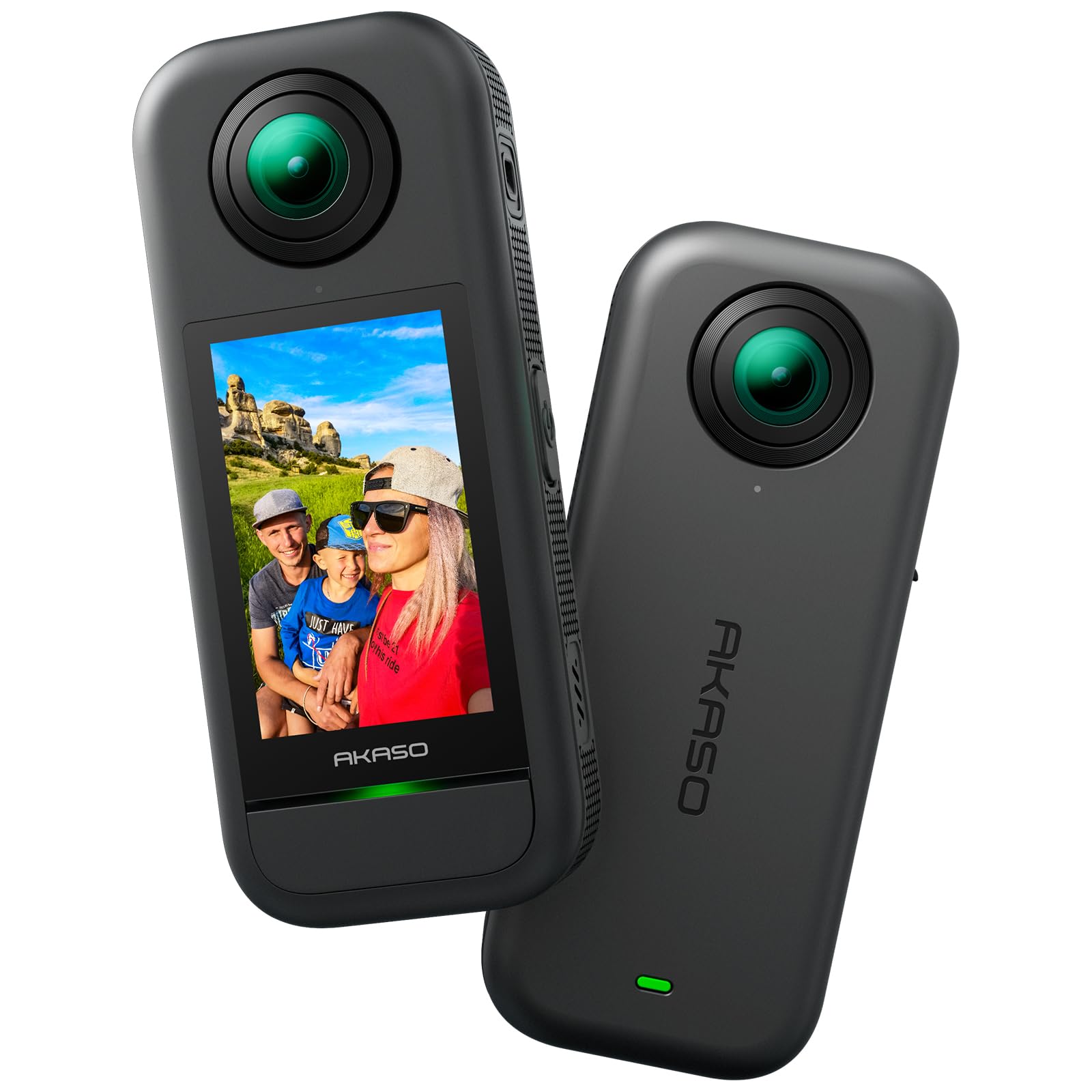
Two batteries in the box sounds like a small thing until you own a 360 camera. These things run hot and hungry, and a spare is the difference between a full afternoon on the bike and an hour of it. The AKASO 360 ships with two, alongside a 180 g body, a 2.29-inch touchscreen, and dual 1/2-inch 48MP sensors that capture 5.7K spherical video and 72MP photos.

For a first 360 camera we think it's the sensible buy. Horizon lock keeps the frame level when you spin the stick, the selfie stick disappears from the shot the way it does on the expensive models, and the app is the friendliest of the group: reframing and trimming happen on your phone without a tutorial. That's the whole point at this price, because you're learning the workflow without paying flagship money to find out whether you enjoy it.

Two housekeeping notes. Pair it with your phone at home on your own Wi-Fi before you leave, because the connection can be fussy in the field and a camera that won't talk to your phone is a paperweight until it does. And buy a V30 microSD before it arrives, since the standard combo ships without one.

Pros

  • Two batteries included in the box
  • Simplest app for reframing and trimming
  • 5.7K 360 and 72MP photos at the lowest price tier
  • 180 g body with horizon lock and hidden stick

Cons

  • ⚠️ Weather resistant, not submersible
  • Low-light footage turns noisy
Our verdict

The best first 360 camera here: two batteries, a genuinely easy app and daylight footage that holds up, as long as you keep it out of the water.

Check Latest Price
5

8K GoPro Shooting

GoPro MAX2

85 /100
LBD Score Excellent

Key details

Lenses
Replaceable
360 Video
8K
360 Photos
29MP
Water Resistance
Waterproof
View on Amazon

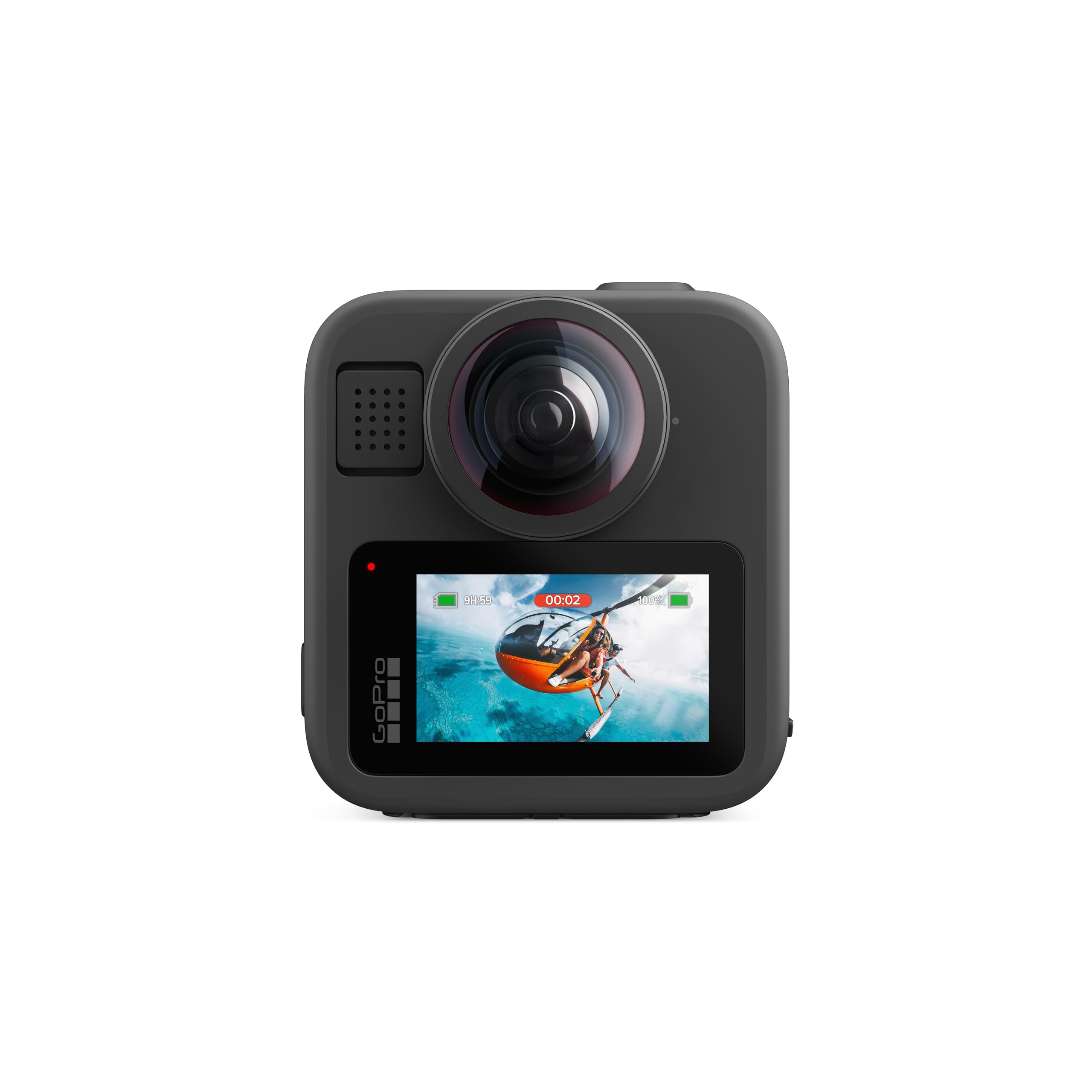
GoPro made the MAX2's lenses replaceable, water-repelling glass, and that's the design choice that matters most. Every 360 camera here wears its glass on the outside, exposed to rocks, branches and the inside of a gear bag; this is the one GoPro where a scratched lens is a swap rather than a repair, and spray beads off the coating instead of smearing across the shot.

The rest is GoPro doing what GoPro does: true 8K spherical video, 29MP 360 photos, HyperSmooth stabilization, and a 1/4-20 thread in the base so a mounting pole vanishes from the frame. The 1.82-inch touchscreen means you can change settings without pulling out your phone, and six microphones are aimed squarely at the wind noise that ruins most action-cam audio.

Where it earns its place is on a moving vehicle or a long ride, where the glass and the audio matter more than the spec sheet: a scratched lens mid-trip doesn't end the trip, and you can talk to camera at speed and come back with something usable. Just manage the heat, because long takes in hot, still air can push it into a thermal shutdown. Give it airflow between clips and don't leave it baking on a dashboard.

The screen is the smallest here, so in practice we left it on the status display and did nearly all our framing and reviewing from the phone, which is fine right up until that phone's battery goes. What's left on the camera is enough to check a clip and change a setting, and not much more.

Pros

  • Replaceable, water-repelling lens glass
  • True 8K spherical and 29MP 360 photos
  • Six microphones aimed at wind noise
  • Waterproof with HyperSmooth stabilization

Cons

  • Heavy at 13.76 ounces for helmet mounting
Our verdict

Choose the MAX2 if you're already deep in GoPro's mounts and want 8K spherical with glass you can replace, and you can live with the weight.

Check Latest Price
6

Budget GoPro 360

GoPro MAX

86 /100
LBD Score Excellent

Key details

360 Video
5.6K30
360 Photos
16.6MP
Battery Life
2 hours
Water Resistance
Waterproof
View on Amazon

The mode switch is the reason to look at the MAX. Take it out of 360 and it behaves like a normal action camera, with single-lens HERO footage, photos and time-lapse, so you can shoot a vlog clip and a spherical clip on the same walk without carrying two cameras. The 1/4-20 thread in the base means the pole disappears from the shot whenever you want the third-person angle.

On the 360 side it captures 5.6K30 spherical video and 16.6MP photos, it's waterproof, and the Enduro battery is rated at about two hours. The Quik app does the reframing on your phone with object tracking that holds a subject centred while you pick the angle, and it's the same app the rest of GoPro's cameras use, which shortens the learning curve if you already own one.

We think of it as the second camera: the one you hand a kid, strap to a bumper, or take somewhere it might not come back from, in a way you wouldn't with a premium flagship. The mounting system, the app and the waterproofing are all sorted, and that counts for a lot when you're clipping a camera to something that moves.

Pros

  • Waterproof body that doubles as a single-lens action cam
  • GoPro mounts and Quik app support
  • Object tracking while reframing on the phone

Cons

  • 5.6K is the lowest spherical resolution here
  • Domed lens glass scuffs easily
Our verdict

A tough, waterproof 5.6K 360 camera that doubles as a normal action cam; buy it for the GoPro mounts and Quik workflow, not the resolution.

Check Latest Price

How We Chose and Tested These 360 Cameras

We started with every 360 camera we could find on the market, then cut anything that couldn't stitch its footage in-camera or pair with a phone app — there's no point carrying a camera you can only fix on a laptop. That left six, spanning the range from budget-friendly to flagship, and all of them went into the same rotation.

Each camera rode the same 40-minute loop: a bike commute on a handlebar mount, two ski days on a helmet, and a rainy Saturday walk with the selfie stick extended to check whether the stick vanished from the shot. We recorded the same four moments — a fast downhill, a crowded lift line, a shaded tree run, and a low-light evening ride — then compared the same frames side by side, looking at stitch lines where the two lenses meet, horizon tilt, and whether the edges stayed sharp when we reframed. We also switched to each camera's widest single-lens mode to see how much of the field of view you actually give up.

Battery life got a stopwatch and no mercy: a full charge recording at top resolution in cold weather until the camera shut itself off, twice per unit. Durability meant a drop from handlebar height onto pavement, a lens swap on the models that allow it, and a five-minute soak for the waterproof claims. For editing, we timed the run from card to a finished 30-second clip in each app, and handed the camera to a friend who'd never used one to see how long it took them to start recording. Value came down to what was in the box: spare battery, case, mount, or none of the above.

How to Choose a 360 Camera

Resolution and what 8K actually buys you

A 360 camera records the whole sphere and you cut a flat clip out of it afterward. That crop throws most of the pixels away, so the resolution number is really a measure of how far you can push in before the footage softens. From 8K there's room to frame a tight shot of a rider and still land something usable; from 5.7K the same crop wants to stay wide, which is fine for phone-first posting.

Sensor size matters more than the number once the light drops. The Osmo 360's 1-inch sensors and the X5's 1/1.28-inch pair give you more headroom at dusk than the 1/2-inch sensors in the cheaper cameras. Shoot midday and share to social, and it's money you don't need to spend; ride or walk into the evening, and it's the upgrade you'll notice every time.

Battery life ends more shoot days than image quality

When a 360 camera dies you don't lose one clip, you lose the rest of the outing. Rated runtimes here run from around two hours up to the X5's claimed 208 minutes, and those figures assume easy conditions: 8K recording and cold weather both pull them down. Two batteries plus a pocket power bank cover a full day.

Count the spares before you choose. The AKASO ships with two batteries in the box; on the others a second battery is a separate purchase, and it is the add-on that changes how a trip feels far more than a faster card does.

Waterproof and weather resistant are not the same promise

Read the exact wording before you plan a water shoot. A camera rated waterproof can be submerged to a stated depth; one rated water resistant or weatherproof handles rain and splashes and nothing else. The AKASO 360 is the clear example in this group, and it's the wrong camera for surfing or snorkeling however good the daylight footage looks.

Whatever you buy, the weak points are the same: the seals and the exposed glass. Close the battery door dry, check the lens covers are seated, and rinse saltwater off with fresh water before it dries.

The editing is the real second job

Shoot first, frame later moves the work from the trail to the desk. AI auto-framing in the Insta360 and DJI apps turns a long recording into a shareable clip in a couple of taps, and for social it's genuinely good; the moment you want a specific angle held for more than a few seconds, you're setting keyframes by hand. That's the difference between a camera that gets used and one that sits in a drawer full of footage you never cut.

Run a test edit on an hour of footage before a big trip. If the app makes you want to throw the phone across the room, the camera is wrong for you no matter how good the video looks on paper.

Frequently Asked Questions

Final Verdict

For most people the Insta360 X5 is the 360 camera to buy. It has the longest rated battery in this group, 8K footage that survives a tight reframe, replaceable lenses and waterproofing, which are the four things that decide whether the camera actually leaves the bag on a real day out. Nothing else here puts all four together.

Two picks cover the exceptions. If your shooting happens after sunset, the DJI Osmo 360's 1-inch sensors are worth switching to a less polished app for. If you're buying your first 360 camera and want to learn the reframing workflow cheaply, the AKASO 360 gets you there — just leave it on the bank.